


Cochabamba

Encyclopedia
Cochabamba is a city in central Bolivia
, located in a valley
bearing the same name in the Andes
mountain range
. It is the capital of the Cochabamba Department
and is the fourth largest city in Bolivia with an urban population of 608,276 (2008) and a metropolitan population of more than 1,000,000 people. The name derives from a compound of the Quechua
words qucha, meaning "lake
", and pampa
, "open plain
". Residents of the city and surrounding areas are commonly referred to as Cochabambinos. Cochabamba is known as the "City of Eternal Spring" and "The Garden City" due to its spring-like temperatures year round. It is also known as "La Llajta", "town" in Quechua.
The city is also host to the first World People's Conference on Climate Change
and the Rights of Mother Earth.
s and climate
. Archaeological evidence suggests that the initial valley inhabitants were of various ethnic indigenous groups. Inca, Tupuraya, Mojocoya, Omereque
, and Tiwanaku
inhabited the valley at various times before the Spanish arrived.
The first Spanish inhabitant of the Valley was Garci Ruiz de Orellana in 1542. He purchased the majority of the land from local tribal chiefs Achata and Consavana through a title registered in 1552 at the Imperial City of Potosí
. The price paid was 130 pesos. His residence, known as the House of Mayorazgo, still stands in the Cala Cala neighbourhood of the city.
The city, called Villa de Oropesa was founded on 2 August 1571 by order of Viceroy
Francisco de Toledo, Count of Oropesa
. It was to be an agricultural production centre to provide food for the mining towns of the relatively nearby Altiplano
region, particularly the city of Potosí
which became one of the largest and richest cities in the world during the 17th century - funding the vast wealth that ultimately made Spain a world power at the time. With the silver mining
industry in Potosi at its height, Cochabamba thrived during its first centuries of existence. The city entered a period of decline during the 18th century as mining began to wane.
In 1786, King Charles III of Spain
renamed the city to the 'loyal and valiant' Villa of Cochabamba. This was done to commend the city's pivotal role in suppressing the indigenous rebellions of 1781 in Oruro
by sending armed forces to Oruro to quell the uprisings. Since the late 19th century it has again been generally successful as an agricultural centre for Bolivia.
The 1793 census shows that the city had a population of 22,305 persons. There were 12,980 mestizos, 6,368 Spaniards, 1,182 indigenous natives, 1,600 mulattos and 175 African slaves.
The population, mostly Catholic, in 1902 was over 330,000. Besides a number of schools and charitable institutions the diocese has 55 parishes, 80 churches and chapels, and 160 priests.
In 2000, Cochabamba was wracked with large-scale protest
s over the privatisation of the city's water supply. See 2000 Cochabamba protests
.
In January 2007 city dwellers clashed with mostly rural protestors, leaving four dead and over 130 injured. The first ever democratically-elected Prefect of Cochabamba, Manfred Reyes Villa
, had allied himself with the leaders of Bolivia's Eastern Departments in a dispute with President Evo Morales
over regional autonomy and other political issues. The protestors blockaded the highway
s, bridge
s, and main roads, having days earlier set fire to the departmental seat of government, trying to force the resignation of Reyes Villa. Citizens attacked the protestors, breaking the blockade and routing them, while the police did little to stop the violence. Further attempts by the protestors to reinstate the blockade and threaten the government were unsuccessful, but the underlying tensions have not been resolved.
In July 2007, a monument erected by veterans of January's protest movement in honour of those killed and injured by government supporters was destroyed in the middle of the night, reigniting racial conflicts in the city.
In August 2008, a nationwide referendum was held, the prefect of Cochabamba, Manfred Reyes Villa, was not confirmed by the voters of the department.
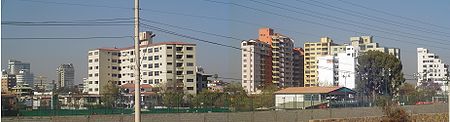 Currently, Cochabamba is among Bolivia's most economically and socially progressive cities. Commensurate with other large cities in the Andean highlands of South America, Cochabamba is a city of varied contrasts. Its central commercial districts, bounded by Plaza Colón and Plaza 14 de Septiembre, is generally equipped with modern urban amenities, and is where the majority of the city's business and commercial industries are based. An active nightlife is centered around Calle España and also along the broad, tree-lined boulevard, El Prado. In contrast, the remote area adjacent to the Wilstermann International Airport
is visibly impoverished, with adobe homes and unpaved roads, which is often the first impression visitors acquire while commuting into the city.
The most widely spoken language in Cochabamba is Spanish
. Although the Spanish that is spoken in the Cochabamba region is generally regarded as rather conservative in its phonetics and vocabulary, few Quechua and Aymara terminology (guagua [child], papa [potato]) have been incorporated into its standardized form.
As with most cities around the globe, English language
is increasingly spoken and understood, particularly among business minded Indigenous and repatriated Cochabambinos. English-language instruction has become incorporated into various levels of Bolivian education from elementary to college levels.
The city's racial demographics consist of the following visible groups in order of prevalence: Western Hemispheric Indigenous (mostly of Quechua ethnicity), Mestizo
or mixed Indigenous, and a minority of white Caucasoid and mixed white (Criollos
).
of Cochabamba department
. The government of the City of Cochabamba is divided into executive
and legislative
branches. The Mayor of Cochabamba is the head of the city government, elected by general election for a term of five years. The Mayor heads an executive branch, which also includes 6 sub-mayors, and a variety of departments comprising 950 total functionaries. The 11-member municipal council is the legislative branch.
The current Mayor is Edwin Castellanos of the Movement Towards Socialism.
-leaf-producing regions.
Cochabamba is also the industrial pole of Bolivia, producing cars
, cleaning products, cosmetics, chemicals, and other items like cement.
The economy of Cochabamba is characterized by produce goods and services.
The airline Boliviana de Aviación
has its headquarters in Cochabamba. The defunct airline Lloyd Aéreo Boliviano
(LAB Airlines) had its management offices on the grounds of Jorge Wilstermann Airport in Cochabamba.
There are almost 70 bus and minibus lines, from A to Z, and dozens of minibuses and taxi lines trufis. Most lines have GPS system for monitoring and regulation of hour (line 1, line 16, line L, Line 3V, line 20, line 30,etc.).
As for the service or commonly called T.RU.FI (taxi con ruta fija) there are at least 60 lines, they are identified by signs on the roof of the vehicle showing the route from the initial stop until the final stop is also indicated line number to which it belongs.
The busiest bus lines are:
And the busiest Taxi Trufi lines are:
.
These companies are nationally recognized:
Comteco, a company dedicated to the public telephone service to national and district levels, also has Internet service, cable TV, and many others.
EMSA Municipal Sanitation Company, responsible for the pickup, transportation, storage and removed from urban waste produced. EMSA covers 88% of the city and collects 400 tonnes of waste are produced per day. Through the municipal government of Cochabamba, special containers made available throughout the city for the storage of solid waste common in much of the city. The municipality's sole disposal facility, the K'ara K'ara waste dump (Botadero K'ara K'ara), has been the center of a long-running controversy over pollution of the air and groundwater, and is frequently blockaded by neighboring residents demanding changes.
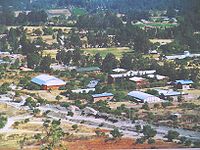 The city is the home of the Universidad Mayor de San Simón, one of the largest and most prominent public universities in Bolivia; the Universidad Catolica Boliviana "San Pablo"; and several smaller private universities such as the Universidad Privada Boliviana, Universidad del Valle, Universidad de Aquino Bolivia and others.
Cochabamba is also home of the Maryknoll Language Institute. Centro Misionero Maryknoll. The Maryknoll Mission Center provides basic courses in Spanish, Aymará and Quechua as well as advanced levels of these three languages. The primary purpose of the Maryknoll Mission Center is to prepare Catholic missionary personnel for contemporary mission in Latin America other parts of the world. The institute also accepts candidates from other churches as well as those who have a serious commitment of service to Latin America.
(IATA code CBB), which handles domestic and international flights. It also houses the headquarters of Boliviana de Aviacion
(BOA
) Bolivia's national airline and Lloyd Aereo Boliviano
, Bolivia's former national airline. TAM Mercosur
and Aerosur
are two airlines that also service this airport.
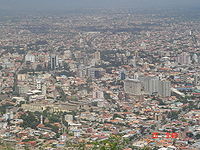 Cochabamba is a steadily emerging market within the Bolivian real estate
industry. An annual mild climate, abundant greenery, mountain vistas, and a progressive local economy are factors that have contributed to the city's appeal for Bolivian nationals, expatriates and foreigners alike. Historic and affluent neighbourhoods such as Cala Cala, El Mirador, and Lomas de Aranjuez showcase some of the city's most distinguished residences.
and ex-president Gonzalo Sanchez de Lozada
were both Senators representing Cochabamba, although they were born in Oruro
and La Paz
respectively and immigrated to Cochabamba at the start of their political careers.
After the road to the then-isolated eastern town of Santa Cruz de la Sierra
was completed in the 1950s, thousands of Cochabambinos migrated to the lowlands and permanently settled there causing the population of that city to mushroom from 50,000 in 1950 to over 1,500,000 today. Many Cochabambino migrants and their descendants now identify themselves as Cambas after absorbing the regional Bolivian culture of the eastern lowlands, but maintain familiar ties with relatives that remained in Cochabamba.
A large population of Bolivian and Bolivian-descended residents is in the Greater Washington, D.C.
-Baltimore
-Northern Virginia
area of USA
(2005 US Census estimates 27,452 +/- 8,883 Bolivians for DC, Virginia, and Maryland); the highest concentration is in Arlington County, Virginia
. These figures may represent a census undercount of undocumented Bolivian alien residents. These combined communities have become the centre for recent and established Bolivian immigrants, most of whom are from the department and city of Cochabamba, hence, locally regarded as Little Cochabamba or Arlibamba. Little Cochabamba contains Bolivian-cuisine restaurants and the Escuela Bolivia; a school-within-a-school programme for children and adults.
After to the mid-1990s, many low-income Cochabambinos emigrated to Bergamo
, Italy
in search of work. Most of the 16,400 (2005 estimate) Bolivians in Bergamo are from Cochabamba, which includes both legal and work visa-expired immigrants. This migration is due to the strong relationship between the Roman Catholic Diocese of Bergamo
and the Archdiocese of Cochabamba.
, Argentina
Viedma, Argentina
Caracas
, Venezuela
Arica
, Chile
San Francisco, USA Miami, USA Almería, Spain
Bergamo, Italy
Nantes, France
Kunming, Yunnan, China
Cabuyao, Philippines
Bolivia
Bolivia officially known as Plurinational State of Bolivia , is a landlocked country in central South America. It is the poorest country in South America...
, located in a valley
Valley
In geology, a valley or dale is a depression with predominant extent in one direction. A very deep river valley may be called a canyon or gorge.The terms U-shaped and V-shaped are descriptive terms of geography to characterize the form of valleys...
bearing the same name in the Andes
Andes
The Andes is the world's longest continental mountain range. It is a continual range of highlands along the western coast of South America. This range is about long, about to wide , and of an average height of about .Along its length, the Andes is split into several ranges, which are separated...
mountain range
Mountain range
A mountain range is a single, large mass consisting of a succession of mountains or narrowly spaced mountain ridges, with or without peaks, closely related in position, direction, formation, and age; a component part of a mountain system or of a mountain chain...
. It is the capital of the Cochabamba Department
Cochabamba Department
Cochabamba is one of the nine component departments of Bolivia. It is known to be the "granary" of the country because of its variety of agricultural products due to Cochabamba's geographical position. It has an area of 55,631 km². Its population, in the 2007 census, was 1,750,000...
and is the fourth largest city in Bolivia with an urban population of 608,276 (2008) and a metropolitan population of more than 1,000,000 people. The name derives from a compound of the Quechua
Quechua languages
Quechua is a Native South American language family and dialect cluster spoken primarily in the Andes of South America, derived from an original common ancestor language, Proto-Quechua. It is the most widely spoken language family of the indigenous peoples of the Americas, with a total of probably...
words qucha, meaning "lake
Lake
A lake is a body of relatively still fresh or salt water of considerable size, localized in a basin, that is surrounded by land. Lakes are inland and not part of the ocean and therefore are distinct from lagoons, and are larger and deeper than ponds. Lakes can be contrasted with rivers or streams,...
", and pampa
Pampa
The Pampas are the fertile South American lowlands, covering more than , that include the Argentine provinces of Buenos Aires, La Pampa, Santa Fe, Entre Ríos and Córdoba, most of Uruguay, and the southernmost Brazilian State, Rio Grande do Sul...
, "open plain
Plain
In geography, a plain is land with relatively low relief, that is flat or gently rolling. Prairies and steppes are types of plains, and the archetype for a plain is often thought of as a grassland, but plains in their natural state may also be covered in shrublands, woodland and forest, or...
". Residents of the city and surrounding areas are commonly referred to as Cochabambinos. Cochabamba is known as the "City of Eternal Spring" and "The Garden City" due to its spring-like temperatures year round. It is also known as "La Llajta", "town" in Quechua.
The city is also host to the first World People's Conference on Climate Change
World People's Conference on Climate Change
The World People's Conference on Climate Change and the Rights of Mother Earth was a global gathering of civil society and governments hosted by the government of Bolivia in Tiquipaya, just outside the city of Cochabamba from April 19–22, 2010...
and the Rights of Mother Earth.
History
The Cochabamba valley was inhabited for over a thousand years due to its fertile productive soilSoil
Soil is a natural body consisting of layers of mineral constituents of variable thicknesses, which differ from the parent materials in their morphological, physical, chemical, and mineralogical characteristics...
s and climate
Climate
Climate encompasses the statistics of temperature, humidity, atmospheric pressure, wind, rainfall, atmospheric particle count and other meteorological elemental measurements in a given region over long periods...
. Archaeological evidence suggests that the initial valley inhabitants were of various ethnic indigenous groups. Inca, Tupuraya, Mojocoya, Omereque
Omereque
Omereque is a location in the Cochabamba Department in central Bolivia. It is the seat of the Omereque Municipality, the third municipal section of the Narciso Campero Province....
, and Tiwanaku
Tiwanaku
Tiwanaku, is an important Pre-Columbian archaeological site in western Bolivia, South America. Tiwanaku is recognized by Andean scholars as one of the most important precursors to the Inca Empire, flourishing as the ritual and administrative capital of a major state power for approximately five...
inhabited the valley at various times before the Spanish arrived.
The first Spanish inhabitant of the Valley was Garci Ruiz de Orellana in 1542. He purchased the majority of the land from local tribal chiefs Achata and Consavana through a title registered in 1552 at the Imperial City of Potosí
Potosí
Potosí is a city and the capital of the department of Potosí in Bolivia. It is one of the highest cities in the world by elevation at a nominal . and it was the location of the Spanish colonial mint, now the National Mint of Bolivia...
. The price paid was 130 pesos. His residence, known as the House of Mayorazgo, still stands in the Cala Cala neighbourhood of the city.
The city, called Villa de Oropesa was founded on 2 August 1571 by order of Viceroy
Viceroy
A viceroy is a royal official who runs a country, colony, or province in the name of and as representative of the monarch. The term derives from the Latin prefix vice-, meaning "in the place of" and the French word roi, meaning king. A viceroy's province or larger territory is called a viceroyalty...
Francisco de Toledo, Count of Oropesa
Francisco de Toledo, Count of Oropesa
Francisco Álvarez de Toledo, Count of Oropesa was Spanish viceroy of Peru from November 26, 1569 to September 23, 1581.-Early years:...
. It was to be an agricultural production centre to provide food for the mining towns of the relatively nearby Altiplano
Altiplano
The Altiplano , in west-central South America, where the Andes are at their widest, is the most extensive area of high plateau on Earth outside of Tibet...
region, particularly the city of Potosí
Potosí
Potosí is a city and the capital of the department of Potosí in Bolivia. It is one of the highest cities in the world by elevation at a nominal . and it was the location of the Spanish colonial mint, now the National Mint of Bolivia...
which became one of the largest and richest cities in the world during the 17th century - funding the vast wealth that ultimately made Spain a world power at the time. With the silver mining
Silver mining
Silver mining refers to the resource extraction of the precious metal element silver by mining.-History:Silver has been known since ancient times. It is mentioned in the Book of Genesis, and slag heaps found in Asia Minor and on the islands of the Aegean Sea indicate that silver was being separated...
industry in Potosi at its height, Cochabamba thrived during its first centuries of existence. The city entered a period of decline during the 18th century as mining began to wane.
In 1786, King Charles III of Spain
Charles III of Spain
Charles III was the King of Spain and the Spanish Indies from 1759 to 1788. He was the eldest son of Philip V of Spain and his second wife, the Princess Elisabeth Farnese...
renamed the city to the 'loyal and valiant' Villa of Cochabamba. This was done to commend the city's pivotal role in suppressing the indigenous rebellions of 1781 in Oruro
Oruro, Bolivia
Oruro is a city in Bolivia with a population of 235,393 , located about equidistant between La Paz and Sucre at approximately 3710 meters above sea level. It is the capital of the department of Oruro....
by sending armed forces to Oruro to quell the uprisings. Since the late 19th century it has again been generally successful as an agricultural centre for Bolivia.
The 1793 census shows that the city had a population of 22,305 persons. There were 12,980 mestizos, 6,368 Spaniards, 1,182 indigenous natives, 1,600 mulattos and 175 African slaves.
The population, mostly Catholic, in 1902 was over 330,000. Besides a number of schools and charitable institutions the diocese has 55 parishes, 80 churches and chapels, and 160 priests.
In 2000, Cochabamba was wracked with large-scale protest
Protest
A protest is an expression of objection, by words or by actions, to particular events, policies or situations. Protests can take many different forms, from individual statements to mass demonstrations...
s over the privatisation of the city's water supply. See 2000 Cochabamba protests
2000 Cochabamba protests
The Cochabamba protests of 2000, also known as the "Cochabamba Water Wars", were a series of protests that took place in Cochabamba, Bolivia's third largest city, between January 1999 and April 2000 in response to multinational participation in the infrastructure and management of the city's...
.
In January 2007 city dwellers clashed with mostly rural protestors, leaving four dead and over 130 injured. The first ever democratically-elected Prefect of Cochabamba, Manfred Reyes Villa
Manfred Reyes Villa
Manfred Reyes Villa is a Bolivian politician, who was mayor of Cochabamba four times and ran unsuccessfully for the presidency in 2002 and 2009 against Gonzalo Sánchez de Lozada and Evo Morales Ayma. He founded and led the Nueva Fuerza Republicana political party...
, had allied himself with the leaders of Bolivia's Eastern Departments in a dispute with President Evo Morales
Evo Morales
Juan Evo Morales Ayma , popularly known as Evo , is a Bolivian politician and activist, currently serving as the 80th President of Bolivia, a position that he has held since 2006. He is also the leader of both the Movement for Socialism party and the cocalero trade union...
over regional autonomy and other political issues. The protestors blockaded the highway
Highway
A highway is any public road. In American English, the term is common and almost always designates major roads. In British English, the term designates any road open to the public. Any interconnected set of highways can be variously referred to as a "highway system", a "highway network", or a...
s, bridge
Bridge
A bridge is a structure built to span physical obstacles such as a body of water, valley, or road, for the purpose of providing passage over the obstacle...
s, and main roads, having days earlier set fire to the departmental seat of government, trying to force the resignation of Reyes Villa. Citizens attacked the protestors, breaking the blockade and routing them, while the police did little to stop the violence. Further attempts by the protestors to reinstate the blockade and threaten the government were unsuccessful, but the underlying tensions have not been resolved.
In July 2007, a monument erected by veterans of January's protest movement in honour of those killed and injured by government supporters was destroyed in the middle of the night, reigniting racial conflicts in the city.
In August 2008, a nationwide referendum was held, the prefect of Cochabamba, Manfred Reyes Villa, was not confirmed by the voters of the department.
People and culture
Airport
An airport is a location where aircraft such as fixed-wing aircraft, helicopters, and blimps take off and land. Aircraft may be stored or maintained at an airport...
is visibly impoverished, with adobe homes and unpaved roads, which is often the first impression visitors acquire while commuting into the city.
The most widely spoken language in Cochabamba is Spanish
Spanish language
Spanish , also known as Castilian , is a Romance language in the Ibero-Romance group that evolved from several languages and dialects in central-northern Iberia around the 9th century and gradually spread with the expansion of the Kingdom of Castile into central and southern Iberia during the...
. Although the Spanish that is spoken in the Cochabamba region is generally regarded as rather conservative in its phonetics and vocabulary, few Quechua and Aymara terminology (guagua [child], papa [potato]) have been incorporated into its standardized form.
As with most cities around the globe, English language
English language
English is a West Germanic language that arose in the Anglo-Saxon kingdoms of England and spread into what was to become south-east Scotland under the influence of the Anglian medieval kingdom of Northumbria...
is increasingly spoken and understood, particularly among business minded Indigenous and repatriated Cochabambinos. English-language instruction has become incorporated into various levels of Bolivian education from elementary to college levels.
The city's racial demographics consist of the following visible groups in order of prevalence: Western Hemispheric Indigenous (mostly of Quechua ethnicity), Mestizo
Mestizo
Mestizo is a term traditionally used in Latin America, Philippines and Spain for people of mixed European and Native American heritage or descent...
or mixed Indigenous, and a minority of white Caucasoid and mixed white (Criollos
Criollo (people)
The Criollo class ranked below that of the Iberian Peninsulares, the high-born permanent residence colonists born in Spain. But Criollos were higher status/rank than all other castes—people of mixed descent, Amerindians, and enslaved Africans...
).
Government
Cochabamba, formally the municipality of Cercado, is the capitalCapital City
Capital City was a television show produced by Euston Films which focused on the lives of investment bankers in London living and working on the corporate trading floor for the fictional international bank Shane-Longman....
of Cochabamba department
Cochabamba Department
Cochabamba is one of the nine component departments of Bolivia. It is known to be the "granary" of the country because of its variety of agricultural products due to Cochabamba's geographical position. It has an area of 55,631 km². Its population, in the 2007 census, was 1,750,000...
. The government of the City of Cochabamba is divided into executive
Executive (government)
Executive branch of Government is the part of government that has sole authority and responsibility for the daily administration of the state bureaucracy. The division of power into separate branches of government is central to the idea of the separation of powers.In many countries, the term...
and legislative
Legislature
A legislature is a kind of deliberative assembly with the power to pass, amend, and repeal laws. The law created by a legislature is called legislation or statutory law. In addition to enacting laws, legislatures usually have exclusive authority to raise or lower taxes and adopt the budget and...
branches. The Mayor of Cochabamba is the head of the city government, elected by general election for a term of five years. The Mayor heads an executive branch, which also includes 6 sub-mayors, and a variety of departments comprising 950 total functionaries. The 11-member municipal council is the legislative branch.
The current Mayor is Edwin Castellanos of the Movement Towards Socialism.
Economy
The area in which Cochabamba is situated is commonly referred to as the granary of Bolivia. Its climate is milder than that of the Altiplano region to the west and thus permits an extensive agriculture, including grains, potatoes, and coffee in the highlands and sugarcane, cocoa beans, tobacco, and fruit in the Chapare tropical lowlands, an area that had been one of the country’s main cocaCoca
Coca, Erythroxylum coca, is a plant in the family Erythroxylaceae, native to western South America. The plant plays a significant role in many traditional Andean cultures...
-leaf-producing regions.
Cochabamba is also the industrial pole of Bolivia, producing cars
CARS
Cars, or automobiles, motor cars, are wheeled motor vehicles used for transporting passengers.Cars or CARS may also refer to:-Entertainment:* Cars , a Disney/Pixar film series...
, cleaning products, cosmetics, chemicals, and other items like cement.
The economy of Cochabamba is characterized by produce goods and services.
The airline Boliviana de Aviación
Boliviana de Aviación
Boliviana de Aviación or simply called BoA is the state-owned national flag carrier airline of Bolivia along with private airline AeroSur. It was established by the Bolivian Government under the president Evo Morales, replacing the troubled Lloyd Aéreo Boliviano as flag carrier.The airline is...
has its headquarters in Cochabamba. The defunct airline Lloyd Aéreo Boliviano
Lloyd Aéreo Boliviano
Lloyd Aéreo Boliviano S.A. was an airline serving as flag carrier of Bolivia. It operated domestic and international flights, aiming at passenger as well as cargo transport. LAB was active for more than 80 years, having been based in Cochabamba most of the time, with Cochabamba Airport being an...
(LAB Airlines) had its management offices on the grounds of Jorge Wilstermann Airport in Cochabamba.
Urban Transport
The metropolitan area of Cochabamba (Vinto, Tiquipaya, Quillacollo, Colcapirhua, Cochabamba and Sacaba) has an extensive transportation system, which cover all the districts.There are almost 70 bus and minibus lines, from A to Z, and dozens of minibuses and taxi lines trufis. Most lines have GPS system for monitoring and regulation of hour (line 1, line 16, line L, Line 3V, line 20, line 30,etc.).
As for the service or commonly called T.RU.FI (taxi con ruta fija) there are at least 60 lines, they are identified by signs on the roof of the vehicle showing the route from the initial stop until the final stop is also indicated line number to which it belongs.
The busiest bus lines are:
- Line "Q" (CBBA-QLLO)
- Line "W" (CBBA-QLLO)
- Line "3V"
- Line "B" (Airport)
- Line "X-10"
- Line "36"
- Line "1"
- Line "30"
- Line "13"
- Line "Z-12" (CBBA-TIQUIPAYA)
And the busiest Taxi Trufi lines are:
- Taxi Trufi "110"
- Taxi Trufi "260" (Cochabamba-Quillacollo Line)
- Taxi Trufi "270" (Cochabamba-Quillacollo Line)
- Taxi Trufi "103" (Green line and White Line)
- Taxi Trufi "106" (Tiquipaya Line)
- Taxi Trufi "130" (Circular)
- Taxi Trufi "209" (Circular) (Cochabamba-Quillacollo Line)
- Taxi Trufi "123"
- Taxi Trufi "224" (Sacaba Line)
- Taxi Trufi "240" (Sacaba Line)
- Taxi Trufi "244" (Sacaba Line)
- Taxi Trufi "115"
Basic Services
Cochabamba account generally higher quality basic services in Bolivia, except, probably SEMAPASemapa
Semapa - Sociedade de Investimento e Gestão is a Portuguese conglomerate holding company with interests in the cement, pulp and paper and environmental services sectors....
.
These companies are nationally recognized:
Comteco, a company dedicated to the public telephone service to national and district levels, also has Internet service, cable TV, and many others.
EMSA Municipal Sanitation Company, responsible for the pickup, transportation, storage and removed from urban waste produced. EMSA covers 88% of the city and collects 400 tonnes of waste are produced per day. Through the municipal government of Cochabamba, special containers made available throughout the city for the storage of solid waste common in much of the city. The municipality's sole disposal facility, the K'ara K'ara waste dump (Botadero K'ara K'ara), has been the center of a long-running controversy over pollution of the air and groundwater, and is frequently blockaded by neighboring residents demanding changes.
Print Media
There are several newspapers in Cochabamba, there is also movement of national and international newspapers, highlighting the following:- Periódico Los Tiempos
- Diario Opinión
- Periódico La Voz
- Editorial Canelas S.A. - Gente
- Semanario Gente linda
Radio Stations
The main radio stations scattered across the department and the capital are:- Estrella FM 93,1
- Centro Ltda.
- Mega DJ
- Milenio
- La Voz del Juno
- Kancha Parlaspa
- Bandera Tricolor
- Cochabamba
- Gaviota Dorada
- Del Valle
- San Rafael
- La Voz del Valle - Punata
- Continental
- Oro
- Triunfo Morena
- Epoca
- La Verdad F.M.100.7
- M&D Comunicaciones
- Universal
- Fantástico 97.1
- Panorama FM 90.9
- Punata radio Panorama FM 88.9
- FM-100 Clásica
- FM Stereo 98.7 – La voz de América
- Bethel FFM 95.5
- Ritmo 97.5
- La Triple Nueve 99.9
- La Fabrica de la Musica 107.1
- Magnal de Capinota
- Radios Fides Cochabamba, Punata y Chapare
- CEPRA Pongo Khasa 1,390 AM
- Pio XII FM 97.9
- Mundial
- Porvenir
- Radio Cosmos de Bolivia
- CEPRA - Centro de Producción Radiofónica
- CEPRA - Radio Morochota
- Enlace
Television Channels
In the capital and throughout the department there are many television channels that broadcast on a local, provincial, national or international all day or part of it. The transmission towers that transmit channels nationally and internationally are in the high Cala Cala, Villa Moscu or Villa Taquiña.- Canal 2: Corazón de América (local)
- Canal 4: Red ATB (national)
- Canal 5: Red Bolivisión (national)
- Canal 7: TVB (Channel of the State)
- Canal 9: Red Uno de BoliviaRed Uno de BoliviaRed Uno de Bolivia is a commercial Bolivian television station based in La Paz....
(national) - Canal 11: TVU (local)
- Canal 13: Red UnitelUnitelUnitel may refer to:*Unitel Communications Incorporated, a Canadian telecommunications company later known as AT&T Canada.*Unitel Bolivia, a Bolivian television network*Unitel , a Mongolian mobile phone network*Unitel...
(national) - Canal 15: Cristo viene la Red (Religious Channel)
- Canal 18: Radio Televisión Popular (RTP) (national)
- Canal 20 - Piñami de Comunicaciones (provincial)
- Canal 21: Canal 21 (local)
- Canal 23: ATV (América TV) (local)
- Canal 26: Metro TV (local)
- Canal 27 – Sistema Cristiano de Comunicaciones (local)
- Canal 24: Red ADVenir Internacional (Christian Channel/International)
- Canal 35 - Televisión Tunari (provincial)
- Canal 36: Cadena A (national)
- Canal 39: Univalle TV (local)
- Canal 42: Red PAT (national)
- Canal 47: Familia TV (local)
- Canal 48: Red Unitepc (local)
- Canal 51: MTV Cochabamba(local)
- Canal 57: RTL Canal de Noticias(local)
- http://www.comteco.com.bo/tvcable.php: Interac TV (Satelital television & Cable TV)
Education
Cochabamba is also home of the Maryknoll Language Institute. Centro Misionero Maryknoll. The Maryknoll Mission Center provides basic courses in Spanish, Aymará and Quechua as well as advanced levels of these three languages. The primary purpose of the Maryknoll Mission Center is to prepare Catholic missionary personnel for contemporary mission in Latin America other parts of the world. The institute also accepts candidates from other churches as well as those who have a serious commitment of service to Latin America.
Airport
Cochabamba is served by the modern Jórge Wilstermann International AirportJorge Wilstermann International Airport
Jorge Wilstermann International Airport, known in Spanish as Aeropuerto Internacional Jorge Wilstermann is an airport serving Cochabamba, a city in the Cochabamba department of Bolivia...
(IATA code CBB), which handles domestic and international flights. It also houses the headquarters of Boliviana de Aviacion
Boliviana de Aviación
Boliviana de Aviación or simply called BoA is the state-owned national flag carrier airline of Bolivia along with private airline AeroSur. It was established by the Bolivian Government under the president Evo Morales, replacing the troubled Lloyd Aéreo Boliviano as flag carrier.The airline is...
(BOA
Boa
The Boidae are a family of nonvenomous snakes found in America, Africa, Europe, Asia and some Pacific Islands. Relatively primitive snakes, adults are medium to large in size, with females usually larger than the males. Two subfamilies comprising eight genera and 43 species are currently...
) Bolivia's national airline and Lloyd Aereo Boliviano
Lloyd Aereo Boliviano
Lloyd Aéreo Boliviano S.A. was an airline serving as flag carrier of Bolivia. It operated domestic and international flights, aiming at passenger as well as cargo transport. LAB was active for more than 80 years, having been based in Cochabamba most of the time, with Cochabamba Airport being an...
, Bolivia's former national airline. TAM Mercosur
TAM Mercosur
TAM Airlines, also known as Transportes Aéreos del Mercosur S.A., formerly known as TAM Mercosur and LAP , is the flag carrier and the national airline of Paraguay with its headquarters in Asunción, Paraguay...
and Aerosur
Aerosur
Compañía Boliviana de Transporte Aéreo Privado Aerosur, S.A.,, usually shortened and styled AeroSur is a privately-owned airline from Bolivia, which serves as the country's flag carrier since 1998, along with state-owned Boliviana de Aviación...
are two airlines that also service this airport.
Neighborhoods
Real estate
In general use, esp. North American, 'real estate' is taken to mean "Property consisting of land and the buildings on it, along with its natural resources such as crops, minerals, or water; immovable property of this nature; an interest vested in this; an item of real property; buildings or...
industry. An annual mild climate, abundant greenery, mountain vistas, and a progressive local economy are factors that have contributed to the city's appeal for Bolivian nationals, expatriates and foreigners alike. Historic and affluent neighbourhoods such as Cala Cala, El Mirador, and Lomas de Aranjuez showcase some of the city's most distinguished residences.
- Queru Queru - North
- La Recoleta - North
- Cala Cala - North
- Lomas de Aranjuez - North
- El Mirador - North
- Las Brisas - North
- Sarco - Northwest
- Mayorazgo - Northwest
- Barrio Profesional - Northwest
- America Oeste - Northwest
- Colquiri - Northwest
- Muyurina - Northeast
- Tupuraya - Northeast
- Hippodromo - West
- Villa Busch - West
- Temporal - North
- La Chimba - Southwest
- Aeropuerto - Southwest
- Ticti Norte - Fringe North
- Jaihuayco - South
- Zona sud - South
- Ticti - South
- Valle Hermoso - South
Metropolitan Area
The city is connected with the next towns and cities:- QuillacolloQuillacolloQuillacollo is the capital of Quillacollo Province in Cochabamba Department, Bolivia.- Population and growth :The city of Quillacollo is located westward of Cochabamba City. Quillacollo's population is 74,980 based on the 2001 census and is estimated to reach 85,224 in 2009...
- SacabaSacabaSacaba is the capital of the Bolivian province of Chapare. The city, located 13 kilometers eastward from Cochabamba, is the second largest city in the Cochabamba Department after Cochabamba city...
- VintoVintoVinto is a town in the Cochabamba Department in central Bolivia. It is the seat of the Vinto Municipality, the fourth municipal section of the Quillacollo Province.- Medical Care :...
- ColcapirhuaColcapirhuaColcapirhua is a town in the Cochabamba Department in central Bolivia. It is the seat of the Colcapirhua Municipality, the fifth municipal section of the Quillacollo Province.- External links :* *...
- TiquipayaTiquipayaTiquipaya is a town in the Cochabamba Department in central Bolivia. It is the seat of the Tiquipaya Municipality, the third municipal section of the Quillacollo Province.- References :...
- ClizaClizaCliza is a town in the Cochabamba Department, Bolivia. It is the capital of the Germán Jordán Province and the Cliza Municipality. Along with Punata, Cliza is the major city in the valle alto of the Cochabamba Department.- External links :*...
- TarataTarataTarata is a city in the Tacna Region in southern Peru. It is the capital of Tarata Province....
- PunataPunataPunata is the capital of Punata Province and Punata Municipality in Cochabamba Department, Bolivia. At the time of census 2001 it had a population of 14,742 inhabitants...
Additional notes of interest
- Cochabamba is also mentioned in the documentary The Corporation, about their fight against privatisation of water by a foreign-owned company. The people protested against this and won. The privatisation had gone to such an extent that even rain water was not allowed to be collected. Read Cochabamba protests of 2000.
- A Mastercard commercial depicting the world switching from a competitor's credit card to Mastercard all over the world ends with the competitor saying that he still has Cochabamba, which ends up switching to Mastercard anyway.
- Cochabamba has been confirmed to be the seat of a future South American Parliament when it is formed by UNASUR. UNASUR has yet to determine what the composition of the Parliament will be, but existing treaties all agree it will meet in Cochabamba.
- Cochabamba was the first place rugby union in BoliviaRugby union in BoliviaRugby union in Bolivia is a minor, but growing sport.-Governing body:The governing body is the Federación Boliviana de Rugby, which is affiliated to CONSUR, but not to the International Rugby Board.-History:...
was formally established. - Cochabamba was featured as a location in the story in the 1983 film, ScarfaceScarface (1983 film)Scarface is a 1983 American epic crime drama movie directed by Brian De Palma, written by Oliver Stone, produced by Martin Bregman and starring Al Pacino as Tony Montana...
. Powerful drug lord Alejandro Sosa resided there, governed large coca plantations and owned cocaine labs where upon further refining, would be shipped to Tony Montana in Florida. - Cochabamba is the setting of the 2010 movie También la lluvia (Even the rain), which takes place during the water war of 2000. It depicts a film team making a movie about the colonization of Latin America, when the protests against privatization arise. The star is Mexican actor Gael Garcia Bernal, and the film has received good criticism.
Cochabambino migration
Historically, Cochabamba has been a destination for many Bolivians from the western highlands due to relatively improved economic opportunities and a more temperate climate. Bolivia's current President Evo MoralesEvo Morales
Juan Evo Morales Ayma , popularly known as Evo , is a Bolivian politician and activist, currently serving as the 80th President of Bolivia, a position that he has held since 2006. He is also the leader of both the Movement for Socialism party and the cocalero trade union...
and ex-president Gonzalo Sanchez de Lozada
Gonzalo Sánchez de Lozada
Gonzalo Sánchez de Lozada y Sánchez de Bustamante , familiarly known as "Goni", is a Bolivian politician, businessman, and former President of Bolivia. A lifelong member of the Movimiento Nacionalista Revolucionario , he is credited for using "shock therapy", the economic theory championed by then...
were both Senators representing Cochabamba, although they were born in Oruro
Oruro, Bolivia
Oruro is a city in Bolivia with a population of 235,393 , located about equidistant between La Paz and Sucre at approximately 3710 meters above sea level. It is the capital of the department of Oruro....
and La Paz
La Paz
Nuestra Señora de La Paz is the administrative capital of Bolivia, as well as the departmental capital of the La Paz Department, and the second largest city in the country after Santa Cruz de la Sierra...
respectively and immigrated to Cochabamba at the start of their political careers.
After the road to the then-isolated eastern town of Santa Cruz de la Sierra
Santa Cruz de la Sierra
Santa Cruz de la Sierra, commonly known as Santa Cruz, is the capital of the Santa Cruz department in eastern Bolivia and the largest city in the country...
was completed in the 1950s, thousands of Cochabambinos migrated to the lowlands and permanently settled there causing the population of that city to mushroom from 50,000 in 1950 to over 1,500,000 today. Many Cochabambino migrants and their descendants now identify themselves as Cambas after absorbing the regional Bolivian culture of the eastern lowlands, but maintain familiar ties with relatives that remained in Cochabamba.
A large population of Bolivian and Bolivian-descended residents is in the Greater Washington, D.C.
Washington, D.C.
Washington, D.C., formally the District of Columbia and commonly referred to as Washington, "the District", or simply D.C., is the capital of the United States. On July 16, 1790, the United States Congress approved the creation of a permanent national capital as permitted by the U.S. Constitution....
-Baltimore
Baltimore
Baltimore is the largest independent city in the United States and the largest city and cultural center of the US state of Maryland. The city is located in central Maryland along the tidal portion of the Patapsco River, an arm of the Chesapeake Bay. Baltimore is sometimes referred to as Baltimore...
-Northern Virginia
Northern Virginia
Northern Virginia consists of several counties and independent cities in the Commonwealth of Virginia, in a widespread region generally radiating southerly and westward from Washington, D.C...
area of USA
United States
The United States of America is a federal constitutional republic comprising fifty states and a federal district...
(2005 US Census estimates 27,452 +/- 8,883 Bolivians for DC, Virginia, and Maryland); the highest concentration is in Arlington County, Virginia
Virginia
The Commonwealth of Virginia , is a U.S. state on the Atlantic Coast of the Southern United States. Virginia is nicknamed the "Old Dominion" and sometimes the "Mother of Presidents" after the eight U.S. presidents born there...
. These figures may represent a census undercount of undocumented Bolivian alien residents. These combined communities have become the centre for recent and established Bolivian immigrants, most of whom are from the department and city of Cochabamba, hence, locally regarded as Little Cochabamba or Arlibamba. Little Cochabamba contains Bolivian-cuisine restaurants and the Escuela Bolivia; a school-within-a-school programme for children and adults.
After to the mid-1990s, many low-income Cochabambinos emigrated to Bergamo
Bergamo
Bergamo is a town and comune in Lombardy, Italy, about 40 km northeast of Milan. The comune is home to over 120,000 inhabitants. It is served by the Orio al Serio Airport, which also serves the Province of Bergamo, and to a lesser extent the metropolitan area of Milan...
, Italy
Italy
Italy , officially the Italian Republic languages]] under the European Charter for Regional or Minority Languages. In each of these, Italy's official name is as follows:;;;;;;;;), is a unitary parliamentary republic in South-Central Europe. To the north it borders France, Switzerland, Austria and...
in search of work. Most of the 16,400 (2005 estimate) Bolivians in Bergamo are from Cochabamba, which includes both legal and work visa-expired immigrants. This migration is due to the strong relationship between the Roman Catholic Diocese of Bergamo
Roman Catholic Diocese of Bergamo
The Diocese of Bergamo is a see of the Catholic Church in Italy, and is a suffragan of the Archdiocese of Milan. It was founded in the fourth century CE, and its first bishop was Saint Narno...
and the Archdiocese of Cochabamba.
Notable residents
- Jaime LaredoJaime LaredoJaime Laredo is a violinist and conductor. Currently the conductor and Music Director of the Vermont Symphony Orchestra, he began his musical career when he was five years old. In 1948 he came to North America and took lessons from Antonio DeGrass...
, classical violinist - Jaime EscalanteJaime EscalanteJaime Alfonso Escalante Gutierrez was a Bolivian educator well-known for teaching students calculus from 1974 to 1991 at Garfield High School, East Los Angeles, California...
, professor and teacher whose life was dramatized in the 1988 film Stand and DeliverStand and DeliverStand and Deliver is a 1988 American drama film, based on the true story of high school mathematics teacher Jaime Escalante. Edward James Olmos portrayed Escalante in the film and received an Academy Award nomination for Best Actor.-Plot:... - Renato Prada OropezaRenato Prada OropezaRenato Prada Oropeza was a Bolivian and Mexican scientist-literary researcher and writer, author of novels, short stories and poetry books, hermeneutics, semiotics and literary theory. Many of his literary works have been translated into several languages...
, professor, semiologist, writer
Sister cities
CórdobaCórdoba, Argentina
Córdoba is a city located near the geographical center of Argentina, in the foothills of the Sierras Chicas on the Suquía River, about northwest of Buenos Aires. It is the capital of Córdoba Province. Córdoba is the second-largest city in Argentina after the federal capital Buenos Aires, with...
, Argentina
Argentina
Argentina , officially the Argentine Republic , is the second largest country in South America by land area, after Brazil. It is constituted as a federation of 23 provinces and an autonomous city, Buenos Aires...
Viedma, Argentina
Argentina
Argentina , officially the Argentine Republic , is the second largest country in South America by land area, after Brazil. It is constituted as a federation of 23 provinces and an autonomous city, Buenos Aires...
Caracas
Caracas
Caracas , officially Santiago de León de Caracas, is the capital and largest city of Venezuela; natives or residents are known as Caraquenians in English . It is located in the northern part of the country, following the contours of the narrow Caracas Valley on the Venezuelan coastal mountain range...
, Venezuela
Venezuela
Venezuela , officially called the Bolivarian Republic of Venezuela , is a tropical country on the northern coast of South America. It borders Colombia to the west, Guyana to the east, and Brazil to the south...
Arica
Arica
Arica is a city in northern Chile. "Arica" may also refer to:Places* Arica and Parinacota Region, Chile* Arica Airport , Chile* Arica, Amazonas, town in Colombia* Rio Aricá-açu, tributary of the Cuiabá River south of Cuiabá, BrazilOther...
, Chile
Chile
Chile ,officially the Republic of Chile , is a country in South America occupying a long, narrow coastal strip between the Andes mountains to the east and the Pacific Ocean to the west. It borders Peru to the north, Bolivia to the northeast, Argentina to the east, and the Drake Passage in the far...
San Francisco, USA Miami, USA Almería, Spain
Almería
Almería is a city in Andalusia, Spain, on the Mediterranean Sea. It is the capital of the province of the same name.-Toponym:Tradition says that the name Almería stems from the Arabic المرية Al-Mariyya: "The Mirror", comparing it to "The Mirror of the Sea"...
Bergamo, Italy
Bergamo
Bergamo is a town and comune in Lombardy, Italy, about 40 km northeast of Milan. The comune is home to over 120,000 inhabitants. It is served by the Orio al Serio Airport, which also serves the Province of Bergamo, and to a lesser extent the metropolitan area of Milan...
Nantes, France
Nantes
Nantes is a city in western France, located on the Loire River, from the Atlantic coast. The city is the 6th largest in France, while its metropolitan area ranks 8th with over 800,000 inhabitants....
Kunming, Yunnan, China
Kunming
' is the capital and largest city of Yunnan Province in Southwest China. It was known as Yunnan-Fou until the 1920s. A prefecture-level city, it is the political, economic, communications and cultural centre of Yunnan, and is the seat of the provincial government...
Cabuyao, Philippines
External links
- Cochabamba Travel Guide
- Weather in Cochabamba
- The History of Cochabamba
- Cbba.info Map of Cochabamba City