

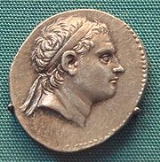
Sophagasenus

Encyclopedia
Sophagasenos also spelt Sophagasenus or Sophagasenas (Sanskrit
: Subhagasena) was a local Indian king ruling in Kabul
and Kapisa valley (Paropamisade of the classical writings) during the last decade of 3rd century BC. Sophagasnus finds reference only in "The Histories" of Polybius
. The identity of Sophagasenus is not clear. Many historians believe that Sophagasenus was a princely scion of the Mauryas of Magadha
but others believe him to have been a non-Mauryan local ruler from the area he ruled i.e. from Kabul
/Kapisa land. Some writers relate him to the Jatt lineage while others claim him from Yadava or Yadu
line, but for no valid reason.
makes use of Asoka’s genealogical list given in Asokavadana or Divyavadana as well as the list of kings given by Taranatha
in his "The History of Buddhism in India". to connect Sophagasenus with the Maurya king Vrishasena mentioned in Divyavadana, thus theorizing that Virasena of Taranatha’s account was a Maurya king Vrishasena of Divyavadana and that king Sophagasenus of Kabul
/Kapisa valley was probably a son and successor of this Virasena. As it can be seen, the belated accounts of Taranatha (completed in 1608 AD) indicate that Virasena was the father of the Magadhan king Nanda and the grandfather of king Mahapadama (sic). But simultaneously, Taranatha also makes Virasena the great grandson of king Asoka and the grandson of Kunala and the son of king Vigatasoka. It is notable that Taranatha's accounts establish that Arhat Kasyapa II was born in Gandhara but they nowhere indicate Virasena was the king of Gandhara
. Taranatha simply says that when Kasayapa II was working for the welfare of living beings "with threefold deeds of Law", king Virasena at that time (apparently in Central India) was maintaining monks from four quarters for three years and offering gifts to all the Chaityas in the whole world. Thus Taranatha simply makes king Virasena a "contemporary" of Arhat Kasyapa II (who was born in Gandhara) and nothing more.
To enumerate king Asoka's successors, Taranatha
has followed an old Buddhist quasi-historical text Manjusrimulakalpa. Manjusrimulakalpa (Mmk) lists king Asoka's successors as Visoka (=Vigatasoka of Taranatha), Surasena (=Virasena of Taranatha), Nanda, Chandragupta, and Bindusara. Another variant of king Virasena found in Taranatha's account itself is Indrasena. Scholars have restored king Virasena of Taranatha with king Surasena mentioned in the Manjusrimulakalpa. Dr K. P. Jayaswal, Dr N Dutt etc have also identified Asoka of Manjusrimulakalpa with Kalasoka (of Saisunaga dynasty) mentioned in the Mahavamsa
. Further, Nandivardhana, son of Kalasoka of Saisuanaga dynasty has been identified with Visoka or Vagatasoka of Taranatha. Thus, the Manjusrimulakalpa list of kings of Central India (Magadha) actually starts with Saisunaga kings, covers the Nanda kings and ends with Mauryas Chandragupta
and Bindusara
.
King Surasena, (misquoted by Taranatha
as Virasena or Indrasena), was succeeded by his son king Nanda
who ruled Central India (Madhyadesa) i.e Magadha
for 29 years. This Surasena of Manjusrimulakalpa has been identified with Nanda king Ugrasena
(founder of Nanda dynasty) mentioned in Mahabhodivamsa, or Nanda king Mahapadamapati of the Puranas
. Taranatha also mistook the name Mahapadama Nanda for two personages Nanda and Mahapadama and made the latter son of the former; or it may be that Nanda took appellation of Mahapadama sometime after commencement of his reign. It is noteworthy that Taranatha's Virasena (restored as Surasena by later scholars) was the king of Magadha and not of Gandhara as was erroneously supposed by Dr F. W. Thomas. Thus, it was this wrong interpretation of Tarantha's account by Dr F. W. Thomas which has led him to erroneously identify Virasena of Tarantha with Vrishasena of Divyavadana
and derive erroneous conclusion that Virasena was a Maurya ruler of Gandhara
and king Subhagasenna was probably his son/successor who later succeeded Virasena as the ruler of Kabul
valley. Also in the light of above facts, Dr Thomas' equation to relate Vrishasena of Divyavadana
with Virasena of Taranatha automatically loses its argumentative weight since Virasena was misquoted by Taranatha for king Surasena of Central India. Many scholars have, however, accepted Dr Thomas’s hypothesis without critical scrutiny. Interestingly, some scholars also identify Virasena of Taranatha variously with the later Maurya king Suyasas (son of Asoka) or with Jalauka (son of Asoka) or with Salisuka or with Somasarman. There are even some who say that Sophagasenus was the epithet worn by king Asoka himself. Louis de La Vallée-Poussin
holds that Sophagasenus which translates to Subhagasena may be considered to be the father of Virasena, which does not however bear scrutiny. As can be seen from the known facts of history and from the chronological order of kings given in Manjusrimulakalpa as well as by Taranatha, it is hard to believe the list given in Taranatha's History. Thus, Taranatha’s list of Asoka’s successors is obviously erroneous, commingled and confused. Commenting on Taranatha's accounts in respect of Asoka, Dr Vincent A. Smith
observes that Taranatha’s account is hopelessly confused. Sir Charles Elliot has also branded Taranatha’s account as confusing and untrustworthy. Susan L. Huntington too comments on Taranatha’s history and calls it unreliable. Thus, we can not put too much reliance on Taranatha
’s account on Asoka and his successors.
(restored as Surasena of Manjusrimulakalpa). Thus, Dr Thomas's hypothesis does not seem to hold. Dr Romila Thapar
is strongly against the view that Subhagasena was a Maurya king. Dr Thapar calls Subhagasena an obsecure Indian ruler. Scholars like M. M. Austin, Max Cary, and others, also write that the identity of Subhagasena is uncertain . It is admitted that the antecedents and ancestors of that Subhagasena are not known. H. G. Rawilson also opines that the identity of Subhagasena is uncertain. According to Cambridge History of India, Indian history knows no ruler of corresponding name, and it has therefore been conjectured that Sophagasenus was some local ruler who had taken advantage of the decay of the Maurya empire to establish his own in the country west of Indus. John Ma also calls Sophagasenos a local dynast, otherwise unknown from any of Indian sources. It was also conjectured at one time that Subhagasena was a title for Jalauka, son of great Asoka who had died in 231 BC. But Jalaukla himself is a misty personality. We do not know who the Sophagasenus was. "After Asoka's death, the interest of his successors, west of Indus must have disappeared because when later on (~206 BC), Antiochus III, 6th successor of Seleucus entered the Indus valley, he was resisted not by Mauryas but by a local ruler named Subhagasena..." . One quite agrees with Dr Thapar, Dr Rawilson and other scholars as quoted above that the ancestry of Sophagasenus is unclear and uncertain and in no can it be linked to Maurya rulers of Magadha
on the basis of flimsy and unreliable evidence of Taranatha who is a careless and untrustworthy writer of comparatively recent times.
, our only source on Sophagasenus, gives few very important clues about this ruler.
Firstly, immediately on crossing Caucasus, Antiochus faces Sophagasena. This shows that the king was ruler of Kabul
/Kapisa valleys. or what is also known as Paropamisadean territory south of Hindukush. Secondly, Sophagasenus is called an Indian king. Thirdly, the expression "renewal of friendship" used by Polybius which seems to suggest that Sophagasenus had previous dealings or prior alliance with Antiochus III. Fourthly, there is reference to Sophagasenus providing a large cash indemnity and many elephants to Antiochus. All these clues are very interesting and revealing. The region of Kabul
/Kapisa (Paropamisade) was the heartland of the Ashvakan Kambojas
who were especially engaged in horse-culture and cavalry
profession. The linguistic traces of Kamboja have been found in plenty in Pull-i-Drunta and Lamghan
valleys. We also know that just a century prior to Antiochus III's inroads into Kabul and Kapisa, the Aspasio and Assakenoi clan
s of the Kambojas
had offered a stubborn resistance to his predecessors i.e the Alexander of Macedon
in the same very region where Sophagasenus of Polybius is said to have been ruling. It is an admitted fact that the Aspasio section of the Kambojas was more Iranian
than Indian in culture and customs but the Assakenoi section had been completely Indianized by this time. Based on the evidence of historians who had accompanied Alexander, Arrian
calls the Ashvakas/Assakenoi as India
ns. Even the name Kapisa, which constituted the heart of this region, is said by scholars to be another variant of Sanskrit Kamboja
. Evidence from Rock Edicts V and XIII of king Asoka, which were inscribed between 260 BC and 240 BC, locate the Yonas in Arachosia
, the Gandharas (western Gandharas) in Peshawar
valley, and the Kambojas in Paropamisade i.e in Kabul
/Kunar
and Swat
valleys south of Hindukush, as neighbors to Daradas
. Polybius's attestation about elephants being provided by Sophagasenus as a gift to Antiochus is in line with the preponderous evidence from several ancient Sanskrit
and other sources that, like their horses, Kambojas were also noted for their celebrated war elephants. There are references to Kamboja kings
presenting thousands of elephants, besides blanket
s, cows, camel
s and horses etc as gifts to king Yudhishtra at the time of Rajasuya Yajna. Mahabharata refers to a wonderful army of war elephants fielded by Sudakshina at Kurukshetra.
In the fierce fight that took place between the prince
Prapaksha Kamboja
(younger brother of Sudakshina) and Arjuna
after Sudakshin Kamboj was martyred, Arjuna is said to have slaughtered numerous steeds and elephants of his antagonist's division. In the battle of Massaga, the Ashvaka Kambojas had faced Alexander with an army of 30,000 cavalry, 30,000 infantry and 30 elephants. The Asama-patras of king Valabhadeva of Assam, also proudly refer to the prized elephants from Kamboja in his stable. All this evidence seems to reinforce the view that Sophagasenus was a Kamboja ruler from Kabul/Kapisa land.
Lastly, Polybius's reference to "renewal of friendship" indicates that Sophagasenus must have come to the throne some years prior to 206 BC. The existence of at least one independent kingdom in north-west before BC 206 shows that Maurya empire must have begun to break-up nearly a a quarter century prior to usurpation of Magdhan
throne by Pushyamitra in 185 BC. However, the reference could simply refer to past friendships between the Greeks and Indians (e.g. the marriage alliance between Seleucus I and Chandragupta Maurya.)
declined after 232 BC, after the strong arm of Asoka was withdrawn on his death. His successors were unable to keep possession of the outlying regions including Kamboja
(Kabul
/Kunar
valley
s), Yona
(Arachosia
) and western Gandhara
(Peshawar
valley). These areas were inhabited by martial and freedom loving self-ruling people who seldom easily yielded to foreign control. Already during the heydays of Maurya empire, three revolts had occurred in eastern Gandhara alone—two during reign of Bindusara
and one during later years of king Asoka. We do not have any surviving records of the political conditions in the regions west of river Indus including Kamboja, but it is not too difficult to visualize that the areas west of Indus were even more impatient of foreign control. Not long ago, the same Ashvakas had assassinated Nicanor, the Greek Strap of Massaga in 326 BC while Alexander was still in Punjab. Asoka’s Rock Edicts V and XIII amply prove that the nations of Kamboja
, Yona
, Gandhara
(i.e. western Gandhara) etc were semi-sovereign and were ruled by their own community chieftains who enjoyed a feudatory status under the Mauryas. The 'Ŕāja-Vişayas' of king Asoka's thirteenth Rock Edict, which include the Kambojas, Yonas, Nabhika, Bhojas, Andhras etc, were "the sovereign (self-ruling) states within the Maurya Empire". M Boyce writes: "The Kambojas enjoyed a measure of autonomy...and were governed in some measure by the members of their own community on whom was laid the responsibility of transmitting to them the king's words, and having these engraved on stone". We have the case of Sibyrtios as a local ruler of Arachosia during time of Chandragupta and Whsu (Vakshu) a local ruler of Kamboja during time of king Asoka. Since the status of these border nations was midway between provincials proper and the unsubdued borders, the moment these local feudatory rulers found a ripe opportunity to say good-bye to their nominal overlords, they did exactly so after the strong arm of king Asoka was withdrawn in 232 BC. According to Dr R. K. Mukerjee, Dr. Satyaketu Vidyalankar, Dr J. L. Kamboj etc, the Yonas, Kambojas, Gandharas etc became bolder after the powerful arm of king Asoka was withdrawn after 233 BC and they shook the Maurya yoke off their shoulders. These semi-sovereign border nations were mainly responsible for the eventual break-up and ultimate fall of the Maurya empire. It is possible that Antiochus-Sophagasenus alliance which Polybius, the Greek historian, refers to may have been directed against the Imperial Mauryas of Pataliputra. It may have been designed couple of years prior to 206 BC since Polybius does allude to Antiochus III's renewal of treaty with Sophagasenus. It appears likely that the Greeks
intrigue played a part in the creation of an independent nation under Sophagasenus and ultimate disintegration of the Maurya empire before the Greek raids. Thus, it seems reasonable to think that on finding the right opportunity to strike, the local ruling chieftain of the Ashavka Kambojas (Paropamisade) broke off with Magadha
and carved out an independent kingdom of his own in Kabul/Kapisa valley. We know that since Paropamisade was the heart of Kamboja land, the local ruler for these warlike and freedom loving people naturally may have been a Kamboja background. This may indeed be true since in the Rock Edicts V and XIII which were inscribed only a couple of decades ago, the Kambojas as a feudatory or semi-sovereign (self-ruling) nation finds most prominent position in the edicts of Asoka. The same Kambojas a century earlier had played a very prominent role in the creation of Mauryan Empire by constituting an important component of Chandragupta's army of frontier-highlanders in 324-20 BC. All this evidence shows that the Kambojas had been very powerful during these centuries. Therefore, looking at time and space propinquity in the context of political scenario during time of Sophagasenus (Subhagasena), one is naturally led to infer that king Sophagasenus must have belonged to the Ashvakan Kshatrya branch of these powerful Kambojas of Kabul/Kapisa region. This view is further reinforced by the fact that the coins
of the Ashvaka Kambojas, bearing a legend "Vatasvaka" in Brahmi
, have been found in north-west frontiers. Dr E. J. Rapson has dated these coins to at least 200 BC which affirms that the Ashvakas were indeed the powerful rulers on west of Indus around 210/200 BC and that Indian king Sophagasenus of Polybius may indeed have been an Ashvaka Kamboja ruler. It is also tempting to link the Apraca
branch of the kings of Bajaur
to king Sophagasenus in this background. Scholars have linked the princes of Apraca dynasty
of Bajaur to the Ashvaka clan. And Yuvaraja Kharaosta Kamuio (Kamboja
) mentioned in the Mathura Lion Capital
appears to be connected with Apraca kings through Apracaraja Indravarman's Silver Reliquary
(q.v.). Later when Bactrian Greeks under Demetrius
conquered Paropamisade and rest of Afghanistan
, the ancestor of Apraca rulers of Kunar/Bajaur finds reference with Greek king Menander
in Shinkot reliquary inscriptions found from Bajaur
in Kunar.
Sanskrit
Sanskrit , is a historical Indo-Aryan language and the primary liturgical language of Hinduism, Jainism and Buddhism.Buddhism: besides Pali, see Buddhist Hybrid Sanskrit Today, it is listed as one of the 22 scheduled languages of India and is an official language of the state of Uttarakhand...
: Subhagasena) was a local Indian king ruling in Kabul
Kabul
Kabul , spelt Caubul in some classic literatures, is the capital and largest city of Afghanistan. It is also the capital of the Kabul Province, located in the eastern section of Afghanistan...
and Kapisa valley (Paropamisade of the classical writings) during the last decade of 3rd century BC. Sophagasnus finds reference only in "The Histories" of Polybius
Polybius
Polybius , Greek ) was a Greek historian of the Hellenistic Period noted for his work, The Histories, which covered the period of 220–146 BC in detail. The work describes in part the rise of the Roman Republic and its gradual domination over Greece...
. The identity of Sophagasenus is not clear. Many historians believe that Sophagasenus was a princely scion of the Mauryas of Magadha
Magadha
Magadha formed one of the sixteen Mahājanapadas or kingdoms in ancient India. The core of the kingdom was the area of Bihar south of the Ganga; its first capital was Rajagriha then Pataliputra...
but others believe him to have been a non-Mauryan local ruler from the area he ruled i.e. from Kabul
Kabul
Kabul , spelt Caubul in some classic literatures, is the capital and largest city of Afghanistan. It is also the capital of the Kabul Province, located in the eastern section of Afghanistan...
/Kapisa land. Some writers relate him to the Jatt lineage while others claim him from Yadava or Yadu
Yadu
Yadu is one of the five Indo-Aryan tribes mentioned in the Rig Veda . The Mahabharata, the Harivamsha and the Puranas mention Yadu as the eldest son of king Yayati and his queen Devayani. The prince of King Yayati, Yadu was a self-respecting and a very established ruler...
line, but for no valid reason.
Polybius on Sophagasenus
Polybius, the Greek historian, makes reference to Sophagasenus in context with Antiochus III’s expedition across the Caucasus Indicus (Hindukush) in around 206 BC. Having crossed the Caucasus Mountains, Antiochus moved up to Kabul and met Sophagasenus the Indian king with whom he renewed league and friendship he had made previously. and received more elephants until he had one hundred and fifty of them altogether. He then returned home via Arachosia, Drangiana and Karmania. No other source except Polybius makes any reference to Sophagasenus.Thomas' hypothesis on identity of Sophagasenus
Dr. F. W. ThomasF. W. Thomas
Frederick William Thomas was an Indologist and Tibetologist. He studied Sanskrit under the influential Orientalist Edward Byles Cowell at Cambridge. He was a librarian at the India Office Library between 1898 and 1927. Subsequently he was appointed the Boden professor of Sanskrit at Oxford...
makes use of Asoka’s genealogical list given in Asokavadana or Divyavadana as well as the list of kings given by Taranatha
Taranatha
Tāranātha was a Lama of the Jonang school of Tibetan Buddhism. He is widely considered its most remarkable scholar and exponent....
in his "The History of Buddhism in India". to connect Sophagasenus with the Maurya king Vrishasena mentioned in Divyavadana, thus theorizing that Virasena of Taranatha’s account was a Maurya king Vrishasena of Divyavadana and that king Sophagasenus of Kabul
Kabul
Kabul , spelt Caubul in some classic literatures, is the capital and largest city of Afghanistan. It is also the capital of the Kabul Province, located in the eastern section of Afghanistan...
/Kapisa valley was probably a son and successor of this Virasena. As it can be seen, the belated accounts of Taranatha (completed in 1608 AD) indicate that Virasena was the father of the Magadhan king Nanda and the grandfather of king Mahapadama (sic). But simultaneously, Taranatha also makes Virasena the great grandson of king Asoka and the grandson of Kunala and the son of king Vigatasoka. It is notable that Taranatha's accounts establish that Arhat Kasyapa II was born in Gandhara but they nowhere indicate Virasena was the king of Gandhara
Gandhara
Gandhāra , is the name of an ancient kingdom , located in northern Pakistan and eastern Afghanistan. Gandhara was located mainly in the vale of Peshawar, the Potohar plateau and on the Kabul River...
. Taranatha simply says that when Kasayapa II was working for the welfare of living beings "with threefold deeds of Law", king Virasena at that time (apparently in Central India) was maintaining monks from four quarters for three years and offering gifts to all the Chaityas in the whole world. Thus Taranatha simply makes king Virasena a "contemporary" of Arhat Kasyapa II (who was born in Gandhara) and nothing more.
To enumerate king Asoka's successors, Taranatha
Taranatha
Tāranātha was a Lama of the Jonang school of Tibetan Buddhism. He is widely considered its most remarkable scholar and exponent....
has followed an old Buddhist quasi-historical text Manjusrimulakalpa. Manjusrimulakalpa (Mmk) lists king Asoka's successors as Visoka (=Vigatasoka of Taranatha), Surasena (=Virasena of Taranatha), Nanda, Chandragupta, and Bindusara. Another variant of king Virasena found in Taranatha's account itself is Indrasena. Scholars have restored king Virasena of Taranatha with king Surasena mentioned in the Manjusrimulakalpa. Dr K. P. Jayaswal, Dr N Dutt etc have also identified Asoka of Manjusrimulakalpa with Kalasoka (of Saisunaga dynasty) mentioned in the Mahavamsa
Mahavamsa
The Mahavamsa is a historical poem written in the Pali language, of the kings of Sri Lanka...
. Further, Nandivardhana, son of Kalasoka of Saisuanaga dynasty has been identified with Visoka or Vagatasoka of Taranatha. Thus, the Manjusrimulakalpa list of kings of Central India (Magadha) actually starts with Saisunaga kings, covers the Nanda kings and ends with Mauryas Chandragupta
Chandragupta Maurya
Chandragupta Maurya , was the founder of the Maurya Empire. Chandragupta succeeded in conquering most of the Indian subcontinent. Chandragupta is considered the first unifier of India and its first genuine emperor...
and Bindusara
Bindusara
Bindusara was the second Mauryan emperor after Chandragupta Maurya. During his reign, the empire expanded southwards. He had two well-known sons, Susima and Ashoka, who were the viceroys of Taxila and Ujjain...
.
King Surasena, (misquoted by Taranatha
Taranatha
Tāranātha was a Lama of the Jonang school of Tibetan Buddhism. He is widely considered its most remarkable scholar and exponent....
as Virasena or Indrasena), was succeeded by his son king Nanda
Nanda
Nanda is a surname of Punjabis . Nanda is a Tarkhan , Ahluwalia and Kamboj surname. All the clans of Tarkhan , Lohar, Gujjar, Kamboj, Ahluwalia tribes have a close genetic and ancestral relationship with each other, and together they form the Khatri/Rajput caste.-Among Kamboj people:*Nanda is a...
who ruled Central India (Madhyadesa) i.e Magadha
Magadha
Magadha formed one of the sixteen Mahājanapadas or kingdoms in ancient India. The core of the kingdom was the area of Bihar south of the Ganga; its first capital was Rajagriha then Pataliputra...
for 29 years. This Surasena of Manjusrimulakalpa has been identified with Nanda king Ugrasena
Ugrasena
Ugrasena was the King of Mathura, a kingdom that was established after the various Yadava clans, which include the Vrishnis and Bhojas decided that the dividing states would unite as one and that the Kingship would not be subject to heredity and if decided not to be so, the succeeding leader...
(founder of Nanda dynasty) mentioned in Mahabhodivamsa, or Nanda king Mahapadamapati of the Puranas
Puranas
The Puranas are a genre of important Hindu, Jain and Buddhist religious texts, notably consisting of narratives of the history of the universe from creation to destruction, genealogies of kings, heroes, sages, and demigods, and descriptions of Hindu cosmology, philosophy, and geography.Puranas...
. Taranatha also mistook the name Mahapadama Nanda for two personages Nanda and Mahapadama and made the latter son of the former; or it may be that Nanda took appellation of Mahapadama sometime after commencement of his reign. It is noteworthy that Taranatha's Virasena (restored as Surasena by later scholars) was the king of Magadha and not of Gandhara as was erroneously supposed by Dr F. W. Thomas. Thus, it was this wrong interpretation of Tarantha's account by Dr F. W. Thomas which has led him to erroneously identify Virasena of Tarantha with Vrishasena of Divyavadana
Divyavadana
The Divyāvadāna, or Divine Stories, is an anthology of Buddhist tales, many originating in the Mūlasarvāstivāda vinaya texts. The stories themselves are therefore quite ancient and may be among the first Buddhist texts ever committed to writing, but this particular collection of them is not...
and derive erroneous conclusion that Virasena was a Maurya ruler of Gandhara
Gandhara
Gandhāra , is the name of an ancient kingdom , located in northern Pakistan and eastern Afghanistan. Gandhara was located mainly in the vale of Peshawar, the Potohar plateau and on the Kabul River...
and king Subhagasenna was probably his son/successor who later succeeded Virasena as the ruler of Kabul
Kabul
Kabul , spelt Caubul in some classic literatures, is the capital and largest city of Afghanistan. It is also the capital of the Kabul Province, located in the eastern section of Afghanistan...
valley. Also in the light of above facts, Dr Thomas' equation to relate Vrishasena of Divyavadana
Divyavadana
The Divyāvadāna, or Divine Stories, is an anthology of Buddhist tales, many originating in the Mūlasarvāstivāda vinaya texts. The stories themselves are therefore quite ancient and may be among the first Buddhist texts ever committed to writing, but this particular collection of them is not...
with Virasena of Taranatha automatically loses its argumentative weight since Virasena was misquoted by Taranatha for king Surasena of Central India. Many scholars have, however, accepted Dr Thomas’s hypothesis without critical scrutiny. Interestingly, some scholars also identify Virasena of Taranatha variously with the later Maurya king Suyasas (son of Asoka) or with Jalauka (son of Asoka) or with Salisuka or with Somasarman. There are even some who say that Sophagasenus was the epithet worn by king Asoka himself. Louis de La Vallée-Poussin
Louis de La Vallée-Poussin
Louis de La Vallée Poussin — Birth full name Louis Étienne Joseph Marie de La Vallée-Poussin — was a Belgian Indologist and scholar of Buddhist Studies.-Education:...
holds that Sophagasenus which translates to Subhagasena may be considered to be the father of Virasena, which does not however bear scrutiny. As can be seen from the known facts of history and from the chronological order of kings given in Manjusrimulakalpa as well as by Taranatha, it is hard to believe the list given in Taranatha's History. Thus, Taranatha’s list of Asoka’s successors is obviously erroneous, commingled and confused. Commenting on Taranatha's accounts in respect of Asoka, Dr Vincent A. Smith
Vincent Arthur Smith
Vincent Arthur Smith was born in 1843 in Dublin which was then part of the United Kingdom of Great Britain and Ireland. He was an Indologist, historian and art historian who worked in the Indian Civil Service and retired early to devote himself to his writing.His Oxford History of India, covering...
observes that Taranatha’s account is hopelessly confused. Sir Charles Elliot has also branded Taranatha’s account as confusing and untrustworthy. Susan L. Huntington too comments on Taranatha’s history and calls it unreliable. Thus, we can not put too much reliance on Taranatha
Taranatha
Tāranātha was a Lama of the Jonang school of Tibetan Buddhism. He is widely considered its most remarkable scholar and exponent....
’s account on Asoka and his successors.
Differing opinions on the antecedents and ancestry of Sophagasenos
Many scholars have rejected the hypothesis propounded by Dr Thomas’s and followed by several later scholars. Dr V. A. Smith does not accept Sophagasenus connection with Virasena or with the Maurya rulers of Pataliputra. Sophagasenus is not identified with the name of any known Indian king. The detailed lists of Maurya successors in numerous Puranas do not mention any king named Virasena or Subhagasena. We are really inclined to doubt F. M. Thomas's theory that Subhagasena was successor of Virasena until we equate the latter with Vrishasena of Asokavadana. But as we have seen above, there is absolutely no equation or equivalence between Vrishasena of Divyavadana/Asokavadana and king Virasena of TaranathaTaranatha
Tāranātha was a Lama of the Jonang school of Tibetan Buddhism. He is widely considered its most remarkable scholar and exponent....
(restored as Surasena of Manjusrimulakalpa). Thus, Dr Thomas's hypothesis does not seem to hold. Dr Romila Thapar
Romila Thapar
Romila Thapar is an Indian historian whose principal area of study is ancient India.-Work:After graduating from Panjab University, Thapar earned her doctorate under A. L. Basham at the School of Oriental and African Studies, the University of London in 1958...
is strongly against the view that Subhagasena was a Maurya king. Dr Thapar calls Subhagasena an obsecure Indian ruler. Scholars like M. M. Austin, Max Cary, and others, also write that the identity of Subhagasena is uncertain . It is admitted that the antecedents and ancestors of that Subhagasena are not known. H. G. Rawilson also opines that the identity of Subhagasena is uncertain. According to Cambridge History of India, Indian history knows no ruler of corresponding name, and it has therefore been conjectured that Sophagasenus was some local ruler who had taken advantage of the decay of the Maurya empire to establish his own in the country west of Indus. John Ma also calls Sophagasenos a local dynast, otherwise unknown from any of Indian sources. It was also conjectured at one time that Subhagasena was a title for Jalauka, son of great Asoka who had died in 231 BC. But Jalaukla himself is a misty personality. We do not know who the Sophagasenus was. "After Asoka's death, the interest of his successors, west of Indus must have disappeared because when later on (~206 BC), Antiochus III, 6th successor of Seleucus entered the Indus valley, he was resisted not by Mauryas but by a local ruler named Subhagasena..." . One quite agrees with Dr Thapar, Dr Rawilson and other scholars as quoted above that the ancestry of Sophagasenus is unclear and uncertain and in no can it be linked to Maurya rulers of Magadha
Magadha
Magadha formed one of the sixteen Mahājanapadas or kingdoms in ancient India. The core of the kingdom was the area of Bihar south of the Ganga; its first capital was Rajagriha then Pataliputra...
on the basis of flimsy and unreliable evidence of Taranatha who is a careless and untrustworthy writer of comparatively recent times.
A possible identity of Sophagasenus
PolybiusPolybius
Polybius , Greek ) was a Greek historian of the Hellenistic Period noted for his work, The Histories, which covered the period of 220–146 BC in detail. The work describes in part the rise of the Roman Republic and its gradual domination over Greece...
, our only source on Sophagasenus, gives few very important clues about this ruler.
Firstly, immediately on crossing Caucasus, Antiochus faces Sophagasena. This shows that the king was ruler of Kabul
Kabul
Kabul , spelt Caubul in some classic literatures, is the capital and largest city of Afghanistan. It is also the capital of the Kabul Province, located in the eastern section of Afghanistan...
/Kapisa valleys. or what is also known as Paropamisadean territory south of Hindukush. Secondly, Sophagasenus is called an Indian king. Thirdly, the expression "renewal of friendship" used by Polybius which seems to suggest that Sophagasenus had previous dealings or prior alliance with Antiochus III. Fourthly, there is reference to Sophagasenus providing a large cash indemnity and many elephants to Antiochus. All these clues are very interesting and revealing. The region of Kabul
Kabul
Kabul , spelt Caubul in some classic literatures, is the capital and largest city of Afghanistan. It is also the capital of the Kabul Province, located in the eastern section of Afghanistan...
/Kapisa (Paropamisade) was the heartland of the Ashvakan Kambojas
Kambojas
The Kambojas were a kshatriya tribe of Iron Age India, frequently mentioned in Sanskrit and Pali literature.They were an Indo-Iranian tribe situated at the boundary of the Indo-Aryans and the Iranians, and appear to have moved from the Iranian into the Indo-Aryan sphere over time.The Kambojas...
who were especially engaged in horse-culture and cavalry
Cavalry
Cavalry or horsemen were soldiers or warriors who fought mounted on horseback. Cavalry were historically the third oldest and the most mobile of the combat arms...
profession. The linguistic traces of Kamboja have been found in plenty in Pull-i-Drunta and Lamghan
Laghman
Laghman can refer to:* Laghman Province in Afghanistan* Laghman, a place in Jowzjan Province, Afghanistan* Lamian and variants thereof as soup...
valleys. We also know that just a century prior to Antiochus III's inroads into Kabul and Kapisa, the Aspasio and Assakenoi clan
Clan
A clan is a group of people united by actual or perceived kinship and descent. Even if lineage details are unknown, clan members may be organized around a founding member or apical ancestor. The kinship-based bonds may be symbolical, whereby the clan shares a "stipulated" common ancestor that is a...
s of the Kambojas
Kambojas
The Kambojas were a kshatriya tribe of Iron Age India, frequently mentioned in Sanskrit and Pali literature.They were an Indo-Iranian tribe situated at the boundary of the Indo-Aryans and the Iranians, and appear to have moved from the Iranian into the Indo-Aryan sphere over time.The Kambojas...
had offered a stubborn resistance to his predecessors i.e the Alexander of Macedon
Macedon
Macedonia or Macedon was an ancient kingdom, centered in the northeastern part of the Greek peninsula, bordered by Epirus to the west, Paeonia to the north, the region of Thrace to the east and Thessaly to the south....
in the same very region where Sophagasenus of Polybius is said to have been ruling. It is an admitted fact that the Aspasio section of the Kambojas was more Iranian
Culture of Iran
To best understand Iran, Afghanistan, their related societies and their people, one must first attempt to acquire an understanding of their culture. It is in the study of this area where the Persian identity optimally expresses itself...
than Indian in culture and customs but the Assakenoi section had been completely Indianized by this time. Based on the evidence of historians who had accompanied Alexander, Arrian
Arrian
Lucius Flavius Arrianus 'Xenophon , known in English as Arrian , and Arrian of Nicomedia, was a Roman historian, public servant, a military commander and a philosopher of the 2nd-century Roman period...
calls the Ashvakas/Assakenoi as India
India
India , officially the Republic of India , is a country in South Asia. It is the seventh-largest country by geographical area, the second-most populous country with over 1.2 billion people, and the most populous democracy in the world...
ns. Even the name Kapisa, which constituted the heart of this region, is said by scholars to be another variant of Sanskrit Kamboja
Kambojas
The Kambojas were a kshatriya tribe of Iron Age India, frequently mentioned in Sanskrit and Pali literature.They were an Indo-Iranian tribe situated at the boundary of the Indo-Aryans and the Iranians, and appear to have moved from the Iranian into the Indo-Aryan sphere over time.The Kambojas...
. Evidence from Rock Edicts V and XIII of king Asoka, which were inscribed between 260 BC and 240 BC, locate the Yonas in Arachosia
Arachosia
Arachosia is the Latinized form of the Greek name of an Achaemenid and Seleucid governorate in the eastern part of their respective empires, around modern-day southern Afghanistan. The Greek term "Arachosia" corresponds to the Iranian land of Harauti which was between Kandahar in Afghanistan and...
, the Gandharas (western Gandharas) in Peshawar
Peshawar
Peshawar is the capital of Khyber-Pakhtunkhwa and the administrative center and central economic hub for the Federally Administered Tribal Areas of Pakistan....
valley, and the Kambojas in Paropamisade i.e in Kabul
Kabul
Kabul , spelt Caubul in some classic literatures, is the capital and largest city of Afghanistan. It is also the capital of the Kabul Province, located in the eastern section of Afghanistan...
/Kunar
Kunar
Kunar may refer to:*Kunar Valley, Afghanistan and Pakistan*Kunar Province, Afghanistan*Kunar River, Afghanistan and Pakistan...
and Swat
Swat
SWAT is the special-weapons-and-tactics unit of a law-enforcement agency. Swat or SWAT may also refer to:In media:* SWAT , a video games series spin-off of Police Quest...
valleys south of Hindukush, as neighbors to Daradas
Daradas
Daradas were a people who lived north and north-east to the Kashmir valley. This kingdom is identified to be the Gilgit region in Kashmir along the river Sindhu or Indus. They are often spoken along with the Kambojas...
. Polybius's attestation about elephants being provided by Sophagasenus as a gift to Antiochus is in line with the preponderous evidence from several ancient Sanskrit
Sanskrit
Sanskrit , is a historical Indo-Aryan language and the primary liturgical language of Hinduism, Jainism and Buddhism.Buddhism: besides Pali, see Buddhist Hybrid Sanskrit Today, it is listed as one of the 22 scheduled languages of India and is an official language of the state of Uttarakhand...
and other sources that, like their horses, Kambojas were also noted for their celebrated war elephants. There are references to Kamboja kings
Prince
Prince is a general term for a ruler, monarch or member of a monarch's or former monarch's family, and is a hereditary title in the nobility of some European states. The feminine equivalent is a princess...
presenting thousands of elephants, besides blanket
Blanket
A blanket is a type of bedding, generally speaking, a large piece of cloth, intended to keep the user warm, especially while sleeping. Blankets are distinguished from sheets by their thickness and purpose; the thickest sheet is still thinner than the lightest blanket. Blankets are generally used...
s, cows, camel
Camel
A camel is an even-toed ungulate within the genus Camelus, bearing distinctive fatty deposits known as humps on its back. There are two species of camels: the dromedary or Arabian camel has a single hump, and the bactrian has two humps. Dromedaries are native to the dry desert areas of West Asia,...
s and horses etc as gifts to king Yudhishtra at the time of Rajasuya Yajna. Mahabharata refers to a wonderful army of war elephants fielded by Sudakshina at Kurukshetra.
In the fierce fight that took place between the prince
Prince
Prince is a general term for a ruler, monarch or member of a monarch's or former monarch's family, and is a hereditary title in the nobility of some European states. The feminine equivalent is a princess...
Prapaksha Kamboja
Kamboj
The Kambojs , also Kamboh, are an ethnic community of the Punjab region. They may relate to the Kambojas, an Iranian tribe known to the people of Iron Age India and mentioned in ancient Sanskrit texts and epigraphy. Kamboj is frequently used as a surname in lieu of the sub-caste or the gotra name...
(younger brother of Sudakshina) and Arjuna
Arjuna
Arjuna in Indian mythology is the greatest warrior on earth and is one of the Pandavas, the heroes of the Hindu epic Mahābhārata. Arjuna, whose name means 'bright', 'shining', 'white' or 'silver' Arjuna (Devanagari: अर्जुन, Thai: อรชุน, Orachun, Tamil: Arjunan, Indonesian and Javanese: Harjuna,...
after Sudakshin Kamboj was martyred, Arjuna is said to have slaughtered numerous steeds and elephants of his antagonist's division. In the battle of Massaga, the Ashvaka Kambojas had faced Alexander with an army of 30,000 cavalry, 30,000 infantry and 30 elephants. The Asama-patras of king Valabhadeva of Assam, also proudly refer to the prized elephants from Kamboja in his stable. All this evidence seems to reinforce the view that Sophagasenus was a Kamboja ruler from Kabul/Kapisa land.
Lastly, Polybius's reference to "renewal of friendship" indicates that Sophagasenus must have come to the throne some years prior to 206 BC. The existence of at least one independent kingdom in north-west before BC 206 shows that Maurya empire must have begun to break-up nearly a a quarter century prior to usurpation of Magdhan
Magadha
Magadha formed one of the sixteen Mahājanapadas or kingdoms in ancient India. The core of the kingdom was the area of Bihar south of the Ganga; its first capital was Rajagriha then Pataliputra...
throne by Pushyamitra in 185 BC. However, the reference could simply refer to past friendships between the Greeks and Indians (e.g. the marriage alliance between Seleucus I and Chandragupta Maurya.)
Conclusions
Maurya EmpireMaurya Empire
The Maurya Empire was a geographically extensive Iron Age historical power in ancient India, ruled by the Mauryan dynasty from 321 to 185 BC...
declined after 232 BC, after the strong arm of Asoka was withdrawn on his death. His successors were unable to keep possession of the outlying regions including Kamboja
Kambojas
The Kambojas were a kshatriya tribe of Iron Age India, frequently mentioned in Sanskrit and Pali literature.They were an Indo-Iranian tribe situated at the boundary of the Indo-Aryans and the Iranians, and appear to have moved from the Iranian into the Indo-Aryan sphere over time.The Kambojas...
(Kabul
Kabul
Kabul , spelt Caubul in some classic literatures, is the capital and largest city of Afghanistan. It is also the capital of the Kabul Province, located in the eastern section of Afghanistan...
/Kunar
Kunar
Kunar may refer to:*Kunar Valley, Afghanistan and Pakistan*Kunar Province, Afghanistan*Kunar River, Afghanistan and Pakistan...
valley
Valley
In geology, a valley or dale is a depression with predominant extent in one direction. A very deep river valley may be called a canyon or gorge.The terms U-shaped and V-shaped are descriptive terms of geography to characterize the form of valleys...
s), Yona
Yona
"Yona" is a Pali word used in ancient India to designate Greek speakers. Its equivalent in Sanskrit, Malayalam, Kannada, Telugu and Tamil is the word "Yavana" and "Jobonan/Jubonan" in Bengali...
(Arachosia
Arachosia
Arachosia is the Latinized form of the Greek name of an Achaemenid and Seleucid governorate in the eastern part of their respective empires, around modern-day southern Afghanistan. The Greek term "Arachosia" corresponds to the Iranian land of Harauti which was between Kandahar in Afghanistan and...
) and western Gandhara
Gandhara
Gandhāra , is the name of an ancient kingdom , located in northern Pakistan and eastern Afghanistan. Gandhara was located mainly in the vale of Peshawar, the Potohar plateau and on the Kabul River...
(Peshawar
Peshawar
Peshawar is the capital of Khyber-Pakhtunkhwa and the administrative center and central economic hub for the Federally Administered Tribal Areas of Pakistan....
valley). These areas were inhabited by martial and freedom loving self-ruling people who seldom easily yielded to foreign control. Already during the heydays of Maurya empire, three revolts had occurred in eastern Gandhara alone—two during reign of Bindusara
Bindusara
Bindusara was the second Mauryan emperor after Chandragupta Maurya. During his reign, the empire expanded southwards. He had two well-known sons, Susima and Ashoka, who were the viceroys of Taxila and Ujjain...
and one during later years of king Asoka. We do not have any surviving records of the political conditions in the regions west of river Indus including Kamboja, but it is not too difficult to visualize that the areas west of Indus were even more impatient of foreign control. Not long ago, the same Ashvakas had assassinated Nicanor, the Greek Strap of Massaga in 326 BC while Alexander was still in Punjab. Asoka’s Rock Edicts V and XIII amply prove that the nations of Kamboja
Kambojas
The Kambojas were a kshatriya tribe of Iron Age India, frequently mentioned in Sanskrit and Pali literature.They were an Indo-Iranian tribe situated at the boundary of the Indo-Aryans and the Iranians, and appear to have moved from the Iranian into the Indo-Aryan sphere over time.The Kambojas...
, Yona
Yona
"Yona" is a Pali word used in ancient India to designate Greek speakers. Its equivalent in Sanskrit, Malayalam, Kannada, Telugu and Tamil is the word "Yavana" and "Jobonan/Jubonan" in Bengali...
, Gandhara
Gandhara
Gandhāra , is the name of an ancient kingdom , located in northern Pakistan and eastern Afghanistan. Gandhara was located mainly in the vale of Peshawar, the Potohar plateau and on the Kabul River...
(i.e. western Gandhara) etc were semi-sovereign and were ruled by their own community chieftains who enjoyed a feudatory status under the Mauryas. The 'Ŕāja-Vişayas' of king Asoka's thirteenth Rock Edict, which include the Kambojas, Yonas, Nabhika, Bhojas, Andhras etc, were "the sovereign (self-ruling) states within the Maurya Empire". M Boyce writes: "The Kambojas enjoyed a measure of autonomy...and were governed in some measure by the members of their own community on whom was laid the responsibility of transmitting to them the king's words, and having these engraved on stone". We have the case of Sibyrtios as a local ruler of Arachosia during time of Chandragupta and Whsu (Vakshu) a local ruler of Kamboja during time of king Asoka. Since the status of these border nations was midway between provincials proper and the unsubdued borders, the moment these local feudatory rulers found a ripe opportunity to say good-bye to their nominal overlords, they did exactly so after the strong arm of king Asoka was withdrawn in 232 BC. According to Dr R. K. Mukerjee, Dr. Satyaketu Vidyalankar, Dr J. L. Kamboj etc, the Yonas, Kambojas, Gandharas etc became bolder after the powerful arm of king Asoka was withdrawn after 233 BC and they shook the Maurya yoke off their shoulders. These semi-sovereign border nations were mainly responsible for the eventual break-up and ultimate fall of the Maurya empire. It is possible that Antiochus-Sophagasenus alliance which Polybius, the Greek historian, refers to may have been directed against the Imperial Mauryas of Pataliputra. It may have been designed couple of years prior to 206 BC since Polybius does allude to Antiochus III's renewal of treaty with Sophagasenus. It appears likely that the Greeks
Greeks
The Greeks, also known as the Hellenes , are a nation and ethnic group native to Greece, Cyprus and neighboring regions. They also form a significant diaspora, with Greek communities established around the world....
intrigue played a part in the creation of an independent nation under Sophagasenus and ultimate disintegration of the Maurya empire before the Greek raids. Thus, it seems reasonable to think that on finding the right opportunity to strike, the local ruling chieftain of the Ashavka Kambojas (Paropamisade) broke off with Magadha
Magadha
Magadha formed one of the sixteen Mahājanapadas or kingdoms in ancient India. The core of the kingdom was the area of Bihar south of the Ganga; its first capital was Rajagriha then Pataliputra...
and carved out an independent kingdom of his own in Kabul/Kapisa valley. We know that since Paropamisade was the heart of Kamboja land, the local ruler for these warlike and freedom loving people naturally may have been a Kamboja background. This may indeed be true since in the Rock Edicts V and XIII which were inscribed only a couple of decades ago, the Kambojas as a feudatory or semi-sovereign (self-ruling) nation finds most prominent position in the edicts of Asoka. The same Kambojas a century earlier had played a very prominent role in the creation of Mauryan Empire by constituting an important component of Chandragupta's army of frontier-highlanders in 324-20 BC. All this evidence shows that the Kambojas had been very powerful during these centuries. Therefore, looking at time and space propinquity in the context of political scenario during time of Sophagasenus (Subhagasena), one is naturally led to infer that king Sophagasenus must have belonged to the Ashvakan Kshatrya branch of these powerful Kambojas of Kabul/Kapisa region. This view is further reinforced by the fact that the coins
COinS
ContextObjects in Spans, commonly abbreviated COinS, is a method to embed bibliographic metadata in the HTML code of web pages. This allows bibliographic software to publish machine-readable bibliographic items and client reference management software to retrieve bibliographic metadata. The...
of the Ashvaka Kambojas, bearing a legend "Vatasvaka" in Brahmi
Brāhmī script
Brāhmī is the modern name given to the oldest members of the Brahmic family of scripts. The best-known Brāhmī inscriptions are the rock-cut edicts of Ashoka in north-central India, dated to the 3rd century BCE. These are traditionally considered to be early known examples of Brāhmī writing...
, have been found in north-west frontiers. Dr E. J. Rapson has dated these coins to at least 200 BC which affirms that the Ashvakas were indeed the powerful rulers on west of Indus around 210/200 BC and that Indian king Sophagasenus of Polybius may indeed have been an Ashvaka Kamboja ruler. It is also tempting to link the Apraca
Apraca
Apraca, or Avaca, was an ancient Indo-Scythian kingdom or satrapy in the area of Bajaur in modern Pakistan from the 1st century BCE to the 1st century CE. Its rulers formed a small dynasty, called the Apracarajas...
branch of the kings of Bajaur
Bajaur
Bajaur or Bajur or Bajour is an Agency of the Federally Administered Tribal Areas of Pakistan. Smallest of the agencies in FATA, it has a hilly terrain. According to the 1998 census, the population was 595,227 but other more recent estimates it has grown to 757,000...
to king Sophagasenus in this background. Scholars have linked the princes of Apraca dynasty
Apraca
Apraca, or Avaca, was an ancient Indo-Scythian kingdom or satrapy in the area of Bajaur in modern Pakistan from the 1st century BCE to the 1st century CE. Its rulers formed a small dynasty, called the Apracarajas...
of Bajaur to the Ashvaka clan. And Yuvaraja Kharaosta Kamuio (Kamboja
Kambojas
The Kambojas were a kshatriya tribe of Iron Age India, frequently mentioned in Sanskrit and Pali literature.They were an Indo-Iranian tribe situated at the boundary of the Indo-Aryans and the Iranians, and appear to have moved from the Iranian into the Indo-Aryan sphere over time.The Kambojas...
) mentioned in the Mathura Lion Capital
Mathura lion capital
The Mathura lion capital is an Indo-Scythian sandstone capital from Mathura in Central India, dated to the 1st century CE.The capital is covered with Prakrit inscriptions in the kharoshthi script of northwestern India...
appears to be connected with Apraca kings through Apracaraja Indravarman's Silver Reliquary
Apracaraja Indravarman's Silver Reliquary
An Inscribed Silver Buddhist Reliquary or Apracaraja Indravarman's Silver Reliquary has been found, presumably from Bajaur area of ancient Kapisa . Believed to have been fabricated originally at Taxila, the silver reliquary consists of two parts—the base and the cover—both being fluted , and the...
(q.v.). Later when Bactrian Greeks under Demetrius
Demetrius
Demetrius, also spelled as Demetrios, Dimitrios, Demitri, and Dimitri , is a male given name.Demetrius and its variations may refer to the following:...
conquered Paropamisade and rest of Afghanistan
Afghanistan
Afghanistan , officially the Islamic Republic of Afghanistan, is a landlocked country located in the centre of Asia, forming South Asia, Central Asia and the Middle East. With a population of about 29 million, it has an area of , making it the 42nd most populous and 41st largest nation in the world...
, the ancestor of Apraca rulers of Kunar/Bajaur finds reference with Greek king Menander
Menander
Menander , Greek dramatist, the best-known representative of Athenian New Comedy, was the son of well-to-do parents; his father Diopeithes is identified by some with the Athenian general and governor of the Thracian Chersonese known from the speech of Demosthenes De Chersoneso...
in Shinkot reliquary inscriptions found from Bajaur
Bajaur
Bajaur or Bajur or Bajour is an Agency of the Federally Administered Tribal Areas of Pakistan. Smallest of the agencies in FATA, it has a hilly terrain. According to the 1998 census, the population was 595,227 but other more recent estimates it has grown to 757,000...
in Kunar.