

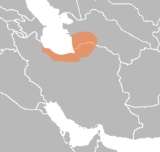
Hyrcania

Encyclopedia

Satrap
Satrap was the name given to the governors of the provinces of the ancient Median and Achaemenid Empires and in several of their successors, such as the Sassanid Empire and the Hellenistic empires....
y located in the territories of present day Gilan, Golestan
Golestan Province
Golestan Province is one of the 31 provinces of Iran, located in the north-east of the country, south of the Caspian Sea. Its capital is Gorgan....
, Mazandaran and part of Turkmenistan
Turkmenistan
Turkmenistan , formerly also known as Turkmenia is one of the Turkic states in Central Asia. Until 1991, it was a constituent republic of the Soviet Union, the Turkmen Soviet Socialist Republic . Turkmenistan is one of the six independent Turkic states...
, lands south of the Caspian Sea
Caspian Sea
The Caspian Sea is the largest enclosed body of water on Earth by area, variously classed as the world's largest lake or a full-fledged sea. The sea has a surface area of and a volume of...
. To the Greeks, the Caspian Sea
Caspian Sea
The Caspian Sea is the largest enclosed body of water on Earth by area, variously classed as the world's largest lake or a full-fledged sea. The sea has a surface area of and a volume of...
was the "Hyrcanian Sea".
Etymology
Hyrcania (Ὑρκανία) is the GreekGreek language
Greek is an independent branch of the Indo-European family of languages. Native to the southern Balkans, it has the longest documented history of any Indo-European language, spanning 34 centuries of written records. Its writing system has been the Greek alphabet for the majority of its history;...
name for the region in historiographic accounts. It is a calque of Old Persian Verkâna as recorded in Darius the Great
Darius I of Persia
Darius I , also known as Darius the Great, was the third king of kings of the Achaemenid Empire...
's Behistun Inscription
Behistun Inscription
The Behistun Inscription The Behistun Inscription The Behistun Inscription (also Bistun or Bisutun, Modern Persian: بیستون The Behistun Inscription (also Bistun or Bisutun, Modern Persian: بیستون...
, as well as in other Old Persian cuneiform inscriptions. Verkā means "wolf" in Old Iranian, cf. Avestan vəhrkō, Gilaki
Gilaki language
The Gilaki language is a Caspian language, and a member of the northwestern Iranian language branch, spoken in Iran's Gīlān Province.The language is divided into three dialects: Western Gilaki, Eastern Gilaki, and Galeshi . Furthermore, the Gilaki language is closely related to Mazanderani, and the...
and Mazandarani
Mazandarani language
Mazandarani or Tabari is an Iranian language of the Northwestern branch, spoken mainly in Iran's Mazandaran, Gilan and Golestan provinces...
Verk, Modern Persian
Persian language
Persian is an Iranian language within the Indo-Iranian branch of the Indo-European languages. It is primarily spoken in Iran, Afghanistan, Tajikistan and countries which historically came under Persian influence...
gorg, and Sanskrit
Sanskrit
Sanskrit , is a historical Indo-Aryan language and the primary liturgical language of Hinduism, Jainism and Buddhism.Buddhism: besides Pali, see Buddhist Hybrid Sanskrit Today, it is listed as one of the 22 scheduled languages of India and is an official language of the state of Uttarakhand...
Vŗka (वृक). See also Warg
Warg
In Norse mythology, a vargr is a wolf and in particular refers to the wolf Fenrir and his sons Sköll and Hati. Based on this, J. R. R. Tolkien in his fiction used the Old English form warg In Norse mythology, a vargr (often anglicised as warg or varg) is a wolf and in particular refers to the...
. Consequently, Hyrcania means "Wolf-land". The name was extended to the Caspian Sea
Caspian Sea
The Caspian Sea is the largest enclosed body of water on Earth by area, variously classed as the world's largest lake or a full-fledged sea. The sea has a surface area of and a volume of...
and underlie the name of the city Gorgan
Gorgan
Gorgan Some east of Gorgan is the Golestan National Park. The city has a regional airport and several universities. Gorgan Airport was opened in September 2005.-Etymology:...
, capital of the Golestan Province
Golestan Province
Golestan Province is one of the 31 provinces of Iran, located in the north-east of the country, south of the Caspian Sea. Its capital is Gorgan....
.
History
Hyrcania was situated between the Caspian SeaCaspian Sea
The Caspian Sea is the largest enclosed body of water on Earth by area, variously classed as the world's largest lake or a full-fledged sea. The sea has a surface area of and a volume of...
, which was in ancient times called the Hyrcanian Ocean, in the north and the Alborz
Alborz
Alborz , also written as Alburz, Elburz or Elborz, is a mountain range in northern Iran stretching from the borders of Azerbaijan and Armenia in the northwest to the southern end of the Caspian Sea, and ending in the east at the borders of Turkmenistan and Afghanistan...
mountains in the south and west. The country had a tropical climate and was very fertile. The Persians considered it one of "the good lands and countries" which their supreme god Ahura Mazda
Ahura Mazda
Ahura Mazdā is the Avestan name for a divinity of the Old Iranian religion who was proclaimed the uncreated God by Zoroaster, the founder of Zoroastrianism...
had created personally. To the northeast, Hyrcania was open to the Central Asia
Central Asia
Central Asia is a core region of the Asian continent from the Caspian Sea in the west, China in the east, Afghanistan in the south, and Russia in the north...
n steppes, where nomadic tribes had been living for centuries.
Achaemenid era
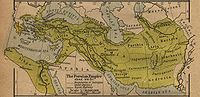
Cyrus the Great
Cyrus II of Persia , commonly known as Cyrus the Great, also known as Cyrus the Elder, was the founder of the Achaemenid Empire. Under his rule, the empire embraced all the previous civilized states of the ancient Near East, expanded vastly and eventually conquered most of Southwest Asia and much...
(559-530 BC) or Cambyses
Cambyses
Cambyses can refer to two ancient rulers and two plays:-*Cambyses I, King of Anshan 600 to 559 BCE*Cambyses II, King of Persia 530 to 522 BCE*Cambyses, a tragedy by Thomas Preston...
(530-522 BC). Under the Achaemenids, it seems to have been administered as a sub-province of Parthia
Parthia
Parthia is a region of north-eastern Iran, best known for having been the political and cultural base of the Arsacid dynasty, rulers of the Parthian Empire....
and is not named separately in the provincial lists of Darius and Xerxes
Xerxes I of Persia
Xerxes I of Persia , Ḫšayāršā, ), also known as Xerxes the Great, was the fifth king of kings of the Achaemenid Empire.-Youth and rise to power:...
. The capital and also the largest city and site of the “royal palace” of Hyrcania was Zadracarta. From the Behistun inscription
Behistun Inscription
The Behistun Inscription The Behistun Inscription The Behistun Inscription (also Bistun or Bisutun, Modern Persian: بیستون The Behistun Inscription (also Bistun or Bisutun, Modern Persian: بیستون...
we know that it was Persian by 522. The story is as follows: After the death of Cambyses, the Magian usurper Gaumâta, who did not belong to the Achaemenian dynasty, usurped the throne. The adherents of the Persian royal house, however, helped Darius to become king; he killed the usurper on September 29, 522 BC. Almost immediately, the subjects of the empire revolted. When Darius was suppressing these rebellions and stayed in Babylon
Babylon
Babylon was an Akkadian city-state of ancient Mesopotamia, the remains of which are found in present-day Al Hillah, Babil Province, Iraq, about 85 kilometers south of Baghdad...
, the Median leader Phraortes
Phraortes
Phraortes , son of Diyako, was the second king of the Median Empire....
made his bid for power (December 522). His revolt soon spread to Armenia
Armenia
Armenia , officially the Republic of Armenia , is a landlocked mountainous country in the Caucasus region of Eurasia...
, Assyria
Assyria
Assyria was a Semitic Akkadian kingdom, extant as a nation state from the mid–23rd century BC to 608 BC centred on the Upper Tigris river, in northern Mesopotamia , that came to rule regional empires a number of times through history. It was named for its original capital, the ancient city of Assur...
, Parthia
Parthia
Parthia is a region of north-eastern Iran, best known for having been the political and cultural base of the Arsacid dynasty, rulers of the Parthian Empire....
and Hyrcania. However the Persian garrison in Parthia still held out. It was commanded by Darius' father Hystaspes. On March 8, 521 BC, the Parthians and their allies, the Hyrcanians, attacked the Persian garrison, but they were defeated. Not much later, Darius was able to relieve his father. This was the first appearance in history of the Hyrcanians.
In the 5th century BC, the Greek researcher Herodotus
Herodotus
Herodotus was an ancient Greek historian who was born in Halicarnassus, Caria and lived in the 5th century BC . He has been called the "Father of History", and was the first historian known to collect his materials systematically, test their accuracy to a certain extent and arrange them in a...
of Halicarnassus
Halicarnassus
Halicarnassus was an ancient Greek city at the site of modern Bodrum in Turkey. It was located in southwest Caria on a picturesque, advantageous site on the Ceramic Gulf. The city was famous for the tomb of Mausolus, the origin of the word mausoleum, built between 353 BC and 350 BC, and...
mentions them several times in his Histories. He has a confused report on irrigation (3.117), which may be compared to the statement of the second-century historian Polybius
Polybius
Polybius , Greek ) was a Greek historian of the Hellenistic Period noted for his work, The Histories, which covered the period of 220–146 BC in detail. The work describes in part the rise of the Roman Republic and its gradual domination over Greece...
that the Persians had built large irrigation works (World history 10.28.3). Herodotus also tells us that Hyrcanian soldiers were part of the large army which king Xerxes I (486-465) commanded against the Greeks in 480. The historian notes that they carried the same arms as the Persians.
It is possible -but not proven- that during the Persian period, a wall was built to defend Hyrcania against the nomads of the Central Asian steppe. The ruins of the wall north of the river Gorgân, which are still visible today, called the Gates of Alexander
Gates of Alexander
The Gates of Alexander was a legendary barrier supposedly built by Alexander the Great in the Caucasus to keep the uncivilized barbarians of the north from invading the land to the south. The gates were a popular subject in medieval travel literature, starting with the Alexander Romance in a...
, were built later, but they probably replaced a Persian defense work.
In the confused years after the death of king Artaxerxes I Makrocheir
Artaxerxes I of Persia
Artaxerxes I was the sixth king of kings of the Achaemenid Empire from 465 BCE to 424 BCE. He was the son of Xerxes I of Persia and Amestris, daughter of Otanes.*Artaxerxes I was the sixth king of kings of the Achaemenid Empire from 465 BCE to 424 BCE. He was the son of Xerxes I of Persia and...
(465-434), three of his sons succeeded to the throne: Xerxes II, Sogdianus and Darius II
Darius II of Persia
Darius II , was king of the Persian Empire from 423 BC to 405 BC.Artaxerxes I, who died on December 25, 424 BC, was followed by his son Xerxes II. After a month and a half Xerxes II was murdered by his brother Secydianus or Sogdianus...
. The latter was a satrap in Hyrcania and may have used troops from Hyrcania and the 'upper satrapies' - that is Aria, Parthia, Arachosia
Arachosia
Arachosia is the Latinized form of the Greek name of an Achaemenid and Seleucid governorate in the eastern part of their respective empires, around modern-day southern Afghanistan. The Greek term "Arachosia" corresponds to the Iranian land of Harauti which was between Kandahar in Afghanistan and...
, Bactria
Bactria (satrapy)
Bactria was a satrapy of the Achaemenid Empire under the reign of Cyrus the Great. Although the first mention of Bactria comes in 520 BCE at the Behistun inscription. Bactria was a special satrapy in that it was ruled by a crown prince or an intended heir. The capital of Bactria was Bactra, and the...
, and Sogdiana
Sogdiana
Sogdiana or Sogdia was the ancient civilization of an Iranian people and a province of the Achaemenid Empire, eighteenth in the list on the Behistun Inscription of Darius the Great . Sogdiana is "listed" as the second of the "good lands and countries" that Ahura Mazda created...
.
Hyrcania makes its reappearance in history when the Macedonian
Ancient Macedonians
The Macedonians originated from inhabitants of the northeastern part of the Greek peninsula, in the alluvial plain around the rivers Haliacmon and lower Axios...
king Alexander the Great (336-323) invaded Asia
Asia
Asia is the world's largest and most populous continent, located primarily in the eastern and northern hemispheres. It covers 8.7% of the Earth's total surface area and with approximately 3.879 billion people, it hosts 60% of the world's current human population...
. Hyrcanians are mentioned during the battle of Gaugamela (October 1, 331), and in August 329, when the last Persian king, Darius III Codomannus
Darius III of Persia
Darius III , also known by his given name of Codomannus, was the last king of the Achaemenid Empire of Persia from 336 BC to 330 BC....
, was dead, many Persian noblemen fled to Hyrcania, where they surrendered to Alexander (a.o. Artabazus
Artabazus of Phrygia
Artabazus was a Persian general and satrap. He was the son of the Persian satrap of Phrygia, Pharnabazus, and younger kinsman of Ariobarzanes of Phrygia who revolted against Artaxerxes II around 366 BC.-Revolt by Ariobarzan:In 362 BC, Artabazus was sent by Artaxerxes II to capture Datames, the...
).
Seleucid era
After Alexander's reign, his empire fell apart and Hyrcania became part of the new Seleucid EmpireSeleucid Empire
The Seleucid Empire was a Greek-Macedonian state that was created out of the eastern conquests of Alexander the Great. At the height of its power, it included central Anatolia, the Levant, Mesopotamia, Persia, today's Turkmenistan, Pamir and parts of Pakistan.The Seleucid Empire was a major centre...
. At the end of the 3rd century BC, northeastern nomads belonging to the tribe of the Parni
Parni
The Parni or Aparni were an east Iranian people of the Ochus River valley, southeast of the Caspian Sea...
, invaded Parthia and Hyrcania. Although Parthia
Parthia
Parthia is a region of north-eastern Iran, best known for having been the political and cultural base of the Arsacid dynasty, rulers of the Parthian Empire....
was forever lost to the Seleucids, Hyrcania was in the last decade of the third century reconquered by Antiochus III the Great
Antiochus III the Great
Antiochus III the Great Seleucid Greek king who became the 6th ruler of the Seleucid Empire as a youth of about eighteen in 223 BC. Antiochus was an ambitious ruler who ruled over Greater Syria and western Asia towards the end of the 3rd century BC...
(223-187). After a generation, however, Hyrcania was lost again.
Arsacid era
To the Arsacid Parthians - the new name of the Parni tribe - Hyrcania was an important part of the empire, situated between their Parthian territories and their homeland on the steppe. It is certain that the Parthian kings used a Hyrcanian town as their summer residence. They were also responsible for the 'Wall of Alexander', which is 180 km long and has forty castles. Nonetheless, it was not an uncontested part of their empire; for example, an uprising is known to have started in AD 58 and lasted at least until AD 61, ending with a compromise treaty.Sassanid era
Hyrcania was a province of the Sassanid EmpireSassanid Empire
The Sassanid Empire , known to its inhabitants as Ērānshahr and Ērān in Middle Persian and resulting in the New Persian terms Iranshahr and Iran , was the last pre-Islamic Persian Empire, ruled by the Sasanian Dynasty from 224 to 651...
until its conquest by the Arabs. It was an important territory in that it kept out inner Asian tribes from invading. Due to this, the Sassanids built many fortresses in the region.
Post-Sassanid era
After the fall of the Sassanian Empire to Muslim Arab invaders, many noblemen fled to Hyrcania, where they settled permanently.In the 8th century, the caliphate
Caliphate
The term caliphate, "dominion of a caliph " , refers to the first system of government established in Islam and represented the political unity of the Muslim Ummah...
did not manage to conquer Hyrcania. This was mostly because of the geographical location but also due to significant resistance from notables such as Vandad Hormoz, Mâziar
Maziar
Maziar was an Iranian aristocrat of the House of Karen and feudal ruler of the mountainous region of Tabaristan...
, and Babak Khorramdin
Babak Khorramdin
Bābak Khorram-Din was one of the main Persian revolutionary leaders of the Iranian Khorram-Dinān , which was a local freedom movement fighting the Abbasid Caliphate. Khorramdin appears to be a compound analogous to dorustdin and Behdin "Good Religion" , and are considered an offshoot of...
. Under the leadership of a few remaining aristocratic families such as the Karens
House of Karen
The House of Karen were an aristocratic feudal family of Hyrcania...
and the Bavands
Bavand Dynasty
The Bavandi Dynasty was an Iranian dynasty that started in the early seventh century, as an independent group of rulers, reigning over Tabaristan in what is now northern Iran....
, Hyrcania remained independent or semi-independent for many years after the collapse of the Sassanids.
Literary references
In Latin literatureLatin literature
Latin literature includes the essays, histories, poems, plays, and other writings of the ancient Romans. In many ways, it seems to be a continuation of Greek literature, using many of the same forms...
, Hyrcania is often mentioned in relationship to tigers, which were apparently particularly abundant there during the Classical Age
Classical antiquity
Classical antiquity is a broad term for a long period of cultural history centered on the Mediterranean Sea, comprising the interlocking civilizations of ancient Greece and ancient Rome, collectively known as the Greco-Roman world...
. Virgil
Virgil
Publius Vergilius Maro, usually called Virgil or Vergil in English , was an ancient Roman poet of the Augustan period. He is known for three major works of Latin literature, the Eclogues , the Georgics, and the epic Aeneid...
, in the Aeneid
Aeneid
The Aeneid is a Latin epic poem, written by Virgil between 29 and 19 BC, that tells the legendary story of Aeneas, a Trojan who travelled to Italy, where he became the ancestor of the Romans. It is composed of roughly 10,000 lines in dactylic hexameter...
, had the abandoned Dido accuse Aeneas
Aeneas
Aeneas , in Greco-Roman mythology, was a Trojan hero, the son of the prince Anchises and the goddess Aphrodite. His father was the second cousin of King Priam of Troy, making Aeneas Priam's second cousin, once removed. The journey of Aeneas from Troy , which led to the founding a hamlet south of...
:
Nec tibi diva parens generis nec Dardanus auctor,
perfide, sed duris genuit te cautibus horrens
Caucasus Hyrcanaeque admorunt ubera tigres. (IV.365-7)
"You had neither a goddess for a parent, nor was Dardanus the author of your race, faithless one, but the horrible Caucasus produced you from hard crags, and Hyrcanian tigers nursed you."
Tigers have, however, become extinct in the area since the early 1970s.
Following its geographical listing by Isidore of Seville
Isidore of Seville
Saint Isidore of Seville served as Archbishop of Seville for more than three decades and is considered, as the historian Montalembert put it in an oft-quoted phrase, "le dernier savant du monde ancien"...
in the early 7th century Etymologiae
Etymologiae
Etymologiae is an encyclopedia compiled by Isidore of Seville towards the end of his life. It forms a bridge between a condensed epitome of classical learning at the close of Late Antiquity and the inheritance received, in large part through Isidore's work, by the early Middle Ages...
(a standard Mediaeval textbook), the name of Hyrcania became known and taught as far off as Ireland, where it was included in poems such as Cú-cen-máthair by Luccreth moccu Chiara
Luccreth moccu Chiara
Luccreth moccu Chíara was a poet from County Kerry, Ireland who wrote in archaic Old Irish. Moccu is an archaic form marking affiliation to an ancestral population group or gens, in this case the Cíarraige...
(665 AD), the Auraicept na n-Éces
Auraicept na n-Éces
Auraicept na n-Éces is claimed as a 7th century work of Irish grammarians, written by a scholar named Longarad....
, and Lebor Gabála Érenn
Lebor Gabála Érenn
Lebor Gabála Érenn is the Middle Irish title of a loose collection of poems and prose narratives recounting the mythical origins and history of the Irish from the creation of the world down to the Middle Ages...
(11th century).
Hyrcania is mentioned in the short story "Rinconete y Cortadillo" by Cervantes
Cervantes
-People:*Alfonso J. Cervantes , mayor of St. Louis, Missouri*Francisco Cervantes de Salazar, 16th-century man of letters*Ignacio Cervantes, Cuban composer*Jorge Cervantes, a world-renowned expert on indoor, outdoor, and greenhouse cannabis cultivation...
, and constitutes one of his exemplary stories which were published in 1613. Cervantes uses this reference to portray the illiteracy of Juliana la Cariharta, a member of Monipodio's guild. She is intending to make reference to Ocaña, a provincial town in Toledo
Toledo, Spain
Toledo's Alcázar became renowned in the 19th and 20th centuries as a military academy. At the outbreak of the Spanish Civil War in 1936 its garrison was famously besieged by Republican forces.-Economy:...
, Spain
Spain
Spain , officially the Kingdom of Spain languages]] under the European Charter for Regional or Minority Languages. In each of these, Spain's official name is as follows:;;;;;;), is a country and member state of the European Union located in southwestern Europe on the Iberian Peninsula...
; but she has misheard it and does not realise the difference.
Shakespeare, relying on his Latin sources, makes repeated references in his plays to the "Hyrcan tiger" (Macbeth
Macbeth
The Tragedy of Macbeth is a play by William Shakespeare about a regicide and its aftermath. It is Shakespeare's shortest tragedy and is believed to have been written sometime between 1603 and 1607...
, III.iv.1281) or "th' Hyrcanian beast" (Hamlet
Hamlet
The Tragical History of Hamlet, Prince of Denmark, or more simply Hamlet, is a tragedy by William Shakespeare, believed to have been written between 1599 and 1601...
, II.ii.447) as an emblem of bloodthirsty cruelty. In Henry VI, Part 3
Henry VI, part 3
Henry VI, Part 3 or The Third Part of Henry the Sixt is a history play by William Shakespeare believed to have been written in 1591, and set during the lifetime of King Henry VI of England...
, the Duke of York compares Queen Margaret unfavorably to "Tygers of Hyrcania" (I.iv.622) for her inhumanity.
The comic book heroine Red Sonja
Red Sonja
Red Sonja, the She-Devil with a Sword, is a fictional character, a high fantasy sword and sorcery heroine created by Roy Thomas and Barry Windsor-Smith, and loosely based on Red Sonya of Rogatino in Robert E. Howard's 1934 short story "The Shadow of the Vulture"...
is described as coming from Hyrkania.