

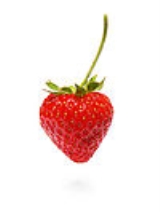
Strawberry

Encyclopedia
Fragaria is a genus
of flowering plant
s in the rose
family, Rosaceae
, commonly known as strawberries for their edible fruit
s. Although it is commonly thought that strawberries get their name from straw being used as a mulch
in cultivating the plants, the etymology of the word is uncertain. There are more than 20 described species
and many hybrids and cultivar
s. The most common strawberries grown commercially are cultivars of the garden strawberry
, a hybrid known as Fragaria × ananassa. Strawberries have a taste that varies by cultivar, and ranges from quite sweet to rather tart. Strawberries are an important commercial fruit crop, widely grown in all temperate regions of the world.
s.
s. There are seven basic types of chromosomes that they all have in common. However, they exhibit different polyploidy
. Some species are diploid, having two sets of the seven chromosomes (14 chromosomes total). Others are tetraploid (four sets, 28 chromosomes total), hexaploid (six sets, 42 chromosomes total), octoploid (eight sets, 56 chromosomes total), or decaploid (ten sets, 70 chromosomes total).
As a rough rule (with exceptions), strawberry species with more chromosomes tend to be more robust and produce larger plants with larger berries.
and moth
s feed on strawberry plants: see list of Lepidoptera that feed on strawberry plants.
Genus
In biology, a genus is a low-level taxonomic rank used in the biological classification of living and fossil organisms, which is an example of definition by genus and differentia...
of flowering plant
Flowering plant
The flowering plants , also known as Angiospermae or Magnoliophyta, are the most diverse group of land plants. Angiosperms are seed-producing plants like the gymnosperms and can be distinguished from the gymnosperms by a series of synapomorphies...
s in the rose
Rose
A rose is a woody perennial of the genus Rosa, within the family Rosaceae. There are over 100 species. They form a group of erect shrubs, and climbing or trailing plants, with stems that are often armed with sharp prickles. Flowers are large and showy, in colours ranging from white through yellows...
family, Rosaceae
Rosaceae
Rosaceae are a medium-sized family of flowering plants, including about 2830 species in 95 genera. The name is derived from the type genus Rosa. Among the largest genera are Alchemilla , Sorbus , Crataegus , Cotoneaster , and Rubus...
, commonly known as strawberries for their edible fruit
Fruit
In broad terms, a fruit is a structure of a plant that contains its seeds.The term has different meanings dependent on context. In non-technical usage, such as food preparation, fruit normally means the fleshy seed-associated structures of certain plants that are sweet and edible in the raw state,...
s. Although it is commonly thought that strawberries get their name from straw being used as a mulch
Mulch
In agriculture and gardening, is a protective cover placed over the soil to retain moisture, reduce erosion, provide nutrients, and suppress weed growth and seed germination. Mulching in gardens and landscaping mimics the leaf cover that is found on forest floors....
in cultivating the plants, the etymology of the word is uncertain. There are more than 20 described species
Species
In biology, a species is one of the basic units of biological classification and a taxonomic rank. A species is often defined as a group of organisms capable of interbreeding and producing fertile offspring. While in many cases this definition is adequate, more precise or differing measures are...
and many hybrids and cultivar
Cultivar
A cultivar'Cultivar has two meanings as explained under Formal definition. When used in reference to a taxon, the word does not apply to an individual plant but to all those plants sharing the unique characteristics that define the cultivar. is a plant or group of plants selected for desirable...
s. The most common strawberries grown commercially are cultivars of the garden strawberry
Garden Strawberry
The garden strawberry, Fragaria × ananassa, is a hybrid species that is cultivated worldwide for its fruit, the strawberry. The fruit is widely appreciated for its characteristic aroma, bright red color, juicy texture, and sweetness...
, a hybrid known as Fragaria × ananassa. Strawberries have a taste that varies by cultivar, and ranges from quite sweet to rather tart. Strawberries are an important commercial fruit crop, widely grown in all temperate regions of the world.
Description
Strawberries are not true berries. The fleshy and edible part of the fruit is a receptacle, and the parts that are sometimes mistakenly called "seeds" are acheneAchene
An achene is a type of simple dry fruit produced by many species of flowering plants. Achenes are monocarpellate and indehiscent...
s.
Classification
There are more than 20 different Fragaria species worldwide. Numbers of other species have been proposed, some of which are now recognized as subspecies. Key to the classification of strawberry species is recognizing that they vary in the number of chromosomeChromosome
A chromosome is an organized structure of DNA and protein found in cells. It is a single piece of coiled DNA containing many genes, regulatory elements and other nucleotide sequences. Chromosomes also contain DNA-bound proteins, which serve to package the DNA and control its functions.Chromosomes...
s. There are seven basic types of chromosomes that they all have in common. However, they exhibit different polyploidy
Polyploidy
Polyploid is a term used to describe cells and organisms containing more than two paired sets of chromosomes. Most eukaryotic species are diploid, meaning they have two sets of chromosomes — one set inherited from each parent. However polyploidy is found in some organisms and is especially common...
. Some species are diploid, having two sets of the seven chromosomes (14 chromosomes total). Others are tetraploid (four sets, 28 chromosomes total), hexaploid (six sets, 42 chromosomes total), octoploid (eight sets, 56 chromosomes total), or decaploid (ten sets, 70 chromosomes total).
As a rough rule (with exceptions), strawberry species with more chromosomes tend to be more robust and produce larger plants with larger berries.
Diploid species
- Fragaria daltonianaFragaria daltonianaFragaria daltoniana is a species of strawberry native to the Himalayas. Its fruit has a poor flavor, and is of no commercial value. All strawberries have a base haploid count of 7 chromosomes. Fragaria daltoniana is diploid, having 2 pairs of these chromosomes for a total of 14...
J.Gay (Himalayas) - Fragaria iinumaeFragaria iinumaeFragaria iinumae is a species of strawberry native to Japan and eastern Russia.In Japan it was first discovered on and the name was given....
Makino (East RussiaRussiaRussia or , officially known as both Russia and the Russian Federation , is a country in northern Eurasia. It is a federal semi-presidential republic, comprising 83 federal subjects...
, Japan) - Fragaria nilgerrensisFragaria nilgerrensisFragaria nilgerrensis is a species of wild strawberry native to southern and southeast Asia. Its fruit has a poor flavour, and is of no commercial value....
Schlecht. ex J.Gay (SouthSouth AsiaSouth Asia, also known as Southern Asia, is the southern region of the Asian continent, which comprises the sub-Himalayan countries and, for some authorities , also includes the adjoining countries to the west and the east...
and Southeast AsiaSoutheast AsiaSoutheast Asia, South-East Asia, South East Asia or Southeastern Asia is a subregion of Asia, consisting of the countries that are geographically south of China, east of India, west of New Guinea and north of Australia. The region lies on the intersection of geological plates, with heavy seismic...
) - Fragaria nipponicaFragaria nipponicaFragaria nipponica is a species of strawberry native to the western side of the Japanese island of Honshū, with a variety Fragaria nipponica var. yakusimensis on Yakushima. Some botanists treat it as a synonym of Fragaria yezoensis....
MakinoTomitaro Makinothumb|200px|Tomitaro Makino was a pioneer Japanese botanist noted for his taxonomic work. He has been called "Father of Japanese Botany", as he was one of the first Japanese botanists to work extensively on classifying Japanese plants using the system developed by Linnaeus...
(JapanJapanJapan is an island nation in East Asia. Located in the Pacific Ocean, it lies to the east of the Sea of Japan, China, North Korea, South Korea and Russia, stretching from the Sea of Okhotsk in the north to the East China Sea and Taiwan in the south...
) - Fragaria nubicolaFragaria nubicolaFragaria nubicola is a species of strawberry native to the Himalaya. It is of no commercial value. All strawberries have a base haploid count of 7 chromosomes. Fragaria nubicola is diploid, having 2 pairs of these chromosomes for a total of 14 chromosomes.-External links:**...
Lindl.John LindleyJohn Lindley FRS was an English botanist, gardener and orchidologist.-Early years:Born in Catton, near Norwich, England, John Lindley was one of four children of George and Mary Lindley. George Lindley was a nurseryman and pomologist and ran a commercial nursery garden...
ex LacaitaCharles Carmichael LacaitaCharles Carmichael Lacaita was a British botanist and Liberal politician.Lacaita was the only son of Sir James Philip Lacaita and his wife Maria Clavering Gibson-Carmichael daughter of Sir Thomas Gibson-Carmichael. He was educated at Balliol College, Oxford and was called to the bar at Lincoln's...
(HimalayasHimalayasThe Himalaya Range or Himalaya Mountains Sanskrit: Devanagari: हिमालय, literally "abode of snow"), usually called the Himalayas or Himalaya for short, is a mountain range in Asia, separating the Indian subcontinent from the Tibetan Plateau...
) - Fragaria vesca CovilleFrederick Vernon CovilleFrederick Vernon Coville was an American botanist who careered in the United States Department of Agriculture , where he became Chief Botanist, and was the first director of the United States National Arboretum...
- Woodland Strawberry (Northern HemisphereNorthern HemisphereThe Northern Hemisphere is the half of a planet that is north of its equator—the word hemisphere literally means “half sphere”. It is also that half of the celestial sphere north of the celestial equator...
) - Fragaria viridisFragaria viridisFragaria viridis is a species of strawberry native to Europe and central Asia. It has extremely small berries with fine flavour. They have surprisingly little of the usual strawberry aroma, but a refreshing acidity, and sometimes ripen without becoming red...
DuchesneAntoine Nicolas DuchesneAntoine Nicolas Duchesne was a French botanist known for his keen observation of variation within species, and for demonstrating that species are not immutable, because mutations can occur...
(EuropeEuropeEurope is, by convention, one of the world's seven continents. Comprising the westernmost peninsula of Eurasia, Europe is generally 'divided' from Asia to its east by the watershed divides of the Ural and Caucasus Mountains, the Ural River, the Caspian and Black Seas, and the waterways connecting...
, Central Asia) - Fragaria yezoensisFragaria yezoensisFragaria yezoensis is a species of strawberry native to the eastern side of the Japanese island of Hokkaidō, and the adjacent Kuril Islands and Sakhalin in Russia. It is of no economic value. Some botanists include the very similar Fragaria nipponica in F. yezoensis as a synonym.All strawberries...
H.HaraHiroshi Hara (botanist)was a Japanese botanist.-References:...
(Northeast Asia)
Tetraploid species
- Fragaria moupinensisFragaria moupinensisFragaria moupinensis is a species of strawberry native to China.All strawberries have a base monoploid count of 7 chromosomes. Fragaria moupinensis is tetraploid, having 4 pairs of these chromosomes for a total of 28 chromosomes.-External links:*...
Cardot (China) - Fragaria orientalis Lozinsk. - (eastern Asia, eastern Siberia)
Hexaploid species
- Fragaria moschata DuchesneAntoine Nicolas DuchesneAntoine Nicolas Duchesne was a French botanist known for his keen observation of variation within species, and for demonstrating that species are not immutable, because mutations can occur...
- Musk strawberryMusk StrawberryThe musk strawberry , is a species of strawberry native to Europe. Its French name hautbois strawberry is anglicised as hautboy strawberry....
(Europe)
Octoploid species and hybrids
- Fragaria × ananassa DuchesneAntoine Nicolas DuchesneAntoine Nicolas Duchesne was a French botanist known for his keen observation of variation within species, and for demonstrating that species are not immutable, because mutations can occur...
ex Rozier - Garden strawberryGarden StrawberryThe garden strawberry, Fragaria × ananassa, is a hybrid species that is cultivated worldwide for its fruit, the strawberry. The fruit is widely appreciated for its characteristic aroma, bright red color, juicy texture, and sweetness... - Fragaria chiloensisFragaria chiloensisFragaria chiloensis, the beach strawberry, Chilean strawberry, or coastal strawberry, is one of two species of strawberry that were hybridized to create the modern garden strawberry . It is noted for its large berries. Its natural range is the Pacific Ocean coasts of North and South America, and...
(L.Carolus LinnaeusCarl Linnaeus , also known after his ennoblement as , was a Swedish botanist, physician, and zoologist, who laid the foundations for the modern scheme of binomial nomenclature. He is known as the father of modern taxonomy, and is also considered one of the fathers of modern ecology...
) Mill.Philip MillerPhilip Miller FRS was a Scottish botanist.Miller was chief gardener at the Chelsea Physic Garden from 1722 until he was pressured to retire shortly before his death...
- Beach strawberry (Western AmericasAmericasThe Americas, or America , are lands in the Western hemisphere, also known as the New World. In English, the plural form the Americas is often used to refer to the landmasses of North America and South America with their associated islands and regions, while the singular form America is primarily...
)- Fragaria chiloensis subsp. chiloensis forma chiloensis
- Fragaria chiloensis subsp. chiloensis forma patagonica (ArgentinaArgentinaArgentina , officially the Argentine Republic , is the second largest country in South America by land area, after Brazil. It is constituted as a federation of 23 provinces and an autonomous city, Buenos Aires...
, ChileChileChile ,officially the Republic of Chile , is a country in South America occupying a long, narrow coastal strip between the Andes mountains to the east and the Pacific Ocean to the west. It borders Peru to the north, Bolivia to the northeast, Argentina to the east, and the Drake Passage in the far...
) - Fragaria chiloensis subsp. lucida (E. Vilm. ex Gay) Staudt (coast of British ColumbiaBritish ColumbiaBritish Columbia is the westernmost of Canada's provinces and is known for its natural beauty, as reflected in its Latin motto, Splendor sine occasu . Its name was chosen by Queen Victoria in 1858...
, Washington, OregonOregonOregon is a state in the Pacific Northwest region of the United States. It is located on the Pacific coast, with Washington to the north, California to the south, Nevada on the southeast and Idaho to the east. The Columbia and Snake rivers delineate much of Oregon's northern and eastern...
, CaliforniaCaliforniaCalifornia is a state located on the West Coast of the United States. It is by far the most populous U.S. state, and the third-largest by land area...
) - Fragaria chiloensis subsp. pacifica Staudt (coast of AlaskaAlaskaAlaska is the largest state in the United States by area. It is situated in the northwest extremity of the North American continent, with Canada to the east, the Arctic Ocean to the north, and the Pacific Ocean to the west and south, with Russia further west across the Bering Strait...
, British Columbia, Washington, Oregon, California) - Fragaria chiloensis subsp. sandwicensis (Decne.Joseph DecaisneJoseph Decaisne was a French botanist and agronomist.Although he was born in Brussels, Belgium, he exercised his activity exclusively in Paris...
) Staudt - Ōhelo papa (HawaiiHawaiiHawaii is the newest of the 50 U.S. states , and is the only U.S. state made up entirely of islands. It is the northernmost island group in Polynesia, occupying most of an archipelago in the central Pacific Ocean, southwest of the continental United States, southeast of Japan, and northeast of...
)
- Fragaria iturupensis Staudt - Iturup StrawberryIturup StrawberryFragaria iturupensis, the Iturup Strawberry, is a species of strawberry, endemic to Iturup in the Kuril Islands. It is noted to have relatively large berries for a wild species, similar in appearance to those of Fragaria virginiana....
(IturupIturupIturup is the largest island of the South Kuril Islands. It is the northernmost island in the southern Kuril/Chishima islands, and though it is presently controlled by Russia, Japan also claims this island...
, Kuril IslandsKuril IslandsThe Kuril Islands , in Russia's Sakhalin Oblast region, form a volcanic archipelago that stretches approximately northeast from Hokkaidō, Japan, to Kamchatka, Russia, separating the Sea of Okhotsk from the North Pacific Ocean. There are 56 islands and many more minor rocks. It consists of Greater...
) - Fragaria virginiana Mill.Philip MillerPhilip Miller FRS was a Scottish botanist.Miller was chief gardener at the Chelsea Physic Garden from 1722 until he was pressured to retire shortly before his death...
- Virginia StrawberryVirginia StrawberryThe Virginia Strawberry is one of two species of strawberry that were hybridized to create the modern domesticated Garden Strawberry...
(North AmericaNorth AmericaNorth America is a continent wholly within the Northern Hemisphere and almost wholly within the Western Hemisphere. It is also considered a northern subcontinent of the Americas...
)
Ecology
A number of species of butterfliesButterfly
A butterfly is a mainly day-flying insect of the order Lepidoptera, which includes the butterflies and moths. Like other holometabolous insects, the butterfly's life cycle consists of four parts: egg, larva, pupa and adult. Most species are diurnal. Butterflies have large, often brightly coloured...
and moth
Moth
A moth is an insect closely related to the butterfly, both being of the order Lepidoptera. Moths form the majority of this order; there are thought to be 150,000 to 250,000 different species of moth , with thousands of species yet to be described...
s feed on strawberry plants: see list of Lepidoptera that feed on strawberry plants.
See also
- Accessory fruitAccessory fruitAn accessory fruit is a fruit in which some of the flesh is derived not from the ovary but from some adjacent tissue exterior to the carpel. Examples of accessory tissue are the receptacle of strawberries, figs, or mulberries, and the calyx of Gaultheria procumbens or Syzygium jambos...
- Mock StrawberryMock StrawberryPotentilla indica , also called mock strawberry, Gurbir, Indian strawberry or false strawberry, has foliage and fruit similar to true strawberry, though it is classified in a different genus, and has yellow flowers, unlike the white or slightly pink flowers of true strawberries...
and Barren StrawberryWaldsteinia fragarioidesWaldsteinia fragarioides , also called Barren strawberry, is a low, spreading plant with showy yellow flowers that appear in early spring...
, which both bear resemblance to Fragaria, are closely related species in the genus PotentillaPotentillaPotentilla is the genus of typical cinquefoils, containing about 500 species of annual, biennial and perennial herbs in the rose family Rosaceae. They are generally Holarctic in distribution, though some may even be found in montane biomes of the New Guinea Highlands...
. - Strawberry TreeStrawberry TreeArbutus unedo, commonly called Strawberry Tree, Apple of Cain, or Cane Apple, is an evergreen shrub or small tree in the family Ericaceae, native to the Mediterranean region and western Europe north to western France and Ireland...
is a name for several trees that are unrelated to strawberry.
External links
- Balconmicrobio.com - How to grow strawberries in balcony
- GRIN Fragaria Taxonomy Database Listing of Fragaria species, from the USDAUnited States Department of AgricultureThe United States Department of Agriculture is the United States federal executive department responsible for developing and executing U.S. federal government policy on farming, agriculture, and food...
website