

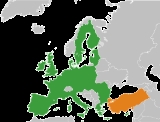
Accession of Turkey to the European Union

Encyclopedia
Turkey's application to accede to the European Union was made on 14 April 1987. Turkey
has been an associate member
of the European Union
(EU) and its predecessors since 1963. After the ten founding members, Turkey was one of the first countries to become a member of the Council of Europe
in 1949, and was also a founding member of the Organisation for Economic Co-operation and Development
(OECD) in 1961 and the Organization for Security and Co-operation in Europe
(OSCE) in 1973. The country has also been an associate member of the Western European Union
since 1992, and is a part of the "Western Europe" branch of the Western European and Others Group
(WEOG) at the United Nations
. Turkey signed a Customs Union agreement with the EU in 1995 and was officially recognised as a candidate for full membership on 12 December 1999, at the Helsinki
summit of the European Council
. Negotiations were started on 3 October 2005, and the process, should it be in Turkey's favour, is likely to take at least a decade to complete. The membership bid has become a major controversy of the ongoing enlargement of the European Union
.
 After the Ottoman Empire's collapse
following World War I
, Turkish revolutionaries led by Mustafa Kemal Atatürk
emerged victorious in the Turkish War of Independence
, establishing the modern Turkish Republic as it exists today. Atatürk, President of Turkey
, implemented a series of reforms
, including secularization and industrialization, intended to modernize the country. During World War II
, Turkey remained neutral until February 1945
, when it joined the Allies
. The country took part in the Marshall Plan
of 1947, became a member of the Council of Europe
in 1949, and a member of NATO in 1952. During the Cold War
, Turkey allied itself with the United States
and Western Europe
.
in 1959, and on 12 September 1963 signed the "Agreement Creating An Association Between The Republic of Turkey and the European Economic Community", also known as the Ankara Agreement
. This agreement came into effect the following year on 12 December 1964. The Ankara Agreement sought to integrate Turkey into a customs union with the EEC whilst acknowledging the final goal of membership. In November 1970, a further protocol called the "Additional Protocol" established a timetable for the abolition of tariffs and quotas on goods traded between Turkey and the EEC.
On 14 April 1987, Turkey submitted its application for formal membership into the European Community. The European Commission
responded in December 1989 by confirming Ankara’s eventual membership but also by deferring the matter to more favorable times, citing Turkey’s economic and political situation, as well its poor relations with Greece and the conflict with Cyprus
as creating an unfavorable environment with which to begin negotiations. This position was confirmed again in the Luxembourg European Council of 1997 in which accession talks were started with central and eastern European states and Cyprus, but not Turkey. During the 1990s, Turkey proceeded with a closer integration with the European Union by agreeing to a customs union in 1995. Moreover, the Helsinki European Council of 1999 proved a milestone as the EU recognised Turkey as a candidate on equal footing with other potential candidates.
The European Commission
recommended that the negotiations should begin in 2005, but also added various precautionary measures. The EU leaders agreed on 16 December 2004 to start accession negotiations with Turkey from 3 October 2005. Despite an offer from the Austrian People's Party
and the German
Christian Democratic Union
of a privileged partnership
status, a less than full membership, EU accession negotiations were officially launched.
Turkey's accession talks have since been stalled by a number of domestic and external problems. Both Austria and France have said they would hold a referendum on Turkey's accession. In the case of France, a change in its Constitution was made to impose such a referendum, but later another constitution change has enabled the parliament (if a large majority of its members agrees) to prevent such a referendum. The issue of Cyprus continues to be a major obstacle to negotiations. European officials have commented on the slowdown in Turkish reforms which, combined with the Cyprus problem, led the EU’s Enlargement Commissioner Olli Rehn
in March 2007 to warn of an impeding ‘train crash’ in the negotiations. Due to these setbacks, negotiations again came to a halt in December 2006, with the EU freezing talks in 8 of the 35 key areas under negotiation.
on each of the 35 chapters of the acquis communautaire, the total body of EU law. Afterwards, the member states must unanimously agree on granting Turkey membership to the European Union.
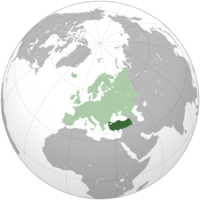
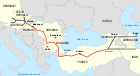 Proponents of Turkey's membership argue that it is a key regional power
with a large economy
and the second largest military force of NATO
that will enhance the EU's position as a global geostrategic player; given Turkey's geographic location and economic, political, cultural and historic ties in regions with large natural resources that are at the immediate vicinity of the EU's geopolitical sphere of influence; such as the East Mediterranean
and Black Sea
coasts, the Middle East
, the Caspian Sea
basin and Central Asia
.
 According to the Swedish foreign minister
, Carl Bildt
, "the accession of Turkey would give the EU a decisive role for stability in the eastern part of the Mediterranean and the Black Sea, which is clearly in the strategic interest of Europe." One of Turkey's key supporters for its bid to join the EU is the United Kingdom
.
Upon joining the EU, Turkey's 73 million inhabitants would bestow the second largest number of MEPs
in the European Parliament
. Demographic projections indicate that Turkey would surpass Germany in the number of seats by 2020.
Turkey's membership would also affect future enlargement plans, especially the number of nations seeking EU membership, grounds on which Valéry Giscard d'Estaing
has opposed Turkey's admission. Giscard has suggested that it would lead to demands for accession by Morocco
. Morocco's application
is already rejected on geographic grounds; while Turkey, unlike Morocco, has territory in Europe. French President Nicolas Sarkozy
stated in January 2007 that "enlarging Europe with no limit risks destroying European political union, and that I do not accept...I want to say that Europe must give itself borders, that not all countries have a vocation to become members of Europe, beginning with Turkey which has no place inside the European Union."
EU member states must unanimously agree on Turkey's membership for the Turkish accession to be successful. A number of nations may oppose it; notably Austria
, which historically served as a bulwark for Christian Europe against the Ottoman Empire
whose armies twice laid siege to Vienna
in 1529
and 1683
; and France
, where some are anxious at the prospect of a new wave of Muslim immigrants, given the country's already large, and poorly integrated, Muslim community.
Negotiations to remove the French constitutional requirement for a compulsory referendum on all EU accessions after Croatia resulted in a new proposal to require a compulsory referendum on the accession of any country with a population of more than 5% of the EU's total population; this clause would mainly apply to Turkey and Ukraine. The French Senate, however, blocked the change in the French constitution, in order to maintain good relations with Turkey. Current constitution situation is as follows : if 3/5 of the delegates (from the Senate+the Parliament) agree to the Turkey accession, there would be no referendum.
Free movement of people across the EU will give many Turkish people the opportunity to easily migrate to other parts of Europe in search of work, or a higher standard of living. The option of migration out of Turkey will inevitably ease tensions in the east of the country, as the prospect of a better standard of living will tend to cool separatist tendencies. Some secularists in Turkey envisage that the accession of Turkey will contribute to the spread of secular western values in Turkey. Conversely, some non-secularists in Turkey envisage that accession will contribute to the further growth and acceptance of Islam in Europe.
Given Turkey's large and growing population, Turkey will have a correspondingly large representation in the European Parliament. This will give Turkey strong direct influence over EU policies. Membership in the EU will also increase Turkey's prestige regionally and internationally.
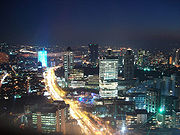 Turkey has the world's 15th largest GDP-PPP and 17th largest Nominal GDP. The country is a founding member of the OECD and the G-20 major economies
.
 Turkey has taken advantage of a customs union with the European Union, signed in 1995, to increase its industrial production destined for exports, while at the same time benefiting from EU-origin foreign investment into the country. In 2008, Turkey's exports reached 141.8 billion USD (main export partners: Germany 11.2%, UK 8%, Italy 6.95%, France 5.6%, Spain 4.3%, USA 3.88%; total EU exports 56.5%.) However, larger imports amounting to about 204.8 billion USD threaten the balance of trade (main import partners: Russia 13.8%, Germany 10.3%, China 7.8%, Italy 6%, USA 4.8%, France 4.6%, Iran 3.9%, UK 3.2%; total EU imports 40.4%; total Asia imports 27%).
The opening of talks regarding the Economic and Monetary Policy acquis chapter
of Turkey's accession bid was expected to begin in June 2007, but were stalled by France
.
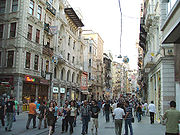 As of 2005, the population of Turkey stood at 71.5 million with a yearly growth rate of 1.5%. The Turkish population is relatively young, with 25.5% falling within the 0–15 age bracket.
Turkey's large population would alter the balance of power in the representative European institutions. Upon joining the EU, Turkey's 78 million inhabitants would bestow it the second largest number of MEP
s in the European Parliament
. Demographic projections indicate that Turkey would surpass Germany in the number of seats by 2020.
was divided when, on 20 July 1974, Turkey occupied a third of the island
in response to an Athens-engineered coup aimed at annexing Cyprus to Greece. Since then, Turkey has refused to acknowledge the Republic of Cyprus (an EU member since 2004) as the sole authority on the island, and recognizes the self-declared Turkish Republic of Northern Cyprus
since its establishment in 1983. The Turkish invasion in 1974 and the resulting movement of refugees along both sides of the Green Line; and the establishment of the self-declared Turkish Republic of Northern Cyprus
in 1983 form the core issues which surround the ongoing Cyprus dispute
.
Turkey and the Turkish Cypriots
backed the 2004 Annan Plan for Cyprus
aimed at the reunification of the island, but the plan was subsequently rejected by Greek Cypriots on the grounds that it did not meet their needs. According to Greek Cypriots, the latest proposal included maintained residence rights for the many Anatolian Turks who moved to Cyprus after the invasion (and their descendants who were born on the island after 1974), while the Greek Cypriots who lost their property after the Turkish invasion would be granted only a restricted right of return to the north following the island's proposed reunification. Although the outcome received much criticism in the EU as well, the Republic of Cyprus was admitted into the EU a week after the referendum.
The Turkish government has refused to officially recognise the Republic of Cyprus until the removal of the political and economic blockade on the Turkish Republic of Northern Cyprus. Turkey's non-recognition of the Republic of Cyprus has led to complications within the Customs Union. Under the customs agreements which Turkey had already signed as a precondition to start EU membership negotiations in 2005, it is obliged to open its ports to Cypriot planes and vessels, but Turkey refuses to do this. It refuses to do so until the 27-nation bloc fulfils its pledge to ease the international isolation of the breakaway and internationally unrecognised Turkish Republic of Northern Cyprus.
Turkey’s refusal to implement a trade pact between Turkey and the EU that requires the Turkish Government allow Greek Cypriot vessels to use its air and sea ports has prompted the EU to freeze eight chapters in Turkey’s accession talks.
In November 2009, Turkish Deputy Prime Minister Cemil Cicek
said that should Turkey be forced to choose between supporting either EU membership or Turkish Cypriots, "[then] Turkey’s choice will forever be to stand next to the Turkish Cypriots. Everybody should understand this."
believe Turkey has a place in the European Union. The former Greek Prime Minister
Kostas Karamanlis stated that Turkish membership of the EU could only be predicated upon, "full compliance, full accession" in December 2006. In 2005 the European Commission referred to relations between Turkey and Greece as "continuing to develop positively" while also citing a key barrier to progress being Turkey's ongoing claim of casus belli
over a dispute about territorial waters boundaries.
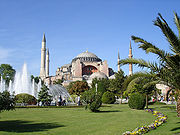 Turkey has a secular
constitution
, with no official state religion. 99% of the Turkish population is Muslim
of whom over 70% belong to the Sunni
branch of Islam. A sizeable minority, about over 25% of the Muslim population, is affiliated with the Shi'a Alevi
branch. The Christians (Eastern Orthodox, Catholic, Gregorian, Syriac, Protestant) and Jews
(Sephardic, Ashkenazi) were formerly sizable religious minorities in the country. Turkey would be the first Muslim-majority country to join the European Union, although Albania
, Bosnia and Herzegovina
and Kosovo
are also Muslim-majority, and have been recognized as potential candidate countries.
Official population census polls in Turkey do not include information regarding a person's religious belief or ethnic background due to the regulations set by the Turkish constitution, which defines all citizens of the Republic of Turkey as Turkish in terms of nationality, regardless of faith or race.
There is a strong tradition of secularism in Turkey
. The state has no official religion nor promotes any, and actively monitors the area between the religions. The constitution recognizes the freedom of religion
for individuals, whereas religious communities are placed under the protection of the state; but the constitution explicitly states that they cannot become involved in the political process (by forming a religious party, for instance) or establish faith-based schools. No party can claim that it represents a form of religious belief; nevertheless, religious sensibilities are generally represented through conservative parties. Turkey prohibits by law the wearing of religious headcover
and theo-political symbolic garments for both sexes in government buildings, schools, and universities; the law was upheld by the Grand Chamber of the European Court of Human Rights
as "legitimate" in the Leyla Şahin v. Turkey
case on 10 November 2005.
, shall be punishable by imprisonment of between six months and two years" and also that "expressions of thought intended to criticise shall not constitute a crime."
The EU was especially critical of this law during the September 2005 trial of novelist Orhan Pamuk
over comments that recognized the deaths of thirty thousand Kurds and a million Armenians. Enlargement commissioner Olli Rehn and members of the European Parliament called the case "regrettable", "most unfortunate", and "unacceptable". After the case was dropped three months later, Turkey's Foreign Minister Abdullah Gül
indicated that Turkey may abandon or modify Article 301, stating that "there may be need for a new law". In September 2006, the European Parliament called for the abolition of laws, such as Article 301, "which threaten European free speech norms". On 30 April 2008, the law was reformed. According to the reform, it is now a crime to explicitly insult the "Turkish nation" rather than "Turkishness"; opening court cases based on Article 301 require the approval of the Justice Minister; and the maximum punishment has been reduced to two years in jail.
Kemal Kerinçsiz
, an ultra-nationalist lawyer, and other members of Büyük Hukukçular Birliği (Great Jurists Union) headed by Kerinçsiz, have been "behind nearly all of [Article 301] trials." In January 2008, Kerinçsiz was arrested for participating in an ultra-nationalist underground organization, Ergenekon
, allegedly behind the attacks on the Turkish Council of State
and Cumhuriyet
newspaper, the assassination of several Christian missionaries and Armenian-Turkish journalist Hrant Dink
, as well as allegedly plotting the assassination of Nobel laureate Orhan Pamuk.
.jpg) Turkey gave women the right to vote
Turkey gave women the right to vote
in 1930 for municipal elections. In 1934 this right was expanded for the national elections, while women were also given the right for becoming elected as MPs
in the Turkish Parliament, or for being appointed as Minister
s, Prime Minister
, Speaker of the Parliament
and President of the Republic
. In 1993 Tansu Çiller
became the first female Prime Minister of Turkey.
In its second report on women's role in social, economic and political life in Turkey, the European Parliament
emphasized that respecting human rights, including women’s rights, is a condition sine qua non
for Turkey's membership of the EU. According to the report, Turkey's legal framework on women's rights "has in general been satisfactory, but its substantive implementation remains flawed."
) among the 47 members of the Council of Europe which refused to recognize the status of conscientious objector
s or give them an alternative to military service.
September–October 2006 survey shows that 59% of EU-27 citizens are against Turkey joining the EU, while only about 28% are in favour. Nearly all citizens (about 9 in 10) expressed concerns about human rights as the leading cause. In the earlier March–May 2006 Eurobarometer
, citizens from the new member states were more in favour of Turkey joining (44% in favour) than the old EU-15 (38% in favour). At the time of the survey, the country whose population most strongly opposed Turkish membership was Austria
(con: 81%), while Romania
was most in favour of the accession (pro: 66%). On a wider political scope, the highest support comes from the Turkish Cypriot Community (pro: 67%) (which is not recognised as sovereign state and is de facto not EU territory and out of the European institutions). These communities are even more in favour of the accession than the Turkish populace itself (pro: 54%). Opposition in Denmark
to Turkish membership was polled at 60% in October 2007, despite the Danish government's support for Turkey's EU bid.
s. A mid-2006 Eurobarometer
survey revealed that 43% of Turkish citizens view the EU positively; just 35% trust the EU, 45% support enlargement and just 29% support an EU constitution.
Moreover, Turks are divided on whether to join at all. A 2007 poll put Turkish support for accession to the EU at 41.9% (up from 32% in 2006), with 27.7% opposed and 24.0% indifferent. A 2009 poll showed that support for accession had risen to 48%, even as negative views of the EU had risen from 28% to 32%.
In 2010, despite the government accelerating its quest to join the bloc, public opinion changed with just 38 percent in favour, in contrast to 73 percent in 2004. This was read in line with Turkey’s increasing economic prosperity and a growing role as a regional power-broker. Twenty percent of Turks also favoured closer ties with other Muslim countries instead, a doubling in just one year.
Turkey
Turkey , known officially as the Republic of Turkey , is a Eurasian country located in Western Asia and in East Thrace in Southeastern Europe...
has been an associate member
Ankara Agreement
The Agreement Creating An Association Between The Republic of Turkey and the European Economic Community , made in 1963, is an agreement aiming towards the accession of Turkey into the European Economic Community ....
of the European Union
European Union
The European Union is an economic and political union of 27 independent member states which are located primarily in Europe. The EU traces its origins from the European Coal and Steel Community and the European Economic Community , formed by six countries in 1958...
(EU) and its predecessors since 1963. After the ten founding members, Turkey was one of the first countries to become a member of the Council of Europe
Council of Europe
The Council of Europe is an international organisation promoting co-operation between all countries of Europe in the areas of legal standards, human rights, democratic development, the rule of law and cultural co-operation...
in 1949, and was also a founding member of the Organisation for Economic Co-operation and Development
Organisation for Economic Co-operation and Development
The Organisation for Economic Co-operation and Development is an international economic organisation of 34 countries founded in 1961 to stimulate economic progress and world trade...
(OECD) in 1961 and the Organization for Security and Co-operation in Europe
Organization for Security and Co-operation in Europe
The Organization for Security and Co-operation in Europe is the world's largest security-oriented intergovernmental organization. Its mandate includes issues such as arms control, human rights, freedom of the press and fair elections...
(OSCE) in 1973. The country has also been an associate member of the Western European Union
Western European Union
The Western European Union was an international organisation tasked with implementing the Modified Treaty of Brussels , an amended version of the original 1948 Treaty of Brussels...
since 1992, and is a part of the "Western Europe" branch of the Western European and Others Group
Western European and Others Group
The Western European and Others Group is one of several unofficial Regional Groups in the United Nations that act as voting blocs and negotiation forums. Regional voting blocs were formed in 1961 to encourage voting to various UN bodies from regional groups...
(WEOG) at the United Nations
United Nations
The United Nations is an international organization whose stated aims are facilitating cooperation in international law, international security, economic development, social progress, human rights, and achievement of world peace...
. Turkey signed a Customs Union agreement with the EU in 1995 and was officially recognised as a candidate for full membership on 12 December 1999, at the Helsinki
Helsinki
Helsinki is the capital and largest city in Finland. It is in the region of Uusimaa, located in southern Finland, on the shore of the Gulf of Finland, an arm of the Baltic Sea. The population of the city of Helsinki is , making it by far the most populous municipality in Finland. Helsinki is...
summit of the European Council
European Council
The European Council is an institution of the European Union. It comprises the heads of state or government of the EU member states, along with the President of the European Commission and the President of the European Council, currently Herman Van Rompuy...
. Negotiations were started on 3 October 2005, and the process, should it be in Turkey's favour, is likely to take at least a decade to complete. The membership bid has become a major controversy of the ongoing enlargement of the European Union
Enlargement of the European Union
The Enlargement of the European Union is the process of expanding the European Union through the accession of new member states. This process began with the Inner Six, who founded the European Coal and Steel Community in 1952...
.
Background
Partitioning of the Ottoman Empire
The Partitioning of the Ottoman Empire was a political event that occurred after World War I. The huge conglomeration of territories and peoples formerly ruled by the Sultan of the Ottoman Empire was divided into several new nations.The partitioning was planned from the early days of the war,...
following World War I
World War I
World War I , which was predominantly called the World War or the Great War from its occurrence until 1939, and the First World War or World War I thereafter, was a major war centred in Europe that began on 28 July 1914 and lasted until 11 November 1918...
, Turkish revolutionaries led by Mustafa Kemal Atatürk
Mustafa Kemal Atatürk
Mustafa Kemal Atatürk was an Ottoman and Turkish army officer, revolutionary statesman, writer, and the first President of Turkey. He is credited with being the founder of the Republic of Turkey....
emerged victorious in the Turkish War of Independence
Turkish War of Independence
The Turkish War of Independence was a war of independence waged by Turkish nationalists against the Allies, after the country was partitioned by the Allies following the Ottoman Empire's defeat in World War I...
, establishing the modern Turkish Republic as it exists today. Atatürk, President of Turkey
President of Turkey
The President of Turkey is the head of state of the Republic of Turkey. The presidency is largely a ceremonial office but has some important functions...
, implemented a series of reforms
Atatürk's Reforms
Atatürk's Reforms were a series of political, legal, cultural, social and economic reforms that were designed to modernize the new Republic of Turkey into a democratic and secular nation-state...
, including secularization and industrialization, intended to modernize the country. During World War II
World War II
World War II, or the Second World War , was a global conflict lasting from 1939 to 1945, involving most of the world's nations—including all of the great powers—eventually forming two opposing military alliances: the Allies and the Axis...
, Turkey remained neutral until February 1945
Second Cairo Conference
The Second Cairo Conference of December 4–6, 1943, held in Cairo, Egypt, addressed Turkey's possible contribution to the Allies in World War II...
, when it joined the Allies
Allies of World War II
The Allies of World War II were the countries that opposed the Axis powers during the Second World War . Former Axis states contributing to the Allied victory are not considered Allied states...
. The country took part in the Marshall Plan
Marshall Plan
The Marshall Plan was the large-scale American program to aid Europe where the United States gave monetary support to help rebuild European economies after the end of World War II in order to combat the spread of Soviet communism. The plan was in operation for four years beginning in April 1948...
of 1947, became a member of the Council of Europe
Council of Europe
The Council of Europe is an international organisation promoting co-operation between all countries of Europe in the areas of legal standards, human rights, democratic development, the rule of law and cultural co-operation...
in 1949, and a member of NATO in 1952. During the Cold War
Cold War
The Cold War was the continuing state from roughly 1946 to 1991 of political conflict, military tension, proxy wars, and economic competition between the Communist World—primarily the Soviet Union and its satellite states and allies—and the powers of the Western world, primarily the United States...
, Turkey allied itself with the United States
United States
The United States of America is a federal constitutional republic comprising fifty states and a federal district...
and Western Europe
Western Europe
Western Europe is a loose term for the collection of countries in the western most region of the European continents, though this definition is context-dependent and carries cultural and political connotations. One definition describes Western Europe as a geographic entity—the region lying in the...
.
1960s–1990s
The country first applied for associate membership in the European Economic CommunityEuropean Economic Community
The European Economic Community The European Economic Community (EEC) The European Economic Community (EEC) (also known as the Common Market in the English-speaking world, renamed the European Community (EC) in 1993The information in this article primarily covers the EEC's time as an independent...
in 1959, and on 12 September 1963 signed the "Agreement Creating An Association Between The Republic of Turkey and the European Economic Community", also known as the Ankara Agreement
Ankara Agreement
The Agreement Creating An Association Between The Republic of Turkey and the European Economic Community , made in 1963, is an agreement aiming towards the accession of Turkey into the European Economic Community ....
. This agreement came into effect the following year on 12 December 1964. The Ankara Agreement sought to integrate Turkey into a customs union with the EEC whilst acknowledging the final goal of membership. In November 1970, a further protocol called the "Additional Protocol" established a timetable for the abolition of tariffs and quotas on goods traded between Turkey and the EEC.
On 14 April 1987, Turkey submitted its application for formal membership into the European Community. The European Commission
European Commission
The European Commission is the executive body of the European Union. The body is responsible for proposing legislation, implementing decisions, upholding the Union's treaties and the general day-to-day running of the Union....
responded in December 1989 by confirming Ankara’s eventual membership but also by deferring the matter to more favorable times, citing Turkey’s economic and political situation, as well its poor relations with Greece and the conflict with Cyprus
Turkish invasion of Cyprus
The Turkish invasion of Cyprus, launched on 20 July 1974, was a Turkish military invasion in response to a Greek military junta backed coup in Cyprus...
as creating an unfavorable environment with which to begin negotiations. This position was confirmed again in the Luxembourg European Council of 1997 in which accession talks were started with central and eastern European states and Cyprus, but not Turkey. During the 1990s, Turkey proceeded with a closer integration with the European Union by agreeing to a customs union in 1995. Moreover, the Helsinki European Council of 1999 proved a milestone as the EU recognised Turkey as a candidate on equal footing with other potential candidates.
2000s
The next significant step in Turkey–EU relations came with the December 2002 Copenhagen European Council. According to it, "the EU would open negotiations with Turkey 'without delay' if the European Council in December 2004, on the basis of a report and a recommendation from the Commission, decides that Turkey fulfills the Copenhagen political criteria."The European Commission
European Commission
The European Commission is the executive body of the European Union. The body is responsible for proposing legislation, implementing decisions, upholding the Union's treaties and the general day-to-day running of the Union....
recommended that the negotiations should begin in 2005, but also added various precautionary measures. The EU leaders agreed on 16 December 2004 to start accession negotiations with Turkey from 3 October 2005. Despite an offer from the Austrian People's Party
Austrian People's Party
The Austrian People's Party is a Christian democratic and conservative political party in Austria. A successor to the Christian Social Party of the late 19th and early 20th centuries, it is similar to the Christian Democratic Union of Germany in terms of ideology...
and the German
Germany
Germany , officially the Federal Republic of Germany , is a federal parliamentary republic in Europe. The country consists of 16 states while the capital and largest city is Berlin. Germany covers an area of 357,021 km2 and has a largely temperate seasonal climate...
Christian Democratic Union
Christian Democratic Union (Germany)
The Christian Democratic Union of Germany is a Christian democratic and conservative political party in Germany. It is regarded as on the centre-right of the German political spectrum...
of a privileged partnership
Privileged partnership
Privileged partnership is the term coined by the German conservative party CDU for their model of the future relation between Turkey and the European Union, which falls short of full membership...
status, a less than full membership, EU accession negotiations were officially launched.
Turkey's accession talks have since been stalled by a number of domestic and external problems. Both Austria and France have said they would hold a referendum on Turkey's accession. In the case of France, a change in its Constitution was made to impose such a referendum, but later another constitution change has enabled the parliament (if a large majority of its members agrees) to prevent such a referendum. The issue of Cyprus continues to be a major obstacle to negotiations. European officials have commented on the slowdown in Turkish reforms which, combined with the Cyprus problem, led the EU’s Enlargement Commissioner Olli Rehn
Olli Rehn
Olli Ilmari Rehn is a Finnish politician, currently serving as European Commissioner for Economic and Financial Affairs. He had previously served as Commissioner for Enlargement...
in March 2007 to warn of an impeding ‘train crash’ in the negotiations. Due to these setbacks, negotiations again came to a halt in December 2006, with the EU freezing talks in 8 of the 35 key areas under negotiation.
Future
The earliest date that Turkey could enter the EU is 2013, the date when the next financial perspectives (the EU's six year budgetary perspectives) will come into force. Ankara is currently aiming to comply with EU law by this date, but Brussels has refused to back 2013 as a deadline. In 2006 European Commission President José Manuel Barroso said that the accession process will take at least until 2021.Timeline
- 31 July 1959 – Turkey applies for associate membership in the European Economic CommunityEuropean Economic CommunityThe European Economic Community The European Economic Community (EEC) The European Economic Community (EEC) (also known as the Common Market in the English-speaking world, renamed the European Community (EC) in 1993The information in this article primarily covers the EEC's time as an independent...
. - 12 September 1963 – Association AgreementAnkara AgreementThe Agreement Creating An Association Between The Republic of Turkey and the European Economic Community , made in 1963, is an agreement aiming towards the accession of Turkey into the European Economic Community ....
signed, acknowledging the final goal of membership. - 1 December 1964 – Association Agreement comes into effect.
- 23 November 1970 – Protocol signed providing a timetable for the abolition of tariffs and quotas on goods.
- 1980 – Freeze in relations following the 1980 Turkish coup d'état.
- 1983 – Relations fully restored following elections.
- 14 April 1987 – Application for formal membership into the European Community.
- 18 December 1989 – European Commission refuses to immediately begin accession negotiations, citing Turkey’s economic and political situation, poor relations with Greece and their conflict with Cyprus, but overall reaffirming eventual membership as the goal.
- 6 March 1995 – European Union-Turkey Customs UnionEuropean Union-Turkey Customs UnionOn 31 December 1995 the customs union between Turkey and the European Union came into effect. Goods can travel between the two entities without any customs restrictions. The Customs Union does not cover essential economic areas, such as agriculture, to which bilateral trade concessions apply,...
is formed. - 12 December 1999 – European CouncilEuropean CouncilThe European Council is an institution of the European Union. It comprises the heads of state or government of the EU member states, along with the President of the European Commission and the President of the European Council, currently Herman Van Rompuy...
recognises Turkey as a candidate on equal footing with other potential candidates. - 12 December 2002 – European Council states that "the EU would open negotiations with Turkey 'without delay' if Turkey fulfills the Copenhagen criteriaCopenhagen criteriaThe Copenhagen criteria are the rules that define whether a country is eligible to join the European Union. The criteria require that a state has the institutions to preserve democratic governance and human rights, has a functioning market economy, and accepts the obligations and intent of the EU...
." - 24 April 2004 – Turkey & Turkish Republic of Northern CyprusTurkish Republic of Northern CyprusNorthern Cyprus or North Cyprus , officially the Turkish Republic of Northern Cyprus , is a self-declared state that comprises the northeastern part of the island of Cyprus...
back the Annan Plan for CyprusAnnan Plan for CyprusThe Annan Plan was a United Nations proposal to resolve the Cyprus dispute, reuniting the breakaway Northern Cyprus with the Republic of Cyprus. The proposal was to restructure Cyprus as the "United Cyprus Republic", which would be a federation of two states. It was revised a number of times before...
. - 17 December 2004 – European UnionEuropean UnionThe European Union is an economic and political union of 27 independent member states which are located primarily in Europe. The EU traces its origins from the European Coal and Steel Community and the European Economic Community , formed by six countries in 1958...
agrees to start negotiations. - 3 October 2005 – Opening of 6 chapters of the Acquis: Right of Establishment & Freedom To Provide Services, Company Law, Financial Services, Information Society & Media, Statistics, and Financial Control.
- 12 June 2006 – Chapter on Science & Research opened and closed.
- 11 December 2006 – Continued dispute over Cyprus prompts the EU to freeze talks on 8 chapters and state that no chapters would be closed until a resolution is found.
- 29 March 2007 – Chapter on Enterprise & Industrial Policy opened.
- 25 June 2007 – Chapter on Statistics & Financial Control opened, but the opening of the chapter on Economic & Monetary Policy was blocked by French President Nicolas SarkozyNicolas SarkozyNicolas Sarkozy is the 23rd and current President of the French Republic and ex officio Co-Prince of Andorra. He assumed the office on 16 May 2007 after defeating the Socialist Party candidate Ségolène Royal 10 days earlier....
. - 20 December 2007 – Chapters on Health & Consumer Protection and Trans-European Networks are opened.
- 17 June 2008 – Chapters on Company Law and Intellectual Property Law are opened.
- 19 December 2008 – Chapters on Free Movement of Capital and Information Society & Media are opened.
- 30 June 2009 – Chapter on Taxation is opened.
- 8 December 2009 – Chapter on Environment is opened.
- 30 June 2010 – Chapter on Food Safety, Veterinary & Phytosanitary Policy is opened.
Status of the acquis chapters
To accede to the EU, Turkey must first successfully complete negotiations with the European CommissionEuropean Commission
The European Commission is the executive body of the European Union. The body is responsible for proposing legislation, implementing decisions, upholding the Union's treaties and the general day-to-day running of the Union....
on each of the 35 chapters of the acquis communautaire, the total body of EU law. Afterwards, the member states must unanimously agree on granting Turkey membership to the European Union.
Negotiation progress
| Acquis chapter | EC Assessment At Start | Current Situation | Screening Started | Screening Completed | Chapter Frozen | Chapter Unfrozen | Chapter Opened | Chapter Closed |
|---|---|---|---|---|---|---|---|---|
| 1. Free Movement of Goods | Further efforts needed | Generally aligned with the acquis | 16.1.2006 | 24.2.2006 | 11.12.2006The EU Council froze the opening of eight chapters over Turkey's rejection to open its ports and airports to traffic from Cyprus in 2006 | – | – | – |
| 2. Freedom of Movement For Workers | Very hard to adopt | Alignment at early stage | 19.7.2006 | 11.9.2006 | 8.12.2009Some of the chapters do not proceed to the next stage in the process, because they are blocked by Cyprus. | – | – | – |
| 3. Right of Establishment For Companies & Freedom To Provide Services | Very hard to adopt | Alignment at early stage | 21.11.2005 | 20.12.2005 | 11.12.2006 | – | – | – |
| 4. Free Movement of Capital | Further efforts needed | Further efforts needed | 25.11.2005 | 22.12.2005 | – | – | 19.12.2008 | – |
| 5. Public Procurement | Totally incompatible with acquis | Further efforts needed | 7.11.2005 | 28.11.2005 | – | – | – | – |
| 6. Company Law | Considerable efforts needed | Further efforts needed | 21.6.2006 | 20.7.2006 | – | – | 17.6.2008 | – |
| 7. Intellectual Property Law | Further efforts needed | Further efforts needed | 6.2.2006 | 3.3.2006 | – | – | 17.6.2008 | – |
| 8. Competition Policy | Very hard to adopt | Further efforts needed | 8.11.2005 | 2.12.2005 | – | – | – | – |
| 9. Financial Services | Considerable efforts needed | Further efforts needed | 29.3.2006 | 3.5.2006 | 11.12.2006 | – | – | – |
| 10. Information Society & Media | Further efforts needed | Further efforts needed | 12.6.2006 | 14.7.2006 | – | – | 19.12.2008 | – |
| 11. Agriculture & Rural Development | Very hard to adopt | Considerable efforts needed | 5.12.2005 | 26.1.2006 | 11.12.2006 | – | – | – |
| 12. Food Safety, Veterinary & Phytosanitary Policy | Very hard to adopt | Further efforts needed | 9.3.2006 | 28.4.2006 | – | – | 30.6.2010 | – |
| 13. Fisheries | Very hard to adopt | Further efforts needed | 24.2.2006 | 31.3.2006 | 11.12.2006 | – | – | – |
| 14. Transport Policy | Considerable efforts needed | Considerable efforts needed | 26.6.2006 | 28.9.2006 | 11.12.2006 | – | – | – |
| 15. Energy | Considerable efforts needed | Further efforts needed | 15.5.2006 | 16.6.2006 | 8.12.2009 | – | – | – |
| 16. Taxation | Considerable efforts needed | Further efforts needed | 6.6.2006 | 12.7.2006 | – | – | 30.6.2009 | – |
| 17. Economic & Monetary Policy | Considerable efforts needed | Generally aligned with the acquis | 16.2.2006 | 23.3.2006 | 25.06.2007Some of the chapters do not proceed to the next stage in the process, because they are blocked by France. | – | – | – |
| 18. Statistics | Considerable efforts needed | Generally aligned with the acquis | 19.6.2006 | 18.7.2006 | – | – | 25.6.2007 | – |
| 19. Social Policy & Employment | Considerable efforts needed | Considerable efforts needed | 8.2.2006 | 22.3.2006 | – | – | – | – |
| 20. Enterprise & Industrial Policy | No major difficulties expected | Alignment Complete | 27.3.2006 | 5.5.2006 | – | – | 29.3.2007 | – |
| 21. Trans-European Networks | Considerable efforts needed | Further efforts needed | 30.6.2006 | 29.9.2006 | – | – | 19.12.2007 | – |
| 22. Regional Policy & Coordination of Structural Instruments | Considerable efforts needed | Further efforts needed | 11.9.2006 | 10.10.2006 | 25.06.2007 | – | – | – |
| 23. Judiciary & Fundamental Rights | Considerable efforts needed | Considerable efforts needed | 7.9.2006 | 13.10.2006 | 8.12.2009 | – | – | – |
| 24. Justice, Freedom & Security | Considerable efforts needed | Further efforts needed | 23.1.2006 | 15.2.2006 | 8.12.2009 | – | – | – |
| 25. Science & Research | No major difficulties expected | Generally aligned with the acquis | 20.10.2005 | 14.11.2005 | – | – | 12.6.2006 | 12.6.2006 |
| 26. Education & Culture | Further efforts needed | Further efforts needed | 26.10.2005 | 16.11.2005 | 8.12.2009 | – | – | – |
| 27. Environment | Totally incompatible with acquis | Alignment at early stage | 3.4.2006 | 2.6.2006 | – | – | 21.12.2009 | – |
| 28. Consumer & Health Protection | Further efforts needed | Further efforts needed | 8.6.2006 | 11.7.2006 | – | – | 19.12.2007 | – |
| 29. Customs Union | No major difficulties expected | Generally aligned with the acquis | 31.1.2006 | 14.03.2006 | 11.12.2006 | – | – | – |
| 30. External Relations | No major difficulties expected | Generally aligned with the acquis | 10.7.2006 | 13.9.2006 | 11.12.2006 | – | – | – |
| 31. Foreign, Security & Defence Policy | Further efforts needed | Further efforts needed | 14.9.2006 | 6.10.2006 | 8.12.2009 | – | – | – |
| 32. Financial Control | Further efforts needed | Further efforts needed | 18.5.2006 | 30.6.2006 | – | – | 26.7.2007 | – |
| 33. Financial & Budgetary Provisions | No major difficulties expected | Further efforts needed | 6.9.2006 | 4.10.2006 | 25.06.2007 | – | – | – |
| 34. Institutions | Nothing to adopt | Nothing to adopt | – | – | – | – | – | – |
| 35. Other Issues | Nothing to adopt | Nothing to adopt | – | – | – | – | – | – |
| Progress | 33 out of 33 | 33 out of 33 | 17 out of 33 | 0 out of 17 | 13 out of 35 | 1 out of 35 |
Effect upon the EU
Regional power
In international relations, a regional power is a state that has power within a geographic region. States which wield unrivaled power and influence within a region of the world possess regional hegemony.-Characteristics:...
with a large economy
Economy of Turkey
The economy of Turkey is defined as an emerging market economy by the IMF and is largely developed, making Turkey one of the world's newly industrialized countries. The country is among the world's leading producers of agricultural products; textiles; motor vehicles, ships and other transportation...
and the second largest military force of NATO
Turkish Armed Forces
The Turkish Armed Forces are the military forces of the Republic of Turkey. They consist of the Army, the Navy , and the Air Force...
that will enhance the EU's position as a global geostrategic player; given Turkey's geographic location and economic, political, cultural and historic ties in regions with large natural resources that are at the immediate vicinity of the EU's geopolitical sphere of influence; such as the East Mediterranean
Mediterranean Sea
The Mediterranean Sea is a sea connected to the Atlantic Ocean surrounded by the Mediterranean region and almost completely enclosed by land: on the north by Anatolia and Europe, on the south by North Africa, and on the east by the Levant...
and Black Sea
Black Sea
The Black Sea is bounded by Europe, Anatolia and the Caucasus and is ultimately connected to the Atlantic Ocean via the Mediterranean and the Aegean seas and various straits. The Bosphorus strait connects it to the Sea of Marmara, and the strait of the Dardanelles connects that sea to the Aegean...
coasts, the Middle East
Middle East
The Middle East is a region that encompasses Western Asia and Northern Africa. It is often used as a synonym for Near East, in opposition to Far East...
, the Caspian Sea
Caspian Sea
The Caspian Sea is the largest enclosed body of water on Earth by area, variously classed as the world's largest lake or a full-fledged sea. The sea has a surface area of and a volume of...
basin and Central Asia
Central Asia
Central Asia is a core region of the Asian continent from the Caspian Sea in the west, China in the east, Afghanistan in the south, and Russia in the north...
.
Minister for Foreign Affairs (Sweden)
The Minister for Foreign Affairs is the foreign minister of Sweden and the head of the Ministry for Foreign Affairs.The office was instituted in 1809 as a result of the constitutional Instrument of Government promulgated in the same year. Until 1876 the office was called Prime Minister for Foreign...
, Carl Bildt
Carl Bildt
, Honorary KCMG is a Swedish politician, diplomat and nobleman. Formerly Prime Minister of Sweden from 1991 to 1994 and leader of the liberal conservative Moderate Party from 1986 to 1999, Bildt has served as Swedish Minister for Foreign Affairs since 6 October 2006...
, "the accession of Turkey would give the EU a decisive role for stability in the eastern part of the Mediterranean and the Black Sea, which is clearly in the strategic interest of Europe." One of Turkey's key supporters for its bid to join the EU is the United Kingdom
United Kingdom
The United Kingdom of Great Britain and Northern IrelandIn the United Kingdom and Dependencies, other languages have been officially recognised as legitimate autochthonous languages under the European Charter for Regional or Minority Languages...
.
Upon joining the EU, Turkey's 73 million inhabitants would bestow the second largest number of MEPs
Member of the European Parliament
A Member of the European Parliament is a person who has been elected to the European Parliament. The name of MEPs differ in different languages, with terms such as europarliamentarian or eurodeputy being common in Romance language-speaking areas.When the European Parliament was first established,...
in the European Parliament
European Parliament
The European Parliament is the directly elected parliamentary institution of the European Union . Together with the Council of the European Union and the Commission, it exercises the legislative function of the EU and it has been described as one of the most powerful legislatures in the world...
. Demographic projections indicate that Turkey would surpass Germany in the number of seats by 2020.
Turkey's membership would also affect future enlargement plans, especially the number of nations seeking EU membership, grounds on which Valéry Giscard d'Estaing
Valéry Giscard d'Estaing
Valéry Marie René Georges Giscard d'Estaing is a French centre-right politician who was President of the French Republic from 1974 until 1981...
has opposed Turkey's admission. Giscard has suggested that it would lead to demands for accession by Morocco
Morocco
Morocco , officially the Kingdom of Morocco , is a country located in North Africa. It has a population of more than 32 million and an area of 710,850 km², and also primarily administers the disputed region of the Western Sahara...
. Morocco's application
Morocco and the European Union
Diplomatic relations between Morocco and the European Union date back to 1960, when a commercial agreement was concluded. However, the beginning of Moroccan King Mohammed VI's reign marked a major shift toward more cooperation, comprehension and partnership. In 1976 a first co-operation agreement...
is already rejected on geographic grounds; while Turkey, unlike Morocco, has territory in Europe. French President Nicolas Sarkozy
Nicolas Sarkozy
Nicolas Sarkozy is the 23rd and current President of the French Republic and ex officio Co-Prince of Andorra. He assumed the office on 16 May 2007 after defeating the Socialist Party candidate Ségolène Royal 10 days earlier....
stated in January 2007 that "enlarging Europe with no limit risks destroying European political union, and that I do not accept...I want to say that Europe must give itself borders, that not all countries have a vocation to become members of Europe, beginning with Turkey which has no place inside the European Union."
EU member states must unanimously agree on Turkey's membership for the Turkish accession to be successful. A number of nations may oppose it; notably Austria
Austria
Austria , officially the Republic of Austria , is a landlocked country of roughly 8.4 million people in Central Europe. It is bordered by the Czech Republic and Germany to the north, Slovakia and Hungary to the east, Slovenia and Italy to the south, and Switzerland and Liechtenstein to the...
, which historically served as a bulwark for Christian Europe against the Ottoman Empire
Ottoman Empire
The Ottoman EmpireIt was usually referred to as the "Ottoman Empire", the "Turkish Empire", the "Ottoman Caliphate" or more commonly "Turkey" by its contemporaries...
whose armies twice laid siege to Vienna
Vienna
Vienna is the capital and largest city of the Republic of Austria and one of the nine states of Austria. Vienna is Austria's primary city, with a population of about 1.723 million , and is by far the largest city in Austria, as well as its cultural, economic, and political centre...
in 1529
Siege of Vienna
The Siege of Vienna in 1529 was the first attempt by the Ottoman Empire, led by Suleiman the Magnificent, to capture the city of Vienna, Austria. The siege signalled the pinnacle of the Ottoman Empire's power, the maximum extent of Ottoman expansion in central Europe, and was the result of a...
and 1683
Battle of Vienna
The Battle of Vienna took place on 11 and 12 September 1683 after Vienna had been besieged by the Ottoman Empire for two months...
; and France
France
The French Republic , The French Republic , The French Republic , (commonly known as France , is a unitary semi-presidential republic in Western Europe with several overseas territories and islands located on other continents and in the Indian, Pacific, and Atlantic oceans. Metropolitan France...
, where some are anxious at the prospect of a new wave of Muslim immigrants, given the country's already large, and poorly integrated, Muslim community.
Negotiations to remove the French constitutional requirement for a compulsory referendum on all EU accessions after Croatia resulted in a new proposal to require a compulsory referendum on the accession of any country with a population of more than 5% of the EU's total population; this clause would mainly apply to Turkey and Ukraine. The French Senate, however, blocked the change in the French constitution, in order to maintain good relations with Turkey. Current constitution situation is as follows : if 3/5 of the delegates (from the Senate+the Parliament) agree to the Turkey accession, there would be no referendum.
Benefits to Turkey
Upon accession to the EU, Turkey expects to receive economic development aid similar to what Ireland, Greece, Spain and Portugal received. This will accelerate Turkey's rate of economic development. There is also an expectation that, there will be an increase in European foreign investment in the Turkish economy, further driving economic growth. Additionally, in times of economic crisis, Turkey could expect economic assistance from the EU, similar to what Ireland and Greece received after the 2008 financial crisis.Free movement of people across the EU will give many Turkish people the opportunity to easily migrate to other parts of Europe in search of work, or a higher standard of living. The option of migration out of Turkey will inevitably ease tensions in the east of the country, as the prospect of a better standard of living will tend to cool separatist tendencies. Some secularists in Turkey envisage that the accession of Turkey will contribute to the spread of secular western values in Turkey. Conversely, some non-secularists in Turkey envisage that accession will contribute to the further growth and acceptance of Islam in Europe.
Given Turkey's large and growing population, Turkey will have a correspondingly large representation in the European Parliament. This will give Turkey strong direct influence over EU policies. Membership in the EU will also increase Turkey's prestige regionally and internationally.
Economy
G-20 major economies
The Group of Twenty Finance Ministers and Central Bank Governors is a group of finance ministers and central bank governors from 20 major economies: 19 countries plus the European Union, which is represented by the President of the European Council and by the European Central Bank...
.
The opening of talks regarding the Economic and Monetary Policy acquis chapter
Acquis
The Community acquis or acquis communautaire , sometimes called the EU acquis, and often shortened to acquis, is the accumulated legislation, legal acts, and court decisions which constitute the body of European Union law...
of Turkey's accession bid was expected to begin in June 2007, but were stalled by France
France
The French Republic , The French Republic , The French Republic , (commonly known as France , is a unitary semi-presidential republic in Western Europe with several overseas territories and islands located on other continents and in the Indian, Pacific, and Atlantic oceans. Metropolitan France...
.
Population
Turkey's large population would alter the balance of power in the representative European institutions. Upon joining the EU, Turkey's 78 million inhabitants would bestow it the second largest number of MEP
Member of the European Parliament
A Member of the European Parliament is a person who has been elected to the European Parliament. The name of MEPs differ in different languages, with terms such as europarliamentarian or eurodeputy being common in Romance language-speaking areas.When the European Parliament was first established,...
s in the European Parliament
European Parliament
The European Parliament is the directly elected parliamentary institution of the European Union . Together with the Council of the European Union and the Commission, it exercises the legislative function of the EU and it has been described as one of the most powerful legislatures in the world...
. Demographic projections indicate that Turkey would surpass Germany in the number of seats by 2020.
Cyprus
The island of CyprusCyprus
Cyprus , officially the Republic of Cyprus , is a Eurasian island country, member of the European Union, in the Eastern Mediterranean, east of Greece, south of Turkey, west of Syria and north of Egypt. It is the third largest island in the Mediterranean Sea.The earliest known human activity on the...
was divided when, on 20 July 1974, Turkey occupied a third of the island
Turkish invasion of Cyprus
The Turkish invasion of Cyprus, launched on 20 July 1974, was a Turkish military invasion in response to a Greek military junta backed coup in Cyprus...
in response to an Athens-engineered coup aimed at annexing Cyprus to Greece. Since then, Turkey has refused to acknowledge the Republic of Cyprus (an EU member since 2004) as the sole authority on the island, and recognizes the self-declared Turkish Republic of Northern Cyprus
Turkish Republic of Northern Cyprus
Northern Cyprus or North Cyprus , officially the Turkish Republic of Northern Cyprus , is a self-declared state that comprises the northeastern part of the island of Cyprus...
since its establishment in 1983. The Turkish invasion in 1974 and the resulting movement of refugees along both sides of the Green Line; and the establishment of the self-declared Turkish Republic of Northern Cyprus
Turkish Republic of Northern Cyprus
Northern Cyprus or North Cyprus , officially the Turkish Republic of Northern Cyprus , is a self-declared state that comprises the northeastern part of the island of Cyprus...
in 1983 form the core issues which surround the ongoing Cyprus dispute
Cyprus dispute
The Cyprus dispute is the result of the ongoing conflict between the Republic of Cyprus and Turkey, over the Turkish occupied northern part of Cyprus....
.
Turkey and the Turkish Cypriots
Turkish Cypriots
Turkish Cypriots are the ethnic Turks and members of the Turkish-speaking ethnolinguistic community of the Eastern Mediterranean island of Cyprus. The term is used to refer explicitly to the indigenous Turkish Cypriots, whose Ottoman Turkish forbears colonised the island in 1571...
backed the 2004 Annan Plan for Cyprus
Annan Plan for Cyprus
The Annan Plan was a United Nations proposal to resolve the Cyprus dispute, reuniting the breakaway Northern Cyprus with the Republic of Cyprus. The proposal was to restructure Cyprus as the "United Cyprus Republic", which would be a federation of two states. It was revised a number of times before...
aimed at the reunification of the island, but the plan was subsequently rejected by Greek Cypriots on the grounds that it did not meet their needs. According to Greek Cypriots, the latest proposal included maintained residence rights for the many Anatolian Turks who moved to Cyprus after the invasion (and their descendants who were born on the island after 1974), while the Greek Cypriots who lost their property after the Turkish invasion would be granted only a restricted right of return to the north following the island's proposed reunification. Although the outcome received much criticism in the EU as well, the Republic of Cyprus was admitted into the EU a week after the referendum.
The Turkish government has refused to officially recognise the Republic of Cyprus until the removal of the political and economic blockade on the Turkish Republic of Northern Cyprus. Turkey's non-recognition of the Republic of Cyprus has led to complications within the Customs Union. Under the customs agreements which Turkey had already signed as a precondition to start EU membership negotiations in 2005, it is obliged to open its ports to Cypriot planes and vessels, but Turkey refuses to do this. It refuses to do so until the 27-nation bloc fulfils its pledge to ease the international isolation of the breakaway and internationally unrecognised Turkish Republic of Northern Cyprus.
Turkey’s refusal to implement a trade pact between Turkey and the EU that requires the Turkish Government allow Greek Cypriot vessels to use its air and sea ports has prompted the EU to freeze eight chapters in Turkey’s accession talks.
In November 2009, Turkish Deputy Prime Minister Cemil Cicek
Cemil Çiçek
Cemil Çiçek is a Turkish politician who is the current Speaker of the Parliament of Turkey since July 4, 2011. He served as the Deputy Prime Minister of Turkey and Justice and Development Party Member of Parliament from Ankara. He was formerly Minister of Justice and government spokesman.-Early...
said that should Turkey be forced to choose between supporting either EU membership or Turkish Cypriots, "[then] Turkey’s choice will forever be to stand next to the Turkish Cypriots. Everybody should understand this."
Greece
The issue of Turkish membership, has been contentious in Greece, opinion polls suggest only 25% of GreeksGreeks
The Greeks, also known as the Hellenes , are a nation and ethnic group native to Greece, Cyprus and neighboring regions. They also form a significant diaspora, with Greek communities established around the world....
believe Turkey has a place in the European Union. The former Greek Prime Minister
Prime Minister of Greece
The Prime Minister of Greece , officially the Prime Minister of the Hellenic Republic , is the head of government of the Hellenic Republic and the leader of the Greek cabinet. The current interim Prime Minister is Lucas Papademos, a former Vice President of the European Central Bank, following...
Kostas Karamanlis stated that Turkish membership of the EU could only be predicated upon, "full compliance, full accession" in December 2006. In 2005 the European Commission referred to relations between Turkey and Greece as "continuing to develop positively" while also citing a key barrier to progress being Turkey's ongoing claim of casus belli
Casus belli
is a Latin expression meaning the justification for acts of war. means "incident", "rupture" or indeed "case", while means bellic...
over a dispute about territorial waters boundaries.
Religion
Secularism
Secularism is the principle of separation between government institutions and the persons mandated to represent the State from religious institutions and religious dignitaries...
constitution
Constitution
A constitution is a set of fundamental principles or established precedents according to which a state or other organization is governed. These rules together make up, i.e. constitute, what the entity is...
, with no official state religion. 99% of the Turkish population is Muslim
Islam
Islam . The most common are and . : Arabic pronunciation varies regionally. The first vowel ranges from ~~. The second vowel ranges from ~~~...
of whom over 70% belong to the Sunni
Sunni Islam
Sunni Islam is the largest branch of Islam. Sunni Muslims are referred to in Arabic as ʾAhl ūs-Sunnah wa āl-Ǧamāʿah or ʾAhl ūs-Sunnah for short; in English, they are known as Sunni Muslims, Sunnis or Sunnites....
branch of Islam. A sizeable minority, about over 25% of the Muslim population, is affiliated with the Shi'a Alevi
Alevi
The Alevi are a religious and cultural community, primarily in Turkey, constituting probably more than 15 million people....
branch. The Christians (Eastern Orthodox, Catholic, Gregorian, Syriac, Protestant) and Jews
Jews
The Jews , also known as the Jewish people, are a nation and ethnoreligious group originating in the Israelites or Hebrews of the Ancient Near East. The Jewish ethnicity, nationality, and religion are strongly interrelated, as Judaism is the traditional faith of the Jewish nation...
(Sephardic, Ashkenazi) were formerly sizable religious minorities in the country. Turkey would be the first Muslim-majority country to join the European Union, although Albania
Albania
Albania , officially known as the Republic of Albania , is a country in Southeastern Europe, in the Balkans region. It is bordered by Montenegro to the northwest, Kosovo to the northeast, the Republic of Macedonia to the east and Greece to the south and southeast. It has a coast on the Adriatic Sea...
, Bosnia and Herzegovina
Bosnia and Herzegovina
Bosnia and Herzegovina , sometimes called Bosnia-Herzegovina or simply Bosnia, is a country in Southern Europe, on the Balkan Peninsula. Bordered by Croatia to the north, west and south, Serbia to the east, and Montenegro to the southeast, Bosnia and Herzegovina is almost landlocked, except for the...
and Kosovo
Kosovo
Kosovo is a region in southeastern Europe. Part of the Ottoman Empire for more than five centuries, later the Autonomous Province of Kosovo and Metohija within Serbia...
are also Muslim-majority, and have been recognized as potential candidate countries.
Official population census polls in Turkey do not include information regarding a person's religious belief or ethnic background due to the regulations set by the Turkish constitution, which defines all citizens of the Republic of Turkey as Turkish in terms of nationality, regardless of faith or race.
There is a strong tradition of secularism in Turkey
Secularism in Turkey
Secularism in Turkey defines the relationship between religion and state in the country of Turkey. Secularism was first introduced with the 1928 amendment of the Constitution of 1924, which removed the provision declaring that the "Religion of the State is Islam", and with the later reforms of...
. The state has no official religion nor promotes any, and actively monitors the area between the religions. The constitution recognizes the freedom of religion
Freedom of religion
Freedom of religion is a principle that supports the freedom of an individual or community, in public or private, to manifest religion or belief in teaching, practice, worship, and observance; the concept is generally recognized also to include the freedom to change religion or not to follow any...
for individuals, whereas religious communities are placed under the protection of the state; but the constitution explicitly states that they cannot become involved in the political process (by forming a religious party, for instance) or establish faith-based schools. No party can claim that it represents a form of religious belief; nevertheless, religious sensibilities are generally represented through conservative parties. Turkey prohibits by law the wearing of religious headcover
Hijab
The word "hijab" or "'" refers to both the head covering traditionally worn by Muslim women and modest Muslim styles of dress in general....
and theo-political symbolic garments for both sexes in government buildings, schools, and universities; the law was upheld by the Grand Chamber of the European Court of Human Rights
European Court of Human Rights
The European Court of Human Rights in Strasbourg is a supra-national court established by the European Convention on Human Rights and hears complaints that a contracting state has violated the human rights enshrined in the Convention and its protocols. Complaints can be brought by individuals or...
as "legitimate" in the Leyla Şahin v. Turkey
Leyla Sahin v. Turkey
Leyla Şahin v. Turkey was a 2004 European Court of Human Rights case brought against Turkey by a medical student challenging a Turkish law which bans wearing the Islamic headscarf at universities and other educational and state institutions...
case on 10 November 2005.
Article 301
Article 301 states that "a person who publicly insults the Turkish nation, the State of the Republic of Turkey, or the Grand National Assembly of TurkeyGrand National Assembly of Turkey
The Grand National Assembly of Turkey , usually referred to simply as the Meclis , is the unicameral Turkish legislature. It is the sole body given the legislative prerogatives by the Turkish Constitution. It was founded in Ankara on 23 April 1920 in the midst of the Turkish War of Independence...
, shall be punishable by imprisonment of between six months and two years" and also that "expressions of thought intended to criticise shall not constitute a crime."
The EU was especially critical of this law during the September 2005 trial of novelist Orhan Pamuk
Orhan Pamuk
Ferit Orhan Pamuk , generally known simply as Orhan Pamuk, is a Turkish novelist. He is also the Robert Yik-Fong Tam Professor in the Humanities at Columbia University, where he teaches comparative literature and writing....
over comments that recognized the deaths of thirty thousand Kurds and a million Armenians. Enlargement commissioner Olli Rehn and members of the European Parliament called the case "regrettable", "most unfortunate", and "unacceptable". After the case was dropped three months later, Turkey's Foreign Minister Abdullah Gül
Abdullah Gül
Dr. Abdullah Gül, GCB is the 11th and current President of the Republic of Turkey, serving in that office since 28 August 2007. He previously served for four months as Prime Minister from 2002-03, and as Minister of Foreign Affairs from 2003-07....
indicated that Turkey may abandon or modify Article 301, stating that "there may be need for a new law". In September 2006, the European Parliament called for the abolition of laws, such as Article 301, "which threaten European free speech norms". On 30 April 2008, the law was reformed. According to the reform, it is now a crime to explicitly insult the "Turkish nation" rather than "Turkishness"; opening court cases based on Article 301 require the approval of the Justice Minister; and the maximum punishment has been reduced to two years in jail.
Kemal Kerinçsiz
Kemal Kerinçsiz
Kemal Kerinçsiz is a Turkish lawyer, famous for filing complaints against more than 40 Turkish journalists and authors for "insulting Turkishness"...
, an ultra-nationalist lawyer, and other members of Büyük Hukukçular Birliği (Great Jurists Union) headed by Kerinçsiz, have been "behind nearly all of [Article 301] trials." In January 2008, Kerinçsiz was arrested for participating in an ultra-nationalist underground organization, Ergenekon
Ergenekon network
Ergenekon is the name given to an alleged clandestine, Kemalist ultra-nationalist organization in Turkey with possible ties to members of the country's military and security forces...
, allegedly behind the attacks on the Turkish Council of State
Turkish Council of State
The Turkish Council of State is the highest administrative court in the Republic of Turkey and is based in Ankara. Its role and tasks are prescribed by the Constitution of Turkey within the articles on the supreme courts....
and Cumhuriyet
Cumhuriyet
Cumhuriyet is a centre-left Turkish daily newspaper, founded on May 7, 1924 by journalist Yunus Nadi Abalıoğlu. Based in Istanbul, it has been situated since October 17, 2005 in Mecidiyeköy. Cumhuriyet was the last newspaper to leave the old press district Cağaloğlu...
newspaper, the assassination of several Christian missionaries and Armenian-Turkish journalist Hrant Dink
Hrant Dink
Hrant Dink or Հրանտ Դինք ) was a Turkish citizen of Armenian descent editor, journalist and columnist....
, as well as allegedly plotting the assassination of Nobel laureate Orhan Pamuk.
Women's rights
Timeline of women's suffrage
Women's suffrage has been achieved at various times in various countries throughout the world. In many countries women's suffrage was granted before universal suffrage, so women from certain classes or races were still unable to vote, while some granted it to both sexes at the same time.The...
in 1930 for municipal elections. In 1934 this right was expanded for the national elections, while women were also given the right for becoming elected as MPs
Member of Parliament
A Member of Parliament is a representative of the voters to a :parliament. In many countries with bicameral parliaments, the term applies specifically to members of the lower house, as upper houses often have a different title, such as senate, and thus also have different titles for its members,...
in the Turkish Parliament, or for being appointed as Minister
Minister (government)
A minister is a politician who holds significant public office in a national or regional government. Senior ministers are members of the cabinet....
s, Prime Minister
Prime minister
A prime minister is the most senior minister of cabinet in the executive branch of government in a parliamentary system. In many systems, the prime minister selects and may dismiss other members of the cabinet, and allocates posts to members within the government. In most systems, the prime...
, Speaker of the Parliament
Speaker (politics)
The term speaker is a title often given to the presiding officer of a deliberative assembly, especially a legislative body. The speaker's official role is to moderate debate, make rulings on procedure, announce the results of votes, and the like. The speaker decides who may speak and has the...
and President of the Republic
President of the Republic
The President of the Republic is a title used for heads of government or heads of state in some republics:*President of Argentina, the Presidente de la República Argentina* President of Brazil, the Presidente da República Federativa do Brasil...
. In 1993 Tansu Çiller
Tansu Çiller
Tansu Penbe Çiller is a Turkish economist and politician. She was Turkey's first and only female Prime Minister.- Early career :She is the daughter of a Turkish governor of Bilecik province during the 1950s. She graduated from the School of Economics at Robert College after finishing the American...
became the first female Prime Minister of Turkey.
In its second report on women's role in social, economic and political life in Turkey, the European Parliament
European Parliament
The European Parliament is the directly elected parliamentary institution of the European Union . Together with the Council of the European Union and the Commission, it exercises the legislative function of the EU and it has been described as one of the most powerful legislatures in the world...
emphasized that respecting human rights, including women’s rights, is a condition sine qua non
Sine qua non
Sine qua non or condicio sine qua non refers to an indispensable and essential action, condition, or ingredient...
for Turkey's membership of the EU. According to the report, Turkey's legal framework on women's rights "has in general been satisfactory, but its substantive implementation remains flawed."
Conscientious objectors
Turkey is one of two states (along with AzerbaijanAzerbaijan
Azerbaijan , officially the Republic of Azerbaijan is the largest country in the Caucasus region of Eurasia. Located at the crossroads of Western Asia and Eastern Europe, it is bounded by the Caspian Sea to the east, Russia to the north, Georgia to the northwest, Armenia to the west, and Iran to...
) among the 47 members of the Council of Europe which refused to recognize the status of conscientious objector
Conscientious objector
A conscientious objector is an "individual who has claimed the right to refuse to perform military service" on the grounds of freedom of thought, conscience, and/or religion....
s or give them an alternative to military service.
In the EU
Public opinion in EU countries generally opposes Turkish membership, though with varying degrees of intensity. The EurobarometerEurobarometer
Eurobarometer is a series of surveys regularly performed on behalf of the European Commission since 1973. It produces reports of public opinion of certain issues relating to the European Union across the member states...
September–October 2006 survey shows that 59% of EU-27 citizens are against Turkey joining the EU, while only about 28% are in favour. Nearly all citizens (about 9 in 10) expressed concerns about human rights as the leading cause. In the earlier March–May 2006 Eurobarometer
Eurobarometer
Eurobarometer is a series of surveys regularly performed on behalf of the European Commission since 1973. It produces reports of public opinion of certain issues relating to the European Union across the member states...
, citizens from the new member states were more in favour of Turkey joining (44% in favour) than the old EU-15 (38% in favour). At the time of the survey, the country whose population most strongly opposed Turkish membership was Austria
Austria
Austria , officially the Republic of Austria , is a landlocked country of roughly 8.4 million people in Central Europe. It is bordered by the Czech Republic and Germany to the north, Slovakia and Hungary to the east, Slovenia and Italy to the south, and Switzerland and Liechtenstein to the...
(con: 81%), while Romania
Romania
Romania is a country located at the crossroads of Central and Southeastern Europe, on the Lower Danube, within and outside the Carpathian arch, bordering on the Black Sea...
was most in favour of the accession (pro: 66%). On a wider political scope, the highest support comes from the Turkish Cypriot Community (pro: 67%) (which is not recognised as sovereign state and is de facto not EU territory and out of the European institutions). These communities are even more in favour of the accession than the Turkish populace itself (pro: 54%). Opposition in Denmark
Denmark
Denmark is a Scandinavian country in Northern Europe. The countries of Denmark and Greenland, as well as the Faroe Islands, constitute the Kingdom of Denmark . It is the southernmost of the Nordic countries, southwest of Sweden and south of Norway, and bordered to the south by Germany. Denmark...
to Turkish membership was polled at 60% in October 2007, despite the Danish government's support for Turkey's EU bid.
In Turkey
The opening of membership talks with the EU in December 2004 was celebrated by Turkey with much fanfare, but the Turkish populace has become increasingly sceptical as negotiations are delayed based on what it views as lukewarm support for its accession to the EU and alleged double standards in its negotiations particularly with regard to the French and Austrian referendumReferendum
A referendum is a direct vote in which an entire electorate is asked to either accept or reject a particular proposal. This may result in the adoption of a new constitution, a constitutional amendment, a law, the recall of an elected official or simply a specific government policy. It is a form of...
s. A mid-2006 Eurobarometer
Eurobarometer
Eurobarometer is a series of surveys regularly performed on behalf of the European Commission since 1973. It produces reports of public opinion of certain issues relating to the European Union across the member states...
survey revealed that 43% of Turkish citizens view the EU positively; just 35% trust the EU, 45% support enlargement and just 29% support an EU constitution.
Moreover, Turks are divided on whether to join at all. A 2007 poll put Turkish support for accession to the EU at 41.9% (up from 32% in 2006), with 27.7% opposed and 24.0% indifferent. A 2009 poll showed that support for accession had risen to 48%, even as negative views of the EU had risen from 28% to 32%.
In 2010, despite the government accelerating its quest to join the bloc, public opinion changed with just 38 percent in favour, in contrast to 73 percent in 2004. This was read in line with Turkey’s increasing economic prosperity and a growing role as a regional power-broker. Twenty percent of Turks also favoured closer ties with other Muslim countries instead, a doubling in just one year.
Official points of view
- On 27 July 2010, David CameronDavid CameronDavid William Donald Cameron is the current Prime Minister of the United Kingdom, First Lord of the Treasury, Minister for the Civil Service and Leader of the Conservative Party. Cameron represents Witney as its Member of Parliament ....
, during a visit to Turkey has promised to "fight" for Turkey's membership of the European Union, saying he is "angry" at the slow pace of negotiations, saying: "A European Union without Turkey at its heart was "not stronger but weaker... not more secure but less... not richer but poorer." - On 4 November 2009, David MilibandDavid MilibandDavid Wright Miliband is a British Labour Party politician who has been the Member of Parliament for South Shields since 2001, and was the Secretary of State for Foreign and Commonwealth Affairs from 2007 to 2010. He is the elder son of the late Marxist theorist Ralph Miliband...
, the Foreign Secretary of the United Kingdom, during a visit to Turkey underlined the UK government's support for Turkey's bid to join the European Union, saying: "I am very clear that Turkish accession to the EU is important and will be of huge benefit to both Turkey and the EU." - Current French President, Nicolas SarkozyNicolas SarkozyNicolas Sarkozy is the 23rd and current President of the French Republic and ex officio Co-Prince of Andorra. He assumed the office on 16 May 2007 after defeating the Socialist Party candidate Ségolène Royal 10 days earlier....
, unlike his predecessor, opposes the entrance of Turkey in the European Union, but wishes Turkey to remain a partner of Europe. He has also often mentioned geographical reasonsGeography of TurkeyTurkey is situated in Anatolia and the Balkans, bordering the Black Sea, between Bulgaria and Georgia, and bordering the Aegean Sea and the Mediterranean Sea, between Greece and Syria. The geographic coordinates of the country lie at:...
to justify his position, thus saying "I do not believe that Turkey belongs to Europe, and for a simple reason: because it is in Asia MinorAnatoliaAnatolia is a geographic and historical term denoting the westernmost protrusion of Asia, comprising the majority of the Republic of Turkey...
. What I wish to offer Turkey is a true partnership with Europe, but not integration into Europe". - German Chancellor Angela MerkelAngela MerkelAngela Dorothea Merkel is the current Chancellor of Germany . Merkel, elected to the Bundestag from Mecklenburg-Vorpommern, has been the chairwoman of the Christian Democratic Union since 2000, and chairwoman of the CDU-CSU parliamentary coalition from 2002 to 2005.From 2005 to 2009 she led a...
has advocated a privileged partnershipPrivileged partnershipPrivileged partnership is the term coined by the German conservative party CDU for their model of the future relation between Turkey and the European Union, which falls short of full membership...
and has opposed full membership of Turkey to the EU. In 2006, Chancellor Merkel said "Turkey could be in deep, deep trouble when it comes to its aspirations to join the European Union" regarding its refusal to open up its ports to European Union member CyprusCyprusCyprus , officially the Republic of Cyprus , is a Eurasian island country, member of the European Union, in the Eastern Mediterranean, east of Greece, south of Turkey, west of Syria and north of Egypt. It is the third largest island in the Mediterranean Sea.The earliest known human activity on the...
. - On 5 April 2009, SpanishSpainSpain , officially the Kingdom of Spain languages]] under the European Charter for Regional or Minority Languages. In each of these, Spain's official name is as follows:;;;;;;), is a country and member state of the European Union located in southwestern Europe on the Iberian Peninsula...
Prime MinisterPrime ministerA prime minister is the most senior minister of cabinet in the executive branch of government in a parliamentary system. In many systems, the prime minister selects and may dismiss other members of the cabinet, and allocates posts to members within the government. In most systems, the prime...
José Luis Rodríguez ZapateroJosé Luis Rodríguez ZapateroJosé Luis Rodríguez Zapatero is a member of the Spanish Socialist Workers' Party . He was elected for two terms as Prime Minister of Spain, in the 2004 and 2008 general elections. On 2 April 2011 he announced he will not stand for re-election in 2012...
stated that "Spain firmly supports Turkey’s candidature to enter the EU, provided it meets the necessary requisites." Zapatero told Turkish Prime Minister Recep Tayyip ErdoğanRecep Tayyip ErdoganRecep Tayyip Erdoğan has been Prime Minister of Turkey since 2003 and is chairman of the ruling Justice and Development Party , which holds a majority of the seats in the Grand National Assembly of Turkey. Erdoğan served as Mayor of Istanbul from 1994 to 1998. He graduated in 1981 from Marmara...
that "Spain’s position is 'firm, clear and solid' in favour of Turkey’s candidature to enter the European Union." "We must 'open the door' for Turkey to enter 'the EU peace and cooperation project', provided it meets the necessary requisites for integration," Zapatero added; before remarking that "Turkey’s entrance is good both for Turkey and for the EU." - On 13 November 2008, the ItalianItalyItaly , officially the Italian Republic languages]] under the European Charter for Regional or Minority Languages. In each of these, Italy's official name is as follows:;;;;;;;;), is a unitary parliamentary republic in South-Central Europe. To the north it borders France, Switzerland, Austria and...
Prime MinisterPrime ministerA prime minister is the most senior minister of cabinet in the executive branch of government in a parliamentary system. In many systems, the prime minister selects and may dismiss other members of the cabinet, and allocates posts to members within the government. In most systems, the prime...
Silvio BerlusconiSilvio BerlusconiSilvio Berlusconi , also known as Il Cavaliere – from knighthood to the Order of Merit for Labour which he received in 1977 – is an Italian politician and businessman who served three terms as Prime Minister of Italy, from 1994 to 1995, 2001 to 2006, and 2008 to 2011. Berlusconi is also the...
urged the EU to "accelerate Turkey's membership bid" and pledged to "help Ankara gain accession." Berlusconi pledged to "try and win over those EU members resistant to Turkey’s application." "Regarding the opposition shown by certain countries – some of which are important countries – I am confident we will be able to convince them of the strategic importance of Turkey, within the European framework, as a country bordering the Middle East," Berlusconi declared. - On 5 November 2008, the ItalianItalyItaly , officially the Italian Republic languages]] under the European Charter for Regional or Minority Languages. In each of these, Italy's official name is as follows:;;;;;;;;), is a unitary parliamentary republic in South-Central Europe. To the north it borders France, Switzerland, Austria and...
Foreign MinisterForeign ministerA Minister of Foreign Affairs, or foreign minister, is a cabinet minister who helps form the foreign policy of a sovereign state. The foreign minister is often regarded as the most senior ministerial position below that of the head of government . It is often granted to the deputy prime minister in...
Franco Frattini declared that "the Italian government will support the inclusion of Turkey in the European Union with all its strength." He indicated that "the Italian Parliament will give a 'clear word' when necessary with the 'enormous majority' of the BerlusconiSilvio BerlusconiSilvio Berlusconi , also known as Il Cavaliere – from knighthood to the Order of Merit for Labour which he received in 1977 – is an Italian politician and businessman who served three terms as Prime Minister of Italy, from 1994 to 1995, 2001 to 2006, and 2008 to 2011. Berlusconi is also the...
government, but also with 'the opposition' which it knows it can count on." "Turkey's inclusion will not be a problem, but it will be part of the solution for strengthening Europe in relations with other countries, such as the Caucasus region" he added. - On 29 May 2009, the French President Nicolas Sarkozy cancelled a visit to SwedenSwedenSweden , officially the Kingdom of Sweden , is a Nordic country on the Scandinavian Peninsula in Northern Europe. Sweden borders with Norway and Finland and is connected to Denmark by a bridge-tunnel across the Öresund....
scheduled for June 2, 2009, in order to avoid a clash on the question of Turkey's EU membership just a few days before the European elections and a month before Stockholm took over the EU's rotating presidency. The French President, who is an outspoken opponent of Turkey's entry to the European Union, did not want to highlight the strong divergence of views on this topic with SwedishSwedenSweden , officially the Kingdom of Sweden , is a Nordic country on the Scandinavian Peninsula in Northern Europe. Sweden borders with Norway and Finland and is connected to Denmark by a bridge-tunnel across the Öresund....
Prime MinisterPrime ministerA prime minister is the most senior minister of cabinet in the executive branch of government in a parliamentary system. In many systems, the prime minister selects and may dismiss other members of the cabinet, and allocates posts to members within the government. In most systems, the prime...
Fredrik ReinfeldtFredrik ReinfeldtJohn Fredrik Reinfeldt is the Prime Minister of Sweden, leader of the liberal conservative Moderate Party and former President of the European Council...
, the French newspaper Le MondeLe MondeLe Monde is a French daily evening newspaper owned by La Vie-Le Monde Group and edited in Paris. It is one of two French newspapers of record, and has generally been well respected since its first edition under founder Hubert Beuve-Méry on 19 December 1944...
reported on May 28, 2009. Sweden favours further EU enlargement, including to Turkey. Swedish Foreign MinisterForeign ministerA Minister of Foreign Affairs, or foreign minister, is a cabinet minister who helps form the foreign policy of a sovereign state. The foreign minister is often regarded as the most senior ministerial position below that of the head of government . It is often granted to the deputy prime minister in...
Carl BildtCarl Bildt, Honorary KCMG is a Swedish politician, diplomat and nobleman. Formerly Prime Minister of Sweden from 1991 to 1994 and leader of the liberal conservative Moderate Party from 1986 to 1999, Bildt has served as Swedish Minister for Foreign Affairs since 6 October 2006...
told the French newspaper Le FigaroLe FigaroLe Figaro is a French daily newspaper founded in 1826 and published in Paris. It is one of three French newspapers of record, with Le Monde and Libération, and is the oldest newspaper in France. It is also the second-largest national newspaper in France after Le Parisien and before Le Monde, but...
that "the EU has 'a strategic interest' in Turkey's EU integration and warned against 'closing the door' to Ankara." "If we judge Cyprus to be in Europe, although it is an island along Syria's shores, it is hard not to consider that Turkey is in Europe," Mr Bildt said, referring to Mr Sarkozy's repeated statements that Turkey is not a European country and does not belong to Europe. In the Le Figaro interview, Mr Bildt said: "My vision of Europe is not as defensive as I observe it with other people." The French president's trip to Sweden was cancelled the day after the interview was published. "Nicolas Sarkozy cancelled his visit because of the Carl Bildt interview," one French minister told Le Monde. "The president wanted to avoid a clash on Turkey and did not want that his visit to Sweden interferes with the elections [five days later]." - On 28 June 2007, PortuguesePortugalPortugal , officially the Portuguese Republic is a country situated in southwestern Europe on the Iberian Peninsula. Portugal is the westernmost country of Europe, and is bordered by the Atlantic Ocean to the West and South and by Spain to the North and East. The Atlantic archipelagos of the...
State Secretary for European Affairs Manuel Lobo Antunes affirmed that "Turkey should join the EU once it has successfully completed membership talks, which are likely to run for at least a decade." "We think it is important and fundamental that Turkey joins the European Union once it fulfils all the conditions and all the criteria," he said, adding that "PortugalPortugalPortugal , officially the Portuguese Republic is a country situated in southwestern Europe on the Iberian Peninsula. Portugal is the westernmost country of Europe, and is bordered by the Atlantic Ocean to the West and South and by Spain to the North and East. The Atlantic archipelagos of the...
aims in the next six months to 'put the process on track'." - European Commission President José Manuel Barroso said that Turkey is not ready to join the EU "tomorrow nor the day after tomorrow", but its membership negotiations should continue. He also called on France and other member states to honour the decision to continue accession talks, describing it as a matter of credibility for the Union.
- The EU Progress Report from 9 November 2005 stated that:
"On 29 July 2005, Turkey signed the Additional Protocol adapting the EC Turkey Association Agreement to the accession of 10 new countries on 1 May 2004. At the same time, Turkey issued a declaration stating that signature of the Additional Protocol did not amount to recognition of the Republic of Cyprus. On 21 September, the EU adopted a counter-declaration indicating that Turkey’s declaration was unilateral, did not form part of the Protocol and had no legal effect on Turkey’s obligations under the Protocol. The EU declaration stressed that recognition of all Member States was a necessary component of the accession process. It also underlined the need for supporting the efforts of the Secretary General of the UN to bring about a comprehensive settlement of the Cyprus problem which would contribute to peace, stability and harmonious relations in the region."
- In November 2006, the European Commission members decided to suspend parts of the talks with Turkey regarding accession, as Turkish officials said that they will not open Turkish ports to traffic from Republic of Cyprus until the EU eases its embargo on Turkish-controlled northern Cyprus.
- In November 2009 Greek President Karolos PapouliasKarolos Papoulias-Honours:*Knight Grand Cross with Grand Cordon of the Order of Merit of the Italian Republic *Knight Grand Cross of the Grand Order of King Tomislav *Knight of the Order of the Elephant- External links :*...
stated that he would not support Turkey's accession "as long as Ankara behaves as an occupying force in Cyprus." - In a 2010 meeting with the Austrian Foreign Minister, United States Secretary of State Hillary Clinton said "If we were the EU member we would be strongly in favor of Turkey’s joining the alliance" and went on to say “With respect to Turkey, the United States, along with many other countries in Europe, support the membership of Turkey inside the EU. I know that it is an issue that divides the European Union. We don’t have a vote, but if we were a member, we would be strongly in favor of it.”
See also
- Foreign relations of the European UnionForeign relations of the European UnionAlthough there has been a large degree of integration between European Union member states, foreign relations is still a largely inter-governmental matter, with the 27 members controlling their own relations to a large degree. However with the Union holding more weight as a single bloc, there are...
- France – Turkey relations
- Germany – Turkey relations
- Greece – Turkey relations
- Turkey – United Kingdom relations
- Cyprus disputeCyprus disputeThe Cyprus dispute is the result of the ongoing conflict between the Republic of Cyprus and Turkey, over the Turkish occupied northern part of Cyprus....
- Independent Commission on TurkeyIndependent Commission on TurkeyThe Independent Commission on Turkey is a commission formed by a group of distinguished European policymakers to examine the challenges and opportunities presented by Turkey's possible membership in the European Union....
- Turks in EuropeTurks in EuropeThe Turks in Europe refers to Turkish people living in Europe. According to a 2011 academic estimate, there is approximately 9 million Turks living in Europe, excluding those who live in Turkey....
External links
- Republic of Turkey Secretariat General for EU Affairs
- Myths and Facts about Enlargement, European CommissionEuropean CommissionThe European Commission is the executive body of the European Union. The body is responsible for proposing legislation, implementing decisions, upholding the Union's treaties and the general day-to-day running of the Union....
. - Turkey: key documents, European CommissionEuropean CommissionThe European Commission is the executive body of the European Union. The body is responsible for proposing legislation, implementing decisions, upholding the Union's treaties and the general day-to-day running of the Union....
. - Turkey's Chief Negotiator for the EU Egemen Bağış: "We Perceive Europe as a Union of Values"