

Turkish invasion of Cyprus

Encyclopedia
The Turkish invasion of Cyprus, launched on 20 July 1974, was a Turkish
military invasion in response to a Greek military junta backed coup in Cyprus
. It is known in Turkey
as the Cyprus Peace Operation , Cyprus Operation (Kıbrıs Harekâtı) or by its Turkish Armed Forces
code name Operation Atilla
(Atilla Harekâtı).
The coup, staged by the Cypriot National Guard
in conjunction with EOKA B
, deposed the Cypriot president Archbishop Makarios III
and installed Nikos Sampson
in his place.
More than one quarter of the population of Cyprus was expelled from the occupied northern part of the island where Greek Cypriots constituted 80% of the population. There was also a flow of roughly 60,000 Turkish Cypriots
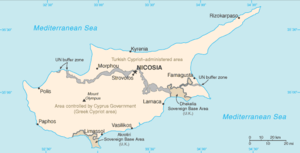
from the south to the north after the conflict. The Turkish invasion ended in the partition of Cyprus along the UN-monitored Green Line which still divides Cyprus today. In 1983 the Turkish Republic of Northern Cyprus (TRNC) declared independence, although Turkey is the only country which recognises it.
, following the Ottoman–Venetian War (1570–1573)
. The island and its population was later leased to Britain by the Cyprus Convention
, an agreement reached during the Congress of Berlin
in 1878 between the United Kingdom
and the Ottoman Empire
. Britain formally annexed Cyprus (together with Egypt and Sudan
) on 5 November 1914 as a reaction to the Ottoman Empire's decision to join the First World War on the side of the Central Powers
; subsequently the island became a British Crown colony
. Article 20 of the Treaty of Lausanne
in 1923 marked the end of the Turkish claim to the island. Article 21 of the treaty gave the minority Muslims
on the island the choice of leaving the island to live as Turks in Turkey, or to stay on the island as British nationals.
 At this time the population of Cyprus was composed by both Greeks and Turks, who identified themselves with their respective "mother" countries. However, the elites of both communities shared the belief that they were socially more progressive (better educated and less conservative) and therefore distinct from the mainlanders. Greek and Turkish Cypriots lived quietly side by side for many years.
Broadly, three main forces can be held responsible for transforming two ethnic communities into two national ones: Education, British colonial practices, and insular religious teachings accompanying economic development. Formal education was perhaps the most important as it affected Cypriots during childhood and youth, education has been a main vehicle of transferring inter-communal hostility.
British colonial policies also promoted ethnic polarization. The British applied the principle of "divide and rule", setting the two groups against each other to prevent combined action against colonial rule. For example, when Greek Cypriots rebelled in the 1950s, the colonial office expanded the size of the Auxiliary Police
and in September 1955, established the Special Mobile Reserve which was recruited exclusively from the Turkish community, to crush EOKA. This and similar practices contributed to inter-communal animosity.
Failure to fully adopt secular practices also fostered ethnic nationalism
as the two main ethnic groups practised their own distinct religions, with very little crossover. Although economic development
and increased education reduced the explicitly religious characteristics of the two communities, the growth of nationalism on the two mainlands increased the significance of other differences. Turkish nationalism was at the core of the revolutionary program promoted by the father of modern Turkey, Mustafa Kemal Atatürk
(1881–1938)., and affected Turkish Cypriots who followed his principles. President of the Republic of Turkey from 1923 to 1938, Atatürk attempted to build a new nation on the ruins of the Ottoman Empire and elaborated the program of "six principles
" (the "Six Arrows") to do so.
These principles of secularism
(laicism
) and nationalism reduced Islam's role in the everyday life of individuals and emphasized Turkish identity as the main source of nationalism. Traditional education with a religious foundation was discarded and replaced with one that followed secular principles and, shorn of Arab and Persian influences, was purely Turkish. Turkish Cypriots quickly adopted the secular program of Turkish nationalism.
Under Ottoman rule Turkish Cypriots had been classified as Muslims, a distinction based on religion. Being thoroughly secular Atatürk's program made their Turkish identity paramount, and may have further reinforced their division from their Greek Cypriot neighbors.
In the early fifties a Greek nationalist group was formed called the Ethniki Organosis Kyprion Agoniston (EOKA
, or "National Organisation of Cypriot Fighters"). Their objective was to drive the British out of the island first, and then to integrate the island with Greece. EOKA was a Greek nationalist organization and some members murdered Turkish Cypriots who were thought to have colluded with the British. EOKA wished to remove all obstacles, British, Greek Cypriot or Turkish Cypriot from their path to independence, or union with Greece. EOKA initiated its activities by planting the first bombs on 1 April 1951 with the directive by Greek Foreign Minister
Stefanopoulos.
The first secret talks for EOKA, as a nationalist organization established to integrate the island to Greece, were started in the chairmanship of Archbishop Makarios III
in Athens
on 2 July 1952. In the aftermath of these meetings a "Council of Revolution" was established on 7 March 1953. In early 1954 secret weaponry shipments to Cyprus started with the knowledge of the Greek government
. Lt. Georgios Grivas, formerly an officer in the Greek army, covertly disembarked on the island on 9 November 1954 and EOKA's campaign against the British forces began to grow.
The first Turk to be killed by EOKA on 21 June 1955 was a policeman. EOKA also targeted Greek collaborators.
A year later EOKA revived its attempts to liberate Cyprus from British rule. The Turkish Resistance Organization
(TMT, Türk Mukavemet Teşkilatı) declared war on the Greek Cypriot rebels as well.
On 12 June 1958, eight Greek Cypriot civilians from Kondemenos village were killed by the TMT near the Turkish Cypriot populated village of Geunyeli, after being dropped off there by the British authorities. After this the Turkish government ordered the TMT to blow up the offices of the Turkish press office in Nicosia to falsely put the blame onto the Greek Cypriots and prevent independence negotiations from succeeding. It also began a string of assassinations and murders of prominent Turkish Cypriot supporters of independence. The following year, after the conclusion of the independence agreements on Cyprus, the Turkish Navy
sent a ship to Cyprus fully loaded with arms for the TMT. The ship was stopped and the crew were caught red-handed in the infamous "Deniz" incident. British rule lasted until 1960 when the island was declared an independent state under the London-Zurich agreements. The agreement created a foundation for the Republic of Cyprus by the Turkish Cypriot and Greek Cypriot communities, although the republic was seen as a necessary compromise between the two reluctant communities.
The 1960 Constitution of the Cyprus Republic proved unworkable however, lasting only three years. Greek Cypriots wanted to end the separate Turkish Cypriot municipal councils permitted by the British in 1958, made subject to review under the 1960 agreements. For many Greek Cypriots these municipalities were the first stage on the way to the partition they feared. The Greek Cypriots wanted enosis
, integration with Greece, while Turkish Cypriots wanted taksim, partition between Greece and Turkey.
Resentment also rose within the Greek Cypriot community because Turkish Cypriots had been given a larger share of governmental posts than the size of their population warranted. In accordance with the constitution 30% of civil service jobs were allocated to the Turkish community even though at they time they only constituted 18.3% of the population. Additionally, the position of vice president was reserved for the Turkish population and both the president and vice president were given veto power over crucial issues. The veto power in particular made it difficult for the government to operate efficiently as any proposal had to be agreed to by both communities. The Turkish Cypriots had also vetoed the amalgamation of Turkish Cypriot and Greek Cypriot troops into the same units.
Between 21 and 26 December 1963, the conflict centered in the Omorphita suburb of Nicosia, which had been an area of tension in 1958. The participants now were Greek Cypriot irregulars and Turkish Cypriot civilians and former TMT members, known as the "fighters" during the Cyprus problem
, the Turkish fighters were less powerful, outnumbered and were held down in "ghettos" from the superior Greek Cypriot side who were supplied with stored EOKA guns and eventually guns from foreign powers. Many Greek and Turkish Cypriot civilians who were caught in the crossfire and chaos that ensued over the Christmas week were killed, others were massacred by Greek or Turkish irregulars and had their homes looted and burnt down in small villages as the problem developed. The government of Turkey used these events as an excuse to cancel the residence permits of 12,000 Greek citizens living in Istanbul leading to the confiscation of their property.
Both President Makarios and Dr. Küçük issued calls for peace, but these were ignored. Meanwhile, within a week of the violence flaring up, the Turkish army
contingent had moved out of its barracks and seized the most strategic position on the island across the Nicosia to Kyrenia road, the historic jugular vein
of the island. So crucial was this road to Turkish strategic thinking
that they retained control of that road until 1974, at which time it acted as a crucial link in Turkey's military invasion. From 1963 up to the point of the Turkish invasion of 20 July 1974, Greek Cypriots who wanted to use the road could only do so if accompanied by a UN convoy.
700 Turkish hostages, including women and children, were taken from the northern suburbs of Nicosia. By 1964, 193 Turkish Cypriots and 133 Greek Cypriots were killed, with a further 209 Turks and 41 Greeks missing, presumed dead. The British Daily Telegraph later called it the "anti Turkish pogrom".
Thereafter Turkey once again put forward the idea of partition. The intensified fighting especially around areas under the control of Turkish Cypriot militias, as well as the failure of the constitution were used as justification for a possible Turkish invasion. Turkey was on the brink of invading when US president
Johnson stated, in his famous letter of 5 June 1964, that the US was against a possible invasion and stated that he would not come to the aid of Turkey if an invasion of Cyprus led to conflict with the Soviet Union. One month later, within the framework of a plan prepared by the US Secretary of State, Dean Acheson, negotiations with Greece and Turkey began.
After 1963–64 crisis, the Turkish population began to form enclaves in different areas that were blockaded by the National Guard and were directly supported by Turkey. In response to this, their movement and access to basic supplies became more restricted by Greek forces. Fighting broke out again in 1967 as the Turkish Cypriots pushed for more freedom of movement. Once again, this was only settled after Turkey threatened to invade on the basis that they would be protecting the Turkish population from possible ethnic cleansing by Greek Cypriot forces. In order to avoid this, a compromise was reached in which Greece was forced to remove some of its troops from the island, Georgios Grivas, leader of the EOKA had to leave Cyprus, and the Cypriot government lifted some restrictions of movement and access to supplies of the Turkish populations.
which was sponsored by the military junta of Athens
.
The junta had come to power in a military coup in 1967 which was condemned by the whole of Europe
but had the support of the United States. In the autumn of 1973 after the 17 November student uprising
there had been a further coup in Athens
in which the original Greek junta had been replaced by one still more obscurantist headed by the Chief of Military Police, Brigadier Ioannides, though the actual head of state
was General Phaedon Gizikis
. Ioannides believed that Makarios was no longer a true supporter of enosis, and suspected him of being a communist sympathizer. This led Ioannides to support the EOKA-B and National Guard as they tried to undermine Makarios.
On 2 July 1974, Makarios wrote an open letter
to President Gizikis complaining bluntly that 'cadres of the Greek military regime support and direct the activities of the 'EOKA-B' terrorist organization'. He also ordered that Greece remove some 600 Greek officers in the Cypriot National Guard from Cyprus. The Greek Government's immediate reply was to order the go-ahead of the coup. On 15 July 1974 sections of the Cypriot National Guard
, led by its Greek officers, overthrew the government.
Makarios narrowly escaped death in the attack. He fled the presidential palace by catching a taxi after escorting a party of school children out of the building and went to Paphos
, where the British managed to retrieve him by Westland Whirlwind helicopter in the afternoon of 16 July and flew him from Akrotiri to Malta in an Royal Air Force
Armstrong Whitworth Argosy
transport and from there to London by de Havilland Comet
the next morning.
In the meantime, Nikos Sampson
was declared provisional president of the new government. Sampson was a Greek ultra nationalist who was known to be fanatically anti-Turkish and had taken part in violence against Turkish civilians in earlier conflicts.
The Sampson regime took over radio stations and declared that Makarios had been killed, but Makarios, safe in London, was soon able to counteract these reports. In the coup itself, an estimated 650 people were killed or wounded , but in the days following, as many as 2,000 Makarios supporters, including many members of AKEL, the communist political party, were killed and many more were jailed At this phase, the main targets of the coup forces were Makarios supporters and other political opponents. Ethnic violence committed by both sides became prevalent later in the conflict.
In response to the coup, US Secretary of State Henry Kissinger
sent Joseph Sisco to try to mediate the conflict. Turkey issued a list of demands to Greece via a US negotiator. These demands included the immediate removal of Nikos Sampson, the withdrawal of 650 Greek officers from the Cypriot National Guard, the admission of Turkish troops to protect their population, equal rights for both populations, and access to the sea from the northern coast for Turkish Cypriots. These demands were rejected as they would have given Turkey an unacceptable amount of power on the island. Turkey, led by Prime Minister Bülent Ecevit
, then applied to Britain as a signatory of the Treaty of Guarantee to take action to return Cyprus to its neutral status. Britain declined this offer, and refused to let Turkey use its bases on Cyprus as part of the operation.
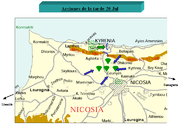 Turkey invaded Cyprus on Saturday, 20 July 1974. Heavily armed troops landed shortly before dawn at Kyrenia (Girne)
on the northern coast meeting resistance from Greek and Greek Cypriot forces. Ankara said that it was invoking its right under the Treaty of Guarantee to protect the Turkish Cypriots and guarantee the independence of Cyprus The operation, codenamed 'Operation Atilla
', is known in the North as 'the 1974 Peace Operation'.
Turkish forces primarily used a clear and hold strategy, forcing many Greek Cypriots to flee to the south. By the time a ceasefire was agreed three days later, Turkish troops held 3% of the territory of Cyprus. Five thousand Greek Cypriots had fled their homes.
By the time the UN Security Council was able to obtain a ceasefire on the 22 July the Turkish forces had only secured a narrow corridor between Kyrenia and Nicosia, which they succeeded in widening during the next few days in violation of that ceasefire, demanded in Resolution 353
.
On 23 July 1974 the Greek military junta collapsed mainly because of the events in Cyprus. Greek political leaders in exile started returning to the country. On 24 July 1974 Constantine Karamanlis
returned from Paris and was sworn in as Prime Minister. He decided against further military involvement as the Turkish forces were much stronger. Shortly after this Nikos Sampson renounced the presidency and Glafcos Clerides temporarily took the role of president.
The first round of peace talks took place in Geneva, Switzerland from July 25–30, 1974, which the representateive of the Greek-Cypriots, Glafcos Clerides, the representative of the Turkish-Cypriots, Rauf Denktaş
, and the Turkish Foreign Minister, Turan Güneş participated in. The talks fell apart as a compromise was unable to be reached. At the second round of peace talks that started on 14 August 1974, Turkey demanded from the Cypriot government to accept its plan for a federal state
, and population transfer
. When the Cypriot acting president
Clerides asked for 36 to 48 hours in order to consult with Athens and with Greek Cypriot leaders, the Turkish Foreign Minister denied Clerides that opportunity on the grounds that Makarios and others would use it to play for more time.
, When I say "Ayşe is going on vacation" (Turkish
: "Ayşe Tatile Çıksın"Ayşe is a daughter of Turan Güneş, today Ayşe Güneş Ayata, (Alper Sedat Aslandaş & Baskın Bıçakçı, Popüler Siyasî Deyimler Sözlüğü, İletişim Yayınları, 1995, ISBN 975-470-510-0, p. 34.)), it will mean that our armed forces are ready to go into action. Even if the telephone line is tapped, that would rouse no suspicion. An hour and a half after the conference broke up, Turan Güneş called Ecevit and said the code word. On August 14 Turkey launched its "Second Peace Operation", to gain control of 40 percent of Cyprus. Britain's then foreign secretary
and soon to be prime minister James Callaghan
, later disclosed that U.S. Secretary of State
Henry Kissinger
"vetoed" at least one British military
action to pre-empt the Turkish landing. Turkish troops rapidly occupied even more than was asked for at Geneva. 40% of the land came under Turkish occupation reaching as far south as the Louroujina Salient
.
In the process, many Greek Cypriots became refugees. The Cypriot government estimates their numbers at about 200,000, with other sources stating 140,000 to 160,000. Many of them were forced out of their homes by the Turkish army
which has been acknowledged by the European Court of Human Rights
in four interstate applications between Cyprus and Turkey as well as in other cases as in the case of Loizidou vs Turkey
), the rest fleeing at the word of the approaching Turkish army.
The ceasefire line from 1974 today separates the two communities on the island, and is commonly referred to as the Green Line.
After the conflict, Cypriot representatives and the United Nations consented to the transfer of the remainder of the 51,000 Turkish Cypriots that had not left their homes in the south to settle in the north, if they wished to do so.
The United Nations Security Council
has challenged the legality of Turkey's action, because Article Four of the Treaty of Guarantee gives the right to guarantors to take action with the sole aim of re-establishing the state of affairs. The aftermath of Turkey's invasion, however, did not safeguard the Republic's sovereignty and territorial integrity, but had the opposite effect: the de facto partitioning of the Republic, the creation of a separate political entity in the north
On 13 February 1975, Turkey declared the occupied areas of the Republic of Cyprus to be a "Federated Turkish State" to the universal condemnation of the international community
(see UN Security Council Resolution
367(1975)). The United Nations recognizes the sovereignty of the Republic of Cyprus according to the terms of its independence in 1960. The conflict continues to affect Turkey's relations with Cyprus, Greece and the European Union
.
, in an interview with the Greek newspaper Eleftherotipia on 26 February 1981, said that:
There were also massacres against the Turkish Cypriots during the invasion of the island, including the Maratha, Santalaris and Aloda massacre
, in which 126 people were killed on 14 August 1974 and the Tochni
(Taşkent) massacre. A veteran member of the EOKA B, Andreas Dimitriu, stated in an interview that EOKA B
worked in conjunction with the Greek Cypriot officials at the time to murder 89 Turkish Cypriots at Taşkent. Washington Post covered another news of atrocity in which it is written that: "In a Greek raid on a small Turkish village near Limassol, 36 people out of a population of 200 were killed. The Greeks said that they had been given orders to kill the inhabitants of the Turkish villages before the Turkish forces arrived."
The Republic of Cyprus has been found guilty of violations of the European Convention of Human Rights. In the case of Aziz
v. Cyprus, the European Court of Human Rights
decided on 22 September 2004 that the Republic of Cyprus violated Article 14 of the European Convention of Human Rights and Article 3 of its Protocol No.1 by preventing Aziz, a Turkish Cypriot who is citizen of the Republic of Cyprus from exercising his right to vote
in 2001 parliamentary elections. In compliance with the European Court of Human Rights ruling, all Turkish Cypriots living in the areas under the control of the Republic of Cyprus were granted a right to vote in all elections. However, they still cannot run in presidential elections.
.
According to historian Brad R. Roth
writing in a volume published by Oxford University Press:
According to historian Thomas M. Franck writing in a volume published by Cambridge University Press:
According to historians David A. Lake and Donald S. Rothchild writing in a volume published by Princeton University Press:
In 1976 and again in 1983, the European Commission of Human Rights
found Turkey guilty of repeated violations of the European Convention of Human Rights. Turkey has been condemned for preventing the return of Greek Cypriot refugees to their properties. The European Commission of Human Rights reports of 1976 and 1983 state the following:
"Having found violations of a number of Articles of the Convention, the Commission notes that the acts violating the Convention were exclusively directed against members of one of two communities in Cyprus, namely the Greek Cypriot community. It concludes by eleven votes to three that Turkey has thus failed to secure the rights and freedoms set forth in these Articles without discrimination on the grounds of ethnic origin, race, religion as required by Article 14
of the Convention."
The 20,000 Greek Cypriots who were enclaved in the occupied Karpass Peninsula
in 1975 were subjected by the Turks to violations of their human rights so that by 2001 when the European Court of Human Rights found Turkey guilty of the violation of 14 articles of the European Convention of Human Rights in its judgement of Cyprus v. Turkey (application no. 25781/94) less than 600 still remained. In the same judgement Turkey was found guilty of violating the rights of the Turkish Cypriots by authorising the trial of civilians by a military court
.
Since the Turkish invasion, a large number of Turks have been brought to the north from Anatolia in violation of Article 49 of the Geneva Convention and hence a war crime
, to occupy the homes of the Greek Cypriot refugees.
Approximately 70,000 Turkish Cypriots have been forced to emigrate from the north due to economic hardships brought on by the international isolation
of Northern Cyprus.
 On 5 October 1994, the US Senate unanimously adopted an Act to ascertain the fate of five US citizens missing since the Turkish invasion. Following this, the US President appointed Ambassador Robert Dillon, who came to Cyprus to carry out investigations. The grave of Andreas Kasapis, one of the 84 missing persons from the village of Assia, was discovered in January 1998 in the Turkish occupied area of Northern Cyprus and his remains were sent to the US for DNA
testing and identified, yet the Turkish side has still failed to provide reliable information as to the fate of another 1587 Greek Cypriots.
Facts and information on the death and the burial site of 201 out of 500 cases of Turkish Cypriot missing persons were provided by the Cyprus government on 12 May 2003.
On 6 December 2002, excavations at the village of Alaminos
, led to the discovery of human remains
, which according to existing testimonies, belonged to Turkish Cypriots who lost their lives during a fire exchange with a unit of the National Guard
, on 20 July 1974.
Exhumations carried out by British experts in the occupied village of Trachonas
which was a burial site designated by the Turkish side in 1998 were completed on 11 January 2005, but failed to locate any remains belonging to Greek Cypriots listed as missing. After this failure the Cyprus government raised questions over the willingness of the Turkish side to resolve this humanitarian issue.
However, since 2004, the whole issue of missing persons in Cyprus took a dramatic new turn after the Committee on Missing Persons (CMP) designed and started to implement (as from August 2006) its project on the Exhumation, Identification and Return of Remains of Missing Persons. The whole project is being implemented by bi-communal teams of Greek Cypriots and Turkish Cypriot scientists (archaeologists, anthropologists and geneticists) under the overall responsibility of the CMP. By the end of 2007, 57 individuals had been identified and their remains returned to their families.
, who had sold the mosaics, was arrested in Germany in a police raid and found to be in possession of a stash consisting of mosaics, fresco
es and icons dating back to the 6th, 12th and 15th centuries worth over $50 million. The mosaics, depicting Saints Thaddeus and Thomas, are two more sections from the apse of the Kanakaria Church, while the frescoes, including the Last Judgement and the Tree of Jesse
, were taken off the north and south walls of the Monastery of Antiphonitis, built between the 12th and 15th centuries.
According to a Greek Cypriot claim, since 1974, at least 55 churches have been converted into mosques and another 50 churches and monasteries have been converted into stables, stores, hostels, museums, or have been demolished. According to the government spokesman
of the de facto Turkish Republic of Northern Cyprus, this has been done to keep the buildings from falling into ruin.
In January 2011, the British singer Boy George
returned an 18th century icon of Christ to the Church of Cyprus that he had bought without knowing the origin of. The icon, which had adorned his home for 26 years, had been looted from the church of St Charalampus
from the village of New Chorio
, near Kythrea
, in 1974. The icon was noticed by church officials during a television interview of Boy George at his home. The church contacted the singer who agreed to return the icon at Saints Anargyroi
Church, Highgate
, north London
.
, which prohibits an occupier from transferring or deporting parts of its own civilian population into an occupied territory.
UN Resolution
1987/19 (1987) of the "Sub-Commission On Prevention Of Discrimination And Protection Of Minorities" which was adopted on 2 September 1987 demanded "the full restoration of all human rights to the whole population of Cyprus, including the freedom of movement
, the freedom of settlement and the right to property
" and also expressed "its concern also at the policy and practice of the implantation of settlers in the occupied territories
of Cyprus which constitute a form of colonialism
and attempt to change illegally the demographic structure of Cyprus".
In a report prepared by Mete Hatay on behalf of PRIO, the Oslo peace center, it was estimated that the number of Turkish mainlanders in the north who have been granted the right to vote is 37,000. This figure however excludes mainlanders who are married to Turkish Cypriots or adult children of Mainland Settlers as well as all minors. The report also estimates the number of Turkish mainlanders who have not been granted the right to vote, whom it labels as "transients", at a further 105,000.
. Makarios described the coup which replaced him as "An Invasion of Cyprus by Greece" in his speech to the UN security council and stated that there were "no prospects" of success in the talks aimed at resolving the situation between Greek and Turkish Cypriots, as long as the leaders of the coup, sponsored and supported by Greece, were in power.
Turks often claim that the Council of Europe
supported the legality of the invasion by Turkey in its resolution of the 29 July 1974. They claim that the Court of Appeal in Athens stated that the invasion was legal and that "The real culprits... are the Greek officers who engineered and staged a coup and prepared the conditions for the invasion".
"Turkey exercised its right of intervention in accordance with Article IV of the Guarantee Treaty."
after the militant struggle against the British was a compromise to Turkish minority who wanted to see the island under Turkey's control. That becomes evident through today's occupation of 36% of the island having as a "justification" that Turkey's forceful presence is to restore constitutional order, 33 years ago.
Since 1974 Turkey has occupied 36% of the island and claims that her presence is to secure the rights of the Turkish Cypriots. Greek Cypriots argue that all these are diplomatic ploys, furthered by ultra nationalist Turkish militants to justify Turkey's expansionist objective
.
Turkey's support for partition through the forced displacement of populations is revealed in the Galo Plaza
report of 1965 and in its demands during negotiations with the British over Cyprus independence and the so called Acheson
plan which would have divided Cyprus between Turkey and Greece.
Turks seeking to justify the Turkish invasion, often refer to a few isolated judgements which may, taken out of context, appear to go against the grain. They often refer to a purported judgement of the Standing Committee of the Consultative Assembly of the Council of Europe
(resolution 532/1974), dated 29 July 1974, which stated the following:
The key feature of the statement purportedly made at the CoE is the date at which is was made. At the time of the statement, it was not yet absolutely apparent that Turkey, rather than using its right of intervention as a Guarantor power, was acting contrary to it, under its guise.
Critically, following the date, the Greek junta had collapsed and the democratic government of the Republic of Cyprus was restored under Glafkos Clerides leaving further "intervention" unwarranted. Nevertheless, there followed a second wave of Turkish invasion which was universally condemned and revealed the underlying motivations behind the first wave.
Whereas the first wave of military action was and still is said (by many Turks) to have been carried out in accordance with the right of intervention, the second wave of military action revealed that Turkey's right of intervention was used as little more than a guise for an invasion. The second phase of the Turkish invasion was characterised by a disproportionate use of violence and disproportionate occupation of territory (in relation to the ethnic populations) Ultimately, the right of intervention to protect the sovereignty, integrity and independence of the Republic of Cyprus was abused as those goals were undermined by Turkey's creation of an internationally unrecognised pseudo-state, the TRNC, and the stationing of 40000 Turkish troops on sovereign territory of the Republic of Cyprus, in violation of all resolutions of the United Nations.
The decision reflected the mood and attitude towards the Greek junta which was itself exogenous to the Republic of Cyprus. It is for this reason that President Makarios, in his speech to the UN Security Council on 19 July 1974, described the coup which replaced him as "...an Invasion of Cyprus by Greece..." and called for the restoration of the democratic government.
At least 180,000 Greek Cypriot refugees were created by the invasion. They are still denied their basic human rights, including right of access to and use of their property. Greek Cypriots also wish that the 40000 Turkish troops in northern Cyprus (about 1 soldier per 3 civilians living in Turkish occupied territory) return to Turkey and many wish that the Turkish settlers, placed there by Turkey as part of its long term plan of Turkish expansionism, also return to Turkey.
Many Greek Cypriots have long believed that the NATO powers, notably Britain and America, were against the idea of an independent Cyprus because of fears that it could fall into communist hands and become a "Mediterranean Cuba".
The United Nations Security Council decisions for the immediate unconditional withdrawal of all foreign troops from Cyprus soil and the safe return of the refugees to their homes have not been implemented by Turkey and the TRNC. Turkey and TRNC defend their position, stating that any such withdrawal would have led to a resumption of intercommunal fighting and killing.
Negotiations to find a solution to the Cyprus problem have been taking place on and off since 1964. Between 1974 and 2002, the Turkish Cypriot side (effectively controlled by the Turkish government) was seen by the international community as the side refusing a balanced solution. Since 2002, the situation has been reversed according to US and UK officials, and the Greek Cypriot side rejected a plan which would have called for the dissolution of the Republic of Cyprus without guarantees that the Turkish occupation forces would be removed. The latest Annan Plan
to reunify the island which was endorsed by the United States, United Kingdom and Turkey was accepted by a referendum by Turkish Cypriots but overwhelmingly rejected in parallel referendum by Greek Cypriots, after Greek Cypriot Leadership and Greek Orthodox Church
urging the Greek population to vote No.
Greek Cypriots rejected the UN settlement plan
in an April 2004 referendum. On 24 April 2004, the Greek Cypriots rejected by a three-to-one margin the plan proposed by UN Secretary-General
Kofi Annan
for the settlement of the Cyprus dispute
. The plan, which was approved by a two-to-one margin by the Turkish Cypriots in a separate but simultaneous referendum, would have created a United Cyprus Republic and ensured that the entire island would reap the benefits of Cyprus' entry into the European Union
on 1 May. The plan would have created a United Cyprus Republic consisting of a Greek Cypriot constituent state
and a Turkish Cypriot constituent state linked by a federal government. More than half of the Greek Cypriots who were displaced in 1974 and their descendants would have had their properties returned to them and would have lived in them under Greek Cypriot administration within a period of 31/2 to 42 months after the entry into force
of the settlement. For those whose property could not be returned, they would have received monetary compensation.
The entire island entered the EU on 1 May 2004 still divided, although the EU acquis communautaire – the body of common rights and obligations – applies only to the areas under direct government control, and is suspended in the areas occupied by the Turkish military and administered by Turkish Cypriots. However, individual Turkish Cypriots able to document their eligibility for Republic of Cyprus citizenship legally enjoy the same rights accorded to other citizens of European Union
states. Nicosia continues to oppose EU efforts to establish direct trade and economic links to occupied north Cyprus as a way of encouraging the Turkish Cypriot community to continue to support the resolution of the Cyprus dispute.
(1983) considered the "attempt to create the Turkish Republic of Northern Cyprus is invalid, and will contribute to a worsening of the situation in Cyprus". It went on to state that it "Considers the declaration referred to above as legally invalid and calls for its withdrawal".
by people other than its inhabitants as inadmissible and calls for the transfer of this area to the administration of the United Nations"
To this day, neither Turkey nor the TRNC have complied with the above resolutions and Varosha remains uninhabited.
In 22 July 2010, United Nations' International Court of Justice decided that "International law contains no prohibition on declarations of independence". In response to this non legally-binding direction, German Foreign Minister Guido Westerwelle
said it "has nothing to do with any other cases in the world" including Cyprus.
Turkey
Turkey , known officially as the Republic of Turkey , is a Eurasian country located in Western Asia and in East Thrace in Southeastern Europe...
military invasion in response to a Greek military junta backed coup in Cyprus
Cyprus
Cyprus , officially the Republic of Cyprus , is a Eurasian island country, member of the European Union, in the Eastern Mediterranean, east of Greece, south of Turkey, west of Syria and north of Egypt. It is the third largest island in the Mediterranean Sea.The earliest known human activity on the...
. It is known in Turkey
Turkey
Turkey , known officially as the Republic of Turkey , is a Eurasian country located in Western Asia and in East Thrace in Southeastern Europe...
as the Cyprus Peace Operation , Cyprus Operation (Kıbrıs Harekâtı) or by its Turkish Armed Forces
Turkish Armed Forces
The Turkish Armed Forces are the military forces of the Republic of Turkey. They consist of the Army, the Navy , and the Air Force...
code name Operation Atilla
Operation Atilla
Attila Operations refers to the two operations performed by the Turkish Armed Forces during the invasion of Cyprus.Atilla I was the first stage of the operation. The invasion began in the early hours of 20 July 1974 in response to a Greek-inspired coup d'etat that sought to overthrow the...
(Atilla Harekâtı).
The coup, staged by the Cypriot National Guard
Cypriot National Guard
The Cypriot National Guard , also known as the "Greek Cypriot National Guard" or simply as "National Guard", is the combined arms military force of the Republic of Cyprus...
in conjunction with EOKA B
EOKA B
EOKA-B was a Greek Cypriot paramilitary organisation formed in 1971. It followed a right-wing nationalistic ideology and had the ultimate goal of achieving the enosis of Cyprus with Greece...
, deposed the Cypriot president Archbishop Makarios III
Makarios III
Makarios III , born Andreas Christodolou Mouskos , was the archbishop and primate of the autocephalous Cypriot Orthodox Church and the first President of the Republic of Cyprus ....
and installed Nikos Sampson
Nikos Sampson
Nikos Sampson was the de facto president of Cyprus who succeeded Archbishop Makarios, President of Cyprus, in 1974. Sampson was a journalist and a member of EOKA, which rose against the British colonial administration, seeking Enosis of the island of Cyprus with Greece...
in his place.
More than one quarter of the population of Cyprus was expelled from the occupied northern part of the island where Greek Cypriots constituted 80% of the population. There was also a flow of roughly 60,000 Turkish Cypriots
Turkish Cypriots
Turkish Cypriots are the ethnic Turks and members of the Turkish-speaking ethnolinguistic community of the Eastern Mediterranean island of Cyprus. The term is used to refer explicitly to the indigenous Turkish Cypriots, whose Ottoman Turkish forbears colonised the island in 1571...
from the south to the north after the conflict. The Turkish invasion ended in the partition of Cyprus along the UN-monitored Green Line which still divides Cyprus today. In 1983 the Turkish Republic of Northern Cyprus (TRNC) declared independence, although Turkey is the only country which recognises it.
Background
In 1571 the Greeks of Cyprus were conquered by the Ottoman EmpireOttoman Empire
The Ottoman EmpireIt was usually referred to as the "Ottoman Empire", the "Turkish Empire", the "Ottoman Caliphate" or more commonly "Turkey" by its contemporaries...
, following the Ottoman–Venetian War (1570–1573)
Ottoman–Venetian War (1570–1573)
The Fourth Ottoman–Venetian War, also known as the War of Cyprus was fought between 1570–1573. It was waged between the Ottoman Empire and the Republic of Venice, the latter joined by the Holy League, a coalition of Christian states formed under the auspices of the Pope, which included Spain , the...
. The island and its population was later leased to Britain by the Cyprus Convention
Cyprus Convention
The Cyprus Convention of 4 June, 1878 was a secret agreement reached between the United Kingdom and the Ottoman Empire which granted control of Cyprus to Great Britain in exchange for their support of the Ottomans during the Congress of Berlin...
, an agreement reached during the Congress of Berlin
Congress of Berlin
The Congress of Berlin was a meeting of the European Great Powers' and the Ottoman Empire's leading statesmen in Berlin in 1878. In the wake of the Russo-Turkish War of 1877–78, the meeting's aim was to reorganize the countries of the Balkans...
in 1878 between the United Kingdom
United Kingdom of Great Britain and Ireland
The United Kingdom of Great Britain and Ireland was the formal name of the United Kingdom during the period when what is now the Republic of Ireland formed a part of it....
and the Ottoman Empire
Ottoman Empire
The Ottoman EmpireIt was usually referred to as the "Ottoman Empire", the "Turkish Empire", the "Ottoman Caliphate" or more commonly "Turkey" by its contemporaries...
. Britain formally annexed Cyprus (together with Egypt and Sudan
Khedivate of Egypt
The Khedivate of Egypt was an autonomous tributary state of the Ottoman Empire.- Rise of Muhammad Ali :The Egypt Eyalet was an eyalet of the Ottoman Empire. The eyalet was ruled locally by the Mamluk military caste and their various beys , who started to fight amongst themselves for control of...
) on 5 November 1914 as a reaction to the Ottoman Empire's decision to join the First World War on the side of the Central Powers
Central Powers
The Central Powers were one of the two warring factions in World War I , composed of the German Empire, the Austro-Hungarian Empire, the Ottoman Empire, and the Kingdom of Bulgaria...
; subsequently the island became a British Crown colony
British overseas territories
The British Overseas Territories are fourteen territories of the United Kingdom which, although they do not form part of the United Kingdom itself, fall under its jurisdiction. They are remnants of the British Empire that have not acquired independence or have voted to remain British territories...
. Article 20 of the Treaty of Lausanne
Treaty of Lausanne
The Treaty of Lausanne was a peace treaty signed in Lausanne, Switzerland on 24 July 1923, that settled the Anatolian and East Thracian parts of the partitioning of the Ottoman Empire. The treaty of Lausanne was ratified by the Greek government on 11 February 1924, by the Turkish government on 31...
in 1923 marked the end of the Turkish claim to the island. Article 21 of the treaty gave the minority Muslims
Islam
Islam . The most common are and . : Arabic pronunciation varies regionally. The first vowel ranges from ~~. The second vowel ranges from ~~~...
on the island the choice of leaving the island to live as Turks in Turkey, or to stay on the island as British nationals.
Broadly, three main forces can be held responsible for transforming two ethnic communities into two national ones: Education, British colonial practices, and insular religious teachings accompanying economic development. Formal education was perhaps the most important as it affected Cypriots during childhood and youth, education has been a main vehicle of transferring inter-communal hostility.
British colonial policies also promoted ethnic polarization. The British applied the principle of "divide and rule", setting the two groups against each other to prevent combined action against colonial rule. For example, when Greek Cypriots rebelled in the 1950s, the colonial office expanded the size of the Auxiliary Police
Auxiliary police
Auxiliary police or special constables in England) are usually the part-time reserves of a regular police force. They may be armed or unarmed. They may be unpaid volunteers or paid members of the police service with which they are affiliated...
and in September 1955, established the Special Mobile Reserve which was recruited exclusively from the Turkish community, to crush EOKA. This and similar practices contributed to inter-communal animosity.
Failure to fully adopt secular practices also fostered ethnic nationalism
Ethnic nationalism
Ethnic nationalism is a form of nationalism wherein the "nation" is defined in terms of ethnicity. Whatever specific ethnicity is involved, ethnic nationalism always includes some element of descent from previous generations and the implied claim of ethnic essentialism, i.e...
as the two main ethnic groups practised their own distinct religions, with very little crossover. Although economic development
Economic development
Economic development generally refers to the sustained, concerted actions of policymakers and communities that promote the standard of living and economic health of a specific area...
and increased education reduced the explicitly religious characteristics of the two communities, the growth of nationalism on the two mainlands increased the significance of other differences. Turkish nationalism was at the core of the revolutionary program promoted by the father of modern Turkey, Mustafa Kemal Atatürk
Mustafa Kemal Atatürk
Mustafa Kemal Atatürk was an Ottoman and Turkish army officer, revolutionary statesman, writer, and the first President of Turkey. He is credited with being the founder of the Republic of Turkey....
(1881–1938)., and affected Turkish Cypriots who followed his principles. President of the Republic of Turkey from 1923 to 1938, Atatürk attempted to build a new nation on the ruins of the Ottoman Empire and elaborated the program of "six principles
Kemalist ideology
Kemalist Ideology, "Kemalism" or also known as the "Six Arrows" is the principle that defines the basic characteristics of the Republic of Turkey. It was developed by the Turkish national movement and its leader Mustafa Kemal Atatürk.-Fundamentals:...
" (the "Six Arrows") to do so.
These principles of secularism
Secularism
Secularism is the principle of separation between government institutions and the persons mandated to represent the State from religious institutions and religious dignitaries...
(laicism
Laïcité
French secularism, in French, laïcité is a concept denoting the absence of religious involvement in government affairs as well as absence of government involvement in religious affairs. French secularism has a long history but the current regime is based on the 1905 French law on the Separation of...
) and nationalism reduced Islam's role in the everyday life of individuals and emphasized Turkish identity as the main source of nationalism. Traditional education with a religious foundation was discarded and replaced with one that followed secular principles and, shorn of Arab and Persian influences, was purely Turkish. Turkish Cypriots quickly adopted the secular program of Turkish nationalism.
Under Ottoman rule Turkish Cypriots had been classified as Muslims, a distinction based on religion. Being thoroughly secular Atatürk's program made their Turkish identity paramount, and may have further reinforced their division from their Greek Cypriot neighbors.
In the early fifties a Greek nationalist group was formed called the Ethniki Organosis Kyprion Agoniston (EOKA
EOKA
EOKA was an anticolonial, antiimperialist nationalist organisation with the ultimate goal of "The liberation of Cyprus from the British yoke". Although not stated in its initial declaration of existence which was printed and distributed on the 1st of April 1955, EOKA also had a target of achieving...
, or "National Organisation of Cypriot Fighters"). Their objective was to drive the British out of the island first, and then to integrate the island with Greece. EOKA was a Greek nationalist organization and some members murdered Turkish Cypriots who were thought to have colluded with the British. EOKA wished to remove all obstacles, British, Greek Cypriot or Turkish Cypriot from their path to independence, or union with Greece. EOKA initiated its activities by planting the first bombs on 1 April 1951 with the directive by Greek Foreign Minister
Foreign minister
A Minister of Foreign Affairs, or foreign minister, is a cabinet minister who helps form the foreign policy of a sovereign state. The foreign minister is often regarded as the most senior ministerial position below that of the head of government . It is often granted to the deputy prime minister in...
Stefanopoulos.
The first secret talks for EOKA, as a nationalist organization established to integrate the island to Greece, were started in the chairmanship of Archbishop Makarios III
Makarios III
Makarios III , born Andreas Christodolou Mouskos , was the archbishop and primate of the autocephalous Cypriot Orthodox Church and the first President of the Republic of Cyprus ....
in Athens
Athens
Athens , is the capital and largest city of Greece. Athens dominates the Attica region and is one of the world's oldest cities, as its recorded history spans around 3,400 years. Classical Athens was a powerful city-state...
on 2 July 1952. In the aftermath of these meetings a "Council of Revolution" was established on 7 March 1953. In early 1954 secret weaponry shipments to Cyprus started with the knowledge of the Greek government
Politics of Greece
The Politics of Greece takes place in a large parliamentary representative democratic republic, whereby the Prime Minister of Greece is the head of government, and of a multi-party system. Legislative power is vested in both the government and the Hellenic Parliament...
. Lt. Georgios Grivas, formerly an officer in the Greek army, covertly disembarked on the island on 9 November 1954 and EOKA's campaign against the British forces began to grow.
The first Turk to be killed by EOKA on 21 June 1955 was a policeman. EOKA also targeted Greek collaborators.
A year later EOKA revived its attempts to liberate Cyprus from British rule. The Turkish Resistance Organization
Turkish Resistance Organization
The Turkish Resistance Organisation was a Turkish Cypriot pro-taksim paramilitary organisation formed by Rauf Denktaş and Turkish military officer Rıza Vuruşkan in 1958 as a defence organisation to counter the Greek Cypriot Fighter's Organisation EOKA....
(TMT, Türk Mukavemet Teşkilatı) declared war on the Greek Cypriot rebels as well.
On 12 June 1958, eight Greek Cypriot civilians from Kondemenos village were killed by the TMT near the Turkish Cypriot populated village of Geunyeli, after being dropped off there by the British authorities. After this the Turkish government ordered the TMT to blow up the offices of the Turkish press office in Nicosia to falsely put the blame onto the Greek Cypriots and prevent independence negotiations from succeeding. It also began a string of assassinations and murders of prominent Turkish Cypriot supporters of independence. The following year, after the conclusion of the independence agreements on Cyprus, the Turkish Navy
Turkish Navy
The Turkish Navy is the naval warfare service branch of the Turkish Armed Forces.- Ottoman fleet after Mudros :Following the demise of the Ottoman Empire in the aftermath of World War I, on November 3, 1918, the fleet commander of the Ottoman Navy, Liva Amiral Arif Pasha, ordered all flags to be...
sent a ship to Cyprus fully loaded with arms for the TMT. The ship was stopped and the crew were caught red-handed in the infamous "Deniz" incident. British rule lasted until 1960 when the island was declared an independent state under the London-Zurich agreements. The agreement created a foundation for the Republic of Cyprus by the Turkish Cypriot and Greek Cypriot communities, although the republic was seen as a necessary compromise between the two reluctant communities.
The 1960 Constitution of the Cyprus Republic proved unworkable however, lasting only three years. Greek Cypriots wanted to end the separate Turkish Cypriot municipal councils permitted by the British in 1958, made subject to review under the 1960 agreements. For many Greek Cypriots these municipalities were the first stage on the way to the partition they feared. The Greek Cypriots wanted enosis
Enosis
Enosis refers to the movement of the Greek-Cypriot population to incorporate the island of Cyprus into Greece.Similar movements had previously developed in other regions with ethnic Greek majorities such as the Ionian Islands, Crete and the Dodecanese. These regions were eventually incorporated...
, integration with Greece, while Turkish Cypriots wanted taksim, partition between Greece and Turkey.
Resentment also rose within the Greek Cypriot community because Turkish Cypriots had been given a larger share of governmental posts than the size of their population warranted. In accordance with the constitution 30% of civil service jobs were allocated to the Turkish community even though at they time they only constituted 18.3% of the population. Additionally, the position of vice president was reserved for the Turkish population and both the president and vice president were given veto power over crucial issues. The veto power in particular made it difficult for the government to operate efficiently as any proposal had to be agreed to by both communities. The Turkish Cypriots had also vetoed the amalgamation of Turkish Cypriot and Greek Cypriot troops into the same units.
1963–1974
In December 1963 the President of the Republic Makarios proposed thirteen constitutional amendments after the government was repeatedly vetoed by the Turkish Cypriot legislators, forcing deadlock over all major legislations and the budget. Makarios believed it would help facilitate the functioning of the state and to more accurately reflect their ethnic make up. The amendments would have involved the Turkish community giving up many of their protections as a minority, including adjusting ethnic quotas in the government and revoking the presidential and vice presidential veto power. These amendments were rejected by the Turkish side and the Turkish representation left the government, although there is some dispute over whether they left in protest or whether they were forced out by the National Guard. The 1960 constitution fell apart and communal violence ensued. Turkey, Great Britain and Greece, the guarantors of the agreements which had led to Cyprus's independence, wanted to send a NATO force to the island under the command of General Peter Young.Between 21 and 26 December 1963, the conflict centered in the Omorphita suburb of Nicosia, which had been an area of tension in 1958. The participants now were Greek Cypriot irregulars and Turkish Cypriot civilians and former TMT members, known as the "fighters" during the Cyprus problem
Cyprus dispute
The Cyprus dispute is the result of the ongoing conflict between the Republic of Cyprus and Turkey, over the Turkish occupied northern part of Cyprus....
, the Turkish fighters were less powerful, outnumbered and were held down in "ghettos" from the superior Greek Cypriot side who were supplied with stored EOKA guns and eventually guns from foreign powers. Many Greek and Turkish Cypriot civilians who were caught in the crossfire and chaos that ensued over the Christmas week were killed, others were massacred by Greek or Turkish irregulars and had their homes looted and burnt down in small villages as the problem developed. The government of Turkey used these events as an excuse to cancel the residence permits of 12,000 Greek citizens living in Istanbul leading to the confiscation of their property.
Both President Makarios and Dr. Küçük issued calls for peace, but these were ignored. Meanwhile, within a week of the violence flaring up, the Turkish army
Turkish Army
The Turkish Army or Turkish Land Forces is the main branch of the Turkish Armed Forces responsible for land-based military operations. The modern history of the army began with its formation after the collapse of the Ottoman Empire...
contingent had moved out of its barracks and seized the most strategic position on the island across the Nicosia to Kyrenia road, the historic jugular vein
Jugular vein
The jugular veins are veins that bring deoxygenated blood from the head back to the heart via the superior vena cava.-Internal and external:There are two sets of jugular veins: external and internal....
of the island. So crucial was this road to Turkish strategic thinking
Strategic Thinking
Recent strategic thought points ever more clearly towards the conclusion that the critical strategic question is not “What?” , but “Why?”...
that they retained control of that road until 1974, at which time it acted as a crucial link in Turkey's military invasion. From 1963 up to the point of the Turkish invasion of 20 July 1974, Greek Cypriots who wanted to use the road could only do so if accompanied by a UN convoy.
700 Turkish hostages, including women and children, were taken from the northern suburbs of Nicosia. By 1964, 193 Turkish Cypriots and 133 Greek Cypriots were killed, with a further 209 Turks and 41 Greeks missing, presumed dead. The British Daily Telegraph later called it the "anti Turkish pogrom".
Thereafter Turkey once again put forward the idea of partition. The intensified fighting especially around areas under the control of Turkish Cypriot militias, as well as the failure of the constitution were used as justification for a possible Turkish invasion. Turkey was on the brink of invading when US president
President of the United States
The President of the United States of America is the head of state and head of government of the United States. The president leads the executive branch of the federal government and is the commander-in-chief of the United States Armed Forces....
Johnson stated, in his famous letter of 5 June 1964, that the US was against a possible invasion and stated that he would not come to the aid of Turkey if an invasion of Cyprus led to conflict with the Soviet Union. One month later, within the framework of a plan prepared by the US Secretary of State, Dean Acheson, negotiations with Greece and Turkey began.
After 1963–64 crisis, the Turkish population began to form enclaves in different areas that were blockaded by the National Guard and were directly supported by Turkey. In response to this, their movement and access to basic supplies became more restricted by Greek forces. Fighting broke out again in 1967 as the Turkish Cypriots pushed for more freedom of movement. Once again, this was only settled after Turkey threatened to invade on the basis that they would be protecting the Turkish population from possible ethnic cleansing by Greek Cypriot forces. In order to avoid this, a compromise was reached in which Greece was forced to remove some of its troops from the island, Georgios Grivas, leader of the EOKA had to leave Cyprus, and the Cypriot government lifted some restrictions of movement and access to supplies of the Turkish populations.
Greek military coup of July 1974
In the spring of 1974, Greek Cypriot intelligence discovered that EOKA-B was planning a coup against President MakariosMakarios III
Makarios III , born Andreas Christodolou Mouskos , was the archbishop and primate of the autocephalous Cypriot Orthodox Church and the first President of the Republic of Cyprus ....
which was sponsored by the military junta of Athens
Greek military junta of 1967-1974
The Greek military junta of 1967–1974, alternatively "The Regime of the Colonels" , or in Greece "The Junta", and "The Seven Years" are terms used to refer to a series of right-wing military governments that ruled Greece from 1967 to 1974...
.
The junta had come to power in a military coup in 1967 which was condemned by the whole of Europe
Europe
Europe is, by convention, one of the world's seven continents. Comprising the westernmost peninsula of Eurasia, Europe is generally 'divided' from Asia to its east by the watershed divides of the Ural and Caucasus Mountains, the Ural River, the Caspian and Black Seas, and the waterways connecting...
but had the support of the United States. In the autumn of 1973 after the 17 November student uprising
Athens Polytechnic uprising
The Athens Polytechnic uprising in 1973 was a massive demonstration of popular rejection of the Greek military junta of 1967-1974. The uprising began on November 14, 1973, escalated to an open anti-junta, anti-US and anti-imperialist revolt and ended in bloodshed in the early morning of November...
there had been a further coup in Athens
Athens
Athens , is the capital and largest city of Greece. Athens dominates the Attica region and is one of the world's oldest cities, as its recorded history spans around 3,400 years. Classical Athens was a powerful city-state...
in which the original Greek junta had been replaced by one still more obscurantist headed by the Chief of Military Police, Brigadier Ioannides, though the actual head of state
Head of State
A head of state is the individual that serves as the chief public representative of a monarchy, republic, federation, commonwealth or other kind of state. His or her role generally includes legitimizing the state and exercising the political powers, functions, and duties granted to the head of...
was General Phaedon Gizikis
Phaedon Gizikis
Phaedon Gizikis was a Greek Army officer and President of Greece from 1973 to 1974.Born on 16 June 1917, in Volos, Greece, Phaedon Gizikis was a career Greek army officer...
. Ioannides believed that Makarios was no longer a true supporter of enosis, and suspected him of being a communist sympathizer. This led Ioannides to support the EOKA-B and National Guard as they tried to undermine Makarios.
On 2 July 1974, Makarios wrote an open letter
Open letter
An open letter is a letter that is intended to be read by a wide audience, or a letter intended for an individual, but that is nonetheless widely distributed intentionally....
to President Gizikis complaining bluntly that 'cadres of the Greek military regime support and direct the activities of the 'EOKA-B' terrorist organization'. He also ordered that Greece remove some 600 Greek officers in the Cypriot National Guard from Cyprus. The Greek Government's immediate reply was to order the go-ahead of the coup. On 15 July 1974 sections of the Cypriot National Guard
Cypriot National Guard
The Cypriot National Guard , also known as the "Greek Cypriot National Guard" or simply as "National Guard", is the combined arms military force of the Republic of Cyprus...
, led by its Greek officers, overthrew the government.
Makarios narrowly escaped death in the attack. He fled the presidential palace by catching a taxi after escorting a party of school children out of the building and went to Paphos
Paphos
Paphos , sometimes referred to as Pafos, is a coastal city in the southwest of Cyprus and the capital of Paphos District. In antiquity, two locations were called Paphos: Old Paphos and New Paphos. The currently inhabited city is New Paphos. It lies on the Mediterranean coast, about west of the...
, where the British managed to retrieve him by Westland Whirlwind helicopter in the afternoon of 16 July and flew him from Akrotiri to Malta in an Royal Air Force
Royal Air Force
The Royal Air Force is the aerial warfare service branch of the British Armed Forces. Formed on 1 April 1918, it is the oldest independent air force in the world...
Armstrong Whitworth Argosy
Armstrong Whitworth Argosy
-Video:*-References:NotesBibliography*Mondey, David, ed., The Complete Illustrated Encyclopedia of the World's Aircraft: Military and Civil Aviation From the Beginnings to the Present Day. Secaucus, New Jersey: Chartwell Books Inc., 1978, ISBN 0-89009-771-2....
transport and from there to London by de Havilland Comet
De Havilland Comet
The de Havilland DH 106 Comet was the world's first commercial jet airliner to reach production. Developed and manufactured by de Havilland at the Hatfield, Hertfordshire, United Kingdom headquarters, it first flew in 1949 and was a landmark in aeronautical design...
the next morning.
In the meantime, Nikos Sampson
Nikos Sampson
Nikos Sampson was the de facto president of Cyprus who succeeded Archbishop Makarios, President of Cyprus, in 1974. Sampson was a journalist and a member of EOKA, which rose against the British colonial administration, seeking Enosis of the island of Cyprus with Greece...
was declared provisional president of the new government. Sampson was a Greek ultra nationalist who was known to be fanatically anti-Turkish and had taken part in violence against Turkish civilians in earlier conflicts.
The Sampson regime took over radio stations and declared that Makarios had been killed, but Makarios, safe in London, was soon able to counteract these reports. In the coup itself, an estimated 650 people were killed or wounded , but in the days following, as many as 2,000 Makarios supporters, including many members of AKEL, the communist political party, were killed and many more were jailed At this phase, the main targets of the coup forces were Makarios supporters and other political opponents. Ethnic violence committed by both sides became prevalent later in the conflict.
In response to the coup, US Secretary of State Henry Kissinger
Henry Kissinger
Heinz Alfred "Henry" Kissinger is a German-born American academic, political scientist, diplomat, and businessman. He is a recipient of the Nobel Peace Prize. He served as National Security Advisor and later concurrently as Secretary of State in the administrations of Presidents Richard Nixon and...
sent Joseph Sisco to try to mediate the conflict. Turkey issued a list of demands to Greece via a US negotiator. These demands included the immediate removal of Nikos Sampson, the withdrawal of 650 Greek officers from the Cypriot National Guard, the admission of Turkish troops to protect their population, equal rights for both populations, and access to the sea from the northern coast for Turkish Cypriots. These demands were rejected as they would have given Turkey an unacceptable amount of power on the island. Turkey, led by Prime Minister Bülent Ecevit
Bülent Ecevit
Mustafa Bülent Ecevit was a Turkish politician, poet, writer and journalist, who was the leader of Republican People's Party , later of the Democratic Left Party and four-time Prime Minister of Turkey.- Personal life :...
, then applied to Britain as a signatory of the Treaty of Guarantee to take action to return Cyprus to its neutral status. Britain declined this offer, and refused to let Turkey use its bases on Cyprus as part of the operation.
Turkish first invasion- July 1974
Kyrenia
Kyrenia is a town on the northern coast of Cyprus, noted for its historic harbour and castle. Internationally recognised as part of the Republic of Cyprus, Kyrenia has been under Turkish control since the Turkish invasion of Cyprus in 1974...
on the northern coast meeting resistance from Greek and Greek Cypriot forces. Ankara said that it was invoking its right under the Treaty of Guarantee to protect the Turkish Cypriots and guarantee the independence of Cyprus The operation, codenamed 'Operation Atilla
Operation Atilla
Attila Operations refers to the two operations performed by the Turkish Armed Forces during the invasion of Cyprus.Atilla I was the first stage of the operation. The invasion began in the early hours of 20 July 1974 in response to a Greek-inspired coup d'etat that sought to overthrow the...
', is known in the North as 'the 1974 Peace Operation'.
Turkish forces primarily used a clear and hold strategy, forcing many Greek Cypriots to flee to the south. By the time a ceasefire was agreed three days later, Turkish troops held 3% of the territory of Cyprus. Five thousand Greek Cypriots had fled their homes.
By the time the UN Security Council was able to obtain a ceasefire on the 22 July the Turkish forces had only secured a narrow corridor between Kyrenia and Nicosia, which they succeeded in widening during the next few days in violation of that ceasefire, demanded in Resolution 353
United Nations Security Council Resolution 353
United Nations Security Council Resolution 353, adopted unanimously on July 20, 1974, in response to the Turkish invasion of Cyprus, the Council demanded the immediate withdrawal of all foreign military personnel present in the Republic of Cyprus in contravention of paragraph 1 of the United...
.
On 23 July 1974 the Greek military junta collapsed mainly because of the events in Cyprus. Greek political leaders in exile started returning to the country. On 24 July 1974 Constantine Karamanlis
Constantine Karamanlis
Konstantínos G. Karamanlís , commonly anglicised to Constantine Karamanlis or Caramanlis, was a four-time Prime Minister, the 3rd and 5th President of the Third Hellenic Republic and a towering figure of Greek politics whose political career spanned much of the latter half of the 20th century.-...
returned from Paris and was sworn in as Prime Minister. He decided against further military involvement as the Turkish forces were much stronger. Shortly after this Nikos Sampson renounced the presidency and Glafcos Clerides temporarily took the role of president.
The first round of peace talks took place in Geneva, Switzerland from July 25–30, 1974, which the representateive of the Greek-Cypriots, Glafcos Clerides, the representative of the Turkish-Cypriots, Rauf Denktaş
Rauf Denktas
Rauf Raif Denktaş is the founder and the first president of the Turkish Republic of Northern Cyprus , a de facto state which is only recognized by Turkey...
, and the Turkish Foreign Minister, Turan Güneş participated in. The talks fell apart as a compromise was unable to be reached. At the second round of peace talks that started on 14 August 1974, Turkey demanded from the Cypriot government to accept its plan for a federal state
Federation
A federation , also known as a federal state, is a type of sovereign state characterized by a union of partially self-governing states or regions united by a central government...
, and population transfer
Population transfer
Population transfer is the movement of a large group of people from one region to another by state policy or international authority, most frequently on the basis of ethnicity or religion...
. When the Cypriot acting president
Acting president
An Acting President is a person who temporarily fills the role of an organization's or country's president, either when the real president is unavailable or when the post is vacant .-See also:*Acting *Acting President of Pakistan*Acting President of Malta*Acting President of...
Clerides asked for 36 to 48 hours in order to consult with Athens and with Greek Cypriot leaders, the Turkish Foreign Minister denied Clerides that opportunity on the grounds that Makarios and others would use it to play for more time.
Turkish second invasion- 14-16 August 1974
The Turkish Foreign Minister Turan Güneş had said to the Prime Minister Bülent EcevitBülent Ecevit
Mustafa Bülent Ecevit was a Turkish politician, poet, writer and journalist, who was the leader of Republican People's Party , later of the Democratic Left Party and four-time Prime Minister of Turkey.- Personal life :...
, When I say "Ayşe is going on vacation" (Turkish
Turkish language
Turkish is a language spoken as a native language by over 83 million people worldwide, making it the most commonly spoken of the Turkic languages. Its speakers are located predominantly in Turkey and Northern Cyprus with smaller groups in Iraq, Greece, Bulgaria, the Republic of Macedonia, Kosovo,...
: "Ayşe Tatile Çıksın"Ayşe is a daughter of Turan Güneş, today Ayşe Güneş Ayata, (Alper Sedat Aslandaş & Baskın Bıçakçı, Popüler Siyasî Deyimler Sözlüğü, İletişim Yayınları, 1995, ISBN 975-470-510-0, p. 34.)), it will mean that our armed forces are ready to go into action. Even if the telephone line is tapped, that would rouse no suspicion. An hour and a half after the conference broke up, Turan Güneş called Ecevit and said the code word. On August 14 Turkey launched its "Second Peace Operation", to gain control of 40 percent of Cyprus. Britain's then foreign secretary
Secretary of State for Foreign and Commonwealth Affairs
The Secretary of State for Foreign and Commonwealth Affairs, commonly referred to as the Foreign Secretary, is a senior member of Her Majesty's Government heading the Foreign and Commonwealth Office and regarded as one of the Great Offices of State...
and soon to be prime minister James Callaghan
James Callaghan
Leonard James Callaghan, Baron Callaghan of Cardiff, KG, PC , was a British Labour politician, who was Prime Minister of the United Kingdom from 1976 to 1979 and Leader of the Labour Party from 1976 to 1980...
, later disclosed that U.S. Secretary of State
United States Secretary of State
The United States Secretary of State is the head of the United States Department of State, concerned with foreign affairs. The Secretary is a member of the Cabinet and the highest-ranking cabinet secretary both in line of succession and order of precedence...
Henry Kissinger
Henry Kissinger
Heinz Alfred "Henry" Kissinger is a German-born American academic, political scientist, diplomat, and businessman. He is a recipient of the Nobel Peace Prize. He served as National Security Advisor and later concurrently as Secretary of State in the administrations of Presidents Richard Nixon and...
"vetoed" at least one British military
British Armed Forces
The British Armed Forces are the armed forces of the United Kingdom of Great Britain and Northern Ireland.Also known as Her Majesty's Armed Forces and sometimes legally the Armed Forces of the Crown, the British Armed Forces encompasses three professional uniformed services, the Royal Navy, the...
action to pre-empt the Turkish landing. Turkish troops rapidly occupied even more than was asked for at Geneva. 40% of the land came under Turkish occupation reaching as far south as the Louroujina Salient
Louroujina Salient
The Louroujina Salient marks the southernmost extent of North Cyprus. It is named after the Turkish Cypriot village of Louroujina. Akıncılar was one of the biggest Turkish Cypriot villages in Cyprus before the division of the island....
.
In the process, many Greek Cypriots became refugees. The Cypriot government estimates their numbers at about 200,000, with other sources stating 140,000 to 160,000. Many of them were forced out of their homes by the Turkish army
Turkish Army
The Turkish Army or Turkish Land Forces is the main branch of the Turkish Armed Forces responsible for land-based military operations. The modern history of the army began with its formation after the collapse of the Ottoman Empire...
which has been acknowledged by the European Court of Human Rights
European Court of Human Rights
The European Court of Human Rights in Strasbourg is a supra-national court established by the European Convention on Human Rights and hears complaints that a contracting state has violated the human rights enshrined in the Convention and its protocols. Complaints can be brought by individuals or...
in four interstate applications between Cyprus and Turkey as well as in other cases as in the case of Loizidou vs Turkey
Loizidou vs Turkey
Loizidou v. Turkey is a landmark legal case regarding the rights of refugees wishing to return to their former homes and properties. The European Court of Human Rights ruled that Mrs. Titina Loizidou, and consequently all other refugees, have the right to return to their former properties. The...
), the rest fleeing at the word of the approaching Turkish army.
The ceasefire line from 1974 today separates the two communities on the island, and is commonly referred to as the Green Line.
After the conflict, Cypriot representatives and the United Nations consented to the transfer of the remainder of the 51,000 Turkish Cypriots that had not left their homes in the south to settle in the north, if they wished to do so.
The United Nations Security Council
United Nations Security Council
The United Nations Security Council is one of the principal organs of the United Nations and is charged with the maintenance of international peace and security. Its powers, outlined in the United Nations Charter, include the establishment of peacekeeping operations, the establishment of...
has challenged the legality of Turkey's action, because Article Four of the Treaty of Guarantee gives the right to guarantors to take action with the sole aim of re-establishing the state of affairs. The aftermath of Turkey's invasion, however, did not safeguard the Republic's sovereignty and territorial integrity, but had the opposite effect: the de facto partitioning of the Republic, the creation of a separate political entity in the north
On 13 February 1975, Turkey declared the occupied areas of the Republic of Cyprus to be a "Federated Turkish State" to the universal condemnation of the international community
International community
The international community is a term used in international relations to refer to all peoples, cultures and governments of the world or to a group of them. The term is used to imply the existence of common duties and obligations between them...
(see UN Security Council Resolution
United Nations Security Council Resolution
A United Nations Security Council resolution is a UN resolution adopted by the fifteen members of the Security Council; the UN body charged with "primary responsibility for the maintenance of international peace and security"....
367(1975)). The United Nations recognizes the sovereignty of the Republic of Cyprus according to the terms of its independence in 1960. The conflict continues to affect Turkey's relations with Cyprus, Greece and the European Union
European Union
The European Union is an economic and political union of 27 independent member states which are located primarily in Europe. The EU traces its origins from the European Coal and Steel Community and the European Economic Community , formed by six countries in 1958...
.
Atrocities and Human right abuses
Atrocities towards the civilian Turkish Cypriot and Greek Cypriot communities had been committed by both sides.Atrocities against Turkish Cypriots
Atrocities against the Turkish Cypriot community had been committed before and during the invasion of the island. For instance, Greek historian Ronaldos Kaçaunis stated that he was an eye witness to the murder and communal burial of 32 Turkish Cypriots civilians in the year 1963 in Magosa. Contemporanous newspapers also reported about the forceful exodus of the Turkish Cypriots from their homes. According to the Times journal issued in the year 1964, threats, shootings and attempts of arson are committed against the Turkish Cypriots to force them out of their homes. Daily Express wrote that "25,000 Turks have already been forced to leave their homes" The Guardian reported a massacre of Turks at Limassol on 16 February 1964. The de-facto president of Cyprus Nikos SampsonNikos Sampson
Nikos Sampson was the de facto president of Cyprus who succeeded Archbishop Makarios, President of Cyprus, in 1974. Sampson was a journalist and a member of EOKA, which rose against the British colonial administration, seeking Enosis of the island of Cyprus with Greece...
, in an interview with the Greek newspaper Eleftherotipia on 26 February 1981, said that:
Had Turkey not intervened, I would not only have proclaimed Enosis but I would have annihilated the Turks in Cyprus as well.
There were also massacres against the Turkish Cypriots during the invasion of the island, including the Maratha, Santalaris and Aloda massacre
Maratha, Santalaris and Aloda massacre
Maratha, Santalaris and Aloda massacre , refers to the massacre of Turkish Cypriots by EOKA B on 14 August 1974 in the villages of Maratha, Santalaris and Aloda. 89 people from Maratha and Santalaris were killed, and a further 37 people were killed in the village of Aloda...
, in which 126 people were killed on 14 August 1974 and the Tochni
Tochni
Tochni is a village located in the Larnaca District of Cyprus, about halfway between the cities of Larnaca and Limassol. Prior to 1974, the majority of the village was made up of Turkish Cypriots and it was known as "Taşkent". In August 1974, 85 inhabitants of the village was massacred by...
(Taşkent) massacre. A veteran member of the EOKA B, Andreas Dimitriu, stated in an interview that EOKA B
EOKA B
EOKA-B was a Greek Cypriot paramilitary organisation formed in 1971. It followed a right-wing nationalistic ideology and had the ultimate goal of achieving the enosis of Cyprus with Greece...
worked in conjunction with the Greek Cypriot officials at the time to murder 89 Turkish Cypriots at Taşkent. Washington Post covered another news of atrocity in which it is written that: "In a Greek raid on a small Turkish village near Limassol, 36 people out of a population of 200 were killed. The Greeks said that they had been given orders to kill the inhabitants of the Turkish villages before the Turkish forces arrived."
The Republic of Cyprus has been found guilty of violations of the European Convention of Human Rights. In the case of Aziz
Ibrahim Aziz (Cyprus)
Ibrahim Aziz is a Turkish Cypriot political analyst living in Nicosia, Republic of Cyprus. Aziz was the president of the New Cyprus Association in 1998. He is a former member of AKEL....
v. Cyprus, the European Court of Human Rights
European Court of Human Rights
The European Court of Human Rights in Strasbourg is a supra-national court established by the European Convention on Human Rights and hears complaints that a contracting state has violated the human rights enshrined in the Convention and its protocols. Complaints can be brought by individuals or...
decided on 22 September 2004 that the Republic of Cyprus violated Article 14 of the European Convention of Human Rights and Article 3 of its Protocol No.1 by preventing Aziz, a Turkish Cypriot who is citizen of the Republic of Cyprus from exercising his right to vote
Suffrage
Suffrage, political franchise, or simply the franchise, distinct from mere voting rights, is the civil right to vote gained through the democratic process...
in 2001 parliamentary elections. In compliance with the European Court of Human Rights ruling, all Turkish Cypriots living in the areas under the control of the Republic of Cyprus were granted a right to vote in all elections. However, they still cannot run in presidential elections.
Atrocities against Greek Cypriots
The Turkish policy of forcing a third of the island's Greek population from their homes in the occupied North, preventing their return and settling Turks from the mainland there is considered an example of ethnic cleansingEthnic cleansing
Ethnic cleansing is a purposeful policy designed by one ethnic or religious group to remove by violent and terror-inspiring means the civilian population of another ethnic orreligious group from certain geographic areas....
.
According to historian Brad R. Roth
Brad R. Roth
Brad R. Roth is a professor of political science and law at Wayne State University, Detroit.-Biography:His research has focused on international law, political theory, and human rights. He received a B.A. from Swarthmore College, a J.D. from Harvard Law School, an LL.M. from Columbia Law School,...
writing in a volume published by Oxford University Press:
This is the case of Cyprus, where external guarantors were reserved "the right to take action" to preserve a constitutional arrangement providing for power- sharing between the two ethnic groups that together comprised the Cypriot political community. In 1974, Turkey invoked the treaty as a justification (or pretext) for invading Cyprus. a move that, although plausibly provoked by predatory designs of the extra-constitutional Cypriot leadership in collusion with Greece, led to a partition of the country accompanied by measures now known as "ethnic cleansing".
According to historian Thomas M. Franck writing in a volume published by Cambridge University Press:
Once its objective had been achieved by the collapse of the Greek junta, however, Turkey went on to occupy a disproportionate part of the island, precipitating large-scale ethnic cleansing The UN system, although of necessity positioning its peacekeepers along the resultant line of demarcation forged by events beyond its control, firmly rejected – and, almost three decades later still rejects — the island's forcible partition in violation of the "territorial integrity" endorsed both by the Council and Assembly.
According to historians David A. Lake and Donald S. Rothchild writing in a volume published by Princeton University Press:
In Cyprus, the ethnic cleansing of the northern part of the island and its secession as the Turkish Republic of Northern Cyprus has not received international recognition, beyond Turkey (Richarte 1995).
In 1976 and again in 1983, the European Commission of Human Rights
European Commission of Human Rights
European Commission of Human Rights was a special tribunal.From 1954 to the entry into force of Protocol 11 of the European Convention on Human Rights, individuals did not have direct access to the European Court of Human Rights; they had to apply to the Commission, which if it found the case to be...
found Turkey guilty of repeated violations of the European Convention of Human Rights. Turkey has been condemned for preventing the return of Greek Cypriot refugees to their properties. The European Commission of Human Rights reports of 1976 and 1983 state the following:
"Having found violations of a number of Articles of the Convention, the Commission notes that the acts violating the Convention were exclusively directed against members of one of two communities in Cyprus, namely the Greek Cypriot community. It concludes by eleven votes to three that Turkey has thus failed to secure the rights and freedoms set forth in these Articles without discrimination on the grounds of ethnic origin, race, religion as required by Article 14
Article 14
Article 14 is a CD released by Irregular Records. It is a compilation of many different British artists. Money from the sale of this album goes to The Medical Foundation For The Care Of Victims Of Torture.-Track listing:#"The A39s"...
of the Convention."
The 20,000 Greek Cypriots who were enclaved in the occupied Karpass Peninsula
Karpass Peninsula
The Karpass Peninsula , also known as Karpasia or Kırpaşa is a long, finger-like peninsula that is one of the most prominent geographical features of the island of Cyprus. Its farthest extent is Cape Apostolos Andreas, and its major population centre is the town of Rizokarpaso...
in 1975 were subjected by the Turks to violations of their human rights so that by 2001 when the European Court of Human Rights found Turkey guilty of the violation of 14 articles of the European Convention of Human Rights in its judgement of Cyprus v. Turkey (application no. 25781/94) less than 600 still remained. In the same judgement Turkey was found guilty of violating the rights of the Turkish Cypriots by authorising the trial of civilians by a military court
Military tribunal
A military tribunal is a kind of military court designed to try members of enemy forces during wartime, operating outside the scope of conventional criminal and civil proceedings. The judges are military officers and fulfill the role of jurors...
.
Since the Turkish invasion, a large number of Turks have been brought to the north from Anatolia in violation of Article 49 of the Geneva Convention and hence a war crime
War crime
War crimes are serious violations of the laws applicable in armed conflict giving rise to individual criminal responsibility...
, to occupy the homes of the Greek Cypriot refugees.
Approximately 70,000 Turkish Cypriots have been forced to emigrate from the north due to economic hardships brought on by the international isolation
International isolation
International isolation is a penalty applied by the international community or a sizeable or powerful group of countries, like the United Nations, towards one nation, government or people group...
of Northern Cyprus.
Missing persons
The issue of missing persons in Cyprus took a dramatic new turn in the summer of 2007 when the UN-sponsored Committee on Missing Persons (CMP) began returning remains of identified missing individuals to their families (see end of section).DNA
Deoxyribonucleic acid is a nucleic acid that contains the genetic instructions used in the development and functioning of all known living organisms . The DNA segments that carry this genetic information are called genes, but other DNA sequences have structural purposes, or are involved in...
testing and identified, yet the Turkish side has still failed to provide reliable information as to the fate of another 1587 Greek Cypriots.
Facts and information on the death and the burial site of 201 out of 500 cases of Turkish Cypriot missing persons were provided by the Cyprus government on 12 May 2003.
On 6 December 2002, excavations at the village of Alaminos
Alaminos, Cyprus
Alaminos is a village located in the Larnaca District of Cyprus, est of Larnaca. In 1960, prior to the Turkish invasion of Cyprus, the village had 564 inhabitants, with a roughly equal number of Greek and Turkish Cypriots. Today the town has around 300 inhabitants....
, led to the discovery of human remains
Body
With regard to living things, a body is the physical body of an individual. "Body" often is used in connection with appearance, health issues and death...
, which according to existing testimonies, belonged to Turkish Cypriots who lost their lives during a fire exchange with a unit of the National Guard
Cypriot National Guard
The Cypriot National Guard , also known as the "Greek Cypriot National Guard" or simply as "National Guard", is the combined arms military force of the Republic of Cyprus...
, on 20 July 1974.
Exhumations carried out by British experts in the occupied village of Trachonas
Trachonas
Trachonas is a suburb of Nicosia, located at the northern edge of the city within the de-facto Turkish Republic of Northern Cyprus....
which was a burial site designated by the Turkish side in 1998 were completed on 11 January 2005, but failed to locate any remains belonging to Greek Cypriots listed as missing. After this failure the Cyprus government raised questions over the willingness of the Turkish side to resolve this humanitarian issue.
However, since 2004, the whole issue of missing persons in Cyprus took a dramatic new turn after the Committee on Missing Persons (CMP) designed and started to implement (as from August 2006) its project on the Exhumation, Identification and Return of Remains of Missing Persons. The whole project is being implemented by bi-communal teams of Greek Cypriots and Turkish Cypriot scientists (archaeologists, anthropologists and geneticists) under the overall responsibility of the CMP. By the end of 2007, 57 individuals had been identified and their remains returned to their families.
Destruction of cultural heritage
In 1989, the government of Cyprus took an American art dealer to court for the return of four rare 6th century Byzantine mosaics that survived an edict by the Emperor of Byzantium, imposing the destruction of all images of sacred figures. Cyprus won the case, and the mosaics were eventually returned. In October 1997, Aydın DikmenAydin Dikmen
Aydın Dikmen is a Turkish art dealer who was arrested in 1998 for trying to sell Eastern Orthodox art that had been looted from Cyprus during the 1974 invasion....
, who had sold the mosaics, was arrested in Germany in a police raid and found to be in possession of a stash consisting of mosaics, fresco
Fresco
Fresco is any of several related mural painting types, executed on plaster on walls or ceilings. The word fresco comes from the Greek word affresca which derives from the Latin word for "fresh". Frescoes first developed in the ancient world and continued to be popular through the Renaissance...
es and icons dating back to the 6th, 12th and 15th centuries worth over $50 million. The mosaics, depicting Saints Thaddeus and Thomas, are two more sections from the apse of the Kanakaria Church, while the frescoes, including the Last Judgement and the Tree of Jesse
Tree of Jesse
The Tree of Jesse is a depiction in art of the Ancestors of Christ, shown in a tree which rises from Jesse of Bethlehem, the father of King David; the original use of the family tree as a schematic representation of a genealogy...
, were taken off the north and south walls of the Monastery of Antiphonitis, built between the 12th and 15th centuries.
According to a Greek Cypriot claim, since 1974, at least 55 churches have been converted into mosques and another 50 churches and monasteries have been converted into stables, stores, hostels, museums, or have been demolished. According to the government spokesman
of the de facto Turkish Republic of Northern Cyprus, this has been done to keep the buildings from falling into ruin.
In January 2011, the British singer Boy George
Boy George
Boy George is a British singer-songwriter who was part of the English New Romantic movement which emerged in the early 1980s. He helped give androgyny an international stage with the success of Culture Club during the 1980s. His music is often classified as blue-eyed soul, which is influenced by...
returned an 18th century icon of Christ to the Church of Cyprus that he had bought without knowing the origin of. The icon, which had adorned his home for 26 years, had been looted from the church of St Charalampus
Charalampus
Saint Charalampus was an early Christian bishop in Magnesia, a region of Thessaly, in the diocese of the same name. His name Χαράλαμπος means joyful light in Greek...
from the village of New Chorio
Neo Chorio, Nicosia
Neo Chorio is village located in the Nicosia of Cyprus, 2 km south of Kythrea....
, near Kythrea
Kythrea
Kythrea is a village on the island of Cyprus.Kythrea is situated near the ancient kingdom of Chytroi which was founded by Chytros. Chytroi was one of the ten city-kingdoms of Cyprus in antiquity. According to one tradition the name Kythrea came from Chytroi...
, in 1974. The icon was noticed by church officials during a television interview of Boy George at his home. The church contacted the singer who agreed to return the icon at Saints Anargyroi
Saints Cosmas and Damian
Saints Cosmas and Damian were twin brothers, physicians, and early Christian martyrs born in Cilicia, part of today's Turkey. They practiced their profession in the seaport of Ayas, Adana, then in the Roman province of Syria...
Church, Highgate
Highgate
Highgate is an area of North London on the north-eastern corner of Hampstead Heath.Highgate is one of the most expensive London suburbs in which to live. It has an active conservation body, the Highgate Society, to protect its character....
, north London
London
London is the capital city of :England and the :United Kingdom, the largest metropolitan area in the United Kingdom, and the largest urban zone in the European Union by most measures. Located on the River Thames, London has been a major settlement for two millennia, its history going back to its...
.
Turkish settlers
As a result of the Turkish invasion, the Parliamentary Assembly of the Council of Europe, stated that the demographic structure of the island has been continuously modified as a result of the deliberate policies of the Turks. Following the occupation of Northern Cyprus, civilian settlers from Turkey began arriving on the island. Despite the lack of consensus on the exact figures, all parties concerned admitted that Turkish nationals began systematically arriving in the northern part of the island in 1975. It was suggested that over 120,000 settlers were brought into Cyprus from mainland Turkey. This was despite Article 49 of the Fourth Geneva ConventionFourth Geneva Convention
The Geneva Convention relative to the Protection of Civilian Persons in Time of War, commonly referred to as the Fourth Geneva Convention and abbreviated as GCIV, is one of the four treaties of the Geneva Conventions. It was adopted in August 1949, and defines humanitarian protections for civilians...
, which prohibits an occupier from transferring or deporting parts of its own civilian population into an occupied territory.
UN Resolution
United Nations resolution
A United Nations resolution is a formal text adopted by a United Nations body. Although any UN body can issue resolutions, in practice most resolutions are issued by the Security Council or the General Assembly.-Legal status:...
1987/19 (1987) of the "Sub-Commission On Prevention Of Discrimination And Protection Of Minorities" which was adopted on 2 September 1987 demanded "the full restoration of all human rights to the whole population of Cyprus, including the freedom of movement
Freedom of movement
Freedom of movement, mobility rights or the right to travel is a human right concept that the constitutions of numerous states respect...
, the freedom of settlement and the right to property
Right to property
The right to property, also known as the right to protection of property, is a human right and is understood to establish an entitlement to private property...
" and also expressed "its concern also at the policy and practice of the implantation of settlers in the occupied territories
Occupied territories
Occupied territory is territory under military occupation. Occupation is a term of art in international law; in accordance with Article 42 of the Laws and Customs of War on Land ; October 18, 1907, territory is considered occupied when it is actually placed under the authority of the hostile army...
of Cyprus which constitute a form of colonialism
Colonialism
Colonialism is the establishment, maintenance, acquisition and expansion of colonies in one territory by people from another territory. It is a process whereby the metropole claims sovereignty over the colony and the social structure, government, and economics of the colony are changed by...
and attempt to change illegally the demographic structure of Cyprus".
In a report prepared by Mete Hatay on behalf of PRIO, the Oslo peace center, it was estimated that the number of Turkish mainlanders in the north who have been granted the right to vote is 37,000. This figure however excludes mainlanders who are married to Turkish Cypriots or adult children of Mainland Settlers as well as all minors. The report also estimates the number of Turkish mainlanders who have not been granted the right to vote, whom it labels as "transients", at a further 105,000.
Turkish Cypriot opinions
Turkish Cypriot opinion quotes Archbishop Makarios III, who whilst ruling a government they did not approve of, at least did not support immediate enosisEnosis
Enosis refers to the movement of the Greek-Cypriot population to incorporate the island of Cyprus into Greece.Similar movements had previously developed in other regions with ethnic Greek majorities such as the Ionian Islands, Crete and the Dodecanese. These regions were eventually incorporated...
. Makarios described the coup which replaced him as "An Invasion of Cyprus by Greece" in his speech to the UN security council and stated that there were "no prospects" of success in the talks aimed at resolving the situation between Greek and Turkish Cypriots, as long as the leaders of the coup, sponsored and supported by Greece, were in power.
Turks often claim that the Council of Europe
Council of Europe
The Council of Europe is an international organisation promoting co-operation between all countries of Europe in the areas of legal standards, human rights, democratic development, the rule of law and cultural co-operation...
supported the legality of the invasion by Turkey in its resolution of the 29 July 1974. They claim that the Court of Appeal in Athens stated that the invasion was legal and that "The real culprits... are the Greek officers who engineered and staged a coup and prepared the conditions for the invasion".
"Turkey exercised its right of intervention in accordance with Article IV of the Guarantee Treaty."
Greek Cypriot opinions
The Republic of Cyprus establishedZürich and London Agreement
The Zürich and London Agreement for the constitution of Cyprus started with an agreement on the 19 February 1959 in Lancaster House in London, between Turkey, Greece, the United Kingdom and Cypriot community leaders...
after the militant struggle against the British was a compromise to Turkish minority who wanted to see the island under Turkey's control. That becomes evident through today's occupation of 36% of the island having as a "justification" that Turkey's forceful presence is to restore constitutional order, 33 years ago.
Since 1974 Turkey has occupied 36% of the island and claims that her presence is to secure the rights of the Turkish Cypriots. Greek Cypriots argue that all these are diplomatic ploys, furthered by ultra nationalist Turkish militants to justify Turkey's expansionist objective
Pan-Turkism
Pan-Turkism is a nationalist movement that emerged in 1880s among the Turkic intellectuals of the Russian Empire, with the aim of cultural and political unification of all Turkic peoples.-Name:...
.
Turkey's support for partition through the forced displacement of populations is revealed in the Galo Plaza
Galo Plaza
Galo Plaza Lasso was an Ecuadorian politician and statesman who served as the Ecuadorian Ambassador to the U.S, President of Ecuador from 1948 to 1952, and Secretary General of the Organization of American States from 1968 to 1975...
report of 1965 and in its demands during negotiations with the British over Cyprus independence and the so called Acheson
Dean Acheson
Dean Gooderham Acheson was an American statesman and lawyer. As United States Secretary of State in the administration of President Harry S. Truman from 1949 to 1953, he played a central role in defining American foreign policy during the Cold War...
plan which would have divided Cyprus between Turkey and Greece.
Turks seeking to justify the Turkish invasion, often refer to a few isolated judgements which may, taken out of context, appear to go against the grain. They often refer to a purported judgement of the Standing Committee of the Consultative Assembly of the Council of Europe
Council of Europe
The Council of Europe is an international organisation promoting co-operation between all countries of Europe in the areas of legal standards, human rights, democratic development, the rule of law and cultural co-operation...
(resolution 532/1974), dated 29 July 1974, which stated the following:
The key feature of the statement purportedly made at the CoE is the date at which is was made. At the time of the statement, it was not yet absolutely apparent that Turkey, rather than using its right of intervention as a Guarantor power, was acting contrary to it, under its guise.
Critically, following the date, the Greek junta had collapsed and the democratic government of the Republic of Cyprus was restored under Glafkos Clerides leaving further "intervention" unwarranted. Nevertheless, there followed a second wave of Turkish invasion which was universally condemned and revealed the underlying motivations behind the first wave.
Whereas the first wave of military action was and still is said (by many Turks) to have been carried out in accordance with the right of intervention, the second wave of military action revealed that Turkey's right of intervention was used as little more than a guise for an invasion. The second phase of the Turkish invasion was characterised by a disproportionate use of violence and disproportionate occupation of territory (in relation to the ethnic populations) Ultimately, the right of intervention to protect the sovereignty, integrity and independence of the Republic of Cyprus was abused as those goals were undermined by Turkey's creation of an internationally unrecognised pseudo-state, the TRNC, and the stationing of 40000 Turkish troops on sovereign territory of the Republic of Cyprus, in violation of all resolutions of the United Nations.
The decision reflected the mood and attitude towards the Greek junta which was itself exogenous to the Republic of Cyprus. It is for this reason that President Makarios, in his speech to the UN Security Council on 19 July 1974, described the coup which replaced him as "...an Invasion of Cyprus by Greece..." and called for the restoration of the democratic government.
At least 180,000 Greek Cypriot refugees were created by the invasion. They are still denied their basic human rights, including right of access to and use of their property. Greek Cypriots also wish that the 40000 Turkish troops in northern Cyprus (about 1 soldier per 3 civilians living in Turkish occupied territory) return to Turkey and many wish that the Turkish settlers, placed there by Turkey as part of its long term plan of Turkish expansionism, also return to Turkey.
Many Greek Cypriots have long believed that the NATO powers, notably Britain and America, were against the idea of an independent Cyprus because of fears that it could fall into communist hands and become a "Mediterranean Cuba".
Ongoing negotiations
See Cyprus Negotiations.The United Nations Security Council decisions for the immediate unconditional withdrawal of all foreign troops from Cyprus soil and the safe return of the refugees to their homes have not been implemented by Turkey and the TRNC. Turkey and TRNC defend their position, stating that any such withdrawal would have led to a resumption of intercommunal fighting and killing.
Negotiations to find a solution to the Cyprus problem have been taking place on and off since 1964. Between 1974 and 2002, the Turkish Cypriot side (effectively controlled by the Turkish government) was seen by the international community as the side refusing a balanced solution. Since 2002, the situation has been reversed according to US and UK officials, and the Greek Cypriot side rejected a plan which would have called for the dissolution of the Republic of Cyprus without guarantees that the Turkish occupation forces would be removed. The latest Annan Plan
Annan Plan for Cyprus
The Annan Plan was a United Nations proposal to resolve the Cyprus dispute, reuniting the breakaway Northern Cyprus with the Republic of Cyprus. The proposal was to restructure Cyprus as the "United Cyprus Republic", which would be a federation of two states. It was revised a number of times before...
to reunify the island which was endorsed by the United States, United Kingdom and Turkey was accepted by a referendum by Turkish Cypriots but overwhelmingly rejected in parallel referendum by Greek Cypriots, after Greek Cypriot Leadership and Greek Orthodox Church
Greek Orthodox Church
The Greek Orthodox Church is the body of several churches within the larger communion of Eastern Orthodox Christianity sharing a common cultural tradition whose liturgy is also traditionally conducted in Koine Greek, the original language of the New Testament...
urging the Greek population to vote No.
Greek Cypriots rejected the UN settlement plan
Settlement Plan
The Settlement Plan was an agreement between the Polisario Front and Morocco on the organization of a referendum, which would constitute an expression of self-determination for the people of Western Sahara, leading either to full independence, or integration with the kingdom of Morocco...
in an April 2004 referendum. On 24 April 2004, the Greek Cypriots rejected by a three-to-one margin the plan proposed by UN Secretary-General
United Nations Secretary-General
The Secretary-General of the United Nations is the head of the Secretariat of the United Nations, one of the principal organs of the United Nations. The Secretary-General also acts as the de facto spokesperson and leader of the United Nations....
Kofi Annan
Kofi Annan
Kofi Atta Annan is a Ghanaian diplomat who served as the seventh Secretary-General of the UN from 1 January 1997 to 31 December 2006...
for the settlement of the Cyprus dispute
Cyprus dispute
The Cyprus dispute is the result of the ongoing conflict between the Republic of Cyprus and Turkey, over the Turkish occupied northern part of Cyprus....
. The plan, which was approved by a two-to-one margin by the Turkish Cypriots in a separate but simultaneous referendum, would have created a United Cyprus Republic and ensured that the entire island would reap the benefits of Cyprus' entry into the European Union
European Union
The European Union is an economic and political union of 27 independent member states which are located primarily in Europe. The EU traces its origins from the European Coal and Steel Community and the European Economic Community , formed by six countries in 1958...
on 1 May. The plan would have created a United Cyprus Republic consisting of a Greek Cypriot constituent state
Greek Cypriot State
The Greek Cypriot State was to have been one of the constituent states of the United Cyprus Republic proposed by the failed 2004 Annan Plan for Cyprus aimed at reunification of Cyprus....
and a Turkish Cypriot constituent state linked by a federal government. More than half of the Greek Cypriots who were displaced in 1974 and their descendants would have had their properties returned to them and would have lived in them under Greek Cypriot administration within a period of 31/2 to 42 months after the entry into force
Coming into force
Coming into force or entry into force refers to the process by which legislation, regulations, treaties and other legal instruments come to have legal force and effect...
of the settlement. For those whose property could not be returned, they would have received monetary compensation.
The entire island entered the EU on 1 May 2004 still divided, although the EU acquis communautaire – the body of common rights and obligations – applies only to the areas under direct government control, and is suspended in the areas occupied by the Turkish military and administered by Turkish Cypriots. However, individual Turkish Cypriots able to document their eligibility for Republic of Cyprus citizenship legally enjoy the same rights accorded to other citizens of European Union
Citizenship of the European Union
Citizenship of the European Union was introduced by the Maastricht Treaty . European citizenship is supplementary to national citizenship and affords rights such as the right to vote in European elections, the right to free movement and the right to consular protection from other EU states'...
states. Nicosia continues to oppose EU efforts to establish direct trade and economic links to occupied north Cyprus as a way of encouraging the Turkish Cypriot community to continue to support the resolution of the Cyprus dispute.
Declaration of Turkish Republic of Northern Cyprus
In 1983 the subordinate local administration in the north declared independence under the name "Turkish Republic of Northern Cyprus". Immediately upon this declaration Britain convened a meeting of the United Nations Security Council to condemn the declaration as "legally invalid". United Nations Security Council Resolution 541United Nations Security Council Resolution 541
United Nations Security Council Resolution 541, adopted on November 18, 1983, after reaffirming Resolution 365 and Resolution 367 , the Council condemned Northern Cyprus' decision to declare independence....
(1983) considered the "attempt to create the Turkish Republic of Northern Cyprus is invalid, and will contribute to a worsening of the situation in Cyprus". It went on to state that it "Considers the declaration referred to above as legally invalid and calls for its withdrawal".
Return of Varosha
In the following year UN resolution 550 (1984) condemned the "exchange of Ambassadors" between Turkey and the TRNC and went on to add that the Security Council "Considers attempts to settle any part of VaroshaVarosha (Famagusta)
Varosha is a quarter in the Cypriot city of Famagusta. It is located within Northern Cyprus. Prior to the Turkish invasion of Cyprus in 1974, it was the modern tourist area of Famagusta. Its inhabitants fled during the invasion, and it has remained abandoned ever since.-History:In the 1970s,...
by people other than its inhabitants as inadmissible and calls for the transfer of this area to the administration of the United Nations"
To this day, neither Turkey nor the TRNC have complied with the above resolutions and Varosha remains uninhabited.
In 22 July 2010, United Nations' International Court of Justice decided that "International law contains no prohibition on declarations of independence". In response to this non legally-binding direction, German Foreign Minister Guido Westerwelle
Guido Westerwelle
Guido Westerwelle [] is a German liberal politician, who, since 28 October 2009, has been serving as the Foreign Minister in the second cabinet of Chancellor Angela Merkel, and who was Vice Chancellor of Germany from 2009 to 2011. He is the first openly gay person to hold either of those positions...
said it "has nothing to do with any other cases in the world" including Cyprus.
See also
- Battle of Tylliria (Cyprus 1964)
- Timeline of events in Cyprus, 1974
- Military operations during the Invasion of Cyprus (1974)
- Battle of Pentemili beachhead (1974)Battle of Pentemili beachhead (1974)Pentemili is the name of the beach of northern Cyprus where the Turkish troops landed on 20 July 1974. It is located 5 miles west of Kyrenia, thus the name. For 3 days , heavy fighting took place around the beachhead of Pentemili, between Turkish and Greek Cypriot forces.- The landing :The Turkish...
- Reported Military Losses during the Invasion of Cyprus (1974)Reported Military Losses during the Invasion of Cyprus (1974)On 20 July 1974, the armed forces of Turkey invaded the northern portion of the Republic of Cyprus on the pretext of intervening against a military coup taking place on the island by the Athens-backed Cyprus National Guard against the country's democratically elected President, Archbishop Makarios...
- Attila '74: The Rape of CyprusAttilas '74Attila '74: The Rape of Cyprus is an award-winning 1974 documentary film by Michael Cacoyannis about the Turkish invasion of Cyprus in 1974 It was filmed on location in Cyprus and Greece in the immediate aftermath of the two Turkish invasions and subsequent occupation of approximately the northern...
- Cyprus National Guard
- Cyprus Air ForcesCyprus Air ForcesThe Cyprus Air Command is the armed air wing of the National Guard. This force does not have any fixed wing combat aircraft, but is equipped with attack and anti-tank helicopters, surface-to-air missile and integrated radar systems, as well as Unmanned aerial vehicles .- Current Air Force...
- Cyprus Navy and Marine PoliceCyprus Navy and Marine PoliceThe Cyprus Naval Command is the armed sea wing of the Cyprus National Guard...
- Military Equipment of CyprusMilitary Equipment of CyprusCurrently, the Cyprus National Guard is a combined arms force and represents the organised air, land and sea capabilities of the Republic of Cyprus. Equipment has in the past, and usually still is, imported from other countries, since the country has only very limited heavy industrial and...
- Greco-Turkish relationsGreco-Turkish relationsThe relations between the Greek and the Turkish states have been marked by alternating periods of mutual hostility and reconciliation ever since Greece won its independence from the Ottoman Empire in 1821...
- Enclaved Greek CypriotsEnclaved Greek CypriotsEnclaved Greek Cypriots, more commonly referred to as the Enclaved, are the Greek Cypriots who have remained in enclaved villages in Northern Cyprus after the Turkish invasion of Cyprus in 1974....
- Turkish Cypriot EnclavesTurkish Cypriot EnclavesThe Turkish Cypriot enclaves were enclaves inhabited by Turkish Cypriots before the 1974 Turkish invasion of Cyprus.-Events leading to the creation of the enclaves:...
- Modern history of CyprusModern history of CyprusThis article covers the modern history of Cyprus, from 1878 to the present.-Cyprus as a Protectorate:In 1878 as a result of the Cyprus Convention, the United Kingdom received as a protectorate, the island of Cyprus from the Ottoman Empire in exchange for United Kingdoms military support to the...
- Cypriot refugees
- Cyprus under the Ottoman EmpireCyprus under the Ottoman EmpireThe Eyalet of Cyprus was created in 1571, and changed its status frequently. It was a sanjak of the Eyalet of the Archipelago from 1660 to 1703, and again from 1784 onwards; a fief of the Grand Vizier , and again an eyalet for the short period 1745-1748.- Ottoman raids and conquest :Throughout the...
- List of modern conflicts in the Middle East
Official publications and sources
- The House of Commons Foreign Affairs Committee report on Cyprus.
- Letter by the President of the Republic, Mr Tassos Papadopoulos, to the U.N. Secretary-General, Mr Kofi Annan, dated 7 June, which circulated as an official document of the U.N. Security Council
- Legal Issues arising from certain population transfers and displacements on the territory of the Republic of Cyprus in the period since 20 July 1974
- Address to Cypriots by President Papadopoulos (FULL TEXT)
- The Republic of Cyprus Press and Information Office, Aspects of the Cyprus Problem
- 1st Report of the European Commission of Human Rights; Turkey's invasion in Cyprus and aftermath (20 July 1974 – 18 May 1976)
- 2nd Report of the European Commission of Human Rights; Turkey's invasion in Cyprus and aftermath (19 May 1976 to 10 February 1983)
- European Court of Human Rights Case of Cyprus v. Turkey (Application no. 25781/94)
Books
- Brendan O'Malley and Ian CraigIan CraigIan David Craig is a former Australian Test cricketer who represented Australia in 11 Tests between 1953 and 1958. A slightly built right-handed batsman, Craig holds the record for being the youngest Australian to make a first-class double century, gain Test selection and captain his country...
, "The Cyprus Conspiracy" (London: IB TaurisI.B. TaurisI. B. Tauris is an independent publishing house with offices in London and New York.-History:I.B.Tauris was founded in 1983. Its declared strategy was to fill the perceived gap between trade publishing houses and university presses—that is, to publish serious but accessible works on international...
1999) - Christopher HitchensChristopher HitchensChristopher Eric Hitchens is an Anglo-American author and journalist whose books, essays, and journalistic career span more than four decades. He has been a columnist and literary critic at The Atlantic, Vanity Fair, Slate, World Affairs, The Nation, Free Inquiry, and became a media fellow at the...
, "Hostage to History: Cyprus from the Ottomans to Kissinger" (New York: Verso, 1997) - Christopher HitchensChristopher HitchensChristopher Eric Hitchens is an Anglo-American author and journalist whose books, essays, and journalistic career span more than four decades. He has been a columnist and literary critic at The Atlantic, Vanity Fair, Slate, World Affairs, The Nation, Free Inquiry, and became a media fellow at the...
, "The Trial of Henry KissingerThe Trial of Henry KissingerThe Trial of Henry Kissinger is Christopher Hitchens' examination of the alleged war crimes of Henry Kissinger, the National Security Advisor and later Secretary of State for President Nixon and President Ford...
" (Verso, 2001) - Christopher HitchensChristopher HitchensChristopher Eric Hitchens is an Anglo-American author and journalist whose books, essays, and journalistic career span more than four decades. He has been a columnist and literary critic at The Atlantic, Vanity Fair, Slate, World Affairs, The Nation, Free Inquiry, and became a media fellow at the...
, "Cyprus" (Quartet, 1984) - Christopher BrewinChristopher BrewinChristopher Brewin is a British academic and expert on Cyprus. He has been Senior Lecturer in International Relations in Keele University, Staffordshire, England, since 1972.-Education:...
, "European Union and Cyprus" (Huntingdon: Eothen Press, 2000) - Claude Nicolet, "United States Policy Towards Cyprus, 1954–1974" (Mannheim: Bibliopolis, 2001)
- Dudley Barker, "Grivas, Portrait of a Terrorist" (New York Harcourt: Brace and Company 2005)
- Farid Mirbagheri, "Cyprus and International Peacemaking" (London: Hurst, 1989)
- James Ker-Lindsay, "EU Accession and UN Peacemaking in Cyprus" (Basingstoke: Palgrave Macmillan, 2005)
- Pierre Oberling, "The Road to Bellapais: the Turkish Cypriot exodus to northern Cyprus" (Social Science Monographs, 1982)
- Nancy Cranshaw, "The Cyprus Revolt: An Account of the Struggle for Union with Greece" (London: George Allen & UnwinAllen & UnwinAllen & Unwin, formerly a major British publishing house, is now an independent book publisher and distributor based in Australia. The Australian directors have been the sole owners of the Allen & Unwin name since effecting a management buy out at the time the UK parent company, Unwin Hyman, was...
, 1978) - Oliver Richmond, "Mediating in Cyprus" (London: Frank Cass, 1998)
- The Lobby for Cyprus study group, Origins of the present crisis – 1950s to 1970s
- Christos P. Ioannides, "In Turkey's image: The transformation of occupied Cyprus into a Turkish province", (New Rochelle, NY: Caratzas, 1991)
- Dr. Stavros Panteli, "The history of modern Cyprus", Topline Publishing, ISBN 0-948853-32-8
Other sources
- ITN documentary, Cyprus, Britain's Grim Legacy
- Channel 4 Television documentaryDocumentary filmDocumentary films constitute a broad category of nonfictional motion pictures intended to document some aspect of reality, primarily for the purposes of instruction or maintaining a historical record...
, Secret History – Dead or Alive? - https://www.cia.gov/library/publications/the-world-factbook/geos/cy.htmlCIA World FactbookThe World FactbookThe World Factbook is a reference resource produced by the Central Intelligence Agency of the United States with almanac-style information about the countries of the world. The official paper copy version is available from the National Technical Information Service and the Government Printing Office...
] - UN Chronicle
External links
- Nilgun Gulcan, Chronology – Cyprus Issue, Journal of Turkish WeeklyJournal of Turkish WeeklyJournal of Turkish Weekly is a Web site run by the International Strategic Research Organization, targeted towards policymakers. The journal provides Turkish approach on global and regional issues. Established in 2004. It is owned by the USAK Derneği, which publishes other printed and online...
. - Aspects of the Cyprus Problem, The Republic of Cyprus Press and Information Office
- Association Of Turkish Cypriots Abroad
- CYPRUSNET