
All Topics  
European Court of Human Rights

 
European Court of Human Rights

   Email Print
   Bookmark   Link


European Court of Human Rights


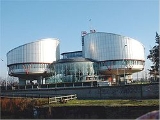
The European Court of Human Rights (ECtHR) in Strasbourg
Strasbourg

Strasbourg is the capital and principal city of the Alsace Regions of France in northeastern France. With 702,412 inhabitants in 2007, its metropolitan area is the Aire urbaine....
 was established under the European Convention on Human Rights
European Convention on Human Rights

The Convention for the Protection of Human Rights and Fundamental Freedoms , was adopted under the auspices of the Council of Europe in 1950 to protect human rights and fundamental Freedom in Europe....
 (ECHR) of 1950 to monitor compliance by Contracting Parties. The European Convention on Human Rights, or formally named Convention for the Protection of Human Rights and Fundamental Freedoms, is one of the most important conventions adopted by the Council of Europe
Council of Europe

The Council of Europe is the oldest international organisation working towards European integration, having been founded in 1949. It has a particular emphasis on legal standards, human rights, democracy development, the rule of law and cultural co-operation....
. All 47 member states of the Council of Europe are contracting parties of the Convention.


Discussion
Ask a question about 'European Court of Human Rights'
Start a new discussion about 'European Court of Human Rights'
Answer questions from other users
Full Discussion Forum


Encyclopedia


The European Court of Human Rights (ECtHR) in Strasbourg
Strasbourg

Strasbourg is the capital and principal city of the Alsace Regions of France in northeastern France. With 702,412 inhabitants in 2007, its metropolitan area is the Aire urbaine....
 was established under the European Convention on Human Rights
European Convention on Human Rights

The Convention for the Protection of Human Rights and Fundamental Freedoms , was adopted under the auspices of the Council of Europe in 1950 to protect human rights and fundamental Freedom in Europe....
 (ECHR) of 1950 to monitor compliance by Contracting Parties. The European Convention on Human Rights, or formally named Convention for the Protection of Human Rights and Fundamental Freedoms, is one of the most important conventions adopted by the Council of Europe
Council of Europe

The Council of Europe is the oldest international organisation working towards European integration, having been founded in 1949. It has a particular emphasis on legal standards, human rights, democracy development, the rule of law and cultural co-operation....
. All 47 member states of the Council of Europe are contracting parties of the Convention. Applications against Contracting Parties for human rights
Human rights

Human rights refer to the "basic rights and freedom to which all humans are entitled." Examples of rights and freedoms which have come to be commonly thought of as human rights include civil and political rights, such as the right to life and liberty, freedom of speech, and equality before the law; and social, cultural and economic rights, i...
 violations can be brought before the Court either by other States Parties or by individuals.

History and structure

The Court was instituted as a permanent court with full-time judges on 1 November 1998, replacing the then existing enforcement mechanisms, which included the European Commission of Human Rights
European Commission of Human Rights

European Commission of Human Rights was a special tribunal.From 1954 to the entry into force of Protocol 11 of the European Convention on Human Rights, individuals did not have direct access to the European Court of Human Rights; they had to apply to the Commission, which if it found the case to be well-founded would launch a case in the Co...
 (created in 1954) and the European Court of Human Rights, which had been created in 1959.

The Court delivered its first judgment in 1960, Lawless v. Ireland.

The new format of the Court was the result of the ratification of Protocol 11, an amendment to the Convention that was ratified in November 1998. The new full-time Judges were subsequently elected by the Parliamentary Assembly
Parliamentary assembly

A parliamentary assembly is part of many international organizations. Examples include:*European Parliamentary Assembly *NATO Parliamentary Assembly ...
 of the Council of Europe.

By the time Protocol No. 11 entered into force on 1 November 1998 establishing a full-time Court and opening up direct access to the Court for 800 million Europeans, the Court had delivered 837 judgments. Seven years on at the end of 2005 the Court had delivered 5,968 judgments.

All member states of the Council of Europe have to sign and ratify the Convention. The court consists of a number of judges equal to the number of Contracting Parties, which currently stand at 47. Each judge is elected in respect of a Contracting Party by the Parliamentary Assembly
Parliamentary assembly

A parliamentary assembly is part of many international organizations. Examples include:*European Parliamentary Assembly *NATO Parliamentary Assembly ...
 of the Council of Europe. Despite this correspondence, however, there are no nationality requirements for judges (e.g. a Swiss national is elected in respect of Liechtenstein). Judges are assumed to be impartial arbiters, rather than representatives of any country. Judges are elected to six-year terms. They can be re-elected.

The court is divided into five "Sections", each of which consists of a geographic and gender-balanced selection of justices. The entire court elects a President and five Section Presidents, two of whom also serve as Vice-Presidents of the court. All terms last for three years. Each section selects a Chamber, which consists of the Section President and a rotating selection of six other justices. The court also maintains a 17-member Grand Chamber, which consists of the President, Vice-Presidents, and Section Presidents, in addition to a rotating selection of justices from one of two balanced groups. The selection of judges alternates between the groups every nine months.

On 18 September 2008, the Court has delivered its 10 000th judgment, Takhayeva and Others v. Russia (no. 23286/04). The Strasbourg Court found violations of Articles 2 (right to life), 3 (prohibition of inhuman or degrading treatment), 5 (right to liberty and security) and 13 (right to an effective remedy) of the European Convention on Human Rights
European Convention on Human Rights

The Convention for the Protection of Human Rights and Fundamental Freedoms , was adopted under the auspices of the Council of Europe in 1950 to protect human rights and fundamental Freedom in Europe....
 concerning the applicants’ complaint that their relative disappeared after being abducted from their village in Chechnya
Chechnya

The Chechen Republic , or, informally, Chechnya , sometimes referred to as Ichkeria , Chechnia, Chechenia or Nox?iyn, is a federal subjects of Russia of Russia....
 by Russian servicemen.

Procedure

Complaints of violations by member states are filed in Strasbourg
Strasbourg

Strasbourg is the capital and principal city of the Alsace Regions of France in northeastern France. With 702,412 inhabitants in 2007, its metropolitan area is the Aire urbaine....
, and are assigned to a Section. Each complaint is first heard by a committee of three judges, which may unanimously vote to strike any complaint without further examination. Once past committee, the complaint is heard and decided by a full Chamber. Decisions of great importance may be appealed to the Grand Chamber. Any decision of the court is binding on the member states and must be complied with, except if it consists of an advisory opinion

It is the role of the Committee of Ministers of the Council of Europe to supervise the execution of court judgments, though it has no formal means of using force against member countries in order to comply. However, the ultimate sanction of non-compliance is expulsion from the Council of Europe and thus becoming a 'pariah' state within Europe. Furthermore, the European Union
European Union

The European Union is an economic and political union of 27 European Union member state, located primarily in Europe. It was established by the Treaty of Maastricht on 1 November 1993 upon the foundations of the pre-existing European Economic Community....
 takes a keen interest in the Convention and Court (and its jurisprudence
Jurisprudence

Jurisprudence is the theory and philosophy of law. Scholars of jurisprudence, or legal philosophers, hope to obtain a deeper understanding of the nature of law, of legal reasoning, legal systems and of legal institutions....
) so would not look kindly upon any EU member state that did not fulfill its Convention obligations.

Judges

As of 23 Dec 2008 (in order of precedence):

The Plenary Court elects the Registrar and one or more Deputy Registrars. The Registrar is the head of the Registry, which performs legal and administrative tasks and drafts decisions and judgments on behalf of the Court. The Registrar and Deputy Registrar as of 4 January 2007 are:

  • Erik Fribergh, Registrar ( Sweden
    Sweden

    Sweden , officially the Kingdom of Sweden , is a Nordic countries on the Scandinavian Peninsula in Northern Europe. Sweden has land borders with Norway to the west and Finland to the northeast, and it is connected to Denmark by the ?resund Bridge in the south....
    )
  • Michael O’Boyle, Deputy Registrar ( Ireland
    Republic of Ireland

    Ireland is an Island country in north-western Europe. The modern Sovereignty state occupies about five-sixths of the island of Ireland, which was partitioned by the British on 3 May 1921....
    )


Sections

Composition of the Sections (2007)
Position Section I Section II Section III Section IV Section V
Section President Mr C.L. Rozakis Mrs F. Tulkens Mr B.M. Zupancic Sir Nicolas Bratza Mr P. Lorenzen
Section Vice-President Mr L. Loucaides Mr A.B. Baka Mr C. Birsan Mr J. Casadevall Mrs S. Botoucharova
JudgeMrs N. VajicMr I. Cabral BarretoMr J.-P. CostaMr G. BonelloMr K. Jungwiert
JudgeMr A. KovlerMr R. TürmenMrs E. Fura-SandstromMr K. TrajaMr V. Butkevych
JudgeMrs E. SteinerMr M. UgrekhelidzeMrs A. GyulumyanMr S. PavlovschiMrs M. Tsatsa-Nikolovska
JudgeMr K. HajiyevMr V. ZagrebelskyMr E. MyjerMr L. GarlickiMr R. Maruste
JudgeMr D. SpielmannMrs A. MularoniMr D. BjörgvinssonMrs L. MijovicMr J. Borrego Borrego
JudgeMr S. E. JebensMrs D. JocieneMrs I. ZiemeleMr J. ŠikutaMrs R. Jaeger
JudgeMr G. MalinverniMr D. PopovicMrs I. Berro-LefèvreMrs P. HirveläMr M. Villiger
Section RegistrarS. NielsenS. DolléS. QuesadaL. EarlyC. Westerdiek
Deputy Section RegistrarA. WampachF. Elens-PassosS. NaismithF. AraçiS. Phillips


Reform

Due to the increase in awareness of European citizens of their rights under the Convention, the Court was becoming a victim of its own success. Some cases were taking up to five years before being decided and there is a significant backlog. For example, according to the (issued by the Council of Europe), between 1 November 2003 and 29 February 2004 the Court dealt with 7315 cases, of which 6255 were declared inadmissible.

Working on the principle that 'justice delayed is justice denied
Justice delayed is justice denied

"Justice delayed is justice denied" is a law clich? meaning that if Legal remedy is available for a party that has suffered some injury, but is not forthcoming in a timely fashion, it is effectively the same as having no redress at all....
', the Council of Europe set up a working party to consider ways of improving the efficiency of the Court. This resulted in an amendment to the Convention for the Protection of Human Rights and Fundamental Freedoms
European Convention on Human Rights

The Convention for the Protection of Human Rights and Fundamental Freedoms , was adopted under the auspices of the Council of Europe in 1950 to protect human rights and fundamental Freedom in Europe....
, Protocol 14. This new protocol, which requires universal ratification by all Council of Europe member states to come into force, makes a number of changes:

  • A single judge can decide on a case's admissibility. Currently, three judges decide.
  • Where cases are broadly similar to ones brought previously before the Court, and are essentially due to a member state failing to change their domestic law to correct a failing highlighted by that previous judgment, the case can be decided by three judges rather than the seven-judge Chamber.
  • A case may not be admissible if it is considered that the applicant has not suffered 'significant disadvantage'. However, this is not a 'hard and fast' rule.
  • A member state can be brought before the court by the Committee of Ministers
    Committee of Ministers

    The Committee of Ministers of the Council of Europe or commonly the Committee of Ministers is the Council of Europe's decision-making body....
     if that state refuses to enforce a judgment against it.
  • The Committee of Ministers
    Committee of Ministers

    The Committee of Ministers of the Council of Europe or commonly the Committee of Ministers is the Council of Europe's decision-making body....
     can ask the Court for an 'interpretation' of a judgement to help determine the best way for a member state to comply with it.


Amnesty International

Amnesty International is an international non-governmental organization which defines its mission as "to conduct research and generate action to prevent and end grave abuses of human rights and to demand justice for those whose rights have been violated." Founded in London, England in 1961, AI draws its attention to human rights abuses and...
 has expressed concern that these changes to the admissibility criteria will mean individuals may lose the ability to 'gain redress for human rights violations'.

Some notable cases

In December 1977, the court ruled that the government of the United Kingdom
United Kingdom

The United Kingdom of Great Britain and Northern Ireland, commonly known as the United Kingdom , the UK or Britain,is a sovereign state located off the northwestern coast of continental Europe....
 was guilty of "inhuman and degrading treatment", of men interned without trial, by the court, following a case brought by the Republic of Ireland
Republic of Ireland

Ireland is an Island country in north-western Europe. The modern Sovereignty state occupies about five-sixths of the island of Ireland, which was partitioned by the British on 3 May 1921....
 (Case No. 5310/71). The court found that while their internment was a violation of the convention rights, it was justifiable in the circumstances; it however ruled that the practice of the five techniques
Five techniques

The term five techniques refers to certain interrogation practices adopted by the Northern Ireland and United Kingdom governments during Operation Demetrius in the early 1970s....
 and the practice of beating prisoners constituted inhumane and degrading punishment in violation of the convention, although not torture.

In 1980, the court ruled out the foetal right to sue the mother carrying the foetus. In Paton v. United Kingdom, it was discovered that the life of foetus is "intimately connected with, and cannot be regarded in isolation from, the life of the pregnant woman".

In 2003 and 2004, the court ruled that "that sharia
Sharia

Sharia is the body of Islamic religious law. The term means "way" or "path to the water source"; it is the legal framework within which the public and private aspects of life are regulated for those living in a legal system based on Fiqh and for Muslims living outside the domain....
 is incompatible with the fundamental principles of democracy" (13/02/2003), because the sharia rules on inheritance, women's rights and religious freedom violate human rights as established in the European Convention on Human Rights.

In 2006, the court denied admissibility of the applications of former Soviet
Soviet Union

The Union of Soviet Socialist Republics was a Constitution of the Soviet Union socialist state that existed in Eurasia from 1922 to 1991.The name is a translation of the , romanization of Russian Soyuz Sovetskikh Sotsialisticheskikh Respublik, abbreviated ????, SSSR....
 secret services operatives convicted in Estonia
Estonia

Estonia , officially the Republic of Estonia is a country in the Baltic region of Northern Europe. It is bordered to the north by Finland across the Gulf of Finland, to the west by Sweden across the Baltic Sea, to the south by Latvia , and to the east by the Russia ....
 for Stalinist crimes against humanity after Estonia became independent in 1991. See also European Court of Human Rights cases on Occupation of Baltic States
European Court of Human Rights cases on Occupation of Baltic States

European Court of Human Rights cases on Occupation of Baltic States are landmark rulings by the European Court of Human Rights, which concern activities of the USSR including military and security services in the occupied Baltic states between 1940 and 1991....
.

Since the Russian military invaded Chechnya
Chechnya

The Chechen Republic , or, informally, Chechnya , sometimes referred to as Ichkeria , Chechnia, Chechenia or Nox?iyn, is a federal subjects of Russia of Russia....
 for the second time in 1999, the court has agreed to hear cases of human rights abuse brought forward by Chechen civilian
Civilian

A civilian under international humanitarian law is a person who is not a member of his or her country's armed forces. The term is also often used colloquially to refer to people who are not members of a particular profession or occupation, especially by law enforcement agency, which often use rank structures similar to those of military units...
s against Russia in the course of the Second Chechen War
Second Chechen War

The Second Chechen War, in a later phase better known as the War in the North Caucasus, was launched by the Russian Federation starting August 26 1999, in which Russian federal forces re-took control of the separatist region of Chechnya and installed a pro-Kremlin regime which is now lead by President Ramzan Kadyrov....
, with 31 rulings to date as of June 2008 (including regarding the cases of torture and extrajudicial executions). In 2007, for example, the Court ruled that Russia was responsible for the killings of a human rights activist Zura Bitiyeva
Zura Bitiyeva

Zura Bitieva , was a locally well-known human rights activism in Chechnya, who was summary execution by a death squad of death squad presumably composed of an unidentified Spetsnaz or Osnaz servicemen....
 and her family. Bitiyeva herself had filed a complaint against Moscow with the ECHR in 2000 for abuse while in detention, in then-second case from Chechnya, but she was murdered in 2003 before the ruling was issued. Other cases ruled against Russia included the deaths (or presumed deaths after years of forced disappearance
Forced disappearance

A forced disappearance occurs when force is used to cause a person to vanish from public view, followed by a refusal to acknowledge the deprivation of liberty , thereby placing the victim outside the protection of law....
) of Ruslan Alikhadzhyev, Shakhid Baysayev
Shakhid Baysayev

Shakhid Baysayev was Chechen people civilian who was forced disappearance after being detained by Russian special police forces on the outskirts of Grozny, Chechnya in March 2000....
, Nura Luluyeva
Nura Luluyeva

Nura Luluyeva was a Chechen people woman who was kidnapping, tortured and murdered by unidentified Russian servicemen in 2000. No one was ever punished for the crime by the Russian state....
 and Khadzhi-Murat Yandiyev
Khadzhi-Murat Yandiyev

Khadzhi-Murat Yandiyev was a 25-year old Ingushes insurgent fighter, who was Forced disappearance in February 2000 after being filmed in the company of Russian Army general ordering him taken away and shot....
, the case of the indiscriminate bombing of Katyr-Yurt
Bombing of Katyr-Yurt

The reported bombing of Katyr-Yurt occurred on February 4 2000, when Russian forces bombed the village of Katyr-Yurt and a refugee convoy under white flags in an attempt to stop the breakout of the Chechen Republic of Ichkeria forces from Grozny, killing or injuring hundreds of people....
, and some of the deaths during the Novye Aldi massacre
Novye Aldi massacre

Novye Aldi massacre was a February 5 2000, incident in which Russian Federation summary execution at least 50 civilians in the Novye Aldi suburb of Grozny, the capital of Chechnya....
. As of 2008, ECHR has been flooded by a complaints from Chechnya, what the Human Rights Watch
Human Rights Watch

Human Rights Watch is a United States based, international non-governmental organization that conducts research and advocacy on human rights. Its headquarters are in New York City....
 called "the last hope for the victims".

In 19.2.2009, within the case of A. and Others v. the United Kingdom, the Grand Chamber of the Court held unanimously that there had been a violation of right to liberty and security, a violation of right to have lawfulness of detention decided by a court, and violation of right to be compensated for these violations. The case concerned the applicants’ complaints that they were detained in high security conditions under a statutory scheme which permitted the indefinite detention of non-nationals certified by the Secretary of State as suspected of involvement in terrorism. The applicants were 11 individuals, six are of Algerian
Algerian

Algerian may refer to:* Something of, or related to Algeria* A person or people from Algeria, or of Algerian descent. For information about the Algerian people, see Demographics of Algeria and Culture of Algeria....
 nationality; four are, respectively, of French
French people

French people can refer to:* The legal residents and citizens of France, regardless of ancestry. For a legal discussion, see French nationality law....
, Jordanian
Jordanian

Jordanian may refer to:* Something of, from, or related to Jordan, an Arab country in Southwest Asia* A person from Jordan, or of Jordanian descent....
, Moroccan
Moroccan

Moroccan may refer to:* Something of, from, or related to Morocco, ia country located in North Africa** A person from Morocco, or of Moroccan descent....
 and Tunisian
Tunisian

Tunisian refer to anything of or relating to Tunisia. It may also refer to:*Tunisian Arabic*Tunisian people*Cuisine of Tunisia...
 nationality; and, one, born in a Palestinian refugee camp in Jordan
Jordan

Jordan , officially the Hashemite Kingdom of Jordan, is an Arab country in Southwest Asia spanning the southern part of the Syrian Desert down to the Gulf of Aqaba....
, is stateless
Stateless

Stateless may refer to:* Without state, see state In society:* Stateless nation, a group of people without a nation-state* Statelessness, the legal and social concept applicable to persons who are not citizens or subjects of any state...
. The Court made awards under Article 41 of the European Convention on Human Rights
European Convention on Human Rights

The Convention for the Protection of Human Rights and Fundamental Freedoms , was adopted under the auspices of the Council of Europe in 1950 to protect human rights and fundamental Freedom in Europe....
 (just satisfaction) which were substantially lower than those which it had made in past cases of unlawful detention, in view of the fact that the detention scheme was devised in the face of a public emergency and as an attempt to reconcile the need to protect the United Kingdom
United Kingdom

The United Kingdom of Great Britain and Northern Ireland, commonly known as the United Kingdom , the UK or Britain,is a sovereign state located off the northwestern coast of continental Europe....
 public against terrorism with the obligation not to send the applicants back to countries where they faced a real risk of ill-treatment. The Court therefore awarded, to the six Algerian applicants EUR 3,400, EUR 3,900, EUR 3,800, EUR 3,400, EUR 2,500 and EUR 1,700, respectively; to the stateless and Tunisian applicants EUR 3,900, each; and to the Jordanian applicant, EUR 2,800. The applicants were jointly awarded EUR 60,000 for legal costs.

Other cases

  • Dudgeon v. United Kingdom
    Dudgeon v. United Kingdom

    Dudgeon v. United Kingdom was a European Court of Human Rights case, similar to the U.S. cases of Bowers v. Hardwick and Lawrence v. Texas....
    : sodomy
    Sodomy

    Sodomy is a term used today predominantly in law to describe the act of anal intercourse, oral intercourse, as well as bestiality. When used in a religious context, it has a negative connotation....
     and the right to privacy
  • McLibel case
    McLibel case

    "McLibel" directs here. For the film see McLibel .The McDonald's Restaurants v Morris & Steel, colloquially the McLibel case, was a long-running England lawsuit for libel filed by McDonald's against environmentalism activists Helen Steel and David Morris over a pamphlet critical of the company....
    : legal aid
    Legal aid

    Most Liberal democracy consider that it is necessary to provide some level of legal aid to persons otherwise unable to afford legal representation....
     in libel cases
  • Murray v. United Kingdom
    Murray v. United Kingdom

    Murray v. United Kingdom was a legal case heard by the European Court of Human Rights in 1994 to determine if part of the United Kingdom's anti-terrorism laws were in violation of the Convention for the Protection of Human Rights and Fundamental Freedoms....
    : anti-terrorism laws
  • John Murray v. United Kingdom
    John Murray v. United Kingdom

    John Murray v. United Kingdom was a legal case heard by the European Court of Human Rights in 1996 regarding the right to silence in the United Kingdom, especially the legality of the reduction in the right so as to allow for adverse inferences to be made....
    : right to silence
    Right to silence

    The right to remain silent is a law protection given to people undergoing police interrogation or trial . The law is recognized, explicitly or by convention, in many of the world's legal systems....
  • Funke v. France
    Funke v. France

    Funke v. France was a legal case heard by the European Court of Human Rights in September 1992, with the court publishing its judgement on February 25, 1993....
    : right to a fair trial
    Right to a fair trial

    The right to fair trial is seen as an essential right in all countries respecting the rule of law. A trial in these countries that is deemed unfair will typically be restarted, or its verdict wiktionary:quashed....
  • Saunders v. the United Kingdom
    Saunders v. the United Kingdom

    Saunders v. the United Kingdom was a legal case heard by the European Court of Human Rights regarding the right against self-incrimination and the presumption of innocence as included in the European Convention on Human Rights Convention for the Protection of Human Rights and Fundamental Freedoms#Article 6 - fair trial....
    : right to silence
  • List of ECHR cases concerning existence of political parties
    List of ECHR cases concerning existence of political parties

    Chronological list*1957 - Communist Party of Germany, Reimann and Fisch v. Germany*1998 - United Communist Party of Turkey and Others v. Turkey...
  • List of ECtHR cases concerning legal ethics
  • List of LGBT-related cases
    List of LGBT-related ECHR cases

    This list contains cases of the European Court of Human Rights related to LGBT people....
  • ASLEF v. United Kingdom
    ASLEF v. United Kingdom

    Associated Society of Locomotive Engineers and Firemen v. the United Kingdom [2007] IRLR 361 was a landmark case before the European Court of Human Rights and upheld the right of Associated Society of Locomotive Engineers and Firemen, a British trade union, to be able to choose its members....
    : right of unions to expel members
  • Church of Scientology Moscow versus Russia
  • Soering v. United Kingdom
    Soering v. United Kingdom

    Soering v. the United Kingdom 11 Eur. Ct. H.R. is a landmark decision judgment of the European Court of Human Rights which established that the extradition of a young German national to the United States to face charges of Capital punishment violated Article 3 of the European Convention on Human Rights guaranteeing the right against in...
    : extradition
    Extradition

    Extradition is the official process by which one nation or state requests and obtains from another nation or state the surrender of a suspected or convicted criminal....
    , right against inhuman and degrading treatment


Architecture

The building, which houses the court chambers and Registry (administration and référendaires), was designed by the Richard Rogers
Richard Rogers

Richard George Rogers, Baron Rogers of Riverside, Order of the Companions of Honour, Royal Institute of British Architects, Chartered Society of Designers, is a British architect noted for his modernist and Functionalism designs....
 Partnership and completed in 1995. The design is meant to reflect, amongst other things, the two distinct components of the Commission and Court (as it then was). Wide scale use of glass emphasises the 'openness' of the court to European citizens.

See also

  • African Court on Human and Peoples' Rights
    African Court on Human and Peoples' Rights

    The African Court on Human and Peoples' Rights is a regional court that rules on African Union states' compliance with the African Charter on Human and Peoples' Rights....
     - regional court established in 2006
  • European Court of Human Rights cases
  • Human rights in Europe
    Human rights in Europe

    The current human rights situation in Europe on the whole is believed by many to be good. However, there are several human rights alleged problems ranging from the treatment of asylum seekers through police brutality to various infringements of the judicial rights and freedoms of businesspersons under bureaucratic regulatory sub-regimes....
  • Inter-American Court of Human Rights
    Inter-American Court of Human Rights

    The Inter-American Court of Human Rights is an autonomous judicial institution based in the city of San Jos?, Costa Rica, Costa Rica.Together with the Inter-American Commission on Human Rights, it makes up the human rights protection system of the Organization of American States , which serves to uphold and promote basic rights and freedoms...
     - regional court established in 1979


External links

  • (before Protocol 14)
  • - IFEX
    International Freedom of Expression Exchange

    The International Freedom of Expression Exchange , founded in 1992, is a global network of 81 Non-governmental organization that promotes and defends the right to freedom of expression....