

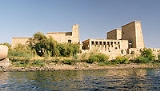
Philae

Encyclopedia
Philae is an island
in the Nile River and the previous site of an Ancient Egypt
ian temple
complex in southern Egypt
. The complex was dismantled and relocated to a nearby island
during a UNESCO project started because of the construction of the Aswan Dam
, after the site was partly flooded by the earlier Aswan Low Dam
for half a century.
, Diodorus, Ptolemy
, Seneca
, Pliny the Elder
. It was, as the plural name indicates, the appellation of two small islands situated in latitude 24° north
, just above the First Cataract near Aswan
(Ancient Egyptian
: Swenet, "Trade;" ). Groskurd computes the distance between these islands and Aswan at about 61.5 miles (99 km).
Philae proper, although the smaller island, is, from the numerous and picturesque ruins formerly there, the more interesting of the two. Prior to the inundation, it was not more than 1250 feet (381 m) long and about 400 feet (121.9 m) broad. It is composed of Syenite
stone: its sides are steep and on their summits a lofty wall was built encompassing the island.
Philae, being accounted one of the burying-places of Osiris
, was held in high reverence both by the Egyptians to the north and the Nubia
ns (often referred to as Ethiopia
ns in Greek) to the south. It was deemed profane for any but priests to dwell there and was accordingly sequestered and denominated "the Unapproachable" . It was reported too that neither birds flew over it nor fish approached its shores. These indeed were the traditions of a remote period; since in the time of the Ptolemies of Egypt, Philae was so much resorted to, partly by pilgrims to the tomb of Osiris, partly by persons on secular errands, that the priests petitioned Ptolemy Physcon (170-117 BC) to prohibit public functionaries at least from coming thither and living at their expense. In the 19th century AD, William John Bankes
brought the Philae obelisk
on which this petition was engraved to England
. When its Egyptian hieroglyphs
were compared with those of the Rosetta stone
, it threw great light upon the Egyptian consonantal alphabet.
The islands of Philae were not, however, merely sacerdotal abodes; they were the centres of commerce also between Meroë
and Memphis
. For the rapids of the cataracts were at most seasons impracticable, and the commodities exchanged between Egypt and Nubia were reciprocally landed and re-embarked at Syene and Philae.
The neighbouring granite
quarries
attracted hither also a numerous population of miners and stonemasons; and, for the convenience of this traffic, a gallery or road was formed in the rocks along the east bank of the Nile, portions of which are still extant.
Philae also was remarkable for the singular effects of light and shade resulting from its position near the Tropic of Cancer
. As the sun approached its northern limit the shadows from the projecting cornices and moldings of the temples sink lower and lower down the plain surfaces of the walls, until, the sun having reached its highest altitude, the vertical walls are overspread with dark shadows, forming a striking contrast with the fierce light which illuminates all surrounding objects.
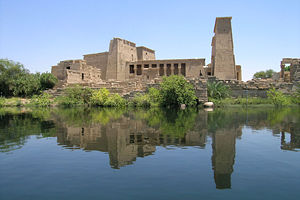


 The most conspicuous feature of both islands was their architectural wealth. Monuments of various eras, extending from the Pharaohs to the Caesars, occupy nearly their whole area. The principal structures, however, lay at the south end of the smaller island.
The most ancient were the remains of a temple for Isis
built in the reign of Nectanebo I
during 380-362 BC, was approached from the river through a double colonnade
. Nekhtnebef is his nomen and he became the founding pharaoh of the thirtieth and last dynasty of native rulers when he deposed and killed Nefaarud II
. Isis was the goddess to whom the initial buildings were dedicated. See Gerhart Haeny's 'A Short History of Philae' (BIFAO 1983) and numerous other articles which incontrovertibly identify Isis (not Hathor
) as the primary goddess of the sacred isle.
For the most part, the other ruins date from the Ptolemaic times
, more especially with the reigns of Ptolemy Philadelphus, Ptolemy Epiphanes, and Ptolemy Philometor (282-145 BC), with many traces of Roman work in Philae dedicated to Ammon
-Osiris
.
In front of the propyla were two colossal lion
s in granite, behind which stood a pair of obelisks, each 44 feet (13.4 m) high. The propyla were pyramidal in form and colossal in dimensions. One stood between the dromos
and pronaos, another between the pronaos and the portico
, while a smaller one led into the sekos or adytum
. At each corner of the adytum stood a monolithic shrine, the cage of a sacred hawk. Of these shrines one is now in the Louvre
, the other in the Museum at Florence.
Beyond the entrance into the principal court are small temples, one of which, dedicated to Isis, Hathor, and a wide range of deities related to midwifery
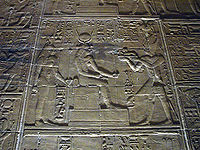
, is covered with sculptures representing the birth of Ptolemy Philometor, under the figure of the god Horus
. The story of Osiris
is everywhere represented on the walls of this temple, and two of its inner chambers are particularly rich in symbolic imagery. Upon the two great propyla are Greek inscriptions intersected and partially destroyed by Egyptian figures cut across them.
The inscriptions do not at all belong to the Macedonian era, and are of earlier date than the sculptures, which were probably inserted during that interval of renaissance for the native religion which followed the extinction of the Greek dynasty in Egypt in 30 BC by the Romans.
The monuments in both islands indeed attested, beyond any others in the Nile valley, the survival of pure Egyptian art centuries after the last of the Pharaohs had ceased to reign. Great pains have been taken to mutilate the sculptures of this temple. The work of demolition is attributable, in the first instance, to the zeal of the early Christians, and afterward, to the policy of the Iconoclasts
, who curried favour for themselves with the Byzantine court
by the destruction of heathen images as well as Christian ones.
The soil of Philae had been prepared carefully for the reception of its buildings–being leveled where it was uneven, and supported by masonry where it was crumbling or insecure. For example, the western wall of the Great Temple, and the corresponding wall of the dromos, were supported by very strong foundations, built below the pre-inundation level of the water, and rested on the granite which in this region forms the bed of the Nile. Here and there steps were hewn out from the wall to facilitate the communication between the temple and the river.
At the southern extremity of the dromos of the Great Temple was a smaller temple, apparently dedicated to Hathor
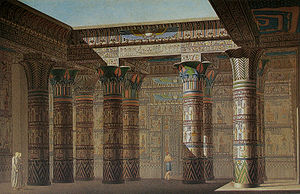
; at least the few columns that remained of it are surmounted with the head of that goddess. Its portico consisted of twelve columns, four in front and three deep. Their capitals represented various forms and combinations of the palm branch, the doum-palm branch, and the lotus flower. These, as well as the sculptures on the columns, the ceilings, and the walls were painted with the most vivid colors, which, owing to the dryness of the climate, have lost little of their original brilliance.
s of Egypt kept there a strong garrison, and, for the same reason, it was a barrack also for Macedonian and Roman
soldiers in their turn. The first temple structure, which was built by native pharaohs of the thirtieth dynasty, was the one for Hathor
.
. The principal deity of the temple complex was Isis
, but other temples and shrines were dedicated to other deities such as Hathor
and Harendotes. The temple was closed down officially in the 6th century AD by the Byzantine emperor, Justinian ( 527-565 AD ). Philae was a seat of the Christian religion as well as of the ancient Egyptian faith. Ruins of a Christian church were discovered, and more than one adytum bore traces of having been made to serve at different eras the purposes of a chapel of Osiris and of Christ.
 The island of Philae attracted much attention in the 19th century. In the 1820s, Joseph Bonomi the Younger
, a British Egyptologist and museum
curator
visited the island. So did Amelia Edwards
, a British novelist in 1873–1874.
These visits are only a small sample of the great interest that Victorian-era
Britain had for Egypt. Soon, tourism
to Philae became common.
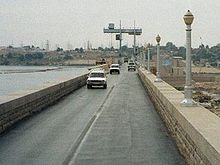 In 1902, the Aswan Low Dam
was completed on the Nile River by the British
. This threatened many ancient landmarks, including the temple complex of Philae, with being submerged. The dam was heightened twice, from 1907–12 and from 1929–34, and the island of Philae was nearly always flooded. In fact, the complex was not underwater only when the dam
's sluice
s were open, from July to October.
It was postulated that the temples be relocated, piece by piece, to nearby islands, such as Bigeh
or Elephantine
. However, the temples' foundation
s and other architectural
supporting structures were strengthened instead. Although the buildings were physically secure, the island's attractive vegetation
and the colors of the temples' relief
s were washed away. Also, the bricks of the Philae temples soon became encrusted with silt
and other debris carried by the Nile.
started a project in order to try and save the buildings on the island from the destructive effect of the ever increasing waters of the Nile
.
The temples had been practically intact since the ancient days, but with each inundation the situation worsened and in the sixties the island was submerged up to a third of the buildings all year round.
First of all a large coffer dam was built, constructed of two rows of steel plates between which a million cubic meters of sand was tipped. Any water that seeped through was pumped away.
Next the monuments were cleaned and measured, by using photogrammetry
, a method that enables the exact reconstruction of the original size of the building blocks that were used by the ancients.
Then every building was dismantled into about 40,000 units, and then transported to the nearby island of Agilkia
, situated on higher ground some 500 meters away.
Beghé, like Philae, was a holy island; its and rocks are inscribed with the names and titles of Amenhotep III
, Rameses the Great, Psammetichus
, Apries
, and Amasis, together with memorials of the later Macedonian and Roman rulers of Egypt. Its principal ruins consisted of the propylon and two columns of a temple, which was apparently of small dimensions, but of elegant proportions. Near them were the fragments of two colossal granite statues and also an excellent piece of masonry of much later date, having the aspect of an arch belonging to some Greek church or Saracen mosque
.
Island
An island or isle is any piece of sub-continental land that is surrounded by water. Very small islands such as emergent land features on atolls can be called islets, cays or keys. An island in a river or lake may be called an eyot , or holm...
in the Nile River and the previous site of an Ancient Egypt
Ancient Egypt
Ancient Egypt was an ancient civilization of Northeastern Africa, concentrated along the lower reaches of the Nile River in what is now the modern country of Egypt. Egyptian civilization coalesced around 3150 BC with the political unification of Upper and Lower Egypt under the first pharaoh...
ian temple
Egyptian temple
Egyptian temples were built for the official worship of the gods and commemoration of pharaohs in Ancient Egypt and in regions under Egyptian control. These temples were seen as houses for the gods or kings to whom they were dedicated...
complex in southern Egypt
Egypt
Egypt , officially the Arab Republic of Egypt, Arabic: , is a country mainly in North Africa, with the Sinai Peninsula forming a land bridge in Southwest Asia. Egypt is thus a transcontinental country, and a major power in Africa, the Mediterranean Basin, the Middle East and the Muslim world...
. The complex was dismantled and relocated to a nearby island
Agilkia Island
Agilkia Island is an island in the Nile River and the present site of an Ancient Egyptian temple complex of Philae in southern Egypt...
during a UNESCO project started because of the construction of the Aswan Dam
Aswan Dam
The Aswan Dam is an embankment dam situated across the Nile River in Aswan, Egypt. Since the 1950s, the name commonly refers to the High Dam, which is larger and newer than the Aswan Low Dam, which was first completed in 1902...
, after the site was partly flooded by the earlier Aswan Low Dam
Aswan Low Dam
The Aswan Low Dam or Old Aswan Dam is a gravity masonry buttress dam on the Nile River in Aswan, Egypt. The dam was built at the former first cataract of the Nile, and is located about 1000 km up-river and 690 km south-southeast of Cairo...
for half a century.
Situation
Philae is mentioned by numerous ancient writers, including StraboStrabo
Strabo, also written Strabon was a Greek historian, geographer and philosopher.-Life:Strabo was born to an affluent family from Amaseia in Pontus , a city which he said was situated the approximate equivalent of 75 km from the Black Sea...
, Diodorus, Ptolemy
Ptolemy
Claudius Ptolemy , was a Roman citizen of Egypt who wrote in Greek. He was a mathematician, astronomer, geographer, astrologer, and poet of a single epigram in the Greek Anthology. He lived in Egypt under Roman rule, and is believed to have been born in the town of Ptolemais Hermiou in the...
, Seneca
Seneca the Younger
Lucius Annaeus Seneca was a Roman Stoic philosopher, statesman, dramatist, and in one work humorist, of the Silver Age of Latin literature. He was tutor and later advisor to emperor Nero...
, Pliny the Elder
Pliny the Elder
Gaius Plinius Secundus , better known as Pliny the Elder, was a Roman author, naturalist, and natural philosopher, as well as naval and army commander of the early Roman Empire, and personal friend of the emperor Vespasian...
. It was, as the plural name indicates, the appellation of two small islands situated in latitude 24° north
24th parallel north
The 24th parallel north is a circle of latitude that is 24 degrees north of the Earth's equatorial plane. It crosses Africa, Asia, the Indian Ocean, the Pacific Ocean, North America and the Atlantic Ocean....
, just above the First Cataract near Aswan
Aswan
Aswan , formerly spelled Assuan, is a city in the south of Egypt, the capital of the Aswan Governorate.It stands on the east bank of the Nile at the first cataract and is a busy market and tourist centre...
(Ancient Egyptian
Egyptian language
Egyptian is the oldest known indigenous language of Egypt and a branch of the Afroasiatic language family. Written records of the Egyptian language have been dated from about 3400 BC, making it one of the oldest recorded languages known. Egyptian was spoken until the late 17th century AD in the...
: Swenet, "Trade;" ). Groskurd computes the distance between these islands and Aswan at about 61.5 miles (99 km).
Philae proper, although the smaller island, is, from the numerous and picturesque ruins formerly there, the more interesting of the two. Prior to the inundation, it was not more than 1250 feet (381 m) long and about 400 feet (121.9 m) broad. It is composed of Syenite
Syenite
Syenite is a coarse-grained intrusive igneous rock of the same general composition as granite but with the quartz either absent or present in relatively small amounts Syenite is a coarse-grained intrusive igneous rock of the same general composition as granite but with the quartz either absent or...
stone: its sides are steep and on their summits a lofty wall was built encompassing the island.
Philae, being accounted one of the burying-places of Osiris
Osiris
Osiris is an Egyptian god, usually identified as the god of the afterlife, the underworld and the dead. He is classically depicted as a green-skinned man with a pharaoh's beard, partially mummy-wrapped at the legs, wearing a distinctive crown with two large ostrich feathers at either side, and...
, was held in high reverence both by the Egyptians to the north and the Nubia
Nubia
Nubia is a region along the Nile river, which is located in northern Sudan and southern Egypt.There were a number of small Nubian kingdoms throughout the Middle Ages, the last of which collapsed in 1504, when Nubia became divided between Egypt and the Sennar sultanate resulting in the Arabization...
ns (often referred to as Ethiopia
Ethiopia
Ethiopia , officially known as the Federal Democratic Republic of Ethiopia, is a country located in the Horn of Africa. It is the second-most populous nation in Africa, with over 82 million inhabitants, and the tenth-largest by area, occupying 1,100,000 km2...
ns in Greek) to the south. It was deemed profane for any but priests to dwell there and was accordingly sequestered and denominated "the Unapproachable" . It was reported too that neither birds flew over it nor fish approached its shores. These indeed were the traditions of a remote period; since in the time of the Ptolemies of Egypt, Philae was so much resorted to, partly by pilgrims to the tomb of Osiris, partly by persons on secular errands, that the priests petitioned Ptolemy Physcon (170-117 BC) to prohibit public functionaries at least from coming thither and living at their expense. In the 19th century AD, William John Bankes
William John Bankes
William John Bankes , the second, but first surviving son of Henry Bankes, was a notable explorer, Egyptologist and adventurer. He was a member of the Bankes family of Dorset and he had Sir Charles Barry recase Kingston Lacy in stone as it is today...
brought the Philae obelisk
Philae obelisk
The Philae obelisk was one of two obelisks found at Philae in Upper Egypt in 1815 and soon afterwards acquired by William John Bankes. He noted two inscriptions on it, one in Egyptian hieroglyphs the other in ancient Greek...
on which this petition was engraved to England
England
England is a country that is part of the United Kingdom. It shares land borders with Scotland to the north and Wales to the west; the Irish Sea is to the north west, the Celtic Sea to the south west, with the North Sea to the east and the English Channel to the south separating it from continental...
. When its Egyptian hieroglyphs
Egyptian hieroglyphs
Egyptian hieroglyphs were a formal writing system used by the ancient Egyptians that combined logographic and alphabetic elements. Egyptians used cursive hieroglyphs for religious literature on papyrus and wood...
were compared with those of the Rosetta stone
Rosetta Stone
The Rosetta Stone is an ancient Egyptian granodiorite stele inscribed with a decree issued at Memphis in 196 BC on behalf of King Ptolemy V. The decree appears in three scripts: the upper text is Ancient Egyptian hieroglyphs, the middle portion Demotic script, and the lowest Ancient Greek...
, it threw great light upon the Egyptian consonantal alphabet.
The islands of Philae were not, however, merely sacerdotal abodes; they were the centres of commerce also between Meroë
Meroë
Meroë Meroitic: Medewi or Bedewi; Arabic: and Meruwi) is an ancient city on the east bank of the Nile about 6 km north-east of the Kabushiya station near Shendi, Sudan, approximately 200 km north-east of Khartoum. Near the site are a group of villages called Bagrawiyah...
and Memphis
Memphis, Egypt
Memphis was the ancient capital of Aneb-Hetch, the first nome of Lower Egypt. Its ruins are located near the town of Helwan, south of Cairo.According to legend related by Manetho, the city was founded by the pharaoh Menes around 3000 BC. Capital of Egypt during the Old Kingdom, it remained an...
. For the rapids of the cataracts were at most seasons impracticable, and the commodities exchanged between Egypt and Nubia were reciprocally landed and re-embarked at Syene and Philae.
The neighbouring granite
Granite
Granite is a common and widely occurring type of intrusive, felsic, igneous rock. Granite usually has a medium- to coarse-grained texture. Occasionally some individual crystals are larger than the groundmass, in which case the texture is known as porphyritic. A granitic rock with a porphyritic...
quarries
Quarry
A quarry is a type of open-pit mine from which rock or minerals are extracted. Quarries are generally used for extracting building materials, such as dimension stone, construction aggregate, riprap, sand, and gravel. They are often collocated with concrete and asphalt plants due to the requirement...
attracted hither also a numerous population of miners and stonemasons; and, for the convenience of this traffic, a gallery or road was formed in the rocks along the east bank of the Nile, portions of which are still extant.
Philae also was remarkable for the singular effects of light and shade resulting from its position near the Tropic of Cancer
Tropic of Cancer
The Tropic of Cancer, also referred to as the Northern tropic, is the circle of latitude on the Earth that marks the most northerly position at which the Sun may appear directly overhead at its zenith...
. As the sun approached its northern limit the shadows from the projecting cornices and moldings of the temples sink lower and lower down the plain surfaces of the walls, until, the sun having reached its highest altitude, the vertical walls are overspread with dark shadows, forming a striking contrast with the fierce light which illuminates all surrounding objects.
Construction
The most ancient were the remains of a temple for Isis
Isis
Isis or in original more likely Aset is a goddess in Ancient Egyptian religious beliefs, whose worship spread throughout the Greco-Roman world. She was worshipped as the ideal mother and wife as well as the matron of nature and magic...
built in the reign of Nectanebo I
Nectanebo I
Nectanabo was a pharaoh of the Thirtieth dynasty of Egypt.In 380 BC, Nectanebo deposed and killed Nefaarud II, starting the last dynasty of Egyptian kings. He seems to have spent much of his reign defending his kingdom from Persian reconquest with the occasional help of troops from Athens or Sparta...
during 380-362 BC, was approached from the river through a double colonnade
Colonnade
In classical architecture, a colonnade denotes a long sequence of columns joined by their entablature, often free-standing, or part of a building....
. Nekhtnebef is his nomen and he became the founding pharaoh of the thirtieth and last dynasty of native rulers when he deposed and killed Nefaarud II
Nefaarud II
Nepherities II or Nefaarud II became Pharaoh of Egypt in 380 BC after the death of his father Hakor. He was the last pharaoh of the twenty-ninth dynasty and the son of Hakor. He was deposed and likely killed by Nectanebo I after ruling Egypt for only 4 months.-References:...
. Isis was the goddess to whom the initial buildings were dedicated. See Gerhart Haeny's 'A Short History of Philae' (BIFAO 1983) and numerous other articles which incontrovertibly identify Isis (not Hathor
Hathor
Hathor , is an Ancient Egyptian goddess who personified the principles of love, beauty, music, motherhood and joy. She was one of the most important and popular deities throughout the history of Ancient Egypt...
) as the primary goddess of the sacred isle.
For the most part, the other ruins date from the Ptolemaic times
Ptolemaic Egypt
Ptolemaic Egypt began when Ptolemy I Soter invaded Egypt and declared himself Pharaoh of Egypt in 305 BC and ended with the death of queen Cleopatra VII of Egypt and the Roman conquest in 30 BC. The Ptolemaic Kingdom was a powerful Hellenistic state, extending from southern Syria in the east, to...
, more especially with the reigns of Ptolemy Philadelphus, Ptolemy Epiphanes, and Ptolemy Philometor (282-145 BC), with many traces of Roman work in Philae dedicated to Ammon
Amun
Amun, reconstructed Egyptian Yamānu , was a god in Egyptian mythology who in the form of Amun-Ra became the focus of the most complex system of theology in Ancient Egypt...
-Osiris
Osiris
Osiris is an Egyptian god, usually identified as the god of the afterlife, the underworld and the dead. He is classically depicted as a green-skinned man with a pharaoh's beard, partially mummy-wrapped at the legs, wearing a distinctive crown with two large ostrich feathers at either side, and...
.
In front of the propyla were two colossal lion
Lion
The lion is one of the four big cats in the genus Panthera, and a member of the family Felidae. With some males exceeding 250 kg in weight, it is the second-largest living cat after the tiger...
s in granite, behind which stood a pair of obelisks, each 44 feet (13.4 m) high. The propyla were pyramidal in form and colossal in dimensions. One stood between the dromos
Dromos
Dromos can refer to:* the cursus publicus, the public road system of the Roman and Byzantine empires;* Dromos in architecture, an entrance passage;* also modes used in Greek music....
and pronaos, another between the pronaos and the portico
Portico
A portico is a porch leading to the entrance of a building, or extended as a colonnade, with a roof structure over a walkway, supported by columns or enclosed by walls...
, while a smaller one led into the sekos or adytum
Adytum
-Biography:Adytum was formed in the Autumn of 2004 by Brendan Dean, Ryan Lewis and Daniel Bonofiglio. Soon after practicing began the trio wrote what is now to be known as Adytum's first battle cry, "The Willow's Haunting". In 2007 after the fall out with their two original members, Dean Williams...
. At each corner of the adytum stood a monolithic shrine, the cage of a sacred hawk. Of these shrines one is now in the Louvre
Louvre
The Musée du Louvre – in English, the Louvre Museum or simply the Louvre – is one of the world's largest museums, the most visited art museum in the world and a historic monument. A central landmark of Paris, it is located on the Right Bank of the Seine in the 1st arrondissement...
, the other in the Museum at Florence.
Beyond the entrance into the principal court are small temples, one of which, dedicated to Isis, Hathor, and a wide range of deities related to midwifery
Midwifery
Midwifery is a health care profession in which providers offer care to childbearing women during pregnancy, labour and birth, and during the postpartum period. They also help care for the newborn and assist the mother with breastfeeding....
, is covered with sculptures representing the birth of Ptolemy Philometor, under the figure of the god Horus
Horus
Horus is one of the oldest and most significant deities in the Ancient Egyptian religion, who was worshipped from at least the late Predynastic period through to Greco-Roman times. Different forms of Horus are recorded in history and these are treated as distinct gods by Egyptologists...
. The story of Osiris
Osiris
Osiris is an Egyptian god, usually identified as the god of the afterlife, the underworld and the dead. He is classically depicted as a green-skinned man with a pharaoh's beard, partially mummy-wrapped at the legs, wearing a distinctive crown with two large ostrich feathers at either side, and...
is everywhere represented on the walls of this temple, and two of its inner chambers are particularly rich in symbolic imagery. Upon the two great propyla are Greek inscriptions intersected and partially destroyed by Egyptian figures cut across them.
The inscriptions do not at all belong to the Macedonian era, and are of earlier date than the sculptures, which were probably inserted during that interval of renaissance for the native religion which followed the extinction of the Greek dynasty in Egypt in 30 BC by the Romans.
The monuments in both islands indeed attested, beyond any others in the Nile valley, the survival of pure Egyptian art centuries after the last of the Pharaohs had ceased to reign. Great pains have been taken to mutilate the sculptures of this temple. The work of demolition is attributable, in the first instance, to the zeal of the early Christians, and afterward, to the policy of the Iconoclasts
Iconoclasm
Iconoclasm is the deliberate destruction of religious icons and other symbols or monuments, usually with religious or political motives. It is a frequent component of major political or religious changes...
, who curried favour for themselves with the Byzantine court
Byzantine Empire
The Byzantine Empire was the Eastern Roman Empire during the periods of Late Antiquity and the Middle Ages, centred on the capital of Constantinople. Known simply as the Roman Empire or Romania to its inhabitants and neighbours, the Empire was the direct continuation of the Ancient Roman State...
by the destruction of heathen images as well as Christian ones.
The soil of Philae had been prepared carefully for the reception of its buildings–being leveled where it was uneven, and supported by masonry where it was crumbling or insecure. For example, the western wall of the Great Temple, and the corresponding wall of the dromos, were supported by very strong foundations, built below the pre-inundation level of the water, and rested on the granite which in this region forms the bed of the Nile. Here and there steps were hewn out from the wall to facilitate the communication between the temple and the river.
At the southern extremity of the dromos of the Great Temple was a smaller temple, apparently dedicated to Hathor
Hathor
Hathor , is an Ancient Egyptian goddess who personified the principles of love, beauty, music, motherhood and joy. She was one of the most important and popular deities throughout the history of Ancient Egypt...
; at least the few columns that remained of it are surmounted with the head of that goddess. Its portico consisted of twelve columns, four in front and three deep. Their capitals represented various forms and combinations of the palm branch, the doum-palm branch, and the lotus flower. These, as well as the sculptures on the columns, the ceilings, and the walls were painted with the most vivid colors, which, owing to the dryness of the climate, have lost little of their original brilliance.
Pharaonic era
The ancient Egyptian name of the smaller island is Philak, or boundary. As their southern frontier, the PharaohPharaoh
Pharaoh is a title used in many modern discussions of the ancient Egyptian rulers of all periods. The title originates in the term "pr-aa" which means "great house" and describes the royal palace...
s of Egypt kept there a strong garrison, and, for the same reason, it was a barrack also for Macedonian and Roman
Roman Empire
The Roman Empire was the post-Republican period of the ancient Roman civilization, characterised by an autocratic form of government and large territorial holdings in Europe and around the Mediterranean....
soldiers in their turn. The first temple structure, which was built by native pharaohs of the thirtieth dynasty, was the one for Hathor
Hathor
Hathor , is an Ancient Egyptian goddess who personified the principles of love, beauty, music, motherhood and joy. She was one of the most important and popular deities throughout the history of Ancient Egypt...
.
Greco-Roman era
The island temple was built during the Ptolemaic dynastyPtolemaic dynasty
The Ptolemaic dynasty, was a Macedonian Greek royal family which ruled the Ptolemaic Empire in Egypt during the Hellenistic period. Their rule lasted for 275 years, from 305 BC to 30 BC...
. The principal deity of the temple complex was Isis
Isis
Isis or in original more likely Aset is a goddess in Ancient Egyptian religious beliefs, whose worship spread throughout the Greco-Roman world. She was worshipped as the ideal mother and wife as well as the matron of nature and magic...
, but other temples and shrines were dedicated to other deities such as Hathor
Hathor
Hathor , is an Ancient Egyptian goddess who personified the principles of love, beauty, music, motherhood and joy. She was one of the most important and popular deities throughout the history of Ancient Egypt...
and Harendotes. The temple was closed down officially in the 6th century AD by the Byzantine emperor, Justinian ( 527-565 AD ). Philae was a seat of the Christian religion as well as of the ancient Egyptian faith. Ruins of a Christian church were discovered, and more than one adytum bore traces of having been made to serve at different eras the purposes of a chapel of Osiris and of Christ.
1800s
Joseph Bonomi the Younger
Joseph Bonomi the Younger was an English sculptor, artist, Egyptologist and museum curator.-Early life:Bonomi was born in London into a family of architects...
, a British Egyptologist and museum
Museum
A museum is an institution that cares for a collection of artifacts and other objects of scientific, artistic, cultural, or historical importance and makes them available for public viewing through exhibits that may be permanent or temporary. Most large museums are located in major cities...
curator
Curator
A curator is a manager or overseer. Traditionally, a curator or keeper of a cultural heritage institution is a content specialist responsible for an institution's collections and involved with the interpretation of heritage material...
visited the island. So did Amelia Edwards
Amelia Edwards
Amelia Ann Blanford Edwards was an English novelist, journalist, traveller and Egyptologist.Born in London to an Irish mother and a father who had been a British Army officer before becoming a banker, Edwards was educated at home by her mother, showing considerable promise as a writer at a young age...
, a British novelist in 1873–1874.
- The approach by water is quite the most beautiful. Seen from the level of a small boat, the island, with its palms, its colonnades, its pylons, seems to rise out of the river like a mirage. Piled rocks frame it on either side, and the purple mountains close up the distance. As the boat glides nearer between glistening boulders, those sculptured towers rise higher and even higher against the sky. They show no sign of ruin or age. All looks solid, stately, perfect. One forgets for the moment that anything is changed. If a sound of antique chanting were to be borne along the quiet air–if a procession of white-robed priests bearing aloft the veiled ark of the God, were to come sweeping round between the palms and pylons–we should not think it strange.
These visits are only a small sample of the great interest that Victorian-era
Victorian era
The Victorian era of British history was the period of Queen Victoria's reign from 20 June 1837 until her death on 22 January 1901. It was a long period of peace, prosperity, refined sensibilities and national self-confidence...
Britain had for Egypt. Soon, tourism
Tourism
Tourism is travel for recreational, leisure or business purposes. The World Tourism Organization defines tourists as people "traveling to and staying in places outside their usual environment for not more than one consecutive year for leisure, business and other purposes".Tourism has become a...
to Philae became common.
Aswan Low Dam
Aswan Low Dam
The Aswan Low Dam or Old Aswan Dam is a gravity masonry buttress dam on the Nile River in Aswan, Egypt. The dam was built at the former first cataract of the Nile, and is located about 1000 km up-river and 690 km south-southeast of Cairo...
was completed on the Nile River by the British
United Kingdom
The United Kingdom of Great Britain and Northern IrelandIn the United Kingdom and Dependencies, other languages have been officially recognised as legitimate autochthonous languages under the European Charter for Regional or Minority Languages...
. This threatened many ancient landmarks, including the temple complex of Philae, with being submerged. The dam was heightened twice, from 1907–12 and from 1929–34, and the island of Philae was nearly always flooded. In fact, the complex was not underwater only when the dam
Dam
A dam is a barrier that impounds water or underground streams. Dams generally serve the primary purpose of retaining water, while other structures such as floodgates or levees are used to manage or prevent water flow into specific land regions. Hydropower and pumped-storage hydroelectricity are...
's sluice
Sluice
A sluice is a water channel that is controlled at its head by a gate . For example, a millrace is a sluice that channels water toward a water mill...
s were open, from July to October.
It was postulated that the temples be relocated, piece by piece, to nearby islands, such as Bigeh
Bigeh
Bigeh is an island in the first cataract of the Nile River, Egypt, close to the island of Philae. Its fortification controlled the access to Nubia .Bigeh was sacred to the ancient Egyptians.. There was a belief that Osiris was buried on the island...
or Elephantine
Elephantine
Elephantine is an island in the River Nile, located just downstream of the First Cataract at the southern border of Ancient Egypt. This region is referred to as Upper Egypt because the land is higher than that near the Mediterranean coast. The island may have received its name because it was a...
. However, the temples' foundation
Foundation (architecture)
A foundation is the lowest and supporting layer of a structure. Foundations are generally divided into two categories: shallow foundations and deep foundations.-Shallow foundations:...
s and other architectural
Architecture
Architecture is both the process and product of planning, designing and construction. Architectural works, in the material form of buildings, are often perceived as cultural and political symbols and as works of art...
supporting structures were strengthened instead. Although the buildings were physically secure, the island's attractive vegetation
Vegetation
Vegetation is a general term for the plant life of a region; it refers to the ground cover provided by plants. It is a general term, without specific reference to particular taxa, life forms, structure, spatial extent, or any other specific botanical or geographic characteristics. It is broader...
and the colors of the temples' relief
Relief
Relief is a sculptural technique. The term relief is from the Latin verb levo, to raise. To create a sculpture in relief is thus to give the impression that the sculpted material has been raised above the background plane...
s were washed away. Also, the bricks of the Philae temples soon became encrusted with silt
Silt
Silt is granular material of a size somewhere between sand and clay whose mineral origin is quartz and feldspar. Silt may occur as a soil or as suspended sediment in a surface water body...
and other debris carried by the Nile.
Rescue project
In 1960 UNESCOUNESCO
The United Nations Educational, Scientific and Cultural Organization is a specialized agency of the United Nations...
started a project in order to try and save the buildings on the island from the destructive effect of the ever increasing waters of the Nile
Nile
The Nile is a major north-flowing river in North Africa, generally regarded as the longest river in the world. It is long. It runs through the ten countries of Sudan, South Sudan, Burundi, Rwanda, Democratic Republic of the Congo, Tanzania, Kenya, Ethiopia, Uganda and Egypt.The Nile has two major...
.
The temples had been practically intact since the ancient days, but with each inundation the situation worsened and in the sixties the island was submerged up to a third of the buildings all year round.
First of all a large coffer dam was built, constructed of two rows of steel plates between which a million cubic meters of sand was tipped. Any water that seeped through was pumped away.
Next the monuments were cleaned and measured, by using photogrammetry
Photogrammetry
Photogrammetry is the practice of determining the geometric properties of objects from photographic images. Photogrammetry is as old as modern photography and can be dated to the mid-nineteenth century....
, a method that enables the exact reconstruction of the original size of the building blocks that were used by the ancients.
Then every building was dismantled into about 40,000 units, and then transported to the nearby island of Agilkia
Agilkia Island
Agilkia Island is an island in the Nile River and the present site of an Ancient Egyptian temple complex of Philae in southern Egypt...
, situated on higher ground some 500 meters away.
Nearby Locations of Interest
Prior to the inundation, a little west of Philae lay a larger island, anciently called Snem or Senmut, but now Beghé. It is very precipitous, and from its most elevated peak affords a fine view of the Nile, from its smooth surface south of the islands to its plunge over the shelves of rock that form the First Cataract. Philae, Beghé, and another lesser island divided the river into four principal streams, and north of them it took a rapid turn to the west and then to the north, where the cataract begins.Beghé, like Philae, was a holy island; its and rocks are inscribed with the names and titles of Amenhotep III
Amenhotep III
Amenhotep III also known as Amenhotep the Magnificent was the ninth pharaoh of the Eighteenth dynasty. According to different authors, he ruled Egypt from June 1386 to 1349 BC or June 1388 BC to December 1351 BC/1350 BC after his father Thutmose IV died...
, Rameses the Great, Psammetichus
Psammetichus
Psammetichus or Psamtik was the name of three Egyptian pharaohs of the 26th Saite Dynasty.*Psammetichus I*Psammetichus II*Psammetichus III...
, Apries
Apries
Apries is the name by which Herodotus and Diodorus designate Wahibre Haaibre, Ουαφρης , a pharaoh of Egypt , the fourth king of the Twenty-sixth dynasty of Egypt. He was equated with the Waphres of Manetho, who correctly records that he reigned for 19 years...
, and Amasis, together with memorials of the later Macedonian and Roman rulers of Egypt. Its principal ruins consisted of the propylon and two columns of a temple, which was apparently of small dimensions, but of elegant proportions. Near them were the fragments of two colossal granite statues and also an excellent piece of masonry of much later date, having the aspect of an arch belonging to some Greek church or Saracen mosque
Saracen
Saracen was a term used by the ancient Romans to refer to a people who lived in desert areas in and around the Roman province of Arabia, and who were distinguished from Arabs. In Europe during the Middle Ages the term was expanded to include Arabs, and then all who professed the religion of Islam...
.
See also
- ElephantineElephantineElephantine is an island in the River Nile, located just downstream of the First Cataract at the southern border of Ancient Egypt. This region is referred to as Upper Egypt because the land is higher than that near the Mediterranean coast. The island may have received its name because it was a...
- Abu SimbelAbu SimbelAbu Simbel temples refers to two massive rock temples in Abu Simbel in Nubia, southern Egypt on the western bank of Lake Nasser about 230 km southwest of Aswan...
- AswanAswanAswan , formerly spelled Assuan, is a city in the south of Egypt, the capital of the Aswan Governorate.It stands on the east bank of the Nile at the first cataract and is a busy market and tourist centre...
- LuxorLuxorLuxor is a city in Upper Egypt and the capital of Luxor Governorate. The population numbers 487,896 , with an area of approximately . As the site of the Ancient Egyptian city of Thebes, Luxor has frequently been characterized as the "world's greatest open air museum", as the ruins of the temple...
- Diocese of PhilaeDiocese of Philae-List of Bishops:*Makedonios, c. 346*Mark, c. 350s, banished to the Siwa Oasis by the Arian archbishop George of Cappadocia*Isaiah, c. 368*Psoulousia, c. 385*Unknown?*Danielios, c. 450*Unknown?...
- "Coptic cross from the Ancient Egyptian Temple of Philae."
External links
- Philae Satellite view @ Google Maps
- @ 1911 Encyclopedia Britannica
- Sacred Temple Island of Philae
- Philae @ Mark Millmore's Ancient Egypt
- Philae @ EgyptSites
- Cruising the Nile: Philae
- Philae @ Rigby's World of Egypt
- Philae @ The Domain of Het-Hert another alternative name for HathorHathorHathor , is an Ancient Egyptian goddess who personified the principles of love, beauty, music, motherhood and joy. She was one of the most important and popular deities throughout the history of Ancient Egypt...
- aerial view of the temples - Philae @ Akhet Egyptology
- Philae Temple images
- Temple Complex: Distant Views
- Pictures of complex's features
- Philae Temple photographs on GlobalAmity.net