
All Topics  
Aurignacian


   Email Print
   Bookmark   Link


Aurignacian


The Aurignacian culture is an archaeological culture
Archaeological culture

In addition to its usual meaning in social science, in archaeology, the term wikt:culture is also used in reference to several related concepts unique to the discipline....
 of the Upper Palaeolithic, located in Europe
Europe

Europe is, conventionally, one of the world's seven continents. Comprising the westernmost peninsula of Eurasia, Europe is generally divided from Asia to its east by the water divide of the Ural Mountains, the Ural , the Caspian Sea, and by the Caucasus Mountains to the southeast....
 and southwest Asia
Asia

Asia is the world's largest and most populous continent. It covers 8.6% of the Earth's total surface area and, with over 4 billion people, it contains more than 60% of the world's current human population....
. It dates to between 32,000 and 26,000 BC. The name originates from the type site
Type site

In archaeology a type site is a archaeological site that is considered the model of a particular archaeological culture. For example, the type site of the Pre-Pottery Neolithic A culture is Jericho, in the West Bank, while the type site of the pre-celtic/Celt Bronze Age Hallstatt culture is the lakeside village of Hallstatt, Austria....
 of Aurignac
Aurignac

Aurignac is a Communes of France in the Haute-Garonne Departments of France in southwestern France, on the edge of the Pyr?n?es. It is the seat of the canton of Aurignac , which is composed of 19 communes....
 in the Haute Garonne area of France
France

France , officially the French Republic , is a country whose Metropolitan France is located in Western Europe and that also comprises various Overseas departments and territories of France....
. The Aurignacian culture is considered by some archaeologists to have co-existed with the Périgordian
Périgordian

P?rigordian is a term for several distinct but related Upper Palaeolithic archaeological culture which are thought by some archaeologists to represent a contiguous tradition....
 culture of tool making.

people of the Aurignacian culture produced worked bone points with grooves cut in the bottom and some of the earliest cave art.


Discussion
Ask a question about 'Aurignacian'
Start a new discussion about 'Aurignacian'
Answer questions from other users
Full Discussion Forum


Recent Posts


Encyclopedia


The Aurignacian culture is an archaeological culture
Archaeological culture

In addition to its usual meaning in social science, in archaeology, the term wikt:culture is also used in reference to several related concepts unique to the discipline....
 of the Upper Palaeolithic, located in Europe
Europe

Europe is, conventionally, one of the world's seven continents. Comprising the westernmost peninsula of Eurasia, Europe is generally divided from Asia to its east by the water divide of the Ural Mountains, the Ural , the Caspian Sea, and by the Caucasus Mountains to the southeast....
 and southwest Asia
Asia

Asia is the world's largest and most populous continent. It covers 8.6% of the Earth's total surface area and, with over 4 billion people, it contains more than 60% of the world's current human population....
. It dates to between 32,000 and 26,000 BC. The name originates from the type site
Type site

In archaeology a type site is a archaeological site that is considered the model of a particular archaeological culture. For example, the type site of the Pre-Pottery Neolithic A culture is Jericho, in the West Bank, while the type site of the pre-celtic/Celt Bronze Age Hallstatt culture is the lakeside village of Hallstatt, Austria....
 of Aurignac
Aurignac

Aurignac is a Communes of France in the Haute-Garonne Departments of France in southwestern France, on the edge of the Pyr?n?es. It is the seat of the canton of Aurignac , which is composed of 19 communes....
 in the Haute Garonne area of France
France

France , officially the French Republic , is a country whose Metropolitan France is located in Western Europe and that also comprises various Overseas departments and territories of France....
. The Aurignacian culture is considered by some archaeologists to have co-existed with the Périgordian
Périgordian

P?rigordian is a term for several distinct but related Upper Palaeolithic archaeological culture which are thought by some archaeologists to represent a contiguous tradition....
 culture of tool making.

Main characteristics

The people of the Aurignacian culture produced worked bone points with grooves cut in the bottom and some of the earliest cave art. Their flint tools were more varied than those of earlier industries, employing finer blade
Blade (archaeology)

In archaeology a blade is a type of stone tool created by striking a long narrow lithic flake from a stone lithic core.Blades are defined as being flakes that are at least twice as long as they are wide and that have parallel or subparallel sides and at least two ridges on the dorsal side....
s struck from prepared cores
Lithic core

In archaeology, a lithic core is a distinctive Artifact that results from the practice of lithic reduction. In this sense, a core is the scarred nucleus resulting from the detachment of one or more lithic flakes from a lump of source material or tool stone, usually by using a hard hammer percussor such as a hammerstone....
 rather than using crude flakes
Lithic flake

In archaeology, a lithic flake is a "portion of rock removed from an objective piece by percussion or pressure," and may also be referred to as a chip or spall, or collectively as debitage....
. The people also made pendant
Pendant

A pendant is a hanging object, generally attached to a necklace or an earring. In modern French language this is a the gerund form of ?hanging? ....
s, bracelet
Bracelet

A bracelet is an article of jewelry which is worn around the wrist. Bracelets can be manufacturing from leather, cloth, hemp, plastic or metal, and sometimes contain Rock s, wood, and/or Animal shells....
s and ivory
Ivory

File:Ivory decoration.jpgIvory is formed from dentine and constitutes the bulk of the teeth and tusks of animals such as the elephant, hippopotamus, walrus, mammoth and narwhal....
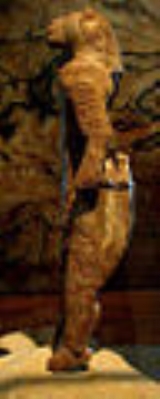
 beads, and three-dimensional figurines to ornament themselves. The Aurignacian tool industry is characterized by complex art, which includes figurines depicting faunal representations of the time period associated with now-extinct mammal
Mammal

Mammals are a class of vertebrate animals whose name is derived from their distinctive feature, mammary glands, with which they feed their young....
s, including mammoth
Mammoth

A mammoth is any species of the extinct genus Mammuthus. These proboscideans are members of the Elephantidae and close relatives of modern elephants....
s, rhinoceros
Rhinoceros

Rhinoceros , often colloquially abbreviated rhino, is a name used to group five extant species of odd-toed ungulates in the family Rhinocerotidae....
, and the European horse, along with anthropomorphized depictions that could be inferred as some of the earliest evidence of religion
Evolutionary origin of religions

The evolutionary origin of religions refers to the emergence of religious behavior during the course of human evolution. When humans first became religion remains unknown, but there is credible evidence of religious behavior from the Middle Paleolithic era and possibly earlier....
.

Bâtons de commandement
Bâton de commandement

A b?ton de commandement or b?ton perc? is a name given by archaeologists to a particular prehistoric artifact of uncertain function. The name b?tons de commandement was the name first applied to the class of artifacts, but it makes an assumption of function; the name b?ton perc?, meaning pierced rod, is a more recent ter...
 are also found at their sites. This sophistication and self-awareness leads some archaeologists to consider the makers of Aurignacian artifacts
Artifact (archaeology)

In archaeology, an artifact or artefact is any object made or modified by a human archaeological culture, and often one later recovered by some archaeological endeavor....
 the first modern humans in Europe. Human remains and Aurignacian artifact
Artifact (archaeology)

In archaeology, an artifact or artefact is any object made or modified by a human archaeological culture, and often one later recovered by some archaeological endeavor....
s originally found at Cro-Magnon
Cro-Magnon

Cro-Magnon is one of the main types of archaic Homo sapiens of the Paleolithic Europe Upper Paleolithic, living approximately 40,000 to 10,000 years ago....
 in France
France

France , officially the French Republic , is a country whose Metropolitan France is located in Western Europe and that also comprises various Overseas departments and territories of France....
 indicate that the culture was modern human rather than Neanderthal
Neanderthal

The Neanderthal , or Neandertal, is an extinct member of the Homo genus that is known from Pleistocene specimens found in Europe and parts of western and central Asia....
. That was not true and was discovered by directly dating human remains. The AMHuman bones are quite recent 3.9–5.0 kya.

In June 2007, a 35,000 year old figurine of a mammoth was discovered in the Vogelherd cave in south-western Germany
Germany

Germany , officially the Federal Republic of Germany , is a country in Central Europe. It is bordered to the north by the North Sea, Denmark, and the Baltic Sea; to the east by Poland and the Czech Republic; to the south by Austria and Switzerland; and to the west by France, Luxembourg, Belgium, and the Netherlands....
. Currently being studied by the University of Tübingen, the figurine details the once intricate and complex artistic qualities by the inhabitants of Aurignacian culture.

Tools

Stone tools from the Aurignacian culture are known as Mode 4, characterised by blades (rather than flakes, typical of mode 2 Acheulean
Acheulean

Acheulean is the name given to an archaeological industry of stone tool manufacture associated with prehistoric hominins during the Lower Palaeolithic era across Africa and much of West Asia and Europe....
 and mode 3 Mousterian
Mousterian

Mousterian is a name given by archaeologists to a style of predominantly flint tools associated primarily with Neanderthal and dating to the Middle Paleolithic, the middle part of the Old Stone Age....
) from prepared cores. Also seen throughout the upper paleolithic is a greater degree of tool standardisation and the use of bone
Bone

Bones are rigid organ that form part of the endoskeleton of vertebrates. They function to move, support, and protect the various organs of the body, produce red blood cell and white blood cells and store minerals....
 and antler
Antler

Antlers are the usually large and complex horn -like appendages of most deer species, mostly worn by males in true horns. Each antler grows from an attachment point on the skull called a pedicle....
 for tools such as needles
Sewing needle

A sewing needle is a long slender tool with a pointed tip. The first needles were made of bone or wood; modern ones are manufactured from high carbon steel wire, nickel- or gold plated for corrosion resistance....
 and harpoons.

See also

  • Synoptic table of the principal old world prehistoric cultures
    Synoptic table of the principal old world prehistoric cultures

    The synoptic table of the principal old world prehistoric cultures gives a rough picture of the relationships between the various principal Archaeological culture of Prehistory outside the Americas, Antarctica, Australia and Oceania....
  • Ksar Akil
    Ksar Akil

    Ksar Akil is an Upper Paleolithic site in Lebanon....


External links

  • , Libor Balák at the Czech Academy of Sciences, the Institute of Archaeology in Brno, The Center for Paleolithic and Paleoethnological Research