


Ordos culture

Encyclopedia
The Ordos culture comprises the period from Upper Paleolithic
to the late Bronze age
at the Ordos Desert
, in the south of the Inner Mongolian Autonomous Region of the People's Republic of China
. The Ordos were predominantly Mongoloid, as known from their skeletal remains and artifacts, but numerous interactions between Europoid and Mongoloid might have also taken place in that region over the course of several centuries, until its occupation by Qin
and Han
dynasties.
The human fossil remains of the Ordos Man from Salawusu site dated between 50,000 and 35,000 BCE show strong Mongoloid features, specifically on the fore-tooth and occipital bone
.
The Zhukaigou culture
is one of the neolithic
cultures at Ordos, dated between 2200 and 1500 BCE. It contained about 327 burials, recent genetic evidence shown that they were related to the remains from Yinniugou, as well as modern populations like Daurs and Evenks. The archaeological finds at the site is similar to those of the lower Xiajiadian culture
. Those finds are important as it was responsible for the development of snake pattern design on the decoration of weapon and depicting animal artifact, known in later as the Ordos style.
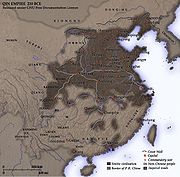 The people in Ordos are recorded in the area of the Ordos desert from the 6th to the 2nd century BCE. What kind of populations occupied the area before them is unclear, but may have been Mongoloid.
The skeletal remains at Taohongbala (桃紅巴拉) tomb dated to between 7th and 6th century BCE are generally identified as belonging to the Xiongnu bronze culture, and show strong Mongoloid features.
A similar type of burial at Hulusitai around Bayannur uncovered in 1979, which is dated to between 5th to 4th century BCE, is considered as the only Xiongnu's culture situated at the northern slope of Yinshan. The site consisted of mainly bronze artifacts and pottery and 27 horse skeletal remains. Further excavation in 1983 at Guoxianyaozi amounting to a total of 31 burials dated to about 6th to 5th century BCE, showed strong north Mongoloid. Those features generally decreased towards the south, and skeletal remains of east and north Mongoloid can be seen from the finds in Maoqinggou and Yinniugou dated to around 7th century BCE, which amount to a total of 117 burials. Many bronze weapons of those cultures are similar to those of Chinese style.
Many depictions of the Ordos people tend to have straight hair. Those are especially strong in the archaeological finds at Baotou
(M63:22, M63:23, M84:5) Etuoke (M1, M6), Xihaokou (M3), lower Woertuhao (M3:1), and Mengjialiang.
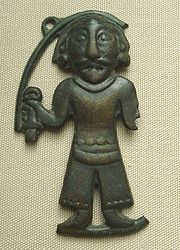 Later, horse nomads occupied the area from the 6th to the 2nd century BCE before being driven away by the Xiongnu
. According to Lebedynsky, they are thought to be the easternmost people of Scythian affinity to have settled here, just to the east of the better-known Yuezhi
. They are mainly known from their skeletal remains and artifacts.
They were in contact and often at war with the pre-Han and Han
populations of the period. Their former territory is now located just north of the Great Wall of China, and on the south bank of the northernmost hook of the Yellow river
.
According to Lebedynsky, the people represented in archaeological finds tend to display Europoïd features, and are thought to be of Scythian affinity. The weapons, found in tombs throughout the steppes of the Ordos, are very close to those of the Scythians, especially the Sakas.
The Ordos people manufactured belt plaques, horse gear and weapons depicting animals, often in combat. The "animal-style" is similar to nomadic traditions found in Central Asia, such as that of the Scythians.
who, after being vanquished by the Xiongnu
, migrated to southern Asia to form the Kushan empire
. They were also culturally related to another nomadic tribe to the east, the Eastern Hu (Chinese:東胡, "Donghu"), who shared a similar "art of the steppes" but appear to have been Mongoloids. They may also have been related to the Di
people (Chinese:氐 "Western Barbarians") of Chinese annals.
By one account, the area of Ordos was the legendary original land of the Turks
.
before it was occupied by Qin and Zhao. It is generally thought to be their homeland, however when exactly they came to occupy the region is unclear, and it might have been much earlier than traditionally thought, as suggested by archaeological finds.
As the Xiongnu expanded southward into Yuezhi territory around 160 BCE under their leader Modun, the Yuezhi in turn defeated the Sakas and pushed them away at the Issyk Kul
. It is thought the Xiongnu also occupied the Ordos area during the same period, when they came in direct contact with the Chinese. From there, the Xiongnu conducted numerous devastating raids into Chinese territory (167, 158, 142, 129 BCE).
The Han Dynasty
started to fight the Xiongnu in the 2nd century BCE under emperor Han Wudi, and colonized the area of the Ordos under Shuofang
commandery in 127 BCE. Prior to the campaign, there were already commanderies established earlier by Qin and Zhao until they were overrun by the Xiongnu in 209 BCE.
(Asian Gallery):
Upper Paleolithic
The Upper Paleolithic is the third and last subdivision of the Paleolithic or Old Stone Age as it is understood in Europe, Africa and Asia. Very broadly it dates to between 40,000 and 10,000 years ago, roughly coinciding with the appearance of behavioral modernity and before the advent of...
to the late Bronze age
Bronze Age
The Bronze Age is a period characterized by the use of copper and its alloy bronze as the chief hard materials in the manufacture of some implements and weapons. Chronologically, it stands between the Stone Age and Iron Age...
at the Ordos Desert
Ordos Desert
The Ordos Desert is a desert and steppe region lying on a plateau in the south of the Inner Mongolian Autonomous Region of the People's Republic of China . The soil of the Ordos is a mixture of clay and sand and, as a result, is poorly suited for agriculture. It extends over an area of...
, in the south of the Inner Mongolian Autonomous Region of the People's Republic of China
People's Republic of China
China , officially the People's Republic of China , is the most populous country in the world, with over 1.3 billion citizens. Located in East Asia, the country covers approximately 9.6 million square kilometres...
. The Ordos were predominantly Mongoloid, as known from their skeletal remains and artifacts, but numerous interactions between Europoid and Mongoloid might have also taken place in that region over the course of several centuries, until its occupation by Qin
Qin Dynasty
The Qin Dynasty was the first imperial dynasty of China, lasting from 221 to 207 BC. The Qin state derived its name from its heartland of Qin, in modern-day Shaanxi. The strength of the Qin state was greatly increased by the legalist reforms of Shang Yang in the 4th century BC, during the Warring...
and Han
Han Dynasty
The Han Dynasty was the second imperial dynasty of China, preceded by the Qin Dynasty and succeeded by the Three Kingdoms . It was founded by the rebel leader Liu Bang, known posthumously as Emperor Gaozu of Han. It was briefly interrupted by the Xin Dynasty of the former regent Wang Mang...
dynasties.
Prehistoric people
The Ordos culture is documented from the Upper Palaeolithic. The points and sides of their tools indicate a "Moustero-Levalloisian" element. They seemed to have a masterful knowledge of Upper Palaeolithic technology, producing blades as much as fifteen centimeters long.The human fossil remains of the Ordos Man from Salawusu site dated between 50,000 and 35,000 BCE show strong Mongoloid features, specifically on the fore-tooth and occipital bone
Occipital bone
The occipital bone, a saucer-shaped membrane bone situated at the back and lower part of the cranium, is trapezoidal in shape and curved on itself...
.
The Zhukaigou culture
Zhukaigou culture
The Zhukaigou culture was a late Neolithic and early Bronze Age culture centered in the Ordos Plateau of Inner Mongolia, China. The type site at Zhukaigou was discovered in Ejin Banner, Inner Mongolia, and excavated from 1977 to 1984...
is one of the neolithic
Neolithic
The Neolithic Age, Era, or Period, or New Stone Age, was a period in the development of human technology, beginning about 9500 BC in some parts of the Middle East, and later in other parts of the world. It is traditionally considered as the last part of the Stone Age...
cultures at Ordos, dated between 2200 and 1500 BCE. It contained about 327 burials, recent genetic evidence shown that they were related to the remains from Yinniugou, as well as modern populations like Daurs and Evenks. The archaeological finds at the site is similar to those of the lower Xiajiadian culture
Lower Xiajiadian culture
The Lower Xiajiadian culture is an archaeological culture in Northeast China, found mainly in southeastern Inner Mongolia, northern Hebei and western Liaoning, China. Subsistence was based on millet farming supplemented with animal husbandry and hunting. Archaeological sites have yielded the...
. Those finds are important as it was responsible for the development of snake pattern design on the decoration of weapon and depicting animal artifact, known in later as the Ordos style.
The skeletal remains at Taohongbala (桃紅巴拉) tomb dated to between 7th and 6th century BCE are generally identified as belonging to the Xiongnu bronze culture, and show strong Mongoloid features.
A similar type of burial at Hulusitai around Bayannur uncovered in 1979, which is dated to between 5th to 4th century BCE, is considered as the only Xiongnu's culture situated at the northern slope of Yinshan. The site consisted of mainly bronze artifacts and pottery and 27 horse skeletal remains. Further excavation in 1983 at Guoxianyaozi amounting to a total of 31 burials dated to about 6th to 5th century BCE, showed strong north Mongoloid. Those features generally decreased towards the south, and skeletal remains of east and north Mongoloid can be seen from the finds in Maoqinggou and Yinniugou dated to around 7th century BCE, which amount to a total of 117 burials. Many bronze weapons of those cultures are similar to those of Chinese style.
Many depictions of the Ordos people tend to have straight hair. Those are especially strong in the archaeological finds at Baotou
Baotou
Baotou is a mid-sized industrial city in the Inner Mongolia Autonomous Region of the People's Republic of China. Governed as a prefecture-level city, its urban areas are home to a population of approximately 1.78 million, with a total population of over 2.65 million accounting for counties under...
(M63:22, M63:23, M84:5) Etuoke (M1, M6), Xihaokou (M3), lower Woertuhao (M3:1), and Mengjialiang.
Sakas and Scythians
Xiongnu
The Xiongnu were ancient nomadic-based people that formed a state or confederation north of the agriculture-based empire of the Han Dynasty. Most of the information on the Xiongnu comes from Chinese sources...
. According to Lebedynsky, they are thought to be the easternmost people of Scythian affinity to have settled here, just to the east of the better-known Yuezhi
Yuezhi
The Yuezhi, or Rouzhi , also known as the Da Yuezhi or Da Rouzhi , were an ancient Central Asian people....
. They are mainly known from their skeletal remains and artifacts.
They were in contact and often at war with the pre-Han and Han
Han Dynasty
The Han Dynasty was the second imperial dynasty of China, preceded by the Qin Dynasty and succeeded by the Three Kingdoms . It was founded by the rebel leader Liu Bang, known posthumously as Emperor Gaozu of Han. It was briefly interrupted by the Xin Dynasty of the former regent Wang Mang...
populations of the period. Their former territory is now located just north of the Great Wall of China, and on the south bank of the northernmost hook of the Yellow river
Yellow River
The Yellow River or Huang He, formerly known as the Hwang Ho, is the second-longest river in China and the sixth-longest in the world at the estimated length of . Originating in the Bayan Har Mountains in Qinghai Province in western China, it flows through nine provinces of China and empties into...
.
According to Lebedynsky, the people represented in archaeological finds tend to display Europoïd features, and are thought to be of Scythian affinity. The weapons, found in tombs throughout the steppes of the Ordos, are very close to those of the Scythians, especially the Sakas.
The Ordos people manufactured belt plaques, horse gear and weapons depicting animals, often in combat. The "animal-style" is similar to nomadic traditions found in Central Asia, such as that of the Scythians.
Relationships
The neighbours of Ordos may have been identical with the YuezhiYuezhi
The Yuezhi, or Rouzhi , also known as the Da Yuezhi or Da Rouzhi , were an ancient Central Asian people....
who, after being vanquished by the Xiongnu
Xiongnu
The Xiongnu were ancient nomadic-based people that formed a state or confederation north of the agriculture-based empire of the Han Dynasty. Most of the information on the Xiongnu comes from Chinese sources...
, migrated to southern Asia to form the Kushan empire
Kushan Empire
The Kushan Empire originally formed in the early 1st century AD under Kujula Kadphises in the territories of ancient Bactria on either side of the middle course of the Oxus in what is now northern Afghanistan, Pakistan, and southern Tajikistan and Uzbekistan.During the 1st and early 2nd centuries...
. They were also culturally related to another nomadic tribe to the east, the Eastern Hu (Chinese:東胡, "Donghu"), who shared a similar "art of the steppes" but appear to have been Mongoloids. They may also have been related to the Di
Di (ethnic group)
The Di were an ethnic group in China from the 8th century BCE to approximately the middle of the 6th century CE. Note that the character Di is used to differentiate this group from the Beidi , a generic term for "northern barbarians". They lived in areas of the present-day provinces of Gansu,...
people (Chinese:氐 "Western Barbarians") of Chinese annals.
By one account, the area of Ordos was the legendary original land of the Turks
Turkish people
Turkish people, also known as the "Turks" , are an ethnic group primarily living in Turkey and in the former lands of the Ottoman Empire where Turkish minorities had been established in Bulgaria, Cyprus, Bosnia and Herzegovina, Georgia, Greece, Kosovo, Macedonia, and Romania...
.
Xiongnu occupation
In Chinese accounts, the Xiongnu first appear at Ordos in the Yizhoushu and Shanhaijing during the Warring States PeriodWarring States Period
The Warring States Period , also known as the Era of Warring States, or the Warring Kingdoms period, covers the Iron Age period from about 475 BC to the reunification of China under the Qin Dynasty in 221 BC...
before it was occupied by Qin and Zhao. It is generally thought to be their homeland, however when exactly they came to occupy the region is unclear, and it might have been much earlier than traditionally thought, as suggested by archaeological finds.
As the Xiongnu expanded southward into Yuezhi territory around 160 BCE under their leader Modun, the Yuezhi in turn defeated the Sakas and pushed them away at the Issyk Kul
Issyk Kul
Issyk Kul is an endorheic lake in the northern Tian Shan mountains in eastern Kyrgyzstan. It is the tenth largest lake in the world by volume and the second largest saline lake after the Caspian Sea. Although it is surrounded by snow-capped peaks, it never freezes; hence its name, which means "hot...
. It is thought the Xiongnu also occupied the Ordos area during the same period, when they came in direct contact with the Chinese. From there, the Xiongnu conducted numerous devastating raids into Chinese territory (167, 158, 142, 129 BCE).
The Han Dynasty
Han Dynasty
The Han Dynasty was the second imperial dynasty of China, preceded by the Qin Dynasty and succeeded by the Three Kingdoms . It was founded by the rebel leader Liu Bang, known posthumously as Emperor Gaozu of Han. It was briefly interrupted by the Xin Dynasty of the former regent Wang Mang...
started to fight the Xiongnu in the 2nd century BCE under emperor Han Wudi, and colonized the area of the Ordos under Shuofang
Shuofang
Shuofang was a fort built in the land of nomadic horse hasbandry tribes at the dawn of the Chinese written history. According to Bamboo Annals, Shuofang was built by the Emperor Di Yi of Shang state on the third year of his reign in 1098 BC in the midst of the Kun Barbarians territory in the...
commandery in 127 BCE. Prior to the campaign, there were already commanderies established earlier by Qin and Zhao until they were overrun by the Xiongnu in 209 BCE.
Artifacts
Main artifacts of the Ordos people, as displayed in the British MuseumBritish Museum
The British Museum is a museum of human history and culture in London. Its collections, which number more than seven million objects, are amongst the largest and most comprehensive in the world and originate from all continents, illustrating and documenting the story of human culture from its...
(Asian Gallery):