

United States non-interventionism

Encyclopedia
Non-interventionism, the diplomatic policy whereby a nation seeks to avoid alliances with other nations in order to avoid being drawn into wars not related to direct territorial self-defense, has had a long history in the United States
. It is a form of "realism".
Non-interventionism
on the part of the United States over the course of its foreign policy, is more of a want to aggressively protect the United States' interests than a want to shun the rest of the world.
Non-intervention, sometimes referred to as military non-interventionism, seems to some to be the antithesis of isolationism
. Participating in global economic affairs would likely boost trade and expand US diplomacy, in the view of Edward A. Olsen.
is generally credited with instilling the first non-interventionist ideas into the American body politic; his work Common Sense
contains many arguments in favor of avoiding alliances. These ideas introduced by Paine took such a firm foothold that the Second Continental Congress
struggled against forming an alliance with France
and only agreed to do so when it was apparent that the American Revolutionary War
could be won in no other manner.
George Washington
's farewell address
is often cited as laying the foundation for a tradition of American non-interventionism:
extended Washington's ideas in his March 4, 1801 inaugural address: "peace, commerce, and honest friendship with all nations, entangling alliances with none." Jefferson's phrase "entangling alliances" is, incidentally, sometimes incorrectly attributed to Washington.
In 1823, President James Monroe
articulated what would come to be known as the Monroe Doctrine
, which some have interpreted as non-interventionist in intent: "In the wars of the European powers, in matters relating to themselves, we have never taken part, nor does it comport with our policy, so to do. It is only when our rights are invaded, or seriously menaced that we resent injuries, or make preparations for our defense."
After Tsar Alexander II
put down the 1863 January Uprising
in Poland
, French Emperor Napoleon III asked the United States to "join in a protest to the Tsar." Secretary of State
William H. Seward
declined, "defending 'our policy of non-intervention — straight, absolute, and peculiar as it may seem to other nations,'" and insisted that "[t]he American people must be content to recommend the cause of human progress by the wisdom with which they should exercise the powers of self-government, forbearing at all times, and in every way, from foreign alliances, intervention, and interference."
The United States' policy of non-intervention was maintained throughout most of the 19th century. The first significant foreign intervention by the US was the Spanish-American War
, which saw the US occupy and control the Philippines
.
's administration is credited with inciting the Panamanian Revolt
against Colombia in order to secure construction rights for the Panama Canal (begun in 1904).
United States
President
Woodrow Wilson
, after winning reelection
with the slogan "He kept us out of war," promptly, but reluctantly, intervened in World War I
. Yet non-interventionist sentiment remained; the U.S. Congress refused to endorse the Treaty of Versailles
or the League of Nations
.
, the League of Nations
. Many Americans felt that they did not need the rest of the world, and that they were fine making decisions concerning peace on their own. Even though ‘anti-League’ was the policy of the nation, private citizens and lower diplomats either supported or observed the League. This quasi-isolationism shows that the US was interested in foreign affairs, but was afraid that by pledging full support for the League, the United States would lose the ability to act on foreign policy as it pleased.
Although the United States was unwilling to commit to the League of Nations, they were willing to engage in foreign affairs on their own terms. In August 1928, fifteen nations signed the Kellogg-Briand Pact
, brainchild of American Secretary of State Frank Kellogg and French Foreign Minister Aristide Briand
. This pact that was said to have outlawed war and showed the United States commitment to international peace had its semantic flaws. For example, it did not hold the United States to the conditions of any existing treaties, it still allowed European nations the right to self-defense, and it stated that if one nation broke the Pact, it would be up to the other signatories to enforce it. The Kellogg-Briand Pact was more of a sign of good intentions on the part of the US, rather than a legitimate step towards the sustenance of world peace.
Non-interventionism took a new turn after the Crash of 1929. With the economic hysteria, the US began to focus solely on fixing its economy within its borders and ignored the outside world. As the world’s democratic powers were busy fixing their economies within their borders, the fascist powers of Europe and Asia silently moved their armies into a position to start World War II
. With military victory came the spoils of war - a very draconian pummeling of Germany into submission, via the Treaty of Versailles. This near-total humiliation of Germany in the wake of World War I - as the treaty placed sole blame for the war on the nation - laid the groundwork for a pride-hungry German people to embrace Adolf Hitler's rise to power.
was doing everything it could to prevent it. Between 1936 and 1937, much to the dismay of the pro-Britain President Roosevelt, Congress passed the Neutrality Acts. These Acts did everything they could to delay U.S. entry into a European war. These Acts were not aimed at keeping America out of a modern world war, but the previous one
. For example, in the final Neutrality Act, Americans could not sail on ships flying the flag of a belligerent nation or trade arms with warring nations, potential causes for U.S. entry into war.
On September 1, 1939, Germany invaded Poland
; Britain
and France
subsequently declared war on Germany, marking the start of World War II. In an address to the American People two days later, President Roosevelt assured the nation that he would do all he could to keep them out of war. However, his words showed his true goals. “When peace has been broken anywhere, the peace of all countries everywhere is in danger,” Roosevelt said. Even though he was intent on neutrality as the official policy of the United States, he still echoed the dangers of staying out of this war. He also cautioned the American people to not let their wish to avoid war at all costs supersede the security of the nation.
The war in Europe split the American people into two distinct groups: non-interventionists and interventionists. The two sides argued over America’s involvement in this Second World War. The basic principle of the interventionist argument was fear of German invasion. By the summer of 1940, France had fallen to the Germans, and Britain was the only democratic stronghold between Germany and the United States. Interventionists feared that if Britain fell, their security as a nation would shrink immediately. They were also afraid of a world after this war, a world where they would have to coexist with the fascist power of Europe. In a 1940 speech, Roosevelt argued, “Some, indeed, still hold to the now somewhat obvious delusion that we … can safely permit the United States to become a lone island … in a world dominated by the philosophy of force.” A national survey found that in the summer of 1940 67% of Americans believed that a German-Italian victory would endanger the United States, that if such an event occurred 88% supported "arm[ing] to the teeth at any expense to be prepared for any trouble", and that 71% favored "the immediate adoption of compulsory military training for all young men".
Ultimately, the ideological rift between the ideals of the United States and the goals of the fascist powers is what made the core of the interventionist argument. “How could we sit back as spectators of a war against ourselves?” writer Archibald MacLeish questioned. The reason why interventionists said we could not coexist with the fascist powers was not due to economic pressures or deficiencies in our armed forces but rather because it was the goal of fascist leaders to destroy the American ideology of democracy. In an address to the American people on December 29, 1940, President Roosevelt said, “…the Axis not merely admits but proclaims that there can be no ultimate peace between their philosophy of government and our philosophy of government.” It is not that the interventionists are war mongering and power hungry, it is that they are fearful for the preservation of the American way of life, after these years of war.
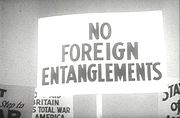
However, there were still many who held on to the age-old tenets of non-interventionism. Although a minority, they were well organized, and had a powerful presence in Congress. Non-interventionists rooted a significant portion of their arguments in historical precedent, citing events such as Washington’s farewell address and the failure of World War I. Ultimately, it came down to the moral and physical separation of the United States from the rest of the world. “If we have strong defenses and understand and believe in what we are defending, we need fear nobody in this world,” Robert Hutschins, President of the University of Chicago, wrote in a 1940 essay. Isolationists believed that our safety as a nation was more important than any foreign war. The interesting thing is that the arguments the non-interventionists used in 1940 echoed the themes of Washington and Jefferson. Charles Lindbergh’s words in a 1940 speech, “…those of us who believe in an independent American destiny must … organize for strength,” are not that different from Washington’s pleas for international isolation
.
As 1940 became 1941, the actions of the Roosevelt administration made it more and more clear that the United States was on a course to war. This policy shift, driven by the President, came in two phases. The first came in 1939 with the passage of the Fourth Neutrality Act, which permitted the United States to trade arms with belligerent nations, as long as these nations came to America to retrieve the arms, and pay for them in cash. This policy was quickly dubbed, ‘Cash and Carry.’ The second phase was the Lend-Lease Act of early 1941. This act allowed the President, “…to lend, lease, sell, or barter arms, ammunition, food, or any ‘defense article’ or any ‘defense information’ to ‘the government of any country whose defense the President deems vital to the defense of the United States.’” He used these two programs to side economically with the British and the French in their fight against the Nazis. In doing so, he made the American economy dependent upon an allied victory. In terms of policy, the United States was on a path to war but the American people still wished to avoid it at all costs, a wish that would come untrue.
The US has intervened in the affairs of other countries through a number of secret operations. The U.S. government has conducted a number of covert operations in an effort to topple foreign governments, including both democratically-elected governments
and authoritarian regimes.
United States
The United States of America is a federal constitutional republic comprising fifty states and a federal district...
. It is a form of "realism".
Non-interventionism
Non-interventionism
Nonintervention or non-interventionism is a foreign policy which holds that political rulers should avoid alliances with other nations, but still retain diplomacy, and avoid all wars not related to direct self-defense...
on the part of the United States over the course of its foreign policy, is more of a want to aggressively protect the United States' interests than a want to shun the rest of the world.
Non-intervention, sometimes referred to as military non-interventionism, seems to some to be the antithesis of isolationism
Isolationism
Isolationism is the policy or doctrine of isolating one's country from the affairs of other nations by declining to enter into alliances, foreign economic commitments, international agreements, etc., seeking to devote the entire efforts of one's country to its own advancement and remain at peace by...
. Participating in global economic affairs would likely boost trade and expand US diplomacy, in the view of Edward A. Olsen.
Early background
Thomas PaineThomas Paine
Thomas "Tom" Paine was an English author, pamphleteer, radical, inventor, intellectual, revolutionary, and one of the Founding Fathers of the United States...
is generally credited with instilling the first non-interventionist ideas into the American body politic; his work Common Sense
Common Sense (pamphlet)
Common Sense is a pamphlet written by Thomas Paine. It was first published anonymously on January 10, 1776, during the American Revolution. Common Sense, signed "Written by an Englishman", became an immediate success. In relation to the population of the Colonies at that time, it had the largest...
contains many arguments in favor of avoiding alliances. These ideas introduced by Paine took such a firm foothold that the Second Continental Congress
Second Continental Congress
The Second Continental Congress was a convention of delegates from the Thirteen Colonies that started meeting on May 10, 1775, in Philadelphia, Pennsylvania, soon after warfare in the American Revolutionary War had begun. It succeeded the First Continental Congress, which met briefly during 1774,...
struggled against forming an alliance with France
France
The French Republic , The French Republic , The French Republic , (commonly known as France , is a unitary semi-presidential republic in Western Europe with several overseas territories and islands located on other continents and in the Indian, Pacific, and Atlantic oceans. Metropolitan France...
and only agreed to do so when it was apparent that the American Revolutionary War
American Revolutionary War
The American Revolutionary War , the American War of Independence, or simply the Revolutionary War, began as a war between the Kingdom of Great Britain and thirteen British colonies in North America, and ended in a global war between several European great powers.The war was the result of the...
could be won in no other manner.
George Washington
George Washington
George Washington was the dominant military and political leader of the new United States of America from 1775 to 1799. He led the American victory over Great Britain in the American Revolutionary War as commander-in-chief of the Continental Army from 1775 to 1783, and presided over the writing of...
's farewell address
George Washington's Farewell Address
George Washington's Farewell Address was written to "The People of the United States" near the end of his second term as President of the United States and before his retirement to his home at Mount Vernon....
is often cited as laying the foundation for a tradition of American non-interventionism:
The great rule of conduct for us, in regard to foreign nations, is in extending our commercial relations, to have with them as little political connection as possible. EuropeEuropeEurope is, by convention, one of the world's seven continents. Comprising the westernmost peninsula of Eurasia, Europe is generally 'divided' from Asia to its east by the watershed divides of the Ural and Caucasus Mountains, the Ural River, the Caspian and Black Seas, and the waterways connecting...
has a set of primary interests, which to us have none, or a very remote relation. Hence she must be engaged in frequent controversies the causes of which are essentially foreign to our concerns. Hence, therefore, it must be unwise in us to implicate ourselves, by artificial ties, in the ordinary vicissitudes of her politics, or the ordinary combinations and collisions of her friendships or enmities.
No entangling alliances (19th century)
President Thomas JeffersonThomas Jefferson
Thomas Jefferson was the principal author of the United States Declaration of Independence and the Statute of Virginia for Religious Freedom , the third President of the United States and founder of the University of Virginia...
extended Washington's ideas in his March 4, 1801 inaugural address: "peace, commerce, and honest friendship with all nations, entangling alliances with none." Jefferson's phrase "entangling alliances" is, incidentally, sometimes incorrectly attributed to Washington.
In 1823, President James Monroe
James Monroe
James Monroe was the fifth President of the United States . Monroe was the last president who was a Founding Father of the United States, and the last president from the Virginia dynasty and the Republican Generation...
articulated what would come to be known as the Monroe Doctrine
Monroe Doctrine
The Monroe Doctrine is a policy of the United States introduced on December 2, 1823. It stated that further efforts by European nations to colonize land or interfere with states in North or South America would be viewed as acts of aggression requiring U.S. intervention...
, which some have interpreted as non-interventionist in intent: "In the wars of the European powers, in matters relating to themselves, we have never taken part, nor does it comport with our policy, so to do. It is only when our rights are invaded, or seriously menaced that we resent injuries, or make preparations for our defense."
After Tsar Alexander II
Alexander II of Russia
Alexander II , also known as Alexander the Liberator was the Emperor of the Russian Empire from 3 March 1855 until his assassination in 1881...
put down the 1863 January Uprising
January Uprising
The January Uprising was an uprising in the former Polish-Lithuanian Commonwealth against the Russian Empire...
in Poland
Poland
Poland , officially the Republic of Poland , is a country in Central Europe bordered by Germany to the west; the Czech Republic and Slovakia to the south; Ukraine, Belarus and Lithuania to the east; and the Baltic Sea and Kaliningrad Oblast, a Russian exclave, to the north...
, French Emperor Napoleon III asked the United States to "join in a protest to the Tsar." Secretary of State
United States Secretary of State
The United States Secretary of State is the head of the United States Department of State, concerned with foreign affairs. The Secretary is a member of the Cabinet and the highest-ranking cabinet secretary both in line of succession and order of precedence...
William H. Seward
William H. Seward
William Henry Seward, Sr. was the 12th Governor of New York, United States Senator and the United States Secretary of State under Abraham Lincoln and Andrew Johnson...
declined, "defending 'our policy of non-intervention — straight, absolute, and peculiar as it may seem to other nations,'" and insisted that "[t]he American people must be content to recommend the cause of human progress by the wisdom with which they should exercise the powers of self-government, forbearing at all times, and in every way, from foreign alliances, intervention, and interference."
The United States' policy of non-intervention was maintained throughout most of the 19th century. The first significant foreign intervention by the US was the Spanish-American War
Spanish-American War
The Spanish–American War was a conflict in 1898 between Spain and the United States, effectively the result of American intervention in the ongoing Cuban War of Independence...
, which saw the US occupy and control the Philippines
Philippines
The Philippines , officially known as the Republic of the Philippines , is a country in Southeast Asia in the western Pacific Ocean. To its north across the Luzon Strait lies Taiwan. West across the South China Sea sits Vietnam...
.
20th century non-intervention
Theodore RooseveltTheodore Roosevelt
Theodore "Teddy" Roosevelt was the 26th President of the United States . He is noted for his exuberant personality, range of interests and achievements, and his leadership of the Progressive Movement, as well as his "cowboy" persona and robust masculinity...
's administration is credited with inciting the Panamanian Revolt
Separation of Panama from Colombia
The Separation of Panama from Colombia was formalized on 3 November 1903 with the establishment of the Republic of Panama from the Republic of Colombia's Department of Panama.-Prelude:...
against Colombia in order to secure construction rights for the Panama Canal (begun in 1904).
United States
United States
The United States of America is a federal constitutional republic comprising fifty states and a federal district...
President
President
A president is a leader of an organization, company, trade union, university, or country.Etymologically, a president is one who presides, who sits in leadership...
Woodrow Wilson
Woodrow Wilson
Thomas Woodrow Wilson was the 28th President of the United States, from 1913 to 1921. A leader of the Progressive Movement, he served as President of Princeton University from 1902 to 1910, and then as the Governor of New Jersey from 1911 to 1913...
, after winning reelection
United States presidential election, 1916
The United States presidential election of 1916 took place while Europe was embroiled in World War I. Public sentiment in the still neutral United States leaned towards the British and French forces, due to the harsh treatment of civilians by the German Army, which had invaded and occupied large...
with the slogan "He kept us out of war," promptly, but reluctantly, intervened in World War I
World War I
World War I , which was predominantly called the World War or the Great War from its occurrence until 1939, and the First World War or World War I thereafter, was a major war centred in Europe that began on 28 July 1914 and lasted until 11 November 1918...
. Yet non-interventionist sentiment remained; the U.S. Congress refused to endorse the Treaty of Versailles
Treaty of Versailles
The Treaty of Versailles was one of the peace treaties at the end of World War I. It ended the state of war between Germany and the Allied Powers. It was signed on 28 June 1919, exactly five years after the assassination of Archduke Franz Ferdinand. The other Central Powers on the German side of...
or the League of Nations
League of Nations
The League of Nations was an intergovernmental organization founded as a result of the Paris Peace Conference that ended the First World War. It was the first permanent international organization whose principal mission was to maintain world peace...
.
Non-Interventionism between the World Wars
In the wake of the First World War, the non-interventionist tendencies of US foreign policy were in full force. First, the United States Congress rejected president Woodrow Wilson’s most cherished condition of the Treaty of VersaillesTreaty of Versailles
The Treaty of Versailles was one of the peace treaties at the end of World War I. It ended the state of war between Germany and the Allied Powers. It was signed on 28 June 1919, exactly five years after the assassination of Archduke Franz Ferdinand. The other Central Powers on the German side of...
, the League of Nations
League of Nations
The League of Nations was an intergovernmental organization founded as a result of the Paris Peace Conference that ended the First World War. It was the first permanent international organization whose principal mission was to maintain world peace...
. Many Americans felt that they did not need the rest of the world, and that they were fine making decisions concerning peace on their own. Even though ‘anti-League’ was the policy of the nation, private citizens and lower diplomats either supported or observed the League. This quasi-isolationism shows that the US was interested in foreign affairs, but was afraid that by pledging full support for the League, the United States would lose the ability to act on foreign policy as it pleased.
Although the United States was unwilling to commit to the League of Nations, they were willing to engage in foreign affairs on their own terms. In August 1928, fifteen nations signed the Kellogg-Briand Pact
Kellogg-Briand Pact
The Kellogg–Briand Pact was an agreement signed on August 27, 1928, by the United States, France, the United Kingdom, Italy, Japan, Weimar Germany and a number of other countries.The pact renounced war , prohibiting the use of war...
, brainchild of American Secretary of State Frank Kellogg and French Foreign Minister Aristide Briand
Aristide Briand
Aristide Briand was a French statesman who served eleven terms as Prime Minister of France during the French Third Republic and received the 1926 Nobel Peace Prize.- Early life :...
. This pact that was said to have outlawed war and showed the United States commitment to international peace had its semantic flaws. For example, it did not hold the United States to the conditions of any existing treaties, it still allowed European nations the right to self-defense, and it stated that if one nation broke the Pact, it would be up to the other signatories to enforce it. The Kellogg-Briand Pact was more of a sign of good intentions on the part of the US, rather than a legitimate step towards the sustenance of world peace.
Non-interventionism took a new turn after the Crash of 1929. With the economic hysteria, the US began to focus solely on fixing its economy within its borders and ignored the outside world. As the world’s democratic powers were busy fixing their economies within their borders, the fascist powers of Europe and Asia silently moved their armies into a position to start World War II
World War II
World War II, or the Second World War , was a global conflict lasting from 1939 to 1945, involving most of the world's nations—including all of the great powers—eventually forming two opposing military alliances: the Allies and the Axis...
. With military victory came the spoils of war - a very draconian pummeling of Germany into submission, via the Treaty of Versailles. This near-total humiliation of Germany in the wake of World War I - as the treaty placed sole blame for the war on the nation - laid the groundwork for a pride-hungry German people to embrace Adolf Hitler's rise to power.
Non-interventionism shortly before WWII
As Europe moved closer and closer to war in the late 1930s, the United States CongressUnited States Congress
The United States Congress is the bicameral legislature of the federal government of the United States, consisting of the Senate and the House of Representatives. The Congress meets in the United States Capitol in Washington, D.C....
was doing everything it could to prevent it. Between 1936 and 1937, much to the dismay of the pro-Britain President Roosevelt, Congress passed the Neutrality Acts. These Acts did everything they could to delay U.S. entry into a European war. These Acts were not aimed at keeping America out of a modern world war, but the previous one
World War I
World War I , which was predominantly called the World War or the Great War from its occurrence until 1939, and the First World War or World War I thereafter, was a major war centred in Europe that began on 28 July 1914 and lasted until 11 November 1918...
. For example, in the final Neutrality Act, Americans could not sail on ships flying the flag of a belligerent nation or trade arms with warring nations, potential causes for U.S. entry into war.
On September 1, 1939, Germany invaded Poland
Poland
Poland , officially the Republic of Poland , is a country in Central Europe bordered by Germany to the west; the Czech Republic and Slovakia to the south; Ukraine, Belarus and Lithuania to the east; and the Baltic Sea and Kaliningrad Oblast, a Russian exclave, to the north...
; Britain
United Kingdom
The United Kingdom of Great Britain and Northern IrelandIn the United Kingdom and Dependencies, other languages have been officially recognised as legitimate autochthonous languages under the European Charter for Regional or Minority Languages...
and France
France
The French Republic , The French Republic , The French Republic , (commonly known as France , is a unitary semi-presidential republic in Western Europe with several overseas territories and islands located on other continents and in the Indian, Pacific, and Atlantic oceans. Metropolitan France...
subsequently declared war on Germany, marking the start of World War II. In an address to the American People two days later, President Roosevelt assured the nation that he would do all he could to keep them out of war. However, his words showed his true goals. “When peace has been broken anywhere, the peace of all countries everywhere is in danger,” Roosevelt said. Even though he was intent on neutrality as the official policy of the United States, he still echoed the dangers of staying out of this war. He also cautioned the American people to not let their wish to avoid war at all costs supersede the security of the nation.
The war in Europe split the American people into two distinct groups: non-interventionists and interventionists. The two sides argued over America’s involvement in this Second World War. The basic principle of the interventionist argument was fear of German invasion. By the summer of 1940, France had fallen to the Germans, and Britain was the only democratic stronghold between Germany and the United States. Interventionists feared that if Britain fell, their security as a nation would shrink immediately. They were also afraid of a world after this war, a world where they would have to coexist with the fascist power of Europe. In a 1940 speech, Roosevelt argued, “Some, indeed, still hold to the now somewhat obvious delusion that we … can safely permit the United States to become a lone island … in a world dominated by the philosophy of force.” A national survey found that in the summer of 1940 67% of Americans believed that a German-Italian victory would endanger the United States, that if such an event occurred 88% supported "arm[ing] to the teeth at any expense to be prepared for any trouble", and that 71% favored "the immediate adoption of compulsory military training for all young men".
Ultimately, the ideological rift between the ideals of the United States and the goals of the fascist powers is what made the core of the interventionist argument. “How could we sit back as spectators of a war against ourselves?” writer Archibald MacLeish questioned. The reason why interventionists said we could not coexist with the fascist powers was not due to economic pressures or deficiencies in our armed forces but rather because it was the goal of fascist leaders to destroy the American ideology of democracy. In an address to the American people on December 29, 1940, President Roosevelt said, “…the Axis not merely admits but proclaims that there can be no ultimate peace between their philosophy of government and our philosophy of government.” It is not that the interventionists are war mongering and power hungry, it is that they are fearful for the preservation of the American way of life, after these years of war.
However, there were still many who held on to the age-old tenets of non-interventionism. Although a minority, they were well organized, and had a powerful presence in Congress. Non-interventionists rooted a significant portion of their arguments in historical precedent, citing events such as Washington’s farewell address and the failure of World War I. Ultimately, it came down to the moral and physical separation of the United States from the rest of the world. “If we have strong defenses and understand and believe in what we are defending, we need fear nobody in this world,” Robert Hutschins, President of the University of Chicago, wrote in a 1940 essay. Isolationists believed that our safety as a nation was more important than any foreign war. The interesting thing is that the arguments the non-interventionists used in 1940 echoed the themes of Washington and Jefferson. Charles Lindbergh’s words in a 1940 speech, “…those of us who believe in an independent American destiny must … organize for strength,” are not that different from Washington’s pleas for international isolation
International isolation
International isolation is a penalty applied by the international community or a sizeable or powerful group of countries, like the United Nations, towards one nation, government or people group...
.
As 1940 became 1941, the actions of the Roosevelt administration made it more and more clear that the United States was on a course to war. This policy shift, driven by the President, came in two phases. The first came in 1939 with the passage of the Fourth Neutrality Act, which permitted the United States to trade arms with belligerent nations, as long as these nations came to America to retrieve the arms, and pay for them in cash. This policy was quickly dubbed, ‘Cash and Carry.’ The second phase was the Lend-Lease Act of early 1941. This act allowed the President, “…to lend, lease, sell, or barter arms, ammunition, food, or any ‘defense article’ or any ‘defense information’ to ‘the government of any country whose defense the President deems vital to the defense of the United States.’” He used these two programs to side economically with the British and the French in their fight against the Nazis. In doing so, he made the American economy dependent upon an allied victory. In terms of policy, the United States was on a path to war but the American people still wished to avoid it at all costs, a wish that would come untrue.
Overt military intervention since 1945
Both Republican and Democratic presidents who, since the 1950s, have often considered used military intervention as a tactic of foreign policy, including in major cases: (in some cases the policies were continued by subsequent presidents.)- President Harry S. TrumanHarry S. TrumanHarry S. Truman was the 33rd President of the United States . As President Franklin D. Roosevelt's third vice president and the 34th Vice President of the United States , he succeeded to the presidency on April 12, 1945, when President Roosevelt died less than three months after beginning his...
's 1950 intervention in KoreaKorean WarThe Korean War was a conventional war between South Korea, supported by the United Nations, and North Korea, supported by the People's Republic of China , with military material aid from the Soviet Union...
to stop the Communist invasion of South Korea, at UN direction - President Dwight D. EisenhowerDwight D. EisenhowerDwight David "Ike" Eisenhower was the 34th President of the United States, from 1953 until 1961. He was a five-star general in the United States Army...
1954 decision to NOT intervene to support the French in Vietnam. - President John F. KennedyJohn F. KennedyJohn Fitzgerald "Jack" Kennedy , often referred to by his initials JFK, was the 35th President of the United States, serving from 1961 until his assassination in 1963....
's intervention in CubaCubaThe Republic of Cuba is an island nation in the Caribbean. The nation of Cuba consists of the main island of Cuba, the Isla de la Juventud, and several archipelagos. Havana is the largest city in Cuba and the country's capital. Santiago de Cuba is the second largest city...
during the Bay of Pigs invasionBay of Pigs InvasionThe Bay of Pigs Invasion was an unsuccessful action by a CIA-trained force of Cuban exiles to invade southern Cuba, with support and encouragement from the US government, in an attempt to overthrow the Cuban government of Fidel Castro. The invasion was launched in April 1961, less than three months...
. - President Lyndon B. JohnsonLyndon B. JohnsonLyndon Baines Johnson , often referred to as LBJ, was the 36th President of the United States after his service as the 37th Vice President of the United States...
's intervention in Dominican RepublicDominican RepublicThe Dominican Republic is a nation on the island of La Hispaniola, part of the Greater Antilles archipelago in the Caribbean region. The western third of the island is occupied by the nation of Haiti, making Hispaniola one of two Caribbean islands that are shared by two countries... - President Lyndon B. JohnsonLyndon B. JohnsonLyndon Baines Johnson , often referred to as LBJ, was the 36th President of the United States after his service as the 37th Vice President of the United States...
's intervention in VietnamVietnam WarThe Vietnam War was a Cold War-era military conflict that occurred in Vietnam, Laos, and Cambodia from 1 November 1955 to the fall of Saigon on 30 April 1975. This war followed the First Indochina War and was fought between North Vietnam, supported by its communist allies, and the government of... - President Ronald ReaganRonald ReaganRonald Wilson Reagan was the 40th President of the United States , the 33rd Governor of California and, prior to that, a radio, film and television actor....
's 1983 intervention in GrenadaGrenadaGrenada is an island country and Commonwealth Realm consisting of the island of Grenada and six smaller islands at the southern end of the Grenadines in the southeastern Caribbean Sea... - President George H. W. BushGeorge H. W. BushGeorge Herbert Walker Bush is an American politician who served as the 41st President of the United States . He had previously served as the 43rd Vice President of the United States , a congressman, an ambassador, and Director of Central Intelligence.Bush was born in Milton, Massachusetts, to...
's 1989 intervention in PanamaPanamaPanama , officially the Republic of Panama , is the southernmost country of Central America. Situated on the isthmus connecting North and South America, it is bordered by Costa Rica to the northwest, Colombia to the southeast, the Caribbean Sea to the north and the Pacific Ocean to the south. The...
to arrest General Manuel NoriegaManuel NoriegaManuel Antonio Noriega Moreno is a Panamanian politician and soldier. He was military dictator of Panama from 1983 to 1989.The 1989 invasion of Panama by the United States removed him from power; he was captured, detained as a prisoner of war, and flown to the United States. Noriega was tried on... - President George H. W. BushGeorge H. W. BushGeorge Herbert Walker Bush is an American politician who served as the 41st President of the United States . He had previously served as the 43rd Vice President of the United States , a congressman, an ambassador, and Director of Central Intelligence.Bush was born in Milton, Massachusetts, to...
's 1991 intervention in KuwaitKuwaitThe State of Kuwait is a sovereign Arab state situated in the north-east of the Arabian Peninsula in Western Asia. It is bordered by Saudi Arabia to the south at Khafji, and Iraq to the north at Basra. It lies on the north-western shore of the Persian Gulf. The name Kuwait is derived from the...
to liberate it from Iraqi occupiers, at UN direction - President George H. W. BushGeorge H. W. BushGeorge Herbert Walker Bush is an American politician who served as the 41st President of the United States . He had previously served as the 43rd Vice President of the United States , a congressman, an ambassador, and Director of Central Intelligence.Bush was born in Milton, Massachusetts, to...
's 1992 intervention in SomaliaSomaliaSomalia , officially the Somali Republic and formerly known as the Somali Democratic Republic under Socialist rule, is a country located in the Horn of Africa. Since the outbreak of the Somali Civil War in 1991 there has been no central government control over most of the country's territory...
for humanitarian reasons, as directed by the UN Security Council - President Bill ClintonBill ClintonWilliam Jefferson "Bill" Clinton is an American politician who served as the 42nd President of the United States from 1993 to 2001. Inaugurated at age 46, he was the third-youngest president. He took office at the end of the Cold War, and was the first president of the baby boomer generation...
's 1994 decision NOT to intervene in the RwandaRwandaRwanda or , officially the Republic of Rwanda , is a country in central and eastern Africa with a population of approximately 11.4 million . Rwanda is located a few degrees south of the Equator, and is bordered by Uganda, Tanzania, Burundi and the Democratic Republic of the Congo...
genocide - President Bill ClintonBill ClintonWilliam Jefferson "Bill" Clinton is an American politician who served as the 42nd President of the United States from 1993 to 2001. Inaugurated at age 46, he was the third-youngest president. He took office at the end of the Cold War, and was the first president of the baby boomer generation...
's 1995 intervention in BosniaBosnia and HerzegovinaBosnia and Herzegovina , sometimes called Bosnia-Herzegovina or simply Bosnia, is a country in Southern Europe, on the Balkan Peninsula. Bordered by Croatia to the north, west and south, Serbia to the east, and Montenegro to the southeast, Bosnia and Herzegovina is almost landlocked, except for the...
, via NATO to prevent ethnic cleansing - President Bill ClintonBill ClintonWilliam Jefferson "Bill" Clinton is an American politician who served as the 42nd President of the United States from 1993 to 2001. Inaugurated at age 46, he was the third-youngest president. He took office at the end of the Cold War, and was the first president of the baby boomer generation...
's 1999 intervention in KosovoKosovoKosovo is a region in southeastern Europe. Part of the Ottoman Empire for more than five centuries, later the Autonomous Province of Kosovo and Metohija within Serbia...
and attacks on SerbiaSerbiaSerbia , officially the Republic of Serbia , is a landlocked country located at the crossroads of Central and Southeast Europe, covering the southern part of the Carpathian basin and the central part of the Balkans...
with NATO involvement - President George W. BushGeorge W. BushGeorge Walker Bush is an American politician who served as the 43rd President of the United States, from 2001 to 2009. Before that, he was the 46th Governor of Texas, having served from 1995 to 2000....
's 2001 intervention in AfghanistanAfghanistanAfghanistan , officially the Islamic Republic of Afghanistan, is a landlocked country located in the centre of Asia, forming South Asia, Central Asia and the Middle East. With a population of about 29 million, it has an area of , making it the 42nd most populous and 41st largest nation in the world...
against the Taliban following the September 11 attacksSeptember 11, 2001 attacksThe September 11 attacks The September 11 attacks The September 11 attacks (also referred to as September 11, September 11th or 9/119/11 is pronounced "nine eleven". The slash is not part of the pronunciation... - President George W. BushGeorge W. BushGeorge Walker Bush is an American politician who served as the 43rd President of the United States, from 2001 to 2009. Before that, he was the 46th Governor of Texas, having served from 1995 to 2000....
's 2003 invasion of Iraq2003 invasion of IraqThe 2003 invasion of Iraq , was the start of the conflict known as the Iraq War, or Operation Iraqi Freedom, in which a combined force of troops from the United States, the United Kingdom, Australia and Poland invaded Iraq and toppled the regime of Saddam Hussein in 21 days of major combat operations...
to depose Saddam HusseinSaddam HusseinSaddam Hussein Abd al-Majid al-Tikriti was the fifth President of Iraq, serving in this capacity from 16 July 1979 until 9 April 2003... - President Barack ObamaBarack ObamaBarack Hussein Obama II is the 44th and current President of the United States. He is the first African American to hold the office. Obama previously served as a United States Senator from Illinois, from January 2005 until he resigned following his victory in the 2008 presidential election.Born in...
's 2011 military intervention in Libya2011 military intervention in LibyaOn 19 March 2011, a multi-state coalition began a military intervention in Libya to implement United Nations Security Council Resolution 1973, which was taken in response to events during the 2011 Libyan civil war...
during its civil war2011 Libyan civil warThe 2011 Libyan civil war was an armed conflict in the North African state of Libya, fought between forces loyal to Colonel Muammar Gaddafi and those seeking to oust his government. The war was preceded by protests in Benghazi beginning on 15 February 2011, which led to clashes with security...
Covert intervention
See Covert United States foreign regime change actionsThe US has intervened in the affairs of other countries through a number of secret operations. The U.S. government has conducted a number of covert operations in an effort to topple foreign governments, including both democratically-elected governments
and authoritarian regimes.