
All Topics  
Second Continental Congress

 
Second Continental Congress

   Email Print
   Bookmark   Link


Second Continental Congress


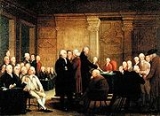
The Second Continental Congress was a convention of delegates from the Thirteen Colonies
Thirteen Colonies

The Thirteen Colonies were part of what became known as British America, a name that was used by Great Britain until the Treaty of Paris recognized the independence of the original thirteen United States of America in 1783....
 that met beginning in May 10, 1775, in Philadelphia, Pennsylvania
Pennsylvania

The Commonwealth of Pennsylvania , often colloquially referred to as PA by natives and Northeasterners, is a U.S. state located in the Northeastern United States and Mid-Atlantic States regions of the United States....
, soon after shooting in the American Revolutionary War
American Revolutionary War

The American Revolutionary War , also known as the American War of Independence, began as a war between the Kingdom of Great Britain and Thirteen Colonies on the North America, and ended in a global war between several European great powers....
 had begun. It succeeded the First Continental Congress
First Continental Congress

The First Continental Congress was a convention of delegates from twelve of the thirteen Kingdom of Great Britain North American colonies that met on September 5, 1774, in Philadelphia Pennsylvania, early in the American Revolution....
, which met briefly during 1774, also in Philadelphia. The second Congress managed the colonial war effort, and moved slowly towards independence, adopting the United States Declaration of Independence
United States Declaration of Independence

The United States Declaration of Independence is a statement adopted by the Second Continental Congress on July 4, 1776, which announced that the Thirteen Colonies then at war with Kingdom of Great Britain were now independent states, and thus no longer a part of the British Empire....
 on July 4, 1776. By raising armies, directing strategy, appointing diplomats, and making formal treaties, the Congress acted as the de facto national government of what became the United States.


Discussion
Ask a question about 'Second Continental Congress'
Start a new discussion about 'Second Continental Congress'
Answer questions from other users
Full Discussion Forum


Recent Posts


Encyclopedia


The Second Continental Congress was a convention of delegates from the Thirteen Colonies
Thirteen Colonies

The Thirteen Colonies were part of what became known as British America, a name that was used by Great Britain until the Treaty of Paris recognized the independence of the original thirteen United States of America in 1783....
 that met beginning in May 10, 1775, in Philadelphia, Pennsylvania
Pennsylvania

The Commonwealth of Pennsylvania , often colloquially referred to as PA by natives and Northeasterners, is a U.S. state located in the Northeastern United States and Mid-Atlantic States regions of the United States....
, soon after shooting in the American Revolutionary War
American Revolutionary War

The American Revolutionary War , also known as the American War of Independence, began as a war between the Kingdom of Great Britain and Thirteen Colonies on the North America, and ended in a global war between several European great powers....
 had begun. It succeeded the First Continental Congress
First Continental Congress

The First Continental Congress was a convention of delegates from twelve of the thirteen Kingdom of Great Britain North American colonies that met on September 5, 1774, in Philadelphia Pennsylvania, early in the American Revolution....
, which met briefly during 1774, also in Philadelphia. The second Congress managed the colonial war effort, and moved slowly towards independence, adopting the United States Declaration of Independence
United States Declaration of Independence

The United States Declaration of Independence is a statement adopted by the Second Continental Congress on July 4, 1776, which announced that the Thirteen Colonies then at war with Kingdom of Great Britain were now independent states, and thus no longer a part of the British Empire....
 on July 4, 1776. By raising armies, directing strategy, appointing diplomats, and making formal treaties, the Congress acted as the de facto national government of what became the United States. With the ratification of the Articles of Confederation
Articles of Confederation

The Articles of Confederation and Perpetual Union was the constitution of the revolutionary wartime alliance of the thirteen United States. The Articles' ratification was completed in 1781, and legally federated several sovereign and independent states, allied under the Articles of Association into a new federation styled the "United States...
 in 1781, the Congress became known as the Congress of the Confederation
Congress of the Confederation

The Congress of the Confederation or the United States in Congress Assembled was the governing body of the United States of America from March 1, 1781, to March 4, 1789....
.

Membership

When the Second Continental Congress came together on May 10, 1775, it was, in effect, a reconvening of the First Continental Congress: many of the same 56 delegates who attended the first meeting were in attendance at the second, and the delegates appointed the same president
President of the Continental Congress

The President of the Continental Congress was the presiding officer of the Continental Congress, the convention of delegates that emerged as the first national government of the United States during the American Revolution....
 (Peyton Randolph
Peyton Randolph

Peyton Randolph was a planter and public official from the Colony of Virginia. He served as Speaker of the Virginia House of Burgesses, chairman of the Virginia Conventions, and President of the Continental Congress....
) and secretary (Charles Thomson
Charles Thomson

File:CharlesThomson.jpgCharles Thomson was a Patriot leader in Philadelphia during the American Revolution and the secretary of the Continental Congress throughout its existence....
). Notable new arrivals included Benjamin Franklin
Benjamin Franklin

Benjamin Franklin was one of the Founding Fathers of the United States of the United States. A noted polymath, Franklin was a leading author and Printer , Satire, list of political philosophers, politician, scientist, inventor, activism, statesman, and diplomacy....
 of Pennsylvania and John Hancock
John Hancock

John Hancock was a merchant, statesman, and prominent Patriot of the American Revolution. He served as President of the Continental Congress of the Second Continental Congress and was the first Governor of Massachusetts of the Massachusetts....
 of Massachusetts. Within two weeks, Randolph was summoned back to Virginia to preside over the House of Burgesses
House of Burgesses

The Virginia House of Burgesses was the first elected lower house in the legislature in the New World established in the Colony of Virginia in 1619....
; he was replaced in the Virginia delegation by Thomas Jefferson
Thomas Jefferson

Thomas Jefferson was the List of Presidents of the United States President of the United States , the principal author of the United States Declaration of Independence , and one of the most influential Founding Fathers of the United States for his promotion of the ideals of republicanism in the United States....
, who arrived several weeks later. Henry Middleton
Henry Middleton

Henry Middleton of South Carolina was the second President of the Continental Congress of the Continental Congress from October 22 1774, until Peyton Randolph was able to resume his duties briefly beginning on May 10, 1775....
 was elected as president to replace Randolph, but he declined, and so Hancock was elected president on May 24.

Delegates from twelve of the Thirteen Colonies
Thirteen Colonies

The Thirteen Colonies were part of what became known as British America, a name that was used by Great Britain until the Treaty of Paris recognized the independence of the original thirteen United States of America in 1783....
 were present when the Second Continental Congress convened. Georgia
Province of Georgia

The Province of Georgia was one of the Southern colonies in British North America. It was the last of the Thirteen original colonies established by Kingdom of Great Britain in what later became the United States....
 had not participated in the First Continental Congress
First Continental Congress

The First Continental Congress was a convention of delegates from twelve of the thirteen Kingdom of Great Britain North American colonies that met on September 5, 1774, in Philadelphia Pennsylvania, early in the American Revolution....
 and did not initially send delegates to the Second Continental Congress. On May 13, 1775, Lyman Hall
Lyman Hall

Lyman Hall , physician, clergyman, and statesman, was a signer of the United States United States Declaration of Independence as a representative of Georgia ....
 was admitted as a delegate from the Parish of St. John's in the Colony of Georgia, not as a delegate from the colony itself. On July 4, 1775, revolutionary Georgians held a Provincial Congress
Provincial Congress

"Provincial Congress" can refer to one of several extra-legal legislative bodies established in some of the Thirteen Colonies early in the American Revolution....
 to decide how to respond to the American Revolution
American Revolution

The American Revolution refers to the political upheaval during the last half of the 18th century in which the Thirteen Colonies of North America overthrew the governance of the British Empire and then rejected the British monarchy to become the sovereign United States of America....
, and that congress decided on July 8 to send delegates to the Continental Congress. They arrived on July 20.

History


Its predecessor, the First Continental Congress, had sent entreaties to the British King George III
George III of the United Kingdom

George III was Kingdom of Great Britain and Kingdom of Ireland from 25 October 1760 until the union of these two countries on 1 January 1801, after which he was King of the United Kingdom of Great Britain and Ireland until his death....
 to stop the Coercive Acts and had created the Continental Association to establish a coordinated protest of the Coercive Acts; in particular, a boycott had been placed on British goods. That First Congress provided that the Second Continental Congress would meet on May 10, 1775, to plan further responses if the British government had not repealed or modified the Coercive Acts.

By the time the Second Continental Congress met, the American Revolutionary War
American Revolutionary War

The American Revolutionary War , also known as the American War of Independence, began as a war between the Kingdom of Great Britain and Thirteen Colonies on the North America, and ended in a global war between several European great powers....
 had already started with the Battles of Lexington and Concord
Battles of Lexington and Concord

The Battles of Lexington and Concord were the first military engagements of the American Revolutionary War. They were fought on April 19, 1775, in Middlesex County, Massachusetts, Province of Massachusetts Bay, within the towns of Lexington, Massachusetts, Concord, Massachusetts, Lincoln, Massachusetts, Arlington, Massachusetts, and Cambridge...
. The Congress was to take charge of the war effort. For the first few months of the struggle, the Patriots
Patriot (American Revolution)

Patriots was the name the colonists of the Kingdom of Great Britain Thirteen Colonies who rebelled against British control during the American Revolution called themselves....
 had carried on their struggle in an ad-hoc and uncoordinated manner. They had seized arsenals, driven out royal officials, and besieged the British army in the city of Boston. On June 14, 1775, Congress voted to create the Continental Army
Continental Army

The American Continental Army was an army formed after the outbreak of the American Revolutionary War by the colonies that became the United States. Established by a resolution of the Continental Congress on June 15, 1775, the army was created to coordinate the military efforts of the Thirteen Colonies in their struggle against the rule of Kingdom...
 out of the militia
Militia (United States)

The role of militia, also known as military service and duty, in the United States of America is complex and has transformed over time. The term militia can be used to describe any number of groups within the United States....
 units around Boston and quickly appointed Congressman George Washington
George Washington

George Washington was the leader of the Continental Army in the American Revolutionary War and served as the List of Presidents of the United States President of the United States of the United States of Americas ....
 of Virginia as commanding general of the Continental Army. On July 6, 1775 Congress approved "A Declaration by the Representatives of the United Colonies of North-America, now met in Congress at Philadelphia, setting forth the causes and necessity of their taking up Arms." On July 8, Congress extended the Olive Branch Petition
Olive Branch Petition

When the Second Continental Congress convened in May 1775, most delegates followed John Dickinson in his quest to reconcile with George III of Great Britain....
 to the British Crown as a final attempt at reconciliation. However, it was received too late to do any good. Silas Deane
Silas Deane

Silas Deane , was a delegate to the United States Continental Congress and later the United States' first foreign diplomat....
 was sent to France as a minister (ambassador) of the Congress. American ports were reopened in defiance of the Navigation Acts.

Although it had no explicit legal authority to govern, it assumed all the functions of a national government, such as appointing ambassadors, signing treaties, raising armies, appointing generals, obtaining loans from Europe, issuing paper money (called "Continentals"), and disbursing funds. The Congress had no authority to levy taxes, and was required to request money, supplies, and troops from the states to support the war effort. Individual states frequently ignored these requests. According to one historian, commenting on the source of the Congress' power:

The appointment of the delegates to both these congresses was generally by popular conventions, though in some instances by state assemblies. But in neither case can the appointing body be considered the original depositary of the power by which the delegates acted; for the conventions were either self-appointed "committees of safety" or hastily assembled popular gatherings, including but a small fraction of the population to be represented, and the state assemblies had no right to surrender to another body one atom of the power which had been granted to them, or to create a new power which should govern the people without their will. The source of the powers of congress is to be sought solely in the acquiescence of the people, without which every congressional resolution, with or without the benediction of popular conventions or state legislatures, would have been a mere brutum fulmen; and, as the congress unquestionably exercised national powers, operating over the whole country, the conclusion is inevitable that the will of the whole people is the source of national government in the United States, even from its first imperfect appearance in the second continental congress.. Cyclopædia of Political Science. New York: Maynard, Merrill, and Co., 1899.


Congress was moving towards declaring independence from the British Empire in 1776, but many delegates lacked the authority from their home governments to take such an action. Advocates of independence in Congress moved to have reluctant colonial governments revise instructions to their delegations, or even replace those governments which would not authorize independence. On May 10, 1776, Congress passed a resolution recommending that any colony lacking a proper (i.e. a revolutionary) government should form such. On May 15 Congress adopted a more radical preamble to this resolution, drafted by John Adams
John Adams

John Adams was an Politics of the United States and the List of Presidents of the United States President of the United States , after being the List of Vice Presidents of the United States Vice President of the United States for two terms....
, in which it advised throwing off oaths of allegiance and suppressing the authority of the Crown in any colonial government that still derived its authority from the Crown. That same day the Virginia Convention instructed its delegation in Philadelphia to propose a resolution that called for a declaration of independence, the formation of foreign alliances, and a confederation of the states. The resolution of independence was delayed for several weeks as revolutionaries consolidated support for independence in their home governments. Congress finally approved the resolution of independence on July 2, 1776. Congress next turned its attention to a formal explanation of this decision, the United States Declaration of Independence
United States Declaration of Independence

The United States Declaration of Independence is a statement adopted by the Second Continental Congress on July 4, 1776, which announced that the Thirteen Colonies then at war with Kingdom of Great Britain were now independent states, and thus no longer a part of the British Empire....
, which was approved on July 4 and published soon thereafter.

The Continental Congress was forced to flee Philadelphia at the end of September 1777, as British troops occupied the city. The Congress moved to York, Pennsylvania
York, Pennsylvania

York, known as the White Rose City , is a city located in South Central Pennsylvania. The population was 40,862 at the United States Census 2000....
, and continued their work.

After more than a year of debate, on November 15, 1777, Congress passed and sent to the states for ratification the Articles of Confederation
Articles of Confederation

The Articles of Confederation and Perpetual Union was the constitution of the revolutionary wartime alliance of the thirteen United States. The Articles' ratification was completed in 1781, and legally federated several sovereign and independent states, allied under the Articles of Association into a new federation styled the "United States...
. The issue was large states wanting a larger say, nullified by small states who feared tyranny. Jefferson's proposal for a Senate to represent the states and a House to represent the people was rejected (a similar proposal was adopted later in the United States Constitution
United States Constitution

The Constitution of the United States of America is the supreme law of the United States. It is the foundation and source of the legal authority underlying the existence of the United States of America; the Federal Government of the United States; and all the State & local governments and Territorial Administrative bodies contained therein....
). The small states won and each state had one vote. Congress urged the individual states to pass the Articles as quickly as possible, but it took three and a half years for all the states to ratify the Articles. Of the then thirteen states, the State Legislature of Virginia was the first to ratify the Articles, on December 16, 1777, and the State Legislature of Maryland became the last to do so, on February 2, 1781. In the meantime, the Second Continental Congress tried to lead the new country through the war with borrowed money and no taxing power.

Finally, on March 1, 1781, the Articles of Confederation were signed by delegates of Maryland at a meeting of the Second Continental Congress, which then declared the Articles ratified. On the next day, the same congressional delegates met as the new Congress of the Confederation
Congress of the Confederation

The Congress of the Confederation or the United States in Congress Assembled was the governing body of the United States of America from March 1, 1781, to March 4, 1789....
. As historian Edmund Burnett wrote, "There was no new organization of any kind, not even the election of a new President." It would be the Confederation Congress that would oversee the conclusion of the American Revolution.

Dates and places of sessions

  • May 10, 1775 – December 12, 1776, Philadelphia, Pennsylvania
    Philadelphia, Pennsylvania

    Philadelphia is the largest city in Pennsylvania and the List of United States cities by population city in the United States. It is the fifth-largest metropolitan area and fourth-largest urban area by population in the United States, the nation's fourth-largest consumer media market as ranked by the Nielsen Media Research, and the 49th-most...
  • December 20, 1776 – March 4, 1777, Baltimore, Maryland
    Baltimore, Maryland

    Baltimore is an independent city and the largest city in the U.S. state of Maryland in the United States. Baltimore is located in central Maryland along the tidal portion of the Patapsco River, an arm of the Chesapeake Bay....
  • March 5, 1777 – September 18, 1777, Philadelphia
  • September 27, 1777 (one day only), Lancaster, Pennsylvania
    Lancaster, Pennsylvania

    Lancaster is a city in the South Central Pennsylvania part of the U.S. state of Pennsylvania and is the county seat of Lancaster County, Pennsylvania....
  • September 30, 1777 – June 27, 1778, York, Pennsylvania
    York, Pennsylvania

    York, known as the White Rose City , is a city located in South Central Pennsylvania. The population was 40,862 at the United States Census 2000....
  • July 2, 1778 – March 1, 1781, Philadelphia


See also


Further reading

  • Adams, Willi Paul. The First American Constitutions: Republican Ideology and the Making of the State Constitutions in the Revolutionary Era. U. of North Carolina Press, 1980. ISBN 0742520692
  • Francis D. Cogliano, Revolutionary America, 1763-1815: A Political History. London: 2000. ISBN 0415180570
  • Worthington C. Ford, et al. ed. Journals of the Continental Congress, 1774–1789. (34 vol., 1904–1937)
  • Peter Force, ed. American Archives 9 vol 1837-1853, major compilation of documents 1774-1776.
  • Kruman, Marc W. Between Authority and Liberty: State Constitution Making in Revolutionary America. U. of North Carolina Pr., 1997. ISBN 0807847976
  • Maier, Pauline. American Scripture: Making the Declaration of Independence (1998)
  • Miller, John C. Triumph of Freedom, 1775-1783 (1948) ISBN 0313207798
  • Rakove, Jack N. The Beginnings of National Politics: An Interpretive History of the Continental Congress. Knopf, 1979. ISBN 0801828643


External links