

The Fifteen Decisive Battles of the World

Encyclopedia
The Fifteen Decisive Battles of the World: from Marathon to Waterloo is a book written by Sir Edward Shepherd Creasy
and published in 1851. This book tells the story of the fifteen military engagement
s (from Marathon to Waterloo) which, according to the author, had a significant impact on world history
.
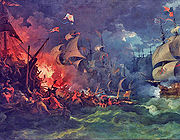
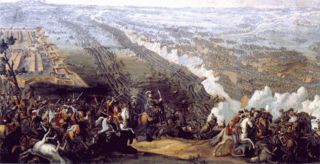

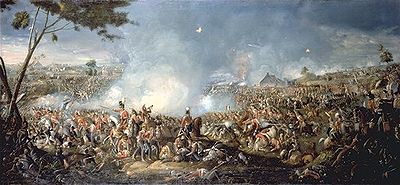 Each chapter of the book describes a different battle. The fifteen chapters are:
, and Creasy's descriptions of the battles and their impact on history are from a decidedly Eurocentric, and specifically Anglocentric, point of view. There is also significant emphasis placed on the events of, at the time, recent history: one-third of the battles are from within a century and a half of Creasy's writing.
Edward Shepherd Creasy
Sir Edward Shepherd Creasy was an English historian. He was born in Bexley, England. He was educated at Eton College and King's College, Cambridge and called to the Bar in 1837. In 1840, he began teaching history at the University of London. He was knighted in 1860 and assumed the position of...
and published in 1851. This book tells the story of the fifteen military engagement
Battle
Generally, a battle is a conceptual component in the hierarchy of combat in warfare between two or more armed forces, or combatants. In a battle, each combatant will seek to defeat the others, with defeat determined by the conditions of a military campaign...
s (from Marathon to Waterloo) which, according to the author, had a significant impact on world history
Macro-historical
Macro-historical analysis seeks out large, long-term trends in world history, searching for ultimate patterns through a comparison of proximate details. For example, a macro-historical study might examine Japanese feudalism and European feudalism in order to decide whether feudal structures are an...
.
Chapters
- The Battle of MarathonBattle of MarathonThe Battle of Marathon took place in 490 BC, during the first Persian invasion of Greece. It was fought between the citizens of Athens, aided by Plataea, and a Persian force commanded by Datis and Artaphernes. It was the culmination of the first attempt by Persia, under King Darius I, to subjugate...
, 490 BC- Excerpt: Two thousand three hundred and forty years ago, a council of AthenianClassical AthensThe city of Athens during the classical period of Ancient Greece was a notable polis of Attica, Greece, leading the Delian League in the Peloponnesian War against Sparta and the Peloponnesian League. Athenian democracy was established in 508 BC under Cleisthenes following the tyranny of Hippias...
Officers was summoned on the slope of one of the mountains that look over the plain of Marathon, on the eastern coast of AtticaAtticaAttica is a historical region of Greece, containing Athens, the current capital of Greece. The historical region is centered on the Attic peninsula, which projects into the Aegean Sea...
. The immediate subject of their meeting was to consider whether they should give battle to an enemy that lay encamped on the shore beneath them; but on the result of their deliberations depended, not merely the fate of two armies, but the whole future progress of human civilization.
- Excerpt: Two thousand three hundred and forty years ago, a council of Athenian
- Defeat of the AtheniansAthensAthens , is the capital and largest city of Greece. Athens dominates the Attica region and is one of the world's oldest cities, as its recorded history spans around 3,400 years. Classical Athens was a powerful city-state...
at SyracuseSyracuse, ItalySyracuse is a historic city in Sicily, the capital of the province of Syracuse. The city is notable for its rich Greek history, culture, amphitheatres, architecture, and as the birthplace of the preeminent mathematician and engineer Archimedes. This 2,700-year-old city played a key role in...
, 413 BC- Known as the Battle of SyracuseSicilian ExpeditionThe Sicilian Expedition was an Athenian expedition to Sicily from 415 BC to 413 BC, during the Peloponnesian War. The expedition was hampered from the outset by uncertainty in its purpose and command structure—political maneuvering in Athens swelled a lightweight force of twenty ships into a...
. - Excerpt: Few cities have undergone more memorable sieges during ancient and mediaeval times than has the city of SyracuseSyracuse, ItalySyracuse is a historic city in Sicily, the capital of the province of Syracuse. The city is notable for its rich Greek history, culture, amphitheatres, architecture, and as the birthplace of the preeminent mathematician and engineer Archimedes. This 2,700-year-old city played a key role in...
.
- Known as the Battle of Syracuse
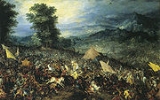
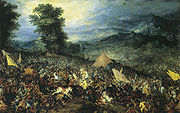
- The Battle of GaugamelaBattle of GaugamelaThe Battle of Gaugamela took place in 331 BC between Alexander the Great and Darius III of Persia. The battle, which is also called the Battle of Arbela, resulted in a massive victory for the ancient Macedonians and led to the fall of the Achaemenid Empire.-Location:Darius chose a flat, open plain...
, 331 BC- Also called the Battle of Arbela.
- Excerpt: ... the ancient Persian empire, which once subjugated all the nations of the earth, was defeated when Alexander had won his victory at Arbela.
- The Battle of the MetaurusBattle of the MetaurusThe Battle of the Metaurus was a pivotal battle in the Second Punic War between Rome and Carthage, fought in 207 BC near the Metauro River in present-day Italy. The battle gets a chapter in the classic The Fifteen Decisive Battles of the World by Sir Edward Shepherd Creasy...
, 207 BC- Excerpt: That battle was the determining crisis of the contest, not merely between RomeRoman RepublicThe Roman Republic was the period of the ancient Roman civilization where the government operated as a republic. It began with the overthrow of the Roman monarchy, traditionally dated around 508 BC, and its replacement by a government headed by two consuls, elected annually by the citizens and...
and CarthageCarthageCarthage , implying it was a 'new Tyre') is a major urban centre that has existed for nearly 3,000 years on the Gulf of Tunis, developing from a Phoenician colony of the 1st millennium BC...
, but between the two great families of the world...
- Excerpt: That battle was the determining crisis of the contest, not merely between Rome
- Victory of ArminiusArminiusArminius , also known as Armin or Hermann was a chieftain of the Germanic Cherusci who defeated a Roman army in the Battle of the Teutoburg Forest...
over the Roman LegionRoman legionA Roman legion normally indicates the basic ancient Roman army unit recruited specifically from Roman citizens. The organization of legions varied greatly over time but they were typically composed of perhaps 5,000 soldiers, divided into maniples and later into "cohorts"...
s under VarusPublius Quinctilius VarusPublius Quinctilius Varus was a Roman politician and general under Emperor Augustus, mainly remembered for having lost three Roman legions and his own life when attacked by Germanic leader Arminius in the Battle of the Teutoburg Forest.-Life:His paternal grandfather was senator Sextus Quinctilius...
, AD 9- Known as the Battle of the Teutoburg ForestBattle of the Teutoburg ForestThe Battle of the Teutoburg Forest took place in 9 CE, when an alliance of Germanic tribes led by Arminius of the Cherusci ambushed and decisively destroyed three Roman legions, along with their auxiliaries, led by Publius Quinctilius Varus.Despite numerous successful campaigns and raids by the...
. - Excerpt: ..that victory secured at once and forever the independence of the TeutonicTeutonsThe Teutons or Teutones were mentioned as a Germanic tribe by Greek and Roman authors, notably Strabo and Marcus Velleius Paterculus and normally in close connection with the Cimbri, whose ethnicity is contested between Gauls and Germani...
race.
- Known as the Battle of the Teutoburg Forest
- The Battle of ChâlonsBattle of ChalonsThe Battle of the Catalaunian Plains , also called the Battle of Châlons sur Marne, took place in AD 451 between a coalition led by the Visigothic king Theodoric I and the Roman general Flavius Aëtius, against the Huns and their allies commanded by their leader Attila...
, AD 451- Also called the Battle of the Catalaunian Fields or the Battle of the Catalun.
- Excerpt: The victory which the Roman general, AëtiusFlavius AëtiusFlavius Aëtius , dux et patricius, was a Roman general of the closing period of the Western Roman Empire. He was an able military commander and the most influential man in the Western Roman Empire for two decades . He managed policy in regard to the attacks of barbarian peoples pressing on the Empire...
, with his GothicGothsThe Goths were an East Germanic tribe of Scandinavian origin whose two branches, the Visigoths and the Ostrogoths, played an important role in the fall of the Roman Empire and the emergence of Medieval Europe....
allies, had then gained over the HunsHunsThe Huns were a group of nomadic people who, appearing from east of the Volga River, migrated into Europe c. AD 370 and established the vast Hunnic Empire there. Since de Guignes linked them with the Xiongnu, who had been northern neighbours of China 300 years prior to the emergence of the Huns,...
, was the last victory of imperial RomeRoman EmpireThe Roman Empire was the post-Republican period of the ancient Roman civilization, characterised by an autocratic form of government and large territorial holdings in Europe and around the Mediterranean....
.
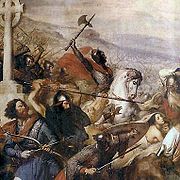
- The Battle of ToursBattle of ToursThe Battle of Tours , also called the Battle of Poitiers and in Battle of the Court of the Martyrs, was fought in an area between the cities of Poitiers and Tours, located in north-central France, near the village of Moussais-la-Bataille, about northeast of Poitiers...
, AD 732- Also called the Battle of Poitiers.
- Excerpt: the great victory won by Charles MartelCharles MartelCharles Martel , also known as Charles the Hammer, was a Frankish military and political leader, who served as Mayor of the Palace under the Merovingian kings and ruled de facto during an interregnum at the end of his life, using the title Duke and Prince of the Franks. In 739 he was offered the...
... gave a decisive check to the career of ArabArabArab people, also known as Arabs , are a panethnicity primarily living in the Arab world, which is located in Western Asia and North Africa. They are identified as such on one or more of genealogical, linguistic, or cultural grounds, with tribal affiliations, and intra-tribal relationships playing...
conquest in Western EuropeWestern EuropeWestern Europe is a loose term for the collection of countries in the western most region of the European continents, though this definition is context-dependent and carries cultural and political connotations. One definition describes Western Europe as a geographic entity—the region lying in the...
.
- The Battle of HastingsBattle of HastingsThe Battle of Hastings occurred on 14 October 1066 during the Norman conquest of England, between the Norman-French army of Duke William II of Normandy and the English army under King Harold II...
, AD 1066- Excerpt: ..no one who appreciates the influence of England and her empire upon the destinies of the world will ever rank that victory as one of secondary importance.
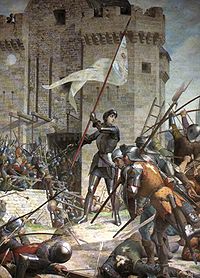
- Joan of ArcJoan of ArcSaint Joan of Arc, nicknamed "The Maid of Orléans" , is a national heroine of France and a Roman Catholic saint. A peasant girl born in eastern France who claimed divine guidance, she led the French army to several important victories during the Hundred Years' War, which paved the way for the...
's Victory over the English at OrléansOrléans-Prehistory and Roman:Cenabum was a Gallic stronghold, one of the principal towns of the Carnutes tribe where the Druids held their annual assembly. It was conquered and destroyed by Julius Caesar in 52 BC, then rebuilt under the Roman Empire...
, AD 1429- Known as the Siege of OrléansSiege of OrléansThe Siege of Orléans marked a turning point in the Hundred Years' War between France and England. This was Joan of Arc's first major military victory and the first major French success to follow the crushing defeat at Agincourt in 1415. The outset of this siege marked the pinnacle of English power...
. - Excerpt: ..the struggle by which the unconscious heroine of France, in the beginning of the fifteenth century, rescued her country from becoming a second Ireland under the yoke of the triumphant English.
- Known as the Siege of Orléans
- Defeat of the Spanish ArmadaSpanish ArmadaThis article refers to the Battle of Gravelines, for the modern navy of Spain, see Spanish NavyThe Spanish Armada was the Spanish fleet that sailed against England under the command of the Duke of Medina Sidonia in 1588, with the intention of overthrowing Elizabeth I of England to stop English...
, AD 1588- Excerpt: The England of our own days is so strong, and the Spain of our own days is so feeble, that it is not easy, without some reflection and care, to comprehend the full extent of the peril which England then ran from the power and the ambition of Spain, or to appreciate the importance of that crisis in the history of the world.
- The Battle of BlenheimBattle of BlenheimThe Battle of Blenheim , fought on 13 August 1704, was a major battle of the War of the Spanish Succession. Louis XIV of France sought to knock Emperor Leopold out of the war by seizing Vienna, the Habsburg capital, and gain a favourable peace settlement...
, AD 1704- Excerpt: Had it not been for Blenheim, all Europe might at this day suffer under the effect of French conquests resembling those of Alexander in extent and those of the Romans in durability.
- The Battle of PultowaBattle of PoltavaThe Battle of Poltava on 27 June 1709 was the decisive victory of Peter I of Russia over the Swedish forces under Field Marshal Carl Gustav Rehnskiöld in one of the battles of the Great Northern War. It is widely believed to have been the beginning of Sweden's decline as a Great Power; the...
, AD 1709- Also called the Battle of Poltava.
- Excerpt: The decisive triumph of Russia over Sweden at Pultowa was therefore all-important to the world, on account of what it overthrew as well as for what it established
- Victory of the AmericansBattle of SaratogaThe Battles of Saratoga conclusively decided the fate of British General John Burgoyne's army in the American War of Independence and are generally regarded as a turning point in the war. The battles were fought eighteen days apart on the same ground, south of Saratoga, New York...
over BurgoyneJohn BurgoyneGeneral John Burgoyne was a British army officer, politician and dramatist. He first saw action during the Seven Years' War when he participated in several battles, mostly notably during the Portugal Campaign of 1762....
at SaratogaSaratoga, New YorkSaratoga is a town in Saratoga County, New York, United States. The population was 5,141 at the 2000 census. It is also the commonly used, but not official, name for the neighboring and much more populous city, Saratoga Springs. The major village in the town of Saratoga is Schuylerville which is...
, AD 1777- Excerpt: The ancient Roman boasted, with reason, of the growth of Rome from humble beginnings to the greatest magnitude which the world had then ever witnessed. But the citizen of the United StatesUnited StatesThe United States of America is a federal constitutional republic comprising fifty states and a federal district...
is still more justly entitled to claim this praise.
- Excerpt: The ancient Roman boasted, with reason, of the growth of Rome from humble beginnings to the greatest magnitude which the world had then ever witnessed. But the citizen of the United States
- The Battle of ValmyBattle of ValmyThe Battle of Valmy was the first major victory by the army of France during the French Revolution. The action took place on 20 September 1792 as Prussian troops commanded by the Duke of Brunswick attempted to march on Paris...
, AD 1792- Excerpt: ..the kings of Europe, after the lapse of eighteen centuries, trembled once more before a conquering military republic.
- The Battle of WaterlooBattle of WaterlooThe Battle of Waterloo was fought on Sunday 18 June 1815 near Waterloo in present-day Belgium, then part of the United Kingdom of the Netherlands...
, AD 1815- Excerpt: The exertions which the allied powers made at this crisis to grapple promptly with the French emperor have truly been termed gigantic, and never were Napoleon's genius and activity more signally displayed than in the celerity and skill by which he brought forward all the military resources of France...
Point of view
The book is a product of the Victorian eraVictorian era
The Victorian era of British history was the period of Queen Victoria's reign from 20 June 1837 until her death on 22 January 1901. It was a long period of peace, prosperity, refined sensibilities and national self-confidence...
, and Creasy's descriptions of the battles and their impact on history are from a decidedly Eurocentric, and specifically Anglocentric, point of view. There is also significant emphasis placed on the events of, at the time, recent history: one-third of the battles are from within a century and a half of Creasy's writing.
Derivative works
Since the publication of Creasy's book, other historians have attempted to modify or add to the list.- In 1899 The Colonial Press published Decisive Battles of the World by Edward Shepherd Creasy with a Special Introduction and Supplementary Chapters On the Battles of Gettysburg 1863Battle of GettysburgThe Battle of Gettysburg , was fought July 1–3, 1863, in and around the town of Gettysburg, Pennsylvania. The battle with the largest number of casualties in the American Civil War, it is often described as the war's turning point. Union Maj. Gen. George Gordon Meade's Army of the Potomac...
, Sedan 1870, SantiagoBattle of Santiago de CubaThe Battle of Santiago de Cuba, fought between Spain and the United States on 3 July 1898, was the largest naval engagement of the Spanish-American War and resulted in the destruction of the Spanish Navy's Caribbean Squadron.-Spanish Fleet:...
and Manila 1898Battle of Manila (1898)The Battle of Manila was a short land engagement between the United States and Spain at the end of the Spanish-American War, which occurred a couple of months after the pivotal American victory during the naval Battle of Manila Bay...
, by John Gilmer Speed (Revised Edition) - In 1908 Harper & Bros published an edition with 8 battles added. Quebec; Yorktown; Vicksburg; Gettysburg; Sedan; Manila Bay; Santiago; and Tsushima.
- In 1920 the Viscount D'AbernonEdgar Vincent, 1st Viscount D'AbernonEdgar Vincent, 1st Viscount D'Abernon, GCB, GCMG, PC, FRS was a British politician, diplomat, art collector and author.-Early life:...
published The Eighteenth Decisive Battle of the World: Warsaw, 1920, in which he claimed that the next battle on the list was the battle of WarsawBattle of Warsaw (1920)The Battle of Warsaw sometimes referred to as the Miracle at the Vistula, was the decisive battle of the Polish–Soviet War. That war began soon after the end of World War I in 1918 and lasted until the Treaty of Riga resulted in the end of the hostilities between Poland and Russia in 1921.The...
, fought in 1920 by the Polish and Bolshevik forces during the Polish-Bolshevik War. - In 1930 TexasTexasTexas is the second largest U.S. state by both area and population, and the largest state by area in the contiguous United States.The name, based on the Caddo word "Tejas" meaning "friends" or "allies", was applied by the Spanish to the Caddo themselves and to the region of their settlement in...
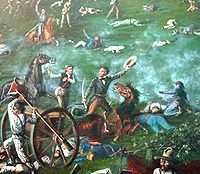
historian Clarence Wharton published San JacintoBattle of San JacintoThe Battle of San Jacinto, fought on April 21, 1836, in present-day Harris County, Texas, was the decisive battle of the Texas Revolution. Led by General Sam Houston, the Texian Army engaged and defeated General Antonio López de Santa Anna's Mexican forces in a fight that lasted just eighteen...
: The Sixteenth Decisive Battle, in which he made the case for adding the final battle of the Texas RevolutionTexas RevolutionThe Texas Revolution or Texas War of Independence was an armed conflict between Mexico and settlers in the Texas portion of the Mexican state Coahuila y Tejas. The war lasted from October 2, 1835 to April 21, 1836...
to Creasy's list. In 1936 the San Jacinto MonumentSan Jacinto MonumentThe San Jacinto Monument is a high column located on the Houston Ship Channel in unincorporated Harris County, Texas near the city of La Porte. The monument is topped with a 220-ton star that commemorates the site of the Battle of San Jacinto, the decisive battle of the Texas Revolution...
was given an inscription that echoed Wharton's view: "Measured by its results, San Jacinto was one of the decisive battles of the world. The freedom of Texas from Mexico won here led to annexation and to the Mexican-American War, resulting in the acquisition by the United States of the states of TexasTexasTexas is the second largest U.S. state by both area and population, and the largest state by area in the contiguous United States.The name, based on the Caddo word "Tejas" meaning "friends" or "allies", was applied by the Spanish to the Caddo themselves and to the region of their settlement in...
, New MexicoNew MexicoNew Mexico is a state located in the southwest and western regions of the United States. New Mexico is also usually considered one of the Mountain States. With a population density of 16 per square mile, New Mexico is the sixth-most sparsely inhabited U.S...
, ArizonaArizonaArizona ; is a state located in the southwestern region of the United States. It is also part of the western United States and the mountain west. The capital and largest city is Phoenix...
, NevadaNevadaNevada is a state in the western, mountain west, and southwestern regions of the United States. With an area of and a population of about 2.7 million, it is the 7th-largest and 35th-most populous state. Over two-thirds of Nevada's people live in the Las Vegas metropolitan area, which contains its...
, CaliforniaCaliforniaCalifornia is a state located on the West Coast of the United States. It is by far the most populous U.S. state, and the third-largest by land area...
, UtahUtahUtah is a state in the Western United States. It was the 45th state to join the Union, on January 4, 1896. Approximately 80% of Utah's 2,763,885 people live along the Wasatch Front, centering on Salt Lake City. This leaves vast expanses of the state nearly uninhabited, making the population the...
and parts of ColoradoColoradoColorado is a U.S. state that encompasses much of the Rocky Mountains as well as the northeastern portion of the Colorado Plateau and the western edge of the Great Plains...
, WyomingWyomingWyoming is a state in the mountain region of the Western United States. The western two thirds of the state is covered mostly with the mountain ranges and rangelands in the foothills of the Eastern Rocky Mountains, while the eastern third of the state is high elevation prairie known as the High...
, KansasKansasKansas is a US state located in the Midwestern United States. It is named after the Kansas River which flows through it, which in turn was named after the Kansa Native American tribe, which inhabited the area. The tribe's name is often said to mean "people of the wind" or "people of the south...
and OklahomaOklahomaOklahoma is a state located in the South Central region of the United States of America. With an estimated 3,751,351 residents as of the 2010 census and a land area of 68,667 square miles , Oklahoma is the 28th most populous and 20th-largest state...
. Almost one-third of the present area of the American Nation, nearly a million square miles of territory, changed sovereignty." - In 1954-1956, British historian J.F.C. FullerJ.F.C. FullerMajor-General John Frederick Charles Fuller, CB, CBE, DSO was a British Army officer, military historian and strategist, notable as an early theorist of modern armoured warfare, including categorising principles of warfare...
published The Decisive Battles of the Western World and their Influence upon History. - In 1956, historian and author Fletcher PrattFletcher PrattMurray Fletcher Pratt was an American writer of science fiction, fantasy and history, particularly noted for his works on naval history and on the American Civil War.- Life and work :...
published The Battles that Changed History, stories of conflicts that forever changed the course of world events. He listed 16 battles from Arbela to MidwayBattle of MidwayThe Battle of Midway is widely regarded as the most important naval battle of the Pacific Campaign of World War II. Between 4 and 7 June 1942, approximately one month after the Battle of the Coral Sea and six months after Japan's attack on Pearl Harbor, the United States Navy decisively defeated...
. - In 1964, American historian Lt. Col. Joseph B. MitchellJoseph B. MitchellJoseph Brady Mitchell was an American military historian. He is the author of Decisive Battles of the American Revolution, Decisive Battles of the Civil War, Discipline and Bayonets: The Armies and Leaders in the War of the American Revolution, Twenty Decisive Battles of the World, Military...
published Twenty Decisive Battles of the World, an update of Creasy's list with five additions:- The Vicksburg CampaignVicksburg CampaignThe Vicksburg Campaign was a series of maneuvers and battles in the Western Theater of the American Civil War directed against Vicksburg, Mississippi, a fortress city that dominated the last Confederate-controlled section of the Mississippi River. The Union Army of the Tennessee under Maj. Gen....
, 1863. By capturing the Mississippi RiverMississippi RiverThe Mississippi River is the largest river system in North America. Flowing entirely in the United States, this river rises in western Minnesota and meanders slowly southwards for to the Mississippi River Delta at the Gulf of Mexico. With its many tributaries, the Mississippi's watershed drains...
during the American Civil WarAmerican Civil WarThe American Civil War was a civil war fought in the United States of America. In response to the election of Abraham Lincoln as President of the United States, 11 southern slave states declared their secession from the United States and formed the Confederate States of America ; the other 25...
, the Union separated the Confederacy into two halves. - Battle of Sadowa, 1866. This PrussiaPrussiaPrussia was a German kingdom and historic state originating out of the Duchy of Prussia and the Margraviate of Brandenburg. For centuries, the House of Hohenzollern ruled Prussia, successfully expanding its size by way of an unusually well-organized and effective army. Prussia shaped the history...
n victory over the Austrians during the Seven Weeks War paved the way for a German empire. - First Battle of the MarneFirst Battle of the MarneThe Battle of the Marne was a First World War battle fought between 5 and 12 September 1914. It resulted in an Allied victory against the German Army under Chief of Staff Helmuth von Moltke the Younger. The battle effectively ended the month long German offensive that opened the war and had...
, 1914. The British and French prevented a German assault of Paris and an early German victory in World War I. - Battle of MidwayBattle of MidwayThe Battle of Midway is widely regarded as the most important naval battle of the Pacific Campaign of World War II. Between 4 and 7 June 1942, approximately one month after the Battle of the Coral Sea and six months after Japan's attack on Pearl Harbor, the United States Navy decisively defeated...
, 1942. The beginning of the United States offensive in the Pacific Ocean during World War II and the devastating loss of four Japanese aircraft carrierAircraft carrierAn aircraft carrier is a warship designed with a primary mission of deploying and recovering aircraft, acting as a seagoing airbase. Aircraft carriers thus allow a naval force to project air power worldwide without having to depend on local bases for staging aircraft operations...
s. - Battle of StalingradBattle of StalingradThe Battle of Stalingrad was a major battle of World War II in which Nazi Germany and its allies fought the Soviet Union for control of the city of Stalingrad in southwestern Russia. The battle took place between 23 August 1942 and 2 February 1943...
, 1942-43. The defeat of the German attempt to conquer the Soviet Union and a significant loss of German resources in World War II.
- The Vicksburg Campaign
- In 1976, Noble FranklandNoble FranklandAnthony Noble Frankland DFC, , D.Phil., is a British historian.Noble Frankland attended Trinity College, Oxford from March 1941 to May 1942, and then from October 1945 to November 1947. He served in the Royal Air Force from 1941 to 1945, as a navigator in RAF Bomber Command and was awarded the...
and Christopher Dowling published Decisive Battles of the Twentieth Century, which listed 23 battles, from the Battle of TsushimaBattle of TsushimaThe Battle of Tsushima , commonly known as the “Sea of Japan Naval Battle” in Japan and the “Battle of Tsushima Strait”, was the major naval battle fought between Russia and Japan during the Russo-Japanese War...
to the Tet Offensive.
In popular culture
- Referring to Creasy's work in the Gilbert and SullivanGilbert and SullivanGilbert and Sullivan refers to the Victorian-era theatrical partnership of the librettist W. S. Gilbert and the composer Arthur Sullivan . The two men collaborated on fourteen comic operas between 1871 and 1896, of which H.M.S...
operetta The Pirates of PenzanceThe Pirates of PenzanceThe Pirates of Penzance; or, The Slave of Duty is a comic opera in two acts, with music by Arthur Sullivan and libretto by W. S. Gilbert. The opera's official premiere was at the Fifth Avenue Theatre in New York City on 31 December 1879, where the show was well received by both audiences...
, Major-General Stanley boasts that he is able to "quote the fights historical; from Marathon to Waterloo, in order categorical."Major-General's SongI Am the Very Model of a Modern Major-General is a patter song from Gilbert and Sullivan's 1879 comic opera The Pirates of Penzance. It is perhaps the most famous song in Gilbert and Sullivan's operas. It is sung by Major-General Stanley at his first entrance, towards the end of Act I...