


Terrestrial locomotion in animals

Encyclopedia
Animal
Animals are a major group of multicellular, eukaryotic organisms of the kingdom Animalia or Metazoa. Their body plan eventually becomes fixed as they develop, although some undergo a process of metamorphosis later on in their life. Most animals are motile, meaning they can move spontaneously and...
s adapted from aquatic to terrestrial environments. Locomotion
Animal locomotion
Animal locomotion, which is the act of self-propulsion by an animal, has many manifestations, including running, swimming, jumping and flying. Animals move for a variety of reasons, such as to find food, a mate, or a suitable microhabitat, and to escape predators...
on land raises different problems than that on water, with reduced friction
Friction
Friction is the force resisting the relative motion of solid surfaces, fluid layers, and/or material elements sliding against each other. There are several types of friction:...
being replaced by the effects of gravity.
There are three basic forms of locomotion found among terrestrial animals
- Legged - Moving by using appendageAppendageIn invertebrate biology, an appendage is an external body part, or natural prolongation, that protrudes from an organism's body . It is a general term that covers any of the homologous body parts that may extend from a body segment...
s - Limbless locomotion - moving without legs, primarily using the body itself as a propulsive structure.
- Rolling - rotating the body over the substrate
Legged locomotion
Movement on appendages is the most common form of terrestrial locomotion, it is the basic form of locomotion of two major groups with many terrestrial members, the vertebrateVertebrate
Vertebrates are animals that are members of the subphylum Vertebrata . Vertebrates are the largest group of chordates, with currently about 58,000 species described. Vertebrates include the jawless fishes, bony fishes, sharks and rays, amphibians, reptiles, mammals, and birds...
s and the arthropod
Arthropod
An arthropod is an invertebrate animal having an exoskeleton , a segmented body, and jointed appendages. Arthropods are members of the phylum Arthropoda , and include the insects, arachnids, crustaceans, and others...
s. Important aspects of legged locomotion are posture (the way the body is supported by the legs), the number of legs, and the functional structure of the leg
Leg
Łęg may refer to the following places in Poland:*A former name for the town of Ełk *Part of the Czyżyny district of Kraków*Łęg, Pleszew County in Greater Poland Voivodeship...
and foot
Foot
The foot is an anatomical structure found in many vertebrates. It is the terminal portion of a limb which bears weight and allows locomotion. In many animals with feet, the foot is a separate organ at the terminal part of the leg made up of one or more segments or bones, generally including claws...
. There are also many gait
Gait
Gait is the pattern of movement of the limbs of animals, including humans, during locomotion over a solid substrate. Most animals use a variety of gaits, selecting gait based on speed, terrain, the need to maneuver, and energetic efficiency...
s, ways of moving the legs to locomote, such as walking
Walking
Walking is one of the main gaits of locomotion among legged animals, and is typically slower than running and other gaits. Walking is defined by an 'inverted pendulum' gait in which the body vaults over the stiff limb or limbs with each step...
, running
Running
Running is a means of terrestrial locomotion allowing humans and other animals to move rapidly on foot. It is simply defined in athletics terms as a gait in which at regular points during the running cycle both feet are off the ground...
, or jumping
Jumping
Jumping or leaping is a form of locomotion or movement in which an organism or non-living mechanical system propels itself through the air along a ballistic trajectory...
.
Posture
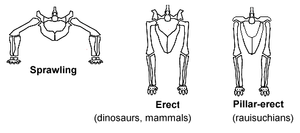
The "sprawling" posture is the most primitive, and is the original limb posture from which the others evolved. The upper limbs are typically held horizontally, while the lower limbs are vertical, though upper limb angle may be substantially increased in large animals. The body may drag along the ground, as in salamanders, or may be substantially elevated, as in monitor lizard
Monitor lizard
Monitor lizards are usually large reptiles, although some can be as small as in length. They have long necks, powerful tails and claws, and well-developed limbs. Most species are terrestrial, but arboreal and semiaquatic monitors are also known...
s. This posture is typically associated with trotting gait
Gait
Gait is the pattern of movement of the limbs of animals, including humans, during locomotion over a solid substrate. Most animals use a variety of gaits, selecting gait based on speed, terrain, the need to maneuver, and energetic efficiency...
s, and the body flexes from side-to-side during movement to increase step length. All limbed reptile
Reptile
Reptiles are members of a class of air-breathing, ectothermic vertebrates which are characterized by laying shelled eggs , and having skin covered in scales and/or scutes. They are tetrapods, either having four limbs or being descended from four-limbed ancestors...
s and salamander
Salamander
Salamander is a common name of approximately 500 species of amphibians. They are typically characterized by a superficially lizard-like appearance, with their slender bodies, short noses, and long tails. All known fossils and extinct species fall under the order Caudata, while sometimes the extant...
s use this posture, as does the platypus
Platypus
The platypus is a semi-aquatic mammal endemic to eastern Australia, including Tasmania. Together with the four species of echidna, it is one of the five extant species of monotremes, the only mammals that lay eggs instead of giving birth to live young...
and several species of frogs that walk. Unusual examples can be founds among amphibious fish
Amphibious fish
Amphibious fish are fish that are able to leave water for extended periods of time. About 11 distantly related genera of fish are considered amphibious. This suggests that many fish genera independently evolved amphibious traits. These fish use a range of terrestrial locomotory modes, such as...
, such as the mudskipper
Mudskipper
Mudskippers are members of the subfamily Oxudercinae , within the family Gobiidae . They are completely amphibious fish, fish that can use their pectoral fins to walk on land...
, which drag themselves across land on their sturdy fins. Among the invertebrate
Invertebrate
An invertebrate is an animal without a backbone. The group includes 97% of all animal species – all animals except those in the chordate subphylum Vertebrata .Invertebrates form a paraphyletic group...
s, most arthropod
Arthropod
An arthropod is an invertebrate animal having an exoskeleton , a segmented body, and jointed appendages. Arthropods are members of the phylum Arthropoda , and include the insects, arachnids, crustaceans, and others...
s—which includes the most diverse group of animals, the insect
Insect
Insects are a class of living creatures within the arthropods that have a chitinous exoskeleton, a three-part body , three pairs of jointed legs, compound eyes, and two antennae...
s—have a stance best described as sprawling. There is also anecdotal evidence that some octopus
Octopus
The octopus is a cephalopod mollusc of the order Octopoda. Octopuses have two eyes and four pairs of arms, and like other cephalopods they are bilaterally symmetric. An octopus has a hard beak, with its mouth at the center point of the arms...
species (such as the Pinnoctopus
Pinnoctopus
Pinnoctopus is a genus of octopuses in the family Octopodidae.-Species:* Pinnoctopus cordiformis Quoy and Gaimard, 1832.* Pinnoctopus kermadecensis-Taxonomic note:ITIS treats Pinnoctopus as a synonym of Octopus Cuvier, 1797....
genus) can also drag themselves across land a short distance by hauling their body along by their tentacles (for example to pursue prey between rockpools) - there may be video evidence of this. The semi-erect posture is more accurately interpreted as an extremely elevated sprawling posture. This mode of locomotion is typically found in large lizards such as monitor lizard
Monitor lizard
Monitor lizards are usually large reptiles, although some can be as small as in length. They have long necks, powerful tails and claws, and well-developed limbs. Most species are terrestrial, but arboreal and semiaquatic monitors are also known...
s and tegus.
Mammal
Mammal
Mammals are members of a class of air-breathing vertebrate animals characterised by the possession of endothermy, hair, three middle ear bones, and mammary glands functional in mothers with young...
s and bird
Bird
Birds are feathered, winged, bipedal, endothermic , egg-laying, vertebrate animals. Around 10,000 living species and 188 families makes them the most speciose class of tetrapod vertebrates. They inhabit ecosystems across the globe, from the Arctic to the Antarctic. Extant birds range in size from...
s typically have a fully erect posture, though each evolved it independently. In these groups the legs are placed beneath the body. This is often linked with the evolution of endothermy, as it avoids Carrier's constraint
Carrier's constraint
Carrier's constraint is the observation that air-breathing vertebrates which have two lungs and flex their bodies sideways during locomotion find it very difficult to move and breathe at the same time, because:...
and thus allows prolonged periods of activity (Bakker 1988). The fully erect stance is not necessarily the "most-evolved" stance; evidence suggests that crocodilians evolved a semi-erect stance in their forelimbs from ancestors with fully erect stance as a result of adapting to a mostly aquatic lifestyle (Reilly & Elias 1998), though their hindlimbs are still held fully erect. For example, the mesozoic
Mesozoic
The Mesozoic era is an interval of geological time from about 250 million years ago to about 65 million years ago. It is often referred to as the age of reptiles because reptiles, namely dinosaurs, were the dominant terrestrial and marine vertebrates of the time...
prehistoric crocodilian Erpetosuchus
Erpetosuchus
Erpetosuchus is an extinct genus of crurotarsan from the Late Triassic. It was first described by E. T. Newton in 1894 for remains found in northeastern Scotland, with more remains found in the United States in recent years. Erpetosuchus is the sister-taxon to Crocodylomorpha.The type species of...
is believed to have had a fully erect stance and been terrestrial.
Number of legs
Springtail
Springtails form the largest of the three lineages of modern hexapods that are no longer considered insects...
, which while normally hexapedal, hurls itself away from danger using its furcula
Furcula (Collembola)
The furcula, or furca, is a tail-like appendage shaped like a fork, found ventrally on the fourth abdominal segment of springtails. Present in most species dwelling the upper soil layers, it is used for jumping when the animal is threatened...
, a tail
Tail
The tail is the section at the rear end of an animal's body; in general, the term refers to a distinct, flexible appendage to the torso. It is the part of the body that corresponds roughly to the sacrum and coccyx in mammals, reptiles, and birds...
-like forked rod that can be rapidly unfurled from the underside of its body.
A number of species move and stand on two legs, that is, they are bipedal. The group that is exclusively bipedal is the bird
Bird
Birds are feathered, winged, bipedal, endothermic , egg-laying, vertebrate animals. Around 10,000 living species and 188 families makes them the most speciose class of tetrapod vertebrates. They inhabit ecosystems across the globe, from the Arctic to the Antarctic. Extant birds range in size from...
s, which have either an alternating or a hopping gait. There are also a number of bipedal mammal
Mammal
Mammals are members of a class of air-breathing vertebrate animals characterised by the possession of endothermy, hair, three middle ear bones, and mammary glands functional in mothers with young...
s. Most of these move by hopping – such as the macropods and various jumping rodent
Rodent
Rodentia is an order of mammals also known as rodents, characterised by two continuously growing incisors in the upper and lower jaws which must be kept short by gnawing....
s. Only a few mammals such as human
Human
Humans are the only living species in the Homo genus...
s and the ground pangolin commonly show an alternating bipedal gait. Also cockroach
Cockroach
Cockroaches are insects of the order Blattaria or Blattodea, of which about 30 species out of 4,500 total are associated with human habitations...
es and some lizard
Lizard
Lizards are a widespread group of squamate reptiles, with nearly 3800 species, ranging across all continents except Antarctica as well as most oceanic island chains...
s may run on their two hind legs. Macropod
Macropod
Macropods are marsupials belonging to the family Macropodidae, which includes kangaroos, wallabies, tree-kangaroos, pademelons, and several others. Macropods are native to Australia, New Guinea, and some nearby islands. Before European settlement of Australia, there were about 53 species of...
s such as kangaroo
Kangaroo
A kangaroo is a marsupial from the family Macropodidae . In common use the term is used to describe the largest species from this family, especially those of the genus Macropus, Red Kangaroo, Antilopine Kangaroo, Eastern Grey Kangaroo and Western Grey Kangaroo. Kangaroos are endemic to the country...
s are the only mammalian example of tripedal
Tripedal
Tripedal is the term used for any animal that stands on three legs. The terms bipedal and quadrupedal are used more commonly when referring to animals that either walk on two legs Tripedal (from the Latin tri = three + ped = foot) is the term used for (or would be used for) any animal that stands...
movement. They have thick muscular tails and when moving slowly may alternate between resting their weight on their tails and their two hind legs.
With the exception of the birds, all terrestrial vertebrate groups with legs are mostly quadrupedal – the mammals, reptile
Reptile
Reptiles are members of a class of air-breathing, ectothermic vertebrates which are characterized by laying shelled eggs , and having skin covered in scales and/or scutes. They are tetrapods, either having four limbs or being descended from four-limbed ancestors...
s, and the amphibian
Amphibian
Amphibians , are a class of vertebrate animals including animals such as toads, frogs, caecilians, and salamanders. They are characterized as non-amniote ectothermic tetrapods...
s usually move on four legs. There are many quadrupedal gaits.
The most diverse group of animals on earth, the insect
Insect
Insects are a class of living creatures within the arthropods that have a chitinous exoskeleton, a three-part body , three pairs of jointed legs, compound eyes, and two antennae...
s, are included in a larger taxon
Taxon
|thumb|270px|[[African elephants]] form a widely-accepted taxon, the [[genus]] LoxodontaA taxon is a group of organisms, which a taxonomist adjudges to be a unit. Usually a taxon is given a name and a rank, although neither is a requirement...
known as hexapods
Hexapoda
The subphylum Hexapoda constitutes the largest grouping of arthropods and includes the insects as well as three much smaller groups of wingless arthropods: Collembola, Protura, and Diplura . The Collembola are very abundant in terrestrial environments...
, most of which are hexapedal, walking and standing on six legs. Exceptions among the insects include praying mantises and water scorpions, which are quadrupeds with their front two legs modified for grasping, some butterflies
Butterfly
A butterfly is a mainly day-flying insect of the order Lepidoptera, which includes the butterflies and moths. Like other holometabolous insects, the butterfly's life cycle consists of four parts: egg, larva, pupa and adult. Most species are diurnal. Butterflies have large, often brightly coloured...
which use only four legs, and some kinds of insect larva
Larva
A larva is a distinct juvenile form many animals undergo before metamorphosis into adults. Animals with indirect development such as insects, amphibians, or cnidarians typically have a larval phase of their life cycle...
e that may have no legs (e.g., maggot
Maggot
In everyday speech the word maggot means the larva of a fly ; it is applied in particular to the larvae of Brachyceran flies, such as houseflies, cheese flies, and blowflies, rather than larvae of the Nematocera, such as mosquitoes and Crane flies...
s), or additional proleg
Proleg
A Proleg is the small fleshy, stub structure found on the ventral surface of the abdomen of most larval forms of insects of the order Lepidoptera, though they can also be found on other larval insects such as sawflies and a few types of flies....
s (e.g., caterpillar
Caterpillar
Caterpillars are the larval form of members of the order Lepidoptera . They are mostly herbivorous in food habit, although some species are insectivorous. Caterpillars are voracious feeders and many of them are considered to be pests in agriculture...
s).
Spider
Spider
Spiders are air-breathing arthropods that have eight legs, and chelicerae with fangs that inject venom. They are the largest order of arachnids and rank seventh in total species diversity among all other groups of organisms...
s and many of their relatives move on eight legs – they are octopedal. However, some creatures move on many more legs. Terrestrial crustacean
Crustacean
Crustaceans form a very large group of arthropods, usually treated as a subphylum, which includes such familiar animals as crabs, lobsters, crayfish, shrimp, krill and barnacles. The 50,000 described species range in size from Stygotantulus stocki at , to the Japanese spider crab with a leg span...
s may have a fair number - woodlice having fourteen legs. Also, as previously mentioned, some insect larvae such as caterpillars and sawfly
Sawfly
Sawfly is the common name for insects belonging to suborder Symphyta of the order Hymenoptera. Sawflies are distinguishable from most other Hymenoptera by the broad connection between the abdomen and the thorax, and by their caterpillar-like larvae...
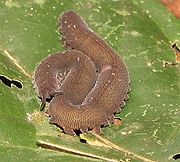
larvae have up to five (caterpillars) or nine (sawflies) additional fleshy prolegs in addition to the six legs normal for insects. Some species of invertebrate have even more legs, the unusual velvet worm
Velvet worm
The velvet worms are a minor ecdysozoan phylum. These obscurely segmented organisms have tiny eyes, antennae, multiple pairs of legs and slime glands. They have variously been compared to worms with legs, caterpillars and slugs...
having stubby legs under the length of its body, with around several dozen pairs of legs. Centipedes have one pair of legs per body segment, with typically around 50 legs, but some species have over 200. The terrestrial animals with the most legs are the millipede
Millipede
Millipedes are arthropods that have two pairs of legs per segment . Each segment that has two pairs of legs is a result of two single segments fused together as one...
s. They have two pairs of legs per body segment, with common species having between 80 and 400 legs overall – with the rare species Illacme plenipes
Illacme plenipes
Illacme plenipes is a millipede found in the central region of the U.S. state of California. It has 750 legs, more than any other millipede. It was first seen in 1926, but was not rediscovered until 2005.-Legs:...
having up to 750 legs. Animals with many legs typically move them in metachronal rhythm
Metachronal rhythm
A metachronal rhythm or metachronal wave refers to wavy movements produced by the sequential action of structures such as cilia, segments of worms or legs. These movements produce the appearance of a travelling wave. A Mexican wave is a large scale example of a metachronal wave...
, which gives the appearance of waves of motion travelling along their legs.
Leg and foot structure
The legLeg
Łęg may refer to the following places in Poland:*A former name for the town of Ełk *Part of the Czyżyny district of Kraków*Łęg, Pleszew County in Greater Poland Voivodeship...
s of tetrapod
Tetrapod
Tetrapods are vertebrate animals having four limbs. Amphibians, reptiles, birds and mammals are all tetrapods; even snakes and other limbless reptiles and amphibians are tetrapods by descent. The earliest tetrapods evolved from the lobe-finned fishes in the Devonian...
s, the main group of terrestrial vertebrate
Vertebrate
Vertebrates are animals that are members of the subphylum Vertebrata . Vertebrates are the largest group of chordates, with currently about 58,000 species described. Vertebrates include the jawless fishes, bony fishes, sharks and rays, amphibians, reptiles, mammals, and birds...
s, have internal bones, with externally attached muscles for movement, and the basic form has three key joint
Joint
A joint is the location at which two or more bones make contact. They are constructed to allow movement and provide mechanical support, and are classified structurally and functionally.-Classification:...
s: the shoulder
Shoulder
The human shoulder is made up of three bones: the clavicle , the scapula , and the humerus as well as associated muscles, ligaments and tendons. The articulations between the bones of the shoulder make up the shoulder joints. The major joint of the shoulder is the glenohumeral joint, which...
joint, the knee
Knee
The knee joint joins the thigh with the leg and consists of two articulations: one between the fibula and tibia, and one between the femur and patella. It is the largest joint in the human body and is very complicated. The knee is a mobile trocho-ginglymus , which permits flexion and extension as...
joint, and the ankle
Ankle
The ankle joint is formed where the foot and the leg meet. The ankle, or talocrural joint, is a synovial hinge joint that connects the distal ends of the tibia and fibula in the lower limb with the proximal end of the talus bone in the foot...
joint, at which the foot
Foot
The foot is an anatomical structure found in many vertebrates. It is the terminal portion of a limb which bears weight and allows locomotion. In many animals with feet, the foot is a separate organ at the terminal part of the leg made up of one or more segments or bones, generally including claws...
is attached. Within this theme there is much variation in form. An alternative form of vertebrate 'leg' to the tetrapod leg is the fins found on amphibious fish
Amphibious fish
Amphibious fish are fish that are able to leave water for extended periods of time. About 11 distantly related genera of fish are considered amphibious. This suggests that many fish genera independently evolved amphibious traits. These fish use a range of terrestrial locomotory modes, such as...
. Also a few tetrapod
Tetrapod
Tetrapods are vertebrate animals having four limbs. Amphibians, reptiles, birds and mammals are all tetrapods; even snakes and other limbless reptiles and amphibians are tetrapods by descent. The earliest tetrapods evolved from the lobe-finned fishes in the Devonian...
s, such as the macropod
Macropod
Macropods are marsupials belonging to the family Macropodidae, which includes kangaroos, wallabies, tree-kangaroos, pademelons, and several others. Macropods are native to Australia, New Guinea, and some nearby islands. Before European settlement of Australia, there were about 53 species of...
s, have adapted their tail
Tail
The tail is the section at the rear end of an animal's body; in general, the term refers to a distinct, flexible appendage to the torso. It is the part of the body that corresponds roughly to the sacrum and coccyx in mammals, reptiles, and birds...
s as additional locomotory appendages.
The basic form of the vertebrate foot
Foot
The foot is an anatomical structure found in many vertebrates. It is the terminal portion of a limb which bears weight and allows locomotion. In many animals with feet, the foot is a separate organ at the terminal part of the leg made up of one or more segments or bones, generally including claws...
has five toe
Toe
Toes are the digits of the foot of a tetrapod. Animal species such as cats that walk on their toes are described as being digitigrade. Humans, and other animals that walk on the soles of their feet, are described as being plantigrade; unguligrade animals are those that walk on hooves at the tips of...
s, however some animals will have evolved fewer than this, and some early tetrapod
Tetrapod
Tetrapods are vertebrate animals having four limbs. Amphibians, reptiles, birds and mammals are all tetrapods; even snakes and other limbless reptiles and amphibians are tetrapods by descent. The earliest tetrapods evolved from the lobe-finned fishes in the Devonian...
s had more; Acanthostega
Acanthostega
Acanthostega is an extinct labyrinthodont genus, among the first vertebrate animals to have recognizable limbs. It appeared in the Upper Devonian about 365 million years ago, and was anatomically intermediate between lobe-finned fishes and the first tetrapods fully capable of coming onto...
had eight toes. Feet have evolved many forms
Comparative foot morphology
Comparative foot morphology is exemplified through study of the form of distal limb structures of a variety of terrestrial vertebrates. A challenge to understanding the role of the feet of a variety of different organisms is the wide range of body types, foot shapes, arrangement of structures,...
depending on the animal's needs. One key variation is where on the foot the animal's weight is placed. Most vertebrates—the amphibians, the reptiles, and some mammals such as human
Human
Humans are the only living species in the Homo genus...
s and bear
Bear
Bears are mammals of the family Ursidae. Bears are classified as caniforms, or doglike carnivorans, with the pinnipeds being their closest living relatives. Although there are only eight living species of bear, they are widespread, appearing in a wide variety of habitats throughout the Northern...
s—are plantigrade
Plantigrade
right|151px|thumb|Human skeleton, showing plantigrade habitIn terrestrial animals, plantigrade locomotion means walking with the podials and metatarsals flat on the ground. It is one of three forms of locomotion adopted by mammals...
, walking on the whole of the underside of the foot. Many mammals, such as cat
Cat
The cat , also known as the domestic cat or housecat to distinguish it from other felids and felines, is a small, usually furry, domesticated, carnivorous mammal that is valued by humans for its companionship and for its ability to hunt vermin and household pests...
s and dog
Dog
The domestic dog is a domesticated form of the gray wolf, a member of the Canidae family of the order Carnivora. The term is used for both feral and pet varieties. The dog may have been the first animal to be domesticated, and has been the most widely kept working, hunting, and companion animal in...
s are digitigrade
Digitigrade
A digitigrade is an animal that stands or walks on its digits, or toes. Digitigrades include walking birds , cats, dogs, and many other mammals, but not plantigrades or unguligrades...
, walking on their toes, the greater stride length allowing more speed. Digitigrade mammals are also often adept at quiet movement. Birds are also digitigrade. Some animals such as horse
Horse
The horse is one of two extant subspecies of Equus ferus, or the wild horse. It is a single-hooved mammal belonging to the taxonomic family Equidae. The horse has evolved over the past 45 to 55 million years from a small multi-toed creature into the large, single-toed animal of today...
s are unguligrade, walking on the tips of their toes. This even further increases their stride length and thus their speed. A few mammals are also known to walk on their knuckle
Knuckle
The knuckles are the joints of the fingers and toes, which are brought into prominence when the hand is clenched and a fist is made. The word is cognate to similar words in other Germanic languages, such as the Dutch "Knokkel" or German "Knöchel" , i.e., Knöchlein, the diminutive of the German...
s, at least for their front legs. Knuckle-walking
Knuckle-walking
Knuckle-walking is a form of quadrupedal walking in which the forelimbs hold the fingers in a partially flexed posture that allows body weight to press down on the ground through the knuckles....
allows the foot (hand) to specialise for food gathering and/or climbing, as with the great apes and the extinct chalicothere
Chalicothere
Chalicotheres were a group of herbivorous, odd-toed ungulate mammals spread throughout North America, Europe, Asia, and Africa during the Early Eocene to Early Pleistocene subepochs living from 55.8 mya—781,000 years ago, existing for approximately .They evolved around 40 million years ago from...
s, or for swimming, as with the platypus
Platypus
The platypus is a semi-aquatic mammal endemic to eastern Australia, including Tasmania. Together with the four species of echidna, it is one of the five extant species of monotremes, the only mammals that lay eggs instead of giving birth to live young...
. In animals where feet have evolved into functional hand
Hand
A hand is a prehensile, multi-fingered extremity located at the end of an arm or forelimb of primates such as humans, chimpanzees, monkeys, and lemurs...
s, hand walking
Hand walking
Hand walking is an unusual form of human locomotion in which a person travels in a vertically inverted orientation with all body weight resting on the hands.It can be executed with legs fully extended or with variations such as stag, straddle or front splits...
is also possible.
Among terrestrial invertebrate
Invertebrate
An invertebrate is an animal without a backbone. The group includes 97% of all animal species – all animals except those in the chordate subphylum Vertebrata .Invertebrates form a paraphyletic group...
s there are a number of leg forms. The arthropod leg
Arthropod leg
The arthropod leg is a form of jointed appendage of arthropods, usually used for walking. Many of the terms used for arthropod leg segments are of Latin origin, and may be confused with terms for bones: coxa , trochanter , femur, tibia, tarsus, ischium, metatarsus, carpus, dactylus ,...
s are jointed and supported by hard external armor, with the muscles attached to the internal surface of this exoskeleton
Exoskeleton
An exoskeleton is the external skeleton that supports and protects an animal's body, in contrast to the internal skeleton of, for example, a human. In popular usage, some of the larger kinds of exoskeletons are known as "shells". Examples of exoskeleton animals include insects such as grasshoppers...
. The other group of legged terrestrial invertebrates, the velvet worms, have soft stumpy legs supported by a hydrostatic skeleton
Hydrostatic skeleton
A hydrostatic skeleton or hydroskeleton is a structure found in many cold-blooded organisms and soft-bodied animals consisting of a fluid-filled cavity, the coelom, surrounded by muscles. The pressure of the fluid and action of the surrounding circular and longitudinal muscles are used to change an...
. The proleg
Proleg
A Proleg is the small fleshy, stub structure found on the ventral surface of the abdomen of most larval forms of insects of the order Lepidoptera, though they can also be found on other larval insects such as sawflies and a few types of flies....
s that some caterpillars have in addition to their six more-standard arthropod legs have a similar form to those of velvet worms, and suggest a distant shared ancestry.
Gaits
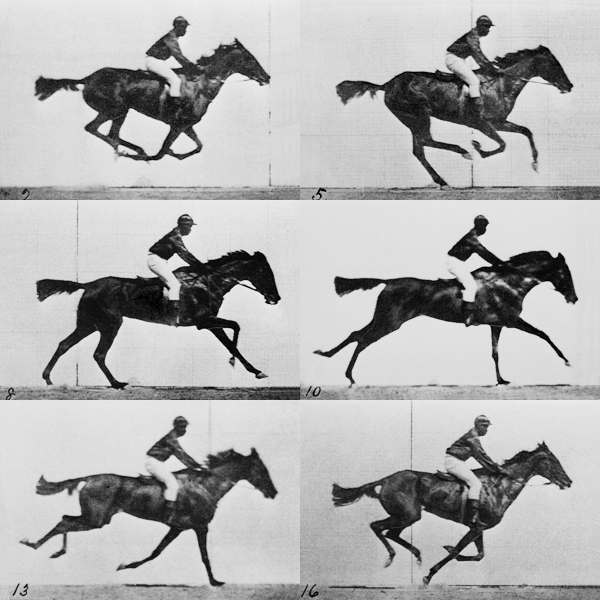
Gait
Gait is the pattern of movement of the limbs of animals, including humans, during locomotion over a solid substrate. Most animals use a variety of gaits, selecting gait based on speed, terrain, the need to maneuver, and energetic efficiency...
s, the order that they place and lift their appendages in locomotion. Gaits can be grouped into categories according to their patterns of support sequence. For quadrupeds, there are three main categories: walking gaits, running gaits, and leaping gaits. In one system, there are 60 discrete patterns: 37 walking gaits, 14 running gaits, and 9 leaping gaits.
Walking
Walking
Walking is one of the main gaits of locomotion among legged animals, and is typically slower than running and other gaits. Walking is defined by an 'inverted pendulum' gait in which the body vaults over the stiff limb or limbs with each step...
is the most common gait, where some feet are on the ground at any given time, and found in almost all legged animals. In an informal sense, running
Running
Running is a means of terrestrial locomotion allowing humans and other animals to move rapidly on foot. It is simply defined in athletics terms as a gait in which at regular points during the running cycle both feet are off the ground...
is considered to occur when at some points in the stride all feet are off the ground in a moment of suspension. Technically, however, moments of suspension occur in both running gaits (such as trot) and leaping gaits (such as canter and gallop). Gaits involving one or more moments of suspension can be found in many animals, and compared to walking they are faster but more energetically costly forms of locomotion.
Animals will use different gaits for different speeds, terrain, and situations. For example horses show four natural gaits, the slowest horse gait
Horse gait
Horse gaits are the various ways in which a horse can move, either naturally or as a result of specialized training by humans.-Classification:...
is the walk, then there are three faster gaits which, from slowest to fastest, are the trot
Trot (horse gait)
The trot is a two-beat diagonal gait of the horse, where the diagonal pairs of legs move forward at the same time. There is a moment of suspension between each beat....
, the canter
Canter
The canter is a controlled, three-beat gait performed by a horse. It is a natural gait possessed by all horses, faster than most horses' trot but slower than the gallop, and is used by all riders. The speed of the canter varies between 16-27 km/h , depending on the length of the stride of the horse...
, and the gallop. Animals may also have unusual gaits that are used occasionally, such as for moving sideways or backwards. For example, the main human gaits
Gait (human)
Human gait is the way locomotion is achieved using human limbs. Different gaits are characterized by differences in limb movement patterns, overall velocity, forces, kinetic and potential energy cycles, and changes in the contact with the surface .- Foot strike :One variable in different gaits is...
are bipedal walking
Walking
Walking is one of the main gaits of locomotion among legged animals, and is typically slower than running and other gaits. Walking is defined by an 'inverted pendulum' gait in which the body vaults over the stiff limb or limbs with each step...
and running
Running
Running is a means of terrestrial locomotion allowing humans and other animals to move rapidly on foot. It is simply defined in athletics terms as a gait in which at regular points during the running cycle both feet are off the ground...
, but they employ many other gaits occasionally, including a four-legged crawl in tight spaces.
In walking, and for many animals running, the motion of legs on either side of the body alternates, i.e. is out of phase. Other animals, such as a horse when galloping, or an inchworm
Inchworm
Inchworms are the caterpillars of geometer moths.Inchworm can also mean:*Inchworm , a song from the film Hans Christian Andersen*Inchworm , a ride-on toy manufactured by Hasbro in the 1970s...
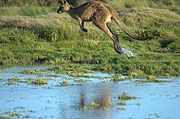
, alternate between their front and back legs. An alternative to a gait that alternates between legs is hopping or saltation, where all legs move together. As a main means of locomotion, this is usually found in bipeds or semi-bipeds. Among the mammals saltation is commonly used among macropod
Macropod
Macropods are marsupials belonging to the family Macropodidae, which includes kangaroos, wallabies, tree-kangaroos, pademelons, and several others. Macropods are native to Australia, New Guinea, and some nearby islands. Before European settlement of Australia, there were about 53 species of...
s (kangaroo
Kangaroo
A kangaroo is a marsupial from the family Macropodidae . In common use the term is used to describe the largest species from this family, especially those of the genus Macropus, Red Kangaroo, Antilopine Kangaroo, Eastern Grey Kangaroo and Western Grey Kangaroo. Kangaroos are endemic to the country...
s and their relatives), jerboa
Jerboa
The jerboa form the bulk of the membership of the family Dipodidae. Jerboas are hopping desert rodents found throughout Asia and Northern Africa. They tend to be found in hot deserts....
s, springhare
Springhare
The springhare , or springhaas, is not actually a hare, but a member of the order Rodentia. It is one of a number of species in the genus Pedetes, and is native to southern Africa. Synonyms are P. caffer or P...
s, kangaroo rat
Kangaroo rat
Kangaroo rats, genus Dipodomys, are small rodents native to North America. The common name derives from their bipedal form: as they hop in a manner similar to the much larger kangaroo, although they are not related...
s, hopping mice, gerbil
Gerbil
A gerbil is a small mammal of the order Rodentia. Once known simply as "desert rats", the gerbil subfamily includes about 110 species of African, Indian, and Asian rodents, including sand rats and jirds, all of which are adapted to arid habitats...
s, and sportive lemur
Sportive lemur
The sportive lemurs are the medium sized primates that make up the Lepilemuridae family. The family consists of only one extant genus, Lepilemur, as well as the extinct genus Megaladapis. They are closely related to the other lemurs and exclusively live on the island of Madagascar...
s. Certain tendons in kangaroo hind legs are very elastic
Elasticity (physics)
In physics, elasticity is the physical property of a material that returns to its original shape after the stress that made it deform or distort is removed. The relative amount of deformation is called the strain....
, allowing kangaroos to effectively bounce along conserving energy from hop to hop, making hopping a very energy efficient way to move around in their nutrient poor environment. Saltation is also used by many small birds. Frog
Frog
Frogs are amphibians in the order Anura , formerly referred to as Salientia . Most frogs are characterized by a short body, webbed digits , protruding eyes and the absence of a tail...
s and flea
Flea
Flea is the common name for insects of the order Siphonaptera which are wingless insects with mouthparts adapted for piercing skin and sucking blood...
s also hop.
Most animals move in the direction of their head. However there are some exceptions. Crab
Crab
True crabs are decapod crustaceans of the infraorder Brachyura, which typically have a very short projecting "tail" , or where the reduced abdomen is entirely hidden under the thorax...
s move sideways, and naked mole rat
Naked Mole Rat
The naked mole rat , also known as the sand puppy or desert mole rat, is a burrowing rodent native to parts of East Africa and the only species currently classified in the genus Heterocephalus...
s, which live in tight tunnels underground, can move backward or forward with equal facility. Crayfish
Crayfish
Crayfish, crawfish, or crawdads – members of the superfamilies Astacoidea and Parastacoidea – are freshwater crustaceans resembling small lobsters, to which they are related...
can move backward much faster than they can move forward.
Gait analysis
Gait analysis
Gait analysis is the systematic study of animal locomotion, more specific as a study of human motion, using the eye and the brain of observers, augmented by instrumentation for measuring body movements, body mechanics, and the activity of the muscles. Gait analysis is used to assess, plan, and...
is the study of gait in humans and other animals. This may involve videoing subjects with markers on particular anatomical landmarks and measuring the forces of their footfall using floor transducer
Transducer
A transducer is a device that converts one type of energy to another. Energy types include electrical, mechanical, electromagnetic , chemical, acoustic or thermal energy. While the term transducer commonly implies the use of a sensor/detector, any device which converts energy can be considered a...
s (strain gauge
Strain gauge
A strain gauge is a device used to measure the strain of an object. Invented by Edward E. Simmons and Arthur C. Ruge in 1938, the most common type of strain gauge consists of an insulating flexible backing which supports a metallic foil pattern. The gauge is attached to the object by a suitable...
s). Skin electrode
Electrode
An electrode is an electrical conductor used to make contact with a nonmetallic part of a circuit...
s may also be used to measure muscle
Muscle
Muscle is a contractile tissue of animals and is derived from the mesodermal layer of embryonic germ cells. Muscle cells contain contractile filaments that move past each other and change the size of the cell. They are classified as skeletal, cardiac, or smooth muscles. Their function is to...
activity.
Limbless locomotion
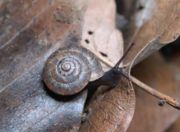
Limbless vertebrates
Many vertebrates have evolved limbless forms. Reptiles have on a number of occasions evolved into limbless forms - snakes, amphisbaenia, and legless lizards...
and invertebrates. These animals, due to lack of appendages, use their bodies to generate propulsive force. These movements are sometimes referred to as "slithering" or "crawling", although neither are formally used in the scientific literature and the latter term is also used for some animals moving on all four limbs. All limbless animals come from cold-blooded
Poikilotherm
A poikilotherm is an organism whose internal temperature varies considerably. It is the opposite of a homeotherm, an organism which maintains thermal homeostasis. Usually the variation is a consequence of variation in the ambient environmental temperature...
groups; there are no endothermic
Endothermic
In thermodynamics, the word endothermic describes a process or reaction in which the system absorbs energy from the surroundings in the form of heat. Its etymology stems from the prefix endo- and the Greek word thermasi,...
limbless animals, i.e. there are no limbless birds or mammals.
Lower body surface
Where the foot is important to the legged mammal, for limbless animals the underside of the body is important. Some animals such as snakeSnake
Snakes are elongate, legless, carnivorous reptiles of the suborder Serpentes that can be distinguished from legless lizards by their lack of eyelids and external ears. Like all squamates, snakes are ectothermic, amniote vertebrates covered in overlapping scales...
s or legless lizard
Legless lizard
Legless lizard may refer to any of several groups of lizards which have independently lost limbs or reduced them to the point of being of no use in locomotion. It is the common name for the family Pygopodidae, but often refers to other groups, such as limbless anguids, depending upon the region of...
s move on their smooth dry underside. Other animals have various features that aid movement. Molluscs such as slug
Slug
Slug is a common name that is normally applied to any gastropod mollusc that lacks a shell, has a very reduced shell, or has a small internal shell...
s and snail
Snail
Snail is a common name applied to most of the members of the molluscan class Gastropoda that have coiled shells in the adult stage. When the word is used in its most general sense, it includes sea snails, land snails and freshwater snails. The word snail without any qualifier is however more often...
s move on a layer of mucus
Mucus
In vertebrates, mucus is a slippery secretion produced by, and covering, mucous membranes. Mucous fluid is typically produced from mucous cells found in mucous glands. Mucous cells secrete products that are rich in glycoproteins and water. Mucous fluid may also originate from mixed glands, which...
that is secreted from their underside, reducing friction and protecting from injury when moving over sharp objects. Earthworm
Earthworm
Earthworm is the common name for the largest members of Oligochaeta in the phylum Annelida. In classical systems they were placed in the order Opisthopora, on the basis of the male pores opening posterior to the female pores, even though the internal male segments are anterior to the female...
s have small bristles (setae) that hook into the substrate and help them move. Some animals such as leeches have suction cups on either end of the body allowing two anchor movement.
Type of movement
Some limbless animals, such as leeches, have suction cups on either end of their body, which allow them to move by anchoring the rear end and then moving forward the front end, which is then anchored and then the back end is pulled in, and so on. This is known as two-anchor movement. A legged animal, the inchwormGeometer moth
The geometer moths or Geometridae are a family of the order Lepidoptera...
, also moves like this, clasping with appendages at either end of its body.
Limbless animals can also move using pedal locomotary waves, rippling the underside of the body. This is the main method used by molluscs such as slugs and snails, and also large flatworms, some other worms, and even earless seal
Earless seal
The true seals or earless seals are one of the three main groups of mammals within the seal superfamily, Pinnipedia. All true seals are members of the family Phocidae . They are sometimes called crawling seals to distinguish them from the fur seals and sea lions of the family Otariidae...
s. The waves may move in the opposite direction to motion, known as retrograde waves, or in the same direction as motion, known as direct waves. Earthworms move by retrograde waves alternatively swelling and contracting down the length of their body, the swollen sections being held in place using setae. Aquatic molluscs such as limpet
Limpet
Limpet is a common name for a number of different kinds of saltwater and freshwater snails ; it is applied to those snails that have a simple shell which is more or less conical in shape, and either is not spirally coiled, or appears not to be coiled in the adult snails.The name limpet is most...
s, which are sometimes out of the water, tend to move using retrograde waves. However terrestrial molluscs such as slugs and snails tend to use direct waves. Lugworm
Lugworm
The lugworm or sandworm, Arenicola marina, is a large marine worm of the phylum Annelida. Its coiled castings are a familiar sight on a beach at low tide but the animal itself is rarely seen except by those who, from curiosity or to use as fishing bait, dig the worm out of the sand.When fully...
s and seals also use direct waves.
Most snakes move using lateral undulation where a lateral wave travels down the snake's body in the opposite direction to the snake's motion and pushes the snake off irregularities in the ground. This mode of locomotion requires these irregularities to function. Another form of locomotion, rectilinear locomotion
Rectilinear locomotion
Rectilinear locomotion is a mode of locomotion most often associated with snakes, particularly heavy-bodied species like terrestrial pythons and boas, although most snakes are capable of it...
, is used at times by some snakes, especially large ones such as pythons and boa. Here large scales on the underside of the body, known as scute
Scute
A scute or scutum is a bony external plate or scale, as on the shell of a turtle, the skin of crocodilians, the feet of some birds or the anterior portion of the mesonotum in insects.-Properties:...
s are used to push backwards and downwards. This is effective on a flat surface and is used for slow, silent movement, such as when stalking prey. Snakes use concertina locomotion
Concertina movement
Concertina movement is the movement occurring in snakes and other legless organisms that consists of gripping or anchoring with portions of the body while pulling/pushing other sections in the direction of movement. Each point on the snake's body goes through alternating cycles of static contact...
for moving slowly in tunnels, here the snake alternates in bracing parts of its body on it surrounds. Finally the caenophidian snakes use the fast and unusual method of movement known as sidewinding
Sidewinding
Sidewinding is a type of locomotion unique to caenophidian snakes, used to move across loose or slippery substrates. It is most often used by the Saharan horned viper, Cerastes cerastes, and the sidewinder rattlesnake, Crotalus cerastes, to move across loose desert sands, but it is also used by...
on sand or loose soil. The snake cycles through throwing the front part of its body in the direction of motion and bringing the back part of its body into line crosswise.
Rolling
Wheel
A wheel is a device that allows heavy objects to be moved easily through rotating on an axle through its center, facilitating movement or transportation while supporting a load, or performing labor in machines. Common examples found in transport applications. A wheel, together with an axle,...
s for locomotion
(see Rotating locomotion in living systems), a small number of animals will move at times by rolling their whole body. Rolling animals can be divided into those that roll under the force of gravity and those that roll using their own power.
Gravity assisted
Web-toed salamander. This 10 cm long salamander lives on steep hills in the Sierra Nevada mountains. When it's disturbed or startled it coils itself up into a little ball often causing it to roll down hill (García-París & Deban 1995).Pebble toad (Oreophrynella niger). This toad lives atop tepui
Tepui
A tepui , or tepuy, is a table-top mountain or mesa found in the Guiana Highlands of South America, especially in Venezuela. The word tepui means "house of the gods" in the native tongue of the Pemon, the indigenous people who inhabit the Gran Sabana....
in the Guiana highlands of south america
South America
South America is a continent situated in the Western Hemisphere, mostly in the Southern Hemisphere, with a relatively small portion in the Northern Hemisphere. The continent is also considered a subcontinent of the Americas. It is bordered on the west by the Pacific Ocean and on the north and east...
. When threatened, often by tarantula
Tarantula
Tarantulas comprise a group of often hairy and often very large arachnids belonging to the family Theraphosidae, of which approximately 900 species have been identified. Some members of the same Suborder may also be called "tarantulas" in the common parlance. This article will restrict itself to...
s, it rolls into ball, and typically being on an incline, rolls away under gravity like a loose pebble. http://news.bbc.co.uk/earth/hi/earth_news/newsid_8307000/8307333.stm
Namib wheeling spiders (Carparachne spp.), found in the Namib desert, will actively roll down sand dunes. This action can be used to successfully escape predators such as the Pompilidae tarantula wasps, which lays its eggs in a paralyzed spider so the larvae have enough food when they hatch. The spiders flip their body sideways and then cartwheel over their bent legs. The rotation is fast, with the golden wheel Spider (Carparachne aureoflava) moving up to 20 revolutions per second, moving the spider at 1 metre per second. At this speed the spider appears only as a blurred ball. This spider was studied by Dr Joh Henschel of the Gobabeb Training & Research Centre.
Pangolin
Pangolin
A pangolin , also scaly anteater or Trenggiling, is a mammal of the order Pholidota. There is only one extant family and one genus of pangolins, comprising eight species. There are also a number of extinct taxa. Pangolins have large keratin scales covering their skin and are the only mammals with...
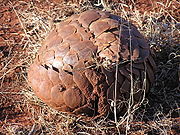
s, a type of mammal covered in thick scales rolls into a tight ball when threatened. Pangolins has been reported to roll away from danger, by both gravity and self-powered methods. A pangolin in hill country in Sumatra
Sumatra
Sumatra is an island in western Indonesia, westernmost of the Sunda Islands. It is the largest island entirely in Indonesia , and the sixth largest island in the world at 473,481 km2 with a population of 50,365,538...
, to flee from the researcher, ran to the edge of a slope and curled into a ball to roll down the slope, crashing through the vegetation, and covering an estimated 30 metres or more in 10 seconds (Tenaza 1975).
Self-powered
CaterpillarCaterpillar
Caterpillars are the larval form of members of the order Lepidoptera . They are mostly herbivorous in food habit, although some species are insectivorous. Caterpillars are voracious feeders and many of them are considered to be pests in agriculture...
of the Mother-Of-Pearl Moth, Pleuroptya ruralis
Pleuroptya ruralis
The Mother of Pearl is a species of moth of the family Crambidae. It is found in Europe. The species is notable for its rolling locomotion....
. When attacked, this caterpillar will touch its head to its tail and roll backwards, up to 5 revolutions at about 40 cm per second, which is about 40 times its normal speed.
Nannosquilla decemspinosa, a species of long-bodied, short-legged Mantis Shrimp, lives in shallow sandy areas along the Pacific coast of Central and South America. When stranded by a low tide the 3 cm stomatopod lies on its back and performs backwards somersaults over and over. The animal moves up to 2 meters at a time by rolling 20-40 times, with speeds of around 72 revolutions per minute. That is 1.5 body lengths per second (3.5 cm/s). Researchers estimate that the stomatopod acts as a true wheel around 40% of the time during this series of rolls. The remaining 60% of the time it has to "jumpstart" a roll by using its body to thrust itself upwards and forwards.
Pangolin
Pangolin
A pangolin , also scaly anteater or Trenggiling, is a mammal of the order Pholidota. There is only one extant family and one genus of pangolins, comprising eight species. There are also a number of extinct taxa. Pangolins have large keratin scales covering their skin and are the only mammals with...
s have also been reported to roll away from danger by self-powered methods. Witnessed by a lion researcher in the Serengeti
Serengeti
The Serengeti ecosystem is a geographical region in Africa. It is located in north Tanzania and extends to south-western Kenya between latitudes 1 and 3 S and longitudes 34 and 36 E. It spans some ....
in Africa, a group of lions surrounded a pangolin, but could not get purchase on it when it rolled into a ball, and so the lions sat around it waiting and dozing. Surrounded by lions, it would unroll itself slightly and give itself a push to roll some distance, until by doing this multiple times it could get far enough away from the lions to be safe. Moving like this would allow a pangolin to cover distance while still remaining in a protective armoured ball .
Limits and extremes
The fastest terrestrial animal is the cheetahCheetah
The cheetah is a large-sized feline inhabiting most of Africa and parts of the Middle East. The cheetah is the only extant member of the genus Acinonyx, most notable for modifications in the species' paws...
, which can attain maximal sprint speeds of approximately 104 km/h (64 mph). The fastest running lizard is the Black Iguana, which has been recorded moving at speed of up to 34.9 km/h (21.7 mph).