
The
jerboa (from
ArabicArabic is a Central Semitic language, thus related to and classified alongside other Semitic languages such as Hebrew and the Neo-Aramaic languages. In terms of speakers, the Arabic macrolanguage is the largest member of the Semitic language family. It is spoken by more than 280 million people as...
يربوع
yarbū' or
HebrewHebrew is a Semitic language of the Afro-Asiatic language family. Culturally, it is considered a Jewish language. Hebrew in its modern form is spoken by more than seven million people in Israel while Classical Hebrew has been used for prayer or study in Jewish communities around the world for over...
ירבוע
yarbōa' ) form the bulk of the membership of the
familyIn biological classification, family is* a taxonomic rank. Other well-known ranks are life, domain, kingdom, phylum, class, order, genus, and species, with family fitting between order and genus...
DipodidaeThe Dipodidae, or dipodids, are a family of rodents found across the northern hemisphere. They include the jerboas, jumping mice, and birch mice. Different species are found in grassland, deserts, and forests...
. Jerboas are jumping
desertA desert is a landscape or region that receives almost no precipitation. Deserts are defined as areas with an average annual precipitation of less than per year, or as areas where more water is lost by evapotranspiration than falls as precipitation. In the Köppen climate classification system,...
rodentRodentia is an order of mammals also known as rodents, characterised by two continuously growing incisors in the upper and lower jaws which must be kept short by gnawing....
s found throughout
AsiaAsia is the world's largest and most populous continent, located in the eastern and northern hemispheres. It covers 8.6% of the earth's total surface area and with approximately 4 billion people, it hosts 60% of the world's current human population.Asia is traditionally defined as part of the...
and Northern Africa.
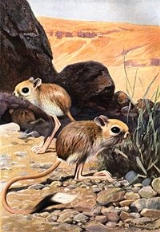
Jerboas resemble
miceA mouse is a small mammal belonging to the order of rodents. The best known mouse species is the common house mouse . It is also a popular pet. The American white-footed mouse and the deer mouse also sometimes live in houses. In some places, certain kinds of field mice are also common...
with long tufted tails and very long hind legs. The small forelegs are not used for locomotion. In general, Asiatic jerboas have five toes on their hind feet and African jerboas have three; the shapes of their ears vary widely between species .
The
jerboa (from
ArabicArabic is a Central Semitic language, thus related to and classified alongside other Semitic languages such as Hebrew and the Neo-Aramaic languages. In terms of speakers, the Arabic macrolanguage is the largest member of the Semitic language family. It is spoken by more than 280 million people as...
يربوع
yarbū' or
HebrewHebrew is a Semitic language of the Afro-Asiatic language family. Culturally, it is considered a Jewish language. Hebrew in its modern form is spoken by more than seven million people in Israel while Classical Hebrew has been used for prayer or study in Jewish communities around the world for over...
ירבוע
yarbōa' ) form the bulk of the membership of the
familyIn biological classification, family is* a taxonomic rank. Other well-known ranks are life, domain, kingdom, phylum, class, order, genus, and species, with family fitting between order and genus...
DipodidaeThe Dipodidae, or dipodids, are a family of rodents found across the northern hemisphere. They include the jerboas, jumping mice, and birch mice. Different species are found in grassland, deserts, and forests...
. Jerboas are jumping
desertA desert is a landscape or region that receives almost no precipitation. Deserts are defined as areas with an average annual precipitation of less than per year, or as areas where more water is lost by evapotranspiration than falls as precipitation. In the Köppen climate classification system,...
rodentRodentia is an order of mammals also known as rodents, characterised by two continuously growing incisors in the upper and lower jaws which must be kept short by gnawing....
s found throughout
AsiaAsia is the world's largest and most populous continent, located in the eastern and northern hemispheres. It covers 8.6% of the earth's total surface area and with approximately 4 billion people, it hosts 60% of the world's current human population.Asia is traditionally defined as part of the...
and Northern Africa.
Characteristics
Jerboas resemble
miceA mouse is a small mammal belonging to the order of rodents. The best known mouse species is the common house mouse . It is also a popular pet. The American white-footed mouse and the deer mouse also sometimes live in houses. In some places, certain kinds of field mice are also common...
with long tufted tails and very long hind legs. The small forelegs are not used for locomotion. In general, Asiatic jerboas have five toes on their hind feet and African jerboas have three; the shapes of their ears vary widely between species . Jerboa fur is long, soft and silky. Diet varies considerably: some are specialist seed, insect, or plant eaters, others are omnivores .
Jerboas have the ability to hop considerable distances relative to its size, an ability that evolved as an adaptation to help them escape from predators, and to assist with long journeys and foraging in its desert environment . Although jerboas are not closely related to the hopping mice of
AustraliaAustralia , officially the Commonwealth of Australia, is a country in the Southern Hemisphere comprising the continental mainland , the island of Tasmania, and numerous smaller islands in the Indian and Pacific Oceans...
or the
kangaroo ratKangaroo rats, genus Dipodomys, are small rodents native to North America. The common name derives from their bipedal form: as they hop in a manner similar to the much larger kangaroo, although they are not related.-Speciation:...
s of
North AmericaNorth America is the northern continent of the Americas, situated in the Earth's northern hemisphere and in the western hemisphere. It is bordered on the north by the Arctic Ocean, on the east by the North Atlantic Ocean, on the southeast by the Caribbean Sea, and on the west by the North Pacific...
, all three groups have evolved a similar set of adaptations to life in the deep desert.
Burrows and Behavior
Jerboas are nocturnal. During the heat of the day, they shelter in burrows. They create four separate types of burrow: two temporary, and two permanent . The temporary burrows are plain tubes used to escape predators during the night, tending to be just deep, unsealed and not camouflaged . Permanent daytime burrows are well-hidden and sealed with a plug of sand to keep heat out and moisture in, and tend to be long . A jerboa's permanent burrow often have multiple entrances, and are much more elaborate structures with a nesting chamber . The winter burrows have food storage chambers below ground level, and a hibernation chamber an astonishing down.
Perhaps the best-known species is the
Lesser Egyptian JerboaThe Lesser Egyptian Jerboa الجربوع , Jaculus jaculus, is a little rodent of Africa and the Middle East.Its diet consists of seeds and grasses, however the Jerboa needs very little water to survive.-References:...
(
Jaculus jaculus) which occupies some of the most hostile deserts on the planet. It does not drink at all, relying on its food to provide enough moisture for survival . Found in both the sandy and stony deserts of
North AfricaNorth Africa or Northern Africa is the northernmost region of the African continent, linked by the Sahara to Sub-Saharan Africa.Geopolitically, the UN definition of Northern Africa includes the following seven countries or territories; Algeria, Egypt, Libya, Morocco, Sudan, Tunisia,Mauritania, and...
, Arabia and
IranIran , officially the Islamic Republic of Iran is a country in Western Asia. The name Iran has been in use natively since the Sassanid period and came into international use from 1935, before which the country was known internationally as Persia...
, this small creature
aestivatesEstivation or aestivation , also known as "summer sleep", is a state of animal dormancy somewhat similar to hibernation...
(analogous to
hibernationHibernation is a state of inactivity and metabolic depression in animals, characterized by lower body temperature, slower breathing, and lower metabolic rate. Hibernating animals conserve energy, especially during winter when food is short, tapping energy reserves, body fat, at a slow rate...
) during the hottest summer months, and has the ability to leap a full metre to escape a predator .
Possible Endangerment
Two species are considered threatened: the
Five-toed Pygmy JerboaThe Five-toed Pygmy Jerboa is a species of rodent in the Dipodidae family. It is monotypic within the genus Cardiocranius.It is found in China, Kazakhstan, and Mongolia.Its natural habitat is temperate desert....
(classed 'VU' vulnerable), the
Thick-tailed Pygmy JerboaThe Thick-tailed Pygmy Jerboa is a species of rodent in the Dipodidae family. It is found in China, Kazakhstan, and Mongolia. Its natural habitats are temperate grassland and temperate desert. It is threatened by habitat loss.-References:*Holden, M. E. and G. G. Musser. 2005. Family Dipodidae. Pp...
(classed 'VU' vulnerable). A rare species only recently captured on film in the deserts of Mongolia and China, the
Long-eared JerboaThe Long-eared Jerboa, Euchoreutes naso, is a nocturnal mouse-like rodent with a long tail, long hind legs for jumping, and exceptionally large ears...
(classed 'LC' least concern ) is no longer believed to be threatened. Many other species have been placed in a "lower risk" category, and one species (
Thomas's Pygmy JerboaThomas's Pygmy Jerboa is a species of rodent in the Dipodidae family. It is endemic to Afghanistan. Its natural habitat is temperate desert.-References:* Baillie, J. 1996. . Downloaded on 30 July 2007....
) lacks the data for assessment.
Classification

- ORDER RODENTIA
Rodentia is an order of mammals also known as rodents, characterised by two continuously growing incisors in the upper and lower jaws which must be kept short by gnawing....
- Family Dipodidae
The Dipodidae, or dipodids, are a family of rodents found across the northern hemisphere. They include the jerboas, jumping mice, and birch mice. Different species are found in grassland, deserts, and forests...
- Subfamily Zapodinae: jumping mice, 4 species in 3 genera
- Subfamily Sicistinae: birch mice
- Subfamily Cardiocraniinae
- Cardiocranius
- Five-toed Pygmy Jerboa
The Five-toed Pygmy Jerboa is a species of rodent in the Dipodidae family. It is monotypic within the genus Cardiocranius.It is found in China, Kazakhstan, and Mongolia.Its natural habitat is temperate desert....
, Cardiocranius paradoxus
- Salpingotus
Salpingotus is a genus of rodent in the Dipodidae family.It contains the following species:* Genus Salpingotus**Subgenus Anguistodontus*** Thick-tailed Pygmy Jerboa **Subgenus Prosalpingotus...
- Thick-tailed Pygmy Jerboa
The Thick-tailed Pygmy Jerboa is a species of rodent in the Dipodidae family. It is found in China, Kazakhstan, and Mongolia. Its natural habitats are temperate grassland and temperate desert. It is threatened by habitat loss.-References:*Holden, M. E. and G. G. Musser. 2005. Family Dipodidae. Pp...
, Salpingotus crassicauda
- Heptner's Pygmy Jerboa
Heptner's Pygmy Jerboa is a species of rodent in the Dipodidae family. It is found in Kazakhstan, Uzbekistan, and possibly Russia. Its natural habitat is temperate desert.-References:...
, Salpingotus heptneri
- Kozlov's Pygmy Jerboa
Kozlov's Pygmy Jerboa is a species of rodent in the Dipodidae family. It is found in China and Mongolia. Its natural habitat is temperate desert.-References:...
, Salpingotus kozlovi
- Baluchistan Pygmy Jerboa
The Baluchistan Pygmy Jerboa is a species of rodent in the Dipodidae family. It is the only species in the genus Salpingotulus. It is endemic to Pakistan.-References:...
, Salpingotus michaelis
- Pallid Pygmy Jerboa, Salpingotus pallidus
- Thomas's Pygmy Jerboa
Thomas's Pygmy Jerboa is a species of rodent in the Dipodidae family. It is endemic to Afghanistan. Its natural habitat is temperate desert.-References:* Baillie, J. 1996. . Downloaded on 30 July 2007....
, Salpingotus thomasi
- Subfamily Dipodinae
Dipodinae is a subfamily of Dipodidae.-Classification:*Family Dipodidae**Subfamily Dipodinae***Tribe Dipodini****Dipus****Eremodipus****Jaculus****Stylodipus***Tribe Paradipodini****Paradipus-Notes:...
- Dipus
- Northern Three-toed Jerboa
The Northern Three-toed Jerboa is a species of rodent in the Dipodidae family. It is monotypic within the genus Dipus.It is found in China, Iran, Kazakhstan, Mongolia, Russia, Turkmenistan, and Uzbekistan.-References:...
, Dipus sagitta
- Eremodipus
- Lichtenstein's Jerboa
Lichtenstein's Jerboa is a species of rodent in the Dipodidae family. It is monotypic within the genus Eremodipus.It is found in Kazakhstan, Turkmenistan, and Uzbekistan.-References:...
, Eremodipus lichensteini
- Jaculus
The genus Jaculus is a member of the Dipodinae subfamily of dipodoid rodents . Jaculus species are distributed in desert and semi-arid regions across northern Africa, the Sahara, the Horn of Africa, Arabia, the Middle East, and Central Asia....
- Blanford's Jerboa
Blanford's Jerboa is a species of rodent in the Dipodidae family. It is found in Turkmenistan, Uzbekistan], Afghanistan, Iran, and Pakistan.-References:...
, Jaculus blanfordi
- Lesser Egyptian Jerboa
The Lesser Egyptian Jerboa الجربوع , Jaculus jaculus, is a little rodent of Africa and the Middle East.Its diet consists of seeds and grasses, however the Jerboa needs very little water to survive.-References:...
, Jaculus jaculus
- Greater Egyptian Jerboa
The Greater Egyptian Jerboa is a species of rodent in the Dipodidae family. It is found in Algeria, Egypt, Israel, Libya, Morocco, Saudi Arabia, and Tunisia. Its natural habitats are subtropical or tropical dry shrubland, sandy shores, and arable land.-References:* Aulagnier, S. 2004. . ...
, Jaculus orientalis
- Turkmen Jerboa, Jaculus turcmenicus
- Stylodipus
Stylodipus is a genus of rodent in the Dipodidae family.It contains the following species:* Andrews's Three-toed Jerboa * Mongolian Three-toed Jerboa...
- Andrews's Three-toed Jerboa
Andrews's Three-toed Jerboa is a species of rodent in the Dipodidae family. It is found in China and Mongolia.- References :* Baillie, J. 1996. . Downloaded on 30 July 2007....
, Stylodipus andrewsi
- Mongolian Three-toed Jerboa
The Mongolian Three-toed Jerboa is a species of rodent in the Dipodidae family. It is found in Mongolia and possibly China.-References:...
, Stylodipus sungorus
- Thick-tailed Three-toed Jerboa
The Thick-tailed Three-toed Jerboa is a species of rodent in the Dipodidae family. It is found in China, Kazakhstan, Russia, Turkmenistan, Ukraine, and Uzbekistan.-References:...
, Stylodipus telum
- Subfamily Euchoreutinae
- Euchoreutes
- Long-eared Jerboa
The Long-eared Jerboa, Euchoreutes naso, is a nocturnal mouse-like rodent with a long tail, long hind legs for jumping, and exceptionally large ears...
, Euchoreutes naso
- Subfamily Allactaginae
Allactaginae is a subfamily of rodents.- Classification :*Family Dipodidae**Subfamily Allactaginae***Allactaga***Allactodipus ***Pygeretmus- References :...
- Allactaga
The genus Allactaga contains the four and five-toed jerboas of Asia.-Characteristics:These are hopping rodents of desert and semi-arid regions with long ears, tails and feet. All members of the genus have five toes except for a single species, the Four-toed Jerboa, Allactaga tetradactyla of...
- Balikun Jerboa
The Balikun Jerboa is a species of rodent in the Dipodidae family.It is found in China and Mongolia.-References:...
,
Allactaga balikunica
- Gobi Jerboa
The Gobi Jerboa is a species of rodent in the Dipodidae family.It is found in China and Mongolia.Its natural habitats are temperate grassland and temperate desert.-References:...
, Allactaga bullata
- Small Five-toed Jerboa
The Small Five-toed Jerboa is a species of rodent in the Dipodidae family.It is found in Afghanistan, Armenia, Azerbaijan, China, Georgia, Iran, Kazakhstan, Pakistan, Russia, Turkey, and Turkmenistan.-References:...
, Allactaga elater
- Euphrates Jerboa
The Euphrates Jerboa is a species of rodent in the Dipodidae family.It is found in Afghanistan, Iran, Iraq, Jordan, Kuwait, Saudi Arabia, Syria, and Turkey....
, Allactaga euphratica
- Iranian Jerboa
The Iranian Jerboa is a jerboa in the subfamily Allactaginae. The species was listed as critically endangered by the IUCN red list. It is only found one small population in Iran. They were found on a flat plain with a gravel substrate and sparse, mountain steppe vegetation. It is a nocturnal...
, Allactaga firouzi
- Hotson's Jerboa
Hotson's Jerboa is a species of rodent in the Dipodidae family.It is found in Afghanistan, Iran, and Pakistan. Named by Oldfield Thomas after John Ernest Buttery Hotson who collected specimens in Baluchistan during 1918-1920....
, Allactaga hotsoni
- Great Jerboa
The Great Jerboa is a species of rodent in the Dipodidae family.It is found in Kazakhstan, Russia, Turkmenistan, and Uzbekistan.It mainly lives in deserts.-References:...
, Allactaga major
- Svertzov's Jerboa
Severtzov's Jerboa is a species of rodent in the Dipodidae family.It is found in Kazakhstan, Tajikistan, Turkmenistan, and Uzbekistan.-References:...
, Allactaga severtzovi
- Mongolian Five-toed Jerboa
The Mongolian Five-toed Jerboa or Siberian Jerboa is a species of rodent in the Dipodidae family.It is found in China, Kazakhstan, Mongolia, and Turkmenistan.-References:...
, Allactaga sibirica
- Four-toed Jerboa
The Four-toed Jerboa is a small jumping desert rodent. This species of jerboa is endangered and lives in coastal salt marshes, and dry and clay deserts. It has long hind legs, short front legs, and long ears about the length of its head. Its fur is the color of the sand it burrows in, with a...
, Allactaga tetradactyla
- Vinogradov's Jerboa
Vinogradov's Jerboa is a species of rodent in the Dipodidae family.It is found in Kazakhstan, Kyrgyzstan, Tajikistan, and Uzbekistan.-References:...
, Allactaga vinogradovi
- Bobrinski's Jerboa
Bobrinski's Jerboa is a species of rodent in the Dipodidae family. It is monotypic within the genus Allactodipus.It is found in Turkmenistan and Uzbekistan.-References:...
, Allactodipus bobrinskii
- Pygeretmus
Pygeretmus is a genus of rodent in the Dipodidae family.It contains the following species:* Lesser Fat-tailed Jerboa * Dwarf Fat-tailed Jerboa * Greater Fat-tailed Jerboa...
- Lesser Fat-tailed Jerboa
The Lesser Fat-tailed Jerboa is a species of rodent in the Dipodidae family. It is endemic to West, Central, and Eastern Kazakhstan, as well as Northwestern Turkmenistan.-Sources:...
,
Pygeretmus platyurus
- Dwarf Fat-tailed Jerboa
The Dwarf Fat-tailed Jerboa is a species of rodent in the Dipodidae family. It is found in China, Iran, Kazakhstan, Mongolia, and Russia.-References:* Baillie, J. 1996. . Downloaded on 30 July 2007....
, Pygeretmus pumilo
- Greater Fat-tailed Jerboa
The Greater Fat-tailed Jerboa is a species of rodent in the Dipodidae family. It is endemic to Kazakhstan. Its natural habitat is temperate desert.-References:...
, Pygeretmus shitkovi
Subfamily Paradipodinae
- Paradipus
- Comb-toed Jerboa
The Comb-toed Jerboa is a species of rodent in the Dipodidae family. It is monotypic within the genus Paradipus. It is found in Kazakhstan, Turkmenistan, and Uzbekistan.-References:...
,
Paradipus ctenodactylus
External links