

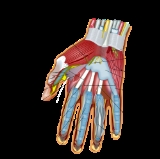
Hand

Encyclopedia
A hand is a prehensile
, multi-finger
ed extremity located at the end of an arm or forelimb of primate
s such as human
s, chimpanzee
s, monkey
s, and lemur
s. A few other vertebrate
s such as the koala (which has two opposable thumbs on each "hand" and fingerprints remarkably similar to human fingerprints) are often described as having either "hands" or "paws" on their front limbs.
Hands are the chief organs for physically manipulating the environment, used for both gross motor skill
s (such as grasping a large object) and fine motor skill
s (such as picking up a small pebble). The fingertips contain some of the densest areas of nerve endings on the body, are the richest source of tactile feedback, and have the greatest positioning capability of the body; thus the sense of touch is intimately associated with hands. Like other paired organs (eyes, feet, legs), each hand is dominantly controlled by the opposing brain hemisphere
, so that handedness
, or the preferred hand choice for single-handed activities such as writing with a pen, reflects individual brain functioning.
Some evolutionary anatomists use the term hand to refer to the appendage of digits on the forelimb more generally — for example, in the context of whether the three digit
s of the bird
hand involved the same homologous
loss of two digits as in the dinosaur
hand.
The hand has 27 bones, 14 of which are the phalanges (proximal, medial, and distal) of the fingers. The metacarpal is the bone that connects the fingers and the wrist. Each human hand has 5 metacarpals.
s and other animal
s have grasping appendages similar in form to a hand such as paw
s, claw
s, and talons, but these are not scientifically considered to be grasping hands. The scientific use of the term hand in this sense to distinguish the terminations of the front paws from the hind ones is an example of anthropomorphism
. The only true grasping hands appear in the mammalian order of primates. Hands must also have opposable thumb
s, as described later in the text.
Humans have two hands located at the distal end of each arm. Ape
s and monkey
s are sometimes described as having four hands, because the toes are long and the hallux
is opposable and looks more like a thumb
, thus enabling the feet to be used as hands. Also, some apes have toes that are longer than human fingers.
The word "hand" is sometimes used by evolutionary anatomists to refer to the appendage of digits on the forelimb such as when researching the homology between the three digit
s of the bird
hand and the dinosaur
hand.
 The four finger
s on the hand are used for the outermost performance; these four digits can be folded over the palm which allows the grasping of objects. Each finger, starting with the one closest to the thumb, has a colloquial name to distinguish it from the others:
The thumb
(connected to the trapezium
) is located on one of the sides, parallel to the arm. The thumb can be easily rotated 90° on a level perpendicular to the palm, unlike the other fingers which can only be rotated approximately 45°. A reliable way of identifying true hands is from the presence of opposable thumbs. Opposable thumbs are identified by the ability to be brought opposite to the fingers, a muscle action known as opposition
.
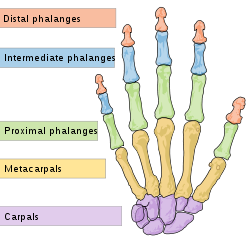 The human hand has 27 bones: the carpus or wrist accounts for 8; the metacarpals or palm contains five; the remaining fourteen are digital bones; fingers and thumb
The eight bones of the wrist are arranged in two rows of four. These bones fit into a shallow socket formed by the bones of the forearm. The bones of proximal row are (from lateral to medial): scaphoid, lunate
, triquetral and pisiform. The bones of the distal row are (from lateral to medial): trapezium
, trapezoid
, capitate and hamate. An easy way to remember them all is with the mnemonic, "She Looks Too Pretty, Try To Catch Her" or "Some Lovers Try Positions That They Can't Handle".
The palm has five bones known as metacarpal bones, one to each of the 5 digits. These metacarpals have a head, a shaft, and a base.
Human hands contain fourteen digital bones, also called phalanges, or phalanx bones
: two in the thumb (the thumb has no middle phalanx) and three in each of the four fingers. These are the distal phalanx, carrying the nail, the middle phalanx, and the proximal phalanx.
Sesamoid bone
s are small ossified nodes embedded in the tendons to provide extra leverage and reduce pressure on the underlying tissue. Many exist around the palm at the bases of the digits; the exact number varies between different people.
The articulations are:
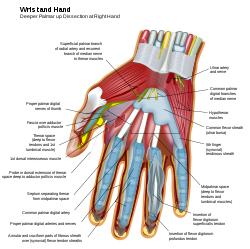 The muscles acting on the hand can be subdivided into two groups: the extrinsic and intrinsic muscle groups. The extrinsic muscle groups are the long flexors
and extensors
. They are called extrinsic because the muscle belly is located on the forearm.
and three volarly
) originating between the metacarpal bones; and the lumbrical muscles
arising from the deep flexor
(and are special because they have no bony origin) to insert on the dorsal extensor hood mechanism.
), moving the thumb in opposition, making grasping possible.
The extensors are located on the back of the forearm and are connected in a more complex way than the flexors to the dorsum of the fingers. The tendons unite with the interosseous and lumbrical muscles to form the extensorhood mechanism. The primary function of the extensors is to straighten out the digits. The thumb has two extensors in the forearm; the tendons of these form the anatomical snuff box
. Also, the index finger and the little finger have an extra extensor, used for instance for pointing. The extensors are situated within 6 separate compartments.
The first four compartments are located in the grooves present on the dorsum of inferior side of radius while the 5th compartment is in between radius and ulna. The 6th compartment is in the groove on the dorsum of inferior side of ulna.
Fractures
of the hand include:
Prehensility
Prehensility is the quality of an appendage or organ that has adapted for grasping or holding. The word is derived from the Latin term prehendere, meaning "to grasp."-Examples:Appendages that can become prehensile include:...
, multi-finger
Finger
A finger is a limb of the human body and a type of digit, an organ of manipulation and sensation found in the hands of humans and other primates....
ed extremity located at the end of an arm or forelimb of primate
Primate
A primate is a mammal of the order Primates , which contains prosimians and simians. Primates arose from ancestors that lived in the trees of tropical forests; many primate characteristics represent adaptations to life in this challenging three-dimensional environment...
s such as human
Human
Humans are the only living species in the Homo genus...
s, chimpanzee
Chimpanzee
Chimpanzee, sometimes colloquially chimp, is the common name for the two extant species of ape in the genus Pan. The Congo River forms the boundary between the native habitat of the two species:...
s, monkey
Monkey
A monkey is a primate, either an Old World monkey or a New World monkey. There are about 260 known living species of monkey. Many are arboreal, although there are species that live primarily on the ground, such as baboons. Monkeys are generally considered to be intelligent. Unlike apes, monkeys...
s, and lemur
Lemur
Lemurs are a clade of strepsirrhine primates endemic to the island of Madagascar. They are named after the lemures of Roman mythology due to the ghostly vocalizations, reflective eyes, and the nocturnal habits of some species...
s. A few other vertebrate
Vertebrate
Vertebrates are animals that are members of the subphylum Vertebrata . Vertebrates are the largest group of chordates, with currently about 58,000 species described. Vertebrates include the jawless fishes, bony fishes, sharks and rays, amphibians, reptiles, mammals, and birds...
s such as the koala (which has two opposable thumbs on each "hand" and fingerprints remarkably similar to human fingerprints) are often described as having either "hands" or "paws" on their front limbs.
Hands are the chief organs for physically manipulating the environment, used for both gross motor skill
Gross motor skill
Gross motor skills are the abilities usually acquired during infancy and early childhood as part of a child's motor development. By the time they reach two years of age, almost all children are able to stand up, walk and run, walk up stairs, etc...
s (such as grasping a large object) and fine motor skill
Fine motor skill
Fine motor skills are the coordination of small muscle movements which occur e.g., in the fingers, usually in coordination with the eyes. In application to motor skills of hands the term dexterity is commonly used....
s (such as picking up a small pebble). The fingertips contain some of the densest areas of nerve endings on the body, are the richest source of tactile feedback, and have the greatest positioning capability of the body; thus the sense of touch is intimately associated with hands. Like other paired organs (eyes, feet, legs), each hand is dominantly controlled by the opposing brain hemisphere
Cerebral hemisphere
A cerebral hemisphere is one of the two regions of the eutherian brain that are delineated by the median plane, . The brain can thus be described as being divided into left and right cerebral hemispheres. Each of these hemispheres has an outer layer of grey matter called the cerebral cortex that is...
, so that handedness
Handedness
Handedness is a human attribute defined by unequal distribution of fine motor skills between the left and right hands. An individual who is more dexterous with the right hand is called right-handed and one who is more skilled with the left is said to be left-handed...
, or the preferred hand choice for single-handed activities such as writing with a pen, reflects individual brain functioning.
Some evolutionary anatomists use the term hand to refer to the appendage of digits on the forelimb more generally — for example, in the context of whether the three digit
Digit (anatomy)
A digit is one of several most distal parts of a limb, such as fingers or toes, present in many vertebrates.- Names:Some languages have different names for hand and foot digits ....
s of the bird
Bird
Birds are feathered, winged, bipedal, endothermic , egg-laying, vertebrate animals. Around 10,000 living species and 188 families makes them the most speciose class of tetrapod vertebrates. They inhabit ecosystems across the globe, from the Arctic to the Antarctic. Extant birds range in size from...
hand involved the same homologous
Homology (biology)
Homology forms the basis of organization for comparative biology. In 1843, Richard Owen defined homology as "the same organ in different animals under every variety of form and function". Organs as different as a bat's wing, a seal's flipper, a cat's paw and a human hand have a common underlying...
loss of two digits as in the dinosaur
Dinosaur
Dinosaurs are a diverse group of animals of the clade and superorder Dinosauria. They were the dominant terrestrial vertebrates for over 160 million years, from the late Triassic period until the end of the Cretaceous , when the Cretaceous–Paleogene extinction event led to the extinction of...
hand.
The hand has 27 bones, 14 of which are the phalanges (proximal, medial, and distal) of the fingers. The metacarpal is the bone that connects the fingers and the wrist. Each human hand has 5 metacarpals.
Definitions
Many mammalMammal
Mammals are members of a class of air-breathing vertebrate animals characterised by the possession of endothermy, hair, three middle ear bones, and mammary glands functional in mothers with young...
s and other animal
Animal
Animals are a major group of multicellular, eukaryotic organisms of the kingdom Animalia or Metazoa. Their body plan eventually becomes fixed as they develop, although some undergo a process of metamorphosis later on in their life. Most animals are motile, meaning they can move spontaneously and...
s have grasping appendages similar in form to a hand such as paw
Paw
A paw is the soft foot of a mammal, generally a quadruped, that has claws or nails. A hard foot is called a hoof. Paws are used to pad feet for walking and increase friction.- Common characteristics :...
s, claw
Claw
A claw is a curved, pointed appendage, found at the end of a toe or finger in most mammals, birds, and some reptiles. However, the word "claw" is also often used in reference to an invertebrate. Somewhat similar fine hooked structures are found in arthropods such as beetles and spiders, at the end...
s, and talons, but these are not scientifically considered to be grasping hands. The scientific use of the term hand in this sense to distinguish the terminations of the front paws from the hind ones is an example of anthropomorphism
Anthropomorphism
Anthropomorphism is any attribution of human characteristics to animals, non-living things, phenomena, material states, objects or abstract concepts, such as organizations, governments, spirits or deities. The term was coined in the mid 1700s...
. The only true grasping hands appear in the mammalian order of primates. Hands must also have opposable thumb
Thumb
The thumb is the first digit of the hand. When a person is standing in the medical anatomical position , the thumb is the lateral-most digit...
s, as described later in the text.
Humans have two hands located at the distal end of each arm. Ape
Ape
Apes are Old World anthropoid mammals, more specifically a clade of tailless catarrhine primates, belonging to the biological superfamily Hominoidea. The apes are native to Africa and South-east Asia, although in relatively recent times humans have spread all over the world...
s and monkey
Monkey
A monkey is a primate, either an Old World monkey or a New World monkey. There are about 260 known living species of monkey. Many are arboreal, although there are species that live primarily on the ground, such as baboons. Monkeys are generally considered to be intelligent. Unlike apes, monkeys...
s are sometimes described as having four hands, because the toes are long and the hallux
Hallux
In tetrapods, the hallux is the innermost toe of the foot. Despite its name it may not be the longest toe on the foot of some individuals...
is opposable and looks more like a thumb
Thumb
The thumb is the first digit of the hand. When a person is standing in the medical anatomical position , the thumb is the lateral-most digit...
, thus enabling the feet to be used as hands. Also, some apes have toes that are longer than human fingers.
The word "hand" is sometimes used by evolutionary anatomists to refer to the appendage of digits on the forelimb such as when researching the homology between the three digit
Digit (anatomy)
A digit is one of several most distal parts of a limb, such as fingers or toes, present in many vertebrates.- Names:Some languages have different names for hand and foot digits ....
s of the bird
Bird
Birds are feathered, winged, bipedal, endothermic , egg-laying, vertebrate animals. Around 10,000 living species and 188 families makes them the most speciose class of tetrapod vertebrates. They inhabit ecosystems across the globe, from the Arctic to the Antarctic. Extant birds range in size from...
hand and the dinosaur
Dinosaur
Dinosaurs are a diverse group of animals of the clade and superorder Dinosauria. They were the dominant terrestrial vertebrates for over 160 million years, from the late Triassic period until the end of the Cretaceous , when the Cretaceous–Paleogene extinction event led to the extinction of...
hand.
Human anatomy
The human hand consists of a broad palm (metacarpus) with 5 digits, attached to the forearm by a joint called the wrist (carpus). The back of the hand is formally called the opisthenar.Digits
Finger
A finger is a limb of the human body and a type of digit, an organ of manipulation and sensation found in the hands of humans and other primates....
s on the hand are used for the outermost performance; these four digits can be folded over the palm which allows the grasping of objects. Each finger, starting with the one closest to the thumb, has a colloquial name to distinguish it from the others:
- index fingerIndex fingerThe index finger, , is the first finger and the second digit of a human hand. It is located between the first and third digits, between the thumb and the middle finger...
, pointer finger, or forefinger - middle fingerMiddle fingerThe middle finger or long finger is the third digit of the human hand, located between the index finger and the ring finger. It is usually the longest finger...
or long finger - ring fingerRing fingerThe ring finger is the fourth digit of the human hand, and the second most ulnar finger, located between the middle finger and the little finger. It is also called digitus medicinalis, the fourth finger, digitus annularis, digitus quartus, or digitus IV in anatomy.- Etymology :According to László A...
- little fingerLittle fingerThe little finger, often called the pinky in American English, pinkie in Scottish English , or small finger in medicine, is the most ulnar and usually smallest finger of the human hand, opposite the thumb, next to the ring finger.-Muscles:There are four muscles that...
, pinky finger, or small finger
The thumb
Thumb
The thumb is the first digit of the hand. When a person is standing in the medical anatomical position , the thumb is the lateral-most digit...
(connected to the trapezium
Trapezium (bone)
The trapezium bone is a carpal bone in the wrist.The trapezium is distinguished by a deep groove on its palmar surface. It is situated at the radial side of the carpus, between the scaphoid and the first metacarpal bone...
) is located on one of the sides, parallel to the arm. The thumb can be easily rotated 90° on a level perpendicular to the palm, unlike the other fingers which can only be rotated approximately 45°. A reliable way of identifying true hands is from the presence of opposable thumbs. Opposable thumbs are identified by the ability to be brought opposite to the fingers, a muscle action known as opposition
Anatomical terms of motion
The movement of body structures is accomplished by the contraction of muscles. Muscles may move parts of the skeleton relatively to each other, or may move parts of internal organs relatively to each other. All such movements are classified by the directions in which the affected structures are moved...
.
Bones
The eight bones of the wrist are arranged in two rows of four. These bones fit into a shallow socket formed by the bones of the forearm. The bones of proximal row are (from lateral to medial): scaphoid, lunate
Lunate bone
The lunate bone is a carpal bone in the human hand that may be distinguished by its deep concavity and crescentic outline. It is situated in the center of the proximal row of the carpus region between the fore arm and hand...
, triquetral and pisiform. The bones of the distal row are (from lateral to medial): trapezium
Trapezium (bone)
The trapezium bone is a carpal bone in the wrist.The trapezium is distinguished by a deep groove on its palmar surface. It is situated at the radial side of the carpus, between the scaphoid and the first metacarpal bone...
, trapezoid
Trapezoid bone
The trapezoid bone is a carpal bone in tetrapods, including humans. It is the smallest bone in the distal row. It may be known by its wedge-shaped form, the broad end of the wedge constituting the dorsal, the narrow end the palmar surface; and by its having four articular facets touching each...
, capitate and hamate. An easy way to remember them all is with the mnemonic, "She Looks Too Pretty, Try To Catch Her" or "Some Lovers Try Positions That They Can't Handle".
The palm has five bones known as metacarpal bones, one to each of the 5 digits. These metacarpals have a head, a shaft, and a base.
Human hands contain fourteen digital bones, also called phalanges, or phalanx bones
Phalanx bones
In anatomy, phalanx bones are those that form the fingers and toes. In primates such as humans and monkeys, the thumb and big toe have two phalanges, while the other fingers and toes consist of three. Phalanges are classified as long bones.The phalanges do not have individual names...
: two in the thumb (the thumb has no middle phalanx) and three in each of the four fingers. These are the distal phalanx, carrying the nail, the middle phalanx, and the proximal phalanx.
Sesamoid bone
Sesamoid bone
In anatomy, a sesamoid bone is a bone embedded within a tendon.Sesamoids are found in locations where a tendon passes over a joint, such as the hand, knee, and foot. Functionally, they act to protect the tendon and to increase its mechanical effect. The presence of the sesamoid bone holds the...
s are small ossified nodes embedded in the tendons to provide extra leverage and reduce pressure on the underlying tissue. Many exist around the palm at the bases of the digits; the exact number varies between different people.
Articulations
The articulations are:
- interphalangeal articulations of hand (the hinge jointHinge jointA hinge joint is a bone joint in which the articular surfaces are molded to each other in such a manner as to permit motion only in one plane—backward and forward—the extent of motion at the same time being considerable....
s between the finger bones) - metacarpophalangeal jointMetacarpophalangeal jointThe metacarpophalangeal joints are of the condyloid kind, formed by the reception of the rounded heads of the metacarpal bones into shallow cavities on the proximal ends of the first phalanges, with the exception of that of the thumb, which presents more of the characters of a ginglymoid joint...
s (where the fingers meet the palm) - intercarpal articulations (where the palm meets the wrist)
- wristWristIn human anatomy, the wrist is variously defined as 1) the carpus or carpal bones, the complex of eight bones forming the proximal skeletal segment of the hand;...
(may also be viewed as belonging to the forearmForearm-See also:*Forearm flexors*Forearm muscles...
.)
Muscles
Flexion
In anatomy, flexion is a position that is made possible by the joint angle decreasing. The skeletal and muscular systems work together to move the joint into a "flexed" position. For example the elbow is flexed when the hand is brought closer to the shoulder...
and extensors
Extension (kinesiology)
In kinesiology, extension is a movement of a joint that results in increased angle between two bones or body surfaces at a joint. Extension usually results in straightening of the bones or body surfaces involved. For example, extension is produced by extending the flexed elbow. Straightening of...
. They are called extrinsic because the muscle belly is located on the forearm.
Intrinsic
The intrinsic muscle groups are the thenar (thumb) and hypothenar (little finger) muscles; the interossei muscles (four dorsallyDorsal interossei of the hand
The dorsal interossei of the hand are muscles that occupy the space between the metacarpals.-Structure:There are four dorsal interossei in each hand...
and three volarly
Palmar interossei muscles
The palmar interossei are small muscles in the hand that lie on the anterior aspect of the metacarpals. They are smaller than the dorsal interossei of the hand, which lie between the metacarpals.-Structure:...
) originating between the metacarpal bones; and the lumbrical muscles
Lumbricals of the hand
The lumbricals are intrinsic muscles of the hand that flex the metacarpophalangeal joints and extend the interphalangeal joints.-Structure:There are four of these small, worm-like muscles on each hand. These muscles are unusual in that they do not attach to bone...
arising from the deep flexor
Flexor digitorum profundus muscle
- References :...
(and are special because they have no bony origin) to insert on the dorsal extensor hood mechanism.
Extrinsic
The fingers have two long flexors, located on the underside of the forearm. They insert by tendons to the phalanges of the fingers. The deep flexor attaches to the distal phalanx, and the superficial flexor attaches to the middle phalanx. The flexors allow for the actual bending of the fingers. The thumb has one long flexor and a short flexor in the thenar muscle group. The human thumb also has other muscles in the thenar group (opponens and abductor brevis muscleAbductor pollicis brevis muscle
The abductor pollicis brevis is a muscle in the hand that functions as an abductor of the thumb.-Structure:The abductor pollicis brevis is a flat, thin muscle located just under the skin. It is a thenar muscle, and therefore contributes to the bulk of the palm's thenar eminence...
), moving the thumb in opposition, making grasping possible.
The extensors are located on the back of the forearm and are connected in a more complex way than the flexors to the dorsum of the fingers. The tendons unite with the interosseous and lumbrical muscles to form the extensorhood mechanism. The primary function of the extensors is to straighten out the digits. The thumb has two extensors in the forearm; the tendons of these form the anatomical snuff box
Anatomical snuff box
The anatomical snuffbox is a triangular deepening on the radial, dorsal aspect of the hand—at the level of the carpal bones, specifically, the scaphoid and trapezium bones forming the floor...
. Also, the index finger and the little finger have an extra extensor, used for instance for pointing. The extensors are situated within 6 separate compartments.
| Compartment 1 (Most radial) | Compartment 2 | Compartment 3 | Compartment 4 | Compartment 5 | Compartment 6 (Most ulnar) |
|---|---|---|---|---|---|
| Abductor pollicis longus | Extensor carpi radialis longus | Extensor pollicis longus | Extensor indicis | Extensor digiti minimi | Extensor carpi ulnaris |
| Extensor pollicis brevis | Extensor carpi radialis brevis | Extensor digitorum communis |
The first four compartments are located in the grooves present on the dorsum of inferior side of radius while the 5th compartment is in between radius and ulna. The 6th compartment is in the groove on the dorsum of inferior side of ulna.
Sexual dimorphism
The average length of an adult male hand is 189 mm, while the average length of an adult female hand is 172 mm. The average hand breadth for adult males and females is 84 and 74 mm respectively.Disorders and diseases
- PolymeliaPolymeliaPolymelia is a birth defect involving limbs , in which the affected individual has more than the usual number of limbs. In humans and most land-dwelling animals, this means having five or more limbs...
, a birth defect in which the individual has more than the usual number of limbs. - AmeliaAmelia (birth defect)Amelia is the birth defect of lacking one or more limbs. It can also result in a shrunken or deformed limb. For example, a child might be born without an elbow or forearm. The term may be modified to indicate the number of legs or arms missing at birth, such as tetra-amelia for the absence of all...
, a congenital absence of limbs - PolydactylyPolydactylyPolydactyly or polydactylism , also known as hyperdactyly, is a congenital physical anomaly in humans, dogs, and cats having supernumerary fingers or toes....
, more than the usual number of fingers or toes. Having more than the typical number of metacarpal bones may be caused by genetic disorderGenetic disorderA genetic disorder is an illness caused by abnormalities in genes or chromosomes, especially a condition that is present from before birth. Most genetic disorders are quite rare and affect one person in every several thousands or millions....
s like Catel-Manzke syndromeCatel-Manzke syndromeCatel-Manzke syndrome is a rare genetic disorder characterized by distinctive abnormalities of the index fingers; the classic features of Pierre Robin syndrome; occasionally with additional physical findings. Pierre Robin syndrome refers to a sequence of abnormalities that may occur as a distinct...
. - SyndactylySyndactylySyndactyly is a condition wherein two or more digits are fused together. It occurs normally in some mammals, such as the siamang and kangaroo, but is an unusual condition in humans.-Classification:...
, fusion of fingers or toes. - Hand infection
- Hand surgeryHand surgeryThe field of hand surgery deals with both surgical and non-surgical treatment of conditions and problems that may take place in the hand or upper extremity including injury and infection. Hand surgery may be practiced by graduates of general surgery, orthopedic surgery and plastic surgery...
- Carpal Tunnel SyndromeCarpal tunnel syndromeCarpal Tunnel Syndrome is an entrapment idiopathic median neuropathy, causing paresthesia, pain, and other symptoms in the distribution of the median nerve due to its compression at the wrist in the carpal tunnel. The pathophysiology is not completely understood but can be considered compression...
- Dupuytren's ContractureDupuytren's contractureDupuytren's contracture , is a fixed flexion contracture of the hand where the fingers bend towards the palm and cannot be fully extended...
- Claw handClaw handClaw hand can refer to:* Ectrodactyly* A symptom of Ulnar nerve entrapment. See Ulnar claw...
, paralysis of intrinsic muscles of hand.
Fractures
Bone fracture
A bone fracture is a medical condition in which there is a break in the continuity of the bone...
of the hand include:
- Scaphoid fractureScaphoid fractureA scaphoid fracture is the most common type of wrist fracture. Scaphoid fractures usually cause pain at the base of the thumb accompanied by swelling in the same area. Scaphoid fractures usually cause pain and sensitivity to palpation in the anatomic snuffbox at the base of the thumb accompanied...
- Rolando fractureRolando fractureThe Rolando fracture is a comminuted intra-articular fracture through the base of the first metacarpal bone . It was first described in 1910 by Silvio Rolando. This is a fracture consisting of 3 distinct fragments; it is typically T- or Y-shaped.-Treatment:There are several proposed methods of...
- a comminutedComminutedComminuted may refer to:*comminuted bone, as in a crushed or splintered bone*comminuted material, which has been pulverised or titurated, such as Pulverised fuel ash in coal burning...
intra-articular fractureFractureA fracture is the separation of an object or material into two, or more, pieces under the action of stress.The word fracture is often applied to bones of living creatures , or to crystals or crystalline materials, such as gemstones or metal...
through the base of the first metacarpal bone - Bennett's fractureBennett's fractureBennett's fracture is a fracture of the base of the first metacarpal bone which extends into the carpometacarpal joint. This intra-articular fracture is the most common type of fracture of the thumb, and is nearly always accompanied by some degree of subluxation or frank dislocation of the...
- a fracture of the base of the first metacarpal boneFirst metacarpal boneThe first metacarpal bone or the metacarpal bone of the thumb is the first bone of the thumb. It is connected to the trapezium of the carpus at the first carpometacarpal joint and to the proximal thumb phalanx at the first metacarpophalangeal joint....
which extends into the carpometacarpalCarpometacarpal jointThe carpometacarpal joints are five joints in the wrist that articulates the distal row of carpal bones and the proximal bases of the five metacarpal bones....
(CMC) joint. - Boxer's fractureBoxer's fractureA "Boxer's fracture" is the second and/or third metacarpal transverse neck fracture that is more likely to occur from a straight punch. The "Boxer's" designation is suggestive of the generally well tolerated way of striking a hard object with the closed fist, with the second and third metacarpal...
- a fracture at the neck of a metacarpal
Additional images
See also
- DermatoglyphicsDermatoglyphicsDermatoglyphics is the scientific study of fingerprints. The term was coined by Dr. Harold Cummins, the father of American fingerprint analysis, even though the process of fingerprint identification had already been in use for several hundred years. All primates have ridged skin...
- Hand strengthHand strengthHand strength measurements are of interest to study pathology of the hand that involves loss of muscle strength. Examples of these pathologies are carpal tunnel syndrome, nerve injury, tendon injuries of the hand, and neuromuscular disorders....
- Hand walkingHand walkingHand walking is an unusual form of human locomotion in which a person travels in a vertically inverted orientation with all body weight resting on the hands.It can be executed with legs fully extended or with variations such as stag, straddle or front splits...
- Handanalysis
- HandstandHandstandA handstand is the act of supporting the body in a stable, inverted vertical position by balancing on the hands. In a basic handstand the body is held straight with arms and legs fully extended, with hands spaced approximately shoulder-width apart...
- Knuckle-walkingKnuckle-walkingKnuckle-walking is a form of quadrupedal walking in which the forelimbs hold the fingers in a partially flexed posture that allows body weight to press down on the ground through the knuckles....
External links
- Hand anatomy (eMedicine)
- Watch the National Film Board of Canada documentary Faces of the Hand (Requires Adobe FlashAdobe FlashAdobe Flash is a multimedia platform used to add animation, video, and interactivity to web pages. Flash is frequently used for advertisements, games and flash animations for broadcast...
)