
All Topics  
Slug


   Email Print
   Bookmark   Link


Slug


Slug is a common non-scientific word, which is often applied to any gastropod mollusk
Mollusca

MolluscsSpelled mollusk in the USA; the spelling "mollusc" is preferred by some authors, see the reasons given by . are animals belonging to the Phylum Mollusca....
 whatsoever that has a very reduced shell, a small internal shell, or no shell at all. Gastropods with coiled shells that are big enough to retract into are called snail
Snail

The word snail is a common name for almost all members of the molluscan class Gastropoda that have coiled animal shells in the adult stage. When the word snail is used in a general sense, it includes sea snails, land snails and freshwater snails....
s. Land gastropods with a shell that is not quite vestigial, but is too small to retract into, like many in the family Urocyclidae
Urocyclidae

Urocyclidae is a family of air-breathing land snails and semislugs, terrestrial pulmonate gastropod mollusks in the clade Eupulmonata, .Some gastropods within this family make and use love darts....
, are known as "semislugs".

A slug-like body is an adaptation which has occurred many times in various groups of snails, both marine
Marine (ocean)

Marine is an umbrella term. As an adjective it is usually applicable to things relating to the sea or ocean, such as marine biology, marine ecology and marine geology....
 and terrestrial
Terrestrial animal

Terrestrial animals are animals that live predominantly or entirely on land, as compared with aquatic animals, which live predominantly or entirely in the water , or amphibians, which rely on a combination of aquatic and terrestrial habitats ....
, but the common name
Common name

A common name is a name in general use within a community . A common name is not necessarily a commonly used name.Many of the conventions and traditions described in this article are based on the English language, and thus may not apply to common names in other languages....
 "slug" is most frequently encountered as applied to air-breathing land species, including a few agricultural and horticultural pest species.

Evolutionarily speaking, the loss or reduction of the shell in gastropods is a derived characteristic; the same basic body design has independently evolved many times, making slugs a strikingly polyphyletic group.


Discussion
Ask a question about 'Slug'
Start a new discussion about 'Slug'
Answer questions from other users
Full Discussion Forum


Recent Posts


Encyclopedia


Slug is a common non-scientific word, which is often applied to any gastropod mollusk
Mollusca

MolluscsSpelled mollusk in the USA; the spelling "mollusc" is preferred by some authors, see the reasons given by . are animals belonging to the Phylum Mollusca....
 whatsoever that has a very reduced shell, a small internal shell, or no shell at all. Gastropods with coiled shells that are big enough to retract into are called snail
Snail

The word snail is a common name for almost all members of the molluscan class Gastropoda that have coiled animal shells in the adult stage. When the word snail is used in a general sense, it includes sea snails, land snails and freshwater snails....
s. Land gastropods with a shell that is not quite vestigial, but is too small to retract into, like many in the family Urocyclidae
Urocyclidae

Urocyclidae is a family of air-breathing land snails and semislugs, terrestrial pulmonate gastropod mollusks in the clade Eupulmonata, .Some gastropods within this family make and use love darts....
, are known as "semislugs".

A slug-like body is an adaptation which has occurred many times in various groups of snails, both marine
Marine (ocean)

Marine is an umbrella term. As an adjective it is usually applicable to things relating to the sea or ocean, such as marine biology, marine ecology and marine geology....
 and terrestrial
Terrestrial animal

Terrestrial animals are animals that live predominantly or entirely on land, as compared with aquatic animals, which live predominantly or entirely in the water , or amphibians, which rely on a combination of aquatic and terrestrial habitats ....
, but the common name
Common name

A common name is a name in general use within a community . A common name is not necessarily a commonly used name.Many of the conventions and traditions described in this article are based on the English language, and thus may not apply to common names in other languages....
 "slug" is most frequently encountered as applied to air-breathing land species, including a few agricultural and horticultural pest species.

Evolutionarily speaking, the loss or reduction of the shell in gastropods is a derived characteristic; the same basic body design has independently evolved many times, making slugs a strikingly polyphyletic group. In other words, the shell-less condition has arisen many times in the evolutionary past, and because of this, the various different taxonomic families of slugs, even just of land slugs, are not closely related to one another, despite a superficial similarity in the overall form of the body.

The word "slug" or "sea slug" is also used for many marine species, almost all of which have gills. The largest group of marine shell-less gastropods or sea slugs are the nudibranch
Nudibranch

A nudibranch is a member of one suborder of soft-bodied, shell-less marine opisthobranch gastropod mollusks, which are noted for their often extraordinary colors and striking forms....
s. There are in addition many other groups of sea slug such as the heterobranch sea butterflies
Sea butterfly

Sea butterflies, also known as Thecosomata or flapping snails, are a taxonomic suborder of small pelagic swimming sea snails. These are holoplanktonic opisthobranch gastropod mollusks in the order Opisthobranchia....
, sea angel
Sea angel

Sea angels, also known as cliones, and previously known as one kind of pteropod, are a group of small swimming sea slugs.These are pelagic marine opisthobranch gastropod mollusks in the suborder Gymnosomata within the superorder Heterobranchia....
s, and sea hare
Sea hare

The suborder Aplysiomorpha or Sea hares are very large sea slugs with a soft internal shell made of protein. These are marine gastropod molluscs in the superfamilies Aplysioidea and Akeroidea....
s, as well as the only very distantly related, pelagic, caenogastropod sea slugs, which are within the superfamily Carinarioidea. There is even an air-breathing sea slug, Onchidella
Onchidella

Onchidella is a genus of small, air-breathing sea slugs, shell-less marine pulmonate gastropod molluscs in the family Onchidiidae.For more information on this unusual family of air-breathing sea slugs, see Onchidiidae....
.

This article is primarily about air-breathing (pulmonate) land slugs.

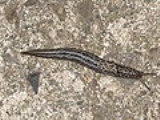
Laevecaulis 2

Land slugs

Land slugs, like all other gastropods, undergo torsion
Torsion (gastropod)

Torsion is a gastropod synapomorphy which occurs in all gastropods during larval development. Torsion is the rotation of the Viscus, Mantle and Gastropod shell 180? with respect to the head and foot of the gastropod....
 (a 180º twisting of the internal organs) during development. Internally the anatomy of a slug clearly shows the effects of this rotation, but externally the bodies of slugs appear rather symmetrical, except for the positioning of the pneumostome
Pneumostome

File:Arion rufus on road.jpgThe pneumostome is a feature of the external body anatomy of an air-breathing land slug or land snail.It is an opening in the right side of the Mantle of a Pulmonata Order or subclassed slug or snail....
, which is on one side of the animal, normally the right hand side.

The soft, slimy bodies of slugs are prone to desiccation
Desiccation

Desiccation is the state of extreme dryness, or the process of extreme drying. A desiccant is a hygroscopic substance that induces or sustains such a state in its local vicinity in a moderately-well sealed container....
, so land-living slugs are confined to moist environments and are forced to retreat to damp hiding places when the weather is dry.

Morphology and behaviour

Slug Parts
Like other snails, slugs macerate food using their radula
Radula

The radula is an anatomical structure found in mollusks and used for feeding. It is a minutely toothed, chitinous ribbon. It is typically used for scraping or cutting food before the food enters the esophagus....
, a rough, tongue-like organ with many tiny tooth-like denticles.

Like other pulmonate land snails, most slugs have two pairs of 'feelers' or tentacles on their head; the upper pair being light sensor
Sensor

A sensor is a device that measures a physical quantity and converts it into a signal which can be read by an observer or by an instrument. For example, a mercury thermometer converts the measured temperature into expansion and contraction of a liquid which can be read on a calibrated glass tube....
s, while the lower pair provides the sense of smell
Olfaction

Olfaction refers to the sense of smell. This sense is mediated by specialized sensory cells of the nasal cavity of vertebrates, and, by analogy, sensory cells of the antennae of invertebrates....
. Both pairs are retractable and can be regrown if lost.

On top of the slug, behind the head, is the saddle-shaped mantle
Mantle (mollusc)

The mantle is a significant part of the anatomy of molluscs: it is the dorsum body wall which covers the visceral mass.In many, but by no means all, species of molluscs, the Epidermis of the mantle secretes calcium carbonate and conchiolin, and creates a mollusc shell....
,
and under this are the genital opening and anus. On one side (almost always the right hand side) of the mantle is a respiratory opening, which is easy to see when open, but difficult to see when closed. This opening is known as the pneumostome
Pneumostome

File:Arion rufus on road.jpgThe pneumostome is a feature of the external body anatomy of an air-breathing land slug or land snail.It is an opening in the right side of the Mantle of a Pulmonata Order or subclassed slug or snail....
. Within the mantle in some species is a very small rather flat shell. Other species have a group of calcareous
Calcareous

Calcareous refers to a sediment, sedimentary rock, or soil type which is formed from or contains a high proportion of calcium carbonate in the form of calcite or aragonite....
 granules instead, which are the evolutionary remnants of a shell.

Like other snails, a slug moves by rhythmic waves of muscular contraction on the underside of its foot. It simultaneously secretes a layer of mucus on which it travels, which helps prevent damage to the tissues of the foot.

Some species of slugs hibernate underground during the winter in temperate climates, but in other species, the adults die in the autumn.

Mucus


Slug
Slugs' bodies are made up mostly of water, and without a full-sized shell to retreat into, their soft tissues are prone to desiccation
Desiccation

Desiccation is the state of extreme dryness, or the process of extreme drying. A desiccant is a hygroscopic substance that induces or sustains such a state in its local vicinity in a moderately-well sealed container....
. They must generate protective mucus to survive. Many species are most active after rain. In drier conditions they hide in damp places under tree bark, fallen logs, rocks, and man-made structures such as planters and so forth, in order to help retain body moisture.

Slugs produce two types of mucus
Mucus

In vertebrates, mucus is a slippery secretion produced by, and covering, mucous membranes. It is a viscous colloid containing antiseptic enzymes and immunoglobulins that serves to protect Epithelium in the respiratory,...
: one which is thin and watery, and another which is thick and sticky. Both kinds of mucus are hygroscopic
Hygroscopy

Hygroscopy is the ability of a substance to attract water molecules from the surrounding Natural environment through either absorption or adsorption....
. The thin mucus is spread out from the centre of the foot to the edges, whereas the thick mucus spreads out from front to back. They also produce thick mucus which coats the whole body of the animal.

The mucus secreted by the foot contains fibres which help prevent the slug from slipping down vertical surfaces. The "slime trail" that a slug leaves behind it has some secondary effects: other slugs coming across a slime trail can recognize others of the same species, which is useful in preparation to mating. Following a slime trail is also a necessary part of the hunting behavior of some carnivorous predatory slugs.

Body mucus provides some protection against predators, as it can make the slug hard to pick up and hold, for example in a bird's beak.

Some species of slug secrete slime cords to lower themselves onto the ground, or to suspend a pair of slugs during copulation.

Reproduction


Slugs are hermaphrodites, having both female and male reproductive organs.

Once a slug has located a mate, they encircle each other and sperm is exchanged through their protruded genitalia. A few days later around 30 eggs are laid into a hole in the ground, or under the cover of objects such as fallen logs.

For a species of slug that has an unusually elaborate mating procedure, see Great grey slug
Great Grey Slug

The Great Grey Slug, Limax maximus , also known as the Tiger slug or the Spotted leopard slug, is one of the largest kinds of keeled air-breathing land slug in the world, ....
.

A commonly seen practice among many slugs is apophallation
Apophallation

Apophallation is a technique resorted to by some species of air-breathing land slugs such as Limax maximus and Ariolimax spp. In these species of hermaphroditic Terrestrial animal gastropod mollusks, after mating, if the slugs cannot successfully separate, a deliberate amputating of the penis takes place....
. The penis of these species is curled like a cork-screw and often becomes entangled in their mate's genitalia in the process of exchanging sperm. When all else fails, apophallation allows the slugs to separate themselves by one or both of the slugs chewing off the other's penis. Once its penis has been removed, a slug is still able to mate subsequently, but using only the female parts of its reproductive system.

Ecology

Arion Lusitanicus Eating
Many species of slugs play an important role in ecosystems by eating dead leaves
Leaf

In botany, a leaf is an above-ground plant Organ specialized for photosynthesis. For this purpose, a leaf is typically flat and thin, to expose the cells containing chloroplast to light over a broad area, and to allow light to penetrate fully into the tissues....
, fungus
Fungus

A fungus is a Eukaryote organism that is a member of the Kingdom Fungi . The fungi are a monophyletic group, also called the Eumycota , that is phylogeny distinct from the morphologically similar slime molds and water molds ....
, and decaying vegetable material. Other species eat parts of living plants.

Some slugs are predators, eating other slugs and snails, or earthworm
Earthworm

Earthworm is the common name for the largest members of Oligochaeta in the phylum Annelida. The earthworm is the most known worm in America, and other countries....
s.

Most slugs will on occasion also eat carrion
Carrion

Carrion refers to the carcass of a dead animal. Carrion is an important food source for large carnivores and omnivores in most ecosystems. Examples of carrion-eaters, or scavengers, include Hyenas, Vultures, Virginia Opossum, Tasmanian Devils, Black Bears, Komodo Dragons, Bald Eagles, Raccoons and Blue-tongued lizards....
, including dead of their own kind.

Predators

Frog
Frog

Frogs are amphibians in the order Anura , formerly referred to as Salientia . The name frog derives from Old English language frogga, , cognate with Sanskrit plava , probably deriving from Proto-Indo-European language praw = "to jump"....
s, toad
Toad

A toad can refer to a number of species of amphibians in the order Anura. A distinction is often made between frogs and toads by their appearance, prompted by the convergent evolution among so-called "toads" to dry habitats....
s, snakes, hedgehog
Hedgehog

A hedgehog is any of the spiny mammals of the subfamily Erinaceinae and the Order Erinaceomorpha. There are 16 species of hedgehog in five genus, found through parts of Europe, Asia, Africa, and New Zealand....
s, Salamander
Salamander

Salamander is a common name of approximately 500 species of amphibians. They are typically characterized by slender bodies, short noses, and long tails....
s, eastern box turtles, human
Human

A human being, also human or man, is a member of a species of bipedalism primates in the family Hominidae . Mitochondrial DNA evidence indicates that modern humans originated in east Africa about 200,000 years ago....
s and also some birds and beetles are slug predators.

Slugs, when attacked, can contract their body, making themselves harder and more compact, and thus more difficult for many animals to grasp when combined with the slippery texture of the mucus that coats the animal. The unpleasant taste of the mucus is also a deterrent.

Human relevance

Unknown Slug On Rhubarb
Most slugs are harmless to humans and their interests, but a small number of species of slugs are pests of agriculture and horticulture. They feed on fruits and vegetables prior to harvest, making holes in the crop, which can make individual items unsuitable to sell for aesthetic reasons and which can make the crop more vulnerable to rot and disease.

Deroceras reticulatum

Deroceras reticulatum, common names "grey field slug" and "grey garden slug", is a species of small air-breathing land slug, a Terrestrial animal pulmonate gastropod mollusk in the family Agriolimacidae....
 is one example of a species of slug that has been widely introduced outside of its native range, and which is a serious pest to agriculture.

As control measures, special pesticides are used in large-scale agriculture, while small home gardens may use slug tape as a deterrent to keep slugs out of crop areas.

In a few rare cases, humans have contracted parasite-induced meningitis
Meningitis

Meningitis is a medical condition caused by inflammation of the protective membranes covering the brain and spinal cord, known collectively as the meninges....
 from eating raw slugs .

A banana slug
Banana slug

Species* Ariolimax californicus J. G. Cooper, 1872 ? California banana slug* Ariolimax columbianus ? Pacific banana slug...
, Ariolimax dolichophallus, named "Sammy" is the mascot of the University of California at Santa Cruz.

In rural southern Italy, the garden slug Arion hortensis is used to treat gastritis or stomach ulcer by swallowing it whole and alive. A clear mucous produced by the slug is used to treat various skin conditions including dermatitis, warts, inflammations, calluses, acne and wounds. .

Subinfraorders, superfamilies, and families

  • Subinfraorder Orthurethra
    Orthurethra

    Orthurethra is a taxonomic grouping of air-breathing land snails and slugs, terrestrial animal pulmonate gastropod Mollusca.In the Taxonomy of the Gastropoda , Orthurethra is treated as an Informal Group and subclade of Stylommatophora....
    • Superfamily Achatinelloidea Gulick, 1873
    • Superfamily Cochlicopoidea Pilsbry, 1900
    • Superfamily Partuloidea
      Partuloidea

      Partuloidea is a taxonomic group, a superfamily of land slugs, in other words shell-less snails.This superfamily of Terrestrial animal pulmonate gastropod mollusks is in the infraorder Stylommatophora and in the order Pulmonata....
       Pilsbry, 1900
    • Superfamily Pupilloidea Turton, 1831
  • Subinfraorder Sigmurethra
    Sigmurethra

    Sigmurethra is a taxonomic category of air-breathing land snails and slugs, terrestrial animal pulmonate gastropod Mollusca. This is an Informal Group which includes the majority of land snails and slug....
    • Superfamily Acavoidea Pilsbry, 1895
    • Superfamily Achatinoidea Swainson, 1840
    • Superfamily Aillyoidea Baker, 1960
    • Superfamily Arionoidea
      Arionoidea

      Arionoidea is a taxonomic group, a superfamily of land slugs, in other words shell-less snails, terrestrial pulmonate gastropod mollusks.This superfamily is in the infraorder Stylommatophora and in the order Pulmonata....
       J.E. Gray
      John Edward Gray

      John Edward Gray was a United Kingdom zoology. He was the elder brother of George Robert Gray and son of the pharmacologist and botanist Samuel Frederick Gray ....
       in Turnton, 1840
    • Superfamily Athoracophoroidea
      • Family Athoracophoridae
        Athoracophoridae

        Athoracophoridae, common name the leaf-veined slugs, are a family of air-breathing land slugs, terrestrial animal pulmonate gastropod mollusks in the infraorder Stylommatophora, the stalk-eyed snails and slugs....
    • Superfamily Orthalicoidea
      • Subfamily Bulimulinae
    • Superfamily Camaenoidea Pilsbry, 1895
    • Superfamily Clausilioidea Mörch, 1864
    • Superfamily Dyakioidea
      Dyakioidea

      Dyakioidea is a taxonomic superfamily of air-breathing land snails, Terrestrial animal pulmonate gastropod mollusks in the suborder Stylommatophora....
       Gude & Woodward, 1921
    • Superfamily Gastrodontoidea
      Gastrodontoidea

      Gastrodontoidea is a taxonomic superfamily of land snails, Terrestrial animal pulmonate gastropod mollusks in the infraorder Stylommatophora....
       Tryon, 1866
    • Superfamily Helicoidea
      Helicoidea

      Helicoidea is a taxonomic superfamily of air-breathing land snails, Terrestrial animal pulmonate gastropod mollusks in the infraorder Stylommatophora....
       Rafinesque, 1815
    • Superfamily Helixarionoidea Bourguignat, 1877
    • Superfamily Limacoidea
      Limacoidea

      Limacoidea is a taxonomic superfamily of medium-sized to large, air-breathing land slugs. They are Terrestrial animal pulmonate gastropod mollusks in the infraorder Stylommatophora ....
       Rafinesque, 1815
    • Superfamily Oleacinoidea H. & A. Adams, 1855
    • Superfamily Orthalicoidea Albers-Martens, 1860
    • Superfamily Plectopylidoidea Moellendorf, 1900
    • Superfamily Polygyroidea Pilsbry, 1894
    • Superfamily Punctoidea
      Punctoidea

      The Punctoidea are a superfamily of air-breathing land snails and slugs, terrestrial animal gastropod mollusks.This superfamily is in the infraorder Stylommatophora, the stalk-eyed snails and slugs....
       Morse, 1864
    • Superfamily Rhytidoidea Pilsbry, 1893
      • Family Rhytididae
        Rhytididae

        Rhytididae is a taxonomic family of medium-sized predatory air-breathing land snails, carnivorous terrestrial animal pulmonate gastropod Mollusca....
    • Superfamily Sagdidoidera Pilsbry, 1895
    • Superfamily Staffordioidea Thiele
      Johannes Thiele

      Johannes Thiele was a Germany zoologist specialized in malacology. His Handbuch der systematischen Weichtierkunde is a standard work. From 1904 until his retirement in 1925 he was the curator of the malacological collection at the Museum f?r Naturkunde in Berlin....
      , 1931
    • Superfamily Streptaxoidea J.E. Gray
      John Edward Gray

      John Edward Gray was a United Kingdom zoology. He was the elder brother of George Robert Gray and son of the pharmacologist and botanist Samuel Frederick Gray ....
      , 1806
    • Superfamily Strophocheiloidea Thiele
      Johannes Thiele

      Johannes Thiele was a Germany zoologist specialized in malacology. His Handbuch der systematischen Weichtierkunde is a standard work. From 1904 until his retirement in 1925 he was the curator of the malacological collection at the Museum f?r Naturkunde in Berlin....
      , 1926
    • Superfamily Parmacelloidea
      Parmacelloidea

      Parmacelloidea is a superfamily of air-breathing land slugs, Terrestrial animal pulmonate gastropod mollusks in the infraorder Stylommatophora and the order Pulmonata....
    • Superfamily Zonitoidea Mörch, 1864


External links

  • hosted by the
  • on the UF
    University of Florida

    The University of Florida is a Public university land-grant university, sea grant colleges, Space grant colleges major research university located on a campus in Gainesville, Florida, in the United States....
     / IFAS
    Institute of Food and Agricultural Sciences

    The University of Florida?s Institute of Food and Agricultural Sciences is a federal-state-county partnership dedicated to developing knowledge in agriculture, human and natural resources, and the life sciences, and enhancing and sustaining the quality of human life by making that information accessible....
     Featured Creatures Web site