


Legless lizard

Encyclopedia
Lizard
Lizards are a widespread group of squamate reptiles, with nearly 3800 species, ranging across all continents except Antarctica as well as most oceanic island chains...
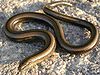
s which have independently lost limbs or reduced them to the point of being of no use in locomotion. It is the common name for the family Pygopodidae
Pygopodidae
Pygopodidae is a family of squamates that have reduced or absent limbs and are related to the geckos. There are at least 35 species in two subfamilies and eight genera. They have unusually long, slender, bodies, giving them a strong resemblance to snakes...
, but often refers to other groups, such as limbless anguids
Anguidae
The Anguidae is a large and diverse family of lizards native to the northern hemisphere. The group includes the slowworms, glass lizards, and alligator lizards, among others. Anguidae is divided into three subfamilies and contains 94 species in eight genera. Their closest living relatives are the...
, depending upon the region of the world. These lizards are often distinguishable from snakes on the basis of one or more of the following characteristics: possessing eyelids, possessing external ear openings, lack of broad belly scales, and/or a very long tail (while snakes have a long body and short tail).
Many families of lizards have independently evolved limblessness
Limbless vertebrates
Many vertebrates have evolved limbless forms. Reptiles have on a number of occasions evolved into limbless forms - snakes, amphisbaenia, and legless lizards...
or greatly reduced limbs (which are presumably non-functional in locomotion), including the following examples:
- AnguidaeAnguidaeThe Anguidae is a large and diverse family of lizards native to the northern hemisphere. The group includes the slowworms, glass lizards, and alligator lizards, among others. Anguidae is divided into three subfamilies and contains 94 species in eight genera. Their closest living relatives are the...
– many limbless species, including genera Ophisaurus and AnguisAnguisAnguis, or the slow worm, is a small genus of lizard in the family Anguidae. It has two described species.Although they are lizards, slow worms have lost their limbs completely and are often mistaken as snakes. Slow-worms typically grow to between , with the females slightly larger than the males...
. - CordylidaeCordylidaeCordylidae is a family of small to medium sized lizards that occur in southern and eastern Africa. They are commonly known as "Girdled", Spinytail lizards or Girdle-tail lizards. Girdled lizards are diurnal and insectivorous...
– genus ChamaesauraChamaesauraThe Chamaesaura, also known as Grass Lizards, are a genus of legless lizards from southern and eastern Africa. The limbs are reduced to small spikes. The elongate shape and lack of limbs allows them to "swim" through grass...
. - PygopodidaePygopodidaePygopodidae is a family of squamates that have reduced or absent limbs and are related to the geckos. There are at least 35 species in two subfamilies and eight genera. They have unusually long, slender, bodies, giving them a strong resemblance to snakes...
– members of the family are named Legless lizards due to their absent forelimbs and greatly reduced hindlimbs. These are small flaps without digits, hence the common name "flap-footed lizards". - DibamidaeDibamidaeDibamidae is a family of legless lizards found in tropical forests. Relatively little is known about the dibamid lizards, which are native to Mexico, SE Asia, Indonesia, the Philippine Islands and western New Guinea....
– all members of the family are limbless burrowers which are nearly or completely blind. - Anniellidae – all members of the family are limbless.
- GymnophthalmidaeGymnophthalmidaeGymnophthalmidae is a family of lizards, sometimes known as spectacled lizards or microteiids. They are called 'spectacled' because of their transparent lower eyelids, so they can still see with closed eyes...
– Many limbless and nearly-limbless species. - Scincidae – Many limbless and nearly-limbless species.
- GerrhosauridaeGerrhosauridaeThe Gerrhosauridae is a family of lizards native to Africa and Madagascar. Also known as plated lizards, they live in a range of habitats, from rocky crevices to sand dunes. Their form is variable, with some species having four fully developed limbs, and others with vestigial hind limbs only...
– Several limbless or reduced-limbed species.