

Tail

Encyclopedia
The tail is the section at the rear end of an animal
's body
; in general, the term refers to a distinct, flexible appendage
to the torso
. It is the part of the body that corresponds roughly to the sacrum
and coccyx
in mammal
s, reptile
s, and bird
s. While tails are primarily a feature of vertebrate
s, some invertebrate
s including scorpion
s and springtail
s, as well as snail
s and slug
s, have tail-like appendages that are sometimes referred to as tails. Tailed objects are sometimes referred to as "caudate" and the part of the body associated with or proximal to the tail are given the adjective "caudal".
for fish
and some other forms of marine life. Many land animals use their tails to brush away flies
and other biting insects. Some species, including cat
s and kangaroo
s, use their tails for balance
; and some, such as New World monkey
s and opossums, have what are known as prehensile tail
s, which are adapted to allow them to grasp tree branches.
Tails are also used for social signaling. Some deer
species flash the white underside of their tails to warn other nearby deer of possible danger, and canids (including domestic dog
s) indicate emotion
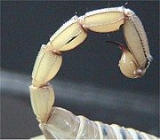
s through the positioning and movement of their tails. Some species' tails are armored, and some, such as the those of scorpion
s, contain venom.
Some species of lizard
can detach ("cast") their tails from their bodies. This can help them to escape from predators, which are either distracted by the wriggling detached tail, or left with only the tail while the rest of the lizard flees. Tails cast in this manner generally grow back over time, though the replacement is typically darker in color than the original.
The tails of most birds end in long feather
s called rectrices. These feathers are used as a rudder, helping the bird to steer and maneuver in flight
; they also help the bird to balance while it is perched. In some species—such as birds of paradise, lyrebirds, and most notably peafowl
—modified tail feathers play an important role in courtship displays. The extra-stiff tail feathers of other species, including woodpecker
s and woodcreeper
s, allow them to brace themselves firmly against tree trunks.
The tails of grazing animals, such as horse
s, are used both to sweep away insects, and positioned or moved in ways that indicate the animal's physical or emotional state.
s have a tail that measures about one-sixth of the size of the embryo itself. As the embryo develops into a fetus
, the tail is absorbed by the growing body. The developmental tail is thus a human vestigial structure. Infrequently, a child is born with a "soft tail", which contains no vertebrae, but only blood vessels, muscles, and nerves, although there have been several documented cases of tails containing cartilage or up to five vertebrae. Some of these tails may in fact be sacrococcygeal teratoma
s. A man named Chandre Oram
, who lives in West Bengal, a state in India, is famous because of his 33 centimetres (13 in) tail. It is not believed to be a true tail, however, but rather a case of spina bifida
.
Humans have a "tail bone" (the coccyx
) attached to the pelvis, in the same place which other mammals have tails. The tail bone is formed of fused vertebrae, usually four, at the bottom of the vertebral column
. It does not protrude externally, but retains an anatomical purpose: providing an attachment for muscles like the gluteus maximus.
Animal
Animals are a major group of multicellular, eukaryotic organisms of the kingdom Animalia or Metazoa. Their body plan eventually becomes fixed as they develop, although some undergo a process of metamorphosis later on in their life. Most animals are motile, meaning they can move spontaneously and...
's body
Body
With regard to living things, a body is the physical body of an individual. "Body" often is used in connection with appearance, health issues and death...
; in general, the term refers to a distinct, flexible appendage
Appendage
In invertebrate biology, an appendage is an external body part, or natural prolongation, that protrudes from an organism's body . It is a general term that covers any of the homologous body parts that may extend from a body segment...
to the torso
Torso
Trunk or torso is an anatomical term for the central part of the many animal bodies from which extend the neck and limbs. The trunk includes the thorax and abdomen.-Major organs:...
. It is the part of the body that corresponds roughly to the sacrum
Sacrum
In vertebrate anatomy the sacrum is a large, triangular bone at the base of the spine and at the upper and back part of the pelvic cavity, where it is inserted like a wedge between the two hip bones. Its upper part connects with the last lumbar vertebra, and bottom part with the coccyx...
and coccyx
Coccyx
The coccyx , commonly referred to as the tailbone, is the final segment of the vertebral column. Comprising three to five separate or fused vertebrae below the sacrum, it is attached to the sacrum by a fibrocartilaginous joint, the sacrococcygeal symphysis, which permits limited movement between...
in mammal
Mammal
Mammals are members of a class of air-breathing vertebrate animals characterised by the possession of endothermy, hair, three middle ear bones, and mammary glands functional in mothers with young...
s, reptile
Reptile
Reptiles are members of a class of air-breathing, ectothermic vertebrates which are characterized by laying shelled eggs , and having skin covered in scales and/or scutes. They are tetrapods, either having four limbs or being descended from four-limbed ancestors...
s, and bird
Bird
Birds are feathered, winged, bipedal, endothermic , egg-laying, vertebrate animals. Around 10,000 living species and 188 families makes them the most speciose class of tetrapod vertebrates. They inhabit ecosystems across the globe, from the Arctic to the Antarctic. Extant birds range in size from...
s. While tails are primarily a feature of vertebrate
Vertebrate
Vertebrates are animals that are members of the subphylum Vertebrata . Vertebrates are the largest group of chordates, with currently about 58,000 species described. Vertebrates include the jawless fishes, bony fishes, sharks and rays, amphibians, reptiles, mammals, and birds...
s, some invertebrate
Invertebrate
An invertebrate is an animal without a backbone. The group includes 97% of all animal species – all animals except those in the chordate subphylum Vertebrata .Invertebrates form a paraphyletic group...
s including scorpion
Scorpion
Scorpions are predatory arthropod animals of the order Scorpiones within the class Arachnida. They have eight legs and are easily recognized by the pair of grasping claws and the narrow, segmented tail, often carried in a characteristic forward curve over the back, ending with a venomous stinger...
s and springtail
Springtail
Springtails form the largest of the three lineages of modern hexapods that are no longer considered insects...
s, as well as snail
Snail
Snail is a common name applied to most of the members of the molluscan class Gastropoda that have coiled shells in the adult stage. When the word is used in its most general sense, it includes sea snails, land snails and freshwater snails. The word snail without any qualifier is however more often...
s and slug
Slug
Slug is a common name that is normally applied to any gastropod mollusc that lacks a shell, has a very reduced shell, or has a small internal shell...
s, have tail-like appendages that are sometimes referred to as tails. Tailed objects are sometimes referred to as "caudate" and the part of the body associated with or proximal to the tail are given the adjective "caudal".
Function
Animal tails are used in a variety of ways. They provide a source of locomotionAnimal locomotion
Animal locomotion, which is the act of self-propulsion by an animal, has many manifestations, including running, swimming, jumping and flying. Animals move for a variety of reasons, such as to find food, a mate, or a suitable microhabitat, and to escape predators...
for fish
Fish
Fish are a paraphyletic group of organisms that consist of all gill-bearing aquatic vertebrate animals that lack limbs with digits. Included in this definition are the living hagfish, lampreys, and cartilaginous and bony fish, as well as various extinct related groups...
and some other forms of marine life. Many land animals use their tails to brush away flies
Fly
True flies are insects of the order Diptera . They possess a pair of wings on the mesothorax and a pair of halteres, derived from the hind wings, on the metathorax...
and other biting insects. Some species, including cat
Cat
The cat , also known as the domestic cat or housecat to distinguish it from other felids and felines, is a small, usually furry, domesticated, carnivorous mammal that is valued by humans for its companionship and for its ability to hunt vermin and household pests...
s and kangaroo
Kangaroo
A kangaroo is a marsupial from the family Macropodidae . In common use the term is used to describe the largest species from this family, especially those of the genus Macropus, Red Kangaroo, Antilopine Kangaroo, Eastern Grey Kangaroo and Western Grey Kangaroo. Kangaroos are endemic to the country...
s, use their tails for balance
Equilibrioception
Equilibrioception or sense of balance is one of the physiological senses. It helps prevent humans and animals from falling over when walking or standing still. Balance is the result of a number of body systems working together: the eyes , ears and the body's sense of where it is in space ideally...
; and some, such as New World monkey
Monkey
A monkey is a primate, either an Old World monkey or a New World monkey. There are about 260 known living species of monkey. Many are arboreal, although there are species that live primarily on the ground, such as baboons. Monkeys are generally considered to be intelligent. Unlike apes, monkeys...
s and opossums, have what are known as prehensile tail
Prehensile tail
A prehensile tail is the tail of an animal that has adapted to be able to grasp and/or hold objects. Fully prehensile tails can be used to hold and manipulate objects, and in particular to aid arboreal creatures in finding and eating food in the trees...
s, which are adapted to allow them to grasp tree branches.
Tails are also used for social signaling. Some deer
Deer
Deer are the ruminant mammals forming the family Cervidae. Species in the Cervidae family include white-tailed deer, elk, moose, red deer, reindeer, fallow deer, roe deer and chital. Male deer of all species and female reindeer grow and shed new antlers each year...
species flash the white underside of their tails to warn other nearby deer of possible danger, and canids (including domestic dog
Dog
The domestic dog is a domesticated form of the gray wolf, a member of the Canidae family of the order Carnivora. The term is used for both feral and pet varieties. The dog may have been the first animal to be domesticated, and has been the most widely kept working, hunting, and companion animal in...
s) indicate emotion
Emotion
Emotion is a complex psychophysiological experience of an individual's state of mind as interacting with biochemical and environmental influences. In humans, emotion fundamentally involves "physiological arousal, expressive behaviors, and conscious experience." Emotion is associated with mood,...
s through the positioning and movement of their tails. Some species' tails are armored, and some, such as the those of scorpion
Scorpion
Scorpions are predatory arthropod animals of the order Scorpiones within the class Arachnida. They have eight legs and are easily recognized by the pair of grasping claws and the narrow, segmented tail, often carried in a characteristic forward curve over the back, ending with a venomous stinger...
s, contain venom.
Some species of lizard
Lizard
Lizards are a widespread group of squamate reptiles, with nearly 3800 species, ranging across all continents except Antarctica as well as most oceanic island chains...
can detach ("cast") their tails from their bodies. This can help them to escape from predators, which are either distracted by the wriggling detached tail, or left with only the tail while the rest of the lizard flees. Tails cast in this manner generally grow back over time, though the replacement is typically darker in color than the original.
The tails of most birds end in long feather
Feather
Feathers are one of the epidermal growths that form the distinctive outer covering, or plumage, on birds and some non-avian theropod dinosaurs. They are considered the most complex integumentary structures found in vertebrates, and indeed a premier example of a complex evolutionary novelty. They...
s called rectrices. These feathers are used as a rudder, helping the bird to steer and maneuver in flight
Bird flight
Flight is the main mode of locomotion used by most of the world's bird species. Flight assists birds while feeding, breeding and avoiding predators....
; they also help the bird to balance while it is perched. In some species—such as birds of paradise, lyrebirds, and most notably peafowl
Peafowl
Peafowl are two Asiatic species of flying birds in the genus Pavo of the pheasant family, Phasianidae, best known for the male's extravagant eye-spotted tail, which it displays as part of courtship. The male is called a peacock, the female a peahen, and the offspring peachicks. The adult female...
—modified tail feathers play an important role in courtship displays. The extra-stiff tail feathers of other species, including woodpecker
Woodpecker
Woodpeckers are near passerine birds of the order Piciformes. They are one subfamily in the family Picidae, which also includes the piculets and wrynecks. They are found worldwide and include about 180 species....
s and woodcreeper
Woodcreeper
The woodcreepers comprise a subfamily of sub-oscine passerine birds endemic to the Neotropics. They have traditionally been considered a distinct family Dendrocolaptidae, but most authorities now place them as a subfamily of the ovenbirds...
s, allow them to brace themselves firmly against tree trunks.
The tails of grazing animals, such as horse
Tail (horse)
The tail of the horse and other equines consists of two parts, the dock and the skirt. The dock consists of the muscles and skin covering the coccygeal vertebrae. The term "skirt" refers to the long hairs that fall below the dock...
s, are used both to sweep away insects, and positioned or moved in ways that indicate the animal's physical or emotional state.
Types
A scut is a short, erect tail. Hares, rabbits, and deer have scuts.
A prehensile tailPrehensile tailA prehensile tail is the tail of an animal that has adapted to be able to grasp and/or hold objects. Fully prehensile tails can be used to hold and manipulate objects, and in particular to aid arboreal creatures in finding and eating food in the trees...
is a tail that can grasp or hold objects. Examples are monkeys, rats and snakes (prehensile body).
Human tails
Human embryoEmbryo
An embryo is a multicellular diploid eukaryote in its earliest stage of development, from the time of first cell division until birth, hatching, or germination...
s have a tail that measures about one-sixth of the size of the embryo itself. As the embryo develops into a fetus
Fetus
A fetus is a developing mammal or other viviparous vertebrate after the embryonic stage and before birth.In humans, the fetal stage of prenatal development starts at the beginning of the 11th week in gestational age, which is the 9th week after fertilization.-Etymology and spelling variations:The...
, the tail is absorbed by the growing body. The developmental tail is thus a human vestigial structure. Infrequently, a child is born with a "soft tail", which contains no vertebrae, but only blood vessels, muscles, and nerves, although there have been several documented cases of tails containing cartilage or up to five vertebrae. Some of these tails may in fact be sacrococcygeal teratoma
Sacrococcygeal teratoma
Sacrococcygeal teratoma is a teratoma located at the base of the coccyx . It is thought to be a derivative of the primitive streak.-Natural history:...
s. A man named Chandre Oram
Chandre Oram
Chandre Oram is an Indian tea estate worker who lives in Alipurduar district of Jalpaiguri, West Bengal. He is famous for having a 33 cm long tail, which has made him an object of devotion to many, who believe him to be an incarnation of Hanuman.- Object of devotion :Oram was born on the date...
, who lives in West Bengal, a state in India, is famous because of his 33 centimetres (13 in) tail. It is not believed to be a true tail, however, but rather a case of spina bifida
Spina bifida
Spina bifida is a developmental congenital disorder caused by the incomplete closing of the embryonic neural tube. Some vertebrae overlying the spinal cord are not fully formed and remain unfused and open. If the opening is large enough, this allows a portion of the spinal cord to protrude through...
.
Humans have a "tail bone" (the coccyx
Coccyx
The coccyx , commonly referred to as the tailbone, is the final segment of the vertebral column. Comprising three to five separate or fused vertebrae below the sacrum, it is attached to the sacrum by a fibrocartilaginous joint, the sacrococcygeal symphysis, which permits limited movement between...
) attached to the pelvis, in the same place which other mammals have tails. The tail bone is formed of fused vertebrae, usually four, at the bottom of the vertebral column
Vertebral column
In human anatomy, the vertebral column is a column usually consisting of 24 articulating vertebrae, and 9 fused vertebrae in the sacrum and the coccyx. It is situated in the dorsal aspect of the torso, separated by intervertebral discs...
. It does not protrude externally, but retains an anatomical purpose: providing an attachment for muscles like the gluteus maximus.
Folklore about tails
- The Japanese have a tradition that some animals can become YokaiYokaiare a class of supernatural monsters in Japanese folklore. The word yōkai is made up of the kanji for "otherworldly" and "weird". Yōkai range eclectically from the malevolent to the mischievous, or occasionally bring good fortune to those who encounter them...
by acquiring extra tails and thus gain supernatural powers. - Some parts of the world the tail of an ox is used by a shamaness as an implement in their blessing rituals.
- A superstition shown in older cartoons says that pouring salt on a bird's tail feathers will keep it from flying.
- In the Dutch languageDutch languageDutch is a West Germanic language and the native language of the majority of the population of the Netherlands, Belgium, and Suriname, the three member states of the Dutch Language Union. Most speakers live in the European Union, where it is a first language for about 23 million and a second...
, the at signAt signThe at sign , also called the ampersat, apetail, arroba, atmark, at symbol, commercial at or monkey tail, is formally an abbreviation of the accounting and commercial invoice term "at the rate of"...
(@) is called Apenstaartje. Literally translated as (little) monkeyMonkeyA monkey is a primate, either an Old World monkey or a New World monkey. There are about 260 known living species of monkey. Many are arboreal, although there are species that live primarily on the ground, such as baboons. Monkeys are generally considered to be intelligent. Unlike apes, monkeys...
-tail.