
The
knee jointA joint is the location at which two or more bones make contact. They are constructed to allow movement and provide mechanical support, and are classified structurally and functionally.-Classification:...
joins the thigh with the leg and consists of two articulations: one between the
fibula and
tibiaThe tibia , shinbone, or shankbone is the larger and stronger of the two bones in the leg below the knee in vertebrates , and connects the knee with the ankle bones....
, and one between the femur and
patella. It is the largest joint in the human body and is very complicated. The knee is a mobile trocho-ginglymus (i.e. a pivotal hinge joint), which permits
flexionIn anatomy, flexion is a position that is made possible by the joint angle decreasing. The skeletal and muscular systems work together to move the joint into a "flexed" position. For example the elbow is flexed when the hand is brought closer to the shoulder...
and
extensionIn kinesiology, extension is a movement of a joint that results in increased angle between two bones or body surfaces at a joint. Extension usually results in straightening of the bones or body surfaces involved. For example, extension is produced by extending the flexed elbow. Straightening of...
as well as a slight medial and lateral rotation. Since in humans the knee supports nearly the whole weight of the body, it is vulnerable to both acute injury and the development of
osteoarthritisOsteoarthritis also known as degenerative arthritis or degenerative joint disease, is a group of mechanical abnormalities involving degradation of joints, including articular cartilage and subchondral bone. Symptoms may include joint pain, tenderness, stiffness, locking, and sometimes an effusion...
.
It is often grouped into
tibiofemoral and patellofemoral components. (The
fibular collateral ligament-External links:*...
is often considered with tibiofemoral components.)
Human anatomy
The knee is a hinge type
synovial jointA Synovial joint, also known as a diarthrosis, is the most common and most movable type of joint in the body of a mammal. As with most other joints, synovial joints achieve movement at the point of contact of the articulating bones....
. It actually comprises three functional compartments: the femoropatellar articulation consists of the
patella, or "kneecap", and the patellar groove on the front of the
femurThe femur , or thigh bone, is the most proximal bone of the leg in tetrapod vertebrates capable of walking or jumping, such as most land mammals, birds, many reptiles such as lizards, and amphibians such as frogs. In vertebrates with four legs such as dogs and horses, the femur is found only in...
through which it slides; and the medial and lateral femorotibial articulations linking the femur, or thigh bone, with the
tibiaThe tibia , shinbone, or shankbone is the larger and stronger of the two bones in the leg below the knee in vertebrates , and connects the knee with the ankle bones....
, the main bone of the lower leg. The joint is bathed in
synovial fluidSynovial fluid is a viscous, non-Newtonian fluid found in the cavities of synovial joints. With its yolk-like consistency , the principal role of synovial fluid is to reduce friction between the articular cartilage of synovial joints during movement.-Overview:The inner membrane of synovial joints...
which is contained inside the synovial membrane called the
joint capsule. The posterolateral corner of the knee is an area that has recently been the subject of renewed scrutiny and research.
Upon birth, a baby will not have a conventional knee cap, but a growth formed of cartilage. In females this turns to a normal bone knee cap by the age of 3, in males the age of 5.
Articular bodies
The articular bodies of the femur are its
lateralThe lateral condyle is one of the two projections on the lower extremity of femur. It is the more prominent and is the broader both in its antero-posterior and transverse diameters....
and
medialThe medial condyle is one of the two projections on the lower extremity of femur.The medial condyle is larger than the lateral condyle due to more weight bearing caused by the center of gravity being medial to the knee. On the posterior surface of the condyle the linea aspera turns into the...
condyles. These diverge slightly distally and posteriorly, with the lateral condyle being wider in front than at the back while the medial condyle is of more constant width. The radius of the condyles' curvature in the
sagittal planeSagittal plane is a vertical plane which passes from front to rear dividing the body into right and left sections.-Variations:Examples include:...
becomes smaller toward the back. This diminishing radius produces a series of
involuteIn the differential geometry of curves, an involute is a curve obtained from another given curve by attaching an imaginary taut string to the given curve and tracing its free end as it is wound onto that given curve; or in reverse, unwound. It is a roulette wherein the rolling curve is a straight...
midpoints (i.e. located on a spiral). The resulting series of transverse axes permit the sliding and rolling motion in the flexing knee while ensuring the collateral ligaments are sufficiently lax to permit the rotation associated with the curvature of the medial condyle about a vertical axis.
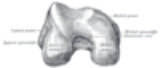
The pair of tibial condyles are separated by the intercondylar eminence composed of a lateral and a medial tubercle.
The
patella is inserted into the thin anterior wall of the joint capsule. On its posterior surface is a lateral and a medial articular surface, both of which communicate with the
patellar surfaceThe articular surface of the higher end of the femur consists of the anterior, inferior, and posterior surfaces of the condyles. Its front part is named the patellar surface and articulates with the patella; it presents a median groove which extends downward to the intercondyloid fossa and two...
which unites the two femoral condyles on the anterior side of the bone's distal end.
Articular capsule
The articular capsule has a
synovialSynovial fluid is a viscous, non-Newtonian fluid found in the cavities of synovial joints. With its yolk-like consistency , the principal role of synovial fluid is to reduce friction between the articular cartilage of synovial joints during movement.-Overview:The inner membrane of synovial joints...
and a fibrous membrane separated by fatty deposits. Anteriorly, the synovial membrane is attached on the margin of the cartilage both on the femur and the tibia, but on the femur, the suprapatellar bursa or recess extends the joint space proximally. The suprapatellar bursa is prevented from being pinched during extension by the
articularis genu muscleThe articularis genu is a small skeletal muscle located anteriorly on the thigh just above the knee.- Origin and insertion :...
. Behind, the synovial membrane is attached to the margins of the two femoral condyles which produces two extensions similar to the anterior recess. Between these two extensions, the synovial membrane passes in front of the two cruciate ligaments at the center of the joint, thus forming a pocket direct inward.
Bursae
Numerous
bursaeA bursa is a small fluid-filled sac lined by synovial membrane with an inner capillary layer of slimy fluid . It provides a cushion between bones and tendons and/or muscles around a joint. This helps to reduce friction between the bones and allows free movement...
surround the knee joint. The largest communicative bursa is the suprapatellar bursa described above. Four considerably smaller bursae are located on the back of the knee. Two non-communicative bursae are located in front of the patella and below the patellar
tendonA tendon is a tough band of fibrous connective tissue that usually connects muscle to bone and is capable of withstanding tension. Tendons are similar to ligaments and fasciae as they are all made of collagen except that ligaments join one bone to another bone, and fasciae connect muscles to other...
, and others are sometimes present.
Cartilage
CartilageCartilage is a flexible connective tissue found in many areas in the bodies of humans and other animals, including the joints between bones, the rib cage, the ear, the nose, the elbow, the knee, the ankle, the bronchial tubes and the intervertebral discs...
is a thin, elastic
tissueTissue is a cellular organizational level intermediate between cells and a complete organism. A tissue is an ensemble of cells, not necessarily identical, but from the same origin, that together carry out a specific function. These are called tissues because of their identical functioning...
that protects the
boneBones are rigid organs that constitute part of the endoskeleton of vertebrates. They support, and protect the various organs of the body, produce red and white blood cells and store minerals. Bone tissue is a type of dense connective tissue...
and makes certain that the
jointA joint is the location at which two or more bones make contact. They are constructed to allow movement and provide mechanical support, and are classified structurally and functionally.-Classification:...
surfaces can slide easily over each other. Cartilage ensures supple knee movement. There are two types of joint cartilage in the knees: fibrous cartilage (the
meniscusIn anatomy, a meniscus is a crescent-shaped fibrocartilaginous structure that, in contrast to articular disks, only partly divides a joint cavity. In humans it is present in the knee, acromioclavicular, sternoclavicular, and temporomandibular joints; in other organisms they may be present in other...
) and
hyaline cartilageHyaline cartilage consists of a slimy mass, pearly bluish in colour with firm consistency and considerable collagen. It contains no nerves or blood vessels, and its structure is relatively simple....
. Fibrous cartilage has tensile strength and can resist pressure. Hyaline cartilage covers the surface along which the joints move. Cartilage will wear over the years. Cartilage has a very limited capacity for self-restoration. The newly formed tissue will generally consist for a large part of fibrous cartilage of lesser quality than the original hyaline cartilage. As a result, new cracks and tears will form in the cartilage over time.
Menisci
The
articular diskThe articular disk is a thin, oval plate of fibrocartilage present in several joints which separates synovial cavities. This separation of the cavity space allows for separate movements to occur in each space....
s of the knee-joint are called
menisciIn anatomy, a meniscus is a crescent-shaped fibrocartilaginous structure that, in contrast to articular disks, only partly divides a joint cavity. In humans it is present in the knee, acromioclavicular, sternoclavicular, and temporomandibular joints; in other organisms they may be present in other...
because they only partly divide the joint space.
[Platzer (2004), p 26] These two disks, the
medial meniscus-External links: *...
and the
lateral meniscusThe lateral meniscus, also called the external semilunar fibrocartilage, is a fibrocartilaginous band that spans the lateral side of the interior of the knee joint. It is one of two menisci of the knee, the other being the medial meniscus. It is nearly circular and covers a larger portion of the...
, consist of connective tissue with extensive collagen fibers containing cartilage-like cells. Strong fibers run along the menisci from one attachment to the other, while weaker radial fibers are interlaced with the former. The menisci are flattened at the center of the knee joint, fused with the synovial membrane laterally, and can move over the tibial surface.
The menisci serve to protect the ends of the bones from rubbing on each other and to effectively deepen the tibial sockets into which the femur attaches. They also play a role in shock absorption, and may be cracked, or torn, when the knee is forcefully rotated and/or bent.
Ligaments
The ligaments surrounding the knee joint offer stability by limiting movements and, together with several menisci and bursae, protect the articular capsule.
Intracapsular
The knee is stabilized by a pair of
cruciate ligamentCruciate ligaments are pairs of ligaments arranged like a letter X. They occur in several joints of the body, such as the knee...
s. The
anterior cruciate ligamentThe anterior cruciate ligament is a cruciate ligament which is one of the four major ligaments of the human knee. In the quadruped stifle , based on its anatomical position, it is referred to as the cranial cruciate ligament.The ACL originates from deep within the notch of the distal femur...
(ACL) stretches from the
lateral condyle of femurThe lateral condyle is one of the two projections on the lower extremity of femur. It is the more prominent and is the broader both in its antero-posterior and transverse diameters....
to the
anterior intercondylar areaThe anterior intercondyloid fossa is the location where the anterior cruciate ligament attaches to the tibia....
. The ACL is critically important because it prevents the tibia from being pushed too far anterior relative to the femur. It is often torn during twisting or bending of the knee. The
posterior cruciate ligamentThe posterior cruciate ligament is one of the four major ligaments of the knee. It connects the posterior intercondylar area of the tibia to the medial condyle of the femur...
(PCL) stretches from
medial condyle of femurThe medial condyle is one of the two projections on the lower extremity of femur.The medial condyle is larger than the lateral condyle due to more weight bearing caused by the center of gravity being medial to the knee. On the posterior surface of the condyle the linea aspera turns into the...
to the posterior intercondylar area. Injury to this ligament is uncommon but can occur as a direct result of forced trauma to the ligament. This ligament prevents posterior displacement of the tibia relative to the femur.
The
transverse ligament stretches from the
lateral meniscusThe lateral meniscus, also called the external semilunar fibrocartilage, is a fibrocartilaginous band that spans the lateral side of the interior of the knee joint. It is one of two menisci of the knee, the other being the medial meniscus. It is nearly circular and covers a larger portion of the...
to the
medial meniscus-External links: *...
. It passes in front of the menisci. Is divided into several strips in 10% of cases. The two menisci are attached to each others anteriorly by the ligament. The
posteriorThe Posterior meniscofemoral ligament is a small fibrous band of the knee joint. It attaches to the posterior area of the lateral meniscus and crosses superiorly and medially behind the posterior cruciate ligament to attach to the medial condyle of the femur....
and
anterior meniscofemoral ligamentThe anterior meniscofemoral ligament or ligament of Humphrey is a small fibrous band of the knee joint. It arises from the posterior horn of the lateral meniscus and passes superiorly and medially in front of the posterior cruciate ligament to attach to the lateral surface of medial femoral...
s stretch from posterior horn of lateral meniscus to the medial femoral condyle. They pass posteriorly behind the posterior cruciate ligament. The posterior meniscofemoral ligament is more commonly present (30%); both ligaments are present less often. The
meniscotibial ligamentsThe coronary ligaments of the knee are portions of the joint capsule which connect the inferior edges of the fibrocartilaginous menisci to the periphery of the tibial plateaus.-Structure:...
(or "coronary") stretches from inferior edges of the mensici to the periphery of the tibial plateaus.
Extracapsular
The
patellar ligamentThe patellar ligament is the central portion of the common tendon of the Quadriceps femoris, which is continued from the patella to the tuberosity of the tibia.-Anatomy:It is a strong, flat, ligament, about 10 cm...
connects the
patella to the
tuberosity of the tibia. It is also occasionally called the patellar tendon because there is no definite separation between the
quadriceps tendonIn human anatomy, the quadriceps tendon connects the quadriceps femoris muscles to the superior aspects of the patella on the anterior of the thigh and controls knee flexion and extension.It can rupture resulting in quadriceps tendon rupture....
(which surrounds the patella) and the area connecting the patella to the tibia. This very strong ligament helps give the patella its mechanical leverage and also functions as a cap for the condyles of the femur. Laterally and medially to the patellar ligament the lateral and medial patellar retinacula connect fibers from the
vasti lateralisThe Vastus lateralis is the largest part of the Quadriceps femoris. It arises by a broad aponeurosis, which is attached to the upper part of the intertrochanteric line, to the anterior and inferior borders of the greater trochanter, to the lateral lip of the gluteal tuberosity, and to the upper...
and medialis muscles to the tibia. Some fibers from the
iliotibial tractThe iliotibial tract or iliotibial band is a longitudinal fibrous reinforcement of the fascia lata. It is attached to the anterolateral iliac tubercle portion of the external lip of the iliac crest and to the lateral condyle of the tibia...
radiate into the lateral retinaculum and the medial retinaculum receives some transverse fibers arising on the medial femoral epicondyle.
The
medial collateral ligamentThe medial collateral ligament of the knee is one of the four major ligaments of the knee. It is on the medial side of the knee joint in humans and other primates. It is also known as the tibial collateral ligament, or abbreviated as the MCL.- Structure :It is a broad, flat, membranous band,...
(MCL a.k.a. "tibial") stretches from the
medial epicondyle of the femur to the medial tibial condyle. It is composed of three groups of fibers, one stretching between the two bones, and two fused with the medial meniscus. The MCL is partly covered by the
pes anserinusThe pes anserinus is the insertion of the conjoined tendons of three muscles onto the anteromedial surface of the proximal extremity of the tibia.-Anatomy:The three muscles are :* sartorius...
and the tendon of the
semimembranosusThe semimembranosus is a muscle in the back of the thigh. It is the most medial of the three hamstring muscles.-Structure:The semimembranosus, so called from its membranous tendon of origin, is situated at the back and medial side of the thigh....
passes under it. It protects the medial side of the knee from being bent open by a stress applied to the lateral side of the knee (a
valgusIn orthopedics, a valgus deformity is a term for outward angulation of the distal segment of a bone or joint. The opposite deformation, medial deviation of the distal bone, is called varus....
force). The lateral collateral ligament (LCL a.k.a. "fibular") stretches from the
lateral epicondyle of the femurThe lateral epicondyle of the femur, smaller and less prominent than the medial epicondyle, gives attachment to the fibular collateral ligament of the knee-joint. Directly below it is a small depression from which a smooth well-marked groove curves obliquely upward and backward to the posterior...
to the
head of fibulaThe upper extremity or head of the fibula is of an irregular quadrate form, presenting above a flattened articular surface, directed upward, forward, and medialward, for articulation with a corresponding surface on the lateral condyle of the tibia....
. It is separate from both the joint capsule and the lateral meniscus. It protects the lateral side from an inside bending force (a
varusIn orthopedics, a varus deformity is a term for the inward angulation of the distal segment of a bone or joint. The opposite of varus is called valgus.The terms varus and valgus always refer to the direction that the distal segment of the joint points....
force).
Lastly, there are two ligaments on the dorsal side of the knee. The
oblique popliteal ligamentThe oblique popliteal ligament is a broad, flat, fibrous band, formed of fasciculi separated from one another by apertures for the passage of vessels and nerves....
is a radiation of the tendon of the
semimembranosusThe semimembranosus is a muscle in the back of the thigh. It is the most medial of the three hamstring muscles.-Structure:The semimembranosus, so called from its membranous tendon of origin, is situated at the back and medial side of the thigh....
on the medial side, from where it is direct laterally and proximally. The
arcuate popliteal ligamentThe arcuate popliteal ligament is an extracapsular ligament of the knee. It is Y-shaped and is attached to the fibular head. From there it goes to its two insertions; one goes over m. popliteus and attaches to the intercondylar area of tibia, the other to the lateral epicondyle of femur and blends...
originates on the apex of the head of the fibula to stretch proximally, crosses the tendon of the
popliteus muscleThe popliteus muscle in the leg is used to unlock the knee during walking/running by laterally rotating the femur on the tibia during a closed chain movement ....
, and passes into the capsule.
Movements
Maximum movements and muscles
| Extension 5-10° | Flexion 120-150° |
Quadriceps (with some assistance from the Tensor fasciae lataeThe tensor fasciae latae or tensor fasciæ latæ is a muscle of the thigh. The English name for this muscle is the muscle that stretches the band on the side... ) |
(In order of importance) SemimembranosusThe semimembranosus is a muscle in the back of the thigh. It is the most medial of the three hamstring muscles.-Structure:The semimembranosus, so called from its membranous tendon of origin, is situated at the back and medial side of the thigh....
SemitendinosusThe semitendinosus is a muscle in the back of the thigh; it is one of the hamstrings.-Structure:The semitendinosus, remarkable for the great length of its tendon of insertion, is situated at the posterior and medial aspect of the thigh ....
Biceps femorisThe biceps femoris is a muscle of the posterior thigh. As its name implies, it has two parts, one of which forms part of the hamstrings muscle group.-Origin and insertion:It has two heads of origin;...
GracilisThe gracilis is the most superficial muscle on the medial side of the thigh. It is thin and flattened, broad above, narrow and tapering below.-Origin and insertion:...
SartoriusThe Sartorius muscle – the longest muscle in the human body – is a long thin muscle that runs down the length of the thigh. Its upper portion forms the lateral border of the femoral triangle.-Origin and insertion:...
PopliteusThe popliteus muscle in the leg is used to unlock the knee during walking/running by laterally rotating the femur on the tibia during a closed chain movement ....
GastrocnemiusIn humans, the gastrocnemius muscle is a very powerful superficial pennate muscle that is in the back part of the lower leg. It runs from its two heads just above the knee to the heel, and is involved in standing, walking, running and jumping. Along with the soleus muscle it forms the calf muscle...
|
| Internal rotation* 10° | External rotation* 30-40° |
(In order of importance) Semimembranosus Semitendinosus Gracilis Sartorius Popliteus |
Biceps femoris |
| *(knee flexed 90°) |
The knee permits
flexionIn anatomy, flexion is a position that is made possible by the joint angle decreasing. The skeletal and muscular systems work together to move the joint into a "flexed" position. For example the elbow is flexed when the hand is brought closer to the shoulder...
and
extensionIn kinesiology, extension is a movement of a joint that results in increased angle between two bones or body surfaces at a joint. Extension usually results in straightening of the bones or body surfaces involved. For example, extension is produced by extending the flexed elbow. Straightening of...
about a virtual transverse axis, as well as a slight medial and lateral rotation about the axis of the lower leg in the flexed position. The knee joint is called "mobile" because the femur and lateral
meniscusIn anatomy, a meniscus is a crescent-shaped fibrocartilaginous structure that, in contrast to articular disks, only partly divides a joint cavity. In humans it is present in the knee, acromioclavicular, sternoclavicular, and temporomandibular joints; in other organisms they may be present in other...
move over the tibia during rotation, while the femur rolls and glides over both menisci during extension-flexion.
The center of the transverse axis of the extension/flexion movements is located where both collateral ligaments and both cruciate ligaments intersect. This center moves upward and backward during flexion, while the distance between the center and the articular surfaces of the femur changes dynamically with the decreasing curvature of the femoral condyles. The total range of motion is dependent on several parameters such as soft-tissue restraints, active insufficiency, and hamstring tightness.
Extended position
With the knee extended both the lateral and
medial collateral ligamentThe medial collateral ligament of the knee is one of the four major ligaments of the knee. It is on the medial side of the knee joint in humans and other primates. It is also known as the tibial collateral ligament, or abbreviated as the MCL.- Structure :It is a broad, flat, membranous band,...
s, as well as the anterior part of the
anterior cruciate ligamentThe anterior cruciate ligament is a cruciate ligament which is one of the four major ligaments of the human knee. In the quadruped stifle , based on its anatomical position, it is referred to as the cranial cruciate ligament.The ACL originates from deep within the notch of the distal femur...
, are taut. During extension, the femoral condyles glide into a position which causes the complete unfolding of the tibial collateral ligament. During the last 10° of extension, an
obligatory terminal rotation is triggered in which the knee is rotated medially 5°. The final rotation is produced by a lateral rotation of the tibia in the non-weight-bearing leg, and by a medial rotation of the femur in the weight-bearing leg. This terminal rotation is made possible by the shape of the medial femoral condyle, assisted by contraction of the popliteus muscle and the
iliotibial tractThe iliotibial tract or iliotibial band is a longitudinal fibrous reinforcement of the fascia lata. It is attached to the anterolateral iliac tubercle portion of the external lip of the iliac crest and to the lateral condyle of the tibia...
and is caused by the stretching of the anterior cruciate ligament. Both cruciate ligaments are slightly unwinded and both lateral ligaments become taut.
Flexed position
In the flexed position, the collateral ligaments are relaxed while the cruciate ligaments are taut. Rotation is controlled by the twisted cruciate ligaments; the two ligaments get twisted around each other during medial rotation of the tibia — which reduces the amount of rotation possible — while they become unwound during lateral rotation of the tibia. Because of the oblique position of the cruciate ligaments at least a part of one of them is always tense and these ligaments control the joint as the collateral ligaments are relaxed. Furthermore, the dorsal fibers of the tibial collateral ligament become tensed during extreme medial rotation and the ligament also reduces the lateral rotation to 45-60°.
Blood supply
The
femoral arteryThe femoral artery is a general term comprising a few large arteries in the thigh. They begin at the inguinal ligament and end just above the knee at adductor canal or Hunter's canal traversing the extent of the femur bone....
and the
popliteal arteryIn human anatomy, the popliteal artery is defined as the extension of the "superficial" femoral artery after passing through the adductor canal and adductor hiatus above the knee...
help form the arterial network surrounding the knee joint (articular
reteRete may refer to: An interwoven network of nerves, blood vessels or passageways.-Italy:*Net , in Latin*La Rete , the common name given to Movimento per la Democrazia , an Italian political party-Technology:...
). There are 6 main branches:
- 1. Superior medial genicular artery
The medial superior genicular runs in front of the Semimembranosus and Semitendinosus, above the medial head of the Gastrocnemius, and passes beneath the tendon of the Adductor magnus....
- 2. Superior lateral genicular artery
-Course:It passes above the lateral condyle of the femur, beneath the tendon of the Biceps femoris.-Branching:It divides into a superficial and a deep branch; the superficial branch supplies the vastus lateralis, and anastomoses with the descending branch of the lateral femoral circumflex and the...
- 3. Inferior medial genicular artery
-Course:It first descends along the upper margin of the popliteus, to which it gives branches; it then passes below the medial condyle of the tibia, beneath the tibial collateral ligament, at the anterior border of which it ascends to the front and medial side of the joint, to supply the upper end...
- 4. Inferior lateral genicular artery
-Course:It runs lateralward above the head of the fibula to the front of the knee-joint, passing in its course beneath the lateral head of the gastrocnemius, the fibular collateral ligament, and the tendon of the biceps femoris.-Branching:...
- 5. Descending genicular artery
The descending genicular artery arises from the femoral artery just before it passes through the opening in the tendon of the Adductor magnusIt immediately divides into:* Saphenous branch of descending genicular artery...
- 6. Recurrent branch of anterior tibial artery
The anterior tibial recurrent artery arises from the anterior tibial, as soon as that vessel has passed through the interosseous space; it ascends in the Tibialis anterior, ramifies on the front and sides of the knee-joint, and assists in the formation of the patellar plexus by anastomosing with...
The medial genicular arteries penetrate the knee joint.
Disorders and injury
Knee pain is caused by trauma, misalignment, and degeneration as well as by conditions like
arthritisArthritis is a form of joint disorder that involves inflammation of one or more joints....
. The most common knee disorder is generally known as patellofemoral syndrome.The majority of minor cases of knee pain can be treated at home with rest and ice but more serious injuries do require
surgicalSurgery is an ancient medical specialty that uses operative manual and instrumental techniques on a patient to investigate and/or treat a pathological condition such as disease or injury, or to help improve bodily function or appearance.An act of performing surgery may be called a surgical...
care.
One form of patellofemoral syndrome involves a tissue-related problem that creates pressure and irritation in the knee between the patella and the trochlea (patellar compression syndrome), which causes pain. The second major class of knee disorder involves a tear, slippage, or dislocation that impairs the structural ability of the knee to balance the leg (patellofemoral instability syndrome). Patellofemoral instability syndrome may cause either pain, a sense of poor balance, or both.
Age also contributes to disorders of the knee. Particularly in older people, knee pain frequently arises due to osteoarthritis. In addition, weakening of tissues around the knee may contribute to the problem. Patellofemoral instability may relate to hip abnormalities or to tightness of surrounding ligaments.
CartilageCartilage is a flexible connective tissue found in many areas in the bodies of humans and other animals, including the joints between bones, the rib cage, the ear, the nose, the elbow, the knee, the ankle, the bronchial tubes and the intervertebral discs...
lesions can be caused by:
- Accidents (fractures)
- Injuries
- The removal of a meniscus
In anatomy, a meniscus is a crescent-shaped fibrocartilaginous structure that, in contrast to articular disks, only partly divides a joint cavity. In humans it is present in the knee, acromioclavicular, sternoclavicular, and temporomandibular joints; in other organisms they may be present in other...
- Anterior cruciate ligament
The anterior cruciate ligament is a cruciate ligament which is one of the four major ligaments of the human knee. In the quadruped stifle , based on its anatomical position, it is referred to as the cranial cruciate ligament.The ACL originates from deep within the notch of the distal femur...
injury
- Posterior cruciate ligament
The posterior cruciate ligament is one of the four major ligaments of the knee. It connects the posterior intercondylar area of the tibia to the medial condyle of the femur...
injury
- Posterolateral corner injury
- Considerable strain on the knee.
Any kind of work during which the knees undergo heavy stress may also be detrimental to cartilage. This is especially the case in professions in which people frequently have to walk, lift, or squat. Other causes of pain may be excessive on, and wear of, the knees, in combination with such things as
muscle weaknessMuscle weakness or myasthenia is a lack of muscle strength. The causes are many and can be divided into conditions that have true or perceived muscle weakness...
and
overweightOverweight is generally defined as having more body fat than is optimally healthy. Being overweight is a common condition, especially where food supplies are plentiful and lifestyles are sedentary...
.
Common complaints:
- A painful, blocked, locked or swollen knee.
- Sufferers sometimes feel as if their knees are about to give way, or may feel uncertain about their movement.
The pain felt by people with
cartilageCartilage is a flexible connective tissue found in many areas in the bodies of humans and other animals, including the joints between bones, the rib cage, the ear, the nose, the elbow, the knee, the ankle, the bronchial tubes and the intervertebral discs...
injury does not come from the cartilage itself, but from the irritated
tissueTissue is a cellular organizational level intermediate between cells and a complete organism. A tissue is an ensemble of cells, not necessarily identical, but from the same origin, that together carry out a specific function. These are called tissues because of their identical functioning...
surrounding the cartilage, or from pieces of cartilage that have come loose. If cartilage injury goes untreated, the layer of cartilage will continue to gradually wear away, causing arthrosis and gradual immobility.
Overall fitness and knee injury
Physical fitness is related integrally to the development of knee problems. The same activity such as climbing stairs may cause pain from patellofemoral compression for someone who is physically unfit, but not for someone else (or even for that person at a different time). Obesity is another major contributor to knee pain. For instance, a 30-year-old woman who weighed 120 lb at age 18 years, before her three pregnancies, and now weighs 285 lb, had added 660 lb of force across her patellofemoral joint with each step.
Common injuries due to physical activity
In sports that place great pressure on the knees, especially with twisting forces, it is common to tear one or more ligaments or cartilages.
Anterior cruciate ligament injury
ACL is the most commonly injured ligament of the knee. The injury is common during sports. Twisting of the knee is a common cause of over-stretching or tearing the ACL. When the ACL is injured one may hear a popping sound and the leg may suddenly give out. Besides
swellingSwelling , is the enlargement of tissue.Swelling can also mean:*Die swell, the increase of volume of material due to absorption of a solvent, common for plastic polymers*Neutron-induced swelling caused by neutron radiation....
and pain, walking may be painful and the knee will feel unstable. Minor tears of the anterior cruciate ligament may heal over time, but a torn ACL requires surgery. After surgery, recovery is prolonged and low impact exercises are recommended to strengthen the joint.
Torn meniscus injury
The menisci act as shock absorbers and separate the two ends of bone in the knee
jointA joint is the location at which two or more bones make contact. They are constructed to allow movement and provide mechanical support, and are classified structurally and functionally.-Classification:...
. There are two menisci in the knee, the medial (inner) and the lateral (outer). When there is torn cartilage, it means that the meniscus has been injured. Meniscus tears occur during sports often when the knee is twisted. Menisci injury may be innocuous and one may be able to walk after a tear, but soon swelling and pain set in. Sometimes the knee will lock while bending. Pain often occurs when one squats. Small
meniscusIn sports and orthopedics, a tear of a meniscus is a rupturing of one or more of the fibrocartilage strips in the knee called menisci. When doctors and patients refer to "torn cartilage" in the knee, they actually may be referring to an injury to a meniscus at the top of one of the tibiae. Menisci...
tears are treated conservatively but most large tears require surgery.
Fractures
Knee fractures are rare but do occur, especially as a result of motor vehicle accidents. There is usually immediate pain; swelling and one may not be able to stand on the leg. The muscles go into
spasmIn medicine a spasm is a sudden, involuntary contraction of a muscle, a group of muscles, or a hollow organ, or a similarly sudden contraction of an orifice. It is sometimes accompanied by a sudden burst of pain, but is usually harmless and ceases after a few minutes...
and even the slightest movements are painful.
X-rayX-radiation is a form of electromagnetic radiation. X-rays have a wavelength in the range of 0.01 to 10 nanometers, corresponding to frequencies in the range 30 petahertz to 30 exahertz and energies in the range 120 eV to 120 keV. They are shorter in wavelength than UV rays and longer than gamma...
s can easily confirm the injury and surgery depends on the degree of displacement and type of fracture.
Ruptured tendon
Tendons usually attach muscle to bone. In the knee the quadriceps and patellar tendon can sometimes tear. The injuries to these tendons occur when there is forceful
contractionMuscle fiber generates tension through the action of actin and myosin cross-bridge cycling. While under tension, the muscle may lengthen, shorten, or remain the same...
of the knee. If the tendon is completely torn, bending or extending the leg is impossible. A completely torn tendon requires surgery but a partially torn tendon can be treated with leg immobilization followed by
physical therapyPhysical therapy , often abbreviated PT, is a health care profession. Physical therapy is concerned with identifying and maximizing quality of life and movement potential within the spheres of promotion, prevention, diagnosis, treatment/intervention,and rehabilitation...
.
Overuse
Overuse injuries of the knee include
tendonitisTendinitis , meaning inflammation of a tendon , is a type of tendinopathy often confused with the more common tendinosis, which has similar symptoms but requires different treatment...
,
bursitisBursitis is the inflammation of one or more bursae of synovial fluid in the body. The bursae rest at the points where internal functionaries, such as muscles and tendons, slide across bone. Healthy bursae create a smooth, almost frictionless functional gliding surface making normal movement painless...
, muscle strains and
iliotibial band syndromeIliotibial band syndrome is a common injury to the thigh, generally associated with running, cycling, hiking or weight-lifting .- Definition :...
. These injuries often develop slowly over weeks or months. Activities that induce pain usually delay healing. Rest, ice and compression do help in most cases. Once the swelling has diminished,
heat packA heat pack is designed to warm up one's body to prevent swelling of injuries. A heat pack can be:* an ice pack that is heated * a heating pad that heats when you start the crystallisation process...
s can increase blood supply and promote healing. Most overuse injuries subside with time but can flare up if the activities are quickly resumed.
To prevent overuse injuries, warm up prior to exercise, limit high impact activities and keep your weight under control.
Surgical interventions
Before the advent of
arthroscopyArthroscopy is a minimally invasive surgical procedure in which an examination and sometimes treatment of damage of the interior of a joint is performed using an arthroscope, a type of endoscope that is inserted into the joint through a small incision...
and arthroscopic surgery, patients having surgery for a torn ACL required at least nine months of rehabilitation, having initially spent several weeks in a full-length plaster cast. With
current techniquesAnterior cruciate ligament reconstruction is a surgical tissue graft replacement of the anterior cruciate ligament, located in the knee, to restore its function after anterior cruciate ligament injury. The torn ligament is removed from the knee before the graft is inserted through a hole created...
, such patients may be walking without crutches in two weeks, and playing some sports in a few months.
In addition to developing new surgical procedures, ongoing research is looking into underlying problems which may increase the likelihood of an athlete suffering a severe knee injury. These findings may lead to effective preventive measures, especially in female athletes, who have been shown to be especially vulnerable to ACL tears from relatively minor trauma.
Articular cartilage repairThe aim of an articular cartilage repair treatment is to restore the surface of an articular joint's hyaline cartilage. Over the last decades, surgeons and researchers have been working hard to elaborate surgical cartilage repair interventions...
treatment :
- Arthroscopic debriment of the knee (arthroscopic lavage
"Lavage" means 'washing'. To lavage a joint means to wash out any blood, fluid or loose debris from inside the joint space.Arthroscopic lavage is generally combined with arthroscopic debridement, where fronds of joint material or degenerative tissue are removed using a combination of injected fluid...
).
- Mosaïc-plasty.
- Microfracture (Ice-picking).
- Autologous Chondrocyte Implantation
Autologous chondrocyte implantation is a biomedical treatment that repairs damages in articular cartilage. ACI provides pain relief while at the same time slowing down the progression or considerably delaying partial or total joint replacement surgery...
.
- Osteochondral Autograft and Allografts.
- PLC Reconstruction
Animal anatomy
In humans the knee refers to the joints between the femur, tibia and patella. In quadrupeds, particularly horses and ungulates the laymans term "knee" is commonly used to refer to the
carpusIn tetrapods, the carpus is the sole cluster of bones in the wrist between the radius and ulna and the metacarpus. The bones of the carpus do not belong to individual fingers , whereas those of the metacarpus do. The corresponding part of the foot is the tarsus...
. The joints between the femur, tibia and patella are known as the
stifleThe stifle joint is a complex joint in the hind limbs of quadruped mammals such as the sheep, horse or dog. It is the equivalent joint to the human knee...
in quadrupeds. In insects and other animals the term knee is used widely to refer to any ginglymus joint.
See also
- Arthrofibrosis
Arthrofibrosis is a complication of injury or trauma where an excessive scar tissue response leads to painful restriction of joint motion, with scar tissue forming within the joint and surrounding soft tissue spaces and persisting despite rehabilitation exercises and stretches...
- Articular cartilage repair
The aim of an articular cartilage repair treatment is to restore the surface of an articular joint's hyaline cartilage. Over the last decades, surgeons and researchers have been working hard to elaborate surgical cartilage repair interventions...
- Autologous Chondrocyte Implantation
Autologous chondrocyte implantation is a biomedical treatment that repairs damages in articular cartilage. ACI provides pain relief while at the same time slowing down the progression or considerably delaying partial or total joint replacement surgery...
- Cartilage
Cartilage is a flexible connective tissue found in many areas in the bodies of humans and other animals, including the joints between bones, the rib cage, the ear, the nose, the elbow, the knee, the ankle, the bronchial tubes and the intervertebral discs...
- Chondromalacia patellae
Chondromalacia patellae is a term that goes back eighty years. It originally meant "soft cartilage under the knee cap," a presumed cause of pain at the front and especially inner side of the knee. This condition often affects young, otherwise healthy individuals.Chondromalacia is due to an...
- Geniculum
A geniculum is a small genu, or angular knee-like structure. It is often used in anatomical nomenclature to designate a sharp knee-like bend in a small structure or organ....
- Genuflection
Genuflection , bending at least one knee to the ground, was from early times a gesture of deep respect for a superior. In 328 BC, Alexander the Great introduced into his court etiquette some form of genuflection already in use in Persia. In the Byzantine Empire even senators were required to...
- Knee arthritis
Arthritis is inflammation in the joints or area of the body where two bones come together. Joints are responsible for the movement of body parts. It is a condition that can be experienced all over the body or in a specific area...
- Knee Cartilage Replacement Therapy
Articular cartilage, most notably that which is found in the knee joint, is generally characterized by very low friction, high wear resistance, and poor regenerative qualities. It is responsible for much of the compressive resistance and load bearing qualities of the knee joint and, without it,...
- Knee examination
The knee examination, in medicine and physiotherapy, is performed as part of a physical examination, or when a patient presents with knee pain or a history that suggests a pathology of the knee joint.The exam includes several parts:*position/lighting/draping...
- Knee osteoarthritis
Knee osteoarthritis is a degenerative disease of the knee joint. It is more common in people older than 40 years. Women have greater chance to be affected.-Signs and symptoms:Some of the signs and symptoms associated with knee osteoarthritis include:* Pain...
- Knee pain
Knee pain is a common complaint for many people. There are several factors that can cause knee pain. Awareness and knowledge of knee pain causes lead to faster diagnosis and treatment. Knee pain can be related to knee joint or around the knee.-Knee joint:...
- Knee-capping
Kneecapping is a form of malicious wounding, often as criminal punishment or torture, in which the victim is injured in the knee, often using a firearm or power drill to damage the knee joint and kneecap.- Use :...
- Posterolateral Knee Injuries
The posterolateral corner of the knee is a complex area of the knee formed by the interaction of multiple structures. Injuries to the posterolateral corner can be debilitating to patients and require prompt recognition and treatment to avoid long term consequences...
- Kneebar
- Kneeling
Kneeling is a human position in which the weight is distributed on the knees and feet on a surface close to horizontal.The position of kneeling may be assumed for practical reasons and for reasons of social or religious custom.- Practical reasons :...
- Knesetja
Knésetja is the Old Norse expression for a custom in Germanic law, by which adoption was formally expressed by setting the fosterchild on the knees of the foster-father.-Germanic law:...
- Partial knee replacement
- Reflex hammer
A reflex hammer is a medical instrument used by physicians to test deep tendon reflexes. Testing for reflexes is an important part of the neurological physical examination in order to detect abnormalities in the central or peripheral nervous system....
Additional images