

Arthropod leg

Encyclopedia
The arthropod leg is a form of jointed appendage
of arthropod
s, usually used for walking
. Many of the terms used for arthropod leg segments are of Latin
origin, and may be confused with terms for bones: coxa (meaning hip
), trochanter (compare trochanter
), femur
, tibia
, tarsus
, ischium, metatarsus
, carpus
, dactylus (meaning finger
), patella.
Homologies of leg segments between groups are difficult to prove and are the source of much argument. Some authors posit up to eleven segments per leg for the most recent common ancestor
of extant arthropod
s but modern arthropods have eight or fewer. It has been argued that the ancestral leg need not have been so complex, and that other events, such as successive loss of function of a Hox-gene
, could result in parallel
gains of leg segments.
The legs of insects and myriapods
are uniramous. In crustaceans, the first antennae are uniramous, but the second antennae are biramous, as are the legs in most species.
For a time, possession of uniramous limbs was believed to be a shared, derived character
, so uniramous arthropods were grouped into a taxon called Uniramia
. It is now believed that several groups of arthropods evolved uniramous limbs independently from ancestors with biramous limbs, so this taxon is no longer used.
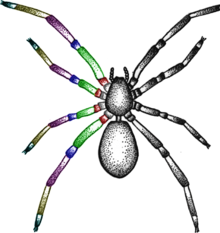
legs differ from those of insects by the addition of two segments on either side of the tibia, the patella between the femur and the tibia, and the metatarsus (sometimes called basitarsus) between the tibia and the tarsus (sometimes called telotarsus), making a total of seven segments.
The situation is identical in scorpion
s, but with the addition of a pre-tarsus beyond the tarsus. The claws of the scorpion are not truly legs, but are pedipalp
s, a different kind of appendage
that is also found in spiders and is specialised for predation and mating.
In Limulus
, there are no metatarsi or pretarsi, leaving six segments per leg.
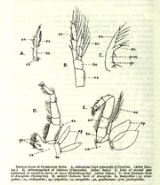
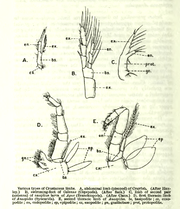
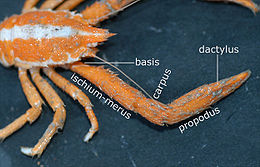
s are divided primitively into seven segments, which do not follow the naming system used in the other groups. They are: coxa, basis, ischium, merus, carpus, propodus, and dactylus. In some groups, some of the limb segments may be fused together. The claw
of a lobster or crab is formed by the articulation of the dactylus against an outgrowth of the propodus. Crustacean limbs also differ in being biramous, whereas all other extant arthropods have uniramous limbs.
s, centipede
s and their relatives have seven-segmented legs, comprising coxa, trochanter, prefemur, femur, tibia, tarsus, and a tarsal claw.
, each with five components. In order from the body they are the coxa, trochanter, femur, tibia, and tarsus. Each is a single segment, except the tarsus which can be from three to seven segments, each referred to as a tarsomere.
Appendage
In invertebrate biology, an appendage is an external body part, or natural prolongation, that protrudes from an organism's body . It is a general term that covers any of the homologous body parts that may extend from a body segment...
of arthropod
Arthropod
An arthropod is an invertebrate animal having an exoskeleton , a segmented body, and jointed appendages. Arthropods are members of the phylum Arthropoda , and include the insects, arachnids, crustaceans, and others...
s, usually used for walking
Walking
Walking is one of the main gaits of locomotion among legged animals, and is typically slower than running and other gaits. Walking is defined by an 'inverted pendulum' gait in which the body vaults over the stiff limb or limbs with each step...
. Many of the terms used for arthropod leg segments are of Latin
Latin
Latin is an Italic language originally spoken in Latium and Ancient Rome. It, along with most European languages, is a descendant of the ancient Proto-Indo-European language. Although it is considered a dead language, a number of scholars and members of the Christian clergy speak it fluently, and...
origin, and may be confused with terms for bones: coxa (meaning hip
Hip (anatomy)
In vertebrate anatomy, hip refer to either an anatomical region or a joint.The hip region is located lateral to the gluteal region , inferior to the iliac crest, and overlying the greater trochanter of the femur, or "thigh bone"...
), trochanter (compare trochanter
Trochanter
In human anatomy, the trochanter is a part of the thigh bone. It can refer to:* Greater trochanter* Lesser trochanter* Third trochanter-See also:* Intertrochanteric crest* Intertrochanteric line...
), femur
Femur
The femur , or thigh bone, is the most proximal bone of the leg in tetrapod vertebrates capable of walking or jumping, such as most land mammals, birds, many reptiles such as lizards, and amphibians such as frogs. In vertebrates with four legs such as dogs and horses, the femur is found only in...
, tibia
Tibia
The tibia , shinbone, or shankbone is the larger and stronger of the two bones in the leg below the knee in vertebrates , and connects the knee with the ankle bones....
, tarsus
Tarsus (skeleton)
In tetrapods, the tarsus is a cluster of articulating bones in each foot situated between the lower end of tibia and fibula of the lower leg and the metatarsus. In the foot the tarsus articulates with the bones of the metatarsus, which in turn articulate with the bones of the individual toes...
, ischium, metatarsus
Metatarsus
The metatarsus or metatarsal bones are a group of five long bones in the foot located between the tarsal bones of the hind- and mid-foot and the phalanges of the toes. Lacking individual names, the metatarsal bones are numbered from the medial side : the first, second, third, fourth, and fifth...
, carpus
Carpus
In tetrapods, the carpus is the sole cluster of bones in the wrist between the radius and ulna and the metacarpus. The bones of the carpus do not belong to individual fingers , whereas those of the metacarpus do. The corresponding part of the foot is the tarsus...
, dactylus (meaning finger
Finger
A finger is a limb of the human body and a type of digit, an organ of manipulation and sensation found in the hands of humans and other primates....
), patella.
Homologies of leg segments between groups are difficult to prove and are the source of much argument. Some authors posit up to eleven segments per leg for the most recent common ancestor
Most recent common ancestor
In genetics, the most recent common ancestor of any set of organisms is the most recent individual from which all organisms in the group are directly descended...
of extant arthropod
Arthropod
An arthropod is an invertebrate animal having an exoskeleton , a segmented body, and jointed appendages. Arthropods are members of the phylum Arthropoda , and include the insects, arachnids, crustaceans, and others...
s but modern arthropods have eight or fewer. It has been argued that the ancestral leg need not have been so complex, and that other events, such as successive loss of function of a Hox-gene
Homeobox
A homeobox is a DNA sequence found within genes that are involved in the regulation of patterns of anatomical development in animals, fungi and plants.- Discovery :...
, could result in parallel
Parallel evolution
Parallel evolution is the development of a similar trait in related, but distinct, species descending from the same ancestor, but from different clades.-Parallel vs...
gains of leg segments.
Biramous and uniramous
The appendages of arthropods may be either biramous or uniramous. A uniramous limb comprises a single series of segments attached end-to-end. A biramous limb, however, branches into two, and each branch consists of a series of segments attached end-to-end.The legs of insects and myriapods
Myriapoda
Myriapoda is a subphylum of arthropods containing millipedes, centipedes, and others. The group contains 13,000 species, all of which are terrestrial...
are uniramous. In crustaceans, the first antennae are uniramous, but the second antennae are biramous, as are the legs in most species.
For a time, possession of uniramous limbs was believed to be a shared, derived character
Cladistics
Cladistics is a method of classifying species of organisms into groups called clades, which consist of an ancestor organism and all its descendants . For example, birds, dinosaurs, crocodiles, and all descendants of their most recent common ancestor form a clade...
, so uniramous arthropods were grouped into a taxon called Uniramia
Uniramia
S. M. Manton's polyphyletic Arthropod hypothesis with Uniramia as one of three Phyla.Uniramia is a group within the arthropods. In the past this group included the Onychophora, which are now considered a separate category. The group is currently used in a narrower sense.Uniramia is one of three...
. It is now believed that several groups of arthropods evolved uniramous limbs independently from ancestors with biramous limbs, so this taxon is no longer used.
Chelicerata
ArachnidArachnid
Arachnids are a class of joint-legged invertebrate animals in the subphylum Chelicerata. All arachnids have eight legs, although in some species the front pair may convert to a sensory function. The term is derived from the Greek words , meaning "spider".Almost all extant arachnids are terrestrial...
legs differ from those of insects by the addition of two segments on either side of the tibia, the patella between the femur and the tibia, and the metatarsus (sometimes called basitarsus) between the tibia and the tarsus (sometimes called telotarsus), making a total of seven segments.
The situation is identical in scorpion
Scorpion
Scorpions are predatory arthropod animals of the order Scorpiones within the class Arachnida. They have eight legs and are easily recognized by the pair of grasping claws and the narrow, segmented tail, often carried in a characteristic forward curve over the back, ending with a venomous stinger...
s, but with the addition of a pre-tarsus beyond the tarsus. The claws of the scorpion are not truly legs, but are pedipalp
Pedipalp
Pedipalps , are the second pair of appendages of the prosoma in the subphylum Chelicerata. They are traditionally thought to be homologous with mandibles in Crustacea and insects, although more recent studies Pedipalps (commonly shortened to palps or palpi), are the second pair of appendages of the...
s, a different kind of appendage
Appendage
In invertebrate biology, an appendage is an external body part, or natural prolongation, that protrudes from an organism's body . It is a general term that covers any of the homologous body parts that may extend from a body segment...
that is also found in spiders and is specialised for predation and mating.
In Limulus
Horseshoe crab
The Atlantic horseshoe crab, Limulus polyphemus, is a marine chelicerate arthropod. Despite its name, it is more closely related to spiders, ticks, and scorpions than to crabs. Horseshoe crabs are most commonly found in the Gulf of Mexico and along the northern Atlantic coast of North America...
, there are no metatarsi or pretarsi, leaving six segments per leg.
Crustacea
The legs of crustaceanCrustacean
Crustaceans form a very large group of arthropods, usually treated as a subphylum, which includes such familiar animals as crabs, lobsters, crayfish, shrimp, krill and barnacles. The 50,000 described species range in size from Stygotantulus stocki at , to the Japanese spider crab with a leg span...
s are divided primitively into seven segments, which do not follow the naming system used in the other groups. They are: coxa, basis, ischium, merus, carpus, propodus, and dactylus. In some groups, some of the limb segments may be fused together. The claw
Claw
A claw is a curved, pointed appendage, found at the end of a toe or finger in most mammals, birds, and some reptiles. However, the word "claw" is also often used in reference to an invertebrate. Somewhat similar fine hooked structures are found in arthropods such as beetles and spiders, at the end...
of a lobster or crab is formed by the articulation of the dactylus against an outgrowth of the propodus. Crustacean limbs also differ in being biramous, whereas all other extant arthropods have uniramous limbs.
Myriapoda
MillipedeMillipede
Millipedes are arthropods that have two pairs of legs per segment . Each segment that has two pairs of legs is a result of two single segments fused together as one...
s, centipede
Centipede
Centipedes are arthropods belonging to the class Chilopoda of the subphylum Myriapoda. They are elongated metameric animals with one pair of legs per body segment. Despite the name, centipedes can have a varying number of legs from under 20 to over 300. Centipedes have an odd number of pairs of...
s and their relatives have seven-segmented legs, comprising coxa, trochanter, prefemur, femur, tibia, tarsus, and a tarsal claw.
Insects
Insects and their relatives are hexapods, having six legs, connected to the thoraxThorax (insect anatomy)
The thorax is the mid section of the insect body. It holds the head, legs, wings and abdomen. It is also called mesosoma in other arthropods....
, each with five components. In order from the body they are the coxa, trochanter, femur, tibia, and tarsus. Each is a single segment, except the tarsus which can be from three to seven segments, each referred to as a tarsomere.