Pangolin

Encyclopedia
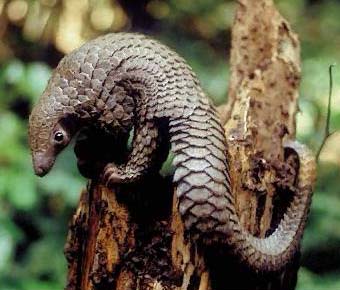
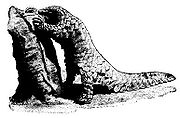
A pangolin also scaly anteater or Trenggiling, is a mammal
of the order Pholidota. There is only one extant family
(Manidae) and one genus
(Manis) of pangolins, comprising eight species
. There are also a number of extinct taxa. Pangolins have large keratin
scales
covering their skin
and are the only mammals with this adaptation. They are found in tropical regions of Africa
and Asia
. The name "pangolin" derives from the Malay
word pengguling ("something that rolls up").
Pangolins are nocturnal animals, and use their well-developed sense of smell to find insects. The long-tailed pangolin
is also active by day. Pangolins spend most of the daytime sleeping, curled up into a ball.
Pangolins were classified with various other orders, for example Xenarthra
, which includes the ordinary anteater
s, sloth
s, and the similar-looking armadillo
s. But newer genetic evidence indicates that their closest living relatives are the Carnivora
, with which they form the clade
Ferae
. Some paleontologists have classified the pangolins in the order Cimolesta
, together with several extinct groups.
, the same material of which human fingernails
and tetrapod
claws are made. The pangolin is often compared to a walking pine cone
or globe artichoke
. It can curl up into a ball when threatened, with its overlapping scales acting as armour
and its face tucked under its tail. The scales are razor-sharp, providing extra defence. The front claws are so long that they are unsuited for walking, and so the animal walks with its fore paws curled over to protect them. Pangolins can also emit a noxious smelling acid
from gland
s near the anus
, similar to the spray of a skunk
. Pangolins have short legs, with sharp claw
s which they use for burrowing into termite and ant mounds, as well as climbing.
The size of pangolins varies by species, ranging from 30 cm to 100 cm (12 to 39 inches). Females are generally smaller than males.
The tongues of pangolins are extremely elongated and extend into the abdominal cavity. By convergent evolution
pangolins, the giant anteater
, and the tube-lipped nectar bat
, all have tongues which are unattached to their hyoid bone and extend past their pharynx
deep into the thorax
. This extension lies between the sternum
and the trachea
. Large pangolins can extend their tongues as much as 40 cm (16 inches), with a diameter of only 0.5 cm (1/4 inch).
In pangolins, the section of the brain that relates to problem solving is highly developed. Although their problem solving ability is primarily used to find food in obscure locations, when kept in captivity pangolins are remarkable escape artists..
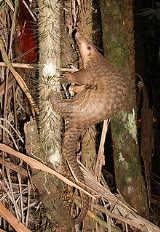
Arboreal pangolins live in hollow trees, whereas the ground dwelling species dig tunnels underground, up to a depth of 3.5 m (11 feet). Pangolins are also good swimmers.
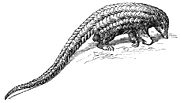 Pangolins lack teeth and the ability to chew
. Instead, they tear open anthill
s or termite mounds with their powerful front claws and probe deep into them with their very long tongue
s. Pangolins have glands in their chests to lubricate the tongue with sticky, ant-catching saliva
.
Some species, such as the Tree Pangolin
, use their strong, prehensile tails to hang from tree branches and strip away bark from the trunk, exposing insect nests inside.
takes place at around three months of age, and pangolins become sexually mature at two years.
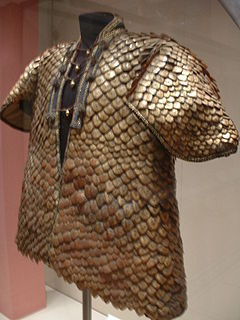 Pangolins are hunted and eaten in many parts of Africa
and are one of the more popular types of bush meat. Pangolins are also in great demand in China because their meat is considered a delicacy and some Chinese believe pangolin scales reduce swelling
, promote blood circulation and help breast-feeding women produce milk. This, coupled with deforestation
, has led to a large decrease in the numbers of Giant Pangolin
s. In November 2010, pangolins were added to the Zoological Society of London
's list of genetically distinct and endangered mammals.
Pangolin populations have suffered from illegal trafficking. In May 2007, for example, 31 pangolins were found aboard an abandoned vessel off the coast of China. The boat contained some 5,000 endangered animals.
The Guardian
provided a description of the killing and eating of pangolins: "A Guangdong chef interviewed last year in the Beijing Science and Technology Daily
described how to cook a pangolin: 'We keep them alive in cages until the customer makes an order. Then we hammer them unconscious, cut their throats and drain the blood. It is a slow death. We then boil them to remove the scales. We cut the meat into small pieces and use it to make a number of dishes, including braised meat and soup. Usually the customers take the blood home with them afterwards.'"
Mammal
Mammals are members of a class of air-breathing vertebrate animals characterised by the possession of endothermy, hair, three middle ear bones, and mammary glands functional in mothers with young...
of the order Pholidota. There is only one extant family
Family (biology)
In biological classification, family is* a taxonomic rank. Other well-known ranks are life, domain, kingdom, phylum, class, order, genus, and species, with family fitting between order and genus. As for the other well-known ranks, there is the option of an immediately lower rank, indicated by the...
(Manidae) and one genus
Genus
In biology, a genus is a low-level taxonomic rank used in the biological classification of living and fossil organisms, which is an example of definition by genus and differentia...
(Manis) of pangolins, comprising eight species
Species
In biology, a species is one of the basic units of biological classification and a taxonomic rank. A species is often defined as a group of organisms capable of interbreeding and producing fertile offspring. While in many cases this definition is adequate, more precise or differing measures are...
. There are also a number of extinct taxa. Pangolins have large keratin
Keratin
Keratin refers to a family of fibrous structural proteins. Keratin is the key of structural material making up the outer layer of human skin. It is also the key structural component of hair and nails...
scales
Scale (zoology)
In most biological nomenclature, a scale is a small rigid plate that grows out of an animal's skin to provide protection. In lepidopteran species, scales are plates on the surface of the insect wing, and provide coloration...
covering their skin
Skin
-Dermis:The dermis is the layer of skin beneath the epidermis that consists of connective tissue and cushions the body from stress and strain. The dermis is tightly connected to the epidermis by a basement membrane. It also harbors many Mechanoreceptors that provide the sense of touch and heat...
and are the only mammals with this adaptation. They are found in tropical regions of Africa
Africa
Africa is the world's second largest and second most populous continent, after Asia. At about 30.2 million km² including adjacent islands, it covers 6% of the Earth's total surface area and 20.4% of the total land area...
and Asia
Asia
Asia is the world's largest and most populous continent, located primarily in the eastern and northern hemispheres. It covers 8.7% of the Earth's total surface area and with approximately 3.879 billion people, it hosts 60% of the world's current human population...
. The name "pangolin" derives from the Malay
Malay language
Malay is a major language of the Austronesian family. It is the official language of Malaysia , Indonesia , Brunei and Singapore...
word pengguling ("something that rolls up").
Pangolins are nocturnal animals, and use their well-developed sense of smell to find insects. The long-tailed pangolin
Long-tailed Pangolin
The Long-tailed Pangolin , also called the Black-bellied Pangolin or ipi, is an arboreal pangolin native to the sub-Saharan forests of Africa. Its common name is derived from its especially long tail...
is also active by day. Pangolins spend most of the daytime sleeping, curled up into a ball.
Pangolins were classified with various other orders, for example Xenarthra
Xenarthra
The superorder Xenarthra is a group of placental mammals , existent today only in the Americas and represented by anteaters, tree sloths, and armadillos. The origins of the order can be traced back as far as the Paleogene in South America...
, which includes the ordinary anteater
Anteater
Anteaters, also known as antbear, are the four mammal species of the suborder Vermilingua commonly known for eating ants and termites. Together with the sloths, they compose the order Pilosa...
s, sloth
Sloth
Sloths are the six species of medium-sized mammals belonging to the families Megalonychidae and Bradypodidae , part of the order Pilosa and therefore related to armadillos and anteaters, which sport a similar set of specialized claws.They are arboreal residents of the jungles of Central and South...
s, and the similar-looking armadillo
Armadillo
Armadillos are New World placental mammals, known for having a leathery armor shell. Dasypodidae is the only surviving family in the order Cingulata, part of the superorder Xenarthra along with the anteaters and sloths. The word armadillo is Spanish for "little armored one"...
s. But newer genetic evidence indicates that their closest living relatives are the Carnivora
Carnivora
The diverse order Carnivora |Latin]] carō "flesh", + vorāre "to devour") includes over 260 species of placental mammals. Its members are formally referred to as carnivorans, while the word "carnivore" can refer to any meat-eating animal...
, with which they form the clade
Clade
A clade is a group consisting of a species and all its descendants. In the terms of biological systematics, a clade is a single "branch" on the "tree of life". The idea that such a "natural group" of organisms should be grouped together and given a taxonomic name is central to biological...
Ferae
Ferae
Ferae is a clade of mammals, consisting of the orders Carnivora and Pholidota . Pangolins do not look much like carnivorans , and were thought to be the closest relatives of Xenarthra...
. Some paleontologists have classified the pangolins in the order Cimolesta
Cimolesta
Cimolesta is an extinct order of mammals. A few experts place the pangolins within Cimolesta, though most other experts prefer to place the pangolins within their own order, Pholidota....
, together with several extinct groups.
Physical description and behaviour
The physical appearance of pangolins is marked by large, hardened, plate-like scales. The scales, which are soft on newborn pangolins but harden as the animal matures, are made of keratinKeratin
Keratin refers to a family of fibrous structural proteins. Keratin is the key of structural material making up the outer layer of human skin. It is also the key structural component of hair and nails...
, the same material of which human fingernails
Nail (anatomy)
A nail is a horn-like envelope covering the dorsal aspect of the terminal phalanges of fingers and toes in humans, most non-human primates, and a few other mammals. Nails are similar to claws, which are found on numerous other animals....
and tetrapod
Tetrapod
Tetrapods are vertebrate animals having four limbs. Amphibians, reptiles, birds and mammals are all tetrapods; even snakes and other limbless reptiles and amphibians are tetrapods by descent. The earliest tetrapods evolved from the lobe-finned fishes in the Devonian...
claws are made. The pangolin is often compared to a walking pine cone
Conifer cone
A cone is an organ on plants in the division Pinophyta that contains the reproductive structures. The familiar woody cone is the female cone, which produces seeds. The male cones, which produce pollen, are usually herbaceous and much less conspicuous even at full maturity...
or globe artichoke
Globe artichoke
The globe artichoke is a perennial thistle of the Cynara genus originating in Southern Europe around the Mediterranean. It grows to tall, with arching, deeply lobed, silvery, glaucous-green leaves long. The flowers develop in a large head from an edible bud about diameter with numerous...
. It can curl up into a ball when threatened, with its overlapping scales acting as armour
Armour (zoology)
Armour in animals is external or superficial protection against attack by predators, formed as part of the body , usually through the hardening of body tissues, outgrowths or secretions. It has therefore mostly developed in 'prey' species...
and its face tucked under its tail. The scales are razor-sharp, providing extra defence. The front claws are so long that they are unsuited for walking, and so the animal walks with its fore paws curled over to protect them. Pangolins can also emit a noxious smelling acid
Acid
An acid is a substance which reacts with a base. Commonly, acids can be identified as tasting sour, reacting with metals such as calcium, and bases like sodium carbonate. Aqueous acids have a pH of less than 7, where an acid of lower pH is typically stronger, and turn blue litmus paper red...
from gland
Gland
A gland is an organ in an animal's body that synthesizes a substance for release of substances such as hormones or breast milk, often into the bloodstream or into cavities inside the body or its outer surface .- Types :...
s near the anus
Anus
The anus is an opening at the opposite end of an animal's digestive tract from the mouth. Its function is to control the expulsion of feces, unwanted semi-solid matter produced during digestion, which, depending on the type of animal, may be one or more of: matter which the animal cannot digest,...
, similar to the spray of a skunk
Skunk
Skunks are mammals best known for their ability to secrete a liquid with a strong, foul odor. General appearance varies from species to species, from black-and-white to brown or cream colored. Skunks belong to the family Mephitidae and to the order Carnivora...
. Pangolins have short legs, with sharp claw
Claw
A claw is a curved, pointed appendage, found at the end of a toe or finger in most mammals, birds, and some reptiles. However, the word "claw" is also often used in reference to an invertebrate. Somewhat similar fine hooked structures are found in arthropods such as beetles and spiders, at the end...
s which they use for burrowing into termite and ant mounds, as well as climbing.
The size of pangolins varies by species, ranging from 30 cm to 100 cm (12 to 39 inches). Females are generally smaller than males.
The tongues of pangolins are extremely elongated and extend into the abdominal cavity. By convergent evolution
Convergent evolution
Convergent evolution describes the acquisition of the same biological trait in unrelated lineages.The wing is a classic example of convergent evolution in action. Although their last common ancestor did not have wings, both birds and bats do, and are capable of powered flight. The wings are...
pangolins, the giant anteater
Giant Anteater
The Giant Anteater, Myrmecophaga tridactyla, is the largest species of anteater. It is the only species in the genus Myrmecophaga. It is found in Central and South America from Honduras to northern Argentina...
, and the tube-lipped nectar bat
Tube-lipped Nectar Bat
The Tube-lipped Nectar Bat is a bat from Ecuador which was first described in 2005. The species name fistulata is derived from the Latin word 'fistula', meaning 'tube'. It refers to the bat's lower lip which extends 3.3-4.8mm beyond the upper lip and is rolled into a funnel shape. The exact...
, all have tongues which are unattached to their hyoid bone and extend past their pharynx
Pharynx
The human pharynx is the part of the throat situated immediately posterior to the mouth and nasal cavity, and anterior to the esophagus and larynx. The human pharynx is conventionally divided into three sections: the nasopharynx , the oropharynx , and the laryngopharynx...
deep into the thorax
Thorax
The thorax is a division of an animal's body that lies between the head and the abdomen.-In tetrapods:...
. This extension lies between the sternum
Sternum
The sternum or breastbone is a long flat bony plate shaped like a capital "T" located anteriorly to the heart in the center of the thorax...
and the trachea
Vertebrate trachea
In tetrapod anatomy the trachea, or windpipe, is a tube that connects the pharynx or larynx to the lungs, allowing the passage of air. It is lined with pseudostratified ciliated columnar epithelium cells with goblet cells that produce mucus...
. Large pangolins can extend their tongues as much as 40 cm (16 inches), with a diameter of only 0.5 cm (1/4 inch).
In pangolins, the section of the brain that relates to problem solving is highly developed. Although their problem solving ability is primarily used to find food in obscure locations, when kept in captivity pangolins are remarkable escape artists..
Arboreal pangolins live in hollow trees, whereas the ground dwelling species dig tunnels underground, up to a depth of 3.5 m (11 feet). Pangolins are also good swimmers.
Diet
Mastication
Mastication or chewing is the process by which food is crushed and ground by teeth. It is the first step of digestion and it increases the surface area of foods to allow more efficient break down by enzymes. During the mastication process, the food is positioned between the teeth for grinding by...
. Instead, they tear open anthill
Ant colony
An ant colony is an underground lair where ants live, eat and mate. Colonies consist of a series of underground chambers, connected to each other and the surface of the earth by small tunnels. There are rooms for nurseries, food storage, and mating...
s or termite mounds with their powerful front claws and probe deep into them with their very long tongue
Tongue
The tongue is a muscular hydrostat on the floors of the mouths of most vertebrates which manipulates food for mastication. It is the primary organ of taste , as much of the upper surface of the tongue is covered in papillae and taste buds. It is sensitive and kept moist by saliva, and is richly...
s. Pangolins have glands in their chests to lubricate the tongue with sticky, ant-catching saliva
Saliva
Saliva , referred to in various contexts as spit, spittle, drivel, drool, or slobber, is the watery substance produced in the mouths of humans and most other animals. Saliva is a component of oral fluid. In mammals, saliva is produced in and secreted from the three pairs of major salivary glands,...
.
Some species, such as the Tree Pangolin
Tree pangolin
The Tree Pangolin is one of eight extant species of pangolin and is native to equatorial Africa. Also known as the White-bellied Pangolin or Three-cusped Pangolin, it is the most common of the African forest pangolins.-Taxonomy:The Tree Pangolin belongs to the subgenus Phataginus and some...
, use their strong, prehensile tails to hang from tree branches and strip away bark from the trunk, exposing insect nests inside.
Reproduction
Gestation is 120–150 days. African pangolin females usually give birth to a single offspring at a time, but the Asiatic species can give birth from one to three. Weight at birth is 80–450 g (3–18 ounces), and the scales are initially soft. The young cling to the mother's tail as she moves about, although in burrowing species, they remain in the burrow for the first 2–4 weeks of life. WeaningWeaning
Weaning is the process of gradually introducing a mammal infant, either human or animal, to what will be its adult diet and withdrawing the supply of its mother's milk.The process takes place only in mammals, as only mammals produce milk...
takes place at around three months of age, and pangolins become sexually mature at two years.
Threats
Africa
Africa is the world's second largest and second most populous continent, after Asia. At about 30.2 million km² including adjacent islands, it covers 6% of the Earth's total surface area and 20.4% of the total land area...
and are one of the more popular types of bush meat. Pangolins are also in great demand in China because their meat is considered a delicacy and some Chinese believe pangolin scales reduce swelling
Swelling (medical)
In medical parlance, swelling is the transient enlargement or protuberance in the body and may include tumors. According to cause, it may be congenital, traumatic, inflammatory, neoplastic or miscellaneous....
, promote blood circulation and help breast-feeding women produce milk. This, coupled with deforestation
Deforestation
Deforestation is the removal of a forest or stand of trees where the land is thereafter converted to a nonforest use. Examples of deforestation include conversion of forestland to farms, ranches, or urban use....
, has led to a large decrease in the numbers of Giant Pangolin
Giant Pangolin
The Giant Pangolin is a pangolin species. Members of the species inhabit Africa with a range stretching along the equator from west Africa to Uganda. The Giant Pangolin is the largest species of pangolin, or "scaly anteaters" – the large, scaled mammals belonging to the Manidae family. It...
s. In November 2010, pangolins were added to the Zoological Society of London
Zoological Society of London
The Zoological Society of London is a charity devoted to the worldwide conservation of animals and their habitats...
's list of genetically distinct and endangered mammals.
Pangolin populations have suffered from illegal trafficking. In May 2007, for example, 31 pangolins were found aboard an abandoned vessel off the coast of China. The boat contained some 5,000 endangered animals.
The Guardian
The Guardian
The Guardian, formerly known as The Manchester Guardian , is a British national daily newspaper in the Berliner format...
provided a description of the killing and eating of pangolins: "A Guangdong chef interviewed last year in the Beijing Science and Technology Daily
Science and Technology Daily
Science and Technology Daily is the official newspaper of the Ministry of Science and Technology of the People's Republic of China. It is published in Chinese and based in Beijing. It was one of the few Chinese newspapers to cover the Tiananmen Square protests of 1989....
described how to cook a pangolin: 'We keep them alive in cages until the customer makes an order. Then we hammer them unconscious, cut their throats and drain the blood. It is a slow death. We then boil them to remove the scales. We cut the meat into small pieces and use it to make a number of dishes, including braised meat and soup. Usually the customers take the blood home with them afterwards.'"
Taxonomy
- ORDER PHOLIDOTA
- Family †EpoicotheriidaeEpoicotheriidaeEpoicotheriidae is an extinct family of pangolin-like insectivore mammals which were endemic to North America from the Eocene to the Oligocene 55.4—33.9 Ma existing for approximately ..Epoicotheriids were highly specialized animals that were convergent on golden moles in the structure of their...
- Family †Metacheiromyidae
- Family Manidae
- Subfamily †Eurotamanduinae
- Genus †EurotamanduaEurotamanduaEurotamandua is an extinct mammal that lived some 49 million years ago, during the early Eocene.A single fossil is known, coming from the Messel Pit. It was about 90 cm long. It is often classified as a pangolin...
- Genus †Eurotamandua
- Subfamily Maninae
- Genus †Cryptomanis
- Genus †EomanisEomanisEomanis is the earliest known true pangolin from the Middle Eocene of Europe. Fossils collected from the Messel Pit, Germany, indicate that this 50 cm long animal was rather similar to living pangolins. However, unlike modern pangolins, its tail and legs did not bear scales...
- Genus †NecromanisNecromanisNecromanis is an extinct genus of pangolin from the Miocene of France. Necromanis is descended from the Eocene pangolins of genus Eomanis....
- Genus †Patriomanis
- Genus Manis
- Subgenus Manis
- Indian PangolinIndian PangolinThe Indian Pangolin or ”Scaly Ant-eater” is a pangolin that is found in the plains and hills of India, Sri Lanka,Nepal and some parts of Pakistan. It is not common anywhere in its range....
(M. crassicaudata) - Chinese PangolinChinese PangolinThe Chinese Pangolin is a pangolin that is found in north India, Nepal, Bhutan, possibly Bangladesh, across Myanmar to northern Indochina, through most of Taiwan and southern China, including the islands of Hainan.-Conservation:...
(M. pentadactyla) - Asian Giant Pangolin (M. paleojavanica) †
- Indian Pangolin
- Subgenus Paramanis
- Sunda Pangolin (M. javanica)
- Philippine PangolinPhilippine pangolinThe Philippine Pangolin or Palawan Pangolin, also known as the Malintong , is a pangolin species endemic to the Palawan province of the Philippines. Its habitat includes primary and secondary forests as well as surrounding grasslands...
(M. culionensis)
- Subgenus Smutsia
- Giant PangolinGiant PangolinThe Giant Pangolin is a pangolin species. Members of the species inhabit Africa with a range stretching along the equator from west Africa to Uganda. The Giant Pangolin is the largest species of pangolin, or "scaly anteaters" – the large, scaled mammals belonging to the Manidae family. It...
(M. gigantea) - Ground Pangolin (M. temmincki)
- Giant Pangolin
- Subgenus Phataginus
- Tree PangolinTree pangolinThe Tree Pangolin is one of eight extant species of pangolin and is native to equatorial Africa. Also known as the White-bellied Pangolin or Three-cusped Pangolin, it is the most common of the African forest pangolins.-Taxonomy:The Tree Pangolin belongs to the subgenus Phataginus and some...
(M. tricuspis)
- Tree Pangolin
- Subgenus Uromanis
- Long-tailed PangolinLong-tailed PangolinThe Long-tailed Pangolin , also called the Black-bellied Pangolin or ipi, is an arboreal pangolin native to the sub-Saharan forests of Africa. Its common name is derived from its especially long tail...
(M. tetradactyla)
- Long-tailed Pangolin
- Subgenus Manis
- Subfamily †Eurotamanduinae
- Family †Epoicotheriidae