

Spartan Army

Encyclopedia
The Spartan army was the military force of Sparta
, one of the leading city-state
s of ancient Greece
. The army stood at the centre of the Spartan state, whose citizens' primary obligation was to be good soldiers. Subject to military drill from infancy, the Spartans were one of the most feared military forces in world history. At Sparta's heyday in the 6th to 4th centuries BC, it was commonly accepted that "one Spartan was worth several men of any other state."
, where they participate among the other Greek contingents. Like the rest of the Mycenaean
armies, it was composed largely of infantry, equipped with short sword
s, spear
s, Dyplon and a simple rounded bronze shield. This was an age of heroic warfare with simple tactics, often little more than a general charge and a great deal of killing — it was common for entire armies
to be chased down and killed after a rout
. The basic tactic of battle was "free for all."
War chariots were used by the elite, but unlike their counterparts in the Middle East, they appear to have been used mostly for transport, with the warrior dismounting to fight on foot and then remounting it to withdraw from combat, although some accounts show warriors throwing their spear from the chariot before dismounting.
s, which ended the Mycenaean civilization and ushered in the so-called "Greek Dark Ages". During this time, Sparta or Lacedaemon was merely a Doric village on the banks of the river Eurotas
in Laconia
. In the early 8th century BC however, Spartan society was transformed. The reforms, which were ascribed by later tradition to the possibly mythical figure of Lycurgus, created new institutions and established the military nature of the Spartan state. This "constitution of Lycurgus" would remain unchanged in its essence for the next five centuries. From ca. 750 BC, Sparta embarked on a steady expansion, first by subduing Amyclae and the other settlements of Laconia
, and later, in the First Messenian War
, conquering the fertile country of Messenia
. By the beginning of the 7th century BC, Sparta was, along with Argos
, the dominant power in the Peloponnese
.
, which tied down the Spartan army for almost twenty years. Over the course of the 6th century BC, Sparta secured her control of the Peloponnese
peninsula: Arcadia
was forced to recognize Spartan overlordship, Argos lost Cynuria (the SE coast of the Peloponnese) in ca. 546 and suffered a further crippling blow by Cleomenes I
at Sepeia
in 494, while repeated expeditions against tyrannical regimes throughout Greece greatly raised their prestige. By the early 5th century BC, Sparta was left the unchallenged master in southern Greece, as the leading power (hegemon) of the newly established Peloponnesian League
(which was more characteristically known to its contemporaries as "the Lacedaemonians and their allies").
 By the late 6th century BC, Sparta was recognized as the preeminent Greek city-state. King Croesus of Lydia established an alliance with them, and later, the Greek cities of Asia Minor appealed to her for help in the Ionian Revolt
. In the second Persian invasion of Greece under Xerxes
, Sparta was assigned the overall leadership of Greek forces on land and at sea. Because of this, the Spartans played a crucial role in the repulsion of the invasion, notably at the battles of Thermopylae
and Plataea
. In the aftermath however, the plottings of Pausanias
with the Persians and the unwillingness of the Spartans to campaign too far from home, meant that they withdrew into a relative isolation, leaving the rising power of Athens
to assume the reins of the continued effort against the Persians. This isolationist tendency was further reinforced by the revolts of some of her allies and a great earthquake
in 464, which was followed by a large scale revolt of the Messenian helots
. The parallel rise of Athens to a major power in Greece led inevitably to friction with Sparta, and to two large-scale conflicts (the First
and Second Peloponnesian War
s) which devastated Greece. Sparta suffered several reverses during these wars, including, for the first time, the surrender of an entire Spartan unit at Sphacteria
in 425 BC, but ultimately emerged victorious, primarily through the aid it received from the Persians. Under its admiral Lysander
, the Persian-funded Peloponnesian fleet captured the cities of the Athenian alliance, and a decisive naval victory at Aegospotami
forced Athens to capitulate. The Athenian defeat left Sparta in a dominant position in Greece.
repeatedly challenged their authority, and the ensuing Corinthian War
led to the humiliating Peace of Antalcidas
, which destroyed Sparta's reputation as the protector of the independence of Greek city-states. At the same time, the Spartan military prestige suffered a severe blow, when a mora of 600 men was decimated by light troops (peltasts) under Iphicrates
. Despite her continuing military prowess, Sparta was incapable of projecting her power over the entirety of Greece, suffered from manpower shortages and was unwilling to reform. As a result, Sparta's strength collapsed after the disastrous defeat suffered at the Battle of Leuctra
by the Thebans under Epaminondas
in 371 BC. The battle resulted in the loss of large numbers of Spartiates and the loss of Messenia.
During the absence of Alexander in the East Agis III
revolted, but was defeated. After Alexander's death, Sparta again became involved, as an independent state, in the many wars of the 3rd century. Under the reformist kings Agis IV
and Cleomenes III
, it enjoyed a short-lived revival, scoring successes against the Achaean League
, before the final defeat in the Battle of Sellasia
. The last Spartan resurgence occurred under Nabis
, but following Sparta's defeat in the War against Nabis
, the city was incorporated into the Achaean League in 189 BC. This marked the end of Sparta as an independent power, thereafter coming under Roman
rule, although retaining the status of an autonomous city.
The Spartan people (the "Lacedaemonians") were divided in three classes: Full citizens, known as the Spartiates proper or Hómoioi ("equals" or peers), who received a grant of land (kláros or klēros, "lot") for their military service. The second class were the Perioeci (the "dwellers nearby"), free non-citizens, generally merchants, craftsmen and sailors, who were used as light infantry and on auxiliary roles on campaign. The third and most numerous class were the Helots
, state-owned serfs used to farm the Spartiate klēros. By the 5th century BC, the helots too were used as light troops in skirmishes. The Spartiates were the core of the Spartan army: they participated in the Assembly (Apella
) and provided the hoplites in the army. Indeed, they were supposed to be soldiers and nothing else, being forbidden to learn and exercise any other trade. To a large degree, the necessity for the constant war footing of the Spartan society was the need to keep the vastly more numerous helots subdued. One of the major problems of the later Spartan society was the steady decline in fully enfranchised citizens, which also meant a decline in available military manpower: the number of Spartiates decreased from 6,000 in 640 BC to 1,000 in 330 BC. The Spartans were therefore forced to use helot hoplites, and occasionally they freed some of the Laconian helots, the neodamōdeis (the "newly enfranchised"), and gave them land to settle in exchange for military service.
The Spartiate population was subdivided into age groups. The youngest at 20 were counted as weaker due to lack of experience, and the oldest, up to 60 or in a crisis 65, were only called up in an emergency, to defend the baggage train.
, who admired the Spartans and whose Constitution of Sparta offers a detailed overview of the Spartan state and society at the beginning of the 4th century BC. Other authors, notably Thucydides
, also provide information, but it is not always as reliable as Xenophon's first-hand accounts.
Little is known of the earlier organization, and much is left open to speculation. The earliest form of social and military organization (during the 7th century BC) seems to have been the three tribes (phylai: the Pamphyloi, Hylleis and Dymanes) who appear in the Second Messenian War
(685-668 BC). A further subdivision was the "fraternity" (phratra), of which 27, or nine per tribe, are recorded. Eventually this system was replaced by five territorial divisions, the obai ("villages"), which supplied a lochos of ca. 1,000 men each. This system was still used during the Persian Wars, as implied by references to the lochoi made by Herodotus
in his history.
The changes that occurred between the Persian and the Peloponnesian Wars are not documented, but according to Thucydides, at Mantinea
in 418 BC there were 7 lochoi present, each subdivided into four pentekostyes of 128 and 16 enōmotiai of 32 men, giving a total of 3584 men for the main Spartan army. By the end of the Peloponnesian War, the structure had evolved further, both to address the shortages in manpower and to create a more flexible system that allowed the Spartans to send smaller detachments on campaign or to garrisons outside their homeland. According to Xenophon, the basic Spartan unit remained the enōmotia, with 36 men in three files of twelve under an enōmotarches. Two enōmotiai formed a pentēkostys of 72 men under a pentēkontēr, and two pentēkostyai were grouped into a lochos of 144 men under a lochagos. Four lochoi formed a mora
of 576 men under a polemarch
os, the largest single tactical unit of the Spartan army. Six morai composed the Spartan army on campaign, to which were added the Skiritai and the contingents of allied states.
; initially both went on campaign, but after the 6th century BC only one, with the other remaining home. Unlike other states, their authority was severely circumscribed; actual power rested with the five elected ephoroi. The kings were accompanied by a select group of 300 men as a royal guard, who were termed hippeis
("cavalrymen"). Despite their title, they were infantry hoplites like all Spartiatai. Indeed, the Spartans did not utilize a cavalry of their own until late into the Peloponnesian War
, when small units of 60 cavalrymen were attached to each mora. The hippeis belonged to the first mora and were the elite of the Spartan army, being deployed on the honorary right side of the battle line. They were selected every year by specially commissioned officials, the hippagretai, from among experienced men who had sons, so that their line would continue. It was the hippeis who participated in a celebrated contest in 546 BC against the Argive knights, and it was these who accompanied king Leonidas in his famous last stand at Thermopylae
.
At first, in the archaic period of 700-600 BC, education for both sexes was, as in most Greek states, centred on the arts, with the male citizen population later receiving military education. However, from the 6th century onwards, the military character of the state became more pronounced, and education was totally subordinated to the needs of the military.
Both boys and girls were brought up by the city women until the age of seven, when boys (paidia) were taken from their mothers and grouped together in "packs" (agelai) and were sent to what is almost equivalent to present-day military boot camp. This military camp was known as the Agoge. They became inured to hardship, being provided with scant food and clothing; this also encouraged them to steal, and if they were caught, they were punished - not for stealing, but for being caught. There is a characteristic story, told by Plutarch: "The boys make such a serious matter of their stealing, that one of them, as the story goes, who was carrying concealed under his cloak a young fox which he had stolen, suffered the animal to tear out his bowels with its teeth and claws, and died rather than have his theft detected." The boys were encouraged to compete against one another in games and mock fights and to foster an esprit de corps. In addition, they were taught to read and write and learned the songs of Tyrtaios, that celebrated Spartan exploits in the Second Messenian War. They learned to read and write not for cultural reasons, but so they could be able to read military maps. At the age of twelve, a boy was classed as a "youth" (meirakion). His physical education was intensified, discipline became much harsher, and the boys were loaded with extra tasks. The youths had to go barefoot, and were dressed only in a tunic both in summer and in winter.
At around age 12 the boys would enter into an institutionalized relationship with a young adult male Spartan. Plutarch
described this form of Spartan pederasty wherein somewhat older warriors would engage promising youths in a long-lasting relationship with a pedagogic motive. The boy was expected to request the relationship, which was seen as a method to pass on knowledge and maintain loyalty on the battlefield.
Adulthood was reached at the age of 18, and the young adult (eiren) initially served as a trainer for the boys. At the same time, the most promising youths were included in the Krypteia. At 20, Spartans became eligible for military service and joined one of the messes (syssitia
), which included 15 men of various ages. Those who were rejected retained a lesser form of citizenship, as only the soldiers were ranked among the homoioi. However, even after that, and even during marriage and until about the age of 30, they would spend most of their day in the barracks
with their unit. Military duty lasted until the 60th year, but there are recorded cases of older people participating in campaigns in times of crisis.
Throughout their adult lives, the Spartiates continued to be subject to a training regime so strict that, as Plutarch says, "... they were the only men in the world with whom war brought a respite in the training for war." Bravery was the ultimate virtue for the Spartans: Spartan mothers would give their sons the shield with the words "[Return] With it or [carried] on it!" , that is to say, either victorious or dead, since in battle, the heavy hoplite shield would be the first thing a fleeing soldier would be tempted to abandon –- rhipsaspia, "dropping the shield", was a synonym for desertion in the field.
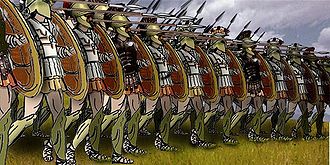
Like the other Greek states, the Spartan army was an infantry-based army fighting in the Phalanx formation
. The Spartans themselves did not introduce any significant changes or tactical innovations in hoplite warfare, but their constant drill and superb discipline made their phalanx much more cohesive and effective. The Spartans employed the phalanx in the classical style in a single line, uniformly deep in files of 8 to 12 men. When fighting alongside their allies, the Spartans would normally occupy the honorary right flank. If, as usually happened, the Spartans achieved victory on their side, they would then wheel left and roll up the enemy formation.
During the Peloponnesian War, engagements became more fluid, light troops became increasingly used and tactics evolved to meet them, but in direct confrontations between two opposing phalanxes, stamina and "pushing ability" were what counted. It was only when the Thebans, under Epaminondas
increased the depth
of a part of their formation at the Battle of Leuctra
that the Spartan phalanx broke.
 The Spartans used the same typical hoplite
equipment as the other Greek neighbors; the only distinctive Spartan features were the crimson tunic (chitōn) and cloak (himation), and the long hair, which the Spartans retained to a far later date than most Greeks. To the Spartans, the long hair retained its older Archaic meaning as the symbol of a free man; to the other Greeks by the 5th century, its peculiar association with the Spartans had come to signify pro-Spartan sympathies. Another widely known Spartan symbol, adopted in the 420s BC, was the letter lambda
(Λ), standing for Laconia
or Lacedaemon, which was painted on the Spartans' shields
. Spartan hoplites were often depicted bearing a transverse horsehair crest on their helmet, which was possibly used to identify officers.
In the Archaic period, Spartans were armored with flanged bronze
cuirass
es, leg greave
s, and a helmet, most usually of the Corinthian
type. It is often disputed which torso armor the Spartans wore during the Persian Wars, though it seems likely they either continued to wear bronze cuirasses of a more sculptured type, or instead had adopted the linothōrax
. During the later 5th century BC, when warfare had become more flexible and full-scale phalanx confrontations became rarer, the Greeks abandoned most forms of body armor. The Lacedaemonians also adopted a new tunic, the exōmis
, which could be arranged so that it left the right arm and shoulder uncovered and free for action in combat. The Spartan's main weapon was the Doru
. For long range, they carried a javelin. The Spartiatēs was always armed with a xiphos as a secondary weapon. The Spartans retained the traditional hoplite phalanx until the reforms of Cleomenes III
, when they were re-equipped with the Macedonian sarissa
and trained in the style of the Macedonian phalanx
.
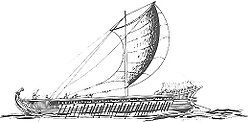 Throughout their history, the Spartans were a land-based force par excellence. During the Persian Wars, they did contribute a small navy of 20 trireme
s, and provided the overall fleet commander, but they largely relied on their allies, primarily the Corinth
ians, for naval power. This fact meant that, when the Peloponnesian War broke out, the Spartans were supreme on land, but the Athenians supreme at sea. The Spartans repeatedly ravaged Attica
, but the Athenians kept being supplied by sea, and were able to stage raids of their own around the Peloponnese with their navy. Eventually, it was the creation of a navy that enabled Sparta to overcome Athens. With Persian gold, Lysander
, appointed navarch
in 407 BC, was able to muster a strong navy, and successfully challenge and destroy Athenian predominance in the Aegean Sea. The Spartan engagement with the sea would be short-lived however, and did not survive the turmoils of the Corinthian War
: in the Battle of Cnidus
of 394 BC, the Spartan navy was decisively defeated by a joint Athenian-Persian fleet, marking the end of Sparta's brief naval supremacy. The final blow would be given 20 years later, at the Battle of Naxos
in 376 BC. A small fleet was periodically maintained thereafter, but its effectiveness was limited; the last revival of Spartan naval power was under Nabis
, who with aid from his Cretan
allies created a fleet to control the Laconian coastline.
The fleet was commanded by navarchs who were appointed for a strictly one year term, and apparently could not be reappointed. The admirals were subordinated to the vice-admiral called epistoleus. This position is seemingly independent of the one year term clause, because it was used, in 405 B.C. to give Lysander
command of the fleet after he was already an admiral for a year.
Messenian Wars
Corinthian War
Cleomenean War
Sparta
Sparta or Lacedaemon, was a prominent city-state in ancient Greece, situated on the banks of the River Eurotas in Laconia, in south-eastern Peloponnese. It emerged as a political entity around the 10th century BC, when the invading Dorians subjugated the local, non-Dorian population. From c...
, one of the leading city-state
City-state
A city-state is an independent or autonomous entity whose territory consists of a city which is not administered as a part of another local government.-Historical city-states:...
s of ancient Greece
Ancient Greece
Ancient Greece is a civilization belonging to a period of Greek history that lasted from the Archaic period of the 8th to 6th centuries BC to the end of antiquity. Immediately following this period was the beginning of the Early Middle Ages and the Byzantine era. Included in Ancient Greece is the...
. The army stood at the centre of the Spartan state, whose citizens' primary obligation was to be good soldiers. Subject to military drill from infancy, the Spartans were one of the most feared military forces in world history. At Sparta's heyday in the 6th to 4th centuries BC, it was commonly accepted that "one Spartan was worth several men of any other state."
The army in the Mycenaean age
The first reference to the Spartans at war is in the IliadIliad
The Iliad is an epic poem in dactylic hexameters, traditionally attributed to Homer. Set during the Trojan War, the ten-year siege of the city of Troy by a coalition of Greek states, it tells of the battles and events during the weeks of a quarrel between King Agamemnon and the warrior Achilles...
, where they participate among the other Greek contingents. Like the rest of the Mycenaean
Mycenaean Greece
Mycenaean Greece was a cultural period of Bronze Age Greece taking its name from the archaeological site of Mycenae in northeastern Argolis, in the Peloponnese of southern Greece. Athens, Pylos, Thebes, and Tiryns are also important Mycenaean sites...
armies, it was composed largely of infantry, equipped with short sword
Sword
A sword is a bladed weapon used primarily for cutting or thrusting. The precise definition of the term varies with the historical epoch or the geographical region under consideration...
s, spear
Spear
A spear is a pole weapon consisting of a shaft, usually of wood, with a pointed head.The head may be simply the sharpened end of the shaft itself, as is the case with bamboo spears, or it may be made of a more durable material fastened to the shaft, such as flint, obsidian, iron, steel or...
s, Dyplon and a simple rounded bronze shield. This was an age of heroic warfare with simple tactics, often little more than a general charge and a great deal of killing — it was common for entire armies
Army
An army An army An army (from Latin arma "arms, weapons" via Old French armée, "armed" (feminine), in the broadest sense, is the land-based military of a nation or state. It may also include other branches of the military such as the air force via means of aviation corps...
to be chased down and killed after a rout
Rout
A rout is commonly defined as a chaotic and disorderly retreat or withdrawal of troops from a battlefield, resulting in the victory of the opposing party, or following defeat, a collapse of discipline, or poor morale. A routed army often degenerates into a sense of "every man for himself" as the...
. The basic tactic of battle was "free for all."
War chariots were used by the elite, but unlike their counterparts in the Middle East, they appear to have been used mostly for transport, with the warrior dismounting to fight on foot and then remounting it to withdraw from combat, although some accounts show warriors throwing their spear from the chariot before dismounting.
The reforms of the Archaic Age and expansion
Mycenaean Sparta, like much of Greece, was soon engulfed in the Dorian invasionDorian invasion
The Dorian invasion is a concept devised by historians of Ancient Greece to explain the replacement of pre-classical dialects and traditions in southern Greece by the ones that prevailed in Classical Greece...
s, which ended the Mycenaean civilization and ushered in the so-called "Greek Dark Ages". During this time, Sparta or Lacedaemon was merely a Doric village on the banks of the river Eurotas
Eurotas
In Greek mythology, Eurotas was a son of Myles and grandson of Lelex, eponymous ancestor of the Leleges, the pre-Greek people residing, in the myth, in the Eurotas Valley. He had no male heir, but he did have a daughter, Sparta. Eurotas bequeathed the kingdom to her husband, Lacedaemon, the son of...
in Laconia
Laconia
Laconia , also known as Lacedaemonia, is one of the regional units of Greece. It is part of the region of Peloponnese. It is situated in the southeastern part of the Peloponnese peninsula. Its administrative capital is Sparti...
. In the early 8th century BC however, Spartan society was transformed. The reforms, which were ascribed by later tradition to the possibly mythical figure of Lycurgus, created new institutions and established the military nature of the Spartan state. This "constitution of Lycurgus" would remain unchanged in its essence for the next five centuries. From ca. 750 BC, Sparta embarked on a steady expansion, first by subduing Amyclae and the other settlements of Laconia
Laconia
Laconia , also known as Lacedaemonia, is one of the regional units of Greece. It is part of the region of Peloponnese. It is situated in the southeastern part of the Peloponnese peninsula. Its administrative capital is Sparti...
, and later, in the First Messenian War
First Messenian War
The First Messenian War was a war between Messenia and Sparta. It began in 743 BC and ended in 724 BC, according the dates given by Pausanias. They are considered solid....
, conquering the fertile country of Messenia
Messenia
Messenia is a regional unit in the southwestern part of the Peloponnese region, one of 13 regions into which Greece has been divided by the Kallikratis plan, implemented 1 January 2011...
. By the beginning of the 7th century BC, Sparta was, along with Argos
Argos
Argos is a city and a former municipality in Argolis, Peloponnese, Greece. Since the 2011 local government reform it is part of the municipality Argos-Mykines, of which it is a municipal unit. It is 11 kilometres from Nafplion, which was its historic harbour...
, the dominant power in the Peloponnese
Peloponnese
The Peloponnese, Peloponnesos or Peloponnesus , is a large peninsula , located in a region of southern Greece, forming the part of the country south of the Gulf of Corinth...
.
Establishment of Spartan hegemony over the Peloponnese
Inevitably, the two powers collided. Initial Argive successes, such as the victory at the Battle of Hysiai in 669 BC, led to an uprising of the MesseniansSecond Messenian War
The Second Messenian War was a war between the Ancient Greek states of Messenia and Sparta. It started around 40 years after the end of the First Messenian War with the uprising of a slave rebellion. This war lasted from 685 to 668.-Prelude:...
, which tied down the Spartan army for almost twenty years. Over the course of the 6th century BC, Sparta secured her control of the Peloponnese
Peloponnese
The Peloponnese, Peloponnesos or Peloponnesus , is a large peninsula , located in a region of southern Greece, forming the part of the country south of the Gulf of Corinth...
peninsula: Arcadia
Arcadia
Arcadia is one of the regional units of Greece. It is part of the administrative region of Peloponnese. It is situated in the central and eastern part of the Peloponnese peninsula. It takes its name from the mythological character Arcas. In Greek mythology, it was the home of the god Pan...
was forced to recognize Spartan overlordship, Argos lost Cynuria (the SE coast of the Peloponnese) in ca. 546 and suffered a further crippling blow by Cleomenes I
Cleomenes I
Cleomenes or Kleomenes was an Agiad King of Sparta in the late 6th and early 5th centuries BC. During his reign, which started around 520 BC, he pursued an adventurous and at times unscrupulous foreign policy aimed at crushing Argos and extending Sparta's influence both inside and outside the...
at Sepeia
Battle of Sepeia
At the Battle of Sepeia , the Spartan forces of Cleomenes I defeated the Argives, fully establishing Spartan dominance in the Peloponnese. The closet thing to a contemporaneous source for the description of the battle is, as for many events in this time period, the Histories of Herodotus...
in 494, while repeated expeditions against tyrannical regimes throughout Greece greatly raised their prestige. By the early 5th century BC, Sparta was left the unchallenged master in southern Greece, as the leading power (hegemon) of the newly established Peloponnesian League
Peloponnesian League
The Peloponnesian League was an alliance in the Peloponnesus from the 6th to the 4th centuries BC.- Early history:By the end of the 6th century, Sparta had become the most powerful state in the Peloponnese, and was the political and military hegemon over Argos, the next most powerful state...
(which was more characteristically known to its contemporaries as "the Lacedaemonians and their allies").
Persian and Peloponnesian Wars
Ionian Revolt
The Ionian Revolt, and associated revolts in Aeolis, Doris, Cyprus and Caria, were military rebellions by several regions of Asia Minor against Persian rule, lasting from 499 BC to 493 BC...
. In the second Persian invasion of Greece under Xerxes
Xerxes I of Persia
Xerxes I of Persia , Ḫšayāršā, ), also known as Xerxes the Great, was the fifth king of kings of the Achaemenid Empire.-Youth and rise to power:...
, Sparta was assigned the overall leadership of Greek forces on land and at sea. Because of this, the Spartans played a crucial role in the repulsion of the invasion, notably at the battles of Thermopylae
Battle of Thermopylae
The Battle of Thermopylae was fought between an alliance of Greek city-states, led by King Leonidas of Sparta, and the Persian Empire of Xerxes I over the course of three days, during the second Persian invasion of Greece. It took place simultaneously with the naval battle at Artemisium, in August...
and Plataea
Battle of Plataea
The Battle of Plataea was the final land battle during the second Persian invasion of Greece. It took place in 479 BC near the city of Plataea in Boeotia, and was fought between an alliance of the Greek city-states, including Sparta, Athens, Corinth and Megara, and the Persian Empire of Xerxes...
. In the aftermath however, the plottings of Pausanias
Pausanias (general)
Pausanias was a Spartan general of the 5th century BC. He was the son of Cleombrotus and nephew of Leonidas I, serving as regent after the latter's death, since Leonidas' son Pleistarchus was still under-age. Pausanias was also the father of Pleistoanax, who later became king, and Cleomenes...
with the Persians and the unwillingness of the Spartans to campaign too far from home, meant that they withdrew into a relative isolation, leaving the rising power of Athens
Athens
Athens , is the capital and largest city of Greece. Athens dominates the Attica region and is one of the world's oldest cities, as its recorded history spans around 3,400 years. Classical Athens was a powerful city-state...
to assume the reins of the continued effort against the Persians. This isolationist tendency was further reinforced by the revolts of some of her allies and a great earthquake
464 BC Sparta earthquake
The Sparta earthquake of 464 BC destroyed much of Sparta, a city-state of ancient Greece. Historical sources suggest that the death toll may have been as high as 20,000, although modern scholars suggest that this figure is likely an exaggeration. The earthquake sparked a revolt of the helots, the...
in 464, which was followed by a large scale revolt of the Messenian helots
Helots
The helots: / Heílôtes) were an unfree population group that formed the main population of Laconia and the whole of Messenia . Their exact status was already disputed in antiquity: according to Critias, they were "especially slaves" whereas to Pollux, they occupied a status "between free men and...
. The parallel rise of Athens to a major power in Greece led inevitably to friction with Sparta, and to two large-scale conflicts (the First
First Peloponnesian War
The First Peloponnesian War was fought between Sparta as the leaders of the Peloponnesian League and Sparta's other allies, most notably Thebes, and the Delian League led by Athens with support from Argos. This war consisted of a series of conflicts and minor wars, such as the Second Sacred War...
and Second Peloponnesian War
Peloponnesian War
The Peloponnesian War, 431 to 404 BC, was an ancient Greek war fought by Athens and its empire against the Peloponnesian League led by Sparta. Historians have traditionally divided the war into three phases...
s) which devastated Greece. Sparta suffered several reverses during these wars, including, for the first time, the surrender of an entire Spartan unit at Sphacteria
Battle of Sphacteria
The Battle of Sphacteria was a land battle of the Peloponnesian War, fought in 425 BC between Athens and Sparta. Following the Battle of Pylos and subsequent peace negotiations, which failed, a number of Spartans were stranded on the island of Sphacteria...
in 425 BC, but ultimately emerged victorious, primarily through the aid it received from the Persians. Under its admiral Lysander
Lysander
Lysander was a Spartan general who commanded the Spartan fleet in the Hellespont which defeated the Athenians at Aegospotami in 405 BC...
, the Persian-funded Peloponnesian fleet captured the cities of the Athenian alliance, and a decisive naval victory at Aegospotami
Battle of Aegospotami
The naval Battle of Aegospotami took place in 405 BC and was the last major battle of the Peloponnesian War. In the battle, a Spartan fleet under Lysander completely destroyed the Athenian navy...
forced Athens to capitulate. The Athenian defeat left Sparta in a dominant position in Greece.
The "Spartan hegemony"
This Spartan ascendancy did not last long. Sparta had suffered serious casualties in the Peloponnesian Wars, and its conservative and narrow mentality soon alienated many of Sparta's erstwhile allies. ThebesThebes, Greece
Thebes is a city in Greece, situated to the north of the Cithaeron range, which divides Boeotia from Attica, and on the southern edge of the Boeotian plain. It played an important role in Greek myth, as the site of the stories of Cadmus, Oedipus, Dionysus and others...
repeatedly challenged their authority, and the ensuing Corinthian War
Corinthian War
The Corinthian War was an ancient Greek conflict lasting from 395 BC until 387 BC, pitting Sparta against a coalition of four allied states; Thebes, Athens, Corinth, and Argos; which were initially backed by Persia. The immediate cause of the war was a local conflict in northwest Greece in which...
led to the humiliating Peace of Antalcidas
Peace of Antalcidas
The Peace of Antalcidas , also known as the King's Peace, was a peace treaty guaranteed by the Persian King Artaxerxes II that ended the Corinthian War in ancient Greece. The treaty's alternate name comes from Antalcidas, the Spartan diplomat who traveled to Susa to negotiate the terms of the...
, which destroyed Sparta's reputation as the protector of the independence of Greek city-states. At the same time, the Spartan military prestige suffered a severe blow, when a mora of 600 men was decimated by light troops (peltasts) under Iphicrates
Iphicrates
Iphicrates was an Athenian general, the son of a shoemaker, who flourished in the earlier half of the 4th century BC....
. Despite her continuing military prowess, Sparta was incapable of projecting her power over the entirety of Greece, suffered from manpower shortages and was unwilling to reform. As a result, Sparta's strength collapsed after the disastrous defeat suffered at the Battle of Leuctra
Battle of Leuctra
The Battle of Leuctra was a battle fought on July 6, 371 BC, between the Boeotians led by Thebans and the Spartans along with their allies amidst the post-Corinthian War conflict. The battle took place in the neighbourhood of Leuctra, a village in Boeotia in the territory of Thespiae...
by the Thebans under Epaminondas
Epaminondas
Epaminondas , or Epameinondas, was a Theban general and statesman of the 4th century BC who transformed the Ancient Greek city-state of Thebes, leading it out of Spartan subjugation into a preeminent position in Greek politics...
in 371 BC. The battle resulted in the loss of large numbers of Spartiates and the loss of Messenia.
Later history
Henceforth Sparta was reduced to the status of a third-rate power, and retreated into isolation. The Spartans were famously the only Greek state not to participate in Alexander the Great's campaign against Persia, so that, when Alexander sent back 300 Persian cuirasses captured at Granicus, he inscribed on them:During the absence of Alexander in the East Agis III
Agis III
Agis III , son of Archidamus III, was the 20th Eurypontid king of Sparta.He succeeded his father in 338 BC, on the very day of the battle of Chaeronea...
revolted, but was defeated. After Alexander's death, Sparta again became involved, as an independent state, in the many wars of the 3rd century. Under the reformist kings Agis IV
Agis IV
Agis IV , the elder son of Eudamidas II, was the 24th king of the Eurypontid dynasty of Sparta. Posterity has reckoned him an idealistic but impractical monarch.-Succession:...
and Cleomenes III
Cleomenes III
Cleomenes III was the King of Sparta from 235-222 BC. He succeeded to the Agiad throne of Sparta after his father, Leonidas II in 235 BC.From 229 BC to 222 BC, Cleomenes waged war against the Achaean League under Aratus of Sicyon. Domestically, he is known for his attempt to reform the Spartan state...
, it enjoyed a short-lived revival, scoring successes against the Achaean League
Achaean League
The Achaean League was a Hellenistic era confederation of Greek city states on the northern and central Peloponnese, which existed between 280 BC and 146 BC...
, before the final defeat in the Battle of Sellasia
Battle of Sellasia
The Battle of Sellasia took place during the summer of 222 BC between the armies of Macedon and the Achaean League, led by Antigonus III Doson, and Sparta under the command of King Cleomenes III...
. The last Spartan resurgence occurred under Nabis
Nabis
Nabis was ruler of Sparta from 207 BC to 192 BC, during the years of the First and Second Macedonian Wars and the War against Nabis. After taking the throne by executing two claimants, he began rebuilding Sparta's power. During the Second Macedonian War, he sided with King Philip V of Macedon and...
, but following Sparta's defeat in the War against Nabis
War against Nabis
The War against Nabis or Laconian War of 195 BC was fought between the Greek city-state of Sparta and a coalition composed of Rome, the Achean League, Pergamum, Rhodes, and Macedon....
, the city was incorporated into the Achaean League in 189 BC. This marked the end of Sparta as an independent power, thereafter coming under Roman
Roman Republic
The Roman Republic was the period of the ancient Roman civilization where the government operated as a republic. It began with the overthrow of the Roman monarchy, traditionally dated around 508 BC, and its replacement by a government headed by two consuls, elected annually by the citizens and...
rule, although retaining the status of an autonomous city.
Social structure
| "...the allies of the Lacedaemonians were offended at Agesilaus Agesilaus II Agesilaus II, or Agesilaos II was a king of Sparta, of the Eurypontid dynasty, ruling from approximately 400 BC to 360 BC, during most of which time he was, in Plutarch's words, "as good as thought commander and king of all Greece," and was for the whole of it greatly identified with his... , because [...] they themselves [provided] so many [soldiers], and the Lacedaemonians, whom they followed, so few. [...] Agesilaus, wishing to refute their argument with numbers [...] ordered all the allies to sit down by themselves promiscuously, the Lacedaemonians apart by themselves. Then his herald called upon the potters to stand up first, and after them the smiths, next, the carpenters in their turn, and the builders, and so on through all the handicrafts. In response, almost all the allies rose up, but not a man of the Lacedaemonians; for they were forbidden to learn or practice a manual art. Then Agesilaus said with a laugh: 'You see, O men, how many more soldiers than you we are sending out.'" |
| Plutarch Plutarch Plutarch then named, on his becoming a Roman citizen, Lucius Mestrius Plutarchus , c. 46 – 120 AD, was a Greek historian, biographer, essayist, and Middle Platonist known primarily for his Parallel Lives and Moralia... , The Life of Agesilaus, 26 |
The Spartan people (the "Lacedaemonians") were divided in three classes: Full citizens, known as the Spartiates proper or Hómoioi ("equals" or peers), who received a grant of land (kláros or klēros, "lot") for their military service. The second class were the Perioeci (the "dwellers nearby"), free non-citizens, generally merchants, craftsmen and sailors, who were used as light infantry and on auxiliary roles on campaign. The third and most numerous class were the Helots
Helots
The helots: / Heílôtes) were an unfree population group that formed the main population of Laconia and the whole of Messenia . Their exact status was already disputed in antiquity: according to Critias, they were "especially slaves" whereas to Pollux, they occupied a status "between free men and...
, state-owned serfs used to farm the Spartiate klēros. By the 5th century BC, the helots too were used as light troops in skirmishes. The Spartiates were the core of the Spartan army: they participated in the Assembly (Apella
Apella
The Apella was the popular deliberative assembly in the Ancient Greek city-state of Sparta, corresponding to the ecclesia in most other Greek states...
) and provided the hoplites in the army. Indeed, they were supposed to be soldiers and nothing else, being forbidden to learn and exercise any other trade. To a large degree, the necessity for the constant war footing of the Spartan society was the need to keep the vastly more numerous helots subdued. One of the major problems of the later Spartan society was the steady decline in fully enfranchised citizens, which also meant a decline in available military manpower: the number of Spartiates decreased from 6,000 in 640 BC to 1,000 in 330 BC. The Spartans were therefore forced to use helot hoplites, and occasionally they freed some of the Laconian helots, the neodamōdeis (the "newly enfranchised"), and gave them land to settle in exchange for military service.
The Spartiate population was subdivided into age groups. The youngest at 20 were counted as weaker due to lack of experience, and the oldest, up to 60 or in a crisis 65, were only called up in an emergency, to defend the baggage train.
Tactical structure
The principal source for the organization of the Spartan Army is XenophonXenophon
Xenophon , son of Gryllus, of the deme Erchia of Athens, also known as Xenophon of Athens, was a Greek historian, soldier, mercenary, philosopher and a contemporary and admirer of Socrates...
, who admired the Spartans and whose Constitution of Sparta offers a detailed overview of the Spartan state and society at the beginning of the 4th century BC. Other authors, notably Thucydides
Thucydides
Thucydides was a Greek historian and author from Alimos. His History of the Peloponnesian War recounts the 5th century BC war between Sparta and Athens to the year 411 BC...
, also provide information, but it is not always as reliable as Xenophon's first-hand accounts.
Little is known of the earlier organization, and much is left open to speculation. The earliest form of social and military organization (during the 7th century BC) seems to have been the three tribes (phylai: the Pamphyloi, Hylleis and Dymanes) who appear in the Second Messenian War
Second Messenian War
The Second Messenian War was a war between the Ancient Greek states of Messenia and Sparta. It started around 40 years after the end of the First Messenian War with the uprising of a slave rebellion. This war lasted from 685 to 668.-Prelude:...
(685-668 BC). A further subdivision was the "fraternity" (phratra), of which 27, or nine per tribe, are recorded. Eventually this system was replaced by five territorial divisions, the obai ("villages"), which supplied a lochos of ca. 1,000 men each. This system was still used during the Persian Wars, as implied by references to the lochoi made by Herodotus
Herodotus
Herodotus was an ancient Greek historian who was born in Halicarnassus, Caria and lived in the 5th century BC . He has been called the "Father of History", and was the first historian known to collect his materials systematically, test their accuracy to a certain extent and arrange them in a...
in his history.
The changes that occurred between the Persian and the Peloponnesian Wars are not documented, but according to Thucydides, at Mantinea
Battle of Mantinea (418 BC)
The Battle of Mantinea of 418 BC was a significant engagement in the Peloponnesian War. Sparta and its allies defeated an army led by Argos and Athens.-Prelude to the battle:...
in 418 BC there were 7 lochoi present, each subdivided into four pentekostyes of 128 and 16 enōmotiai of 32 men, giving a total of 3584 men for the main Spartan army. By the end of the Peloponnesian War, the structure had evolved further, both to address the shortages in manpower and to create a more flexible system that allowed the Spartans to send smaller detachments on campaign or to garrisons outside their homeland. According to Xenophon, the basic Spartan unit remained the enōmotia, with 36 men in three files of twelve under an enōmotarches. Two enōmotiai formed a pentēkostys of 72 men under a pentēkontēr, and two pentēkostyai were grouped into a lochos of 144 men under a lochagos. Four lochoi formed a mora
Mora (military unit)
A mora was an ancient Spartan military unit of about a sixth of the Spartan army, at approx. 600 men by modern estimates, although Xenophon places it at 6000. This can be reconciled by the nature of the Spartan army with an organisation based on year classes, with only the younger troops being...
of 576 men under a polemarch
Polemarch
A polemarch was a senior military title in various ancient Greek city states . The title is composed out of the polemos and archon and translates as "warleader" or "warlord", one of the nine archontes appointed annually in Athens...
os, the largest single tactical unit of the Spartan army. Six morai composed the Spartan army on campaign, to which were added the Skiritai and the contingents of allied states.
The kings and the hippeis
The full army was nominally led in battle by the two kingsKings of Sparta
Sparta was an important Greek city-state in the Peloponnesus. It was unusual among Greek city-states in that it maintained its kingship past the Archaic age. It was even more unusual in that it had two kings simultaneously, coming from two separate lines...
; initially both went on campaign, but after the 6th century BC only one, with the other remaining home. Unlike other states, their authority was severely circumscribed; actual power rested with the five elected ephoroi. The kings were accompanied by a select group of 300 men as a royal guard, who were termed hippeis
Hippeis
Hippeis was the Greek term for cavalry. The Hippeus was the second highest of the four Athenian social classes, made of men who could afford to maintain a war horse in the service of the state. The rank may be compared to Roman Equestrians and medieval knights. Among the Athenians, it referred to...
("cavalrymen"). Despite their title, they were infantry hoplites like all Spartiatai. Indeed, the Spartans did not utilize a cavalry of their own until late into the Peloponnesian War
Peloponnesian War
The Peloponnesian War, 431 to 404 BC, was an ancient Greek war fought by Athens and its empire against the Peloponnesian League led by Sparta. Historians have traditionally divided the war into three phases...
, when small units of 60 cavalrymen were attached to each mora. The hippeis belonged to the first mora and were the elite of the Spartan army, being deployed on the honorary right side of the battle line. They were selected every year by specially commissioned officials, the hippagretai, from among experienced men who had sons, so that their line would continue. It was the hippeis who participated in a celebrated contest in 546 BC against the Argive knights, and it was these who accompanied king Leonidas in his famous last stand at Thermopylae
Battle of Thermopylae
The Battle of Thermopylae was fought between an alliance of Greek city-states, led by King Leonidas of Sparta, and the Persian Empire of Xerxes I over the course of three days, during the second Persian invasion of Greece. It took place simultaneously with the naval battle at Artemisium, in August...
.
Training
| "." "Go tell the Spartans, thou that passest by, that here, obedient to their laws, we lie." |
| Simonides of Ceos Simonides of Ceos Simonides of Ceos was a Greek lyric poet, born at Ioulis on Kea. The scholars of Hellenistic Alexandria included him in the canonical list of nine lyric poets, along with Bacchylides and Pindar... , Epitaph on the burial mound of the Spartans who fell at Thermopylae |
At first, in the archaic period of 700-600 BC, education for both sexes was, as in most Greek states, centred on the arts, with the male citizen population later receiving military education. However, from the 6th century onwards, the military character of the state became more pronounced, and education was totally subordinated to the needs of the military.
Both boys and girls were brought up by the city women until the age of seven, when boys (paidia) were taken from their mothers and grouped together in "packs" (agelai) and were sent to what is almost equivalent to present-day military boot camp. This military camp was known as the Agoge. They became inured to hardship, being provided with scant food and clothing; this also encouraged them to steal, and if they were caught, they were punished - not for stealing, but for being caught. There is a characteristic story, told by Plutarch: "The boys make such a serious matter of their stealing, that one of them, as the story goes, who was carrying concealed under his cloak a young fox which he had stolen, suffered the animal to tear out his bowels with its teeth and claws, and died rather than have his theft detected." The boys were encouraged to compete against one another in games and mock fights and to foster an esprit de corps. In addition, they were taught to read and write and learned the songs of Tyrtaios, that celebrated Spartan exploits in the Second Messenian War. They learned to read and write not for cultural reasons, but so they could be able to read military maps. At the age of twelve, a boy was classed as a "youth" (meirakion). His physical education was intensified, discipline became much harsher, and the boys were loaded with extra tasks. The youths had to go barefoot, and were dressed only in a tunic both in summer and in winter.
At around age 12 the boys would enter into an institutionalized relationship with a young adult male Spartan. Plutarch
Plutarch
Plutarch then named, on his becoming a Roman citizen, Lucius Mestrius Plutarchus , c. 46 – 120 AD, was a Greek historian, biographer, essayist, and Middle Platonist known primarily for his Parallel Lives and Moralia...
described this form of Spartan pederasty wherein somewhat older warriors would engage promising youths in a long-lasting relationship with a pedagogic motive. The boy was expected to request the relationship, which was seen as a method to pass on knowledge and maintain loyalty on the battlefield.
Adulthood was reached at the age of 18, and the young adult (eiren) initially served as a trainer for the boys. At the same time, the most promising youths were included in the Krypteia. At 20, Spartans became eligible for military service and joined one of the messes (syssitia
Syssitia
The syssitia was, in Ancient Greece, a common meal for men and youths in social or religious groups, especially in Crete and Sparta, though also in Megara in the time of Theognis and Corinth in the time of Periander .The banquets spoken of by Homer relate to this tradition...
), which included 15 men of various ages. Those who were rejected retained a lesser form of citizenship, as only the soldiers were ranked among the homoioi. However, even after that, and even during marriage and until about the age of 30, they would spend most of their day in the barracks
Barracks
Barracks are specialised buildings for permanent military accommodation; the word may apply to separate housing blocks or to complete complexes. Their main object is to separate soldiers from the civilian population and reinforce discipline, training and esprit de corps. They were sometimes called...
with their unit. Military duty lasted until the 60th year, but there are recorded cases of older people participating in campaigns in times of crisis.
Throughout their adult lives, the Spartiates continued to be subject to a training regime so strict that, as Plutarch says, "... they were the only men in the world with whom war brought a respite in the training for war." Bravery was the ultimate virtue for the Spartans: Spartan mothers would give their sons the shield with the words "[Return] With it or [carried] on it!" , that is to say, either victorious or dead, since in battle, the heavy hoplite shield would be the first thing a fleeing soldier would be tempted to abandon –- rhipsaspia, "dropping the shield", was a synonym for desertion in the field.
Tactics
Like the other Greek states, the Spartan army was an infantry-based army fighting in the Phalanx formation
Phalanx formation
The phalanx is a rectangular mass military formation, usually composed entirely of heavy infantry armed with spears, pikes, sarissas, or similar weapons...
. The Spartans themselves did not introduce any significant changes or tactical innovations in hoplite warfare, but their constant drill and superb discipline made their phalanx much more cohesive and effective. The Spartans employed the phalanx in the classical style in a single line, uniformly deep in files of 8 to 12 men. When fighting alongside their allies, the Spartans would normally occupy the honorary right flank. If, as usually happened, the Spartans achieved victory on their side, they would then wheel left and roll up the enemy formation.
During the Peloponnesian War, engagements became more fluid, light troops became increasingly used and tactics evolved to meet them, but in direct confrontations between two opposing phalanxes, stamina and "pushing ability" were what counted. It was only when the Thebans, under Epaminondas
Epaminondas
Epaminondas , or Epameinondas, was a Theban general and statesman of the 4th century BC who transformed the Ancient Greek city-state of Thebes, leading it out of Spartan subjugation into a preeminent position in Greek politics...
increased the depth
Echelon formation
An echelon formation is a military formation in which members are arranged diagonally. Each member is stationed behind and to the right , or behind and to the left , of the member ahead...
of a part of their formation at the Battle of Leuctra
Battle of Leuctra
The Battle of Leuctra was a battle fought on July 6, 371 BC, between the Boeotians led by Thebans and the Spartans along with their allies amidst the post-Corinthian War conflict. The battle took place in the neighbourhood of Leuctra, a village in Boeotia in the territory of Thespiae...
that the Spartan phalanx broke.
On the march
According to Xenophon, the army was mobilized by the ephors, and after a series of religious ceremonies and sacrifices, the army assembled and set out. The army proceeded led by the king, with the skiritai and cavalry detachments acting as an advance guard and scouting parties. The necessary provisions (barley, cheese, onions and salted meat) were carried along with the army, and each Spartan was accompanied by a helot manservant. Each mora marched and camped separately, with its own baggage train. Sacrifice was given every morning and before battle by the king and the officers; if the omens were not favourable, a pious leader might refuse to march or to engage the enemy.Clothing, arms and armor
Hoplite
A hoplite was a citizen-soldier of the Ancient Greek city-states. Hoplites were primarily armed as spearmen and fought in a phalanx formation. The word "hoplite" derives from "hoplon" , the type of the shield used by the soldiers, although, as a word, "hopla" could also denote weapons held or even...
equipment as the other Greek neighbors; the only distinctive Spartan features were the crimson tunic (chitōn) and cloak (himation), and the long hair, which the Spartans retained to a far later date than most Greeks. To the Spartans, the long hair retained its older Archaic meaning as the symbol of a free man; to the other Greeks by the 5th century, its peculiar association with the Spartans had come to signify pro-Spartan sympathies. Another widely known Spartan symbol, adopted in the 420s BC, was the letter lambda
Lambda
Lambda is the 11th letter of the Greek alphabet. In the system of Greek numerals lambda has a value of 30. Lambda is related to the Phoenician letter Lamed . Letters in other alphabets that stemmed from lambda include the Roman L and the Cyrillic letter El...
(Λ), standing for Laconia
Laconia
Laconia , also known as Lacedaemonia, is one of the regional units of Greece. It is part of the region of Peloponnese. It is situated in the southeastern part of the Peloponnese peninsula. Its administrative capital is Sparti...
or Lacedaemon, which was painted on the Spartans' shields
Aspis
"Aspis" is the generic term for the word shield. The aspis, which is carried by Greek infantry of various periods, is often referred to as a hoplon .According to Diodorus Siculus:-Construction:...
. Spartan hoplites were often depicted bearing a transverse horsehair crest on their helmet, which was possibly used to identify officers.
In the Archaic period, Spartans were armored with flanged bronze
Bronze
Bronze is a metal alloy consisting primarily of copper, usually with tin as the main additive. It is hard and brittle, and it was particularly significant in antiquity, so much so that the Bronze Age was named after the metal...
cuirass
Cuirass
A cuirass is a piece of armour, formed of a single or multiple pieces of metal or other rigid material, which covers the front of the torso...
es, leg greave
Greave
A greave is a piece of armour that protects the leg.-Description:...
s, and a helmet, most usually of the Corinthian
Corinthian helmet
The Corinthian helmet originated in ancient Greece and took its name from the city-state of Corinth. It was a helmet made of bronze which in its later styles covered the entire head and neck, with slits for the eyes and mouth. A large curved projection protected the nape of the neck...
type. It is often disputed which torso armor the Spartans wore during the Persian Wars, though it seems likely they either continued to wear bronze cuirasses of a more sculptured type, or instead had adopted the linothōrax
Linothorax
The linothorax was a type of upper body armor used by the Ancient Greeks, as well as other civilizations, from the Mycenaean Period through the Hellenistic Period. The earliest attested account of a linothorax used for battle is recorded in Book 2 of Homer's Iliad . It is worn by Ajax the lesser...
. During the later 5th century BC, when warfare had become more flexible and full-scale phalanx confrontations became rarer, the Greeks abandoned most forms of body armor. The Lacedaemonians also adopted a new tunic, the exōmis
Exomis
The exomis was a Greek tunic used by workers and light infantry. The tunic largely replaced the older chitoniskos as the main tunic of the hoplites during the later 5th century BC...
, which could be arranged so that it left the right arm and shoulder uncovered and free for action in combat. The Spartan's main weapon was the Doru
Dory (spear)
The dory or doru - ie not pronounced like the fish - is a spear that was the chief armament of hoplites in Ancient Greece. The word "dory" is first attested in Homer with the meanings of "wood" and "spear". Homeric heroes hold two dorys...
. For long range, they carried a javelin. The Spartiatēs was always armed with a xiphos as a secondary weapon. The Spartans retained the traditional hoplite phalanx until the reforms of Cleomenes III
Cleomenes III
Cleomenes III was the King of Sparta from 235-222 BC. He succeeded to the Agiad throne of Sparta after his father, Leonidas II in 235 BC.From 229 BC to 222 BC, Cleomenes waged war against the Achaean League under Aratus of Sicyon. Domestically, he is known for his attempt to reform the Spartan state...
, when they were re-equipped with the Macedonian sarissa
Sarissa
The sarissa or sarisa was a 4 to 7 meter long spear used in the ancient Greek and Hellenistic warfare. It was introduced by Philip II of Macedon and was used in the traditional Greek phalanx formation as a replacement for the earlier dory, which was considerably shorter. The phalanxes of Philip...
and trained in the style of the Macedonian phalanx
Macedonian phalanx
The Macedonian phalanx is an infantry formation developed by Philip II and used by his son Alexander the Great to conquer the Persian Empire and other armies...
.
Spartan Navy
Trireme
A trireme was a type of galley, a Hellenistic-era warship that was used by the ancient maritime civilizations of the Mediterranean, especially the Phoenicians, ancient Greeks and Romans.The trireme derives its name from its three rows of oars on each side, manned with one man per oar...
s, and provided the overall fleet commander, but they largely relied on their allies, primarily the Corinth
Corinth
Corinth is a city and former municipality in Corinthia, Peloponnese, Greece. Since the 2011 local government reform it is part of the municipality Corinth, of which it is the seat and a municipal unit...
ians, for naval power. This fact meant that, when the Peloponnesian War broke out, the Spartans were supreme on land, but the Athenians supreme at sea. The Spartans repeatedly ravaged Attica
Attica
Attica is a historical region of Greece, containing Athens, the current capital of Greece. The historical region is centered on the Attic peninsula, which projects into the Aegean Sea...
, but the Athenians kept being supplied by sea, and were able to stage raids of their own around the Peloponnese with their navy. Eventually, it was the creation of a navy that enabled Sparta to overcome Athens. With Persian gold, Lysander
Lysander
Lysander was a Spartan general who commanded the Spartan fleet in the Hellespont which defeated the Athenians at Aegospotami in 405 BC...
, appointed navarch
Navarch
Navarch is a Greek word meaning "leader of the ships", which in some states became the title of an office equivalent to that of a modern admiral.- Historical usage :...
in 407 BC, was able to muster a strong navy, and successfully challenge and destroy Athenian predominance in the Aegean Sea. The Spartan engagement with the sea would be short-lived however, and did not survive the turmoils of the Corinthian War
Corinthian War
The Corinthian War was an ancient Greek conflict lasting from 395 BC until 387 BC, pitting Sparta against a coalition of four allied states; Thebes, Athens, Corinth, and Argos; which were initially backed by Persia. The immediate cause of the war was a local conflict in northwest Greece in which...
: in the Battle of Cnidus
Battle of Cnidus
The Battle of Cnidus , was a joint Athenian and Persian operation against the Spartan naval fleet in the Corinthian War. A combined Athenian-Persian fleet, led by the former Greek admiral Conon, destroyed the Spartan fleet led by the inexperienced Peisander, ending Sparta's brief bid for naval...
of 394 BC, the Spartan navy was decisively defeated by a joint Athenian-Persian fleet, marking the end of Sparta's brief naval supremacy. The final blow would be given 20 years later, at the Battle of Naxos
Battle of Naxos
At the Battle of Naxos the new Athenian fleet of Chabrias decisively defeated the Spartans. This was the beginning of Athens's recovery of its Aegean hegemony following its loss in the Peloponnesian War. The victory was decided by Phocion's courageous and skillful action on the left wing...
in 376 BC. A small fleet was periodically maintained thereafter, but its effectiveness was limited; the last revival of Spartan naval power was under Nabis
Nabis
Nabis was ruler of Sparta from 207 BC to 192 BC, during the years of the First and Second Macedonian Wars and the War against Nabis. After taking the throne by executing two claimants, he began rebuilding Sparta's power. During the Second Macedonian War, he sided with King Philip V of Macedon and...
, who with aid from his Cretan
Crete
Crete is the largest and most populous of the Greek islands, the fifth largest island in the Mediterranean Sea, and one of the thirteen administrative regions of Greece. It forms a significant part of the economy and cultural heritage of Greece while retaining its own local cultural traits...
allies created a fleet to control the Laconian coastline.
The fleet was commanded by navarchs who were appointed for a strictly one year term, and apparently could not be reappointed. The admirals were subordinated to the vice-admiral called epistoleus. This position is seemingly independent of the one year term clause, because it was used, in 405 B.C. to give Lysander
Lysander
Lysander was a Spartan general who commanded the Spartan fleet in the Hellespont which defeated the Athenians at Aegospotami in 405 BC...
command of the fleet after he was already an admiral for a year.
Messenian WarsMessenian WarsMessenian Wars is a term of special historical application. It means the wars between Messenia and Sparta in the 8th and 7th centuries BC as well as the 4th century BC.*First Messenian War*Second Messenian War* Third Messenian War...
- First Messenian WarFirst Messenian WarThe First Messenian War was a war between Messenia and Sparta. It began in 743 BC and ended in 724 BC, according the dates given by Pausanias. They are considered solid....
- Second Messenian WarSecond Messenian WarThe Second Messenian War was a war between the Ancient Greek states of Messenia and Sparta. It started around 40 years after the end of the First Messenian War with the uprising of a slave rebellion. This war lasted from 685 to 668.-Prelude:...
- Third Messenian War
Persian Wars
- ThermopylaeBattle of ThermopylaeThe Battle of Thermopylae was fought between an alliance of Greek city-states, led by King Leonidas of Sparta, and the Persian Empire of Xerxes I over the course of three days, during the second Persian invasion of Greece. It took place simultaneously with the naval battle at Artemisium, in August...
- ArtemisiumBattle of ArtemisiumThe Battle of Artemisium was a series of naval engagements over three days during the second Persian invasion of Greece. The battle took place simultaneously with the more famous land battle at Thermopylae, in August or September 480 BC, off the coast of Euboea and was fought between an alliance of...
- SalamisBattle of SalamisThe Battle of Salamis was fought between an Alliance of Greek city-states and the Persian Empire in September 480 BCE, in the straits between the mainland and Salamis, an island in the Saronic Gulf near Athens...
- PlataeaBattle of PlataeaThe Battle of Plataea was the final land battle during the second Persian invasion of Greece. It took place in 479 BC near the city of Plataea in Boeotia, and was fought between an alliance of the Greek city-states, including Sparta, Athens, Corinth and Megara, and the Persian Empire of Xerxes...
- MycaleBattle of MycaleThe Battle of Mycale was one of the two major battles that ended the second Persian invasion of Greece during the Greco-Persian Wars. It took place on or about August 27, 479 BC on the slopes of Mount Mycale, on the coast of Ionia, opposite the island of Samos...
Athenian War
- SybotaBattle of SybotaThe Battle of Sybota took place in 433 BC between Corcyra and Corinth, and was, according to Thucydides, the largest naval battle between Greek city states until that time. It was one of the immediate catalysts for the Peloponnesian War....
- PotidaeaBattle of PotidaeaThe Battle of Potidaea was, with the Battle of Sybota, one of the catalysts for the Peloponnesian War. It was fought near Potidaea in 432 BC between Athens and a combined army from Corinth and Potidaea, along with their various allies....
- ChalcisBattle of ChalcisThe Battle of Spartolos took place in 429 BC between Athens and the Chalkidian League and their allies, in the early part of the Peloponnesian War....
- RhiumBattle of RhiumThe Battle of Rhium or the battle of Chalcis was a naval battle in the Peloponnesian War between an Athenian fleet commanded by Phormio and a Peloponnesian fleet composed of contingents from various states, each with its own commander...
- Naupactus
- MytileneBattle of Mytilene (406 BC)The Battle of Mytilene was a battle fought in 406 BC between Athens and Sparta. The Spartans were victorious....
- TanagraBattle of Tanagra (457 BC)There was a later battle at Tanagra during the Peloponnesian War; see Battle of Tanagra .The Battle of Tanagra took place in 457 BC between Athens and Sparta during the First Peloponnesian War.-Background:...
- OlpaeBattle of OlpaeThe Battle of Olpae was a battle of the Peloponnesian War in 426 BC, between armies led by Athens and Sparta.In 426, 3,000 hoplites from Ambracia invaded Amphilochian Argos in Acarnania on a gulf of the Ionian Sea and occupied the fort of Olpae...
- PylosBattle of PylosThe naval Battle of Pylos took place in 425 BC during the Peloponnesian War at the peninsula of Pylos, on the Bay of Navarino in Messenia, and was an Athenian victory over Sparta...
- SphacteriaBattle of SphacteriaThe Battle of Sphacteria was a land battle of the Peloponnesian War, fought in 425 BC between Athens and Sparta. Following the Battle of Pylos and subsequent peace negotiations, which failed, a number of Spartans were stranded on the island of Sphacteria...
- AmphipolisBattle of AmphipolisThe Battle of Amphipolis was fought in 422 BC during the Peloponnesian War between Athens and Sparta. It was the culmination of events that began in 424 BC with the capture of Amphipolis by the Spartans.-Capture of Amphipolis, 424–423 BC:...
- First MantineaBattle of Mantinea (418 BC)The Battle of Mantinea of 418 BC was a significant engagement in the Peloponnesian War. Sparta and its allies defeated an army led by Argos and Athens.-Prelude to the battle:...
- Sicilian ExpeditionSicilian ExpeditionThe Sicilian Expedition was an Athenian expedition to Sicily from 415 BC to 413 BC, during the Peloponnesian War. The expedition was hampered from the outset by uncertainty in its purpose and command structure—political maneuvering in Athens swelled a lightweight force of twenty ships into a...
- SymeBattle of SymeThe Battle of Syme was a naval battle in 411 BC between Sparta and Athens, during the Peloponnesian War. It took place near the island of Syme in the south-eastern Aegean Sea....
- CynossemaBattle of CynossemaThe naval Battle of Cynossema took place in 411 BC during the Peloponnesian War. In the battle, an Athenian fleet commanded by Thrasybulus and Thrasyllus, although initially thrown on the defensive by a numerically superior Spartan fleet, won a narrow victory...
- AbydosBattle of AbydosThe Battle of Abydos was an Athenian naval victory in the Peloponnesian War. In the battle, the Spartan fleet under Mindarus attempted to rescue a small allied fleet that had been driven ashore at Dardanus, but was attacked by the Athenian fleet, under Thrasybulus...
- CyzicusBattle of CyzicusThe naval Battle of Cyzicus took place in 410 BC during the Peloponnesian War. In the battle, an Athenian fleet commanded by Alcibiades, Thrasybulus, and Theramenes routed and completely destroyed a Spartan fleet commanded by Mindarus. The victory allowed Athens to recover control over a number of...
- NotiumBattle of NotiumThe Battle of Notium in 406 BC, was a Spartan naval victory in the Peloponnesian War. Prior to the battle, the Athenian commander, Alcibiades, left his helmsman, Antiochus, in command of the Athenian fleet, which was blockading the Spartan fleet in Ephesus...
- ArginusaeBattle of ArginusaeThe naval Battle of Arginusae took place in 406 BC during the Peloponnesian War near the Arginusae islands east of the island of Lesbos. In the battle, an Athenian fleet commanded by eight strategoi defeated a Spartan fleet under Callicratidas...
- AegospotamiBattle of AegospotamiThe naval Battle of Aegospotami took place in 405 BC and was the last major battle of the Peloponnesian War. In the battle, a Spartan fleet under Lysander completely destroyed the Athenian navy...
Corinthian WarCorinthian WarThe Corinthian War was an ancient Greek conflict lasting from 395 BC until 387 BC, pitting Sparta against a coalition of four allied states; Thebes, Athens, Corinth, and Argos; which were initially backed by Persia. The immediate cause of the war was a local conflict in northwest Greece in which...
- HaliartusBattle of HaliartusThe Battle of Haliartus was fought in 395 BC between Sparta and Thebes. The Thebans defeated a Spartan force attempting to seize the town of Haliartus, killing the Spartan leader Lysander...
- NemeaBattle of NemeaThe Battle of Nemea was a battle in the Corinthian War, between Sparta and the allied cities of Argos, Athens, Corinth, and Thebes. The battle was fought in Corinthian territory, at the dry bed of the Nemea River...
- CnidusBattle of CnidusThe Battle of Cnidus , was a joint Athenian and Persian operation against the Spartan naval fleet in the Corinthian War. A combined Athenian-Persian fleet, led by the former Greek admiral Conon, destroyed the Spartan fleet led by the inexperienced Peisander, ending Sparta's brief bid for naval...
- CoroneaBattle of CoroneaThe Battle of Choronea can refer to:*Battle of Coronea *Battle of Coronea...
- LechaeumBattle of LechaeumThe Battle of Lechaeum was an Athenian victory in the Corinthian War. In the battle, the Athenian general Iphicrates took advantage of the fact that a Spartan hoplite regiment operating near Corinth was moving in the open without the protection of any missile throwing troops. He decided to ambush...
Theban War
- LeuctraBattle of LeuctraThe Battle of Leuctra was a battle fought on July 6, 371 BC, between the Boeotians led by Thebans and the Spartans along with their allies amidst the post-Corinthian War conflict. The battle took place in the neighbourhood of Leuctra, a village in Boeotia in the territory of Thespiae...
- Second MantineaBattle of Mantinea (362 BC)The Battle of Mantinea was fought on July 4 362 BC between the Thebans, led by Epaminondas and supported by the Arcadians and the Boeotian league against the Spartans, led by King Agesilaus II and supported by the Eleans, Athenians, and Mantineans...
Cleomenean WarCleomenean WarThe Cleomenean War was fought by Sparta and its ally, Elis, against the Achaean League and Macedon. The war ended in a Macedonian and Achaean victory....
- LycaeumBattle of Mount LycaeumThe Battle of Mount Lycaeum was a battle of 227 BC in which Sparta defeated the army of the Achaean League in the Cleomenean War. The Achaean army was led by Aratus of Sicyon, strategos of the Achaean League, having been sent to attack Sparta's ally Elis....
- Ladoceia
- DymeBattle of DymeThe Battle of Dyme or Dymae was a battle that was fought by the Achaean League under the command of their Strategos, Aratus and a Spartan army under the command of King Cleomenes III and was part of the Cleomenean War...
- SellasiaBattle of SellasiaThe Battle of Sellasia took place during the summer of 222 BC between the armies of Macedon and the Achaean League, led by Antigonus III Doson, and Sparta under the command of King Cleomenes III...
In popular culture
- The Gates of FireGates of FireGates of Fire is a 1998 historical fiction novel by Steven Pressfield that recounts the Battle of Thermopylae through Xeones, a Spartan Helot and the sole Greek survivor of the battle....
, a novel by Steven PressfieldSteven PressfieldSteven Pressfield is an American novelist and author of screenplays, principally of military historical fiction set in classical antiquity...
, which provides a gritty, first-person account of the Battle of Thermopylae from the view of a Helot. - 300, a graphic novel and a movie300 (film)300 is a 2007 American fantasy action film based on the 1998 comic series of the same name by Frank Miller. It is a fictionalized retelling of the Battle of Thermopylae. The film was directed by Zack Snyder, while Miller served as executive producer and consultant...
based on the graphic novel, both interpreting the Battle of Thermopylae. - On the television program Deadliest WarriorDeadliest WarriorDeadliest Warrior is a television program in which information on historical or modern warriors and their weapons are used to determine which of them is the "deadliest" based upon tests performed during each episode...
, out of 1,000 battles, the Spartan defeated the Ninja 653 times compared to 347 for the ninja defeating the Spartan. The majority of these kills were done surprisingly by the shield, which was said to deliver a blow whose force far exceeded that of car crash traumas. On Season 2, they brought back the Spartan vs. the Samurai to declare the deadliest ancient warrior, in which the Spartan beat the Samurai 527 kills to 473. - Many colleges and universities have the Spartan as a school mascot, some of which include San Jose State UniversitySan José State UniversitySan Jose State University is a public university located in San Jose, California, United States...
and Michigan State UniversityMichigan State UniversityMichigan State University is a public research university in East Lansing, Michigan, USA. Founded in 1855, it was the pioneer land-grant institution and served as a model for future land-grant colleges in the United States under the 1862 Morrill Act.MSU pioneered the studies of packaging,...
(see also SpartySpartySparty is the mascot of Michigan State University. Sparty is usually depicted as a muscular male Spartan warrior/athlete dressed in stylized Greek costume. After changing the team name from "Aggies" to "Spartans" in 1925, various incarnations of a Spartan warrior with a prominent chin appeared at...
, Michigan State's costumed mascot). - In the Halo universeHalo (series)Halo is a multi-million dollar science fiction video game franchise created by Bungie and now managed by 343 Industries and owned by Microsoft Studios. The series centers on an interstellar war between humanity and a theocratic alliance of aliens known as the Covenant...
, the SPARTAN program is a project designed to produce genetically augmented, power armoredPowered exoskeletonA powered exoskeleton, also known as powered armor, or exoframe, is a powered mobile machine consisting primarily of an exoskeleton-like framework worn by a person and a power supply that supplies at least part of the activation-energy for limb movement.Powered exoskeletons are designed to assist...
supersoldierSupersoldierSupersoldier is a term often used to describe a soldier that operates beyond normal human limits or abilities. Supersoldiers are common in science fiction literature, films, TV programs, computer, conspiracy theories, and video games, but have also made appearances in other related genres, such as...
s. The SPARTANs serve as the protagonists of several works and as major characters in many others; the main character of the Halo trilogy is John-117Master Chief (Halo)Master Chief Petty Officer John-117 is a fictional character and protagonist of the Halo fictional universe, created by Bungie. Master Chief is a player character in the trilogy of science fiction first-person shooter video games Halo: Combat Evolved, Halo 2, and Halo 3 and will appear in the...
, a SPARTAN-II supersoldier, and the protagonist of Halo: ReachHalo: ReachHalo: Reach is a first-person shooter video game developed by Bungie and published by Microsoft Game Studios for the Xbox 360 console. Reach was released in North America, Australia, and Europe on September 14, 2010. The game takes place in the year 2552, where humanity is locked in a war with the...
is SPARTAN-B312, a SPARTAN-III supersoldier. Twice in the novel Halo: Ghosts of OnyxHalo: Ghosts of OnyxGhosts of Onyx is a novel by Eric Nylund, set in the universe of the Halo video game series and released on October 31, 2006. Ghosts of Onyx was the fourth Halo novel published, and Nylund's third contribution to the series...
, companies of 300 SPARTAN-IIIs are sent against numerically superior Covenant forces and succeed in their objective, but suffer almost 100% casualty rates, similar to the Battle of Thermopylae.