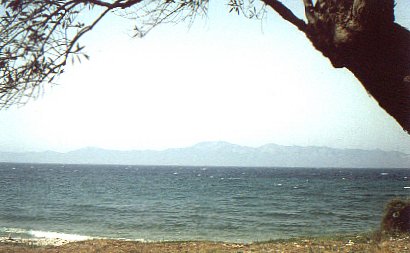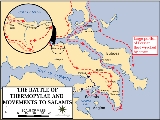
Battle of Artemisium

Encyclopedia
The Battle of Artemisium was a series of naval engagements over three days during the second Persian invasion of Greece
. The battle took place simultaneously with the more famous land battle at Thermopylae
, in August or September 480 BC, off the coast of Euboea
and was fought between an alliance of Greek
city-state
s, including Sparta
, Athens
, Corinth
and others, and the Persian Empire
of Xerxes I.
The Persian invasion was a delayed response to the defeat of the first Persian invasion of Greece
, which had been ended by the Athenian victory at the Battle of Marathon
. Xerxes had amassed a huge army and navy, and set out to conquer all of Greece. The Athenian general Themistocles
proposed that the Allied Greeks block the advance of the Persian army at the pass of Thermopylae
and simultaneously block the Persian navy at the Straits of Artemisium
. An Allied naval force of 271 trireme
s was thus despatched to await the arrival of the Persians.
Approaching Artemisium towards the end of summer, the Persian navy was caught in a gale off the coast of Magnesia
and lost around a third of their 1200 ships. After arriving at Artemisium, the Persians sent a detachment of 200 ships around the coast of Euboea in an attempt to trap the Greeks, but these were caught in another storm and shipwrecked. The main action of the battle took place after two days of smaller engagements. The two sides fought all day, with roughly equal losses; however the smaller Allied fleet could not afford the losses.
After the engagement, the Allies received news of the defeat of the Allied army at Thermopylae. Since their strategy required both Thermopylae and Artemisium to be held, and given their losses, the Allies decided to withdraw to Salamis
. The Persians overran Boeotia
and captured the now-evacuated Athens. However, seeking a decisive victory over the Allied fleet, the Persians were later defeated at the Battle of Salamis
in late 480 BC. Fearing being trapped in Europe, Xerxes withdrew with much of his army to Asia, leaving Mardonius
to complete the conquest of Greece. The following year, however, saw an Allied army decisively defeat the Persians at the Battle of Plataea
, thereby ending the Persian invasion.
. Herodotus, who has been called the 'Father of History', was born in 484 BC in Halicarnassus, Asia Minor (then under Persian overlordship). He wrote his 'Enquiries' (Greek—Historia; English—(The) Histories
) around 440–420 BC, trying to trace the origins of the Greco-Persian Wars, which would still have been relatively recent history (the wars finally ending in 450 BC). Herodotus's approach was entirely novel, and at least in Western society, he does seem to have invented 'history' as we know it. As Holland has it: "For the first time, a chronicler set himself to trace the origins of a conflict not to a past so remote so as to be utterly fabulous, nor to the whims and wishes of some god, nor to a people's claim to manifest destiny, but rather explanations he could verify personally."
Some subsequent ancient historians, despite following in his footsteps, criticised Herodotus, starting with Thucydides
. Nevertheless, Thucydides chose to begin his history where Herodotus left off (at the Siege of Sestos), and therefore evidently felt that Herodotus's history was accurate enough not to need re-writing or correcting. Plutarch
criticised Herodotus in his essay "On The Malignity of Herodotus", describing Herodotus as "Philobarbaros" (barbarian-lover), for not being pro-Greek enough, which suggests that Herodotus might actually have done a reasonable job of being even-handed. A negative view of Herodotus was passed on to Renaissance Europe, though he remained well read. However, since the 19th century his reputation has been dramatically rehabilitated by archaeological finds which have repeatedly confirmed his version of events. The prevailing modern view is that Herodotus generally did a remarkable job in his Historia, but that some of his specific details (particularly troop numbers and dates) should be viewed with skepticism. Nevertheless, there are still some historians who believe Herodotus made up much of his story.
The Sicilian historian Diodorus Siculus
, writing in the 1st century BC in his Bibliotheca Historica
, also provides an account of the Greco-Persian wars, partially derived from the earlier Greek historian Ephorus
. This account is fairly consistent with Herodotus's. The Greco-Persian wars are also described in less detail by a number of other ancient historians including Plutarch, Ctesias of Cnidus, and are referred to by other authors, such as the playwright Aeschylus
. Archaeological evidence, such as the Serpent Column
, also supports some of Herodotus's specific claims.
had supported the unsuccessful Ionian Revolt
against the Persian Empire of Darius I in 499-494 BC. The Persian Empire was still relatively young, and prone to revolts amongst its subject peoples. Moreover, Darius was an usurper, and had spent considerable time extinguishing revolts against his rule. The Ionian revolt threatened the integrity of his empire, and Darius thus vowed to punish those involved (especially those not already part of the empire). Darius also saw the opportunity to expand his empire into the fractious world of Ancient Greece. A preliminary expedition under Mardonius
in 492 BC, to secure the land approaches to Greece, re-conquered Thrace
, and forced Macedon
to become a client kingdom of Persia.
In 491 BC, Darius sent emissaries to all the Greek city-states, asking for a gift of 'earth and water' in token of their submission to him. Having had a demonstration of his power the previous year, the majority of Greek cities duly obliged. In Athens, however, the ambassadors were put on trial and then executed by throwing them in a pit; in Sparta, they were simply thrown down a well. This meant that Sparta was also effectively at war with Persia.
Darius thus put together an amphibious task force under Datis
and Artaphernes
in 490 BC, which attacked Naxos, before receiving the submission of the other Cycladic Islands
. The task force then moved on Eretria, which it besieged and destroyed. Finally, it moved to attack Athens, landing at the bay of Marathon
, where it was met by a heavily outnumbered Athenian army. At the ensuing Battle of Marathon
, the Athenians won a remarkable victory, which resulted in the withdrawal of the Persian army to Asia.
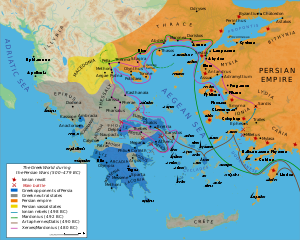 Darius therefore began raising a huge new army with which he meant to completely subjugate Greece; however, in 486 BC, his Egyptian
subjects revolted, indefinitely postponing any Greek expedition. Darius then died whilst preparing to march on Egypt, and the throne of Persia passed to his son Xerxes I. Xerxes crushed the Egyptian revolt, and very quickly re-started the preparations for the invasion of Greece. Since this was to be a full scale invasion, it required long-term planning, stock-piling and conscription. Xerxes decided that the Hellespont would be bridged to allow his army to cross to Europe, and that a canal should be dug across the isthmus of Mount Athos
(rounding which headland, a Persian fleet had been destroyed in 492 BC). These were both feats of exceptional ambition, which would have been beyond any contemporary state. By early 480 BC, the preparations were complete, and the army which Xerxes had mustered at Sardis
marched towards Europe, crossing the Hellespont on two pontoon bridge
s.
The Athenians had also been preparing for war with the Persians since the mid-480s BC, and in 482 BC the decision was taken, under the guidance of the Athenian politician Themistocles
, to build a massive fleet of trireme
s that would be necessary for the Greeks to fight the Persians. However, the Athenians did not have the manpower to fight on land and sea; and therefore combating the Persians would require an alliance of Greek city states. In 481 BC, Xerxes sent ambassadors around Greece asking for earth and water, but making the very deliberate omission of Athens and Sparta. Support thus began to coalesce around these two leading states. A congress of city states met at Corinth
in late autumn of 481 BC, and a confederate alliance of Greek city-states
was formed. It had the power to send envoys asking for assistance and to dispatch troops from the member states to defensive points after joint consultation. This was remarkable for the disjointed Greek world, especially since many of the city-states in attendance were still technically at war with each other.
The 'congress' met again in the spring of 480 BC. A Thessalian
delegation suggested that the allies could muster in the narrow Vale of Tempe
, on the borders of Thessaly, and thereby block Xerxes's advance. A force of 10,000 hoplite
s was dispatched to the Vale of Tempe
, through which they believed the Persian army would have to pass. However, once there, they were warned by Alexander I of Macedon
that the vale could be bypassed through the Sarantoporo Pass, and that the army of Xerxes was overwhelming, the Greeks retreated. Shortly afterwards, they received the news that Xerxes had crossed the Hellespont.
Themistocles therefore suggested a second strategy to the allies. The route to southern Greece (Boeotia, Attica and the Peloponnesus) would require the army of Xerxes to travel through the very narrow pass of Thermopylae
. The pass could easily be blocked by the Greek hoplites, despite the overwhelming numbers of Persians. Furthermore, to prevent the Persians bypassing Thermopylae by sea, the Athenian and allied navies could block the straits of Artemisium. This dual strategy was adopted by the congress. However, the Peloponnesian cities made fall-back plans to defend the Isthmus of Corinth should all else fail, whilst the women and children of Athens were evacuated en masse to the Peloponnesian city of Troezen
.
, probably around late July or the beginning of August. The Allies took up station at Artemisium, most likely beaching their ships at the headland, from which they could be quickly launched as needed. The Allies sent three ships to Skiathos
as scouts to provide warning of the approach of the Persian fleet. Two weeks passed without sight of the Persian fleet. Finally, ten Sidon
ian triremes arrived off Skiathos, and the main Allied fleet was informed by a fire-beacon lit on the island. However, the Allied patrol ships themselves were caught unawares and two were captured, whilst one ran aground. According to Herodotus, in the ensuing confusion, unsure whether or not the beacon heralded the arrival of the whole Persian fleet, as a precaution the whole Allied fleet launched into the straits of Artemisium. Once it became clear that the Persian fleet was not going to arrive that day, they decided to sail to Chalcis
, half-way down on the western coast of Euboea, leaving men on the heights of Euboea
to warn of the actual arrival of the Persian ships.
Historians suggest that the Allies may have misinterpreted the Persian movements and come to the mistaken conclusion that the Persians were sailing east around Skiathos, aiming to sail around the eastern side of Euboea. The signals sent by fire beacons must have been very simplistic, and potentially interpreted wrongly; alternatively, the signallers may have genuinely believed that the Persian fleet was sailing to the east of Skiathos. If the Persians sailed around the outer, eastern side of Euboea, they could head straight to Attica, and thereby cut off the Allied fleet's line of retreat. Furthermore, the Persians had enough ships to attempt to both attack the Straits of Artemisium, and sail around Euboea. The withdrawal to Chalcis therefore gave the Allies the opportunity to escape from the Straits of Euboea if the Persians did travel around the outside of Euboea, but also allowed them to return to Artemisium if necessary. In this context, the watchers left on Euboea could inform the Allies if the Persian fleet did indeed sail east of Euboea. The Allied fleet thus continued to wait at Chalcis. Nevertheless, the Allies, undoubtedly anxious about facing a Persian fleet which outnumbered them so comprehensively, may have somewhat overeacted.
 Around ten days later, the Persian army arrived at Thermopylae, and the Allies at Chalcis were informed by a ship, captained by Abronchius, which had been appointed to liase between the army and the fleet. However, there was still no sign of the Persian fleet, and the first day the Persians spent at Thermopylae passed without them launching an attack. The next day, the Persian fleet finally drew near to Artemisium, heading for the Gap of Skiathos (between the coast of Magnesia
and Skiathos
), when a summer gale (a 'Hellesponter' - probably a north-easterly storm) broke, driving the Persian fleet onto the mountainous coast. The storm lasted two days, wrecking approximately one third of the Persian ships. Meanwhile, at Thermopylae, the Persians had continued to wait for the Greeks to disperse, also choosing not to attack during the storm.
The day after the storm finished, the Allied fleet returned to Artemisium to protect the flank of the army at Thermopylae. The following day, (the fifth since the Persians had arrived at Thermopylae) the Persian army began their attacks on the Allied army at Thermopylae. The same day, the Persian fleet finally appeared through the Gap of Sciathos, and began mooring on the coast opposite Artemisium, at Aphetae. According to Herodotus, 15 Persian ships blundered into the Allied lines, and were captured. Although clearly storm damaged, the Persian fleet still probably outnumbered the Allies by nearly 3:1. As a result, the Allies contemplated withdrawing completely. The Euboeans, not wanting to be abandoned to the Persians, bribed Themistocles to try to ensure that the Allied fleet remained. Since the joint operation at Thermopylae and Artemisium was his strategy in the first place, it is likely this is exactly what Themistocles wanted, and this bribe allowed him in turn to bribe the Spartan and Corinthian admirals, Eurybiades
and Adeimantus
to remain at Artemisium.
Later on that day, a deserter from the Persian fleet, a Greek called Scyllias, swam into the Allied camp. He brought bad news for the Allies — whilst most of the Persian fleet was undergoing repairs, the Persians had detached 200 seaworthy ships to sail around the outer coast of Euboea, to block the escape route of the Allied fleet. The Persians did not want to attack the Allies yet, because they thought the Allies would simply flee, and so they sought to trap them. The Allies resolved to go and meet this detachment, to prevent being trapped, though they planned to leave by nightfall to prevent the Persians becoming aware of their plans.
The Allies most likely realised that this situation presented them with an opportunity to destroy an isolated part of the Persian fleet. Herodotus is not clear on where the Allies planned to meet this detachment, only that they resolved to do so. One possibility is that they planned to sail down the Straits of Euboea, and hope that the other Allied ships, patrolling the coast of Attica,[Note 1] followed the Persians as they entered the Straits of Euboea from the south; then the Persians might themselves be caught in a trap. Alternatively, the Allies may have planned to ambush the detachment as it passed by Artemisium, on its journey from Aphetae. Either way, they decided to make a demonstration towards the Persian lines during what remained of the day, to convince the Persians that they were planning to stay at Artemisium. Herodotus also suggests that this was an opportunity for them to assess Persian seamanship and tactics. The Allies probably waited until late afternoon so that there was little chance of being drawn into a full scale engagement; they did not want to suffer casualties before sailing to meet to the Persian detachment. These decisions finally led to the beginning of the battle.
Some modern scholars have accepted these numbers, especially since the ancient sources are unusually consistent on this point. Other authors reject this number, with 1,207 being seen as more of a reference to the combined Greek fleet in the Iliad
, and generally claim that the Persians could have launched no more than around 600 warships into the Aegean.
, other ships are all Triremes):
The Athenians had been building up a large fleet since 483 BC, ostensibly to help win them in their ongoing conflict with Aegina. However, it is probable this build up, made under the guidance of Themistocles, was also made with a future conflict with the Persians in mind. Although the Athenians initially requested command of the Allied fleet, they allowed command of the fleet to be given to Eurybiades
of Sparta, in order to preserve the unity of the force.
.
The Persians were at a significant tactical advantage, outnumbering the Allies and having "better sailing" ships. The "better sailing" that Herodotus mentions was probably due to the superior seamanship of the crews; most of the Athenian ships (and therefore the majority of the fleet) were newly built, and had inexperienced crews. The most common naval tactics in the Mediterranean area at the time were ramming (triremes were equipped with a ram at the bows), or boarding by ship-borne marines (which essentially turned a sea battle into a land one). The Persians and Asiatic Greeks had by this time begun to use a manoeuver known as diekplous. It is not entirely clear what this was, but it probably involved sailing into gaps between enemy ships and then ramming them in the side. This maneuver would have required skilled sailing, and therefore the Persians would have been more likely to employ it. The Allies however, developed tactics specifically to counter this.
Herodotus suggests that the Allied ships were heavier, and by implication less maneuverable. Their weight would further reduce the likelihood of the Allied ships employing the diekplous. The source of this heaviness is uncertain; possibly the Allied ships were bulkier in construction. Another suggestion is that the heaviness was caused by the weight of fully armoured hoplite marines. The Allies may have had extra marines on board if their ships were less maneuverable, since boarding would then be the main tactic available to them (at the cost of making the ships even heavier). Indeed, Herodotus refers to the Greeks capturing ships, rather than sinking them.
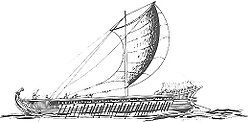 When the Persians saw the Allied fleet rowing towards them, they decided to seize the opportunity to attack, even though it was late in the day, as they thought they would win an easy victory. They quickly advanced on the much smaller Allied fleet. However, the Allies had come up with a tactic for this situation, where they turned their "bows on to the barbarians, [and] they drew their sterns together in the middle". This is usually taken to mean that they formed into a circle, with their rams pointing outwards; Thucydides reports that in the Peloponnesian War
, Peloponnesian fleets twice adopted a circular formation, with their sterns together. However, Herodotus does not actually use the word circle, and Lazenby points out the difficulty of forming a circle of 250 ships (the Peloponnesian fleets had 30–40 ships). It is thus possible the Allies formed into more of a crescent formation, with the wings drawn back to prevent the Persian ships sailing around the Allied line. Whatever the case, it seems likely that this maneuver was intended to negate the superior Persian seamanship, and perhaps specifically the use of diekplous.
Having assumed this formation upon the giving of a prearranged signal, the Allied ships moved suddenly outwards from this position at a second signal, rowing into the Persian ships and catching them off guard. Their superior seamanship negated, the Persians came off worst from the encounter with 30 of their ships captured or sunk. During the battle a Greek ship, captained by Antidorus of Lemnos
, defected to the Allies. Nightfall then ended the battle, with the Allies having fared better than they possibly expected to.
During the night, another storm broke (this time probably a thunder-storm, possibly with a south easterly wind), preventing the Allies from setting off southwards to counter the Persian detachment sent around the outside of Euboea. However, the storm also hit the Persian detachment of ships, driving them off course and onto the rocky coast of 'the Hollows' of Euboea. This part of the Persian fleet was thus also shipwrecked, losing most of the ships.
Again waiting until late afternoon, the Allies took the opportunity to attack a patrol of Cilician ships, destroying them, before retreating as night fell. These ships were possibly survivors of the wrecked detachment sent around Euboea, or were perhaps anchored in an isolated harbour.
Returning to Artemisium, the Allies saw that they would probably not be able to hold the line for another day, such were their losses. They thus debated whether they should withdraw from Artemisium, whilst they awaited news from Thermopylae. Themistocles ordered the men to slaughter and barbecue the flocks of the Euboeans, so that they would not fall into Persian hands. Abronchius arrived on the liaison ship from Thermopylae and told the Allies of the destruction of the Allied rearguard at Thermopylae. Since holding the Straits of Artemisium now no longer held any strategic purpose, and given their losses, the Allies decided to evacuate immediately.
, but did not at first believe it. They sent some ships to see if this was the case, and finding that it was, the whole fleet set sail for Artemisium in the morning. The Persians then sailed on to Histiaea and sacked the surrounding region.
The Allied fleet sailed to Salamis
, off the coast of Attica, to assist with the evacuation of the remaining Athenians. En route, Themistocles left inscriptions addressed to the Ionia
n Greek crews of the Persian fleet on all springs of water that they might stop at, asking them to defect to the Allied cause:
Following Thermopylae, the Persian army burned and sacked the Boeotian cities which had not submitted to the Persians, Plataea
and Thespiae
, before marching on the now evacuated city of Athens.
Meanwhile, the Allies (for the most part Peloponnesian) prepared to defend the Isthmus of Corinth
, demolishing the single road that led through it, and building a wall across it. As at Thermopylae, to make this an effective strategy required the Allied navy to stage a simultaneous blockade, barring the passage of the Persian navy across the Saronic Gulf
, so that troops could not be landed directly on the Peloponnese. However, instead of a mere blockade, Themistocles persuaded the Allies to seek a decisive victory against the Persian fleet. Luring the Persian navy into the Straits of Salamis in September, the Allied fleet was able to destroy much of the Persian fleet, which essentially ended the threat to the Peloponnese.
Fearing that the Greeks might attack the bridges across the Hellespont and trap his army in Europe, Xerxes retreated with much of the army back to Asia. He left a hand picked force under Mardonius
to complete the conquest the following year. However, under pressure from the Athenians, the Peloponnesian Allies eventually agreed to try to force Mardonius to battle, and marched on Attica. Mardonius retreated to Boeotia to lure the Greeks into open terrain and the two sides eventually met near the city of Plataea. There, at the Battle of Plataea
in August 479 BC, the Greek army won a decisive victory, destroying much of the Persian army, and ending the invasion of Greece. Meanwhile, at the near-simultaneous naval Battle of Mycale
the Greeks destroyed much of the remaining Persian fleet, thereby reducing the threat of further invasions.
Nevertheless, in the wider context of the Greco-Persian wars, it was a very significant battle for the Allies. The Allies had demonstrated to themselves that they could stand up to the Persian navy, even having the better of some encounters. For many of the Allied crews, it was their first taste of battle, and the experience gained was invaluable at the forthcoming Battle of Salamis. Moreover, fighting the Persians at Artemisium allowed the Greek admirals to see how the Persian fleet performed, and gave them insights into how it might be beaten. In addition, the events before and during Artemisium were crucial in cutting down the size of the Persian fleet (even if this was not all due to military action), meaning that the odds faced by the Allies at the Battle of Salamis were not overwhelming. As the poet Pindar
put it, Artemisium was "where the sons of the Athenians laid the shining foundation-stone of freedom".
Second Persian invasion of Greece
The second Persian invasion of Greece occurred during the Greco-Persian Wars, as King Xerxes I of Persia sought to conquer all of Greece. The invasion was a direct, if delayed, response to the defeat of the first Persian invasion of Greece at the Battle of Marathon which ended Darius I's attempts...
. The battle took place simultaneously with the more famous land battle at Thermopylae
Battle of Thermopylae
The Battle of Thermopylae was fought between an alliance of Greek city-states, led by King Leonidas of Sparta, and the Persian Empire of Xerxes I over the course of three days, during the second Persian invasion of Greece. It took place simultaneously with the naval battle at Artemisium, in August...
, in August or September 480 BC, off the coast of Euboea
Euboea
Euboea is the second largest Greek island in area and population, after Crete. The narrow Euripus Strait separates it from Boeotia in mainland Greece. In general outline it is a long and narrow, seahorse-shaped island; it is about long, and varies in breadth from to...
and was fought between an alliance of Greek
Ancient Greece
Ancient Greece is a civilization belonging to a period of Greek history that lasted from the Archaic period of the 8th to 6th centuries BC to the end of antiquity. Immediately following this period was the beginning of the Early Middle Ages and the Byzantine era. Included in Ancient Greece is the...
city-state
City-state
A city-state is an independent or autonomous entity whose territory consists of a city which is not administered as a part of another local government.-Historical city-states:...
s, including Sparta
Sparta
Sparta or Lacedaemon, was a prominent city-state in ancient Greece, situated on the banks of the River Eurotas in Laconia, in south-eastern Peloponnese. It emerged as a political entity around the 10th century BC, when the invading Dorians subjugated the local, non-Dorian population. From c...
, Athens
History of Athens
Athens is one of the oldest named cities in the world, having been continuously inhabited for at least 7000 years. Situated in southern Europe, Athens became the leading city of Ancient Greece in the first millennium BCE and its cultural achievements during the 5th century BCE laid the foundations...
, Corinth
Corinth
Corinth is a city and former municipality in Corinthia, Peloponnese, Greece. Since the 2011 local government reform it is part of the municipality Corinth, of which it is the seat and a municipal unit...
and others, and the Persian Empire
Achaemenid Empire
The Achaemenid Empire , sometimes known as First Persian Empire and/or Persian Empire, was founded in the 6th century BCE by Cyrus the Great who overthrew the Median confederation...
of Xerxes I.
The Persian invasion was a delayed response to the defeat of the first Persian invasion of Greece
First Persian invasion of Greece
The first Persian invasion of Greece, during the Persian Wars, began in 492 BCE, and ended with the decisive Athenian victory at the Battle of Marathon in 490 BCE. The invasion, consisting of two distinct campaigns, was ordered by the Persian king Darius I primarily in order to punish the...
, which had been ended by the Athenian victory at the Battle of Marathon
Battle of Marathon
The Battle of Marathon took place in 490 BC, during the first Persian invasion of Greece. It was fought between the citizens of Athens, aided by Plataea, and a Persian force commanded by Datis and Artaphernes. It was the culmination of the first attempt by Persia, under King Darius I, to subjugate...
. Xerxes had amassed a huge army and navy, and set out to conquer all of Greece. The Athenian general Themistocles
Themistocles
Themistocles ; c. 524–459 BC, was an Athenian politician and a general. He was one of a new breed of politicians who rose to prominence in the early years of the Athenian democracy, along with his great rival Aristides...
proposed that the Allied Greeks block the advance of the Persian army at the pass of Thermopylae
Thermopylae
Thermopylae is a location in Greece where a narrow coastal passage existed in antiquity. It derives its name from its hot sulphur springs. "Hot gates" is also "the place of hot springs and cavernous entrances to Hades"....
and simultaneously block the Persian navy at the Straits of Artemisium
Artemisium
Artemisium is a cape north of Euboea, Greece. The legendary hollow cast bronze statue of a debatable Zeus or Poseidon was found off this cape in a sunken ship.-See also:* Temple of Artemis...
. An Allied naval force of 271 trireme
Trireme
A trireme was a type of galley, a Hellenistic-era warship that was used by the ancient maritime civilizations of the Mediterranean, especially the Phoenicians, ancient Greeks and Romans.The trireme derives its name from its three rows of oars on each side, manned with one man per oar...
s was thus despatched to await the arrival of the Persians.
Approaching Artemisium towards the end of summer, the Persian navy was caught in a gale off the coast of Magnesia
Magnesia Prefecture
Magnesia Prefecture was one of the prefectures of Greece. Its capital was Volos. It was established in 1899 from the Larissa Prefecture. The prefecture was disbanded on 1 January 2011 by the Kallikratis programme, and split into the peripheral units of Magnesia and the Sporades.The toponym is...
and lost around a third of their 1200 ships. After arriving at Artemisium, the Persians sent a detachment of 200 ships around the coast of Euboea in an attempt to trap the Greeks, but these were caught in another storm and shipwrecked. The main action of the battle took place after two days of smaller engagements. The two sides fought all day, with roughly equal losses; however the smaller Allied fleet could not afford the losses.
After the engagement, the Allies received news of the defeat of the Allied army at Thermopylae. Since their strategy required both Thermopylae and Artemisium to be held, and given their losses, the Allies decided to withdraw to Salamis
Salamis Island
Salamis , is the largest Greek island in the Saronic Gulf, about 1 nautical mile off-coast from Piraeus and about 16 km west of Athens. The chief city, Salamina , lies in the west-facing core of the crescent on Salamis Bay, which opens into the Saronic Gulf...
. The Persians overran Boeotia
Boeotia
Boeotia, also spelled Beotia and Bœotia , is one of the regional units of Greece. It is part of the region of Central Greece. It was also a region of ancient Greece. Its capital is Livadeia, the second largest city being Thebes.-Geography:...
and captured the now-evacuated Athens. However, seeking a decisive victory over the Allied fleet, the Persians were later defeated at the Battle of Salamis
Battle of Salamis
The Battle of Salamis was fought between an Alliance of Greek city-states and the Persian Empire in September 480 BCE, in the straits between the mainland and Salamis, an island in the Saronic Gulf near Athens...
in late 480 BC. Fearing being trapped in Europe, Xerxes withdrew with much of his army to Asia, leaving Mardonius
Mardonius
Mardonius was a leading Persian military commander during the Persian Wars with Greece in the early 5th century BC.-Early years:Mardonius was the son of Gobryas, a Persian nobleman who had assisted the Achaemenid prince Darius when he claimed the throne...
to complete the conquest of Greece. The following year, however, saw an Allied army decisively defeat the Persians at the Battle of Plataea
Battle of Plataea
The Battle of Plataea was the final land battle during the second Persian invasion of Greece. It took place in 479 BC near the city of Plataea in Boeotia, and was fought between an alliance of the Greek city-states, including Sparta, Athens, Corinth and Megara, and the Persian Empire of Xerxes...
, thereby ending the Persian invasion.
Sources
The main source for the Greco-Persian Wars is the Greek historian HerodotusHerodotus
Herodotus was an ancient Greek historian who was born in Halicarnassus, Caria and lived in the 5th century BC . He has been called the "Father of History", and was the first historian known to collect his materials systematically, test their accuracy to a certain extent and arrange them in a...
. Herodotus, who has been called the 'Father of History', was born in 484 BC in Halicarnassus, Asia Minor (then under Persian overlordship). He wrote his 'Enquiries' (Greek—Historia; English—(The) Histories
Histories (Herodotus)
The Histories of Herodotus is considered one of the seminal works of history in Western literature. Written from the 450s to the 420s BC in the Ionic dialect of classical Greek, The Histories serves as a record of the ancient traditions, politics, geography, and clashes of various cultures that...
) around 440–420 BC, trying to trace the origins of the Greco-Persian Wars, which would still have been relatively recent history (the wars finally ending in 450 BC). Herodotus's approach was entirely novel, and at least in Western society, he does seem to have invented 'history' as we know it. As Holland has it: "For the first time, a chronicler set himself to trace the origins of a conflict not to a past so remote so as to be utterly fabulous, nor to the whims and wishes of some god, nor to a people's claim to manifest destiny, but rather explanations he could verify personally."
Some subsequent ancient historians, despite following in his footsteps, criticised Herodotus, starting with Thucydides
Thucydides
Thucydides was a Greek historian and author from Alimos. His History of the Peloponnesian War recounts the 5th century BC war between Sparta and Athens to the year 411 BC...
. Nevertheless, Thucydides chose to begin his history where Herodotus left off (at the Siege of Sestos), and therefore evidently felt that Herodotus's history was accurate enough not to need re-writing or correcting. Plutarch
Plutarch
Plutarch then named, on his becoming a Roman citizen, Lucius Mestrius Plutarchus , c. 46 – 120 AD, was a Greek historian, biographer, essayist, and Middle Platonist known primarily for his Parallel Lives and Moralia...
criticised Herodotus in his essay "On The Malignity of Herodotus", describing Herodotus as "Philobarbaros" (barbarian-lover), for not being pro-Greek enough, which suggests that Herodotus might actually have done a reasonable job of being even-handed. A negative view of Herodotus was passed on to Renaissance Europe, though he remained well read. However, since the 19th century his reputation has been dramatically rehabilitated by archaeological finds which have repeatedly confirmed his version of events. The prevailing modern view is that Herodotus generally did a remarkable job in his Historia, but that some of his specific details (particularly troop numbers and dates) should be viewed with skepticism. Nevertheless, there are still some historians who believe Herodotus made up much of his story.
The Sicilian historian Diodorus Siculus
Diodorus Siculus
Diodorus Siculus was a Greek historian who flourished between 60 and 30 BC. According to Diodorus' own work, he was born at Agyrium in Sicily . With one exception, antiquity affords no further information about Diodorus' life and doings beyond what is to be found in his own work, Bibliotheca...
, writing in the 1st century BC in his Bibliotheca Historica
Bibliotheca historica
Bibliotheca historica , is a work of universal history by Diodorus Siculus. It consisted of forty books, which were divided into three sections. The first six books are geographical in theme, and describe the history and culture of Egypt , of Mesopotamia, India, Scythia, and Arabia , of North...
, also provides an account of the Greco-Persian wars, partially derived from the earlier Greek historian Ephorus
Ephorus
Ephorus or Ephoros , of Cyme in Aeolia, in Asia Minor, was an ancient Greek historian. Information on his biography is limited; he was the father of Demophilus, who followed in his footsteps as a historian, and to Plutarch's claim that Ephorus declined Alexander the Great's offer to join him on his...
. This account is fairly consistent with Herodotus's. The Greco-Persian wars are also described in less detail by a number of other ancient historians including Plutarch, Ctesias of Cnidus, and are referred to by other authors, such as the playwright Aeschylus
Aeschylus
Aeschylus was the first of the three ancient Greek tragedians whose work has survived, the others being Sophocles and Euripides, and is often described as the father of tragedy. His name derives from the Greek word aiskhos , meaning "shame"...
. Archaeological evidence, such as the Serpent Column
Serpent Column
The Serpent Column — also known as the Serpentine Column, Delphi Tripod or Plataean Tripod — is an ancient bronze column at the Hippodrome of Constantinople in what is now Istanbul, Turkey...
, also supports some of Herodotus's specific claims.
Background
The Greek city-states of Athens and EretriaEretria
Erétria was a polis in Ancient Greece, located on the western coast of the island of Euboea, south of Chalcis, facing the coast of Attica across the narrow Euboean Gulf. Eretria was an important Greek polis in the 6th/5th century BC. However, it lost its importance already in antiquity...
had supported the unsuccessful Ionian Revolt
Ionian Revolt
The Ionian Revolt, and associated revolts in Aeolis, Doris, Cyprus and Caria, were military rebellions by several regions of Asia Minor against Persian rule, lasting from 499 BC to 493 BC...
against the Persian Empire of Darius I in 499-494 BC. The Persian Empire was still relatively young, and prone to revolts amongst its subject peoples. Moreover, Darius was an usurper, and had spent considerable time extinguishing revolts against his rule. The Ionian revolt threatened the integrity of his empire, and Darius thus vowed to punish those involved (especially those not already part of the empire). Darius also saw the opportunity to expand his empire into the fractious world of Ancient Greece. A preliminary expedition under Mardonius
Mardonius
Mardonius was a leading Persian military commander during the Persian Wars with Greece in the early 5th century BC.-Early years:Mardonius was the son of Gobryas, a Persian nobleman who had assisted the Achaemenid prince Darius when he claimed the throne...
in 492 BC, to secure the land approaches to Greece, re-conquered Thrace
Thrace
Thrace is a historical and geographic area in southeast Europe. As a geographical concept, Thrace designates a region bounded by the Balkan Mountains on the north, Rhodope Mountains and the Aegean Sea on the south, and by the Black Sea and the Sea of Marmara on the east...
, and forced Macedon
Macedon
Macedonia or Macedon was an ancient kingdom, centered in the northeastern part of the Greek peninsula, bordered by Epirus to the west, Paeonia to the north, the region of Thrace to the east and Thessaly to the south....
to become a client kingdom of Persia.
In 491 BC, Darius sent emissaries to all the Greek city-states, asking for a gift of 'earth and water' in token of their submission to him. Having had a demonstration of his power the previous year, the majority of Greek cities duly obliged. In Athens, however, the ambassadors were put on trial and then executed by throwing them in a pit; in Sparta, they were simply thrown down a well. This meant that Sparta was also effectively at war with Persia.
Darius thus put together an amphibious task force under Datis
Datis
For other uses of the word Dati, see Dati .Datis or Datus was a Median admiral who served the Persian Empire, under Darius the Great...
and Artaphernes
Artaphernes (son of Artaphernes)
Artaphernes, son of Artaphernes, was the nephew of Darius the Great, and a general of the Achaemenid Empire.He was appointed, together with Datis, to take command of the expedition sent by Darius to punish Athens and Eretria for their support for the Ionian Revolt. Artaphernes and Datis besieged...
in 490 BC, which attacked Naxos, before receiving the submission of the other Cycladic Islands
Cyclades
The Cyclades is a Greek island group in the Aegean Sea, south-east of the mainland of Greece; and a former administrative prefecture of Greece. They are one of the island groups which constitute the Aegean archipelago. The name refers to the islands around the sacred island of Delos...
. The task force then moved on Eretria, which it besieged and destroyed. Finally, it moved to attack Athens, landing at the bay of Marathon
Marathon, Greece
Marathon is a town in Greece, the site of the battle of Marathon in 490 BC, in which the heavily outnumbered Athenian army defeated the Persians. The tumulus or burial mound for the 192 Athenian dead that was erected near the battlefield remains a feature of the coastal plain...
, where it was met by a heavily outnumbered Athenian army. At the ensuing Battle of Marathon
Battle of Marathon
The Battle of Marathon took place in 490 BC, during the first Persian invasion of Greece. It was fought between the citizens of Athens, aided by Plataea, and a Persian force commanded by Datis and Artaphernes. It was the culmination of the first attempt by Persia, under King Darius I, to subjugate...
, the Athenians won a remarkable victory, which resulted in the withdrawal of the Persian army to Asia.
Ancient Egypt
Ancient Egypt was an ancient civilization of Northeastern Africa, concentrated along the lower reaches of the Nile River in what is now the modern country of Egypt. Egyptian civilization coalesced around 3150 BC with the political unification of Upper and Lower Egypt under the first pharaoh...
subjects revolted, indefinitely postponing any Greek expedition. Darius then died whilst preparing to march on Egypt, and the throne of Persia passed to his son Xerxes I. Xerxes crushed the Egyptian revolt, and very quickly re-started the preparations for the invasion of Greece. Since this was to be a full scale invasion, it required long-term planning, stock-piling and conscription. Xerxes decided that the Hellespont would be bridged to allow his army to cross to Europe, and that a canal should be dug across the isthmus of Mount Athos
Mount Athos
Mount Athos is a mountain and peninsula in Macedonia, Greece. A World Heritage Site, it is home to 20 Eastern Orthodox monasteries and forms a self-governed monastic state within the sovereignty of the Hellenic Republic. Spiritually, Mount Athos comes under the direct jurisdiction of the...
(rounding which headland, a Persian fleet had been destroyed in 492 BC). These were both feats of exceptional ambition, which would have been beyond any contemporary state. By early 480 BC, the preparations were complete, and the army which Xerxes had mustered at Sardis
Sardis
Sardis or Sardes was an ancient city at the location of modern Sart in Turkey's Manisa Province...
marched towards Europe, crossing the Hellespont on two pontoon bridge
Pontoon bridge
A pontoon bridge or floating bridge is a bridge that floats on water and in which barge- or boat-like pontoons support the bridge deck and its dynamic loads. While pontoon bridges are usually temporary structures, some are used for long periods of time...
s.
The Athenians had also been preparing for war with the Persians since the mid-480s BC, and in 482 BC the decision was taken, under the guidance of the Athenian politician Themistocles
Themistocles
Themistocles ; c. 524–459 BC, was an Athenian politician and a general. He was one of a new breed of politicians who rose to prominence in the early years of the Athenian democracy, along with his great rival Aristides...
, to build a massive fleet of trireme
Trireme
A trireme was a type of galley, a Hellenistic-era warship that was used by the ancient maritime civilizations of the Mediterranean, especially the Phoenicians, ancient Greeks and Romans.The trireme derives its name from its three rows of oars on each side, manned with one man per oar...
s that would be necessary for the Greeks to fight the Persians. However, the Athenians did not have the manpower to fight on land and sea; and therefore combating the Persians would require an alliance of Greek city states. In 481 BC, Xerxes sent ambassadors around Greece asking for earth and water, but making the very deliberate omission of Athens and Sparta. Support thus began to coalesce around these two leading states. A congress of city states met at Corinth
Corinth
Corinth is a city and former municipality in Corinthia, Peloponnese, Greece. Since the 2011 local government reform it is part of the municipality Corinth, of which it is the seat and a municipal unit...
in late autumn of 481 BC, and a confederate alliance of Greek city-states
History of Greece
The history of Greece encompasses the history of the territory of the modern state of Greece, as well as that of the Greek people and the areas they ruled historically. The scope of Greek habitation and rule has varied much through the ages, and, as a result, the history of Greece is similarly...
was formed. It had the power to send envoys asking for assistance and to dispatch troops from the member states to defensive points after joint consultation. This was remarkable for the disjointed Greek world, especially since many of the city-states in attendance were still technically at war with each other.
The 'congress' met again in the spring of 480 BC. A Thessalian
Thessaly
Thessaly is a traditional geographical region and an administrative region of Greece, comprising most of the ancient region of the same name. Before the Greek Dark Ages, Thessaly was known as Aeolia, and appears thus in Homer's Odyssey....
delegation suggested that the allies could muster in the narrow Vale of Tempe
Vale of Tempe
The Vale of Tempe is a gorge in northern Thessaly, Greece, located between Olympus to the north and Ossa to the south. The valley is 10 kilometers long and as narrow as 25 meters in places, with cliffs nearly 500 meters high, and through it flows the Pineios River on its way to the Aegean Sea...
, on the borders of Thessaly, and thereby block Xerxes's advance. A force of 10,000 hoplite
Hoplite
A hoplite was a citizen-soldier of the Ancient Greek city-states. Hoplites were primarily armed as spearmen and fought in a phalanx formation. The word "hoplite" derives from "hoplon" , the type of the shield used by the soldiers, although, as a word, "hopla" could also denote weapons held or even...
s was dispatched to the Vale of Tempe
Vale of Tempe
The Vale of Tempe is a gorge in northern Thessaly, Greece, located between Olympus to the north and Ossa to the south. The valley is 10 kilometers long and as narrow as 25 meters in places, with cliffs nearly 500 meters high, and through it flows the Pineios River on its way to the Aegean Sea...
, through which they believed the Persian army would have to pass. However, once there, they were warned by Alexander I of Macedon
Alexander I of Macedon
- Biography :Alexander was the son of Amyntas I and Queen Eurydice.According to Herodotus, he was unfriendly to Persia, and had the envoys of Darius I killed when they arrived at the court of his father during the Ionian Revolt...
that the vale could be bypassed through the Sarantoporo Pass, and that the army of Xerxes was overwhelming, the Greeks retreated. Shortly afterwards, they received the news that Xerxes had crossed the Hellespont.
Themistocles therefore suggested a second strategy to the allies. The route to southern Greece (Boeotia, Attica and the Peloponnesus) would require the army of Xerxes to travel through the very narrow pass of Thermopylae
Thermopylae
Thermopylae is a location in Greece where a narrow coastal passage existed in antiquity. It derives its name from its hot sulphur springs. "Hot gates" is also "the place of hot springs and cavernous entrances to Hades"....
. The pass could easily be blocked by the Greek hoplites, despite the overwhelming numbers of Persians. Furthermore, to prevent the Persians bypassing Thermopylae by sea, the Athenian and allied navies could block the straits of Artemisium. This dual strategy was adopted by the congress. However, the Peloponnesian cities made fall-back plans to defend the Isthmus of Corinth should all else fail, whilst the women and children of Athens were evacuated en masse to the Peloponnesian city of Troezen
Troezen
Troezen is a small town and a former municipality in the northeastern Peloponnese, Greece. Since the 2011 local government reform it is part of the municipality Troizinia, of which it is a municipal unit....
.
Prelude
The Allied fleet sailed north to Cape Artemisium once it became known that the Persian army was advancing along the coast past Mount OlympusMount Olympus
Mount Olympus is the highest mountain in Greece, located on the border between Thessaly and Macedonia, about 100 kilometres away from Thessaloniki, Greece's second largest city. Mount Olympus has 52 peaks. The highest peak Mytikas, meaning "nose", rises to 2,917 metres...
, probably around late July or the beginning of August. The Allies took up station at Artemisium, most likely beaching their ships at the headland, from which they could be quickly launched as needed. The Allies sent three ships to Skiathos
Skiathos
Skiathos is a small Greek island in the northwest Aegean Sea. Skiathos is the westernmost island in the Northern Sporades group, east of the Pelion peninsula in Magnesia on the mainland, and west of the island of Skopelos.-Geography:...
as scouts to provide warning of the approach of the Persian fleet. Two weeks passed without sight of the Persian fleet. Finally, ten Sidon
Sidon
Sidon or Saïda is the third-largest city in Lebanon. It is located in the South Governorate of Lebanon, on the Mediterranean coast, about 40 km north of Tyre and 40 km south of the capital Beirut. In Genesis, Sidon is the son of Canaan the grandson of Noah...
ian triremes arrived off Skiathos, and the main Allied fleet was informed by a fire-beacon lit on the island. However, the Allied patrol ships themselves were caught unawares and two were captured, whilst one ran aground. According to Herodotus, in the ensuing confusion, unsure whether or not the beacon heralded the arrival of the whole Persian fleet, as a precaution the whole Allied fleet launched into the straits of Artemisium. Once it became clear that the Persian fleet was not going to arrive that day, they decided to sail to Chalcis
Chalcis
Chalcis or Chalkida , the chief town of the island of Euboea in Greece, is situated on the strait of the Evripos at its narrowest point. The name is preserved from antiquity and is derived from the Greek χαλκός , though there is no trace of any mines in the area...
, half-way down on the western coast of Euboea, leaving men on the heights of Euboea
Euboea
Euboea is the second largest Greek island in area and population, after Crete. The narrow Euripus Strait separates it from Boeotia in mainland Greece. In general outline it is a long and narrow, seahorse-shaped island; it is about long, and varies in breadth from to...
to warn of the actual arrival of the Persian ships.
Historians suggest that the Allies may have misinterpreted the Persian movements and come to the mistaken conclusion that the Persians were sailing east around Skiathos, aiming to sail around the eastern side of Euboea. The signals sent by fire beacons must have been very simplistic, and potentially interpreted wrongly; alternatively, the signallers may have genuinely believed that the Persian fleet was sailing to the east of Skiathos. If the Persians sailed around the outer, eastern side of Euboea, they could head straight to Attica, and thereby cut off the Allied fleet's line of retreat. Furthermore, the Persians had enough ships to attempt to both attack the Straits of Artemisium, and sail around Euboea. The withdrawal to Chalcis therefore gave the Allies the opportunity to escape from the Straits of Euboea if the Persians did travel around the outside of Euboea, but also allowed them to return to Artemisium if necessary. In this context, the watchers left on Euboea could inform the Allies if the Persian fleet did indeed sail east of Euboea. The Allied fleet thus continued to wait at Chalcis. Nevertheless, the Allies, undoubtedly anxious about facing a Persian fleet which outnumbered them so comprehensively, may have somewhat overeacted.
Magnesia Prefecture
Magnesia Prefecture was one of the prefectures of Greece. Its capital was Volos. It was established in 1899 from the Larissa Prefecture. The prefecture was disbanded on 1 January 2011 by the Kallikratis programme, and split into the peripheral units of Magnesia and the Sporades.The toponym is...
and Skiathos
Skiathos
Skiathos is a small Greek island in the northwest Aegean Sea. Skiathos is the westernmost island in the Northern Sporades group, east of the Pelion peninsula in Magnesia on the mainland, and west of the island of Skopelos.-Geography:...
), when a summer gale (a 'Hellesponter' - probably a north-easterly storm) broke, driving the Persian fleet onto the mountainous coast. The storm lasted two days, wrecking approximately one third of the Persian ships. Meanwhile, at Thermopylae, the Persians had continued to wait for the Greeks to disperse, also choosing not to attack during the storm.
The day after the storm finished, the Allied fleet returned to Artemisium to protect the flank of the army at Thermopylae. The following day, (the fifth since the Persians had arrived at Thermopylae) the Persian army began their attacks on the Allied army at Thermopylae. The same day, the Persian fleet finally appeared through the Gap of Sciathos, and began mooring on the coast opposite Artemisium, at Aphetae. According to Herodotus, 15 Persian ships blundered into the Allied lines, and were captured. Although clearly storm damaged, the Persian fleet still probably outnumbered the Allies by nearly 3:1. As a result, the Allies contemplated withdrawing completely. The Euboeans, not wanting to be abandoned to the Persians, bribed Themistocles to try to ensure that the Allied fleet remained. Since the joint operation at Thermopylae and Artemisium was his strategy in the first place, it is likely this is exactly what Themistocles wanted, and this bribe allowed him in turn to bribe the Spartan and Corinthian admirals, Eurybiades
Eurybiades
Eurybiades was the Spartan commander in charge of the Greek navy during the Persian Wars.He was the son of Eurycleides, and was chosen as commander in 480 BC because the Peloponnesian city-states led by Sparta, worried about the growing power of Athens, did not want to serve under an Athenian,...
and Adeimantus
Adeimantus of Corinth
Adeimantus of Corinth , son of Ocytus, was the Corinthian commander during the invasion of Greece by Xerxes. Before the Battle of Artemisium he threatened to sail away. He opposed Themistocles with great insolence in the council which the commanders held before the Battle of Salamis...
to remain at Artemisium.
Later on that day, a deserter from the Persian fleet, a Greek called Scyllias, swam into the Allied camp. He brought bad news for the Allies — whilst most of the Persian fleet was undergoing repairs, the Persians had detached 200 seaworthy ships to sail around the outer coast of Euboea, to block the escape route of the Allied fleet. The Persians did not want to attack the Allies yet, because they thought the Allies would simply flee, and so they sought to trap them. The Allies resolved to go and meet this detachment, to prevent being trapped, though they planned to leave by nightfall to prevent the Persians becoming aware of their plans.
The Allies most likely realised that this situation presented them with an opportunity to destroy an isolated part of the Persian fleet. Herodotus is not clear on where the Allies planned to meet this detachment, only that they resolved to do so. One possibility is that they planned to sail down the Straits of Euboea, and hope that the other Allied ships, patrolling the coast of Attica,[Note 1] followed the Persians as they entered the Straits of Euboea from the south; then the Persians might themselves be caught in a trap. Alternatively, the Allies may have planned to ambush the detachment as it passed by Artemisium, on its journey from Aphetae. Either way, they decided to make a demonstration towards the Persian lines during what remained of the day, to convince the Persians that they were planning to stay at Artemisium. Herodotus also suggests that this was an opportunity for them to assess Persian seamanship and tactics. The Allies probably waited until late afternoon so that there was little chance of being drawn into a full scale engagement; they did not want to suffer casualties before sailing to meet to the Persian detachment. These decisions finally led to the beginning of the battle.
Chronology
The exact chronology of the battles of Thermopylae and Artemisium, and their relation to each other is somewhat unclear. The chronology below represents an estimated reconstruction of the time-line, following Lazenby and Holland.| Day | Events |
| -15 | Persian army leaves Therma |
| c. -13 | Persian reconnaissance fleet arrives at Skiathos. Allies retreat to Chalcis. |
| -4 | Persian army arrives at Thermopylae. Persian fleet leaves Therma. |
| -3 | First day of the storm. |
| -2 | Second day of the storm. |
| -1 | Storm ends. Allied fleet returns to Artemisium. |
| 1 | First day of Persian attacks at Thermopylae. Persian fleet arrives at Artemisium. Persian detachment sent around Euboea. First engagement of the Battle of Artemisium. |
| 2 | Second day of both battles. |
| 3 | Third day of both battles. Rearguard at Thermopylae outflanked and destroyed. |
Persian fleet
Herodotus gives a detailed description of the Persian fleet which assembled at Doriskos in spring 480 BC (see table). However, after the fleet was struck the storm off the coast of Magnesia, approximately one third of the fleet was lost. Thus, by Herodotus's reckoning, the Persian fleet would have had approximately 800 triremes at Artemisium.| Region | Region | Region | Number of ships |
||
|---|---|---|---|---|---|
| Phoenicia Phoenicia Phoenicia , was an ancient civilization in Canaan which covered most of the western, coastal part of the Fertile Crescent. Several major Phoenician cities were built on the coastline of the Mediterranean. It was an enterprising maritime trading culture that spread across the Mediterranean from 1550... and Syria Syria Syria , officially the Syrian Arab Republic , is a country in Western Asia, bordering Lebanon and the Mediterranean Sea to the West, Turkey to the north, Iraq to the east, Jordan to the south, and Israel to the southwest.... |
300 | Egypt Ancient Egypt Ancient Egypt was an ancient civilization of Northeastern Africa, concentrated along the lower reaches of the Nile River in what is now the modern country of Egypt. Egyptian civilization coalesced around 3150 BC with the political unification of Upper and Lower Egypt under the first pharaoh... |
200 | Cyprus Cyprus Cyprus , officially the Republic of Cyprus , is a Eurasian island country, member of the European Union, in the Eastern Mediterranean, east of Greece, south of Turkey, west of Syria and north of Egypt. It is the third largest island in the Mediterranean Sea.The earliest known human activity on the... |
150 |
| Cilicia Cilicia In antiquity, Cilicia was the south coastal region of Asia Minor, south of the central Anatolian plateau. It existed as a political entity from Hittite times into the Byzantine empire... |
100 | Ionia Ionia Ionia is an ancient region of central coastal Anatolia in present-day Turkey, the region nearest İzmir, which was historically Smyrna. It consisted of the northernmost territories of the Ionian League of Greek settlements... |
100 | Pontus Pontus Pontus or Pontos is a historical Greek designation for a region on the southern coast of the Black Sea, located in modern-day northeastern Turkey. The name was applied to the coastal region in antiquity by the Greeks who colonized the area, and derived from the Greek name of the Black Sea: Πόντος... |
100 |
| Caria Caria Caria was a region of western Anatolia extending along the coast from mid-Ionia south to Lycia and east to Phrygia. The Ionian and Dorian Greeks colonized the west of it and joined the Carian population in forming Greek-dominated states there... |
70 | Aeolia Aeolis Aeolis or Aeolia was an area that comprised the west and northwestern region of Asia Minor, mostly along the coast, and also several offshore islands , where the Aeolian Greek city-states were located... |
60 | Lycia Lycia Lycia Lycian: Trm̃mis; ) was a region in Anatolia in what are now the provinces of Antalya and Muğla on the southern coast of Turkey. It was a federation of ancient cities in the region and later a province of the Roman Empire... |
50 |
| Pamphylia Pamphylia In ancient geography, Pamphylia was the region in the south of Asia Minor, between Lycia and Cilicia, extending from the Mediterranean to Mount Taurus . It was bounded on the north by Pisidia and was therefore a country of small extent, having a coast-line of only about 75 miles with a breadth of... |
30 | Dorians from Asia Minor Asia Minor Asia Minor is a geographical location at the westernmost protrusion of Asia, also called Anatolia, and corresponds to the western two thirds of the Asian part of Turkey... |
30 | Cyclades | 17 |
| Total | 1207 |
Some modern scholars have accepted these numbers, especially since the ancient sources are unusually consistent on this point. Other authors reject this number, with 1,207 being seen as more of a reference to the combined Greek fleet in the Iliad
Iliad
The Iliad is an epic poem in dactylic hexameters, traditionally attributed to Homer. Set during the Trojan War, the ten-year siege of the city of Troy by a coalition of Greek states, it tells of the battles and events during the weeks of a quarrel between King Agamemnon and the warrior Achilles...
, and generally claim that the Persians could have launched no more than around 600 warships into the Aegean.
Greek fleet
Herodotus claims there were 280 ships in the Greek fleet at the Battle of Artemisium, made up of the following contingents (numbers in parentheses refer to PentecontersPenteconter (ship)
The penteconter, alt. spelling pentekonter, also transliterated as pentecontor or pentekontor was an ancient Greek galley in use since the archaic period....
, other ships are all Triremes):
| City | City | City | Number of ships |
||
|---|---|---|---|---|---|
| Athens Athens Athens , is the capital and largest city of Greece. Athens dominates the Attica region and is one of the world's oldest cities, as its recorded history spans around 3,400 years. Classical Athens was a powerful city-state... |
127 | Corinth | 40 | Aegina Aegina Aegina is one of the Saronic Islands of Greece in the Saronic Gulf, from Athens. Tradition derives the name from Aegina, the mother of Aeacus, who was born in and ruled the island. During ancient times, Aegina was a rival to Athens, the great sea power of the era.-Municipality:The municipality... |
18 |
| Chalcis Chalcis Chalcis or Chalkida , the chief town of the island of Euboea in Greece, is situated on the strait of the Evripos at its narrowest point. The name is preserved from antiquity and is derived from the Greek χαλκός , though there is no trace of any mines in the area... |
20 | Megara Megara Megara is an ancient city in Attica, Greece. It lies in the northern section of the Isthmus of Corinth opposite the island of Salamis, which belonged to Megara in archaic times, before being taken by Athens. Megara was one of the four districts of Attica, embodied in the four mythic sons of King... |
20 | Sicyon Sicyon Sikyon was an ancient Greek city situated in the northern Peloponnesus between Corinth and Achaea on the territory of the present-day prefecture of Corinthia... |
12 |
| Sparta Sparta Sparta or Lacedaemon, was a prominent city-state in ancient Greece, situated on the banks of the River Eurotas in Laconia, in south-eastern Peloponnese. It emerged as a political entity around the 10th century BC, when the invading Dorians subjugated the local, non-Dorian population. From c... |
10 | Epidaurus Epidaurus Epidaurus was a small city in ancient Greece, at the Saronic Gulf. Two modern towns bear the name Epidavros : Palaia Epidavros and Nea Epidavros. Since 2010 they belong to the new municipality of Epidavros, part of the peripheral unit of Argolis... |
8 | Eretria Eretria Erétria was a polis in Ancient Greece, located on the western coast of the island of Euboea, south of Chalcis, facing the coast of Attica across the narrow Euboean Gulf. Eretria was an important Greek polis in the 6th/5th century BC. However, it lost its importance already in antiquity... |
7 |
| Troezen Troezen Troezen is a small town and a former municipality in the northeastern Peloponnese, Greece. Since the 2011 local government reform it is part of the municipality Troizinia, of which it is a municipal unit.... |
5 | Styra Styra Styra is a village and a former municipality on the island Euboea, Greece. Since the 2011 local government reform it is part of the municipality Karystos, of which it is a municipal unit. It is located in the southern part of Euboea, facing the eastern shore of Attica across the South Euboean Gulf... |
2 | Ceos | 2 (2) |
| Opuntian Opuntian Locris Opuntian Locris or Eastern Locris was an ancient Greek region inhabited by the eastern division of the Locrians, the so-called tribe of the Locri Epicnemidii or Locri Opuntii .-Geography:... Locris Locrians The Locrians were an ancient Greek tribe in Greece. The Locrians spoke the Locrian dialect, a Doric-Northwest dialect, which indicates that they may have been relatives of the Dorians. They inhabited the ancient region of Locris in Central Greece.... |
(7) | Total | 271 (9) |
The Athenians had been building up a large fleet since 483 BC, ostensibly to help win them in their ongoing conflict with Aegina. However, it is probable this build up, made under the guidance of Themistocles, was also made with a future conflict with the Persians in mind. Although the Athenians initially requested command of the Allied fleet, they allowed command of the fleet to be given to Eurybiades
Eurybiades
Eurybiades was the Spartan commander in charge of the Greek navy during the Persian Wars.He was the son of Eurycleides, and was chosen as commander in 480 BC because the Peloponnesian city-states led by Sparta, worried about the growing power of Athens, did not want to serve under an Athenian,...
of Sparta, in order to preserve the unity of the force.
Strategic and tactical considerations
Strategically, the Allied mission was simple. The fleet needed to protect the flank of the army at Thermopylae, whilst not being cut off themselves. For the Persians, the strategic situation was equally simple, although with more options. They needed to force their way through either one of Thermopylae or Artemisium (since holding both was necessary for the Allied effort), or to outflank either position. Outflanking the Straits of Artemisium was theoretically much easier than outflanking Thermopylae, by sailing around the east coast of Euboea. The Greek position at Artemisium may have been chosen in order to watch for such attempts; if the narrowness of the channel had been the only determinant, the Allies could have found a better position near the city of HistiaeaOreoi
Oreoi is a village and a former municipality in Euboea, Greece. Since the 2011 local government reform it is part of the municipality Istiaia-Aidipsos, of which it is a municipal unit. Population 3,392 . It is the home of a large marble statue of a bull from a funerary monument of the 4th century...
.
The Persians were at a significant tactical advantage, outnumbering the Allies and having "better sailing" ships. The "better sailing" that Herodotus mentions was probably due to the superior seamanship of the crews; most of the Athenian ships (and therefore the majority of the fleet) were newly built, and had inexperienced crews. The most common naval tactics in the Mediterranean area at the time were ramming (triremes were equipped with a ram at the bows), or boarding by ship-borne marines (which essentially turned a sea battle into a land one). The Persians and Asiatic Greeks had by this time begun to use a manoeuver known as diekplous. It is not entirely clear what this was, but it probably involved sailing into gaps between enemy ships and then ramming them in the side. This maneuver would have required skilled sailing, and therefore the Persians would have been more likely to employ it. The Allies however, developed tactics specifically to counter this.
Herodotus suggests that the Allied ships were heavier, and by implication less maneuverable. Their weight would further reduce the likelihood of the Allied ships employing the diekplous. The source of this heaviness is uncertain; possibly the Allied ships were bulkier in construction. Another suggestion is that the heaviness was caused by the weight of fully armoured hoplite marines. The Allies may have had extra marines on board if their ships were less maneuverable, since boarding would then be the main tactic available to them (at the cost of making the ships even heavier). Indeed, Herodotus refers to the Greeks capturing ships, rather than sinking them.
First day
Peloponnesian War
The Peloponnesian War, 431 to 404 BC, was an ancient Greek war fought by Athens and its empire against the Peloponnesian League led by Sparta. Historians have traditionally divided the war into three phases...
, Peloponnesian fleets twice adopted a circular formation, with their sterns together. However, Herodotus does not actually use the word circle, and Lazenby points out the difficulty of forming a circle of 250 ships (the Peloponnesian fleets had 30–40 ships). It is thus possible the Allies formed into more of a crescent formation, with the wings drawn back to prevent the Persian ships sailing around the Allied line. Whatever the case, it seems likely that this maneuver was intended to negate the superior Persian seamanship, and perhaps specifically the use of diekplous.
Having assumed this formation upon the giving of a prearranged signal, the Allied ships moved suddenly outwards from this position at a second signal, rowing into the Persian ships and catching them off guard. Their superior seamanship negated, the Persians came off worst from the encounter with 30 of their ships captured or sunk. During the battle a Greek ship, captained by Antidorus of Lemnos
Lemnos
Lemnos is an island of Greece in the northern part of the Aegean Sea. Administratively the island forms a separate municipality within the Lemnos peripheral unit, which is part of the North Aegean Periphery. The principal town of the island and seat of the municipality is Myrina...
, defected to the Allies. Nightfall then ended the battle, with the Allies having fared better than they possibly expected to.
During the night, another storm broke (this time probably a thunder-storm, possibly with a south easterly wind), preventing the Allies from setting off southwards to counter the Persian detachment sent around the outside of Euboea. However, the storm also hit the Persian detachment of ships, driving them off course and onto the rocky coast of 'the Hollows' of Euboea. This part of the Persian fleet was thus also shipwrecked, losing most of the ships.
Second day
The following day, which was also the second day of Battle of Thermopylae, the Persian fleet, now recovering from the two storms, declined to attack the Allies, and instead attempted to make the fleet seaworthy again. News of the shipwreck off Euboea reached the Allies that day, as well as a reinforcement of 53 ships from Athens.Again waiting until late afternoon, the Allies took the opportunity to attack a patrol of Cilician ships, destroying them, before retreating as night fell. These ships were possibly survivors of the wrecked detachment sent around Euboea, or were perhaps anchored in an isolated harbour.
Third day
On the third day of the battle the Persian fleet was ready to attack the Allied lines in full force. Seeing the Persian fleet assemble, the Allies attempted to block the Straits of Artemisium as best they could, and waited for the Persians to attack. The Persians formed a semicircle of ships, and tried to enclose the Allied fleet, upon which the Allies rowed forward and joined battle. The battle raged all day long, with the Allies hard put to defend their line. When the fleets finally disengaged at nightfall, both sides had suffered roughly equal losses. However, the smaller Allied fleet could scarcely afford such losses; half the Athenian ships (the largest contingent in the fleet) were damaged or lost.Returning to Artemisium, the Allies saw that they would probably not be able to hold the line for another day, such were their losses. They thus debated whether they should withdraw from Artemisium, whilst they awaited news from Thermopylae. Themistocles ordered the men to slaughter and barbecue the flocks of the Euboeans, so that they would not fall into Persian hands. Abronchius arrived on the liaison ship from Thermopylae and told the Allies of the destruction of the Allied rearguard at Thermopylae. Since holding the Straits of Artemisium now no longer held any strategic purpose, and given their losses, the Allies decided to evacuate immediately.
Aftermath
The Persians were alerted to the withdrawal of the Greeks by a boat from HistiaeaOreoi
Oreoi is a village and a former municipality in Euboea, Greece. Since the 2011 local government reform it is part of the municipality Istiaia-Aidipsos, of which it is a municipal unit. Population 3,392 . It is the home of a large marble statue of a bull from a funerary monument of the 4th century...
, but did not at first believe it. They sent some ships to see if this was the case, and finding that it was, the whole fleet set sail for Artemisium in the morning. The Persians then sailed on to Histiaea and sacked the surrounding region.
The Allied fleet sailed to Salamis
Salamis Island
Salamis , is the largest Greek island in the Saronic Gulf, about 1 nautical mile off-coast from Piraeus and about 16 km west of Athens. The chief city, Salamina , lies in the west-facing core of the crescent on Salamis Bay, which opens into the Saronic Gulf...
, off the coast of Attica, to assist with the evacuation of the remaining Athenians. En route, Themistocles left inscriptions addressed to the Ionia
Ionia
Ionia is an ancient region of central coastal Anatolia in present-day Turkey, the region nearest İzmir, which was historically Smyrna. It consisted of the northernmost territories of the Ionian League of Greek settlements...
n Greek crews of the Persian fleet on all springs of water that they might stop at, asking them to defect to the Allied cause:
"Men of Ionia, that what you are doing is not proper, campaigning against your fathers and wishing to enslave Greece. It would be best if you came on our side. But if this is not possible, at least during the battle stand aside and also beg the CariaCariaCaria was a region of western Anatolia extending along the coast from mid-Ionia south to Lycia and east to Phrygia. The Ionian and Dorian Greeks colonized the west of it and joined the Carian population in forming Greek-dominated states there...
ns to do the same with you. But if you can not do either the one or the other, if you are chained by higher force and you can not defect during the operations, when we come at hand, act purposely as cowards remembering that we are of the same blood and that the first cause of animosity with the barbarians came from you."
Following Thermopylae, the Persian army burned and sacked the Boeotian cities which had not submitted to the Persians, Plataea
Plataea
Plataea or Plataeae was an ancient city, located in Greece in southeastern Boeotia, south of Thebes. It was the location of the Battle of Plataea in 479 BC, in which an alliance of Greek city-states defeated the Persians....
and Thespiae
Thespiae
Thespiae was an ancient Greek city in Boeotia. It stood on level ground commanded by the low range of hills which runs eastward from the foot of Mount Helicon to Thebes, near modern Thespies.-History:...
, before marching on the now evacuated city of Athens.
Meanwhile, the Allies (for the most part Peloponnesian) prepared to defend the Isthmus of Corinth
Corinth
Corinth is a city and former municipality in Corinthia, Peloponnese, Greece. Since the 2011 local government reform it is part of the municipality Corinth, of which it is the seat and a municipal unit...
, demolishing the single road that led through it, and building a wall across it. As at Thermopylae, to make this an effective strategy required the Allied navy to stage a simultaneous blockade, barring the passage of the Persian navy across the Saronic Gulf
Saronic Gulf
The Saronic Gulf or Gulf of Aegina in Greece forms part of the Aegean Sea and defines the eastern side of the isthmus of Corinth. It is the eastern terminus of the Corinth Canal, which cuts across the isthmus.-Geography:The gulf includes the islands of; Aegina, Salamis, and Poros along with...
, so that troops could not be landed directly on the Peloponnese. However, instead of a mere blockade, Themistocles persuaded the Allies to seek a decisive victory against the Persian fleet. Luring the Persian navy into the Straits of Salamis in September, the Allied fleet was able to destroy much of the Persian fleet, which essentially ended the threat to the Peloponnese.
Fearing that the Greeks might attack the bridges across the Hellespont and trap his army in Europe, Xerxes retreated with much of the army back to Asia. He left a hand picked force under Mardonius
Mardonius
Mardonius was a leading Persian military commander during the Persian Wars with Greece in the early 5th century BC.-Early years:Mardonius was the son of Gobryas, a Persian nobleman who had assisted the Achaemenid prince Darius when he claimed the throne...
to complete the conquest the following year. However, under pressure from the Athenians, the Peloponnesian Allies eventually agreed to try to force Mardonius to battle, and marched on Attica. Mardonius retreated to Boeotia to lure the Greeks into open terrain and the two sides eventually met near the city of Plataea. There, at the Battle of Plataea
Battle of Plataea
The Battle of Plataea was the final land battle during the second Persian invasion of Greece. It took place in 479 BC near the city of Plataea in Boeotia, and was fought between an alliance of the Greek city-states, including Sparta, Athens, Corinth and Megara, and the Persian Empire of Xerxes...
in August 479 BC, the Greek army won a decisive victory, destroying much of the Persian army, and ending the invasion of Greece. Meanwhile, at the near-simultaneous naval Battle of Mycale
Battle of Mycale
The Battle of Mycale was one of the two major battles that ended the second Persian invasion of Greece during the Greco-Persian Wars. It took place on or about August 27, 479 BC on the slopes of Mount Mycale, on the coast of Ionia, opposite the island of Samos...
the Greeks destroyed much of the remaining Persian fleet, thereby reducing the threat of further invasions.
Significance
Considered by itself, Artemisium was a relatively insignificant battle. The Allies did not defeat the Persian navy, nor prevent it from advancing further along the coast of Greece. Conversely, neither did the Persians destroy the Greek fleet, nor irreparably weaken it. The battle was thus an indecisive one, which pleased neither side.Nevertheless, in the wider context of the Greco-Persian wars, it was a very significant battle for the Allies. The Allies had demonstrated to themselves that they could stand up to the Persian navy, even having the better of some encounters. For many of the Allied crews, it was their first taste of battle, and the experience gained was invaluable at the forthcoming Battle of Salamis. Moreover, fighting the Persians at Artemisium allowed the Greek admirals to see how the Persian fleet performed, and gave them insights into how it might be beaten. In addition, the events before and during Artemisium were crucial in cutting down the size of the Persian fleet (even if this was not all due to military action), meaning that the odds faced by the Allies at the Battle of Salamis were not overwhelming. As the poet Pindar
Pindar
Pindar , was an Ancient Greek lyric poet. Of the canonical nine lyric poets of ancient Greece, his work is the best preserved. Quintilian described him as "by far the greatest of the nine lyric poets, in virtue of his inspired magnificence, the beauty of his thoughts and figures, the rich...
put it, Artemisium was "where the sons of the Athenians laid the shining foundation-stone of freedom".
Ancient sources
- Herodotus, The Histories Perseus online version
- Ctesias, Persica (excerpt in Photius's epitome)
- Diodorus Siculus, Biblioteca Historica.
- Thucydides, History of the Peloponnesian War
- Cicero, On the Laws
Modern sources
- Holland, Tom. Persian Fire. London: Abacus, 2005 (ISBN 978-0-349-11717-1)
- Green, Peter. The Greco-Persian Wars. Berkeley: University of California Press, 1970; revised ed., 1996 (hardcover, ISBN 0-520-20573-1); 1998 (paperback, ISBN 0-520-20313-5).
- Lazenby, JF. The Defence of Greece 490–479 BC. Aris & Phillips Ltd., 1993 (ISBN 0-85668-591-7)
- Fehling, D. Herodotus and His "Sources": Citation, Invention, and Narrative Art. Translated by J.G. Howie. Leeds: Francis Cairns, 1989.
- Burn, A.R., "Persia and the Greeks" in The Cambridge History of Iran, Volume 2: The Median and Achaemenid Periods, Ilya Gershevitch, ed. (1985). Cambridge University Press.
- Köster, A.J. Studien zur Geschichte des Antikes Seewesens. Klio Belheft 32 (1934).