


Soviet partisans

Encyclopedia
The Soviet partisans were members of a resistance movement
which fought a guerrilla war against the Axis occupation of the Soviet Union
during World War II
.
The movement was coordinated and controlled by the Soviet government and modeled on that of the Red Army
. The primary objective of the guerrilla warfare
waged by the Soviet partisan
units was the disruption of the Eastern Front
's German rear
, especially road and railroad communications.
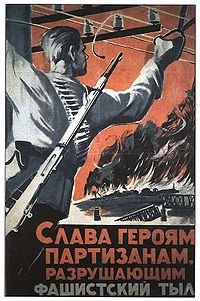
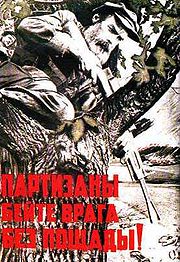 The program of the partisan war was outlined in the Soviet People's Commissaries Council and Communist Party
directives issued on July 29, 1941 and in following documents. Partisan detachments and diversionist groups were to be formed on the German-occupied territories, road and telecommunications disrupted, German personnel killed, and valuable resources destroyed. Joseph Stalin
, in his radio speech on August 3, 1941, reiterated these commands and directives to the people. Adolf Hitler
, when referring to that speech on August 16, pointed out that the declared partisan war in the German rear had its advantages, providing the excuse for destroying "anything that opposes the Germans".
The first partisan detachments, consisting of Red Army personnel and local people, and commanded by Red Army officers or local Communist Party activists, were formed in the first days of the war, including the Starasyel'ski detachment
of Major Dorodnykh in the Zhabinka
district (June 23, 1941), the Pinsk
detachment of Vasily Korzh
on June 26, 1941. The first awards of the Hero of the Soviet Union
order occurred on August 6, 1941 (detachment commanders Pavlovskiy and Bumazhkov).
In 1941, the core of the social base of the partisan movement were the remains of Red Army units destroyed in the first phases of Operation Barbarossa
, personnel of destruction battalions, and the local Communist Party and Komsomol
activists. The most common unit of the period was the detachment.
The "seed" partisan detachments, diversionist and organizational groups were formed and parachuted into German-occupied territories in the summer of 1941. Urban underground groups were formed as a force complementing the activities of partisan units, operating in rural areas. The network of underground structures was actively developed on German-occupied territories to control activities, and it received a steady influx of specially chosen party activists. By the end of 1941, more than 2,000 partisan detachments (with more than 90,000 personnel) operated in German-occupied territories.
However, the activity of partisan forces were not centrally coordinated and supplied until spring of 1942. In order to coordinate partisan operations the Central Headquarters of the Partisan Movement as Stavka
, headed by Panteleimon Ponomarenko
(Chief of Staff) and initially commanded by Kliment Voroshilov
, was organized on May 30, 1942. The Staff had its liaison
networks in the Military Council
s of the Fronts
and Armies
. The territorial Staffs were subsequently created, dealing with the partisan movement in the respective Soviet Republics and in the occupied provinces of the Russian SFSR.
Although initially in Ukraine
and Belorussia some of the local population were supportive of the German occupation that they hoped would bring about the end of Stalinist rule, they soon found that the Nazi regime was more brutal. The occupying forces deported the working-age population to the Third Reich to serve as slave laborers, looted, and arbitrarily applied punishments for any infraction, up to burning the entire villages with their population (for example, Khatyn). Many locals joined the anti-Nazi resistance, and a lot of people became passive supporters of the partisans.
Later NKVD
, SMERSH
and GRU
began training a special group of future partisans (effectively, special forces
units) in the rear and dropping them into occupied territories. Candidates for these groups were chosen among volunteers from the regular Red Army, the NKVD Internal Troops
, and also from among Soviet sportsmen. When dropped behind the German front-line, the groups were to organize and guide the local, self-established partisan units. Radio operators and intelligence gathering officers were essential members of each group since amateur fighters could not be trusted with these tasks. Some commanders of these special units, such as Dmitry Medvedev
, later became well-known partisan leaders.
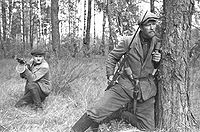
By Soviet estimates, in August 1941 about 231 detachments
were operating already. "Seed" units, formed and inserted into Belarus, totaled 437 by the end of the 1941, comprising more than 7,200 personnel. However, as the front line moved further away, conditions steadily worsened for the partisan units, as resources ran out, and there was no large-scale support from beyond the front until March 1942. One particular difficulty was the lack of radio communication, which was not addressed until April 1942. The partisan unit also lacked the support of local people. For several months, partisan units in Belarus were virtually left to their own devices; especially difficult was the winter of 1941-1942, with severe shortages in ammunition, medicine and supplies. The actions of partisans were generally uncoordinated.
German pacification operations in the summer and autumn 1941 were able to curb the partisan activity significantly. Many units went underground, and generally, in late 1941 to early 1942, the partisan units were not undertaking significant military operations, but limiting themselves to sorting out organizational problems, building up support and establishing an influence over the local people. Although data is incomplete, at the end of 1941, 99 partisan detachments and about 100 partisan groups are known to have operated in Belarus. In Winter 1941-1942, 50 partisan detachments and about 50 underground organisations and groups operated in Belarus. During December 1941, German guard forces in the Army Group "Center" rear comprised 4 security divisions, 1 SS Infantry Brigade
, 2 SS Infantry Brigade
s, 260 companies of different branches of service.
The Battle of Moscow
gave partisan morale a boost. However, the real turning point in the development of the partisan movement in Belarus, and on the German-occupied territories in general, came in the course of the Soviet Winter 1942 offensive.
, a corridor connecting Soviet and German-occupied territories, in February 1942. The partisan units were included in overall Soviet strategical developments shortly after that, and centralized organizational and logistical support were organized, with the Gate's existence being a very important factor in assisting detachments on occupied territory. As early as the spring of 1942, the Soviet partisans were able to effectively undermine German troops and significantly hamper their operations in the region.
Overwhelmingly, Jews and even small-scale Soviet activists felt more secure in the partisan ranks than in civilian life on occupied territory. A direct boost to the partisan numbers were Red Army POWs of the local origin, who were released in the autumn of 1941, but ordered by Germans to return to the concentration camps in March 1942.
In spring 1942, the concentration of smaller partisan units
into brigades
began, prompted by the experience of the first year of war. The coordination, numerical buildup, structural reworking and established supply lines all translated into greatly increased partisan capability, which showed in the increased instances of sabotage on the railroads, with hundreds of engines and thousands of cars destroyed by the end of the year.
In 1942, terror campaigns against the territorial administration, staffed by local "collaborators and traitors" was additionally emphasized. This resulted, however, in definite divisions within the local civilian population, resulting in the beginning of the organisation of anti-partisan units with native personnel in 1942. By November 1942, Soviet partisan units in Belarus numbered about 47,000 personnel.
In January 1943, out of 56,000 partisan personnel, 11,000 were operating in western Belarus, 3.5 fewer per 10,000 local people than in the east, and even more so (up to 5-6 factor) if one accounts for much more efficient Soviet evacuation measures in the East during 1941. Smallholders in the west showed "surprising" sympathies to the partisans. There is strong evidence that this was a decision of the central Soviet authorities, who refrained from a larger accumulation of partisan forces in western Belarus, and let Polish underground military structures grow in these lands during 1941-1942, in order to strengthen relations with the Polish government in exile
of Sikorsky. A certain level of military cooperation, imposed by the command headquarters, was noted between Soviet partisans and Armia Krajowa (AK)
. People of Polish nationality were, to an extent, avoided during the terror campaigns in 1942. After the breakdown of diplomatic relations between the USSR and the Polish government in exile
in April 1943, the situation changed radically. From this moment on, the AK was treated as a hostile military force.
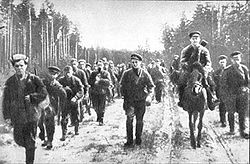 The buildup of the Soviet partisan force in western Belarus was ordered and implemented during 1943, with nine brigades, 10 detachments and 15 operational groups transferred from east to west, effectively tripling the partisan force there (reaching 36,000 troops in December 1943). It is estimated that 10-12,000 personnel were transferred, and about same number came from local volunteers. The buildup of the military force was complemented by the intensification of the underground Communist Party structures and propaganda activity.
The Soviet victory at Stalingrad
, a certain lessening of the terror campaign (de facto from December 1942, formally permitted in February 1943) and an amnesty
promised to collaborators who wished to return to the Soviet camp were significant factors in the 1943 growth of Soviet partisan forces. Desertions from the ranks of the German-controlled police and military formations strengthened units, with sometimes whole detachments coming over to the Soviet camp, including the Volga Tatar
battalion (900 personnel, February 1943), and Gil-Rodionov's 1st Russian People's Brigade of the SS (2,500 personnel, August 1943). In all about 7,000 people of different anti-Soviet formations joined the Soviet partisan force, while about 1,900 specialists and commanders were dropped into occupied Belarus in 1943. However, local people mainly accounted for most increases in the Soviet partisan force.
In autumn 1943, the partisan force in the Belarusian SSR totaled about 153,000, and by the end of 1943 numbers reached about 122,000, with about 30,000 put behind the front line in the course of the liberation of the eastern parts of the Belarusian SSR (end 1943). The partisan movement was so strong that by 1943-1944 there were entire regions in occupied Belarus where Soviet authority was re-established deep inside the German held territories. There were even partisan kolkhoz
es raising crops and livestock to produce food for the partisans.
During the battles for the liberation of Belarus, partisans comprised the fourth Belorussian front. After the liberation of the Belarusian SSR, about 180,000 partisans joined the Soviet Army
in 1944.
During the 1941-1944 period, the total numbers of the Soviet partisan force in Belarus reached 374,000, about 70,000 in the urban underground, and about 400,000 in the reserves. Among Soviet partisans in Belarus were people of 45 different nationalities and 4,000 non-Soviet citizens (including 3,000 Poles, 400 Czechs
and Slovaks
, 300 Yugoslavia
ns, etc.). Around 65% of Belarusian partisans were local people.
, Ukraine
was the first and hardest hit by the Axis invasion
of the Soviet Union in the summer and autumn of 1941. The consequences for the area and for the population that remained under the occupation were devastating. The Nazi regime made little effort to exploit the anti-Soviet sentiments among the Ukrainians that developed from the years of Stalinist rule. Despite the fact that some Western Ukrainians initially welcomed the Germans, the Nazi leadership chose to take a hard line, preserving the collective-farm system, systematically deporting the local population to Greater Germany as a slave labour force and carrying out the Holocaust
on Ukrainian territory. Under these circumstances most of the population resisted the Nazi onslaught and the partisan movement spread over the occupied territory.
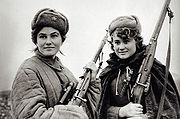 The first Soviet partisan detachments in Ukraine appeared in the Chernihiv
and Sumy
regions. They developed out of Mykola Popudrenko's and Sydir Kovpak
's underground groups, and became a formidable force in 1943. At this stage, they were controlled and supported by the Ukrainian Partisan Movement Headquarters in Moscow
, operating throughout occupied Ukraine (especially in the northeastern part) and numbered over 150,000 fighters. In 1944, partisans led by Kovpak and Vershigora were even able to raid enemy Axis forces in Romania
, Slovakia
and Poland
.
Although the Soviet partisan leadership was officially hostile to the independent nationalist Ukrainian Insurgent Army (UPA), local partisan commanders sometimes established neutral relations with its groups. However, during 1941-1942 and after 1943 both sides set out to destroy the other. Soviet partisans also targeted families, assistants and supporters of the Ukrainian members of the Waffen-SS Division Galizien (Galicia).
, Alexander Saburov
and others and numbered over 60,000 men. The Belgorod
, Oryol
, Kursk
, Novgorod
, Leningrad
, Pskov
and Smolensk
regions also had significant partisan activity during the occupation period. In the Oryol and Smolensk regions partisans were led by Dmitry Medvedev
.
In 1943, after the Red Army started to re-occupy western Russia and north-east Ukraine, many partisans, including units led by Fyodorov, Medvedev and Saburov, were ordered to re-locate their operations into central and western Ukraine still occupied by Nazis.
region of Latvia and the Vilnius
district. Thus Estonia remained partisan free throughout most of the war, by 1944 only 234 partisans were fighting in Estonia and none were native volunteers, all being either NKVD
or Red Army
personnel brought by aeroplane from the Soviet-controlled territories. In Latvia
they were first under Russian and Belarusian command, and from January 1943, directly subordinated to the central Headquarters in Moscow, under the leadership of Arturs Sproģis
. Another prominent commander was the historian Vilis Samsons. His 3,000 man unit is credited with the destruction of nearly 130 German trains; however, this seems to be a fabrication. There is no mention at all of this kind of action in the RVD Riga documents nor any mention by the Latvian and Estonian railway workers which were on the payroll of RVD Riga in 1941-1944.
In 1941, the Soviet partisan movement in Lithuania began with the actions of a small number of Red Army
soldiers left behind enemy lines, much like the beginning of partisan movements in Ukraine and Belarus. The movement grew throughout 1942, and in the summer of that year the Lithuanian Soviet partisan movement began receiving material aid as well as specialists and instructors in guerrilla warfare from Soviet-held territory. On 26 November 1942, the Command of the Lithuanian Partisan Movement (Lietuvos partizaninio judėjimo štabas) was created in Moscow, headed by the First Secretary
of the Lithuanian Communist Party Antanas Sniečkus
, who fled to Moscow in the wake of the German invasion in 1941. Although the Soviet partisans in Lithuania were nominally under the control of the Command of the Lithuanian Partisan Movement, the guerrilla warfare specialists and instructors sent by it reported directly to the Central Command of the Partisan Movement. Modern Lithuanian historians estimate that about half of the Soviet partisans in Lithuania were escapees from POW and concentration camps, Soviet activists and Red Army soldiers left behind the quickly advancing front line
, while the other half was made up of airdropped special operations experts. It is estimated that in total, about 5,000 people engaged in pro-Soviet underground activities in Lithuania during the war. In general, the role of Soviet dissident groups in Lithuania in Second World War was minimal.
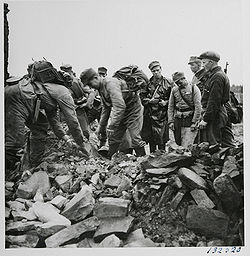 Soviet partisans operated in Finland
and in Karelia
from 1941-1944 where they also made atrocities against civilians a trademark of their way of operation. The partisans operated deep inside Finnish territory and they mainly executed their soldier and civilian prisoners of war after a minor interrogation. Usually Finnish officer POWs had a chance to survive until arriving to a major interrogation in the headquarters of Soviet Karelian partisans or Karelian front, or a quarter of NKVD
. During the Finnish occupation of Karelia
local ethnic Russian people supported the partisan attacks.
Approximately 5,000 partisans altogether fought in the region, although the typical strength of the force was 1,500-2,300. Peculiarities of this front were that partisan units were not created inside occupied territory, but their personnel came from all over the Soviet Union and that they mainly operated from the Soviet side of the front line.
The only major operation ended with failure when the 1st Partisan Brigade was destroyed at the beginning of August 1942 at Lake Seesjärvi. Most operations at the southern part of the front consisted only of a few individuals, but in the roadless northern part, units of 40-100 partisans were not uncommon. Partisans distributed propaganda newspapers, "Truth" in the Finnish language
and "Lenin's Banner" in the Russian language
. One of the more notorious leaders of the partisan movement in Finland and Karelia, was Yuri Andropov
.
In East Karelia
, most partisans attacked Finnish military supply and communication targets, but on the Finnish side of the border, almost two thirds of the attacks targeted civilians, killing 200 and injuring 50, mostly women, children and elderly. On several occasions the partisans executed all civilians, not wanting anyone to witness the atrocities. One such incident was the partisan attack of Lämsänkylä, Kuusamo
, that took place on July 18, 1943, in which the partisans attacked a lonely house and killed all of the seven civilians there, including a six-month-old baby and a three-year-old child, before fleeing.
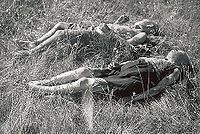 The partisan operations against Finns were estimated as being highly ineffectual. Already in the autumn of 1941 the report of Komissariat of Interior Affairs was highly critical, and it became only worse as the report of counter intelligence agency at April 1944 states. The main explanations which were given to the failure of the operations were the isolated headquarters at Belomorsk which did not know what operative units were doing, personnel which had no local knowledge and were partly made up of criminals (10-20% of all personnel were conscripted from prisons) without knowledge of how to operate in harsh terrain and climate, Finnish efficient counter-partisan patrolling (more than two-thirds of the sent small partisan groups were completely destroyed) and Finnish internment of the ethnic Russian civilian population in concentration camps from the regions with active partisan operations. Internees were released to secure areas, preventing partisans from receiving local supplies. In addition, many Soviet Karelians reported to the Finns the movements of the partisans and did not support the Soviet Partisans.
.
In 1944, the Soviet partisans provided "proletarian internationalist" help to the people of German-occupied Central Europe, with seven united formations and 26 larger detachments
operating in Poland, and 20 united formations and detachments operating in Czechoslovakia
.
_corr.png) In the former eastern territories
In the former eastern territories
of the Second Polish Republic
, attached to the Ukrainian
and Belarusian Soviet Republics after the Soviet invasion of Poland
, the organization and operation of Soviet partisans were similar to that in Ukrainian and Belarusian territories. However, there were notable differences in the interaction of partisans with Polish national forces and the local population.
After an initial period of wary collaboration with the Polish resistance
, the conflicts between these groups intensified, especially as Poles were principally the victims of Soviet terror between 1939 and 1941, and Soviet diplomatic relations with the Polish exile government in London
continued to worsen and were broken off completely by Soviet government in the aftermath of the discovery of the Katyn Massacre
in 1943. In addition to sabotage aimed at the German war machine, Soviet partisans started extensive operations against both the Polish underground and the civilian population of the areas seized by the Soviets in 1939. The campaign of terror resulted in reports to London of horrifying looting, rape and murder. This made many local AK commanders consider the Soviets as just another enemy and eventually on June 22, 1943 Soviets partisans were ordered by Moscow to take on the Polish units as well. The study by German-Polish historian Bogdan Musial
suggests that Soviet partisans, instead of engaging German military and police targets, targeted the poorly armed and trained Belarusian and Polish self-defense forces. The partisans killed about 128 Poles in Naliboki
, on May 8, 1943.
In the wake of growing hostilities between Soviet and Armia Krajowa
(AK) forces, some local AK units caught up in this conflict, acting against the orders of the AK High Command, cooperated in various ways with local German units fighting the same enemy. The most notorious instance of this practice took place in January-February 1944, when the AK units in the area around Vilnius
and Navahrudak, commanded by Aleksander Krzyżanowski
, cooperated for a time with the German
military units in the fight against Soviet partisans. As a consequence of the clandestine, short-term tactical agreement between the local AK leadership and the local Nazi commanders, several AK units aided by the arms and provisions obtained from the Germans in effect fought alongside Germans against Soviet partisans, and by doing so effectively "cleansed" the territory in the Vilnius/Navahrudak area from Soviet partisan units.
However there were no known joint Polish-German actions, and the Germans were unsuccessful in their attempt to turn the Poles toward fighting exclusively against Soviet partisans. Such cooperation of local Polish commanders with the Germans was condemned by AK High Command and the Polish Supreme Commander in London, who on January 17, 1944 ordered it to be discontinued and the guilty parties disciplined.
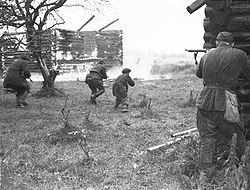
was notorious for the cruelty towards prisoners of war and the enemy in general, partisan activities are thought to have intensified this. Partisan resistance activities included assassinations, bombings and sabotage of supply lines and other infrastructure. The Germans responded without mercy to any suspected partisans they could find. Initially Hitler encouraged mass reprisals as a means to reduce the occupied population and provide greater "Lebensraum
" for Germany.
Soviet communist party master plan included plans for provoking the German occupiers. Provoking the Germans was not very difficult and the Germans responded with 100:1 kill ratios. Though this caused many Soviet civilian deaths it also created a permanent barrier between the German occupiers and the occupied Soviet civilians. After about a year and a half of war there were very few neutral and even fewer pro-Nazi Soviet villages. The villagers understood it had become a war of extermination and they decided that no matter what happened they were going to take Germans with them. Soviet partisans were known to sometimes torture or mutilate their victims after they had been captured or had surrendered. Any partisans captured by the Germans faced certain death. The Germans would publicly hang those who were considered partisans. The pictures of the hangings, especially when it included young boys and girls, were used by the Soviet media to inflame the Red Army
and the long suffering Soviet public. In this sense, Stalin’s speech in 1941 “If they want a war of extermination we will give them a war of extermination” was fulfilled.
Initially the Nazis felt that mass reprisal killings and collective punishment
would intimidate the occupied population and the peasants would become submissive. The Soviet communist party wanted the occupation to be exposed in all its murderous evil. For the first year and a half, the Nazis killed hundreds of thousands of innocent peasants. But after that time, there were very few neutral or pro-Nazi peasants. The Russian peasantry now clearly understood the Germans wanted to enslave and exterminate them while "liberating" their resources.
This year and a half period could be termed as the incubation period. During this period the Soviet communist party used careful military/political activity to create a sympathetic population in the occupied areas. After the liquidation of the German 6th army at Stalingrad the partisan movement took off. All the year and half of military-political activities started to pay off as the occupied population saw a glimmer of hope. Partisan activities were a significant factor in delaying the Nazi build-up in Kursk and during the actual German attack on Kursk when replacement supplies were repeatedly held up.
Many Germans felt hatred for Russian, Belorussian
and Ukrainian
citizens in general and for Soviet activists in particular. There was a brutality in general treatment not seen in occupied Western Europe. While some form of sympathy may have existed between ordinary German or Soviet soldiers and their captives, this was not the case with captured partisans.
The Nazis also tried to establish pro-Nazi “freedom fighters” from amongst their Soviet prisoners. But the general Nazi attitude towards the Eastern Europeans was to treat them as racially inferior animals, such attitudes significantly reducing the appeal of serving them. A notable Nazi collaborator was General Vlasov.
. As is typical in guerrilla warfare
, Soviet partisans requisitioned food, livestock and clothes from local peasants; in some cases the supply was voluntary, in others coerced. The results of such requisitioning were made more severe by the fact that Axis occupation forces had been already carrying out their own requisitions. This led to conflicts with partisans in areas hostile to Soviet power, mostly in territories annexed by the Soviet Union during 1939-1941.
Among the targets of Soviet partisans were not only Axis military and their voluntary collaboration units, but also civilians accused of being collaborators
or sometimes even those who were considered not to support the partisans strongly enough.
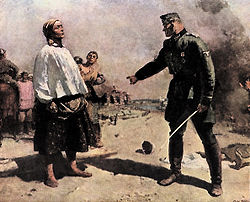 While the partisan movement in some regions greatly contributed into the outcome of the Eastern Front, some historians argue that the price for this was too high.
Partisans are often accused of provoking brutal countermeasures from the Nazi occupiers. Trying to limit partisan activities, German command employed of mass killings of hostage
s among the residents of areas supporting partisan forces. In case of partisan attack or sabotage, a number of locals would be executed. Such hostage operations happened in the form of preliminary arrests, post-attack retaliation actions, and/or compulsory "watch-groups" deployed on vulnerable sites and killed if they did not avert the attack. In Belorussia alone, German anti-partisan actions killed an estimated 345,000 people, mostly civilians.
According to Soviet sources, the partisans tried ways to limit hostage executions or other murders in retaliation for their actions, like targeting uninhabited areas, developing their own forest agriculture and evacuating the whole population of the villages at risk. However, some historians believe such attempts were of little effect.
Activity and its effect on local civilians was a permanent issue of controversy among partisans.
. Able-bodied male Jews were usually welcomed by the partisans (sometimes only if they brought their own weapons). More than 10% of the Soviet partisan movement were Jews. In the Rowne Brigade, Alexander Abugov, commander of the reconnaissance unit, and Dr Ehrlich, commander of the medical services were Jews. Jewish women, children, and the elderly were usually not welcome. Eventually, however, separate Jewish groups, both guerrilla units and mixed family groups of refugee
s (like the Bielski partisans
), were subordinated to the communist partisan leadership and considered as Soviet assets.
Soviet partisans are therefore a controversial issue in those countries. In Latvia, some former Soviet partisans, such as Vasiliy Kononov
have been prosecuted for alleged war crimes against locals during Soviet partisan activity.
), was, at different times, engaged in the armed conflicts with the Soviet partisans, Nazi occupants and the Polish resistance
. Although UPA initially attempted to find a common anti-Soviet ground with Nazi occupiers
against the USSR, it soon was driven underground as it became apparent that the Germans' intentions for Ukraine were to establish a German colony with a subjugated local population, not an independent country as the UPA hoped for. As such, the UPA was driven underground and fought both the Nazi occupiers and the Soviet forces (including partisans) at the same time.
Later, UPA and Soviet partisan leaders tried to negotiate a temporary alliance, but Moscow NKVD Headquarters began harshly suppressing such moves by its local commanders. With two sides becoming established enemies, the Ukrainian civil population was primarily concerned with the survival.
Ukrainian nationalist resistance to Soviet rule continued into the mid-late 1950s.
, and the destruction of the village of Bakaloriškės). The anti-Soviet resistance movements in the Baltic states, known as the Latvian
or Lithuanian partisans
, (established just before the Soviet re-occupation in 1944), and local self-defence
units often came into conflict with Soviet partisan groups, much as the situation between Ukrainian partisans and the UPA in western Ukraine developed. In Estonia and Latvia, almost all the Soviet partisan units, dropped by air, were either crushed by the German forces or the local self-defense units.
In eastern and south-eastern Lithuania Soviet partisans constantly clashed with Polish Armia Krajowa
(Home Army) partisans; AK did not recognise any territorial changes after 1939 and considered this region as a legal part of Poland, while Soviets planned to return it to the Soviet Union after the war. Only in April 1944 did Polish and Soviet partisans started coordinating their actions against the Germans.
Some historians attribute that the Soviet reactions to returning partisans were not better than that to Soviet POWs. In 1955, a pardon was given to all POWs and Nazi collaborators.--->
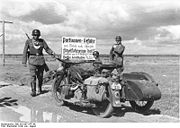 The partisans' activities included disrupting the railroad communications, intelligence gathering and, typically, small hit and run
operations. With the German supply lines already over extended, the partisan operations in the rear of the front lines were able to severely disrupt the flow of supplies to the army that acted deep into the Soviet territory.
In the second half of the war, major partisan operations were coordinated with Soviet offensives. Upon liberation of parts of the Soviet territory the corresponding partisan detachments usually joined the regular Army.
The partisans were an important and numerous force of the war. According to Soviet sources, from 90,000 partisans (including underground) by the end of 1941 it grew to 220,000 in 1942, and to more than 550,000 in 1943. Soviet partisans inflicted thousands of casualties on Axis forces. In Belarus alone the partisans claimed to have killed, injured and taken prisoner some 500,000 German soldiers. Based on German sources, historians consider these claims to be far exaggerated. According to German historian Christian Gerlach, 6,000-7,000 German troops were killed by partisans in Belarus, not including local auxiliaries.
Resistance movement
A resistance movement is a group or collection of individual groups, dedicated to opposing an invader in an occupied country or the government of a sovereign state. It may seek to achieve its objects through either the use of nonviolent resistance or the use of armed force...
which fought a guerrilla war against the Axis occupation of the Soviet Union
Soviet Union
The Soviet Union , officially the Union of Soviet Socialist Republics , was a constitutionally socialist state that existed in Eurasia between 1922 and 1991....
during World War II
World War II
World War II, or the Second World War , was a global conflict lasting from 1939 to 1945, involving most of the world's nations—including all of the great powers—eventually forming two opposing military alliances: the Allies and the Axis...
.
The movement was coordinated and controlled by the Soviet government and modeled on that of the Red Army
Red Army
The Workers' and Peasants' Red Army started out as the Soviet Union's revolutionary communist combat groups during the Russian Civil War of 1918-1922. It grew into the national army of the Soviet Union. By the 1930s the Red Army was among the largest armies in history.The "Red Army" name refers to...
. The primary objective of the guerrilla warfare
Guerrilla warfare
Guerrilla warfare is a form of irregular warfare and refers to conflicts in which a small group of combatants including, but not limited to, armed civilians use military tactics, such as ambushes, sabotage, raids, the element of surprise, and extraordinary mobility to harass a larger and...
waged by the Soviet partisan
Partisan (military)
A partisan is a member of an irregular military force formed to oppose control of an area by a foreign power or by an army of occupation by some kind of insurgent activity...
units was the disruption of the Eastern Front
Eastern Front (World War II)
The Eastern Front of World War II was a theatre of World War II between the European Axis powers and co-belligerent Finland against the Soviet Union, Poland, and some other Allies which encompassed Northern, Southern and Eastern Europe from 22 June 1941 to 9 May 1945...
's German rear
Rear (military)
In military parlance, the rear is the part of concentration of military forces that is farthest from the enemy . The rear typically contains all elements of the force necessary to support combat forces - food, medical supplies and substantial shelters, planners and command headquarters....
, especially road and railroad communications.
Formation of anti-German Soviet resistance
Communist Party of the Soviet Union
The Communist Party of the Soviet Union was the only legal, ruling political party in the Soviet Union and one of the largest communist organizations in the world...
directives issued on July 29, 1941 and in following documents. Partisan detachments and diversionist groups were to be formed on the German-occupied territories, road and telecommunications disrupted, German personnel killed, and valuable resources destroyed. Joseph Stalin
Joseph Stalin
Joseph Vissarionovich Stalin was the Premier of the Soviet Union from 6 May 1941 to 5 March 1953. He was among the Bolshevik revolutionaries who brought about the October Revolution and had held the position of first General Secretary of the Communist Party of the Soviet Union's Central Committee...
, in his radio speech on August 3, 1941, reiterated these commands and directives to the people. Adolf Hitler
Adolf Hitler
Adolf Hitler was an Austrian-born German politician and the leader of the National Socialist German Workers Party , commonly referred to as the Nazi Party). He was Chancellor of Germany from 1933 to 1945, and head of state from 1934 to 1945...
, when referring to that speech on August 16, pointed out that the declared partisan war in the German rear had its advantages, providing the excuse for destroying "anything that opposes the Germans".
The first partisan detachments, consisting of Red Army personnel and local people, and commanded by Red Army officers or local Communist Party activists, were formed in the first days of the war, including the Starasyel'ski detachment
Soviet partisan detachment 1941-1944
Soviet partisan detachment , was the principal organisational form of the Soviet partisan units.Numerical and structural complement of the partisan detachment varied, with usual number of about 100 to several hundred personnel, organised in the 3—4 companies, 3 platoons each, 3 sections each...
of Major Dorodnykh in the Zhabinka
Zhabinka
Zhabinka is a city in the southwestern Belarusian voblast of Brest. It is the administrative center of the Zhabinka Raion. Its population is 12,800.-History:The name was first mentioned in Russian official papers in 1817....
district (June 23, 1941), the Pinsk
Pinsk
Pinsk , a town in Belarus, in the Polesia region, traversed by the river Pripyat, at the confluence of the Strumen and Pina rivers. The region was known as the Marsh of Pinsk. It is a fertile agricultural center. It lies south-west of Minsk. The population is about 130,000...
detachment of Vasily Korzh
Vasily Korzh
Vasily Zakharovich Korzh , also known under the Soviet partisan nom de guerre "Komarov", was a Belarusian communist activist and Soviet World War II hero....
on June 26, 1941. The first awards of the Hero of the Soviet Union
Hero of the Soviet Union
The title Hero of the Soviet Union was the highest distinction in the Soviet Union, awarded personally or collectively for heroic feats in service to the Soviet state and society.-Overview:...
order occurred on August 6, 1941 (detachment commanders Pavlovskiy and Bumazhkov).
In 1941, the core of the social base of the partisan movement were the remains of Red Army units destroyed in the first phases of Operation Barbarossa
Operation Barbarossa
Operation Barbarossa was the code name for Germany's invasion of the Soviet Union during World War II that began on 22 June 1941. Over 4.5 million troops of the Axis powers invaded the USSR along a front., the largest invasion in the history of warfare...
, personnel of destruction battalions, and the local Communist Party and Komsomol
Komsomol
The Communist Union of Youth , usually known as Komsomol , was the youth division of the Communist Party of the Soviet Union. The Komsomol in its earliest form was established in urban centers in 1918. During the early years, it was a Russian organization, known as the Russian Communist Union of...
activists. The most common unit of the period was the detachment.
The "seed" partisan detachments, diversionist and organizational groups were formed and parachuted into German-occupied territories in the summer of 1941. Urban underground groups were formed as a force complementing the activities of partisan units, operating in rural areas. The network of underground structures was actively developed on German-occupied territories to control activities, and it received a steady influx of specially chosen party activists. By the end of 1941, more than 2,000 partisan detachments (with more than 90,000 personnel) operated in German-occupied territories.
However, the activity of partisan forces were not centrally coordinated and supplied until spring of 1942. In order to coordinate partisan operations the Central Headquarters of the Partisan Movement as Stavka
Stavka
Stavka was the term used to refer to a command element of the armed forces from the time of the Kievan Rus′, more formally during the history of Imperial Russia as administrative staff and General Headquarters during late 19th Century Imperial Russian armed forces and those of the Soviet Union...
, headed by Panteleimon Ponomarenko
Panteleimon Ponomarenko
Panteleimon Kondrat'evich Ponomarenko ; 9 August 1902 18 January 1984) was a general in the Red Army before becoming a Soviet administrator in Belarus and then Kazakhstan. He was born in Krasnodar Krai, Russia....
(Chief of Staff) and initially commanded by Kliment Voroshilov
Kliment Voroshilov
Kliment Yefremovich Voroshilov , popularly known as Klim Voroshilov was a Soviet military officer, politician, and statesman...
, was organized on May 30, 1942. The Staff had its liaison
Liaison officer
A liaison officer or LNO is a person that liaises between two organizations to communicate and coordinate their activities. Generally, they are used to achieve the best utilization of resources or employment of services of one organization by another. In the military, liaison officers may...
networks in the Military Council
Military Council
Military Council may refer to:* Military Council for Justice and Democracy, the supreme political body of Mauritania* Military Council of National Salvation, a military dictatorship quasi-government administering Poland during the martial law...
s of the Fronts
Front (Soviet Army)
A front was a major military organization in the Soviet Army during many wars. It was roughly equivalent to an army group in the militaries of most other countries except Germany...
and Armies
Formations of the Soviet Army
Formations are those military organisations which are formed from different speciality Arms and Services troop units to create a balanced, combined combat force...
. The territorial Staffs were subsequently created, dealing with the partisan movement in the respective Soviet Republics and in the occupied provinces of the Russian SFSR.
Although initially in Ukraine
Ukraine
Ukraine is a country in Eastern Europe. It has an area of 603,628 km², making it the second largest contiguous country on the European continent, after Russia...
and Belorussia some of the local population were supportive of the German occupation that they hoped would bring about the end of Stalinist rule, they soon found that the Nazi regime was more brutal. The occupying forces deported the working-age population to the Third Reich to serve as slave laborers, looted, and arbitrarily applied punishments for any infraction, up to burning the entire villages with their population (for example, Khatyn). Many locals joined the anti-Nazi resistance, and a lot of people became passive supporters of the partisans.
Later NKVD
NKVD
The People's Commissariat for Internal Affairs was the public and secret police organization of the Soviet Union that directly executed the rule of power of the Soviets, including political repression, during the era of Joseph Stalin....
, SMERSH
SMERSH
SMERSH was the counter-intelligence agency in the Red Army formed in late 1942 or even earlier, but officially founded on April 14, 1943. The name SMERSH was coined by Joseph Stalin...
and GRU
GRU
GRU or Glavnoye Razvedyvatel'noye Upravleniye is the foreign military intelligence directorate of the General Staff of the Armed Forces of the Russian Federation...
began training a special group of future partisans (effectively, special forces
Special forces
Special forces, or special operations forces are terms used to describe elite military tactical teams trained to perform high-risk dangerous missions that conventional units cannot perform...
units) in the rear and dropping them into occupied territories. Candidates for these groups were chosen among volunteers from the regular Red Army, the NKVD Internal Troops
Internal Troops
The Internal Troops, full name Internal Troops of the Ministry for Internal Affairs ; alternatively translated as "Interior " is a paramilitary gendarmerie-like force in the now-defunct Soviet Union and its successor countries, particularly, in Russia, Ukraine, Georgia and Azerbaijan...
, and also from among Soviet sportsmen. When dropped behind the German front-line, the groups were to organize and guide the local, self-established partisan units. Radio operators and intelligence gathering officers were essential members of each group since amateur fighters could not be trusted with these tasks. Some commanders of these special units, such as Dmitry Medvedev
Dmitry Nikolaevich Medvedev
Dmitry Nikolaevich Medvedev was one of the leaders of the Soviet partisan movement in western Russia and Ukraine....
, later became well-known partisan leaders.
See also
- Partisan detachmentSoviet partisan detachment 1941-1944Soviet partisan detachment , was the principal organisational form of the Soviet partisan units.Numerical and structural complement of the partisan detachment varied, with usual number of about 100 to several hundred personnel, organised in the 3—4 companies, 3 platoons each, 3 sections each...
- Partisan regimentSoviet partisan regiment 1941-1944Soviet partisan regiment , was the organisational form of the Soviet partisan units. On the BSSR territory it was used rarely.The numerical and weapons complement and the chain of command of the partisan regiment were basically the same as of the partisan brigade, with the regiment structure...
- Partisan brigadeSoviet partisan brigade 1941-1944Soviet partisan brigade , was the organisational form of the Soviet partisan units, the principal organisational form of the units operating on the territory of BSSR....
- Partisan groupSoviet partisan group 1941-1944Soviet partisan group , was the smallest organisational form of the Soviet partisan units, the principal organisational form in the initial phase of the partisan war in the German rear....
- Partisan united formation
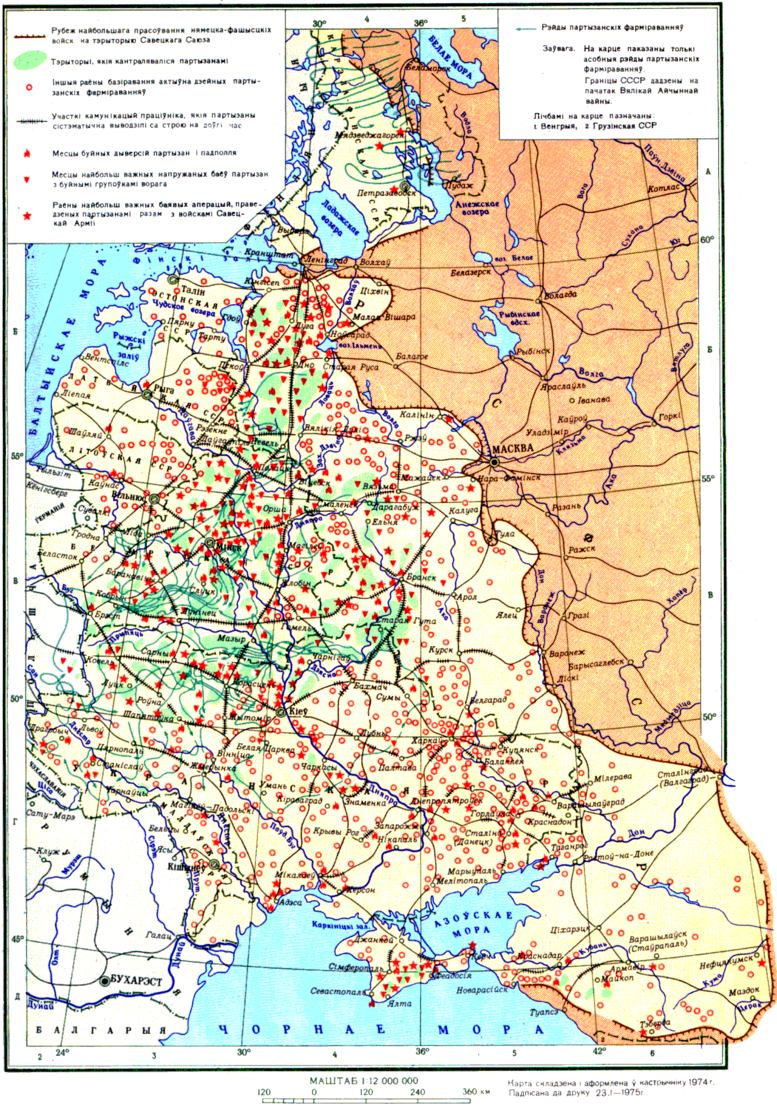
Map of Soviet partisan activities
Belarus
The Soviet authorities considered Belarus to be of importance to the development of the Soviet partisan war from the very beginning. The main factors were its geography, with lots of dense forests and swamps, and its strategic position on communication lines going from Moscow to the West. In fact, Belarusian Communist bodies in the Eastern provinces of Belarus began to organise and facilitate organisation of the partisan units on the day after the first directive was issued (directives No.1 of 1941-07-30 and No.2 of 1941-07-01).By Soviet estimates, in August 1941 about 231 detachments
Soviet partisan detachment 1941-1944
Soviet partisan detachment , was the principal organisational form of the Soviet partisan units.Numerical and structural complement of the partisan detachment varied, with usual number of about 100 to several hundred personnel, organised in the 3—4 companies, 3 platoons each, 3 sections each...
were operating already. "Seed" units, formed and inserted into Belarus, totaled 437 by the end of the 1941, comprising more than 7,200 personnel. However, as the front line moved further away, conditions steadily worsened for the partisan units, as resources ran out, and there was no large-scale support from beyond the front until March 1942. One particular difficulty was the lack of radio communication, which was not addressed until April 1942. The partisan unit also lacked the support of local people. For several months, partisan units in Belarus were virtually left to their own devices; especially difficult was the winter of 1941-1942, with severe shortages in ammunition, medicine and supplies. The actions of partisans were generally uncoordinated.
German pacification operations in the summer and autumn 1941 were able to curb the partisan activity significantly. Many units went underground, and generally, in late 1941 to early 1942, the partisan units were not undertaking significant military operations, but limiting themselves to sorting out organizational problems, building up support and establishing an influence over the local people. Although data is incomplete, at the end of 1941, 99 partisan detachments and about 100 partisan groups are known to have operated in Belarus. In Winter 1941-1942, 50 partisan detachments and about 50 underground organisations and groups operated in Belarus. During December 1941, German guard forces in the Army Group "Center" rear comprised 4 security divisions, 1 SS Infantry Brigade
1 SS Infantry Brigade
The 1 SS Infantry Brigade was a unit of the German Waffen SS formed from former concentration camp guards for service in the Soviet Union behind the main front line during the Second World War. They conducted anti-partisan operations in the rear of the advancing German army and were involved in...
, 2 SS Infantry Brigade
2 SS Infantry Brigade
The 2 SS Infantry Brigade was formed on the 15 May 1941, under the command of Karl Fischer von Treuenfeld with the 4th and 5th SS Infantry Regiments and began its operational service in September in the rear area of Army Group North, under which command it would spend its entire existence...
s, 260 companies of different branches of service.
The Battle of Moscow
Battle of Moscow
The Battle of Moscow is the name given by Soviet historians to two periods of strategically significant fighting on a sector of the Eastern Front during World War II. It took place between October 1941 and January 1942. The Soviet defensive effort frustrated Hitler's attack on Moscow, capital of...
gave partisan morale a boost. However, the real turning point in the development of the partisan movement in Belarus, and on the German-occupied territories in general, came in the course of the Soviet Winter 1942 offensive.
Vitsyebsk gate and West Belarus
The turning point in the development of the Soviet partisan movement came with the opening of the Vitsyebsk gateVitsyebsk gate
"Vitsyebsk gate" or "Surazh gate" was the conventional name in the Soviet, later also in Belarusian, historiography, given to the corridor connecting the Soviet and German-occupied territories, which was a 40 km breach in the place of contact of the German army groups "North" and "Center"...
, a corridor connecting Soviet and German-occupied territories, in February 1942. The partisan units were included in overall Soviet strategical developments shortly after that, and centralized organizational and logistical support were organized, with the Gate's existence being a very important factor in assisting detachments on occupied territory. As early as the spring of 1942, the Soviet partisans were able to effectively undermine German troops and significantly hamper their operations in the region.
Overwhelmingly, Jews and even small-scale Soviet activists felt more secure in the partisan ranks than in civilian life on occupied territory. A direct boost to the partisan numbers were Red Army POWs of the local origin, who were released in the autumn of 1941, but ordered by Germans to return to the concentration camps in March 1942.
In spring 1942, the concentration of smaller partisan units
Soviet partisan detachment 1941-1944
Soviet partisan detachment , was the principal organisational form of the Soviet partisan units.Numerical and structural complement of the partisan detachment varied, with usual number of about 100 to several hundred personnel, organised in the 3—4 companies, 3 platoons each, 3 sections each...
into brigades
Soviet partisan brigade 1941-1944
Soviet partisan brigade , was the organisational form of the Soviet partisan units, the principal organisational form of the units operating on the territory of BSSR....
began, prompted by the experience of the first year of war. The coordination, numerical buildup, structural reworking and established supply lines all translated into greatly increased partisan capability, which showed in the increased instances of sabotage on the railroads, with hundreds of engines and thousands of cars destroyed by the end of the year.
In 1942, terror campaigns against the territorial administration, staffed by local "collaborators and traitors" was additionally emphasized. This resulted, however, in definite divisions within the local civilian population, resulting in the beginning of the organisation of anti-partisan units with native personnel in 1942. By November 1942, Soviet partisan units in Belarus numbered about 47,000 personnel.
In January 1943, out of 56,000 partisan personnel, 11,000 were operating in western Belarus, 3.5 fewer per 10,000 local people than in the east, and even more so (up to 5-6 factor) if one accounts for much more efficient Soviet evacuation measures in the East during 1941. Smallholders in the west showed "surprising" sympathies to the partisans. There is strong evidence that this was a decision of the central Soviet authorities, who refrained from a larger accumulation of partisan forces in western Belarus, and let Polish underground military structures grow in these lands during 1941-1942, in order to strengthen relations with the Polish government in exile
Polish government in Exile
The Polish government-in-exile, formally known as the Government of the Republic of Poland in Exile , was the government in exile of Poland formed in the aftermath of the Invasion of Poland of September 1939, and the subsequent occupation of Poland by Nazi Germany and the Soviet Union, which...
of Sikorsky. A certain level of military cooperation, imposed by the command headquarters, was noted between Soviet partisans and Armia Krajowa (AK)
Armia Krajowa
The Armia Krajowa , or Home Army, was the dominant Polish resistance movement in World War II German-occupied Poland. It was formed in February 1942 from the Związek Walki Zbrojnej . Over the next two years, it absorbed most other Polish underground forces...
. People of Polish nationality were, to an extent, avoided during the terror campaigns in 1942. After the breakdown of diplomatic relations between the USSR and the Polish government in exile
Polish government in Exile
The Polish government-in-exile, formally known as the Government of the Republic of Poland in Exile , was the government in exile of Poland formed in the aftermath of the Invasion of Poland of September 1939, and the subsequent occupation of Poland by Nazi Germany and the Soviet Union, which...
in April 1943, the situation changed radically. From this moment on, the AK was treated as a hostile military force.
1943-1944
The Soviet victory at Stalingrad
Battle of Stalingrad
The Battle of Stalingrad was a major battle of World War II in which Nazi Germany and its allies fought the Soviet Union for control of the city of Stalingrad in southwestern Russia. The battle took place between 23 August 1942 and 2 February 1943...
, a certain lessening of the terror campaign (de facto from December 1942, formally permitted in February 1943) and an amnesty
Amnesty
Amnesty is a legislative or executive act by which a state restores those who may have been guilty of an offense against it to the positions of innocent people, without changing the laws defining the offense. It includes more than pardon, in as much as it obliterates all legal remembrance of the...
promised to collaborators who wished to return to the Soviet camp were significant factors in the 1943 growth of Soviet partisan forces. Desertions from the ranks of the German-controlled police and military formations strengthened units, with sometimes whole detachments coming over to the Soviet camp, including the Volga Tatar
Volga Tatars
The Volga Tatars are the largest subgroup of the Tatars, native to the Volga region.They account for roughly six out of seven million Tatars worldwide....
battalion (900 personnel, February 1943), and Gil-Rodionov's 1st Russian People's Brigade of the SS (2,500 personnel, August 1943). In all about 7,000 people of different anti-Soviet formations joined the Soviet partisan force, while about 1,900 specialists and commanders were dropped into occupied Belarus in 1943. However, local people mainly accounted for most increases in the Soviet partisan force.
In autumn 1943, the partisan force in the Belarusian SSR totaled about 153,000, and by the end of 1943 numbers reached about 122,000, with about 30,000 put behind the front line in the course of the liberation of the eastern parts of the Belarusian SSR (end 1943). The partisan movement was so strong that by 1943-1944 there were entire regions in occupied Belarus where Soviet authority was re-established deep inside the German held territories. There were even partisan kolkhoz
Kolkhoz
A kolkhoz , plural kolkhozy, was a form of collective farming in the Soviet Union that existed along with state farms . The word is a contraction of коллекти́вное хозя́йство, or "collective farm", while sovkhoz is a contraction of советское хозяйство...
es raising crops and livestock to produce food for the partisans.
During the battles for the liberation of Belarus, partisans comprised the fourth Belorussian front. After the liberation of the Belarusian SSR, about 180,000 partisans joined the Soviet Army
Soviet Army
The Soviet Army is the name given to the main part of the Armed Forces of the Soviet Union between 1946 and 1992. Previously, it had been known as the Red Army. Informally, Армия referred to all the MOD armed forces, except, in some cases, the Soviet Navy.This article covers the Soviet Ground...
in 1944.
During the 1941-1944 period, the total numbers of the Soviet partisan force in Belarus reached 374,000, about 70,000 in the urban underground, and about 400,000 in the reserves. Among Soviet partisans in Belarus were people of 45 different nationalities and 4,000 non-Soviet citizens (including 3,000 Poles, 400 Czechs
Czech people
Czechs, or Czech people are a western Slavic people of Central Europe, living predominantly in the Czech Republic. Small populations of Czechs also live in Slovakia, Austria, the United States, the United Kingdom, Chile, Argentina, Canada, Germany, Russia and other countries...
and Slovaks
Slovakia
The Slovak Republic is a landlocked state in Central Europe. It has a population of over five million and an area of about . Slovakia is bordered by the Czech Republic and Austria to the west, Poland to the north, Ukraine to the east and Hungary to the south...
, 300 Yugoslavia
Yugoslavia
Yugoslavia refers to three political entities that existed successively on the western part of the Balkans during most of the 20th century....
ns, etc.). Around 65% of Belarusian partisans were local people.
Ukraine
Alongside BelarusBelarus
Belarus , officially the Republic of Belarus, is a landlocked country in Eastern Europe, bordered clockwise by Russia to the northeast, Ukraine to the south, Poland to the west, and Lithuania and Latvia to the northwest. Its capital is Minsk; other major cities include Brest, Grodno , Gomel ,...
, Ukraine
Ukraine
Ukraine is a country in Eastern Europe. It has an area of 603,628 km², making it the second largest contiguous country on the European continent, after Russia...
was the first and hardest hit by the Axis invasion
Operation Barbarossa
Operation Barbarossa was the code name for Germany's invasion of the Soviet Union during World War II that began on 22 June 1941. Over 4.5 million troops of the Axis powers invaded the USSR along a front., the largest invasion in the history of warfare...
of the Soviet Union in the summer and autumn of 1941. The consequences for the area and for the population that remained under the occupation were devastating. The Nazi regime made little effort to exploit the anti-Soviet sentiments among the Ukrainians that developed from the years of Stalinist rule. Despite the fact that some Western Ukrainians initially welcomed the Germans, the Nazi leadership chose to take a hard line, preserving the collective-farm system, systematically deporting the local population to Greater Germany as a slave labour force and carrying out the Holocaust
Final Solution
The Final Solution was Nazi Germany's plan and execution of the systematic genocide of European Jews during World War II, resulting in the most deadly phase of the Holocaust...
on Ukrainian territory. Under these circumstances most of the population resisted the Nazi onslaught and the partisan movement spread over the occupied territory.
Chernihiv Oblast
Chernihiv Oblast is an oblast of northern Ukraine. The administrative center of the oblast is the city of Chernihiv.-Geography:The total area of the province is around 31,900 km²....
and Sumy
Sumy Oblast
Sumy Oblast is an oblast in the northeastern part of Ukraine. The administrative center of the oblast is the city of Sumy.Other important cities within the oblast include Konotop, Okhtyrka, Romny, and Shostka....
regions. They developed out of Mykola Popudrenko's and Sydir Kovpak
Sydir Kovpak
Sydir Artemovych Kovpak , June 7, 1887December 11, 1967) was a prominent Soviet partisan leader in Ukraine.-Biography:Kovpak was born to a poor peasant family in Ukrainian village near Poltava . For his military service in the World War I he was awarded two Crosses of St...
's underground groups, and became a formidable force in 1943. At this stage, they were controlled and supported by the Ukrainian Partisan Movement Headquarters in Moscow
Moscow
Moscow is the capital, the most populous city, and the most populous federal subject of Russia. The city is a major political, economic, cultural, scientific, religious, financial, educational, and transportation centre of Russia and the continent...
, operating throughout occupied Ukraine (especially in the northeastern part) and numbered over 150,000 fighters. In 1944, partisans led by Kovpak and Vershigora were even able to raid enemy Axis forces in Romania
Romania
Romania is a country located at the crossroads of Central and Southeastern Europe, on the Lower Danube, within and outside the Carpathian arch, bordering on the Black Sea...
, Slovakia
Slovakia
The Slovak Republic is a landlocked state in Central Europe. It has a population of over five million and an area of about . Slovakia is bordered by the Czech Republic and Austria to the west, Poland to the north, Ukraine to the east and Hungary to the south...
and Poland
Poland
Poland , officially the Republic of Poland , is a country in Central Europe bordered by Germany to the west; the Czech Republic and Slovakia to the south; Ukraine, Belarus and Lithuania to the east; and the Baltic Sea and Kaliningrad Oblast, a Russian exclave, to the north...
.
Although the Soviet partisan leadership was officially hostile to the independent nationalist Ukrainian Insurgent Army (UPA), local partisan commanders sometimes established neutral relations with its groups. However, during 1941-1942 and after 1943 both sides set out to destroy the other. Soviet partisans also targeted families, assistants and supporters of the Ukrainian members of the Waffen-SS Division Galizien (Galicia).
Russia
In the Bryansk region, Soviet partisans controlled large areas behind the German lines. In the summer of 1942 they effectively held more than 14,000 square kilometers with a population of over 200,000 people. Soviet partisans in the region were led by Alexei FyodorovAlexei Fyodorov
Alexei Fyodorovich Fyodorov , one of the leaders of Soviet partisan movement during the second world war...
, Alexander Saburov
Alexander Saburov
Alexander Nikolayevich Saburov , one of the leaders of Soviet partisan movement in Ukraine and western Russia during the German-Soviet War.Born near the city of Izhevsk in central Russia, Saburov joined the Communist Party of the Soviet Union in 1933 and the NKVD in 1938.Few months after the German...
and others and numbered over 60,000 men. The Belgorod
Belgorod Oblast
Belgorod Oblast is a federal subjects of Russia . Its administrative center is the city of Belgorod. Population: 1,532,670 .-History:...
, Oryol
Oryol Oblast
Oryol Oblast is a federal subject of Russia . Its administrative center is the city of Oryol. Population: -Geography:It is located in the southwestern part of the Central Federal District, in the Mid-Russian Highlands. Kaluga and Tula Oblasts border it in the north, Bryansk Oblast is located to...
, Kursk
Kursk Oblast
Kursk Oblast is a federal subject of Russia . Its administrative center is the city of Kursk.-Geography:The oblast occupies the southern slopes of the middle-Russian plateau, and its average elevation is from 177 to 225 meters . The surface is hilly, and intersected by ravines...
, Novgorod
Novgorod Oblast
Novgorod Oblast is a federal subject of Russia , located between Moscow and Saint Petersburg. Its administrative center is the city of Veliky Novgorod. Some of the oldest Russian cities, including Veliky Novgorod and Staraya Russa, are located there...
, Leningrad
Leningrad Oblast
Leningrad Oblast is a federal subject of Russia . It was established on August 1, 1927, although it was not until 1946 that the oblast's borders had been mostly settled in their present position...
, Pskov
Pskov Oblast
Pskov Oblast is a federal subject of Russia . Pskov Oblast borders the countries of Estonia and Latvia, as well as Belarus. It is the westernmost federal subject of contiguous Russia . Its major cities are the administrative center Pskov and Velikiye Luki . Area: 55,300 km²...
and Smolensk
Smolensk Oblast
Smolensk Oblast is a federal subject of Russia . Its area is . Population: -Geography:The administrative center of Smolensk Oblast is the city of Smolensk. Other ancient towns include Vyazma and Dorogobuzh....
regions also had significant partisan activity during the occupation period. In the Oryol and Smolensk regions partisans were led by Dmitry Medvedev
Dmitry Nikolaevich Medvedev
Dmitry Nikolaevich Medvedev was one of the leaders of the Soviet partisan movement in western Russia and Ukraine....
.
In 1943, after the Red Army started to re-occupy western Russia and north-east Ukraine, many partisans, including units led by Fyodorov, Medvedev and Saburov, were ordered to re-locate their operations into central and western Ukraine still occupied by Nazis.
Estonia, Latvia and Lithuania
While Soviet sources claim that thousands of partisans were operating in the Baltic region, in fact they only operated in the LatgaleLatgale
Latgale is one of the four historical and cultural regions of Latvia recognised in the Constitution of the Latvian Republic. It is the easternmost region north of the Daugava River...
region of Latvia and the Vilnius
Vilnius
Vilnius is the capital of Lithuania, and its largest city, with a population of 560,190 as of 2010. It is the seat of the Vilnius city municipality and of the Vilnius district municipality. It is also the capital of Vilnius County...
district. Thus Estonia remained partisan free throughout most of the war, by 1944 only 234 partisans were fighting in Estonia and none were native volunteers, all being either NKVD
NKVD
The People's Commissariat for Internal Affairs was the public and secret police organization of the Soviet Union that directly executed the rule of power of the Soviets, including political repression, during the era of Joseph Stalin....
or Red Army
Red Army
The Workers' and Peasants' Red Army started out as the Soviet Union's revolutionary communist combat groups during the Russian Civil War of 1918-1922. It grew into the national army of the Soviet Union. By the 1930s the Red Army was among the largest armies in history.The "Red Army" name refers to...
personnel brought by aeroplane from the Soviet-controlled territories. In Latvia
Latvia
Latvia , officially the Republic of Latvia , is a country in the Baltic region of Northern Europe. It is bordered to the north by Estonia , to the south by Lithuania , to the east by the Russian Federation , to the southeast by Belarus and shares maritime borders to the west with Sweden...
they were first under Russian and Belarusian command, and from January 1943, directly subordinated to the central Headquarters in Moscow, under the leadership of Arturs Sproģis
Arturs Sproģis
Arturs Sproģis was a Latvian colonel and commander of the Soviet partisans during the occupation of Latvia by Nazi Germany in World War II.-Early life and career:...
. Another prominent commander was the historian Vilis Samsons. His 3,000 man unit is credited with the destruction of nearly 130 German trains; however, this seems to be a fabrication. There is no mention at all of this kind of action in the RVD Riga documents nor any mention by the Latvian and Estonian railway workers which were on the payroll of RVD Riga in 1941-1944.
In 1941, the Soviet partisan movement in Lithuania began with the actions of a small number of Red Army
Red Army
The Workers' and Peasants' Red Army started out as the Soviet Union's revolutionary communist combat groups during the Russian Civil War of 1918-1922. It grew into the national army of the Soviet Union. By the 1930s the Red Army was among the largest armies in history.The "Red Army" name refers to...
soldiers left behind enemy lines, much like the beginning of partisan movements in Ukraine and Belarus. The movement grew throughout 1942, and in the summer of that year the Lithuanian Soviet partisan movement began receiving material aid as well as specialists and instructors in guerrilla warfare from Soviet-held territory. On 26 November 1942, the Command of the Lithuanian Partisan Movement (Lietuvos partizaninio judėjimo štabas) was created in Moscow, headed by the First Secretary
General Secretary
The office of general secretary is staffed by the chief officer of:*The General Secretariat for Macedonia and Thrace, a government agency for the Greek regions of Macedonia and Thrace...
of the Lithuanian Communist Party Antanas Sniečkus
Antanas Snieckus
Antanas Sniečkus was First Secretary of the Lithuanian Communist Party from August 1940 to January 22, 1974.- Biography :Antanas Sniečkus was born in 1903, in the village of Būbleliai, near Šakiai. During the First World War, his family fled to Russia where he observed the Russian revolution of 1917...
, who fled to Moscow in the wake of the German invasion in 1941. Although the Soviet partisans in Lithuania were nominally under the control of the Command of the Lithuanian Partisan Movement, the guerrilla warfare specialists and instructors sent by it reported directly to the Central Command of the Partisan Movement. Modern Lithuanian historians estimate that about half of the Soviet partisans in Lithuania were escapees from POW and concentration camps, Soviet activists and Red Army soldiers left behind the quickly advancing front line
Front line
A front line is the farthest-most forward position of an armed force's personnel and equipment - generally in respect of maritime or land forces. Forward Line of Own Troops , or Forward Edge of Battle Area are technical terms used by all branches of the armed services...
, while the other half was made up of airdropped special operations experts. It is estimated that in total, about 5,000 people engaged in pro-Soviet underground activities in Lithuania during the war. In general, the role of Soviet dissident groups in Lithuania in Second World War was minimal.
Finland and Karelia
Finland
Finland , officially the Republic of Finland, is a Nordic country situated in the Fennoscandian region of Northern Europe. It is bordered by Sweden in the west, Norway in the north and Russia in the east, while Estonia lies to its south across the Gulf of Finland.Around 5.4 million people reside...
and in Karelia
Karelia
Karelia , the land of the Karelian peoples, is an area in Northern Europe of historical significance for Finland, Russia, and Sweden...
from 1941-1944 where they also made atrocities against civilians a trademark of their way of operation. The partisans operated deep inside Finnish territory and they mainly executed their soldier and civilian prisoners of war after a minor interrogation. Usually Finnish officer POWs had a chance to survive until arriving to a major interrogation in the headquarters of Soviet Karelian partisans or Karelian front, or a quarter of NKVD
NKVD
The People's Commissariat for Internal Affairs was the public and secret police organization of the Soviet Union that directly executed the rule of power of the Soviets, including political repression, during the era of Joseph Stalin....
. During the Finnish occupation of Karelia
Finnish military administration in Eastern Karelia, 1941–1944
Finnish military administration in Eastern Karelia was an interim administrative system established in those areas of the Karelo-Finnish Soviet Socialist Republic of the Soviet Union which were occupied by the Finnish army during the Continuation War. The military administration was set up on July...
local ethnic Russian people supported the partisan attacks.
Approximately 5,000 partisans altogether fought in the region, although the typical strength of the force was 1,500-2,300. Peculiarities of this front were that partisan units were not created inside occupied territory, but their personnel came from all over the Soviet Union and that they mainly operated from the Soviet side of the front line.
The only major operation ended with failure when the 1st Partisan Brigade was destroyed at the beginning of August 1942 at Lake Seesjärvi. Most operations at the southern part of the front consisted only of a few individuals, but in the roadless northern part, units of 40-100 partisans were not uncommon. Partisans distributed propaganda newspapers, "Truth" in the Finnish language
Finnish language
Finnish is the language spoken by the majority of the population in Finland Primarily for use by restaurant menus and by ethnic Finns outside Finland. It is one of the two official languages of Finland and an official minority language in Sweden. In Sweden, both standard Finnish and Meänkieli, a...
and "Lenin's Banner" in the Russian language
Russian language
Russian is a Slavic language used primarily in Russia, Belarus, Uzbekistan, Kazakhstan, Tajikistan and Kyrgyzstan. It is an unofficial but widely spoken language in Ukraine, Moldova, Latvia, Turkmenistan and Estonia and, to a lesser extent, the other countries that were once constituent republics...
. One of the more notorious leaders of the partisan movement in Finland and Karelia, was Yuri Andropov
Yuri Andropov
Yuri Vladimirovich Andropov was a Soviet politician and the General Secretary of the Communist Party of the Soviet Union from 12 November 1982 until his death fifteen months later.-Early life:...
.
In East Karelia
East Karelia
East Karelia , also rendered as Eastern Karelia or Russian Karelia, is a name for the part of Karelia that since the Treaty of Stolbova in 1617 has remained Christian Orthodox under Russian supremacy. It is separated from the western part of Karelia, called Finnish Karelia or historically Swedish...
, most partisans attacked Finnish military supply and communication targets, but on the Finnish side of the border, almost two thirds of the attacks targeted civilians, killing 200 and injuring 50, mostly women, children and elderly. On several occasions the partisans executed all civilians, not wanting anyone to witness the atrocities. One such incident was the partisan attack of Lämsänkylä, Kuusamo
Kuusamo
Kuusamo is a town and municipality in Finland. It is located in the Oulu province and is part of the Northern Ostrobothnia region. The municipality has a population of and covers an area of of which is water. The population density is ....
, that took place on July 18, 1943, in which the partisans attacked a lonely house and killed all of the seven civilians there, including a six-month-old baby and a three-year-old child, before fleeing.
Outside the Soviet Union
Interestingly, there were formations calling themselves Soviet partisans who operated a long way outside Soviet territory. Usually they were organized by former Soviet citizens who escaped from Nazi camps. One such formation was Rodina (Motherland), acting in FranceFrance
The French Republic , The French Republic , The French Republic , (commonly known as France , is a unitary semi-presidential republic in Western Europe with several overseas territories and islands located on other continents and in the Indian, Pacific, and Atlantic oceans. Metropolitan France...
.
In 1944, the Soviet partisans provided "proletarian internationalist" help to the people of German-occupied Central Europe, with seven united formations and 26 larger detachments
Soviet partisan detachment 1941-1944
Soviet partisan detachment , was the principal organisational form of the Soviet partisan units.Numerical and structural complement of the partisan detachment varied, with usual number of about 100 to several hundred personnel, organised in the 3—4 companies, 3 platoons each, 3 sections each...
operating in Poland, and 20 united formations and detachments operating in Czechoslovakia
Czechoslovakia
Czechoslovakia or Czecho-Slovakia was a sovereign state in Central Europe which existed from October 1918, when it declared its independence from the Austro-Hungarian Empire, until 1992...
.
Poland
Kresy
The Polish term Kresy refers to a land considered by Poles as historical eastern provinces of their country. Today, it makes western Ukraine, western Belarus, as well as eastern Lithuania, with such major cities, as Lviv, Vilnius, and Hrodna. This territory belonged to the Polish-Lithuanian...
of the Second Polish Republic
Second Polish Republic
The Second Polish Republic, Second Commonwealth of Poland or interwar Poland refers to Poland between the two world wars; a period in Polish history in which Poland was restored as an independent state. Officially known as the Republic of Poland or the Commonwealth of Poland , the Polish state was...
, attached to the Ukrainian
Ukrainian SSR
The Ukrainian Soviet Socialist Republic or in short, the Ukrainian SSR was a sovereign Soviet Socialist state and one of the fifteen constituent republics of the Soviet Union lasting from its inception in 1922 to the breakup in 1991...
and Belarusian Soviet Republics after the Soviet invasion of Poland
Soviet invasion of Poland (1939)
The 1939 Soviet invasion of Poland was a Soviet military operation that started without a formal declaration of war on 17 September 1939, during the early stages of World War II. Sixteen days after Nazi Germany invaded Poland from the west, the Soviet Union did so from the east...
, the organization and operation of Soviet partisans were similar to that in Ukrainian and Belarusian territories. However, there were notable differences in the interaction of partisans with Polish national forces and the local population.
After an initial period of wary collaboration with the Polish resistance
Polish resistance movement in World War II
The Polish resistance movement in World War II, with the Home Army at its forefront, was the largest underground resistance in all of Nazi-occupied Europe, covering both German and Soviet zones of occupation. The Polish defence against the Nazi occupation was an important part of the European...
, the conflicts between these groups intensified, especially as Poles were principally the victims of Soviet terror between 1939 and 1941, and Soviet diplomatic relations with the Polish exile government in London
Polish government in Exile
The Polish government-in-exile, formally known as the Government of the Republic of Poland in Exile , was the government in exile of Poland formed in the aftermath of the Invasion of Poland of September 1939, and the subsequent occupation of Poland by Nazi Germany and the Soviet Union, which...
continued to worsen and were broken off completely by Soviet government in the aftermath of the discovery of the Katyn Massacre
Katyn massacre
The Katyn massacre, also known as the Katyn Forest massacre , was a mass execution of Polish nationals carried out by the People's Commissariat for Internal Affairs , the Soviet secret police, in April and May 1940. The massacre was prompted by Lavrentiy Beria's proposal to execute all members of...
in 1943. In addition to sabotage aimed at the German war machine, Soviet partisans started extensive operations against both the Polish underground and the civilian population of the areas seized by the Soviets in 1939. The campaign of terror resulted in reports to London of horrifying looting, rape and murder. This made many local AK commanders consider the Soviets as just another enemy and eventually on June 22, 1943 Soviets partisans were ordered by Moscow to take on the Polish units as well. The study by German-Polish historian Bogdan Musial
Bogdan Musial
Bogdan Musial is a German historian of Polish extraction who specializes in the history of World War II.-Life:Bogdan Musial was born in 1960 in Wielopole, Dąbrowa County, Poland. He worked in Silesian mines and collaborated with the Polish Solidarność movement...
suggests that Soviet partisans, instead of engaging German military and police targets, targeted the poorly armed and trained Belarusian and Polish self-defense forces. The partisans killed about 128 Poles in Naliboki
Naliboki massacre
The Naliboki massacre was the mass killing of about 128 Poles by Soviet partisans at the village of Naliboki in Nazi-occupied Poland on May 8, 1943....
, on May 8, 1943.
In the wake of growing hostilities between Soviet and Armia Krajowa
Armia Krajowa
The Armia Krajowa , or Home Army, was the dominant Polish resistance movement in World War II German-occupied Poland. It was formed in February 1942 from the Związek Walki Zbrojnej . Over the next two years, it absorbed most other Polish underground forces...
(AK) forces, some local AK units caught up in this conflict, acting against the orders of the AK High Command, cooperated in various ways with local German units fighting the same enemy. The most notorious instance of this practice took place in January-February 1944, when the AK units in the area around Vilnius
Vilnius
Vilnius is the capital of Lithuania, and its largest city, with a population of 560,190 as of 2010. It is the seat of the Vilnius city municipality and of the Vilnius district municipality. It is also the capital of Vilnius County...
and Navahrudak, commanded by Aleksander Krzyżanowski
Aleksander Krzyzanowski
Aleksander "Wilk" Krzyżanowski was a Polish officer, major, member of the Polish resistance movement in World War II and Commandant of the Armia Krajowa in the Vilnius Region.- Biography :...
, cooperated for a time with the German
Nazi Germany
Nazi Germany , also known as the Third Reich , but officially called German Reich from 1933 to 1943 and Greater German Reich from 26 June 1943 onward, is the name commonly used to refer to the state of Germany from 1933 to 1945, when it was a totalitarian dictatorship ruled by...
military units in the fight against Soviet partisans. As a consequence of the clandestine, short-term tactical agreement between the local AK leadership and the local Nazi commanders, several AK units aided by the arms and provisions obtained from the Germans in effect fought alongside Germans against Soviet partisans, and by doing so effectively "cleansed" the territory in the Vilnius/Navahrudak area from Soviet partisan units.
However there were no known joint Polish-German actions, and the Germans were unsuccessful in their attempt to turn the Poles toward fighting exclusively against Soviet partisans. Such cooperation of local Polish commanders with the Germans was condemned by AK High Command and the Polish Supreme Commander in London, who on January 17, 1944 ordered it to be discontinued and the guilty parties disciplined.
Major operations
- Vasily Korzh raid, Autumn 1941-March 23, 1942. 1000 km (621.4 mi) raid of a partisan formation in the MinskMinsk- Ecological situation :The ecological situation is monitored by Republican Center of Radioactive and Environmental Control .During 2003–2008 the overall weight of contaminants increased from 186,000 to 247,400 tons. The change of gas as industrial fuel to mazut for financial reasons has worsened...
and PinskPinskPinsk , a town in Belarus, in the Polesia region, traversed by the river Pripyat, at the confluence of the Strumen and Pina rivers. The region was known as the Marsh of Pinsk. It is a fertile agricultural center. It lies south-west of Minsk. The population is about 130,000...
OblastOblastOblast is a type of administrative division in Slavic countries, including some countries of the former Soviet Union. The word "oblast" is a loanword in English, but it is nevertheless often translated as "area", "zone", "province", or "region"...
s of Belarus. - Battle of Bryansk forests, May 1942. Partisan battle against the Nazi punitive expeditionPunitive expeditionA punitive expedition is a military journey undertaken to punish a state or any group of persons outside the borders of the punishing state. It is usually undertaken in response to perceived disobedient or morally wrong behavior, but may be also be a covered revenge...
that included five infantry divisions, military police, 120 tanks and aviation. - Raid of Sydir KovpakSydir KovpakSydir Artemovych Kovpak , June 7, 1887December 11, 1967) was a prominent Soviet partisan leader in Ukraine.-Biography:Kovpak was born to a poor peasant family in Ukrainian village near Poltava . For his military service in the World War I he was awarded two Crosses of St...
, October 26-November 29, 1942. Raid in Bryansk forests and Eastern Ukraine. - Battle of Bryansk forests, May-June, 1943. Partisan battle in the Bryansk forests with German punitive expeditions.
- Operation "Rails War", August 3-September 15, 1943. A major operation of partisan formations against the railroad communications intended to disrupt the German reinforcements and supplies for the Battle of KurskBattle of KurskThe Battle of Kursk took place when German and Soviet forces confronted each other on the Eastern Front during World War II in the vicinity of the city of Kursk, in the Soviet Union in July and August 1943. It remains both the largest series of armored clashes, including the Battle of Prokhorovka,...
and later the Battle of SmolenskBattle of Smolensk (1943)The second Battle of Smolensk was a Soviet strategic offensive operation conducted by the Red Army as part of the Summer-Autumn Campaign of 1943...
. It involved concentrated actions by more than 100,000 partisan fighters from Belarus, the Leningrad OblastLeningrad OblastLeningrad Oblast is a federal subject of Russia . It was established on August 1, 1927, although it was not until 1946 that the oblast's borders had been mostly settled in their present position...
, the Kalinin OblastTver OblastTver Oblast is a federal subject of Russia . Its administrative center is the city of Tver. From 1935 to 1990, it was named Kalinin Oblast after Mikhail Kalinin. Population: Tver Oblast is an area of lakes, such as Seliger and Brosno...
, the Smolensk OblastSmolensk OblastSmolensk Oblast is a federal subject of Russia . Its area is . Population: -Geography:The administrative center of Smolensk Oblast is the city of Smolensk. Other ancient towns include Vyazma and Dorogobuzh....
, the Oryol OblastOryol OblastOryol Oblast is a federal subject of Russia . Its administrative center is the city of Oryol. Population: -Geography:It is located in the southwestern part of the Central Federal District, in the Mid-Russian Highlands. Kaluga and Tula Oblasts border it in the north, Bryansk Oblast is located to...
and Ukraine within an area 1000 km (621.4 mi) along the front and 750 km (466 mi) wide. Reportedly, more than 230,000 rails were destroyed, along with many bridges, trains and other railroad infrastructure. The operation seriously incapacitated German logistics and was instrumental in the Soviet victory in Kursk battle. - Operation "Concerto", September 19-November 1, 1943. "Concerto" was a major operation of partisan formations against the railroad communications intended to disrupt the German reinforcements and supplies for the Battle of the DnieperBattle of the DnieperThe Lower Dnieper Offensive took place in 1943 during the Second World War. It was one of the largest Second World War operations, involving almost 4,000,000 troops on both sides and stretching on a 1400 kilometer long front...
and on the direction of the Soviet offensive in the Smolensk and Gomel directions. Partisans from Belarus, Karelia, the Kalinin OblastTver OblastTver Oblast is a federal subject of Russia . Its administrative center is the city of Tver. From 1935 to 1990, it was named Kalinin Oblast after Mikhail Kalinin. Population: Tver Oblast is an area of lakes, such as Seliger and Brosno...
, Lithuania, Latvia, Estonia and the CrimeaCrimeaCrimea , or the Autonomous Republic of Crimea , is a sub-national unit, an autonomous republic, of Ukraine. It is located on the northern coast of the Black Sea, occupying a peninsula of the same name...
participated in the operations. The area of the operation was 900 km (559.2 mi) along the front (excluding Karelia and Crimea) and 400 km (248.5 mi) wide. Despite bad weather that only permitted the airlift of less than 50% of the planned supplies, the operation lead to a 35-40% decrease in the railroad capacity in the area of operations. This was critical for the success of Soviet military operations in the autumn of 1943. In Belarus alone, the partisans claimed the destruction of more than 90,000 rails along with 1,061 trains, 72 railroad bridges and 58 Axis garrisons. According to the Soviet historiographySoviet historiographySoviet historiography is the methodology of history studies by historians in the Soviet Union . In the USSR, the study of history was marked by alternating periods of freedom allowed and restrictions imposed by the Communist Party of the Soviet Union , and also by the struggle of historians to...
, Axis losses totalled more than 53,000 soldiers. - Battle of Polotsk-Leppel, April 1944. Major battle between Belarusian partisans and German punitive expeditions.
- Battle of Borisovsk-Begoml, April 22-May 15, 1944. Major battle between Belarusian partisans and German punitive expeditions.
- Operation Bagration, June 22-August 19, 1944. Belarusian partisans took major part in the Operation Bagration. They were often considered the fifth front (along with the 1st Baltic Front1st Baltic FrontThe First Baltic Front was a Front of the Soviet Army during the Second World War. The commanders of it were Army General Andrey Yeryomenko and succeeded by Army General Bagramyan. It was formed by re-naming the Kalinin Front in October 12, 1943 and took part in several important military...
, 1st Belorussian Front1st Belorussian FrontThe 1st Belorussian Front was a Front of the Soviet Army during World War II...
, 2nd Belorussian Front2nd Belorussian FrontThe 2nd Belorussian Front was a military formation of Army group size of the Soviet Army during the Second World War...
and 3rd Belorussian Front3rd Belorussian FrontThe 3rd Belorussian Front was a Front of the Soviet Army during the Second World War...
). Upwards of 300,000 partisans took part in the operation.
Nature of partisan resistance activities
Although the Eastern FrontEastern Front (World War II)
The Eastern Front of World War II was a theatre of World War II between the European Axis powers and co-belligerent Finland against the Soviet Union, Poland, and some other Allies which encompassed Northern, Southern and Eastern Europe from 22 June 1941 to 9 May 1945...
was notorious for the cruelty towards prisoners of war and the enemy in general, partisan activities are thought to have intensified this. Partisan resistance activities included assassinations, bombings and sabotage of supply lines and other infrastructure. The Germans responded without mercy to any suspected partisans they could find. Initially Hitler encouraged mass reprisals as a means to reduce the occupied population and provide greater "Lebensraum
Lebensraum
was one of the major political ideas of Adolf Hitler, and an important component of Nazi ideology. It served as the motivation for the expansionist policies of Nazi Germany, aiming to provide extra space for the growth of the German population, for a Greater Germany...
" for Germany.
Soviet communist party master plan included plans for provoking the German occupiers. Provoking the Germans was not very difficult and the Germans responded with 100:1 kill ratios. Though this caused many Soviet civilian deaths it also created a permanent barrier between the German occupiers and the occupied Soviet civilians. After about a year and a half of war there were very few neutral and even fewer pro-Nazi Soviet villages. The villagers understood it had become a war of extermination and they decided that no matter what happened they were going to take Germans with them. Soviet partisans were known to sometimes torture or mutilate their victims after they had been captured or had surrendered. Any partisans captured by the Germans faced certain death. The Germans would publicly hang those who were considered partisans. The pictures of the hangings, especially when it included young boys and girls, were used by the Soviet media to inflame the Red Army
Red Army
The Workers' and Peasants' Red Army started out as the Soviet Union's revolutionary communist combat groups during the Russian Civil War of 1918-1922. It grew into the national army of the Soviet Union. By the 1930s the Red Army was among the largest armies in history.The "Red Army" name refers to...
and the long suffering Soviet public. In this sense, Stalin’s speech in 1941 “If they want a war of extermination we will give them a war of extermination” was fulfilled.
Initially the Nazis felt that mass reprisal killings and collective punishment
Collective punishment
Collective punishment is the punishment of a group of people as a result of the behavior of one or more other individuals or groups. The punished group may often have no direct association with the other individuals or groups, or direct control over their actions...
would intimidate the occupied population and the peasants would become submissive. The Soviet communist party wanted the occupation to be exposed in all its murderous evil. For the first year and a half, the Nazis killed hundreds of thousands of innocent peasants. But after that time, there were very few neutral or pro-Nazi peasants. The Russian peasantry now clearly understood the Germans wanted to enslave and exterminate them while "liberating" their resources.
This year and a half period could be termed as the incubation period. During this period the Soviet communist party used careful military/political activity to create a sympathetic population in the occupied areas. After the liquidation of the German 6th army at Stalingrad the partisan movement took off. All the year and half of military-political activities started to pay off as the occupied population saw a glimmer of hope. Partisan activities were a significant factor in delaying the Nazi build-up in Kursk and during the actual German attack on Kursk when replacement supplies were repeatedly held up.
Many Germans felt hatred for Russian, Belorussian
Belarusians
Belarusians ; are an East Slavic ethnic group who populate the majority of the Republic of Belarus. Introduced to the world as a new state in the early 1990s, the Republic of Belarus brought with it the notion of a re-emerging Belarusian ethnicity, drawn upon the lines of the Old Belarusian...
and Ukrainian
Ukrainians
Ukrainians are an East Slavic ethnic group native to Ukraine, which is the sixth-largest nation in Europe. The Constitution of Ukraine applies the term 'Ukrainians' to all its citizens...
citizens in general and for Soviet activists in particular. There was a brutality in general treatment not seen in occupied Western Europe. While some form of sympathy may have existed between ordinary German or Soviet soldiers and their captives, this was not the case with captured partisans.
The Nazis also tried to establish pro-Nazi “freedom fighters” from amongst their Soviet prisoners. But the general Nazi attitude towards the Eastern Europeans was to treat them as racially inferior animals, such attitudes significantly reducing the appeal of serving them. A notable Nazi collaborator was General Vlasov.
Relations with civilians
To survive, resistance fighters largely relied on the civilian population. This included access to food, clothing and other supplies. However, in the areas they controlled, there was limited opportunity to operate their own agricultureAgriculture
Agriculture is the cultivation of animals, plants, fungi and other life forms for food, fiber, and other products used to sustain life. Agriculture was the key implement in the rise of sedentary human civilization, whereby farming of domesticated species created food surpluses that nurtured the...
. As is typical in guerrilla warfare
Guerrilla warfare
Guerrilla warfare is a form of irregular warfare and refers to conflicts in which a small group of combatants including, but not limited to, armed civilians use military tactics, such as ambushes, sabotage, raids, the element of surprise, and extraordinary mobility to harass a larger and...
, Soviet partisans requisitioned food, livestock and clothes from local peasants; in some cases the supply was voluntary, in others coerced. The results of such requisitioning were made more severe by the fact that Axis occupation forces had been already carrying out their own requisitions. This led to conflicts with partisans in areas hostile to Soviet power, mostly in territories annexed by the Soviet Union during 1939-1941.
Among the targets of Soviet partisans were not only Axis military and their voluntary collaboration units, but also civilians accused of being collaborators
Collaborationism
Collaborationism is cooperation with enemy forces against one's country. Legally, it may be considered as a form of treason. Collaborationism may be associated with criminal deeds in the service of the occupying power, which may include complicity with the occupying power in murder, persecutions,...
or sometimes even those who were considered not to support the partisans strongly enough.
German reprisals
Partisans are often accused of provoking brutal countermeasures from the Nazi occupiers. Trying to limit partisan activities, German command employed of mass killings of hostage
Hostage
A hostage is a person or entity which is held by a captor. The original definition meant that this was handed over by one of two belligerent parties to the other or seized as security for the carrying out of an agreement, or as a preventive measure against certain acts of war...
s among the residents of areas supporting partisan forces. In case of partisan attack or sabotage, a number of locals would be executed. Such hostage operations happened in the form of preliminary arrests, post-attack retaliation actions, and/or compulsory "watch-groups" deployed on vulnerable sites and killed if they did not avert the attack. In Belorussia alone, German anti-partisan actions killed an estimated 345,000 people, mostly civilians.
According to Soviet sources, the partisans tried ways to limit hostage executions or other murders in retaliation for their actions, like targeting uninhabited areas, developing their own forest agriculture and evacuating the whole population of the villages at risk. However, some historians believe such attempts were of little effect.
Activity and its effect on local civilians was a permanent issue of controversy among partisans.
Jews and partisans
Soviet partisans were not in a position to ensure protection to the Jews in the HolocaustThe Holocaust
The Holocaust , also known as the Shoah , was the genocide of approximately six million European Jews and millions of others during World War II, a programme of systematic state-sponsored murder by Nazi...
. Able-bodied male Jews were usually welcomed by the partisans (sometimes only if they brought their own weapons). More than 10% of the Soviet partisan movement were Jews. In the Rowne Brigade, Alexander Abugov, commander of the reconnaissance unit, and Dr Ehrlich, commander of the medical services were Jews. Jewish women, children, and the elderly were usually not welcome. Eventually, however, separate Jewish groups, both guerrilla units and mixed family groups of refugee
Refugee
A refugee is a person who outside her country of origin or habitual residence because she has suffered persecution on account of race, religion, nationality, political opinion, or because she is a member of a persecuted 'social group'. Such a person may be referred to as an 'asylum seeker' until...
s (like the Bielski partisans
Bielski partisans
The Bielski partisans were an organisation of Jewish partisans who rescued Jews from extermination and fought against the Nazi German occupiers and their collaborators in the vicinity of Nowogródek and Lida in German-occupied Poland...
), were subordinated to the communist partisan leadership and considered as Soviet assets.
Conflict with nationalist movements
There was conflict between the Soviet partisans and groups which sought to establish nationalist regimes in Lithuania, Latvia, Estonia, Belarus and Ukraine. Some resistance groups in the Baltic States and Poland sought to restore the pre-1939 regimes.Soviet partisans are therefore a controversial issue in those countries. In Latvia, some former Soviet partisans, such as Vasiliy Kononov
Vasiliy Kononov
Vassili Makarovich Kononov or Vasiliy Makarovich Kononov was the only Soviet partisan from World War II convicted of crimes against humanity for his role in the Mazie Bati killings, where posing as German Wehrmacht officers, Kononov led a unit into a Latvian village and killed 9 people, including...
have been prosecuted for alleged war crimes against locals during Soviet partisan activity.
Relations with Ukrainian nationalist resistance
The Ukrainian Insurgent Army (UPA), a separate resistance force formed in 1942 (as a military arm of the Organization of Ukrainian NationalistsOrganization of Ukrainian Nationalists
The Organization of Ukrainian Nationalists is a Ukrainian political organization which as a movement originally was created in 1929 in Western Ukraine . The OUN accepted violence as an acceptable tool in the fight against foreign and domestic enemies particularly Poland and Russia...
), was, at different times, engaged in the armed conflicts with the Soviet partisans, Nazi occupants and the Polish resistance
Polish resistance movement in World War II
The Polish resistance movement in World War II, with the Home Army at its forefront, was the largest underground resistance in all of Nazi-occupied Europe, covering both German and Soviet zones of occupation. The Polish defence against the Nazi occupation was an important part of the European...
. Although UPA initially attempted to find a common anti-Soviet ground with Nazi occupiers
Nazi Germany
Nazi Germany , also known as the Third Reich , but officially called German Reich from 1933 to 1943 and Greater German Reich from 26 June 1943 onward, is the name commonly used to refer to the state of Germany from 1933 to 1945, when it was a totalitarian dictatorship ruled by...
against the USSR, it soon was driven underground as it became apparent that the Germans' intentions for Ukraine were to establish a German colony with a subjugated local population, not an independent country as the UPA hoped for. As such, the UPA was driven underground and fought both the Nazi occupiers and the Soviet forces (including partisans) at the same time.
Later, UPA and Soviet partisan leaders tried to negotiate a temporary alliance, but Moscow NKVD Headquarters began harshly suppressing such moves by its local commanders. With two sides becoming established enemies, the Ukrainian civil population was primarily concerned with the survival.
Ukrainian nationalist resistance to Soviet rule continued into the mid-late 1950s.
Relations with the locals in Baltic States region
Soviet partisans had very little support from the Baltic countries' populations. Their involvement in controversial actions that affected the civilian population (for example, the killing of the Polish civilians in Kaniūkai, in an event that has come to be called the Koniuchy massacreKoniuchy massacre
The Koniuchy massacre was a massacre of civilians carried out by a Soviet partisan unit along with a contingent of Jewish partisans under their command during the Second World War in the Polish village of Koniuchy on January 29, 1944.-Massacre:A small local self defence unit was created to defend...
, and the destruction of the village of Bakaloriškės). The anti-Soviet resistance movements in the Baltic states, known as the Latvian
Latvian national partisans
Latvian national partisans were the Latvian national partisans who waged guerrilla warfare against Soviet rule.- Aftermath of World War I :...
or Lithuanian partisans
Lithuanian partisans
The Lithuanian partisans can refer to various irregular military units in different historical periods active in Lithuania against foreign invaders and occupiers:...
, (established just before the Soviet re-occupation in 1944), and local self-defence
Local Self-Defence in Lithuania during the Nazi German Occupation (1941–1944)
Local Self-Defence in Lithuania during the Nazi occupation consisted of voluntary units formed from the local population to protect villagers from the raids of the armed Soviet underground...
units often came into conflict with Soviet partisan groups, much as the situation between Ukrainian partisans and the UPA in western Ukraine developed. In Estonia and Latvia, almost all the Soviet partisan units, dropped by air, were either crushed by the German forces or the local self-defense units.
In eastern and south-eastern Lithuania Soviet partisans constantly clashed with Polish Armia Krajowa
Armia Krajowa
The Armia Krajowa , or Home Army, was the dominant Polish resistance movement in World War II German-occupied Poland. It was formed in February 1942 from the Związek Walki Zbrojnej . Over the next two years, it absorbed most other Polish underground forces...
(Home Army) partisans; AK did not recognise any territorial changes after 1939 and considered this region as a legal part of Poland, while Soviets planned to return it to the Soviet Union after the war. Only in April 1944 did Polish and Soviet partisans started coordinating their actions against the Germans.
Stalinist repressions against partisan veterans
Operating thousands of kilometres from the front lines, with little central authority allowed some of the fighters to develop their own ideas that in many cases challenged the Soviet system. The Soviet Union viewed these actions with extreme hostility, and after the liberation of the territory, all partisan fighters had to pass through NKVD interrogation. Although the local population rarely came under any political pressure, some, particularly officers, were arrested on various grounds, with a number ending in labor camps.Some historians attribute that the Soviet reactions to returning partisans were not better than that to Soviet POWs. In 1955, a pardon was given to all POWs and Nazi collaborators.--->
Assessment
Hit-and-run tactics
Hit-and-run tactics is a tactical doctrine where the purpose of the combat involved is not to seize control of territory, but to inflict damage on a target and immediately exit the area to avoid the enemy's defense and/or retaliation.-History:...
operations. With the German supply lines already over extended, the partisan operations in the rear of the front lines were able to severely disrupt the flow of supplies to the army that acted deep into the Soviet territory.
In the second half of the war, major partisan operations were coordinated with Soviet offensives. Upon liberation of parts of the Soviet territory the corresponding partisan detachments usually joined the regular Army.
The partisans were an important and numerous force of the war. According to Soviet sources, from 90,000 partisans (including underground) by the end of 1941 it grew to 220,000 in 1942, and to more than 550,000 in 1943. Soviet partisans inflicted thousands of casualties on Axis forces. In Belarus alone the partisans claimed to have killed, injured and taken prisoner some 500,000 German soldiers. Based on German sources, historians consider these claims to be far exaggerated. According to German historian Christian Gerlach, 6,000-7,000 German troops were killed by partisans in Belarus, not including local auxiliaries.
List of notable Soviet partisans
|
Otomars Oškalns Otomārs Oškalns was a prominent Latvian communist and partisan fighter. He was declared the Hero of the Soviet Union representing the Latvian Soviet Socialist Republic. After his death, Riga's second largest train station was named after him... Alexander Pechersky Alexander Aronovich Pechersky was the chief organizer and leader of the most successful uprising and mass-escape of Jews from a Nazi extermination camp during World War II; this occurred at the Sobibor extermination camp on 14 October 1943.-Early life:... Panteleimon Ponomarenko Panteleimon Kondrat'evich Ponomarenko ; 9 August 1902 18 January 1984) was a general in the Red Army before becoming a Soviet administrator in Belarus and then Kazakhstan. He was born in Krasnodar Krai, Russia.... Zinaida Portnova Zinaida Martynovna Portnova, commonly known as Zina Portnova was a Russian teenager, Soviet partisan and Hero of the Soviet Union.-Biography:... Semyon Rudniev Semyon V. Rudniev was one of the leaders of Soviet partisan movement during World War II, popular Commissar in the partisan formation operating in Ukraine and led by Sydir Kovpak.... Arturs Sproģis Arturs Sproģis was a Latvian colonel and commander of the Soviet partisans during the occupation of Latvia by Nazi Germany in World War II.-Early life and career:... Imants Sudmalis Imants Sudmalis was a Latvian historian and later Soviet communist and partisan, the Hero of the Soviet Union .... Yitzhak Wittenberg Yitzhak Wittenberg was a Jewish resistance fighter in Vilna during World War II. He became famous as the leader of the Fareynikte Partizaner Organizatsye, a resistance group in the Vilna Ghetto. When the Germans learned about the existence of the group, they requested from the head of the Jewish... Simcha Zorin Shalom Zorin was a Jewish Soviet partisan commander in Minsk.Many Jewish partisans in Belorussia had their own units that operated as part of the general Belorussian partisan movement and the overall Jewish resistance movement fighting the Nazis in occupied Europe, although some of these Jewish... Ilya Starinov Colonel Ilya Grigoryevich Starinov was a Soviet military officer.... |
See also
- Come and SeeCome and SeeCome and See directed by Elem Klimov, is a 1985 Soviet war movie and psychological horror drama about and occurring during the Nazi German occupation of the Byelorussian SSR. Aleksei Kravchenko and Olga Mironova star as the protagonists Florya and Glasha. The screenplay is by Ales Adamovich and...
- Belarusian partisansBelarusian partisansBelarusian partisans were fighters in irregular military groups participating in the Belarusian resistance movement, including against Nazi Germany and collaborationism during World War II.- World War II :...
- Estonian partisans
- French partisansFrench ResistanceThe French Resistance is the name used to denote the collection of French resistance movements that fought against the Nazi German occupation of France and against the collaborationist Vichy régime during World War II...
- Italian partisans
- Jewish partisansJewish partisansJewish partisans were fighters in irregular military groups participating in the Jewish resistance movement against Nazi Germany and its collaborators during World War II....
- Latvian partisansLatvian partisansLatvian partisans were fighters in irregular military groups participating in the Latvian resistance movement, including against Nazi Germany and collaborationism during World War II.- Latvian War of Independence :...
- Lithuanian partisansLithuanian partisansThe Lithuanian partisans can refer to various irregular military units in different historical periods active in Lithuania against foreign invaders and occupiers:...
- Polish partisans
- Yugoslav Partisans
- Lithuanian partisans (1941)Lithuanian partisans (1941)Lithuanian partisans is a generic term used during World War II by Nazi officials and quoted in books by modern historians to describe Lithuanian collaborators with the Nazis during the first months of the occupation of Lithuania by Nazi Germany...
- People's War
- Resistance during World War IIResistance during World War IIResistance movements during World War II occurred in every occupied country by a variety of means, ranging from non-cooperation, disinformation and propaganda to hiding crashed pilots and even to outright warfare and the recapturing of towns...
- Young Guard (Soviet resistance)Young Guard (Soviet resistance)The Young Guard was an underground anti-fascist Komsomol organization, in the German-occupied Soviet city of Krasnodon . They were active during the Great Patriotic War until January 1943. They carried out several acts of sabotage and protest before being betrayed to the Germans...
Governmental
Partisan Movement in Belarus - Republic of Belarus Defense Ministry. Partisan Movement in Bryansk region 1941-1943 - Bryansk regional government.Pro-partisans
- Biography of Braiko
- Account of Partisan activity in Western Ukraine
- Famous partisan-miners :Jewish partisans directory (searchable) People with clear conscience — Memoires of Pyotr Petrovich Vershigora It happened by Rovno — Memoires of Dmitry Nikolaevich MedvedevDmitry Nikolaevich MedvedevDmitry Nikolaevich Medvedev was one of the leaders of the Soviet partisan movement in western Russia and Ukraine....
Analysis
- Fragment of the Review of Sowjetische Partisanen in Weißrußland, by Marek Jan ChodakiewiczMarek Jan ChodakiewiczMarek Jan Chodakiewicz is a Polish-American historian specializing in East Central European history of the 19th and 20th century. His historical works include: After the Holocaust: Polish-Jewish Relations in the Wake of World War II, and Between Nazis and Soviets: Occupation Politics in Poland...
, in Sarmatian ReviewSarmatian ReviewSarmatian Review is an English language peer reviewed academic journal on the Slavistics published by Polish Institute of Houston at Rice University three times a year in January, April, and September...
, April 2006