

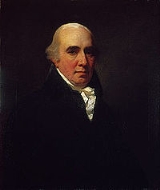
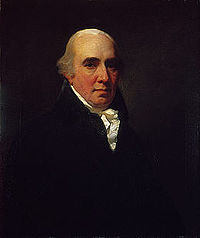
Dugald Stewart

Encyclopedia
Scottish Enlightenment
The Scottish Enlightenment was the period in 18th century Scotland characterised by an outpouring of intellectual and scientific accomplishments. By 1750, Scots were among the most literate citizens of Europe, with an estimated 75% level of literacy...
philosopher and mathematician. His father, Matthew Stewart (1715–1785), was professor of mathematics
Mathematics
Mathematics is the study of quantity, space, structure, and change. Mathematicians seek out patterns and formulate new conjectures. Mathematicians resolve the truth or falsity of conjectures by mathematical proofs, which are arguments sufficient to convince other mathematicians of their validity...
in the University of Edinburgh
University of Edinburgh
The University of Edinburgh, founded in 1583, is a public research university located in Edinburgh, the capital of Scotland, and a UNESCO World Heritage Site. The university is deeply embedded in the fabric of the city, with many of the buildings in the historic Old Town belonging to the university...
(1747–1772).
Life and works
Dugald Stewart was born and educated in Edinburgh at the Royal High SchoolRoyal High School (Edinburgh)
The Royal High School of Edinburgh is a co-educational state school administered by the City of Edinburgh Council. The school was founded in 1128 and is one of the oldest schools in Scotland, and has, throughout its history, been high achieving, consistently attaining well above average exam results...
and the university
University of Edinburgh
The University of Edinburgh, founded in 1583, is a public research university located in Edinburgh, the capital of Scotland, and a UNESCO World Heritage Site. The university is deeply embedded in the fabric of the city, with many of the buildings in the historic Old Town belonging to the university...
, where he read mathematics and moral philosophy under Adam Ferguson
Adam Ferguson
Adam Ferguson FRSE, also known as Ferguson of Raith was a Scottish philosopher, social scientist and historian of the Scottish Enlightenment...
. In 1771, in the hope of gaining a Snell Exhibition and proceeding to Oxford
University of Oxford
The University of Oxford is a university located in Oxford, United Kingdom. It is the second-oldest surviving university in the world and the oldest in the English-speaking world. Although its exact date of foundation is unclear, there is evidence of teaching as far back as 1096...
to study for the English Church, he went to the University of Glasgow to attend the classes of Thomas Reid
Thomas Reid
The Reverend Thomas Reid FRSE , was a religiously trained Scottish philosopher, and a contemporary of David Hume, was the founder of the Scottish School of Common Sense, and played an integral role in the Scottish Enlightenment...
. To Reid he later owed his theory of morality
Morality
Morality is the differentiation among intentions, decisions, and actions between those that are good and bad . A moral code is a system of morality and a moral is any one practice or teaching within a moral code...
, repaying the debt by giving to Reid's views the advantage of his admirable style and academic eloquence. In Glasgow, Stewart boarded in the same house as Archibald Alison
Archibald Alison (Scottish author)
Archibald Alison FRS FRSE was a Scottish episcopalian priest and essayist.-Early life:He was born at Edinburgh on 13 November, 1757, to Patrick Alison, the provost of the Diocese of Edinburgh, himself a younger son of an Alison of Newhall, near Coupar Angus.After studying at the University of...
, author of the Essay on Taste, and a lasting friendship sprang up between them.
After a single session in Glasgow, at the age of nineteen Dugald was summoned by his father, whose health was beginning to fail, to conduct his mathematical classes in the University of Edinburgh
University of Edinburgh
The University of Edinburgh, founded in 1583, is a public research university located in Edinburgh, the capital of Scotland, and a UNESCO World Heritage Site. The university is deeply embedded in the fabric of the city, with many of the buildings in the historic Old Town belonging to the university...
. After acting thus for three years Dugald was elected professor of mathematics in conjunction with his father in 1775. Three years later Adam Ferguson
Adam Ferguson
Adam Ferguson FRSE, also known as Ferguson of Raith was a Scottish philosopher, social scientist and historian of the Scottish Enlightenment...
was appointed secretary to the commissioners sent out to the American colonies, and at his urgent request Stewart lectured as his substitute. Thus during the session 1778–1779, in addition to his mathematical work, he delivered an original course of lectures on morals.
In 1783 he married Helen Bannatyne, who died in 1787, leaving an only son, Colonel Matthew Stewart. In his early years he was influenced by Lord Monboddo, with whom he corresponded.
In 1785 he succeeded Ferguson in the chair of moral philosophy, which he filled for twenty-five years, making it a centre of intellectual and moral influence. Young men were attracted by his reputation from England
England
England is a country that is part of the United Kingdom. It shares land borders with Scotland to the north and Wales to the west; the Irish Sea is to the north west, the Celtic Sea to the south west, with the North Sea to the east and the English Channel to the south separating it from continental...
, Europe and America. Among his pupils were Lord Palmerston, Sir Walter Scott
Walter Scott
Sir Walter Scott, 1st Baronet was a Scottish historical novelist, playwright, and poet, popular throughout much of the world during his time....
, Francis Jeffrey
Francis Jeffrey
Francis Jeffrey, Lord Jeffrey was a Scottish judge and literary critic.He was born in Edinburgh, the son of a clerk in the Court of Session. After attending the Royal High School for six years, he studied at the University of Glasgow from 1787 to May 1789, and at Queen's College, Oxford, from...
, Henry Thomas Cockburn
Henry Thomas Cockburn
Henry Thomas Cockburn, Lord Cockburn was a Scottish lawyer, judge and literary figure. He served as Solicitor General for Scotland between 1830 and 1834.-Background and education:...
, Francis Horner
Francis Horner
Francis Horner was a Scottish Whig MP for St. Ives in 1806, Wendover in 1807, and St. Mawes in 1812 ....
, Sydney Smith
Sydney Smith
Sydney Smith was an English writer and Anglican cleric. -Life:Born in Woodford, Essex, England, Smith was the son of merchant Robert Smith and Maria Olier , who suffered from epilepsy...
, John William Ward, Lord Brougham, Dr. Thomas Brown
Thomas Brown (philosopher)
Thomas Brown FRSE was a Scottish metaphysician.He was born at Kirkmabreck, Kirkcudbright, where his father Rev. Samuel Brown was parish clergyman. He was a wide reader and an eager student...
, James Mill
James Mill
James Mill was a Scottish historian, economist, political theorist, and philosopher. He was a founder of classical economics, together with David Ricardo, and the father of influential philosopher of classical liberalism, John Stuart Mill.-Life:Mill was born at Northwater Bridge, in the parish of...
, Sir James Mackintosh
James Mackintosh
Sir James Mackintosh was a Scottish jurist, politician and historian. His studies and sympathies embraced many interests. He was trained as a doctor and barrister, and worked also as a journalist, judge, administrator, professor, philosopher and politician.-Early life:Mackintosh was born at...
and Sir Archibald Alison
Archibald Alison
Archibald Alison may refer to:*Archibald Alison , Scottish episcopalian priest and essayist*Sir Archibald Alison, 1st Baronet , Scottish lawyer and historian...
.
Stewart's course on moral philosophy embraced, besides ethics
Ethics
Ethics, also known as moral philosophy, is a branch of philosophy that addresses questions about morality—that is, concepts such as good and evil, right and wrong, virtue and vice, justice and crime, etc.Major branches of ethics include:...
proper, lectures on political philosophy
Political philosophy
Political philosophy is the study of such topics as liberty, justice, property, rights, law, and the enforcement of a legal code by authority: what they are, why they are needed, what, if anything, makes a government legitimate, what rights and freedoms it should protect and why, what form it...
or the theory of government, and from 1800 onwards a separate course of lectures was delivered on political economy, then almost unknown as a science. Stewart's enlightened political teaching was sufficient, in the times of reaction succeeding the French Revolution
French Revolution
The French Revolution , sometimes distinguished as the 'Great French Revolution' , was a period of radical social and political upheaval in France and Europe. The absolute monarchy that had ruled France for centuries collapsed in three years...
, to draw upon him the undeserved suspicion of disaffection to the constitution. The summers of 1788 and 1789 he spent in France, where he met Suard, Degbrando, Raynal
Guillaume Thomas François Raynal
Guillaume Thomas Raynal was a French writer and man of letters during the Age of Enlightenment.He was born at Lapanouse in Rouergue...
, and came to sympathize with the revolutionary movement.
In 1790 Stewart married Helen D'Arcy Cranstoun, sister of George Cranstoun. His second wife was well-born and accomplished, and he was in the habit of chewing his nails to her criticism whatever he wrote. They had a son and a daughter, but the son's death in 1809 was a severe blow to his father, and brought about his retirement from the active duties of his chair. Before that, however, Stewart had not been idle as an author. As a student in Glasgow he wrote an essay on Dreaming. In 1792 he published the first volume of the Elements of the Philosophy of the Human Mind; the second volume appeared in 1814, the third not till 1827. In 1793 he printed a textbook, Outlines of Moral Philosophy, which went through many editions; and in the same year he read before the Royal Society of Edinburgh his account of the Life and Writings of Adam Smith
Adam Smith
Adam Smith was a Scottish social philosopher and a pioneer of political economy. One of the key figures of the Scottish Enlightenment, Smith is the author of The Theory of Moral Sentiments and An Inquiry into the Nature and Causes of the Wealth of Nations...
.
Similar memoirs of Robertson the historian and of Reid were afterwards read before the same body and appear in his published works. In 1805 Stewart published pamphlets defending John Leslie
John Leslie (physicist)
Sir John Leslie was a Scottish mathematician and physicist best remembered for his research into heat.Leslie gave the first modern account of capillary action in 1802 and froze water using an air-pump in 1810, the first artificial production of ice.In 1804, he experimented with radiant heat using...
against the charges of unorthodoxy made by the presbytery of Edinburgh. In 1806 he received in lieu of a pension the nominal office of the writership of the Edinburgh Gazette, with a salary of £300. When the shock of his son's death incapacitated him from lecturing during the session of 1809–1810, his place was taken, at his own request, by Dr Thomas Brown, who in 1810 was appointed conjoint professor. On the death of Brown in 1820 Stewart retired altogether from the professorship, which was conferred upon John Wilson
John Wilson (Scottish writer)
John Wilson of Ellerey FRSE was a Scottish advocate, literary critic and author, the writer most frequently identified with the pseudonym Christopher North of Blackwood's Edinburgh Magazine....
, better known as "Christopher North".
From 1809 onwards Stewart lived mainly at Kinneil House
Kinneil House
Kinneil House is a historic house to the west of Bo'ness in east-central Scotland. It was once the principal seat of the Hamilton family in the east of Scotland. The house was saved from demolition in 1936 when 16th-century mural paintings were discovered, and it is now in the care of Historic...
, Bo'ness, which was placed at his disposal by the Duke of Hamilton
Archibald Hamilton, 9th Duke of Hamilton
Archibald Douglas-Hamilton, 9th Duke of Hamilton and 6th Duke of Brandon was a Scottish peer and politician.Hamilton was the eldest son of the 5th Duke of Hamilton and his third wife, Anne, and was educated at Eton...
. In 1810 appeared the Philosophical Essays, in 1814 the second volume of the Elements, in 1811 the first part and in 1821 the second part of the "Dissertation" written for the Encyclopædia Britannica Supplement, entitled "A General View of the Progress of Metaphysical, Ethical, and Political Philosophy since the Revival of Letters."
In June 1814 he was elected a Fellow of the Royal Society
Paralysis
Paralysis is loss of muscle function for one or more muscles. Paralysis can be accompanied by a loss of feeling in the affected area if there is sensory damage as well as motor. A study conducted by the Christopher & Dana Reeve Foundation, suggests that about 1 in 50 people have been diagnosed...
, but recovered a fair degree of health, sufficient to enable him to resume his studies. In 1827 he published the third volume of the Elements, and in 1828, a few weeks before his death, The Philosophy of the Active and Moral Powers. He died in Edinburgh, where he was buried in Canongate Churchyard
Canongate Churchyard
The Canongate Kirkyard stands around Canongate Kirk on the Royal Mile in Edinburgh, Scotland. The churchyard was used for burials from the late 1680s until the mid 20th century....
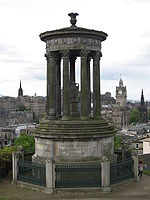
. Additionally, and of greater public note, a monument
Dugald Stewart Monument
The Dugald Stewart Monument is a memorial to the Scottish philosopher Dugald Stewart . It is situated on top of Calton Hill, overlooking Edinburgh city centre....
to his memory was erected on Calton Hill
Calton Hill, Edinburgh
Calton Hill is a hill in central Edinburgh, Scotland, just to the east of the New Town. Views of, and from, the hill are often used in photographs and paintings of the city....
. His memory is also honoured by the newly constructed Dugald Stewart Building at the University of Edinburgh, on Charles Street.
Influence
Stewart was principally responsible for making the "Scottish philosophy" predominant in early 19th-century Europe.http://www.scottishphilosophy.org/dugaldstewart.html In the second half of the century, as with so much of Enlightenment thought, it came to be seen as superseded, and Stewart's work as merely the reproduction of his master Reid, a gross exaggeration. He upheld Reid's psychological method and expounded the "common-sense" doctrine, which was attacked by the two Mills. But part of his originality lay in his readiness to depart from the pure Scottish tradition and incorporate elements of moderate empiricism and the French ideologists (LaromiguièrePierre Laromiguière
Pierre Laromiguière was a French philosopher.He was born at Livignac, and died in Paris. As professor of philosophy at the University of Toulouse, he was unsuccessful and incurred the displeasure of the French parliament by his thesis on the rights of property in connection with taxation...
, Cabanis
Pierre Jean George Cabanis
-Further reading:- Further reading :----...
and Destutt de Tracy
Destutt de Tracy
Antoine Louis Claude Destutt, comte de Tracy was a French Enlightenment aristocrat and philosopher who coined the term "ideology".-Life:The son of a distinguished soldier, Claude Destutt, he was born in Paris...
). It is important to notice the energy of his declaration against the argument of ontology, and also against Condillac
Étienne Bonnot de Condillac
Étienne Bonnot de Condillac was a French philosopher and epistemologist who studied in such areas as psychology and the philosophy of the mind.-Biography:...
's sensationalism. Kant
Immanuel Kant
Immanuel Kant was a German philosopher from Königsberg , researching, lecturing and writing on philosophy and anthropology at the end of the 18th Century Enlightenment....
, he confessed, he could not understand. But his reputation rests as much on his inspiring eloquence, populism, and the beauty of his style as on original work.http://www.scottishphilosophy.org/dugaldstewart.html
Stewart's works were edited in 11 vols. (1854–1858) by Sir William Hamilton
Sir William Hamilton, 9th Baronet
Sir William Hamilton, 9th Baronet was a Scottish metaphysician.-Early life:He was born in Glasgow. He was from an academic family, including Robert Hamilton, the economist...
and completed with a memoir by John Veitch. Matthew Stewart (his eldest son) wrote a life in Annual Biography and Obituary (1829), republished privately in 1838. For his philosophy see McCosh
James McCosh
James McCosh was a prominent philosopher of the Scottish School of Common Sense. He was president of Princeton University 1868-1888.-Biography:...
, Scottish Philosophy (1875), pp. 162–173; A Bain
Alexander Bain
Alexander Bain was a Scottish philosopher and educationalist in the British school of empiricism who was a prominent and innovative figure in the fields of psychology, linguistics, logic, moral philosophy and education reform...
, Mental Science, pp. 208, 313 and app. 29, 65, 88, 89; Moral Science, pp. 639 seq.; Sir L Stephen, English Thought in the XVIII Century.
External links
----