


Public education

Encyclopedia
State schools, also known in the United States
and Canada
as public schools,In much of the Commonwealth, including Australia
, New Zealand
, South Africa
, and the United Kingdom
, the terms 'public education', 'public school' and 'independent school' are used for private school
s, that is, schools primarily funded by tuition, endowment or charitable donations and not through public means. generally refer to primary or secondary schools mandated for or offered to all children by the government
, whether national, regional, or local, provided by an institution of civil government, and paid for, in whole or in part, by state tax
es. The term may also refer to institutions of post-secondary education funded, in whole or in part, and overseen by government.
to twelfth grade, also referred to as primary and secondary education, as well as post-secondary educational institutions such as universities, colleges, and technical schools funded and overseen by government rather than private entities.
State education is inclusive, both in its treatment of students and in that enfranchisement for the government of public education is as broad as for government generally. It is often organized and operated to be a deliberate model of the civil community in which it functions. Although typically provided to groups of students in classrooms in a central school, it may be provided in-home, employing visiting teachers,and/or supervising teachers. It can also be provided in non-school, non-home settings, such as shopping mall space.
State education is generally available to all. In most countries, it is compulsory for children to attend school up to a certain age, but the option of attending private school is open to many. In the case of private school
ing, schools operate independently of the state and generally defray their costs (or even make a profit) by charging parents tuition fees
. The funding for state schools, on the other hand, is provided by tax revenues, so that even individuals who do not attend school (or whose dependents do not attend school) help to ensure that society is educated. In poverty stricken societies, authorities are often lax on compulsory school attendance because the children there are valuable laborers. It is these same children whose income-securing labor cannot be forfeited to allow for school attendance.
The term "public education" when applied to state schools is not synonymous with the term "publicly funded education". Government may make a public policy decision that it wants to have some financial resources distributed in support of, and it may want to have some control over, the provision of private education. Grants-in-aid of private schools and voucher systems provide examples of publicly funded private education. Conversely, a state school (including one run by a school district) may rely heavily on private funding such as high fees or private donations and still be considered state by virtue of governmental ownership and control.
State education often involves the following:
In some countries (such as Germany
), private associations or churches can operate schools according to their own principles, as long as they comply with certain state requirements. When these specific requirements are met, especially in the area of the school curriculum, the schools will qualify to receive state funding. They are then treated financially and for accreditation purposes as part of the state education system, even though they make decisions about hiring and school policy (not hiring atheists, for example), which the state might not make itself.
Proponents of state education assert it to be necessary because of the need in modern society for people who are capable of reading, writing
, and doing basic mathematics. However, some libertarians
argue that education is best left to the private sector; in addition, advocates of alternative forms of education such as unschooling
argue that these same skills can be achieved without subjecting children to state-run compulsory schooling. In most industrialized countries, these views are distinctly in the minority.
. The open schools accept all students from their government-defined catchment areas, and teach using the CSF
. Many open government schools have selective classes in which well performing students are offered extended and accelerated work. Selective government schools are considered more prestigious than open government schools. They have high entrance requirements and cater to a much larger area. Entrance to selective schools is often highly competitive. Some of the renowned selective government schools are Fort Street High School
, Sydney Boys High School
, Sydney Girls High School
, Melbourne High School (2nd in Victoria), Mac.Robertson Girls' High School
(1st in Victoria), James Ruse Agricultural High School
(1st in NSW), Baulkham Hills High School
, North Sydney Girls High School
, Hornsby Girls High School, Adelaide High School
, Brisbane State High School
, Marryatville High School
and Perth Modern School
.
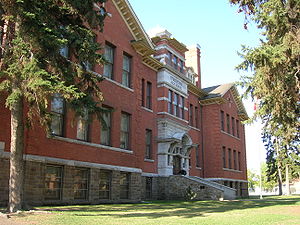 Per the Canadian constitution
, public-school education in Canada is a provincial responsibility and, as such, there are many variations between the provinces. Junior Kindergarten (or equivalent) exists as an official program in only Ontario and Quebec while kindergarten (or equivalent) is available in every province, but provincial funding and the level of hours provided varies widely. Starting at grade one, at about age six there is universal Crown-funded access up to grade twelve (or equivalent). Schools are generally divided into elementary or primary schools (Kindergarten to Grade 8), and secondary, or high school (Grades 9 to 12); in some schools, particularly in rural areas, the elementary and middle levels can be combined into one school. Commencing in 2003, Grade 13, or OAC, was eliminated in Ontario; it had previously been required only for students who intended to go on to university. Children are required to attend school until the age of sixteen in most provinces, while students in Ontario and New Brunswick must attend schools until the age of eighteen.
Some Canadian provinces offer segregated-by-religious-choice, but nonetheless Crown-funded and Crown-regulated, religiously based education. In Ontario
, for example, Roman Catholic schools are known as "Catholic school", not "public school", although these are, by definition, no less "public" than their secular counterparts.
, state schools are funded and administered by the education sector within the government. Although some, especially high schools, have started to charge a fair portion of parents of students an additional tuition fee, due to the increased places offered by the schools in recent years. Top state schools are often very selective, however. Students who miss their entrance requirement may still gain places if they meet a relatively lower requirement and their parents are willing to pay for the additional fees. Some parents appreciate the idea as they may send their children to good schools even though they may not be academically qualified, while others believe that it is not fair for someone who has a background of poverty.
School system is supported today by tax-based government
al and municipal
funding from day care
through primary and secondary education
to higher education and there are no tuition fees for regular students in public schools and universities.
The Danish public primary schools, covering the entire period of compulsory education, are called folkeskoler
(literally 'people's schools' or 'public schools'). The Folkeskole consists of a voluntary pre-school class, the 9-year obligatory course and a voluntary 10th year. It thus caters for pupils aged 6 to 17.
It is also possible for parents to send their children to various kinds of private school
s. These schools also receive government funding, although they are not public. In addition to this funding, these schools may charge a fee from the parents.
, a public school is a non fee-paying school which is funded by the State, while a private school
is also funded by the State but reserved for the elite of the State. The Irish State pays all the teachers in the private sector just as it pays teachers in the public sector. The State also pays for capital expenditure such as buildings in the private sector. The private schools then make this State service exclusive to the elite by imposing fees on an average of 9,000 euro per academic year. Irish law recognises the right of parents to educate their children as they wish and this choice includes private education. However, private education in Ireland, as we can see, is somewhat misleading. It is not entirely private. The State foot the majority of the cost while the main function of the fee is to reserve this type of education for the elite. The fee, combined with State investment in these schools, gives a distinct State supported competitive advantage to these students in the Irish education system. The Irish Leaving Certificate is a State exam taken by all Irish students before they leave secondary school. This exam is the sole and only factor considered for entry into third level education.Many public schools in Ireland teach religion.
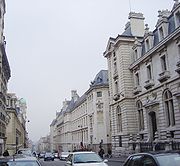 The French educational system is highly centralized, organized, and ramified. It is divided into three stages:
Primary
Schooling in France
is mandatory as of age 6, the first year of primary school. Many parents start sending their children earlier though, around age 3 as kindergarten
classes (maternelle) are usually affiliated to a borough's (commune) primary school. Some even start earlier at age 2 in pré-maternelle or garderie class, which is essentially a daycare facility.
French secondary education is divided into two schools:
The completion of secondary studies leads to the baccalauréat
.
Baccalauréat
The baccalauréat (also known as bac) is the end-of-lycée diploma students sit for in order to enter university
, a Classe Préparatoire aux Grandes Écoles
, or professional life. The term baccalauréat refers to the diploma and the examinations themselves. It is comparable to British
A-Levels, American SAT
s, the Irish
Leaving Certificate
and German
Abitur
.
Most students sit for the baccalauréat général which is divided into 3 streams of study, called séries. The série scientifique (S) is concerned with mathematics
and natural sciences, the série économique et sociale (ES) with economics
and social sciences
, and the série littéraire (L) focuses on French
and foreign languages
and philosophy
.
Tertiary education
A striking trait of higher education in France, compared to other countries such as the United States
, is the small size and multiplicity of establishments, each specialized in a more or less broad spectrum of disciplines. A middle-sized French city, such as Grenoble
or Nancy, may have 2 or 3 universities (for instance: science / humanities), and also a number of engineering and other specialized higher education establishments. For instance, in Paris
and suburbs, there are 13 universities, most of which are specialized on one area or the other, and a large number of smaller institutions.
The Grandes écoles
of France
are higher education establishments outside the mainstream framework of the public universities
. They are generally focused on a single subject area, such as engineering
, have a moderate size, and are often quite (sometimes extremely) selective in their admission of students. They are widely regarded as prestigious, and traditionally have produced most of France's scientists and executives.
is provided to a large extent by the government, with control coming from state level, (Länder
) and funding coming from two levels: federal and state. Curricula, funding, teaching, and other policies are set through the respective state's ministry
of education. Decisions about the acknowledgment of private schools (the German equivalent to accreditation in the US) are also made by these ministries. However, public schools are automatically recognised, since these schools are supervised directly by the ministry of education bureaucracy.
Kindergartens are not part of the German public school system. (Although the first kindergarten in the world was opened in 1840 by Friedrich Wilhelm August Fröbel in the German town of Bad Blankenburg
, and the term Kindergarten is even a loanword
from the German language
). Article 7 Paragraph 6 of the German constitution (the Grundgesetz) abolished pre-school as part of the German school system. However, kindergartens exist all over Germany, where many of these institutions actually are public, but these kindergartens are often community-based and receive an income charging tuition fees and are likewise not considered to be part of the public school system.
A German public school does not charge tuition fees. The first stage of the German public school system is the Grundschule. (Primary School - 1st to 4th grade or, in Berlin
and Brandenburg
, 1st to 6th grade) After Grundschule (at 10 or 12 years of age), there are four secondary schooling options:
A Gesamtschule largely corresponds to an American high school. However, it offers the same school leaving certificates as the other three types of German secondary schools - the Hauptschulabschluss (school leaving certificate of a Hauptschule after 9th Grade or in Berlin and North Rhine-Westphalia after 10th Grade), the Realschulabschluss, also called Mittlere Reife
, (school leaving certificate of a Realschule after 10th Grade) and Abitur, also called Hochschulreife, after 13th or seldom after 12th Grade. Students who graduate from Hauptschule or Realschule continue their schooling at a vocational school until they have full job qualifications.
This type of German school, the Berufsschule, is generally an upper-secondary public vocational school, controlled by the German federal government. It is part of Germany's dual education system
. Students who graduate from a vocational school and students who graduate with good GPA from a Realschule can continue their schooling at another type of German public secondary school, the Fachoberschule, a vocational high school. The school leaving exam of this type of school, the Fachhochschulreife, enables the graduate to start studying at a Fachhochschule
(polytechnic), and in Hesse
also at a university within the state. The Abitur from a Gesamtschule or Gymnasium enables the graduate to start studying at a polytechnic or at a university in all states of Germany.
A number of schools for mature students exists. Schools such as the Abendrealschule
serve students that are headed for the Mittlere Reife
. Schools such as the Aufbaugymnasium
or the Abendgymnasium
prepare students for college and finish with the Abitur
. Those schools are usually free of charge.
In Germany, most institutions of higher education are subsidized by German states and are therefore also referred to as staatliche Hochschulen. (public universities) In some German states, admission to public universities is still cheap, about two hundred Euro per semester, but most of the states introduced additional fees of 500 Euro per semester to achieve a better teaching-quality. Additional fees for guest or graduate students are also charged by many universities.
the term government schools is used for free schools funded by the government.
There are also subsidized schools (which are the majority in Hong Kong and many of which are run by Religious organizations), "Direct Subsidy Scheme" schools, private schools and international schools in Hong Kong. Some schools are international schools, which are not subsidized by the government.
for matters up to the secondary level, and the Ministry of Higher Education
for tertiary education. Although education is the responsibility of the federal government, each state
has an Education Department to help coordinate educational matters in their respective states. The main legislation governing education is the Education Act of 1996.
Education may be obtained from government-sponsored schools, private school
s, or through homeschooling
. By law, primary education
is compulsory
. As in other Asian countries such as Singapore and China, standardised tests are a common feature.
existed in India since antiquity and continues to exist in some regions. After the British rule, a form of British public education system is in place in most places. Other indigenous forms are being revived in various ways across India. According to current estimates, 80% of all schools are government schools making the government the major provider of education. However, because of poor quality of public education, 27% of Indian children are privately educated.
According to some research, private schools often provide superior results at a fraction of the unit cost of government schools.
. Some public schools collects miscellaneous school fees for school activities and for buying school equipments and services.
and Mexico
, the term "public schools" (escuelas públicas in Spanish
, escolas públicas in Portuguese
) is used for educational institutions owned by the federal, state, or city governments which do not charge tuition. Such schools exist in all levels of education, from the very beginning through post-secondary studies. Mexico has nine years of free and compulsory primary and secondary education.
was established in 1560, during the Protestant Reformation
period as the official state religion in Scotland
, and in the following year it set out to provide a school in every parish
controlled by the local kirk-session, with education to be provided free to the poor, and the expectation that church pressure would ensure that all children took part. In the year of 1633 the Parliament of Scotland
introduced local taxation to fund this provision. Schooling was not free, but the tax support kept fees low, and the church and charity funded poorer students. This had considerable success, but by the late 18th century the physical extent of some parishes and population growth in others led to an increasing role for "adventure schools" funded from fees and for schools funded by religious charities, initially Protestant and later Roman Catholic.
In 1872 education for all children aged 5 to 13 was made compulsory with "public schools" (in the Scots meaning of schools for the general public) under local school boards. The leaving age was raised to 14 in 1883, and a Leaving Certificate Examination was introduced in 1888 to set national standards for secondary education. School fees were ended in 1890. The Scottish Education Department ran the system centrally, with local authorities running the schools with considerable autonomy. In 1999, following devolution from the Parliament of the United Kingdom
to the new Scottish Parliament
, central organisation of education was taken over by departments of the Scottish Executive
, with running the schools coming under unitary authority districts
.
In Scotland, the term public school, in official use since 1872, traditionally means "a state-controlled school run by the local burgh or county education authority, genenerally non-fee-paying and supported by contributions from local and national taxation". Largely due to the earlier introduction of state-administered universal education in Scotland and opposed to the rest of the United Kingdom, the term became associated with state schools. The designation was incorporated into the name of many of these older publicly run institutions.
Children in Scottish state schools (or public schools) typically start primary school, or attend a junior school, aged between four and a half and five and a half depending on when the child's birthday falls. Children born between March and August would start school at five years old and those born between September and February start school at age four-and-a-half. Pupils remain at primary school for seven years completing Primary One to Seven.
Then aged eleven or twelve, they start secondary school
for a compulsory four years with the final two years being optional. Pupils sit Standard Grade
exams at the age of fifteen/sixteen, sometimes earlier, most often for up to eight subjects including compulsory exams in English
, mathematics
, a foreign language
, a science
subject and a social subject; it is now required by the Scottish Parliament to have two hours of physical education a week. Each school may vary these compulsory combinations. The school leaving age is generally sixteen (after completion of standard grade), after which students may choose to remain at school and study for Access, Intermediate or Higher Grade and Advanced Higher
exams.
, a state school or government school refers to a school that is state-controlled. These are officially called public schools according to the South African Schools Act of 1996, but it is a term that is not used colloquially. The Act recognised two categories of schools: public and independent. Independent schools include all private schools and schools that are privately governed. Independent schools with low tuition fees are state-aided and receive a subsidy on a sliding-scale. Traditional private schools that charge high fees receive no state subsidy.
State schools are all state-owned, including section 21 schools (formerly referred to as Model C or semi-private schools) that have a governing body and a degree of budget autonomy, as these are still fully owned and accountable to the state.
Compulsory education starts at seven years of age, with an optional year in förskola (pre-school). The Swedish primary school is split into three parts; Lågstadiet – “the low stage”, which covers grades 1 to 3. This is where you learn the basics of the three main subjects – in Swedish called kärnämnen – Swedish, English and mathematics. It also includes some natural science. Mellanstadiet – “the middle stage”, which covers grades 4 to 6, introduces the children to more detailed subjects. Woodwork and needlework, social and domestic science, and even a second, foreign language in grade 6, a B-språk (B-language). The languages available are usually French, Spanish or German depending on the school. Högstadiet, “the high stage”, is the last stage of the compulsory education, between grades 7 and 9. This is when studies get more in-depth and are taken to an international level. Grades 8 and 9 will also introduce marks to the children.
Swedish children take national exams at grades 5 and 9. Children at grade 5 take these exams in the main subjects – Swedish, English and mathematics – while the children at grade 9 take them in natural science and foreign languages as well. Sweden has three different marks: Godkänt (G) – “approved”, Väl godkänt (VG) – “well approved” and Mycket väl godkänt (MVG) – “very well approved”. When applying to gymnasium (high schools) or universities, a meritvärde, “meritous point value”, is calculated. G is worth 10 points, VG 15 points and MVG 20. If a child doesn’t reach the goals in a subject, the mark icke godkänt (IG), which means “not approved”, is set. Children not being accepted in Swedish, English and mathematics will have to study at a special high school program called the “individual program”. Once they are accepted, they may apply to an ordinary high school program. Swedes study at high school for three years, between the ages of 16 and 18.
, the term "state school" refers to government-funded schools which provide education free of charge to pupils. The contrast to this are fee-paying schools, often called "independent schools", "private school
s" or "public schools".
According to the Good Schools Guide,
However, this is not strictly correct as state boarding schools charge fees for the boarding element of approximately £8-10 K pa: see List of state boarding schools in England and Wales.
In England
and Wales
the term "public school" is often used to refer to fee-paying schools. "Public" is used here in a somewhat archaic sense, meaning that they are open to any member of the public, distinguished from religious schools which are open only to members of that religion. Some people call only the older fee-paying schools, "public schools" (for example, schools such as Eton College
and Charterhouse School
), while others use the term for any such school.
In Scotland
, where the educational system is completely different from the rest of UK, the term "public school" in Scottish English
and Scots
is only used to describe Scottish state funded schools (since they are publicly owned) – although, in the media preference is now being given to the term "state funded school" to avoid confusion with the English term. However, Scottish people will sometimes use the term "public school" when referring to a private school located in England. The Scottish term for the what is known in the rest of the UK as a "public school" is "private school" or "independent school". Use of "public school" to denote state funded schools within Scotland is sometimes confusing for speakers of English from other parts of the UK. The Scottish use of the term has found favour abroad, particularly in the United States
and Canada
.
The National Curriculum is followed in all local authority maintained schools in England, Northern Ireland
and Wales. State schools in Wales, including Welsh-medium schools, are controlled by the Welsh Government. Academies, which are state schools, but not maintained by local authorities, have more freedom to adapt the National Curriculum. In Northern Ireland secondary-level
schools are divided into Grammar schools, Secondary schools
and Catholic-maintained schools
, with an increasing number of Integrated schools
. There are also a small number of voluntary Irish Language
schools.
Throughout education in the UK, the vast majority of state-funded schools are under the control of local councils (Local Education Authorities
in England and Wales
, Department of Education
in Northern Ireland
), and are referred to in official literature as "maintained schools". The exceptions are a minority of secondary schools in England funded directly by central government, known as academies and City Technology College
s.
Some state schools, known as faith schools, have formal links with religious organisations, and are permitted to promote a particular religious ethos and to use faith criteria in their admissions. Some maintained schools are partially funded by religious or other charitable bodies; these are known as voluntary controlled school
s, voluntary aided school
s or foundation school
s.
The oldest state school in England is Beverley Grammar School
, which was founded in 700
AD.
The range of achievement in English state schools is enormous. See Education in England
.
, a college or university in a state university system. The term "public school" is used for primary and secondary schools which are funded and/or run by a governmental entity.
Public schools in the United States are administered at the federal level by the United States Department of Education
, at the state level by state education agencies
, and at the local level by local education agencies
. Most states employ this three-tiered model of educational governance. There is usually a state superintendent of schools
, who is elected to coordinate the state department of education, the state board of education, and the state legislature itself. Statewide education policies are disseminated to school "districts" or their equivalents. These are associated with counties, or with groups of counties; but their boundaries are not necessarily coterminous with county boundaries. These intermediate school district comprise many local (city- or township-level) school districts.
In most states, the county and regional "intermediate" school districts and their boards implement state education policy, and provide the channels through which a local district communicates with a state-level board of education, superintendent and department of education.
Local school district
s are administered by local school boards, which operate public primary and secondary school
s within their boundaries. Since public schools are funded by taxpayers, members of school boards are democratically elected to represent the public's interest. The authority of school boards is limited to taxpayer-funded schools. Therefore, schools which receive no taxpayer funding, including privately funded, parochial (religiously affiliated) and home schools are not required to abide by school-board policies. (Homeschooling laws vary from state to state.)
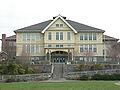 Public schools are provided mainly by local governments. Curricula, funding, teaching, and other policies are set through locally elected school boards by jurisdiction over school district
s. The school districts are special-purpose district
s authorized by provisions of state law. Generally, state governments can and do set minimum standards relating to almost all activities of primary and secondary schools, as well as funding and authorization to enact local school taxes to support the schools—primarily through real property taxes. The federal government funds aid to states and school districts that meet minimum federal standards. School accreditation decisions are made by voluntary regional associations. The first free public school in America was the Syms-Eaton Academy
(1634) in Hampton, Virginia
, while the first tax-supported public school in America was in Dedham, Massachusetts
. In the United States, 88% of students attend public schools, compared with 9% who attend parochial school
s, 1% who attend private independent school
s, and 2% who are home-schooled.
Public school is normally split up into three stages: elementary
school (kindergarten
to 5th or 6th grade), middle
("intermediate" or junior high school) from 5th or 6th grade to 8th or 9th grade, and high school
(9th to 12th grade).
The middle school format is increasingly common, in which the elementary school contains kindergarten through 6th grade and the Middle School contains 7th through 8th grade. In addition, some elementary schools are splitting into two levels, sometimes in separate buildings: primary school (usually K-2) and intermediate (3-5).
The K-8th format is also an emerging popular concept, in which students may attend only two schools for all of their K-12 education. Many charter school
s feature the K-8 format in which all primary grades are housed in one section of the school while the traditional junior high school aged students are housed in another section of the school. Some very small school districts, primarily in rural areas, still maintain a K-12 system in which all students are housed in a single school.
In the United States
, institutions of higher education
that are operated and subsidized by U.S. states are also referred to as "public." However, unlike public secondary schools, public universities
charge tuition, though these fees are usually much lower than those charged by private universities
, particularly for "in-state" students. Community college
s, state colleges, and state universities
are examples of public institutions of higher education. In particular, many state universities are regarded as among the best institutions of higher education in the U.S., though usually they are surpassed in ranking by certain private universities and colleges, such as those of the Ivy League
, which are often very expensive and extremely selective in the students they accept. In several states, the administrations of public universities are elected via the general electoral ballot.
United States
The United States of America is a federal constitutional republic comprising fifty states and a federal district...
and Canada
Canada
Canada is a North American country consisting of ten provinces and three territories. Located in the northern part of the continent, it extends from the Atlantic Ocean in the east to the Pacific Ocean in the west, and northward into the Arctic Ocean...
as public schools,In much of the Commonwealth, including Australia
Australia
Australia , officially the Commonwealth of Australia, is a country in the Southern Hemisphere comprising the mainland of the Australian continent, the island of Tasmania, and numerous smaller islands in the Indian and Pacific Oceans. It is the world's sixth-largest country by total area...
, New Zealand
New Zealand
New Zealand is an island country in the south-western Pacific Ocean comprising two main landmasses and numerous smaller islands. The country is situated some east of Australia across the Tasman Sea, and roughly south of the Pacific island nations of New Caledonia, Fiji, and Tonga...
, South Africa
South Africa
The Republic of South Africa is a country in southern Africa. Located at the southern tip of Africa, it is divided into nine provinces, with of coastline on the Atlantic and Indian oceans...
, and the United Kingdom
United Kingdom
The United Kingdom of Great Britain and Northern IrelandIn the United Kingdom and Dependencies, other languages have been officially recognised as legitimate autochthonous languages under the European Charter for Regional or Minority Languages...
, the terms 'public education', 'public school' and 'independent school' are used for private school
Private school
Private schools, also known as independent schools or nonstate schools, are not administered by local, state or national governments; thus, they retain the right to select their students and are funded in whole or in part by charging their students' tuition, rather than relying on mandatory...
s, that is, schools primarily funded by tuition, endowment or charitable donations and not through public means. generally refer to primary or secondary schools mandated for or offered to all children by the government
Government
Government refers to the legislators, administrators, and arbitrators in the administrative bureaucracy who control a state at a given time, and to the system of government by which they are organized...
, whether national, regional, or local, provided by an institution of civil government, and paid for, in whole or in part, by state tax
Tax
To tax is to impose a financial charge or other levy upon a taxpayer by a state or the functional equivalent of a state such that failure to pay is punishable by law. Taxes are also imposed by many subnational entities...
es. The term may also refer to institutions of post-secondary education funded, in whole or in part, and overseen by government.
General characteristics
This includes basic education, kindergartenKindergarten
A kindergarten is a preschool educational institution for children. The term was created by Friedrich Fröbel for the play and activity institute that he created in 1837 in Bad Blankenburg as a social experience for children for their transition from home to school...
to twelfth grade, also referred to as primary and secondary education, as well as post-secondary educational institutions such as universities, colleges, and technical schools funded and overseen by government rather than private entities.
State education is inclusive, both in its treatment of students and in that enfranchisement for the government of public education is as broad as for government generally. It is often organized and operated to be a deliberate model of the civil community in which it functions. Although typically provided to groups of students in classrooms in a central school, it may be provided in-home, employing visiting teachers,and/or supervising teachers. It can also be provided in non-school, non-home settings, such as shopping mall space.
State education is generally available to all. In most countries, it is compulsory for children to attend school up to a certain age, but the option of attending private school is open to many. In the case of private school
Private school
Private schools, also known as independent schools or nonstate schools, are not administered by local, state or national governments; thus, they retain the right to select their students and are funded in whole or in part by charging their students' tuition, rather than relying on mandatory...
ing, schools operate independently of the state and generally defray their costs (or even make a profit) by charging parents tuition fees
Tuition
Tuition payments, known primarily as tuition in American English and as tuition fees in British English, Canadian English, Australian English, New Zealand English and Indian English, refers to a fee charged for educational instruction during higher education.Tuition payments are charged by...
. The funding for state schools, on the other hand, is provided by tax revenues, so that even individuals who do not attend school (or whose dependents do not attend school) help to ensure that society is educated. In poverty stricken societies, authorities are often lax on compulsory school attendance because the children there are valuable laborers. It is these same children whose income-securing labor cannot be forfeited to allow for school attendance.
The term "public education" when applied to state schools is not synonymous with the term "publicly funded education". Government may make a public policy decision that it wants to have some financial resources distributed in support of, and it may want to have some control over, the provision of private education. Grants-in-aid of private schools and voucher systems provide examples of publicly funded private education. Conversely, a state school (including one run by a school district) may rely heavily on private funding such as high fees or private donations and still be considered state by virtue of governmental ownership and control.
State education often involves the following:
- compulsory student attendanceCompulsory educationCompulsory education refers to a period of education that is required of all persons.-Antiquity to Medieval Era:Although Plato's The Republic is credited with having popularized the concept of compulsory education in Western intellectual thought, every parent in Judea since Moses's Covenant with...
(until a certain age or standard is achieved); - certification of teachers and curricula, either by the government or by a teachers' organization;
- testing and standards provided by government.
In some countries (such as Germany
Germany
Germany , officially the Federal Republic of Germany , is a federal parliamentary republic in Europe. The country consists of 16 states while the capital and largest city is Berlin. Germany covers an area of 357,021 km2 and has a largely temperate seasonal climate...
), private associations or churches can operate schools according to their own principles, as long as they comply with certain state requirements. When these specific requirements are met, especially in the area of the school curriculum, the schools will qualify to receive state funding. They are then treated financially and for accreditation purposes as part of the state education system, even though they make decisions about hiring and school policy (not hiring atheists, for example), which the state might not make itself.
Proponents of state education assert it to be necessary because of the need in modern society for people who are capable of reading, writing
Writing
Writing is the representation of language in a textual medium through the use of a set of signs or symbols . It is distinguished from illustration, such as cave drawing and painting, and non-symbolic preservation of language via non-textual media, such as magnetic tape audio.Writing most likely...
, and doing basic mathematics. However, some libertarians
Libertarianism
Libertarianism, in the strictest sense, is the political philosophy that holds individual liberty as the basic moral principle of society. In the broadest sense, it is any political philosophy which approximates this view...
argue that education is best left to the private sector; in addition, advocates of alternative forms of education such as unschooling
Unschooling
Unschooling is a range of educational philosophies and practices centered on allowing children to learn through their natural life experiences, including play, game play, household responsibilities, work experience, and social interaction, rather than through a more traditional school curriculum....
argue that these same skills can be achieved without subjecting children to state-run compulsory schooling. In most industrialized countries, these views are distinctly in the minority.
Australia
Government (or state) schools are run by the respective state government. They offer free education ;however, many schools ask parents to pay a voluntary contribution fee. They can be divided into two categories: open and selective schoolSelective school
A selective school is a school that admits students on the basis of some sort of selection criteria, usually academic. The term may have different connotations in different systems....
. The open schools accept all students from their government-defined catchment areas, and teach using the CSF
Curriculum
See also Syllabus.In formal education, a curriculum is the set of courses, and their content, offered at a school or university. As an idea, curriculum stems from the Latin word for race course, referring to the course of deeds and experiences through which children grow to become mature adults...
. Many open government schools have selective classes in which well performing students are offered extended and accelerated work. Selective government schools are considered more prestigious than open government schools. They have high entrance requirements and cater to a much larger area. Entrance to selective schools is often highly competitive. Some of the renowned selective government schools are Fort Street High School
Fort Street High School
Fort Street High School is a co-educational, academically selective, public high school currently located at Petersham, an inner western suburb of Sydney, New South Wales, Australia....
, Sydney Boys High School
Sydney Boys High School
Sydney Boys High School is an academically selective public secondary school for boys, located in the City of Sydney, Sydney, New South Wales, Australia, with 1,180 students, from years 7 to 12...
, Sydney Girls High School
Sydney Girls High School
Sydney Girls High School is an academically selective, Public high school for girls, located at Moore Park, in the Eastern Suburbs of Sydney, New South Wales, Australia....
, Melbourne High School (2nd in Victoria), Mac.Robertson Girls' High School
Mac.Robertson Girls' High School
The Mac.Robertson Girls' High School is an academically selective, public high school for girls, located in the city of Melbourne, Victoria, Australia....
(1st in Victoria), James Ruse Agricultural High School
James Ruse Agricultural High School
James Ruse Agricultural High School is one of four New South Wales Government agricultural high schools. It is a selective, co-educational public high school located at Carlingford, New South Wales, Australia...
(1st in NSW), Baulkham Hills High School
Baulkham Hills High School
Baulkham Hills High School is an academically selective high school located in Baulkham Hills. The school was established in 1971 by the New South Wales Department of Education and Training, and currently caters for approximately 1200 students from Years 7 to 12.The school is noted for its...
, North Sydney Girls High School
North Sydney Girls High School
North Sydney Girls High School is an academically selective, public high school for girls, located at Crows Nest, on the Lower North Shore of Sydney, New South Wales, Australia....
, Hornsby Girls High School, Adelaide High School
Adelaide High School
Adelaide High School is a coeducational state high school situated on the corner of West Terrace and Glover Avenue in the Adelaide Parklands. It is the first government high school in South Australia...
, Brisbane State High School
Brisbane State High School
Brisbane State High School is a partially selective, co-educational, state secondary school, located in Brisbane, Queensland, Australia. It is a member of the Great Public Schools' Association of Queensland, and the Queensland Girls' Secondary Schools Sports Association...
, Marryatville High School
Marryatville High School
Marryatville High School is a public state school in Adelaide, South Australia. It was founded in 1976 during the Don Dunstan era of South Australia and was formed out of the old Norwood Boys Technical High School. The school is situated on a large area of land in the eastern suburb of...
and Perth Modern School
Perth Modern School
Perth Modern School is an academically-selective co-educational public high school located in Subiaco, an inner city suburb of Perth, Western Australia.The school, established in 1911, now caters for students with high academic ability....
.
Canada
Constitution of Canada
The Constitution of Canada is the supreme law in Canada; the country's constitution is an amalgamation of codified acts and uncodified traditions and conventions. It outlines Canada's system of government, as well as the civil rights of all Canadian citizens and those in Canada...
, public-school education in Canada is a provincial responsibility and, as such, there are many variations between the provinces. Junior Kindergarten (or equivalent) exists as an official program in only Ontario and Quebec while kindergarten (or equivalent) is available in every province, but provincial funding and the level of hours provided varies widely. Starting at grade one, at about age six there is universal Crown-funded access up to grade twelve (or equivalent). Schools are generally divided into elementary or primary schools (Kindergarten to Grade 8), and secondary, or high school (Grades 9 to 12); in some schools, particularly in rural areas, the elementary and middle levels can be combined into one school. Commencing in 2003, Grade 13, or OAC, was eliminated in Ontario; it had previously been required only for students who intended to go on to university. Children are required to attend school until the age of sixteen in most provinces, while students in Ontario and New Brunswick must attend schools until the age of eighteen.
Some Canadian provinces offer segregated-by-religious-choice, but nonetheless Crown-funded and Crown-regulated, religiously based education. In Ontario
Ontario
Ontario is a province of Canada, located in east-central Canada. It is Canada's most populous province and second largest in total area. It is home to the nation's most populous city, Toronto, and the nation's capital, Ottawa....
, for example, Roman Catholic schools are known as "Catholic school", not "public school", although these are, by definition, no less "public" than their secular counterparts.
China
In ChinaChina
Chinese civilization may refer to:* China for more general discussion of the country.* Chinese culture* Greater China, the transnational community of ethnic Chinese.* History of China* Sinosphere, the area historically affected by Chinese culture...
, state schools are funded and administered by the education sector within the government. Although some, especially high schools, have started to charge a fair portion of parents of students an additional tuition fee, due to the increased places offered by the schools in recent years. Top state schools are often very selective, however. Students who miss their entrance requirement may still gain places if they meet a relatively lower requirement and their parents are willing to pay for the additional fees. Some parents appreciate the idea as they may send their children to good schools even though they may not be academically qualified, while others believe that it is not fair for someone who has a background of poverty.
Denmark
The DanishDenmark
Denmark is a Scandinavian country in Northern Europe. The countries of Denmark and Greenland, as well as the Faroe Islands, constitute the Kingdom of Denmark . It is the southernmost of the Nordic countries, southwest of Sweden and south of Norway, and bordered to the south by Germany. Denmark...
School system is supported today by tax-based government
Government
Government refers to the legislators, administrators, and arbitrators in the administrative bureaucracy who control a state at a given time, and to the system of government by which they are organized...
al and municipal
Municipalities of Denmark
This is a list of Municipalities of Denmark.-Region Hovedstaden:* Albertslund Municipality* Allerød Municipality* Ballerup Municipality* Bornholm Regional Municipality* Brøndby Municipality* Copenhagen Municipality* Dragør Municipality* Egedal Municipality...
funding from day care
Danish Pre-School Education
Pre-school Education in Denmark takes place in different types of schools or day care centres covering the time before children enter compulsory education...
through primary and secondary education
Secondary education in Denmark
Secondary education in Denmark usually takes two to four years and is attended by students between the ages of 15 and 20. Secondary education is not compulsory, but usually free of charge, and students have a wide range of programmes to choose from...
to higher education and there are no tuition fees for regular students in public schools and universities.
The Danish public primary schools, covering the entire period of compulsory education, are called folkeskoler
Danish Folkeskole Education
The Folkeskole is one type of school in Denmark, covering the entire period of compulsory education. This form of education cannot, as in the case of many other nations' education systems, be divided into primary and secondary education....
(literally 'people's schools' or 'public schools'). The Folkeskole consists of a voluntary pre-school class, the 9-year obligatory course and a voluntary 10th year. It thus caters for pupils aged 6 to 17.
It is also possible for parents to send their children to various kinds of private school
Private school
Private schools, also known as independent schools or nonstate schools, are not administered by local, state or national governments; thus, they retain the right to select their students and are funded in whole or in part by charging their students' tuition, rather than relying on mandatory...
s. These schools also receive government funding, although they are not public. In addition to this funding, these schools may charge a fee from the parents.
Ireland
In IrelandRepublic of Ireland
Ireland , described as the Republic of Ireland , is a sovereign state in Europe occupying approximately five-sixths of the island of the same name. Its capital is Dublin. Ireland, which had a population of 4.58 million in 2011, is a constitutional republic governed as a parliamentary democracy,...
, a public school is a non fee-paying school which is funded by the State, while a private school
Private school
Private schools, also known as independent schools or nonstate schools, are not administered by local, state or national governments; thus, they retain the right to select their students and are funded in whole or in part by charging their students' tuition, rather than relying on mandatory...
is also funded by the State but reserved for the elite of the State. The Irish State pays all the teachers in the private sector just as it pays teachers in the public sector. The State also pays for capital expenditure such as buildings in the private sector. The private schools then make this State service exclusive to the elite by imposing fees on an average of 9,000 euro per academic year. Irish law recognises the right of parents to educate their children as they wish and this choice includes private education. However, private education in Ireland, as we can see, is somewhat misleading. It is not entirely private. The State foot the majority of the cost while the main function of the fee is to reserve this type of education for the elite. The fee, combined with State investment in these schools, gives a distinct State supported competitive advantage to these students in the Irish education system. The Irish Leaving Certificate is a State exam taken by all Irish students before they leave secondary school. This exam is the sole and only factor considered for entry into third level education.Many public schools in Ireland teach religion.
France
- primary education (enseignement primaire);
- secondary education (enseignement secondaire);
- tertiary or college education (enseignement supérieur)
Primary
Schooling in France
France
The French Republic , The French Republic , The French Republic , (commonly known as France , is a unitary semi-presidential republic in Western Europe with several overseas territories and islands located on other continents and in the Indian, Pacific, and Atlantic oceans. Metropolitan France...
is mandatory as of age 6, the first year of primary school. Many parents start sending their children earlier though, around age 3 as kindergarten
Kindergarten
A kindergarten is a preschool educational institution for children. The term was created by Friedrich Fröbel for the play and activity institute that he created in 1837 in Bad Blankenburg as a social experience for children for their transition from home to school...
classes (maternelle) are usually affiliated to a borough's (commune) primary school. Some even start earlier at age 2 in pré-maternelle or garderie class, which is essentially a daycare facility.
French secondary education is divided into two schools:
- the collège for the first four years directly following primary school;
- the lycée for the next three years.
The completion of secondary studies leads to the baccalauréat
Baccalauréat
The baccalauréat , often known in France colloquially as le bac, is an academic qualification which French and international students take at the end of the lycée . It was introduced by Napoleon I in 1808. It is the main diploma required to pursue university studies...
.
Baccalauréat
The baccalauréat (also known as bac) is the end-of-lycée diploma students sit for in order to enter university
University
A university is an institution of higher education and research, which grants academic degrees in a variety of subjects. A university is an organisation that provides both undergraduate education and postgraduate education...
, a Classe Préparatoire aux Grandes Écoles
Classe Préparatoire aux Grandes Écoles
The classes préparatoires aux grandes écoles , commonly called classes prépas or prépas, are part of the French post-secondary education system. They consist in two very selective years , acting as a prep course with the main goal of training undergraduate students for enrolment in one of the...
, or professional life. The term baccalauréat refers to the diploma and the examinations themselves. It is comparable to British
United Kingdom
The United Kingdom of Great Britain and Northern IrelandIn the United Kingdom and Dependencies, other languages have been officially recognised as legitimate autochthonous languages under the European Charter for Regional or Minority Languages...
A-Levels, American SAT
SAT
The SAT Reasoning Test is a standardized test for college admissions in the United States. The SAT is owned, published, and developed by the College Board, a nonprofit organization in the United States. It was formerly developed, published, and scored by the Educational Testing Service which still...
s, the Irish
Republic of Ireland
Ireland , described as the Republic of Ireland , is a sovereign state in Europe occupying approximately five-sixths of the island of the same name. Its capital is Dublin. Ireland, which had a population of 4.58 million in 2011, is a constitutional republic governed as a parliamentary democracy,...
Leaving Certificate
Leaving Certificate
The Leaving Certificate Examinations , commonly referred to as the Leaving Cert is the final examination in the Irish secondary school system. It takes a minimum of two years preparation, but an optional Transition Year means that for those students it takes place three years after the Junior...
and German
Germany
Germany , officially the Federal Republic of Germany , is a federal parliamentary republic in Europe. The country consists of 16 states while the capital and largest city is Berlin. Germany covers an area of 357,021 km2 and has a largely temperate seasonal climate...
Abitur
Abitur
Abitur is a designation used in Germany, Finland and Estonia for final exams that pupils take at the end of their secondary education, usually after 12 or 13 years of schooling, see also for Germany Abitur after twelve years.The Zeugnis der Allgemeinen Hochschulreife, often referred to as...
.
Most students sit for the baccalauréat général which is divided into 3 streams of study, called séries. The série scientifique (S) is concerned with mathematics
Mathematics
Mathematics is the study of quantity, space, structure, and change. Mathematicians seek out patterns and formulate new conjectures. Mathematicians resolve the truth or falsity of conjectures by mathematical proofs, which are arguments sufficient to convince other mathematicians of their validity...
and natural sciences, the série économique et sociale (ES) with economics
Economics
Economics is the social science that analyzes the production, distribution, and consumption of goods and services. The term economics comes from the Ancient Greek from + , hence "rules of the house"...
and social sciences
Social sciences
Social science is the field of study concerned with society. "Social science" is commonly used as an umbrella term to refer to a plurality of fields outside of the natural sciences usually exclusive of the administrative or managerial sciences...
, and the série littéraire (L) focuses on French
French language
French is a Romance language spoken as a first language in France, the Romandy region in Switzerland, Wallonia and Brussels in Belgium, Monaco, the regions of Quebec and Acadia in Canada, and by various communities elsewhere. Second-language speakers of French are distributed throughout many parts...
and foreign languages
Language
Language may refer either to the specifically human capacity for acquiring and using complex systems of communication, or to a specific instance of such a system of complex communication...
and philosophy
Philosophy
Philosophy is the study of general and fundamental problems, such as those connected with existence, knowledge, values, reason, mind, and language. Philosophy is distinguished from other ways of addressing such problems by its critical, generally systematic approach and its reliance on rational...
.
Tertiary education
- Peculiarities
A striking trait of higher education in France, compared to other countries such as the United States
United States
The United States of America is a federal constitutional republic comprising fifty states and a federal district...
, is the small size and multiplicity of establishments, each specialized in a more or less broad spectrum of disciplines. A middle-sized French city, such as Grenoble
Grenoble
Grenoble is a city in southeastern France, at the foot of the French Alps where the river Drac joins the Isère. Located in the Rhône-Alpes region, Grenoble is the capital of the department of Isère...
or Nancy, may have 2 or 3 universities (for instance: science / humanities), and also a number of engineering and other specialized higher education establishments. For instance, in Paris
Paris
Paris is the capital and largest city in France, situated on the river Seine, in northern France, at the heart of the Île-de-France region...
and suburbs, there are 13 universities, most of which are specialized on one area or the other, and a large number of smaller institutions.
- Grandes écoles & classes préparatoires (CPGE : Classes Préparatoires aux Grandes Ecoles)
The Grandes écoles
Grandes écoles
The grandes écoles of France are higher education establishments outside the main framework of the French university system. The grandes écoles select students for admission based chiefly on national ranking in competitive written and oral exams...
of France
France
The French Republic , The French Republic , The French Republic , (commonly known as France , is a unitary semi-presidential republic in Western Europe with several overseas territories and islands located on other continents and in the Indian, Pacific, and Atlantic oceans. Metropolitan France...
are higher education establishments outside the mainstream framework of the public universities
University
A university is an institution of higher education and research, which grants academic degrees in a variety of subjects. A university is an organisation that provides both undergraduate education and postgraduate education...
. They are generally focused on a single subject area, such as engineering
Engineering
Engineering is the discipline, art, skill and profession of acquiring and applying scientific, mathematical, economic, social, and practical knowledge, in order to design and build structures, machines, devices, systems, materials and processes that safely realize improvements to the lives of...
, have a moderate size, and are often quite (sometimes extremely) selective in their admission of students. They are widely regarded as prestigious, and traditionally have produced most of France's scientists and executives.
Germany
Education in GermanyGermany
Germany , officially the Federal Republic of Germany , is a federal parliamentary republic in Europe. The country consists of 16 states while the capital and largest city is Berlin. Germany covers an area of 357,021 km2 and has a largely temperate seasonal climate...
is provided to a large extent by the government, with control coming from state level, (Länder
States of Germany
Germany is made up of sixteen which are partly sovereign constituent states of the Federal Republic of Germany. Land literally translates as "country", and constitutionally speaking, they are constituent countries...
) and funding coming from two levels: federal and state. Curricula, funding, teaching, and other policies are set through the respective state's ministry
Ministry (government department)
A ministry is a specialised organisation responsible for a sector of government public administration, sometimes led by a minister or a senior public servant, that can have responsibility for one or more departments, agencies, bureaus, commissions or other smaller executive, advisory, managerial or...
of education. Decisions about the acknowledgment of private schools (the German equivalent to accreditation in the US) are also made by these ministries. However, public schools are automatically recognised, since these schools are supervised directly by the ministry of education bureaucracy.
Kindergartens are not part of the German public school system. (Although the first kindergarten in the world was opened in 1840 by Friedrich Wilhelm August Fröbel in the German town of Bad Blankenburg
Bad Blankenburg
Bad Blankenburg is a spa town in the district of Saalfeld-Rudolstadt, in Thuringia, Germany. It is situated 6 km southwest of Rudolstadt, and 37 km southeast of Erfurt....
, and the term Kindergarten is even a loanword
Loanword
A loanword is a word borrowed from a donor language and incorporated into a recipient language. By contrast, a calque or loan translation is a related concept where the meaning or idiom is borrowed rather than the lexical item itself. The word loanword is itself a calque of the German Lehnwort,...
from the German language
German language
German is a West Germanic language, related to and classified alongside English and Dutch. With an estimated 90 – 98 million native speakers, German is one of the world's major languages and is the most widely-spoken first language in the European Union....
). Article 7 Paragraph 6 of the German constitution (the Grundgesetz) abolished pre-school as part of the German school system. However, kindergartens exist all over Germany, where many of these institutions actually are public, but these kindergartens are often community-based and receive an income charging tuition fees and are likewise not considered to be part of the public school system.
A German public school does not charge tuition fees. The first stage of the German public school system is the Grundschule. (Primary School - 1st to 4th grade or, in Berlin
Berlin
Berlin is the capital city of Germany and is one of the 16 states of Germany. With a population of 3.45 million people, Berlin is Germany's largest city. It is the second most populous city proper and the seventh most populous urban area in the European Union...
and Brandenburg
Brandenburg
Brandenburg is one of the sixteen federal-states of Germany. It lies in the east of the country and is one of the new federal states that were re-created in 1990 upon the reunification of the former West Germany and East Germany. The capital is Potsdam...
, 1st to 6th grade) After Grundschule (at 10 or 12 years of age), there are four secondary schooling options:
- HauptschuleHauptschuleA Hauptschule is a secondary school in Germany and Austria, starting after 4 years of elementary schooling, which offers Lower Secondary Education according to the International Standard Classification of Education...
(the least academic, much like a modernized Volksschule) until 9th or, in Berlin and North Rhine-WestphaliaNorth Rhine-WestphaliaNorth Rhine-Westphalia is the most populous state of Germany, with four of the country's ten largest cities. The state was formed in 1946 as a merger of the northern Rhineland and Westphalia, both formerly part of Prussia. Its capital is Düsseldorf. The state is currently run by a coalition of the...
until 10th Grade. The students attending those type of school may be awarded the Hauptschulabschluss or in some cases also the Mittlere ReifeMittlere ReifeThe Mittlere Reife is a school leaving certificate in Germany that is roughly comparable with the American high school diploma. It is regularly awarded after ten years of schooling.... - RealschuleRealschuleThe Realschule is a type of secondary school in Germany, Austria, Switzerland, and Liechtenstein. It has also existed in Croatia , Denmark , Sweden , Hungary and in the Russian Empire .-History:The Realschule was an outgrowth of the rationalism and empiricism of the seventeenth and...
(formerly Mittelschule) until 10th grade, usually awards the Mittlere ReifeMittlere ReifeThe Mittlere Reife is a school leaving certificate in Germany that is roughly comparable with the American high school diploma. It is regularly awarded after ten years of schooling.... - GymnasiumGymnasium (school)A gymnasium is a type of school providing secondary education in some parts of Europe, comparable to English grammar schools or sixth form colleges and U.S. college preparatory high schools. The word γυμνάσιον was used in Ancient Greece, meaning a locality for both physical and intellectual...
(high school) until 12th grade or 13th grade (with AbiturAbiturAbitur is a designation used in Germany, Finland and Estonia for final exams that pupils take at the end of their secondary education, usually after 12 or 13 years of schooling, see also for Germany Abitur after twelve years.The Zeugnis der Allgemeinen Hochschulreife, often referred to as...
as exit exam, qualifying for admission to university). - Gesamtschule (comprehensive school) with all the options of the three "tracks" above.
A Gesamtschule largely corresponds to an American high school. However, it offers the same school leaving certificates as the other three types of German secondary schools - the Hauptschulabschluss (school leaving certificate of a Hauptschule after 9th Grade or in Berlin and North Rhine-Westphalia after 10th Grade), the Realschulabschluss, also called Mittlere Reife
Mittlere Reife
The Mittlere Reife is a school leaving certificate in Germany that is roughly comparable with the American high school diploma. It is regularly awarded after ten years of schooling....
, (school leaving certificate of a Realschule after 10th Grade) and Abitur, also called Hochschulreife, after 13th or seldom after 12th Grade. Students who graduate from Hauptschule or Realschule continue their schooling at a vocational school until they have full job qualifications.
This type of German school, the Berufsschule, is generally an upper-secondary public vocational school, controlled by the German federal government. It is part of Germany's dual education system
Dual education system
A dual education system combines apprenticeships in a company and vocational education at a vocational school in one course. This system is practiced in several countries, notably Germany, Austria, Bosnia and Herzegovina, Croatia, Serbia, Slovenia, Macedonia, Montenegro and Switzerland, but also...
. Students who graduate from a vocational school and students who graduate with good GPA from a Realschule can continue their schooling at another type of German public secondary school, the Fachoberschule, a vocational high school. The school leaving exam of this type of school, the Fachhochschulreife, enables the graduate to start studying at a Fachhochschule
Fachhochschule
A Fachhochschule or University of Applied Sciences is a German type of tertiary education institution, sometimes specialized in certain topical areas . Fachhochschulen were founded in Germany and later adopted by Austria, Liechtenstein, Switzerland and Greece...
(polytechnic), and in Hesse
Hesse
Hesse or Hessia is both a cultural region of Germany and the name of an individual German state.* The cultural region of Hesse includes both the State of Hesse and the area known as Rhenish Hesse in the neighbouring Rhineland-Palatinate state...
also at a university within the state. The Abitur from a Gesamtschule or Gymnasium enables the graduate to start studying at a polytechnic or at a university in all states of Germany.
A number of schools for mature students exists. Schools such as the Abendrealschule
Abendrealschule
An Abendrealschule is a German class of secondary school for mature students which allows them to gain the Mittlere Reife and sometimes also other school leaving certificates. Classes are usually held in the evening....
serve students that are headed for the Mittlere Reife
Mittlere Reife
The Mittlere Reife is a school leaving certificate in Germany that is roughly comparable with the American high school diploma. It is regularly awarded after ten years of schooling....
. Schools such as the Aufbaugymnasium
Aufbaugymnasium
The Aufbaugymnasium is a school for mature students in Germany and Austria. It serves students who graduated from a Hauptschule or Realschule and are headed for the Abitur....
or the Abendgymnasium
Abendgymnasium
An Abendgymnasium or "Evening Gymnasium" is a German class of secondary school for adults over the age of 19 which allows them to gain the Abitur. Classes are usually held after 17:30 at night, although some classes may be held in the mornings for parents with school-age children...
prepare students for college and finish with the Abitur
Abitur
Abitur is a designation used in Germany, Finland and Estonia for final exams that pupils take at the end of their secondary education, usually after 12 or 13 years of schooling, see also for Germany Abitur after twelve years.The Zeugnis der Allgemeinen Hochschulreife, often referred to as...
. Those schools are usually free of charge.
In Germany, most institutions of higher education are subsidized by German states and are therefore also referred to as staatliche Hochschulen. (public universities) In some German states, admission to public universities is still cheap, about two hundred Euro per semester, but most of the states introduced additional fees of 500 Euro per semester to achieve a better teaching-quality. Additional fees for guest or graduate students are also charged by many universities.
Hong Kong
In Hong KongHong Kong
Hong Kong is one of two Special Administrative Regions of the People's Republic of China , the other being Macau. A city-state situated on China's south coast and enclosed by the Pearl River Delta and South China Sea, it is renowned for its expansive skyline and deep natural harbour...
the term government schools is used for free schools funded by the government.
There are also subsidized schools (which are the majority in Hong Kong and many of which are run by Religious organizations), "Direct Subsidy Scheme" schools, private schools and international schools in Hong Kong. Some schools are international schools, which are not subsidized by the government.
Malaysia
Education in Malaysia is overseen by two government ministries: the Ministry of EducationMinistry of Education (Malaysia)
The Ministry of Education is a Government ministry responsible for Malaysian educational matters...
for matters up to the secondary level, and the Ministry of Higher Education
Ministry of Higher Education (Malaysia)
The Ministry of Higher Education or MOHE is a government ministry that is responsible for determining the policies and direction of higher education in Malaysia.The offices of the MOHE are located in Putrajaya.-Background:...
for tertiary education. Although education is the responsibility of the federal government, each state
States of Malaysia
Malaysia is a federation which consists of thirteen states and three federal territories . Eleven states and two federal territories are located on the Malay Peninsula while the remaining two states and one federal territory are on the island of Borneo.-The states and federal territories:Malaysia...
has an Education Department to help coordinate educational matters in their respective states. The main legislation governing education is the Education Act of 1996.
Education may be obtained from government-sponsored schools, private school
Private school
Private schools, also known as independent schools or nonstate schools, are not administered by local, state or national governments; thus, they retain the right to select their students and are funded in whole or in part by charging their students' tuition, rather than relying on mandatory...
s, or through homeschooling
Homeschooling
Homeschooling or homeschool is the education of children at home, typically by parents but sometimes by tutors, rather than in other formal settings of public or private school...
. By law, primary education
Primary education
A primary school is an institution in which children receive the first stage of compulsory education known as primary or elementary education. Primary school is the preferred term in the United Kingdom and many Commonwealth Nations, and in most publications of the United Nations Educational,...
is compulsory
Compulsory education
Compulsory education refers to a period of education that is required of all persons.-Antiquity to Medieval Era:Although Plato's The Republic is credited with having popularized the concept of compulsory education in Western intellectual thought, every parent in Judea since Moses's Covenant with...
. As in other Asian countries such as Singapore and China, standardised tests are a common feature.
India
A system of public education called GurukulGurukul
A gurukul is a type of school in India, residential in nature, with shishyas living in proximity to the guru, often within the same house...
existed in India since antiquity and continues to exist in some regions. After the British rule, a form of British public education system is in place in most places. Other indigenous forms are being revived in various ways across India. According to current estimates, 80% of all schools are government schools making the government the major provider of education. However, because of poor quality of public education, 27% of Indian children are privately educated.
According to some research, private schools often provide superior results at a fraction of the unit cost of government schools.
Philippines
Public schools in the Philippines are run by the Department of EducationDepartment of Education (Philippines)
The Department of Education , is the executive department of the Philippine government responsible for the management and governing of the Philippine system of basic education. It is the chief formulator of Philippine educational policy and is responsible for the Philippine primary and secondary...
. Some public schools collects miscellaneous school fees for school activities and for buying school equipments and services.
Latin America
In some countries, such as BrazilBrazil
Brazil , officially the Federative Republic of Brazil , is the largest country in South America. It is the world's fifth largest country, both by geographical area and by population with over 192 million people...
and Mexico
Mexico
The United Mexican States , commonly known as Mexico , is a federal constitutional republic in North America. It is bordered on the north by the United States; on the south and west by the Pacific Ocean; on the southeast by Guatemala, Belize, and the Caribbean Sea; and on the east by the Gulf of...
, the term "public schools" (escuelas públicas in Spanish
Spanish language
Spanish , also known as Castilian , is a Romance language in the Ibero-Romance group that evolved from several languages and dialects in central-northern Iberia around the 9th century and gradually spread with the expansion of the Kingdom of Castile into central and southern Iberia during the...
, escolas públicas in Portuguese
Portuguese language
Portuguese is a Romance language that arose in the medieval Kingdom of Galicia, nowadays Galicia and Northern Portugal. The southern part of the Kingdom of Galicia became independent as the County of Portugal in 1095...
) is used for educational institutions owned by the federal, state, or city governments which do not charge tuition. Such schools exist in all levels of education, from the very beginning through post-secondary studies. Mexico has nine years of free and compulsory primary and secondary education.
Scotland
The Church of ScotlandChurch of Scotland
The Church of Scotland, known informally by its Scots language name, the Kirk, is a Presbyterian church, decisively shaped by the Scottish Reformation....
was established in 1560, during the Protestant Reformation
Protestant Reformation
The Protestant Reformation was a 16th-century split within Western Christianity initiated by Martin Luther, John Calvin and other early Protestants. The efforts of the self-described "reformers", who objected to the doctrines, rituals and ecclesiastical structure of the Roman Catholic Church, led...
period as the official state religion in Scotland
Scotland
Scotland is a country that is part of the United Kingdom. Occupying the northern third of the island of Great Britain, it shares a border with England to the south and is bounded by the North Sea to the east, the Atlantic Ocean to the north and west, and the North Channel and Irish Sea to the...
, and in the following year it set out to provide a school in every parish
Parish
A parish is a territorial unit historically under the pastoral care and clerical jurisdiction of one parish priest, who might be assisted in his pastoral duties by a curate or curates - also priests but not the parish priest - from a more or less central parish church with its associated organization...
controlled by the local kirk-session, with education to be provided free to the poor, and the expectation that church pressure would ensure that all children took part. In the year of 1633 the Parliament of Scotland
Parliament of Scotland
The Parliament of Scotland, officially the Estates of Parliament, was the legislature of the Kingdom of Scotland. The unicameral parliament of Scotland is first found on record during the early 13th century, with the first meeting for which a primary source survives at...
introduced local taxation to fund this provision. Schooling was not free, but the tax support kept fees low, and the church and charity funded poorer students. This had considerable success, but by the late 18th century the physical extent of some parishes and population growth in others led to an increasing role for "adventure schools" funded from fees and for schools funded by religious charities, initially Protestant and later Roman Catholic.
In 1872 education for all children aged 5 to 13 was made compulsory with "public schools" (in the Scots meaning of schools for the general public) under local school boards. The leaving age was raised to 14 in 1883, and a Leaving Certificate Examination was introduced in 1888 to set national standards for secondary education. School fees were ended in 1890. The Scottish Education Department ran the system centrally, with local authorities running the schools with considerable autonomy. In 1999, following devolution from the Parliament of the United Kingdom
Parliament of the United Kingdom
The Parliament of the United Kingdom of Great Britain and Northern Ireland is the supreme legislative body in the United Kingdom, British Crown dependencies and British overseas territories, located in London...
to the new Scottish Parliament
Scottish Parliament
The Scottish Parliament is the devolved national, unicameral legislature of Scotland, located in the Holyrood area of the capital, Edinburgh. The Parliament, informally referred to as "Holyrood", is a democratically elected body comprising 129 members known as Members of the Scottish Parliament...
, central organisation of education was taken over by departments of the Scottish Executive
Scottish Executive
The Scottish Government is the executive arm of the devolved government of Scotland. It was established in 1999 as the Scottish Executive, from the extant Scottish Office, and the term Scottish Executive remains its legal name under the Scotland Act 1998...
, with running the schools coming under unitary authority districts
Subdivisions of Scotland
For local government purposes, Scotland is divided into 32 areas designated as "council areas" which are all governed by unitary authorities designated as "councils"...
.
In Scotland, the term public school, in official use since 1872, traditionally means "a state-controlled school run by the local burgh or county education authority, genenerally non-fee-paying and supported by contributions from local and national taxation". Largely due to the earlier introduction of state-administered universal education in Scotland and opposed to the rest of the United Kingdom, the term became associated with state schools. The designation was incorporated into the name of many of these older publicly run institutions.
Children in Scottish state schools (or public schools) typically start primary school, or attend a junior school, aged between four and a half and five and a half depending on when the child's birthday falls. Children born between March and August would start school at five years old and those born between September and February start school at age four-and-a-half. Pupils remain at primary school for seven years completing Primary One to Seven.
Then aged eleven or twelve, they start secondary school
Secondary school
Secondary school is a term used to describe an educational institution where the final stage of schooling, known as secondary education and usually compulsory up to a specified age, takes place...
for a compulsory four years with the final two years being optional. Pupils sit Standard Grade
Standard Grade
Standard Grades are Scotland's educational qualifications for students aged around 14 to 16 years, which are due to be fully replaced in 2014 when Scottish Qualifications Authority's Higher Still system becomes the main qualifications as part of the major shake up of Scotland's education system as...
exams at the age of fifteen/sixteen, sometimes earlier, most often for up to eight subjects including compulsory exams in English
English language
English is a West Germanic language that arose in the Anglo-Saxon kingdoms of England and spread into what was to become south-east Scotland under the influence of the Anglian medieval kingdom of Northumbria...
, mathematics
Mathematics
Mathematics is the study of quantity, space, structure, and change. Mathematicians seek out patterns and formulate new conjectures. Mathematicians resolve the truth or falsity of conjectures by mathematical proofs, which are arguments sufficient to convince other mathematicians of their validity...
, a foreign language
Foreign language
A foreign language is a language indigenous to another country. It is also a language not spoken in the native country of the person referred to, i.e. an English speaker living in Japan can say that Japanese is a foreign language to him or her...
, a science
Science
Science is a systematic enterprise that builds and organizes knowledge in the form of testable explanations and predictions about the universe...
subject and a social subject; it is now required by the Scottish Parliament to have two hours of physical education a week. Each school may vary these compulsory combinations. The school leaving age is generally sixteen (after completion of standard grade), after which students may choose to remain at school and study for Access, Intermediate or Higher Grade and Advanced Higher
Advanced Higher (Scottish)
The Advanced Higher is an optional qualification which forms part of the Scottish secondary education system. It is normally taken by students aged around 16-18 after they have completed Highers, which in turn are the main university entrance qualification...
exams.
South Africa
In South AfricaSouth Africa
The Republic of South Africa is a country in southern Africa. Located at the southern tip of Africa, it is divided into nine provinces, with of coastline on the Atlantic and Indian oceans...
, a state school or government school refers to a school that is state-controlled. These are officially called public schools according to the South African Schools Act of 1996, but it is a term that is not used colloquially. The Act recognised two categories of schools: public and independent. Independent schools include all private schools and schools that are privately governed. Independent schools with low tuition fees are state-aided and receive a subsidy on a sliding-scale. Traditional private schools that charge high fees receive no state subsidy.
State schools are all state-owned, including section 21 schools (formerly referred to as Model C or semi-private schools) that have a governing body and a degree of budget autonomy, as these are still fully owned and accountable to the state.
Sweden
Swedish state schools are funded by tax money. This goes for both primary and secondary school (Swedish: grundskola), high school (Swedish: gymnasium) and universities. When studying at a university, however, you might have to pay for accommodation and literature. There are private schools as well who also receive funding from the government, but they may charge a fee from the parents.Compulsory education starts at seven years of age, with an optional year in förskola (pre-school). The Swedish primary school is split into three parts; Lågstadiet – “the low stage”, which covers grades 1 to 3. This is where you learn the basics of the three main subjects – in Swedish called kärnämnen – Swedish, English and mathematics. It also includes some natural science. Mellanstadiet – “the middle stage”, which covers grades 4 to 6, introduces the children to more detailed subjects. Woodwork and needlework, social and domestic science, and even a second, foreign language in grade 6, a B-språk (B-language). The languages available are usually French, Spanish or German depending on the school. Högstadiet, “the high stage”, is the last stage of the compulsory education, between grades 7 and 9. This is when studies get more in-depth and are taken to an international level. Grades 8 and 9 will also introduce marks to the children.
Swedish children take national exams at grades 5 and 9. Children at grade 5 take these exams in the main subjects – Swedish, English and mathematics – while the children at grade 9 take them in natural science and foreign languages as well. Sweden has three different marks: Godkänt (G) – “approved”, Väl godkänt (VG) – “well approved” and Mycket väl godkänt (MVG) – “very well approved”. When applying to gymnasium (high schools) or universities, a meritvärde, “meritous point value”, is calculated. G is worth 10 points, VG 15 points and MVG 20. If a child doesn’t reach the goals in a subject, the mark icke godkänt (IG), which means “not approved”, is set. Children not being accepted in Swedish, English and mathematics will have to study at a special high school program called the “individual program”. Once they are accepted, they may apply to an ordinary high school program. Swedes study at high school for three years, between the ages of 16 and 18.
United Kingdom
In the United KingdomUnited Kingdom
The United Kingdom of Great Britain and Northern IrelandIn the United Kingdom and Dependencies, other languages have been officially recognised as legitimate autochthonous languages under the European Charter for Regional or Minority Languages...
, the term "state school" refers to government-funded schools which provide education free of charge to pupils. The contrast to this are fee-paying schools, often called "independent schools", "private school
Private school
Private schools, also known as independent schools or nonstate schools, are not administered by local, state or national governments; thus, they retain the right to select their students and are funded in whole or in part by charging their students' tuition, rather than relying on mandatory...
s" or "public schools".
According to the Good Schools Guide,
However, this is not strictly correct as state boarding schools charge fees for the boarding element of approximately £8-10 K pa: see List of state boarding schools in England and Wales.
In England
England
England is a country that is part of the United Kingdom. It shares land borders with Scotland to the north and Wales to the west; the Irish Sea is to the north west, the Celtic Sea to the south west, with the North Sea to the east and the English Channel to the south separating it from continental...
and Wales
Wales
Wales is a country that is part of the United Kingdom and the island of Great Britain, bordered by England to its east and the Atlantic Ocean and Irish Sea to its west. It has a population of three million, and a total area of 20,779 km²...
the term "public school" is often used to refer to fee-paying schools. "Public" is used here in a somewhat archaic sense, meaning that they are open to any member of the public, distinguished from religious schools which are open only to members of that religion. Some people call only the older fee-paying schools, "public schools" (for example, schools such as Eton College
Eton College
Eton College, often referred to simply as Eton, is a British independent school for boys aged 13 to 18. It was founded in 1440 by King Henry VI as "The King's College of Our Lady of Eton besides Wyndsor"....
and Charterhouse School
Charterhouse School
Charterhouse School, originally The Hospital of King James and Thomas Sutton in Charterhouse, or more simply Charterhouse or House, is an English collegiate independent boarding school situated at Godalming in Surrey.Founded by Thomas Sutton in London in 1611 on the site of the old Carthusian...
), while others use the term for any such school.
In Scotland
Scotland
Scotland is a country that is part of the United Kingdom. Occupying the northern third of the island of Great Britain, it shares a border with England to the south and is bounded by the North Sea to the east, the Atlantic Ocean to the north and west, and the North Channel and Irish Sea to the...
, where the educational system is completely different from the rest of UK, the term "public school" in Scottish English
Scottish English
Scottish English refers to the varieties of English spoken in Scotland. It may or may not be considered distinct from the Scots language. It is always considered distinct from Scottish Gaelic, a Celtic language....
and Scots
Scots language
Scots is the Germanic language variety spoken in Lowland Scotland and parts of Ulster . It is sometimes called Lowland Scots to distinguish it from Scottish Gaelic, the Celtic language variety spoken in most of the western Highlands and in the Hebrides.Since there are no universally accepted...
is only used to describe Scottish state funded schools (since they are publicly owned) – although, in the media preference is now being given to the term "state funded school" to avoid confusion with the English term. However, Scottish people will sometimes use the term "public school" when referring to a private school located in England. The Scottish term for the what is known in the rest of the UK as a "public school" is "private school" or "independent school". Use of "public school" to denote state funded schools within Scotland is sometimes confusing for speakers of English from other parts of the UK. The Scottish use of the term has found favour abroad, particularly in the United States
United States
The United States of America is a federal constitutional republic comprising fifty states and a federal district...
and Canada
Canada
Canada is a North American country consisting of ten provinces and three territories. Located in the northern part of the continent, it extends from the Atlantic Ocean in the east to the Pacific Ocean in the west, and northward into the Arctic Ocean...
.
The National Curriculum is followed in all local authority maintained schools in England, Northern Ireland
Northern Ireland
Northern Ireland is one of the four countries of the United Kingdom. Situated in the north-east of the island of Ireland, it shares a border with the Republic of Ireland to the south and west...
and Wales. State schools in Wales, including Welsh-medium schools, are controlled by the Welsh Government. Academies, which are state schools, but not maintained by local authorities, have more freedom to adapt the National Curriculum. In Northern Ireland secondary-level
Secondary education
Secondary education is the stage of education following primary education. Secondary education includes the final stage of compulsory education and in many countries it is entirely compulsory. The next stage of education is usually college or university...
schools are divided into Grammar schools, Secondary schools
Secondary modern school
A secondary modern school is a type of secondary school that existed in most of the United Kingdom from 1944 until the early 1970s, under the Tripartite System, and was designed for the majority of pupils - those who do not achieve scores in the top 25% of the eleven plus examination...
and Catholic-maintained schools
Voluntary aided school
A voluntary aided school is a state-funded school in England and Wales in which a foundation or trust owns the school buildings, contributes to building costs and has a substantial influence in the running of the school...
, with an increasing number of Integrated schools
Integrated Education
The Integrated education movement in Northern Ireland is an attempt to bring together children, parents and teachers from both Roman Catholic and Protestant traditions: the aim being to provide a balanced education, while allowing the opportunity to understand and respect all cultural and religious...
. There are also a small number of voluntary Irish Language
Irish language
Irish , also known as Irish Gaelic, is a Goidelic language of the Indo-European language family, originating in Ireland and historically spoken by the Irish people. Irish is now spoken as a first language by a minority of Irish people, as well as being a second language of a larger proportion of...
schools.
Throughout education in the UK, the vast majority of state-funded schools are under the control of local councils (Local Education Authorities
Local Education Authority
A local education authority is a local authority in England and Wales that has responsibility for education within its jurisdiction...
in England and Wales
England and Wales
England and Wales is a jurisdiction within the United Kingdom. It consists of England and Wales, two of the four countries of the United Kingdom...
, Department of Education
Department of Education (Northern Ireland)
The Department of Education is a devolved Northern Ireland government department in the Northern Ireland Executive...
in Northern Ireland
Northern Ireland
Northern Ireland is one of the four countries of the United Kingdom. Situated in the north-east of the island of Ireland, it shares a border with the Republic of Ireland to the south and west...
), and are referred to in official literature as "maintained schools". The exceptions are a minority of secondary schools in England funded directly by central government, known as academies and City Technology College
City Technology College
In England, a City Technology College is a state-funded all-ability secondary school that charges no fees but is independent of local authority control, being overseen directly by the Department for Education....
s.
Some state schools, known as faith schools, have formal links with religious organisations, and are permitted to promote a particular religious ethos and to use faith criteria in their admissions. Some maintained schools are partially funded by religious or other charitable bodies; these are known as voluntary controlled school
Voluntary controlled school
A voluntary controlled school is a state-funded school in England, Wales and Northern Ireland in which a foundation or trust has some formal influence in the running of the school...
s, voluntary aided school
Voluntary aided school
A voluntary aided school is a state-funded school in England and Wales in which a foundation or trust owns the school buildings, contributes to building costs and has a substantial influence in the running of the school...
s or foundation school
Foundation school
In England and Wales, a foundation school is a state-funded school in which the governing body has greater freedom in the running of the school than in community schools....
s.
The oldest state school in England is Beverley Grammar School
Beverley Grammar School
Beverley Grammar School is a boys' secondary school in Beverley, East Riding of Yorkshire. It was founded in about 700 AD/CE and is the oldest state school in England and the sixth oldest school overall in England. The school is a specialist Engineering College and shares a mixed Sixth form with...
, which was founded in 700
700
Year 700 was a leap year starting on Thursday of the Julian calendar. The denomination 700 for this year has been used since the early medieval period, when the Anno Domini calendar era became the prevalent method in Europe for naming years.- North America :* The Mount Edziza volcanic complex...
AD.
The range of achievement in English state schools is enormous. See Education in England
Education in England
Education in England is overseen by the Department for Education and the Department for Business, Innovation and Skills. Local authorities take responsibility for implementing policy for public education and state schools at a regional level....
.
United States
In the United States, the term "state school" is colloquial for state universityState university
In the United States, a state college or state university is one of the public colleges or universities funded by or associated with the state government. In some cases, these institutions of higher learning are part of a state university system, while in other cases they are not. Several U.S....
, a college or university in a state university system. The term "public school" is used for primary and secondary schools which are funded and/or run by a governmental entity.
Public schools in the United States are administered at the federal level by the United States Department of Education
United States Department of Education
The United States Department of Education, also referred to as ED or the ED for Education Department, is a Cabinet-level department of the United States government...
, at the state level by state education agencies
State education agency
A state education agency , or state department of education, is a formal governmental label for the state-level government agencies within each U.S...
, and at the local level by local education agencies
School district
School districts are a form of special-purpose district which serves to operate the local public primary and secondary schools.-United States:...
. Most states employ this three-tiered model of educational governance. There is usually a state superintendent of schools
Superintendent (education)
In education in the United States, a superintendent is an individual who has executive oversight and administration rights, usually within an educational entity or organization....
, who is elected to coordinate the state department of education, the state board of education, and the state legislature itself. Statewide education policies are disseminated to school "districts" or their equivalents. These are associated with counties, or with groups of counties; but their boundaries are not necessarily coterminous with county boundaries. These intermediate school district comprise many local (city- or township-level) school districts.
In most states, the county and regional "intermediate" school districts and their boards implement state education policy, and provide the channels through which a local district communicates with a state-level board of education, superintendent and department of education.
Local school district
School district
School districts are a form of special-purpose district which serves to operate the local public primary and secondary schools.-United States:...
s are administered by local school boards, which operate public primary and secondary school
Secondary school
Secondary school is a term used to describe an educational institution where the final stage of schooling, known as secondary education and usually compulsory up to a specified age, takes place...
s within their boundaries. Since public schools are funded by taxpayers, members of school boards are democratically elected to represent the public's interest. The authority of school boards is limited to taxpayer-funded schools. Therefore, schools which receive no taxpayer funding, including privately funded, parochial (religiously affiliated) and home schools are not required to abide by school-board policies. (Homeschooling laws vary from state to state.)
School district
School districts are a form of special-purpose district which serves to operate the local public primary and secondary schools.-United States:...
s. The school districts are special-purpose district
Special-purpose district
Special-purpose districts or special district governments in the United States are independent governmental units that exist separately from, and with substantial administrative and fiscal independence from, general purpose local governments such as county, municipal, and township governments. As...
s authorized by provisions of state law. Generally, state governments can and do set minimum standards relating to almost all activities of primary and secondary schools, as well as funding and authorization to enact local school taxes to support the schools—primarily through real property taxes. The federal government funds aid to states and school districts that meet minimum federal standards. School accreditation decisions are made by voluntary regional associations. The first free public school in America was the Syms-Eaton Academy
Syms-Eaton Academy
The Syms-Eaton Academy was America's first free public school. Also known as Syms-Eaton Free School, the school was established in Hampton, Virginia in 1634...
(1634) in Hampton, Virginia
Hampton, Virginia
Hampton is an independent city that is not part of any county in Southeast Virginia. Its population is 137,436. As one of the seven major cities that compose the Hampton Roads metropolitan area, it is on the southeastern end of the Virginia Peninsula. Located on the Hampton Roads Beltway, it hosts...
, while the first tax-supported public school in America was in Dedham, Massachusetts
Dedham, Massachusetts
Dedham is a town in and the county seat of Norfolk County, Massachusetts, United States. The population was 24,729 at the 2010 census. It is located on Boston's southwest border. On the northwest it is bordered by Needham, on the southwest by Westwood and on the southeast by...
. In the United States, 88% of students attend public schools, compared with 9% who attend parochial school
Parochial school
A parochial school is a school that provides religious education in addition to conventional education. In a narrower sense, a parochial school is a Christian grammar school or high school which is part of, and run by, a parish.-United Kingdom:...
s, 1% who attend private independent school
Independent school
An independent school is a school that is independent in its finances and governance; it is not dependent upon national or local government for financing its operations, nor reliant on taxpayer contributions, and is instead funded by a combination of tuition charges, gifts, and in some cases the...
s, and 2% who are home-schooled.
Public school is normally split up into three stages: elementary
Elementary school
An elementary school or primary school is an institution where children receive the first stage of compulsory education known as elementary or primary education. Elementary school is the preferred term in some countries, particularly those in North America, where the terms grade school and grammar...
school (kindergarten
Kindergarten
A kindergarten is a preschool educational institution for children. The term was created by Friedrich Fröbel for the play and activity institute that he created in 1837 in Bad Blankenburg as a social experience for children for their transition from home to school...
to 5th or 6th grade), middle
Middle school
Middle School and Junior High School are levels of schooling between elementary and high schools. Most school systems use one term or the other, not both. The terms are not interchangeable...
("intermediate" or junior high school) from 5th or 6th grade to 8th or 9th grade, and high school
High school
High school is a term used in parts of the English speaking world to describe institutions which provide all or part of secondary education. The term is often incorporated into the name of such institutions....
(9th to 12th grade).
The middle school format is increasingly common, in which the elementary school contains kindergarten through 6th grade and the Middle School contains 7th through 8th grade. In addition, some elementary schools are splitting into two levels, sometimes in separate buildings: primary school (usually K-2) and intermediate (3-5).
The K-8th format is also an emerging popular concept, in which students may attend only two schools for all of their K-12 education. Many charter school
Charter school
Charter schools are primary or secondary schools that receive public money but are not subject to some of the rules, regulations, and statutes that apply to other public schools in exchange for some type of accountability for producing certain results, which are set forth in each school's charter...
s feature the K-8 format in which all primary grades are housed in one section of the school while the traditional junior high school aged students are housed in another section of the school. Some very small school districts, primarily in rural areas, still maintain a K-12 system in which all students are housed in a single school.
In the United States
United States
The United States of America is a federal constitutional republic comprising fifty states and a federal district...
, institutions of higher education
Higher education
Higher, post-secondary, tertiary, or third level education refers to the stage of learning that occurs at universities, academies, colleges, seminaries, and institutes of technology...
that are operated and subsidized by U.S. states are also referred to as "public." However, unlike public secondary schools, public universities
Public university
A public university is a university that is predominantly funded by public means through a national or subnational government, as opposed to private universities. A national university may or may not be considered a public university, depending on regions...
charge tuition, though these fees are usually much lower than those charged by private universities
Private university
Private universities are universities not operated by governments, although many receive public subsidies, especially in the form of tax breaks and public student loans and grants. Depending on their location, private universities may be subject to government regulation. Private universities are...
, particularly for "in-state" students. Community college
Community college
A community college is a type of educational institution. The term can have different meanings in different countries.-Australia:Community colleges carry on the tradition of adult education, which was established in Australia around mid 19th century when evening classes were held to help adults...
s, state colleges, and state universities
State university system
A state university system in the United States is a group of public universities supported by an individual state, or a similar entity such as the District of Columbia. These systems constitute the majority of public-funded universities in the country...
are examples of public institutions of higher education. In particular, many state universities are regarded as among the best institutions of higher education in the U.S., though usually they are surpassed in ranking by certain private universities and colleges, such as those of the Ivy League
Ivy League
The Ivy League is an athletic conference comprising eight private institutions of higher education in the Northeastern United States. The conference name is also commonly used to refer to those eight schools as a group...
, which are often very expensive and extremely selective in the students they accept. In several states, the administrations of public universities are elected via the general electoral ballot.
See also
- Education IndexEducation IndexThis article contains information based on the pre-2010 Human Development Reports. The HDI and its education component have changed in 2010.The United Nations publishes a Human Development Index every year, which consists of the Education index, GDP Index and Life Expectancy Index...
- Dropout crisis
- Free educationFree educationFree education refers to education that is funded through taxation, or charitable organizations rather than tuition fees. Although primary school and other comprehensive or compulsory education is free in many countries, for example, all education is mostly free including...
- List of education articles by country
External links
- Explanatory article at the Good Schools Guide
- Public Education Network
- Center on Reinventing Public Education
- The Story of American Public Education
- Public Education in the United States
- History of Public Education in the United States
- Why Education is Broken Author Isamu Fukui shares his thoughts on the educational system and why it doesn’t work.
- Essay on public education paradigms on YouTube