

Homeschooling

Encyclopedia
Homeschooling or homeschool (also called home education or home based learning) is the education of children at home, typically by parents but sometimes by tutor
s, rather than in other formal settings of public or private school
. Although prior to the introduction of compulsory school attendance laws
, most childhood education occurred within the family or community, homeschooling in the modern sense is an alternative in developed countries
to attending public or private schools.
Homeschooling is a legal option for parents in most countries to provide their children with a learning environment as an alternative to public or private schools outside the home. Parents cite numerous reasons as motivations to homeschool their children. The three reasons that are selected by the majority of parents in the United States are concern about the traditional school environment, to provide religious or moral instruction, and dissatisfaction with academic instruction at traditional public and private schools. Homeschooling may also be a factor in the choice of parenting style
. Homeschooling can be an option for families living in isolated rural locations, living temporarily abroad, and to allow for more traveling; also many young athletes and actors are taught at home. Homeschooling can be about mentorship and apprenticeship, where a tutor or teacher is with the child for many years and then knows the child very well.
Homeschooling may also refer to instruction in the home under the supervision of correspondence schools or umbrella school
s. In some places, an approved curriculum
is legally required if children are to be home-schooled. A curriculum-free philosophy of homeschooling may be called unschooling
, a term coined in 1977 by American educator and author John Holt
in his magazine Growing Without Schooling
. In some cases a liberal arts
education is provided using the trivium and quadrivium
as the main model.
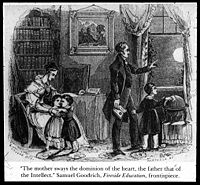 For much of history and in many cultures, enlisting professional teachers (whether as tutors or in a formal academic setting) was an option available only to a small elite. Thus, until relatively recently, the vast majority of people were educated by family members (especially during early childhood) and in the fields or learning a trade.
The earliest compulsory education
in the West
began in the late 17th century and early 18th century in the German states of Gotha
, Calemberg and, particularly, Prussia
. However, even in the 18th century, the vast majority of people in Europe lacked formal schooling, which means they were homeschooled or received no education at all. The same was also true for colonial America and for the United States until the 1850s. Formal schooling in a classroom setting has been the most common means of schooling throughout the world, especially in developed countries, since the early and mid 19th century. Native Americans, who traditionally used homeschooling and apprenticeship, vigorously resisted compulsory education in the United States.
In 1964, John Caldwell Holt
published a book entitled How Children Fail
which criticized traditional schools of the time. The book was based on a theory he had developed as a teacher – that the academic failure of schoolchildren was caused by pressure placed on children by adults. Holt began making appearances on major TV talk shows
and writing book reviews for Life
magazine. In his follow-up work, How Children Learn
, 1967, he tried to demonstrate the learning process of children and why he believed school short-circuits this process.
In these books Holt had not suggested any alternative to institutional schooling; he had hoped to initiate a profound rethinking of education to make schools friendlier toward children. As the years passed he became convinced that the way schools were was what society wanted, and that a serious re-examination was not going to happen in his lifetime.
Working in a similar vein was Rousas John Rushdoony
who focused on education in America and was an advocate of homeschooling, which he saw as a way to combat the intentionally secular nature of the U.S. public school system. He vigorously attacked progressive
school reformers such as Horace Mann
and John Dewey
and argued for the dismantling of the state's influence in education in three works: Intellectual Schizophrenia (a general and concise study of education), The Messianic Character of American Education (a history and castigation of public education in the U.S.), and The Philosophy of the Christian Curriculum (a parent-oriented pedagogical statement). Rushdoony was frequently called as an expert witness by the HSLDA (Home School Legal Defense Association
) in court cases.
During this time, the American educational professionals Raymond and Dorothy Moore
began to research the academic validity of the rapidly growing Early Childhood Education
movement. This research included independent studies by other researchers and a review of over 8,000 studies bearing on Early Childhood Education and the physical and mental development of children.
They asserted that formal schooling before ages 8–12 not only lacked the anticipated effectiveness, but was actually harmful to children. The Moores began to publish their view that formal schooling was damaging young children academically, socially, mentally, and even physiologically. They presented evidence that childhood problems such as juvenile delinquency, nearsightedness, increased enrollment of students in special education
classes, and behavioral problems were the result of increasingly earlier enrollment of students. The Moores cited studies demonstrating that orphans who were given surrogate mothers were measurably more intelligent, with superior long term effects – even though the mothers were mentally retarded teenagers – and that illiterate tribal mothers in Africa produced children who were socially and emotionally more advanced than typical western children, by western standards of measurement.
Their primary assertion was that the bonds and emotional development made at home with parents during these years produced critical long term results that were cut short by enrollment in schools, and could neither be replaced nor afterward corrected in an institutional setting. Recognizing a necessity for early out-of-home care for some children – particularly special needs
and starkly impoverished children, and children from exceptionally inferior homes– they maintained that the vast majority of children are far better situated at home, even with mediocre parents, than with the most gifted and motivated teachers in a school setting (assuming that the child has a gifted and motivated teacher). They described the difference as follows: "This is like saying, if you can help a child by taking him off the cold street and housing him in a warm tent, then warm tents should be provided for all children – when obviously most children already have even more secure housing."
Similar to Holt, the Moores embraced homeschooling after the publication of their first work, Better Late Than Early, 1975, and went on to become important homeschool advocates and consultants with the publication of books like Home Grown Kids, 1981, Homeschool Burnout, and others.
At the time, other authors published books questioning the premises and efficacy of compulsory schooling, including Deschooling Society by Ivan Illich
, 1970 and No More Public School by Harold Bennet, 1972.
In 1976, Holt published Instead of Education; Ways to Help People Do Things Better. In its conclusion, he called for a "Children's Underground Railroad
" to help children escape compulsory schooling. In response, Holt was contacted by families from around the U.S. to tell him that they were educating their children at home. In 1977, after corresponding with a number of these families, Holt began producing Growing Without Schooling
, a magazine dedicated to home education.
In 1980, Holt said, "I want to make it clear that I don't see homeschooling as some kind of answer to badness of schools. I think that the home is the proper base for the exploration of the world which we call learning or education. Home would be the best base no matter how good the schools were."
Holt later wrote a book about homeschooling, Teach Your Own, in 1981.
One common theme in the homeschool philosophies of both Holt and the Moores is that home education should not be an attempt to bring the school construct into the home, or a view of education as an academic preliminary to life. They viewed it as a natural, experiential aspect of life that occurs as the members of the family are involved with one another in daily living.
(including Trivium, Quadrivium
), Charlotte Mason
education, Montessori method
, Theory of multiple intelligences
, Unschooling
, Radical Unschooling, Waldorf education, School-at-home, A Thomas Jefferson Education, and many others. Some of these approaches, particularly unit studies, Montessori, and Waldorf, are also available in private or public school settings.
It is not uncommon for the student to experience more than one approach as the family discovers what works best for them. Many families do choose an eclectic (mixed) approach. For sources of curricula and books, "Homeschooling in the United States: 2003" found that 78 percent utilized "a public library"; 77 percent used "a homeschooling catalog, publisher, or individual specialist"; 68 percent used "retail bookstore or other store"; 60 percent used "an education publisher that was not affiliated with homeschooling." "Approximately half" used curriculum or books from "a homeschooling organization", 37 percent from a "church, synagogue or other religious institution" and 23 percent from "their local public school or district."
41 percent in 2003 utilized some sort of distance learning, approximately 20 percent by "television, video or radio"; 19 percent via "Internet, e-mail, or the World Wide Web"; and 15 percent taking a "correspondence course by mail designed specifically for homeschoolers."
Individual governmental units, e. g. states and local districts, vary in official curriculum and attendance requirements.
, how different tribes lived prior to colonization vs. today; art
, making Native American clothing; history
(of Native Americans in the U.S.); reading from a special reading list; and the science
of plants used by Native Americans.
Unit studies are particularly helpful for teaching multiple grade levels simultaneously, as the topic can easily be adjusted (i.e. from an 8th grader detailing and labeling a spider's anatomy to an elementary student drawing a picture of a spider on its web). As it is generally the case that in a given "homeschool" very few students are spread out among the grade levels, the unit study approach is an attractive option.
Unit study advocates assert that children retain 45% more information following this approach.
of the student are similar or identical to what would be taught in a public or private school; as one example, the same textbooks used in conventional schools are often used. These are comprehensive packages that contain all of the needed books and materials for the whole year. These materials are based on the same subject-area expectations as publicly run schools which allows for easy transition back into the school system. These are among the more expensive options for homeschooling, but they require minimal preparation and are easy to use. Step-by-step instructions and extensive teaching guides are provided. Some include tests or access information for remote testing. Many of these programs allow students to obtain an accredited high school diploma.
s, online tests, online tutoring, and occupational training. Online learning potentially allows students and families access to specialized teachers and materials and greater flexibility in scheduling. Parents can be with their children during an online tutoring session. Finally, online tutoring is useful for students who are disabled or otherwise limited in their ability to travel. Several well-known programs for gifted children, who need differentiation in their curricular choices, are available: the Johns Hopkins University Center for Talented Youth http://cty.jhu.edu/about/index.html and Stanford University's Education Program for Gifted Youth http://epgy.stanford.edu/ both provide challenging materials to students, including both self-paced courses with tutor support and online classroom-based courses. A commercial program of online study in all courses and at all grade levels is available from K12.com http://www.k12.com/. The K12 curriculum has been adopted by a number of public independent study charter schools throughout the country (see, for example, the California Virtual Academies at http://www.k12.com/cava/, where students use the K12 curriculum for credit under the supervision of a credentialed teacher). A number of other online high schools are also offering diplomas in many states, including some directed specifically at gifted students (see Stanford Online High School at http://epgy.stanford.edu/ohs/. Students can enroll in a full-time course load leading to a diploma or enroll in particular courses as part of their enrollment in another school or homeschool). Similarly, as more and more universities make content available online, homeschooled families are finding a wealth of materials available, primarily for use as self-study. Although teacher support is not usually provided in open courseware programs, families teaching their own children may, if the study met their requirements, grant credit for the work through their homeschools. The University of California at Berkeley, the Massachusetts Institute of Technology
and many other renowned universities have contributed materials in this area. Some commercial organizations publish university-level lecture series on a broad range of subjects. Although the companies typically offer no teacher support or credit, homeschool families can, depending on their legal method of homeschooling, grant credit for work that includes the use of these materials if mastery is demonstrated to the satisfaction of the parents or other persons with oversight responsibility. Noted musical educator S. M. Laddusaw has developed an adaptive musical curriculum (based on proprietary software) whereby students can learn piano and basic music theory at the student's own pace. The software recognizes patterns in the student's learning and adjusts the curriculum accordingly.
Groups of homeschooling families often join together to create homeschool co-ops. These groups typically meet once a week and provide a classroom environment. These are family-centered support groups whose members seek to pool their talents and resources in a collective effort to broaden the scope of their children's education. They provide a classroom environment where students can do hands-on and group learning such as performing, science experiments, art projects, foreign language study, spelling bees, discussions, etc. Parents whose children take classes serve in volunteer roles to keep costs low and make the program a success.
Certain states, such as Maine, Florida and New Mexico, have laws that permit homeschooling families to take advantage of public school resources. In such cases, children can be members of sports teams, be members of the school band, can take art classes, and utilize services such as speech therapy while maintaining their homeschool lifestyle.
" or "radical unschooling" to describe all methods of education that are not based in a school.
"Natural learning" refers to a type of learning-on-demand where children pursue knowledge based on their interests and parents take an active part in facilitating activities and experiences conducive to learning but do not rely heavily on textbooks or spend much time "teaching", looking instead for "learning moments" throughout their daily activities. Parents see their role as that of affirming through positive feedback and modeling the necessary skills, and the child's role as being responsible for asking and learning.
The term "unschooling" as coined by John Holt describes an approach in which parents do not authoritatively direct the child's education, but interact with the child following the child's own interests, leaving them free to explore and learn as their interests lead. "Unschooling" does not indicate that the child is not being educated, but that the child is not being "schooled", or educated in a rigid school-type manner. Holt asserted that children learn through the experiences of life, and he encouraged parents to live their lives with their child. Also known as interest-led or child-led learning, unschooling attempts to follow opportunities as they arise in real life, through which a child will learn without coercion. An unschooled child may utilize texts or classroom instruction, but these are not considered central to education. Holt asserted that there is no specific body of knowledge that is, or should be, required of a child.
"Unschooling" should not be confused with "deschooling," which may be used to indicate an anti-"institutional school" philosophy, or a period or form of deprogramming for children or parents who have previously been schooled.
Both unschooling and natural learning advocates believe that children learn best by doing; a child may learn reading to further an interest about history or other cultures, or math skills by operating a small business or sharing in family finances. They may learn animal husbandry keeping dairy goats or meat rabbits, botany tending a kitchen garden, chemistry to understand the operation of firearms or the internal combustion engine, or politics and local history by following a zoning or historical-status dispute. While any type of homeschoolers may also use these methods, the unschooled child initiates these learning activities. The natural learner participates with parents and others in learning together.
Homeschooling families usually have to absorb the total costs of their child's education.
which sees learners as individuals who can and should be autonomous i.e. be responsible for their own learning climate.
Autonomous education helps students develop their self-consciousness, vision, practicality and freedom of discussion. These attributes serve to aid the student in his/her independent learning.
Autonomous learning is very popular with those who home educate their children. The child usually gets to decide what projects they wish to tackle or what interests to pursue. example: a child that loves music will choose to learn or play a musical instrument. In home education this can be instead of or in addition to regular subjects like doing math or English.
At University/College Students are expected to learn independently without constant support from lectures and tutors this is known as autonomous learning. (Source:Book name,Student skills guide,2nd edition,pg 206)
According to Home Education UK the autonomous education philosophy emerged from the epistemology of Karl Popper
in The Myth of the Framework: In Defence of Science and Rationality, which is developed in the debates, which seek to rebut the neo-Marxist social philosophy of convergence proposed the Frankfurt School
(e.g. Theodor W. Adorno
Jürgen Habermas
Max Horkheimer
).
suggests that homeschooled students keep detailed records and portfolios.
In the last several decades, US colleges and universities have become increasingly open to accepting students from diverse backgrounds, including home-schooled students. According to one source, homeschoolers have now matriculated at over 900 different colleges and universities, including institutions with highly selective standards of admission such as the US military academies, Rice University
, Haverford College
, Harvard University
, Stanford University
, Cornell University
, Brown University
, Dartmouth College
, and Princeton University
.
A growing number of homeschooled students are choosing dual enrollment
, earning college credit by taking community college classes while in high school. Others choose to earn college credits through standardized tests such as the College Level Examination Program
(CLEP).
of families who homeschool their children. It provides an opportunity for children to learn from other parents who are more specialized in certain areas or subjects. Co-ops also provide social interaction for homeschooled children. They may take lessons together or go on field trips. Some co-ops also offer events such as prom and graduation for homeschoolers.
Homeschoolers are beginning to utilize Web 2.0
as a way to simulate homeschool cooperatives online. With social networks homeschoolers can chat, discuss threads in forums, share information and tips, and even participate in online classes via blackboard systems similar to those used by colleges.
In 1994, Jason Taylor was a homeschool football player in Pennsylvania who engaged a legal battle against the N.C.A.A. (the leading oversight association governing U.S. collegiate athletics) and it's classification of homeschool athletes as essentially high school drop-outs. Taylor's legal victory has provided a precedent for thousands of other homeschool athletes to compete in colleges and attain the same opportunities in education and professional development that other athletes enjoy. Other homeschool students who have risen to the top of collegiate competition include N.C.A.A. 2005 champion tennis player, Chris Lam, Kevin Johnson of the Tulsa University basketball team, 2010-2011 Big South Player of the Year Jesse Sanders of the Liberty University
Flames and the 2007 Heisman Trophy
winner Tim Tebow
from the University of Florida
.
In Texas, Six-Man Football has also been popular among homeschoolers, with at least five teams being fielded for the 2008-2009 season. Interestingly enough, the top 3 places in the Texas Independent State Championship (TISC, also referred to as "the Ironman Bowl) were claimed by homeschool teams. The Homeschool Sportsnet website lists several homeschool sports teams and organizations.
Parents give many different reasons for homeschooling their children. In the 2003 and 2007 NHES, parents were asked whether particular reasons for homeschooling their children applied to them. The three reasons selected by parents of more than two-thirds of students were concern about the school
environment, to provide religious or moral instruction, and dissatisfaction with the academic instruction available at other schools. From 2003 to 2007, the percentage of students whose parents reported homeschooling to provide religious or moral instruction increased from 72 percent to 83 percent. In 2007, the most common reason parents gave as the most important was a desire to provide religious or moral instruction (36 percent of students). This reason was followed by a concern about the school environment (such as safety, drugs, or negative peer pressure) (21 percent), dissatisfaction with academic instruction (17 percent), and "other reasons" including family time, finances, travel, and distance (14 percent). Other reasons include more flexibility in educational practices and family core stability for children with learning disabilities or prolonged chronic illnesses, or for children of missionaries, military families, or families who move often, as frequently as every two years.
In the 1970s Raymond S. and Dorothy N. Moore conducted four federally funded analyses of more than 8,000 early childhood studies, from which they published their original findings in Better Late Than Early, 1975. This was followed by School Can Wait, a repackaging of these same findings designed specifically for educational professionals. Their analysis concluded that, "where possible, children should be withheld from formal schooling until at least ages eight to ten."
Their reason was that children, "are not mature enough for formal school programs until their senses, coordination, neurological development and cognition are ready." They concluded that the outcome of forcing children into formal schooling is a sequence of "1) uncertainty as the child leaves the family nest early for a less secure environment, 2) puzzlement at the new pressures and restrictions of the classroom, 3) frustration because unready learning tools – senses, cognition, brain hemispheres, coordination – cannot handle the regimentation of formal lessons and the pressures they bring, 4) hyperactivity growing out of nerves and jitter, from frustration, 5) failure which quite naturally flows from the four experiences above, and 6) delinquency which is failure's twin and apparently for the same reason." According to the Moores, "early formal schooling is burning out our children. Teachers who attempt to cope with these youngsters also are burning out." Aside from academic performance, they think early formal schooling also destroys "positive sociability", encourages peer dependence, and discourages self worth, optimism, respect for parents, and trust in peers. They believe this situation is particularly acute for boys because of their delay in maturity.
The Moores cited a Smithsonian Report on the development of genius, indicating a requirement for "1) much time spent with warm, responsive parents and other adults, 2) very little time spent with peers, and 3) a great deal of free exploration under parental guidance." Their analysis suggested that children need "more of home and less of formal school" "more free exploration with... parents, and fewer limits of classroom and books," and "more old fashioned chores – children working with parents – and less attention to rivalry sports and amusements."
John Taylor later found, using the Piers-Harris Children's Self-Concept Scale, "while half of the conventionally schooled children scored at or below the 50th percentile (in self-concept), only 10.3% of the home-schooling children did so." He further stated that "the self-concept of home-schooling children is significantly higher (and very much so statistically) than that of children attending the conventional school. This has implications in the areas of academic achievement and socialization, to mention only two. These areas have been found to parallel self-concept. Regarding socialization, Taylor's results would mean that very few home-schooling children are socially deprived. He states that critics who speak out against homeschooling on the basis of social deprivation are actually addressing an area which favors homeschoolers.
In 2003, the National Home Education Research Institute conducted a survey of 7,300 U.S. adults who had been homeschooled (5,000 for more than seven years). Their findings included:
. Some U.S. states require mandatory testing for homeschooled students, but others do not. Some states that require testing allow homeschooling parents to choose which test to use. An exception are the SAT and ACT tests, where homeschooled and formally schooled students alike are self-selecting; homeschoolers averaged higher scores on college entrance tests in South Carolina. When testing is not required, students taking the tests are self-selected, which biases
any statistical results
. Other test scores (numbers from 1999 data in a year 2000 article) showed mixed results, for example showing higher levels for homeschoolers in English (homeschooled 23.4 vs national average 20.5) and reading (homeschooled 24.4 vs national average 21.4) on the ACT, but mixed scores in math (homeschooled 20.4 vs national average 20.7 on the ACT as opposed homeschooled 535 vs national average 511 on the 1999 SAT math). However, advocates of home education and educational choice counter with an input-output theory, pointing out that home educators expend only an average of $500–$600 a year on each student, in comparison to $9,000-$10,000 for each public school student in the United States, which raises a question about whether home-educated students would be especially dominant on tests if afforded access to an equal commitment of tax-funded educational resources.
, a United States teachers' union and professional association, opposes homeschooling. Such opponents of homeschooling give several examples of areas of concern in relation to homeschooling or its potential effects on society:
Stanford University
political scientist
professor Rob Reich (not to be confused with former U.S. Secretary of Labor, Robert Reich
) wrote in The Civic Perils of Homeschooling (2002) that homeschooling can potentially give students a one-sided point of view, as their parents may, even unwittingly, block or diminish all points of view but their own in teaching. He also argues that homeschooling, by reducing students' contact with peers, reduces their sense of civic engagement with their community.
Gallup polls of American voters have shown a significant change in attitude in the last twenty years, from 73% opposed to home education in 1985 to 54% opposed in 2001.
Tutor
A tutor is a person employed in the education of others, either individually or in groups. To tutor is to perform the functions of a tutor.-Teaching assistance:...
s, rather than in other formal settings of public or private school
Private school
Private schools, also known as independent schools or nonstate schools, are not administered by local, state or national governments; thus, they retain the right to select their students and are funded in whole or in part by charging their students' tuition, rather than relying on mandatory...
. Although prior to the introduction of compulsory school attendance laws
Compulsory education
Compulsory education refers to a period of education that is required of all persons.-Antiquity to Medieval Era:Although Plato's The Republic is credited with having popularized the concept of compulsory education in Western intellectual thought, every parent in Judea since Moses's Covenant with...
, most childhood education occurred within the family or community, homeschooling in the modern sense is an alternative in developed countries
Developed country
A developed country is a country that has a high level of development according to some criteria. Which criteria, and which countries are classified as being developed, is a contentious issue...
to attending public or private schools.
Homeschooling is a legal option for parents in most countries to provide their children with a learning environment as an alternative to public or private schools outside the home. Parents cite numerous reasons as motivations to homeschool their children. The three reasons that are selected by the majority of parents in the United States are concern about the traditional school environment, to provide religious or moral instruction, and dissatisfaction with academic instruction at traditional public and private schools. Homeschooling may also be a factor in the choice of parenting style
Parenting styles
A parenting style is a psychological construct representing standard strategies that parents use in their child rearing. There are many differing theories and opinions on the best ways to rear children, as well as differing levels of time and effort that parents are willing to invest.Many parents...
. Homeschooling can be an option for families living in isolated rural locations, living temporarily abroad, and to allow for more traveling; also many young athletes and actors are taught at home. Homeschooling can be about mentorship and apprenticeship, where a tutor or teacher is with the child for many years and then knows the child very well.
Homeschooling may also refer to instruction in the home under the supervision of correspondence schools or umbrella school
Umbrella school
An umbrella school is an alternative education school which serves to oversee the homeschooling of children to fulfil government educational requirements....
s. In some places, an approved curriculum
Curriculum
See also Syllabus.In formal education, a curriculum is the set of courses, and their content, offered at a school or university. As an idea, curriculum stems from the Latin word for race course, referring to the course of deeds and experiences through which children grow to become mature adults...
is legally required if children are to be home-schooled. A curriculum-free philosophy of homeschooling may be called unschooling
Unschooling
Unschooling is a range of educational philosophies and practices centered on allowing children to learn through their natural life experiences, including play, game play, household responsibilities, work experience, and social interaction, rather than through a more traditional school curriculum....
, a term coined in 1977 by American educator and author John Holt
John Caldwell Holt
John Caldwell Holt was an American author and educator, a proponent of homeschooling, and a pioneer in youth rights theory.-Biography:...
in his magazine Growing Without Schooling
Growing Without Schooling
Growing Without Schooling was a homeschooling newsletter, focused primarily on unschooling. It was founded in 1977 by educator John Holt, and was published in Boston, Massachusetts. Reportedly the first such publication in the United States, it was read worldwide, and helped to catalyze the early...
. In some cases a liberal arts
Liberal arts
The term liberal arts refers to those subjects which in classical antiquity were considered essential for a free citizen to study. Grammar, Rhetoric and Logic were the core liberal arts. In medieval times these subjects were extended to include mathematics, geometry, music and astronomy...
education is provided using the trivium and quadrivium
Quadrivium
The quadrivium comprised the four subjects, or arts, taught in medieval universities, after teaching the trivium. The word is Latin, meaning "the four ways" , and its use for the 4 subjects has been attributed to Boethius or Cassiodorus in the 6th century...
as the main model.
History
The earliest compulsory education
Compulsory education
Compulsory education refers to a period of education that is required of all persons.-Antiquity to Medieval Era:Although Plato's The Republic is credited with having popularized the concept of compulsory education in Western intellectual thought, every parent in Judea since Moses's Covenant with...
in the West
Western culture
Western culture, sometimes equated with Western civilization or European civilization, refers to cultures of European origin and is used very broadly to refer to a heritage of social norms, ethical values, traditional customs, religious beliefs, political systems, and specific artifacts and...
began in the late 17th century and early 18th century in the German states of Gotha
Gotha (district)
Gotha is a Kreis in the middle of Thuringia, Germany. Neighboring districts are Unstrut-Hainich, Sömmerda, the district-free city Erfurt, Ilm-Kreis, Schmalkalden-Meiningen and the Wartburgkreis.-History:...
, Calemberg and, particularly, Prussia
Prussia
Prussia was a German kingdom and historic state originating out of the Duchy of Prussia and the Margraviate of Brandenburg. For centuries, the House of Hohenzollern ruled Prussia, successfully expanding its size by way of an unusually well-organized and effective army. Prussia shaped the history...
. However, even in the 18th century, the vast majority of people in Europe lacked formal schooling, which means they were homeschooled or received no education at all. The same was also true for colonial America and for the United States until the 1850s. Formal schooling in a classroom setting has been the most common means of schooling throughout the world, especially in developed countries, since the early and mid 19th century. Native Americans, who traditionally used homeschooling and apprenticeship, vigorously resisted compulsory education in the United States.
In 1964, John Caldwell Holt
John Caldwell Holt
John Caldwell Holt was an American author and educator, a proponent of homeschooling, and a pioneer in youth rights theory.-Biography:...
published a book entitled How Children Fail
How Children Fail
How Children Fail is a non-fiction book by John Holt, published in 1964 and republished in 1982 in a revised edition. It has sold over a million copies...
which criticized traditional schools of the time. The book was based on a theory he had developed as a teacher – that the academic failure of schoolchildren was caused by pressure placed on children by adults. Holt began making appearances on major TV talk shows
Talk show
A talk show or chat show is a television program or radio program where one person discuss various topics put forth by a talk show host....
and writing book reviews for Life
Life (magazine)
Life generally refers to three American magazines:*A humor and general interest magazine published from 1883 to 1936. Time founder Henry Luce bought the magazine in 1936 solely so that he could acquire the rights to its name....
magazine. In his follow-up work, How Children Learn
How Children Learn
How Children Learn is a nonfiction book by educator John Holt, first published in 1967. A revised edition was released in 1983 with new chapters and commentaries....
, 1967, he tried to demonstrate the learning process of children and why he believed school short-circuits this process.
In these books Holt had not suggested any alternative to institutional schooling; he had hoped to initiate a profound rethinking of education to make schools friendlier toward children. As the years passed he became convinced that the way schools were was what society wanted, and that a serious re-examination was not going to happen in his lifetime.
Working in a similar vein was Rousas John Rushdoony
Rousas John Rushdoony
Rousas John Rushdoony was a Calvinist philosopher, historian, and theologian and is widely credited as the father of Christian Reconstructionism and an inspiration for the modern Christian homeschool movement...
who focused on education in America and was an advocate of homeschooling, which he saw as a way to combat the intentionally secular nature of the U.S. public school system. He vigorously attacked progressive
Progressivism
Progressivism is an umbrella term for a political ideology advocating or favoring social, political, and economic reform or changes. Progressivism is often viewed by some conservatives, constitutionalists, and libertarians to be in opposition to conservative or reactionary ideologies.The...
school reformers such as Horace Mann
Horace Mann
Horace Mann was an American education reformer, and a member of the Massachusetts House of Representatives from 1827 to 1833. He served in the Massachusetts Senate from 1834 to 1837. In 1848, after serving as Secretary of the Massachusetts State Board of Education since its creation, he was...
and John Dewey
John Dewey
John Dewey was an American philosopher, psychologist and educational reformer whose ideas have been influential in education and social reform. Dewey was an important early developer of the philosophy of pragmatism and one of the founders of functional psychology...
and argued for the dismantling of the state's influence in education in three works: Intellectual Schizophrenia (a general and concise study of education), The Messianic Character of American Education (a history and castigation of public education in the U.S.), and The Philosophy of the Christian Curriculum (a parent-oriented pedagogical statement). Rushdoony was frequently called as an expert witness by the HSLDA (Home School Legal Defense Association
Home School Legal Defense Association
The Home School Legal Defense Association is a United States-based "nonprofit advocacy organization established to defend and advance the constitutional right of parents to direct the education of their children and to protect family freedoms."...
) in court cases.
During this time, the American educational professionals Raymond and Dorothy Moore
Raymond S. and Dorothy N. Moore Foundation
The Raymond S. and Dorothy N. Moore Foundation is a non-profit organization in North Bonneville, Washington. The Moore Foundation is best known for its "Moore formula" educational concept in homeschooling, consisting of study, manual work and community service...
began to research the academic validity of the rapidly growing Early Childhood Education
Early childhood education
Early childhood education is the formal teaching and care of young children by people other than their family or in settings outside of the home. 'Early childhood' is usually defined as before the age of normal schooling - five years in most nations, though the U.S...
movement. This research included independent studies by other researchers and a review of over 8,000 studies bearing on Early Childhood Education and the physical and mental development of children.
They asserted that formal schooling before ages 8–12 not only lacked the anticipated effectiveness, but was actually harmful to children. The Moores began to publish their view that formal schooling was damaging young children academically, socially, mentally, and even physiologically. They presented evidence that childhood problems such as juvenile delinquency, nearsightedness, increased enrollment of students in special education
Special education
Special education is the education of students with special needs in a way that addresses the students' individual differences and needs. Ideally, this process involves the individually planned and systematically monitored arrangement of teaching procedures, adapted equipment and materials,...
classes, and behavioral problems were the result of increasingly earlier enrollment of students. The Moores cited studies demonstrating that orphans who were given surrogate mothers were measurably more intelligent, with superior long term effects – even though the mothers were mentally retarded teenagers – and that illiterate tribal mothers in Africa produced children who were socially and emotionally more advanced than typical western children, by western standards of measurement.
Their primary assertion was that the bonds and emotional development made at home with parents during these years produced critical long term results that were cut short by enrollment in schools, and could neither be replaced nor afterward corrected in an institutional setting. Recognizing a necessity for early out-of-home care for some children – particularly special needs
Special needs
In the USA, special needs is a term used in clinical diagnostic and functional development to describe individuals who require assistance for disabilities that may be medical, mental, or psychological. For instance, the Diagnostic and Statistical Manual of Mental Disorders and the International...
and starkly impoverished children, and children from exceptionally inferior homes– they maintained that the vast majority of children are far better situated at home, even with mediocre parents, than with the most gifted and motivated teachers in a school setting (assuming that the child has a gifted and motivated teacher). They described the difference as follows: "This is like saying, if you can help a child by taking him off the cold street and housing him in a warm tent, then warm tents should be provided for all children – when obviously most children already have even more secure housing."
Similar to Holt, the Moores embraced homeschooling after the publication of their first work, Better Late Than Early, 1975, and went on to become important homeschool advocates and consultants with the publication of books like Home Grown Kids, 1981, Homeschool Burnout, and others.
At the time, other authors published books questioning the premises and efficacy of compulsory schooling, including Deschooling Society by Ivan Illich
Ivan Illich
Ivan Illich was an Austrian philosopher, Roman Catholic priest, and "maverick social critic" of the institutions of contemporary western culture and their effects on the provenance and practice of education, medicine, work, energy use, transportation, and economic development.- Personal life...
, 1970 and No More Public School by Harold Bennet, 1972.
In 1976, Holt published Instead of Education; Ways to Help People Do Things Better. In its conclusion, he called for a "Children's Underground Railroad
Underground Railroad
The Underground Railroad was an informal network of secret routes and safe houses used by 19th-century black slaves in the United States to escape to free states and Canada with the aid of abolitionists and allies who were sympathetic to their cause. The term is also applied to the abolitionists,...
" to help children escape compulsory schooling. In response, Holt was contacted by families from around the U.S. to tell him that they were educating their children at home. In 1977, after corresponding with a number of these families, Holt began producing Growing Without Schooling
Growing Without Schooling
Growing Without Schooling was a homeschooling newsletter, focused primarily on unschooling. It was founded in 1977 by educator John Holt, and was published in Boston, Massachusetts. Reportedly the first such publication in the United States, it was read worldwide, and helped to catalyze the early...
, a magazine dedicated to home education.
In 1980, Holt said, "I want to make it clear that I don't see homeschooling as some kind of answer to badness of schools. I think that the home is the proper base for the exploration of the world which we call learning or education. Home would be the best base no matter how good the schools were."
Holt later wrote a book about homeschooling, Teach Your Own, in 1981.
One common theme in the homeschool philosophies of both Holt and the Moores is that home education should not be an attempt to bring the school construct into the home, or a view of education as an academic preliminary to life. They viewed it as a natural, experiential aspect of life that occurs as the members of the family are involved with one another in daily living.
Methodology
Homeschools use a wide variety of methods and materials. There are different paradigms, or educational philosophies, that families adopt including unit studies, Classical educationClassical education movement
The Classical education movement advocates a form of education based in the traditions of Western culture, with a particular focus on education as understood and taught in the Middle Ages. The curricula and pedagogy of classical education was first developed during the Middle Ages by Martianus...
(including Trivium, Quadrivium
Quadrivium
The quadrivium comprised the four subjects, or arts, taught in medieval universities, after teaching the trivium. The word is Latin, meaning "the four ways" , and its use for the 4 subjects has been attributed to Boethius or Cassiodorus in the 6th century...
), Charlotte Mason
Charlotte Mason
Charlotte Maria Shaw Mason was a British educator who invested her life in improving the quality of children's education. Her ideas led to a method used by some homeschoolers.-Biography:...
education, Montessori method
Montessori method
Montessori education is an educational approach developed by Italian physician and educator Maria Montessori. Montessori education is practiced in an estimated 20,000 schools worldwide, serving children from birth to eighteen years old.-Overview:...
, Theory of multiple intelligences
Theory of multiple intelligences
The theory of multiple intelligences was proposed by Howard Gardner in 1983 as a model of intelligence that differentiates intelligence into various specific modalities, rather than seeing it as dominated by a single general ability....
, Unschooling
Unschooling
Unschooling is a range of educational philosophies and practices centered on allowing children to learn through their natural life experiences, including play, game play, household responsibilities, work experience, and social interaction, rather than through a more traditional school curriculum....
, Radical Unschooling, Waldorf education, School-at-home, A Thomas Jefferson Education, and many others. Some of these approaches, particularly unit studies, Montessori, and Waldorf, are also available in private or public school settings.
It is not uncommon for the student to experience more than one approach as the family discovers what works best for them. Many families do choose an eclectic (mixed) approach. For sources of curricula and books, "Homeschooling in the United States: 2003" found that 78 percent utilized "a public library"; 77 percent used "a homeschooling catalog, publisher, or individual specialist"; 68 percent used "retail bookstore or other store"; 60 percent used "an education publisher that was not affiliated with homeschooling." "Approximately half" used curriculum or books from "a homeschooling organization", 37 percent from a "church, synagogue or other religious institution" and 23 percent from "their local public school or district."
41 percent in 2003 utilized some sort of distance learning, approximately 20 percent by "television, video or radio"; 19 percent via "Internet, e-mail, or the World Wide Web"; and 15 percent taking a "correspondence course by mail designed specifically for homeschoolers."
Individual governmental units, e. g. states and local districts, vary in official curriculum and attendance requirements.
Unit studies
The unit study approach incorporates several subjects, such as art, history, math, science, geography and other curriculum subjects, around the context of one topical theme, like water, animals, American slavery, or ancient Rome. For example, a unit study of Native Americans could combine age-appropriate lessons in: social studiesSocial studies
Social studies is the "integrated study of the social sciences and humanities to promote civic competence," as defined by the American National Council for the Social Studies...
, how different tribes lived prior to colonization vs. today; art
Art
Art is the product or process of deliberately arranging items in a way that influences and affects one or more of the senses, emotions, and intellect....
, making Native American clothing; history
History
History is the discovery, collection, organization, and presentation of information about past events. History can also mean the period of time after writing was invented. Scholars who write about history are called historians...
(of Native Americans in the U.S.); reading from a special reading list; and the science
Science
Science is a systematic enterprise that builds and organizes knowledge in the form of testable explanations and predictions about the universe...
of plants used by Native Americans.
Unit studies are particularly helpful for teaching multiple grade levels simultaneously, as the topic can easily be adjusted (i.e. from an 8th grader detailing and labeling a spider's anatomy to an elementary student drawing a picture of a spider on its web). As it is generally the case that in a given "homeschool" very few students are spread out among the grade levels, the unit study approach is an attractive option.
Unit study advocates assert that children retain 45% more information following this approach.
All-in-one curricula
All-in-one homeschooling curricula (variously known as "school-at-home", "The Traditional Approach" "school-in-a-box" or "The Structured Approach"), are methods of homeschooling in which the curriculum and homeworkHomework
Homework, or homework assignment, refers to tasks assigned to students by their teachers to be completed outside of class. Common homework assignments may include a quantity or period of reading to be performed, writing or typing to be completed, problems to be solved, a school project to be built...
of the student are similar or identical to what would be taught in a public or private school; as one example, the same textbooks used in conventional schools are often used. These are comprehensive packages that contain all of the needed books and materials for the whole year. These materials are based on the same subject-area expectations as publicly run schools which allows for easy transition back into the school system. These are among the more expensive options for homeschooling, but they require minimal preparation and are easy to use. Step-by-step instructions and extensive teaching guides are provided. Some include tests or access information for remote testing. Many of these programs allow students to obtain an accredited high school diploma.
Student-paced learning
Similar to All-in-one curricula are learner-paced curriculum packages. These workbooks allow the student to progress at their own speed.Online education
Online resources for homeschooling include courses of study, curricula, educational gameEducational game
Educational games are games that have been designed to teach people about a certain subject, expand concepts, reinforce development, understand an historical event or culture, or assist them in learning a skill as they play...
s, online tests, online tutoring, and occupational training. Online learning potentially allows students and families access to specialized teachers and materials and greater flexibility in scheduling. Parents can be with their children during an online tutoring session. Finally, online tutoring is useful for students who are disabled or otherwise limited in their ability to travel. Several well-known programs for gifted children, who need differentiation in their curricular choices, are available: the Johns Hopkins University Center for Talented Youth http://cty.jhu.edu/about/index.html and Stanford University's Education Program for Gifted Youth http://epgy.stanford.edu/ both provide challenging materials to students, including both self-paced courses with tutor support and online classroom-based courses. A commercial program of online study in all courses and at all grade levels is available from K12.com http://www.k12.com/. The K12 curriculum has been adopted by a number of public independent study charter schools throughout the country (see, for example, the California Virtual Academies at http://www.k12.com/cava/, where students use the K12 curriculum for credit under the supervision of a credentialed teacher). A number of other online high schools are also offering diplomas in many states, including some directed specifically at gifted students (see Stanford Online High School at http://epgy.stanford.edu/ohs/. Students can enroll in a full-time course load leading to a diploma or enroll in particular courses as part of their enrollment in another school or homeschool). Similarly, as more and more universities make content available online, homeschooled families are finding a wealth of materials available, primarily for use as self-study. Although teacher support is not usually provided in open courseware programs, families teaching their own children may, if the study met their requirements, grant credit for the work through their homeschools. The University of California at Berkeley, the Massachusetts Institute of Technology
Massachusetts Institute of Technology
The Massachusetts Institute of Technology is a private research university located in Cambridge, Massachusetts. MIT has five schools and one college, containing a total of 32 academic departments, with a strong emphasis on scientific and technological education and research.Founded in 1861 in...
and many other renowned universities have contributed materials in this area. Some commercial organizations publish university-level lecture series on a broad range of subjects. Although the companies typically offer no teacher support or credit, homeschool families can, depending on their legal method of homeschooling, grant credit for work that includes the use of these materials if mastery is demonstrated to the satisfaction of the parents or other persons with oversight responsibility. Noted musical educator S. M. Laddusaw has developed an adaptive musical curriculum (based on proprietary software) whereby students can learn piano and basic music theory at the student's own pace. The software recognizes patterns in the student's learning and adjusts the curriculum accordingly.
Community resources
Homeschoolers often take advantage of educational opportunities at museums, libraries, community centers, athletic clubs, after-school programs, churches, science preserves, parks, and other community resources. Secondary school level students may take classes at community colleges, which typically have open admission policies. In many communities, homeschooling parents and students participate in community theater, dance, band, symphony, and choral opportunities.Groups of homeschooling families often join together to create homeschool co-ops. These groups typically meet once a week and provide a classroom environment. These are family-centered support groups whose members seek to pool their talents and resources in a collective effort to broaden the scope of their children's education. They provide a classroom environment where students can do hands-on and group learning such as performing, science experiments, art projects, foreign language study, spelling bees, discussions, etc. Parents whose children take classes serve in volunteer roles to keep costs low and make the program a success.
Certain states, such as Maine, Florida and New Mexico, have laws that permit homeschooling families to take advantage of public school resources. In such cases, children can be members of sports teams, be members of the school band, can take art classes, and utilize services such as speech therapy while maintaining their homeschool lifestyle.
Unschooling and natural learning
Some people use the terms "unschoolingUnschooling
Unschooling is a range of educational philosophies and practices centered on allowing children to learn through their natural life experiences, including play, game play, household responsibilities, work experience, and social interaction, rather than through a more traditional school curriculum....
" or "radical unschooling" to describe all methods of education that are not based in a school.
"Natural learning" refers to a type of learning-on-demand where children pursue knowledge based on their interests and parents take an active part in facilitating activities and experiences conducive to learning but do not rely heavily on textbooks or spend much time "teaching", looking instead for "learning moments" throughout their daily activities. Parents see their role as that of affirming through positive feedback and modeling the necessary skills, and the child's role as being responsible for asking and learning.
The term "unschooling" as coined by John Holt describes an approach in which parents do not authoritatively direct the child's education, but interact with the child following the child's own interests, leaving them free to explore and learn as their interests lead. "Unschooling" does not indicate that the child is not being educated, but that the child is not being "schooled", or educated in a rigid school-type manner. Holt asserted that children learn through the experiences of life, and he encouraged parents to live their lives with their child. Also known as interest-led or child-led learning, unschooling attempts to follow opportunities as they arise in real life, through which a child will learn without coercion. An unschooled child may utilize texts or classroom instruction, but these are not considered central to education. Holt asserted that there is no specific body of knowledge that is, or should be, required of a child.
"Unschooling" should not be confused with "deschooling," which may be used to indicate an anti-"institutional school" philosophy, or a period or form of deprogramming for children or parents who have previously been schooled.
Both unschooling and natural learning advocates believe that children learn best by doing; a child may learn reading to further an interest about history or other cultures, or math skills by operating a small business or sharing in family finances. They may learn animal husbandry keeping dairy goats or meat rabbits, botany tending a kitchen garden, chemistry to understand the operation of firearms or the internal combustion engine, or politics and local history by following a zoning or historical-status dispute. While any type of homeschoolers may also use these methods, the unschooled child initiates these learning activities. The natural learner participates with parents and others in learning together.
Homeschooling families usually have to absorb the total costs of their child's education.
Autonomous learning
Autonomous learning is a school of educationEducation
Education in its broadest, general sense is the means through which the aims and habits of a group of people lives on from one generation to the next. Generally, it occurs through any experience that has a formative effect on the way one thinks, feels, or acts...
which sees learners as individuals who can and should be autonomous i.e. be responsible for their own learning climate.
Autonomous education helps students develop their self-consciousness, vision, practicality and freedom of discussion. These attributes serve to aid the student in his/her independent learning.
Autonomous learning is very popular with those who home educate their children. The child usually gets to decide what projects they wish to tackle or what interests to pursue. example: a child that loves music will choose to learn or play a musical instrument. In home education this can be instead of or in addition to regular subjects like doing math or English.
At University/College Students are expected to learn independently without constant support from lectures and tutors this is known as autonomous learning. (Source:Book name,Student skills guide,2nd edition,pg 206)
According to Home Education UK the autonomous education philosophy emerged from the epistemology of Karl Popper
Karl Popper
Sir Karl Raimund Popper, CH FRS FBA was an Austro-British philosopher and a professor at the London School of Economics...
in The Myth of the Framework: In Defence of Science and Rationality, which is developed in the debates, which seek to rebut the neo-Marxist social philosophy of convergence proposed the Frankfurt School
Frankfurt School
The Frankfurt School refers to a school of neo-Marxist interdisciplinary social theory, particularly associated with the Institute for Social Research at the University of Frankfurt am Main...
(e.g. Theodor W. Adorno
Theodor W. Adorno
Theodor W. Adorno was a German sociologist, philosopher, and musicologist known for his critical theory of society....
Jürgen Habermas
Jürgen Habermas
Jürgen Habermas is a German sociologist and philosopher in the tradition of critical theory and pragmatism. He is perhaps best known for his theory on the concepts of 'communicative rationality' and the 'public sphere'...
Max Horkheimer
Max Horkheimer
Max Horkheimer was a German-Jewish philosopher-sociologist, famous for his work in critical theory as a member of the 'Frankfurt School' of social research. His most important works include The Eclipse of Reason and, in collaboration with Theodor Adorno, The Dialectic of Enlightenment...
).
Homeschooling and college admissions
After primary education is completed, many students choose to stop homeschooling in favor of more traditional higher education at established colleges and universities. Many students use standardized test scores to aid colleges in evaluating their educational background. The College BoardCollege Board
The College Board is a membership association in the United States that was formed in 1900 as the College Entrance Examination Board . It is composed of more than 5,900 schools, colleges, universities and other educational organizations. It sells standardized tests used by academically oriented...
suggests that homeschooled students keep detailed records and portfolios.
In the last several decades, US colleges and universities have become increasingly open to accepting students from diverse backgrounds, including home-schooled students. According to one source, homeschoolers have now matriculated at over 900 different colleges and universities, including institutions with highly selective standards of admission such as the US military academies, Rice University
Rice University
William Marsh Rice University, commonly referred to as Rice University or Rice, is a private research university located on a heavily wooded campus in Houston, Texas, United States...
, Haverford College
Haverford College
Haverford College is a private, coeducational liberal arts college located in Haverford, Pennsylvania, United States, a suburb of Philadelphia...
, Harvard University
Harvard University
Harvard University is a private Ivy League university located in Cambridge, Massachusetts, United States, established in 1636 by the Massachusetts legislature. Harvard is the oldest institution of higher learning in the United States and the first corporation chartered in the country...
, Stanford University
Stanford University
The Leland Stanford Junior University, commonly referred to as Stanford University or Stanford, is a private research university on an campus located near Palo Alto, California. It is situated in the northwestern Santa Clara Valley on the San Francisco Peninsula, approximately northwest of San...
, Cornell University
Cornell University
Cornell University is an Ivy League university located in Ithaca, New York, United States. It is a private land-grant university, receiving annual funding from the State of New York for certain educational missions...
, Brown University
Brown University
Brown University is a private, Ivy League university located in Providence, Rhode Island, United States. Founded in 1764 prior to American independence from the British Empire as the College in the English Colony of Rhode Island and Providence Plantations early in the reign of King George III ,...
, Dartmouth College
Dartmouth College
Dartmouth College is a private, Ivy League university in Hanover, New Hampshire, United States. The institution comprises a liberal arts college, Dartmouth Medical School, Thayer School of Engineering, and the Tuck School of Business, as well as 19 graduate programs in the arts and sciences...
, and Princeton University
Princeton University
Princeton University is a private research university located in Princeton, New Jersey, United States. The school is one of the eight universities of the Ivy League, and is one of the nine Colonial Colleges founded before the American Revolution....
.
A growing number of homeschooled students are choosing dual enrollment
Dual enrollment
In education, dual enrollment involved students being enrolled in two separate, academically related institutions. It may also refer to any individual who is participating in two related programs, but such a general form of usage is uncommon....
, earning college credit by taking community college classes while in high school. Others choose to earn college credits through standardized tests such as the College Level Examination Program
College Level Examination Program
The College Level Examination Program is a group of standardized tests that assess college-level knowledge in several subject areas. Many colleges grant credit to students who meet their minimum qualifying score. Qualifying scores vary by school but are typically 50...
(CLEP).
Homeschool cooperatives
A Homeschool Cooperative is a cooperativeCooperative
A cooperative is a business organization owned and operated by a group of individuals for their mutual benefit...
of families who homeschool their children. It provides an opportunity for children to learn from other parents who are more specialized in certain areas or subjects. Co-ops also provide social interaction for homeschooled children. They may take lessons together or go on field trips. Some co-ops also offer events such as prom and graduation for homeschoolers.
Homeschoolers are beginning to utilize Web 2.0
Web 2.0
The term Web 2.0 is associated with web applications that facilitate participatory information sharing, interoperability, user-centered design, and collaboration on the World Wide Web...
as a way to simulate homeschool cooperatives online. With social networks homeschoolers can chat, discuss threads in forums, share information and tips, and even participate in online classes via blackboard systems similar to those used by colleges.
Homeschool athletics
Early in the 21st century, a number of national and international organizations began oversight of sports exclusively for homeschool athletic teams. N.C.H.B.C. has organized a National Basketball Championship with over 350 teams competing through a network of regional qualifying competitions. Currently H.W.S.A. organizes a Baseball National Championship, N.H.S.V.B.T. in volleyball,N.H.S.C. in Soccer, and N.H.FA. in 8-man football. Additional structures are organizing national championships in tennis, and 11-man football. In 2005, the Central Virginia Homeschool Disciples became the first 11-man high school homeschool football team in the U.S.In 1994, Jason Taylor was a homeschool football player in Pennsylvania who engaged a legal battle against the N.C.A.A. (the leading oversight association governing U.S. collegiate athletics) and it's classification of homeschool athletes as essentially high school drop-outs. Taylor's legal victory has provided a precedent for thousands of other homeschool athletes to compete in colleges and attain the same opportunities in education and professional development that other athletes enjoy. Other homeschool students who have risen to the top of collegiate competition include N.C.A.A. 2005 champion tennis player, Chris Lam, Kevin Johnson of the Tulsa University basketball team, 2010-2011 Big South Player of the Year Jesse Sanders of the Liberty University
Liberty University
Liberty University is a private Christian university located in Lynchburg, Virginia. Liberty's annual enrollment is around 72,000 students, 12,000 of whom are residential students and 60,000+ studying through Liberty University Online...
Flames and the 2007 Heisman Trophy
Heisman Trophy
The Heisman Memorial Trophy Award , is awarded annually to the player deemed the most outstanding player in collegiate football. It was created in 1935 as the Downtown Athletic Club trophy and renamed in 1936 following the death of the Club's athletic director, John Heisman The Heisman Memorial...
winner Tim Tebow
Tim Tebow
Timothy Richard "Tim" Tebow is an American football player who is currently the starting quarterback for the Denver Broncos of the National Football League . He was drafted by the Broncos as the 25th overall pick in the 2010 NFL Draft...
from the University of Florida
University of Florida
The University of Florida is an American public land-grant, sea-grant, and space-grant research university located on a campus in Gainesville, Florida. The university traces its historical origins to 1853, and has operated continuously on its present Gainesville campus since September 1906...
.
In Texas, Six-Man Football has also been popular among homeschoolers, with at least five teams being fielded for the 2008-2009 season. Interestingly enough, the top 3 places in the Texas Independent State Championship (TISC, also referred to as "the Ironman Bowl) were claimed by homeschool teams. The Homeschool Sportsnet website lists several homeschool sports teams and organizations.
Motivations
| Reason for homeschooling | Number of homeschooled students |
Percent | s.e. Standard error (statistics) The standard error is the standard deviation of the sampling distribution of a statistic. The term may also be used to refer to an estimate of that standard deviation, derived from a particular sample used to compute the estimate.... |
|---|---|---|---|
| Can give child better education at home | 415,000 | 48.9 | 3.79 |
| Religious reason | 327,000 | 38.4 | 4.44 |
| Poor learning environment at school | 218,000 | 25.6 | 3.44 |
| Family reasons | 143,000 | 16.8 | 2.79 |
| To develop character/morality | 128,000 | 15.1 | 3.39 |
| Object to what school teaches | 103,000 | 12.1 | 2.11 |
| School does not challenge child | 98,000 | 11.6 | 2.39 |
| Other problems with available schools | 76,000 | 9.0 | 2.40 |
| Child has special needs/disability | 69,000 | 8.2 | 1.89 |
| Transportation/convenience | 23,000 | 2.7 | 1.48 |
| Child not old enough to enter school | 15,000 | 1.8 | 1.13 |
| Parent's career | 12,000 | 1.5 | 0.80 |
| Could not get into desired school | 12,000 | 1.5 | 0.99 |
| Other reasons* | 189,000 | 22.2 | 2.90 |
Parents give many different reasons for homeschooling their children. In the 2003 and 2007 NHES, parents were asked whether particular reasons for homeschooling their children applied to them. The three reasons selected by parents of more than two-thirds of students were concern about the school
environment, to provide religious or moral instruction, and dissatisfaction with the academic instruction available at other schools. From 2003 to 2007, the percentage of students whose parents reported homeschooling to provide religious or moral instruction increased from 72 percent to 83 percent. In 2007, the most common reason parents gave as the most important was a desire to provide religious or moral instruction (36 percent of students). This reason was followed by a concern about the school environment (such as safety, drugs, or negative peer pressure) (21 percent), dissatisfaction with academic instruction (17 percent), and "other reasons" including family time, finances, travel, and distance (14 percent). Other reasons include more flexibility in educational practices and family core stability for children with learning disabilities or prolonged chronic illnesses, or for children of missionaries, military families, or families who move often, as frequently as every two years.
Research
- The studies cited in this section have been criticised for selection bias and other problems, see below: Criticism of supportive achievement studies.
Test results
Numerous studies have found that homeschooled students on average outperform their peers on standardized tests. Homeschooling Achievement, a study conducted by National Home Education Research Institute (NHERI), a homeschooling advocacy group, supported the academic integrity of homeschooling. Among the homeschooled students who took the tests, the average homeschooled student outperformed his public school peers by 30 to 37 percentile points across all subjects. The study also indicates that public school performance gaps between minorities and genders were virtually non-existent among the homeschooled students who took the tests.In the 1970s Raymond S. and Dorothy N. Moore conducted four federally funded analyses of more than 8,000 early childhood studies, from which they published their original findings in Better Late Than Early, 1975. This was followed by School Can Wait, a repackaging of these same findings designed specifically for educational professionals. Their analysis concluded that, "where possible, children should be withheld from formal schooling until at least ages eight to ten."
Their reason was that children, "are not mature enough for formal school programs until their senses, coordination, neurological development and cognition are ready." They concluded that the outcome of forcing children into formal schooling is a sequence of "1) uncertainty as the child leaves the family nest early for a less secure environment, 2) puzzlement at the new pressures and restrictions of the classroom, 3) frustration because unready learning tools – senses, cognition, brain hemispheres, coordination – cannot handle the regimentation of formal lessons and the pressures they bring, 4) hyperactivity growing out of nerves and jitter, from frustration, 5) failure which quite naturally flows from the four experiences above, and 6) delinquency which is failure's twin and apparently for the same reason." According to the Moores, "early formal schooling is burning out our children. Teachers who attempt to cope with these youngsters also are burning out." Aside from academic performance, they think early formal schooling also destroys "positive sociability", encourages peer dependence, and discourages self worth, optimism, respect for parents, and trust in peers. They believe this situation is particularly acute for boys because of their delay in maturity.
The Moores cited a Smithsonian Report on the development of genius, indicating a requirement for "1) much time spent with warm, responsive parents and other adults, 2) very little time spent with peers, and 3) a great deal of free exploration under parental guidance." Their analysis suggested that children need "more of home and less of formal school" "more free exploration with... parents, and fewer limits of classroom and books," and "more old fashioned chores – children working with parents – and less attention to rivalry sports and amusements."
John Taylor later found, using the Piers-Harris Children's Self-Concept Scale, "while half of the conventionally schooled children scored at or below the 50th percentile (in self-concept), only 10.3% of the home-schooling children did so." He further stated that "the self-concept of home-schooling children is significantly higher (and very much so statistically) than that of children attending the conventional school. This has implications in the areas of academic achievement and socialization, to mention only two. These areas have been found to parallel self-concept. Regarding socialization, Taylor's results would mean that very few home-schooling children are socially deprived. He states that critics who speak out against homeschooling on the basis of social deprivation are actually addressing an area which favors homeschoolers.
In 2003, the National Home Education Research Institute conducted a survey of 7,300 U.S. adults who had been homeschooled (5,000 for more than seven years). Their findings included:
- Homeschool graduates are active and involved in their communities. 71% participate in an ongoing community service activity, like coaching a sports team, volunteering at a school, or working with a church or neighborhood association, compared with 37% of U.S. adults of similar ages from a traditional education background.
- Homeschool graduates are more involved in civic affairs and vote in much higher percentages than their peers. 76% of those surveyed between the ages of 18 and 24 voted within the last five years, compared with only 29% of the corresponding U.S. populace. The numbers are even greater in older age groups, with voting levels not falling below 95%, compared with a high of 53% for the corresponding U.S. populace.
- 58.9% report that they are "very happy" with life, compared with 27.6% for the general U.S. population. 73.2% find life "exciting", compared with 47.3%.
Criticism of supportive achievement studies
Although there are some studies that show that homeschooled students can do well on standardized tests, some of these studies compare voluntary homeschool testing with mandatory public-school testing. Homeschooled students in the United States are not subject to the testing requirements of the No Child Left Behind ActNo Child Left Behind Act
The No Child Left Behind Act of 2001 is a United States Act of Congress concerning the education of children in public schools.NCLB was originally proposed by the administration of George W. Bush immediately after he took office...
. Some U.S. states require mandatory testing for homeschooled students, but others do not. Some states that require testing allow homeschooling parents to choose which test to use. An exception are the SAT and ACT tests, where homeschooled and formally schooled students alike are self-selecting; homeschoolers averaged higher scores on college entrance tests in South Carolina. When testing is not required, students taking the tests are self-selected, which biases
Selection bias
Selection bias is a statistical bias in which there is an error in choosing the individuals or groups to take part in a scientific study. It is sometimes referred to as the selection effect. The term "selection bias" most often refers to the distortion of a statistical analysis, resulting from the...
any statistical results
Statistics
Statistics is the study of the collection, organization, analysis, and interpretation of data. It deals with all aspects of this, including the planning of data collection in terms of the design of surveys and experiments....
. Other test scores (numbers from 1999 data in a year 2000 article) showed mixed results, for example showing higher levels for homeschoolers in English (homeschooled 23.4 vs national average 20.5) and reading (homeschooled 24.4 vs national average 21.4) on the ACT, but mixed scores in math (homeschooled 20.4 vs national average 20.7 on the ACT as opposed homeschooled 535 vs national average 511 on the 1999 SAT math). However, advocates of home education and educational choice counter with an input-output theory, pointing out that home educators expend only an average of $500–$600 a year on each student, in comparison to $9,000-$10,000 for each public school student in the United States, which raises a question about whether home-educated students would be especially dominant on tests if afforded access to an equal commitment of tax-funded educational resources.
Potential for unmonitored child abuse
There is no evidence to suggest that abuse among homeschoolers is more pervasive or severe than in government institutions. While there are no studies specifically addressing child abuse among home school families, the Government Accounting Office did issue a report in 2009 documenting hundreds of cases of child abuse and death at the hands of public and private school officials. This report did not include student on student violence as seen in 1999 in Columbine High School in Littleton, Colorado, where two students killed 13 of their classmates and wounded 24 others. Further, an AP study found over 2,500 incidents of sexual abuse at public schools. Nevertheless, in Washington, D.C. increased regulation of homeschooling was enacted in response to a mother who had withdrawn her four children from public school and was subsequently charged with their murder. It was claimed that the homeschooling exemption in the District of Columbia allowed the abuse of the children to occur undetected.Philosophical and political opposition
Opposition to homeschooling comes from many sources, including some organizations of teachers and school districts. The National Education AssociationNational Education Association
The National Education Association is the largest professional organization and largest labor union in the United States, representing public school teachers and other support personnel, faculty and staffers at colleges and universities, retired educators, and college students preparing to become...
, a United States teachers' union and professional association, opposes homeschooling. Such opponents of homeschooling give several examples of areas of concern in relation to homeschooling or its potential effects on society:
- Inadequate standards of academic quality and comprehensiveness;
- Lack of socialization with peers of different ethnic and religious backgrounds;
- The potential for development of religious or social extremism;
- Children sheltered from mainstream society, or denied opportunities that are their right, such as social development;
- Potential for development of parallel societies that do not fit into standards of citizenship and the community.
Stanford University
Stanford University
The Leland Stanford Junior University, commonly referred to as Stanford University or Stanford, is a private research university on an campus located near Palo Alto, California. It is situated in the northwestern Santa Clara Valley on the San Francisco Peninsula, approximately northwest of San...
political scientist
Political science
Political Science is a social science discipline concerned with the study of the state, government and politics. Aristotle defined it as the study of the state. It deals extensively with the theory and practice of politics, and the analysis of political systems and political behavior...
professor Rob Reich (not to be confused with former U.S. Secretary of Labor, Robert Reich
Robert Reich
Robert Bernard Reich is an American political economist, professor, author, and political commentator. He served in the administrations of Presidents Gerald Ford and Jimmy Carter and was Secretary of Labor under President Bill Clinton from 1993 to 1997....
) wrote in The Civic Perils of Homeschooling (2002) that homeschooling can potentially give students a one-sided point of view, as their parents may, even unwittingly, block or diminish all points of view but their own in teaching. He also argues that homeschooling, by reducing students' contact with peers, reduces their sense of civic engagement with their community.
Gallup polls of American voters have shown a significant change in attitude in the last twenty years, from 73% opposed to home education in 1985 to 54% opposed in 2001.
International status and statistics
Homeschooling is legal in many countries. Countries with the most prevalent home education movements include Australia, Canada, New Zealand, the United Kingdom, and the United States. Some countries have highly regulated home education programs as an extension of the compulsory school system; others, such as Germany, have outlawed it entirely. Brazil has a law project in process. In other countries, while not restricted by law, homeschooling is not socially acceptable or considered undesirable and is virtually non-existent.See also
- EducationEducationEducation in its broadest, general sense is the means through which the aims and habits of a group of people lives on from one generation to the next. Generally, it occurs through any experience that has a formative effect on the way one thinks, feels, or acts...
- Homeschooling international status and statisticsHomeschooling international status and statisticsHomeschooling is legal in many countries. Countries with the most prevalent home education movements include Australia, Canada, New Zealand, the United Kingdom, and the United States. Some countries have highly regulated home education programs as an extension of the compulsory school system;...
- Alternative educationAlternative educationAlternative education, also known as non-traditional education or educational alternative, includes a number of approaches to teaching and learning other than mainstream or traditional education. Educational alternatives are often rooted in various philosophies that are fundamentally different...
- Alternative schoolAlternative schoolAlternative school is the name used in some parts of the world to describe an institution which provides part of alternative education. It is an educational establishment with a curriculum and methods that are nontraditional...
- Alternative universityAlternative universityAlternative universities which may be known by other names, especially as colleges in the United States are institutions which offer an education and in some cases a lifestyle which is intentionally not the mainstream of other institutions...
- Homeschooling in the United States
- Home education in the United Kingdom
- List of homeschooled people
- UnschoolingUnschoolingUnschooling is a range of educational philosophies and practices centered on allowing children to learn through their natural life experiences, including play, game play, household responsibilities, work experience, and social interaction, rather than through a more traditional school curriculum....
- DeschoolingDeschoolingDeschooling is a term used by both education philosophers and proponents of alternative education and/or homeschooling, though it refers to different things in each context...
- Secular Homeschooling (magazine)Secular Homeschooling (magazine)Secular Homeschooling is an American magazine for people who homeschool for reasons other than religion. It began as a quarterly, but became a bimonthly in July 2009....
- Parenting stylesParenting stylesA parenting style is a psychological construct representing standard strategies that parents use in their child rearing. There are many differing theories and opinions on the best ways to rear children, as well as differing levels of time and effort that parents are willing to invest.Many parents...
- Charlotte MasonCharlotte MasonCharlotte Maria Shaw Mason was a British educator who invested her life in improving the quality of children's education. Her ideas led to a method used by some homeschoolers.-Biography:...
education - Classical educationClassical education movementThe Classical education movement advocates a form of education based in the traditions of Western culture, with a particular focus on education as understood and taught in the Middle Ages. The curricula and pedagogy of classical education was first developed during the Middle Ages by Martianus...
(including Trivium, QuadriviumQuadriviumThe quadrivium comprised the four subjects, or arts, taught in medieval universities, after teaching the trivium. The word is Latin, meaning "the four ways" , and its use for the 4 subjects has been attributed to Boethius or Cassiodorus in the 6th century...
) - Theory of multiple intelligencesTheory of multiple intelligencesThe theory of multiple intelligences was proposed by Howard Gardner in 1983 as a model of intelligence that differentiates intelligence into various specific modalities, rather than seeing it as dominated by a single general ability....
- Waldorf education
- E-learningE-learningE-learning comprises all forms of electronically supported learning and teaching. The information and communication systems, whether networked learning or not, serve as specific media to implement the learning process...
- Anarchistic free school
- AutodidacticismAutodidacticismAutodidacticism is self-education or self-directed learning. In a sense, autodidacticism is "learning on your own" or "by yourself", and an autodidact is a person who teaches him or herself something. The term has its roots in the Ancient Greek words αὐτός and διδακτικός...
- Democratic educationDemocratic educationDemocratic education is a theory of learning and school governance in which students and staff participate freely and equally in a school democracy...
- Gifted educationGifted educationGifted education is a broad term for special practices, procedures and theories used in the education of children who have been identified as gifted or talented...
- School choiceSchool choiceSchool choice is a term used to describe a wide array of programs aimed at giving families the opportunity to choose the school their children will attend. As a matter of form, school choice does not give preference to one form of schooling or another, rather manifests itself whenever a student...
- Exceptional education
- Special educationSpecial educationSpecial education is the education of students with special needs in a way that addresses the students' individual differences and needs. Ideally, this process involves the individually planned and systematically monitored arrangement of teaching procedures, adapted equipment and materials,...
- Montessori education
- Thomas Jefferson EducationThomas Jefferson EducationThomas Jefferson Education, also known as "TJEd" or "Leadership Education" is a philosophy and methodology of education which is popular among some alternative educators, including private schools, charter schools and homeschoolers. It is based on the Seven Keys of Great Teaching and the Phases of...
External links
- A history of the modern homeschool movement, from the Cato Institute.
- National Home Education Research Institute NHERI produces research about homeschooling and sponsors the peer-reviewed academic journal Homeschool Researcher.
- Home Education Network of Victoria, Australia
- Home Education Foundation, New Zealand
- The National Independent Study Accreditation Council