


Pierre Le Gros the Younger

Encyclopedia

Baroque
The Baroque is a period and the style that used exaggerated motion and clear, easily interpreted detail to produce drama, tension, exuberance, and grandeur in sculpture, painting, literature, dance, and music...
Rome. Nowadays, his name is commonly written Legros, while he himself always signed as Le Gros; he is frequently referred to either as 'the Younger' or 'Pierre II' to distinguish him from his father, Pierre Le Gros the Elder
Pierre Le Gros the Elder
Pierre Le Gros the Elder was a French sculptor whose output was largely absorbed by the decoration of the château and the gardens of Versailles, often working to designs provided by Charles Le Brun and collaborating with other sculptors of the Bâtiments du Roi...
, who was also a sculptor. The "ardent drama" of his work and its Italian location make him more an Italian, than a French, sculptor . Despite being virtually unknown to the general public today, he was the pre-eminent sculptor in Rome for nearly two decades, until he was finally superseded at the end of his life by the more classicizing Camillo Rusconi
Camillo Rusconi
Camillo Rusconi was an Italian sculptor of the late Baroque in Rome. His style displays both features of Baroque and Neoclassicism. He has been described as a Carlo Maratta in marble.-Biography:...
.
Biography
Le Gros was born in Paris into a family with a strong artistic pedigree. Jeanne, his mother, died when he was only three, but he stayed in close contact with her brothers, the sculptors Gaspard and Balthazard MarsyGaspard and Balthazard Marsy
The brothers Gaspard and Balthazard Marsy were French sculptors...
, whose workshop he frequented and eventually inherited at the age of fifteen. His artistic training, though, lay in the hands of his father, from whom he learned to sculpt, and his stepmother's father, Jean Le Pautre
Jean le Pautre
Jean le Pautre was a French designer and engraver. Le Pautre was an apprentice to a carpenter and builder. In addition to learning mechanical and constructive work, he developed considerable skill with the pencil...
, who taught him to draw.
Le Gros was awarded the prestigious Prix de Rome
Prix de Rome
The Prix de Rome was a scholarship for arts students, principally of painting, sculpture, and architecture. It was created, initially for painters and sculptors, in 1663 in France during the reign of Louis XIV. It was an annual bursary for promising artists having proved their talents by...
to study at the French Academy in Rome
French Academy in Rome
The French Academy in Rome is an Academy located in the Villa Medici, within the Villa Borghese, on the Pincio in Rome, Italy.-History:...
, where he renewed his close friendship with his cousin Pierre Lepautre
Pierre Lepautre (1659-1744)
Pierre Lepautre was a French sculptor, a member of a prolific family of artists in many media, who were active in the 17th and 18th centuries....
, also a sculptor and fellow at the Academy. His lodging there from 1690-1695 was a fruitful time but not untroubled, since the academy was plagued by a constant financial crisis due to the high cost of Louis XIV's wars. The premises then were also a rather ramshackle affair and far from the grandeur the academy would later enjoy after a move to the Villa Medici
Villa Medici
The Villa Medici is a mannerist villa and an architectural complex with a garden contiguous with the larger Borghese gardens, on the Pincian Hill next to Trinità dei Monti in Rome, Italy. The Villa Medici, founded by Ferdinando I de' Medici, Grand Duke of Tuscany and now property of the French...
in the 19th century.
Keen to prove himself by carving a marble copy after the antique, Le Gros was eventually granted permission to do so by the director of the academy and his superior in Paris. His model was the so-called Vetturia,, an ancient sculpture then in the garden of the Villa Medici in Rome (today in the Loggia dei Lanzi
Loggia dei Lanzi
The Loggia dei Lanzi, also called the Loggia della Signoria, is a building on a corner of the Piazza della Signoria in Florence, Italy, adjoining the Uffizi Gallery. It consists of wide arches open to the street, three bays wide and one bay deep. The arches rest on clustered pilasters with...
in Florence). Finished in 1695, it was finally shipped to Paris some twenty years later and now stands in the Tuileries Garden
Tuileries Garden
The Tuileries Garden is a public garden located between the Louvre Museum and the Place de la Concorde in the 1st arrondissement of Paris. Created by Catherine de Medicis as the garden of the Tuileries Palace in 1564, it was first opened to the public in 1667, and became a public park after the...
. (Long after Le Gros' death it elicited a discussion among academics, whether a modern copy could surpass an antique original — a consciously-expressed aim since the 16th century. This debate relates back to the literary Quarrel of the Ancients and the Moderns
Quarrel of the Ancients and the Moderns
The quarrel of the Ancients and the Moderns was a literary and artistic debate that heated up in the early 1690s and shook the Académie française.-Description:...
of the late seventeenth century. It was also suggested that a sculptor ambitious to exceed the ancients might improve his chances by selecting a mediocre antiquity, as Le Gros had done. His version was greatly admired in the later 18th century and still rated a "copie valant presque un original" in 1852 by Edmond Texier, who then called it a Vénus silencieuse.)
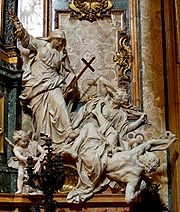
Ignatius of Loyola
Ignatius of Loyola was a Spanish knight from a Basque noble family, hermit, priest since 1537, and theologian, who founded the Society of Jesus and was its first Superior General. Ignatius emerged as a religious leader during the Counter-Reformation...
in the Gesù
Church of the Gesu
The Church of the Gesù is the mother church of the Society of Jesus, a Roman Catholic religious order also known as the Jesuits. Officially named , its facade is "the first truly baroque façade", introducing the baroque style into architecture ,. The church served as model for innumerable Jesuit...
, the Roman mother church of the Jesuit Order. In this most prestigious sculptural commission in Rome for decades, Le Gros was chosen to depict Religion Overthrowing Heresy and Hatred on the right hand side of the altar, using a dynamic ensemble of four over-lifesize marble figures (according to an overall design by the Jesuit painter
Artist
An artist is a person engaged in one or more of any of a broad spectrum of activities related to creating art, practicing the arts and/or demonstrating an art. The common usage in both everyday speech and academic discourse is a practitioner in the visual arts only...
and architect Andrea Pozzo
Andrea Pozzo
Andrea Pozzo was an Italian Jesuit Brother, Baroque painter and architect, decorator, stage designer, and art theoretician. He was best known for his grandiose frescoes using illusionistic technique called quadratura, in which architecture and fancy are intermixed...
). In the group, a towering young robed female figure of Religion wielding a cross scatters the aged personifications of the vices Hatred
Hatred
Hatred is a deep and emotional extreme dislike, directed against a certain object or class of objects. The objects of such hatred can vary widely, from inanimate objects to animals, oneself or other people, entire groups of people, people in general, existence, or the whole world...
(represented by an old woman) and Heresy
Heresy
Heresy is a controversial or novel change to a system of beliefs, especially a religion, that conflicts with established dogma. It is distinct from apostasy, which is the formal denunciation of one's religion, principles or cause, and blasphemy, which is irreverence toward religion...
(a man falling over the edge of the architectural framework into the viewer's space). To one side, a putto
Putto
A putto is a figure of an infant often depicted as a young male. Putti are defined as chubby, winged or wingless, male child figure in nude. Putti are distinct from cherubim, but some English-speakers confuse them with each other, except that in the plural, "the Cherubim" refers to the biblical...
tears apart a volume by the heretic Swiss reformer Zwingli, while a tome beneath the figure of Heresy bears Luther
Martin Luther
Martin Luther was a German priest, professor of theology and iconic figure of the Protestant Reformation. He strongly disputed the claim that freedom from God's punishment for sin could be purchased with money. He confronted indulgence salesman Johann Tetzel with his Ninety-Five Theses in 1517...
's name. In 1697, with his sculptures nearly complete, he won a competition for the altar's main image, the silver statue of St. Ignatius. (Ready in time for the Holy Year
Jubilee (Christian)
The concept of the Jubilee is a special year of remission of sins and universal pardon. In the Biblical Book of Leviticus, a Jubilee year is mentioned to occur every fifty years, in which slaves and prisoners would be freed, debts would be forgiven and the mercies of God would be particularly...
1700, all this work remains on the site for which it was intended.)
These, and other commissions he carried out concurrently, secured Le Gros's reputation, and further patronage led to the requirement for assistants and a larger workshop, which he found in a back wing of the Palazzo Farnese. Indeed, he was the busiest sculptor in Rome at the time, working for the Jesuits on the monumental relief of the Apotheosis of the Blessed Aloysius Gonzaga
Aloysius Gonzaga
- Early life :Aloysius Gonzaga was born at his family's castle in Castiglione delle Stiviere, between Brescia and Mantova in northern Italy in what was then part of the Papal States. He was a member of the illustrious House of Gonzaga...
(1697–99; Cappella Lancelotti, church of Sant'Ignazio
Sant'Ignazio
The Church of Saint Ignatius of Loyola at Campus Martius is Roman Catholic titular church dedicated to Ignatius of Loyola, the founder of the Jesuit order, located in Rome, Italy...
, Rome) while at the same time starting his extensive work for the Dominicans
Dominican Order
The Order of Preachers , after the 15th century more commonly known as the Dominican Order or Dominicans, is a Catholic religious order founded by Saint Dominic and approved by Pope Honorius III on 22 December 1216 in France...
with the Sarcophagus
Sarcophagus
A sarcophagus is a funeral receptacle for a corpse, most commonly carved or cut from stone. The word "sarcophagus" comes from the Greek σαρξ sarx meaning "flesh", and φαγειν phagein meaning "to eat", hence sarkophagus means "flesh-eating"; from the phrase lithos sarkophagos...
for Pope Pius V
Pope Pius V
Pope Saint Pius V , born Antonio Ghislieri , was Pope from 1566 to 1572 and is a saint of the Catholic Church. He is chiefly notable for his role in the Council of Trent, the Counter-Reformation, and the standardization of the Roman liturgy within the Latin Church...
(1697–1698) in Santa Maria Maggiore
Basilica di Santa Maria Maggiore
The Papal Basilica of Saint Mary Major , known also by other names, is the largest Roman Catholic Marian church in Rome, Italy.There are other churches in Rome dedicated to Mary, such as Santa Maria in Trastevere, Santa Maria in Aracoeli, Santa Maria sopra Minerva, but the greater size of the...
. In fact, he became (and was to remain for the rest of his life) the sculptor of choice for Antonin Cloche, the Master of the Dominicans, carving first the tomb (1700–1703), and later the honorary statue (1706–1708) of Cardinal Casanate (in the Lateran Basilica
Basilica of St. John Lateran
The Papal Archbasilica of St. John Lateran , commonly known as St. John Lateran's Archbasilica and St. John Lateran's Basilica, is the cathedral of the Diocese of Rome and the official ecclesiastical seat of the Bishop of Rome, who is the Pope...
and the Biblioteca Casanatense respectively) and embarking on the task to produce with his Saint Dominic (1702–1706) the very first (and for decades the only) monumental statue of a founder of a religious order to adorn a niche in the nave of Saint Peter's. It epitomises his dynamic mature style: "the saint's ardour and authority are well conveyed, emphasized by the ample, skilfully handled sweep of his draperies" (Levey).
Already elected a member of the Accademia di San Luca
Accademia di San Luca
The Accademia di San Luca, was founded in 1577 as an association of artists in Rome, under the directorship of Federico Zuccari, with the purpose of elevating the work of "artists", which included painters, sculptors and architects, above that of mere craftsmen. Other founders included Girolamo...
in 1700, Le Gros also continued to be employed by several branches of the Jesuit order for work such as the statue of St Francis Xavier in the Roman church of Sant'Apollinare
Sant'Apollinare alle Terme Neroniane-Alessandrine
Sant'Apollinare alle Terme is a titular church in Rome, Italy, dedicated to Apollinare, the first bishop of Ravenna. It is the station church for Thursday fifth week in Lent.-History:...
(1702) and the tableau-like and very effective rendering of the Dying Stanislas Kostka
Stanislaus Kostka
Stanisław Kostka S.J. was a Polish novice of the Society of Jesus. In the Catholic Church as Saint Stanislaus Kostka....
in the Jesuit novitiate
Novitiate
Novitiate, alt. noviciate, is the period of training and preparation that a novice monastic or member of a religious order undergoes prior to taking vows in order to discern whether they are called to the religious life....
at Sant'Andrea al Quirinale
Sant'Andrea al Quirinale
The Church of Saint Andrew's at the Quirinal is a Roman Catholic titular church in Rome, built for of the Jesuit seminary on the Quirinal Hill....
. The latter statue in polychrome
Polychrome
Polychrome is one of the terms used to describe the use of multiple colors in one entity. It has also been defined as "The practice of decorating architectural elements, sculpture, etc., in a variety of colors." Polychromatic light is composed of a number of different wavelengths...
marble is today Le Gros's best-known work, but quite atypical, since his normal practice was to provoke naturalistic impressions by an extraordinarily fine surface treatment of a monochrome white marble. A few months earlier, he was commissioned to carve relief of Tobiah
Book of Tobit
The Book of Tobit is a book of scripture that is part of the Catholic and Orthodox biblical canon, pronounced canonical by the Council of Carthage of 397 and confirmed for Roman Catholics by the Council of Trent...
and Gabael (1702–1705) for the chapel of the Monte di Pietà
Mont de Piété
A mount of piety was an institutional pawnbroker run as a charity in Europe from the later Middle Ages times to the 20th century, more often referred to in English by the relevant local term , such as monte di pietà , mont de piété , or monte de piedad...
in Rome.
At some point after 1697, he was hired by Cardinal de Bouillon
Cardinal de Bouillon
Emmanuel Théodose de La Tour d'Auvergne was a French prelate and diplomat, known as the Cardinal de Bouillon.-Biography:...
to create the main sculptural components for his family tomb in the Abbey of Cluny
Cluny Abbey
Cluny Abbey is a Benedictine monastery in Cluny, Saône-et-Loire, France. It was built in the Romanesque style, with three churches built in succession from the 10th to the early 12th centuries....
; Le Gros's work was completed by 1707 and sent to Cluny
Cluny
Cluny or Clungy is a commune in the Saône-et-Loire department in the region of Bourgogne in eastern France. It is 20 km northwest of Mâcon.The town grew up around the Benedictine Cluny Abbey, founded by Duke William I of Aquitaine in 910...
, where it arrived in 1709. Le Gros is here as French as he would ever be and invented a spectacular sepulchral monument, at once continuing in the French baroque tradition and opening up new formal as well as iconological avenues. Alas, it was never to have any part in the development of tomb sculpture, because it was not even unpacked in Cluny
Cluny
Cluny or Clungy is a commune in the Saône-et-Loire department in the region of Bourgogne in eastern France. It is 20 km northwest of Mâcon.The town grew up around the Benedictine Cluny Abbey, founded by Duke William I of Aquitaine in 910...
, due to the fact that Bouillon so completely fell out with his cousin, the Sun King, that all tomb construction was stopped and the marbles and bronzes stored, undisturbed in their sealed crates, for nearly a century. The animated marble figures of the cardinal's parents, Frédéric-Maurice de La Tour d'Auvergne and his wife, together with a Battle Relief and a winged Genius are today installed at the Hôtel-Dieu
Hôtel-Dieu
Hôtel-Dieu is the old name given to the principal hospital in French towns, for instance:*The Hôtel-Dieu de Lyon, created in 1478...
in Cluny, a fragment of the heraldic Tower in a granary of the abbey.
Le Gros also participated in the major sculptural program of his day in Rome, the enterprise to fill Borromini
Francesco Borromini
Francesco Borromini, byname of Francesco Castelli was an architect from Ticino who, with his contemporaries, Gian Lorenzo Bernini and Pietro da Cortona, was a leading figure in the emergence of Roman Baroque architecture.A keen student of the architecture of Michelangelo and the ruins of...
's colossal coloured marble niches in the Basilica of St. John Lateran
Basilica of St. John Lateran
The Papal Archbasilica of St. John Lateran , commonly known as St. John Lateran's Archbasilica and St. John Lateran's Basilica, is the cathedral of the Diocese of Rome and the official ecclesiastical seat of the Bishop of Rome, who is the Pope...
with twelve heroic-scaled figures of the Apostles. This project employed some of the most prominent sculptors of Rome who were, however, made to follow the guidelines and in most cases drawings, of the all influential painter Carlo Maratta
Carlo Maratta
Carlo Maratta or Maratti was an Italian painter, active mostly in Rome, and known principally for his classicizing paintings executed in a Late Baroque Classical manner. Although he is part of the classical tradition stemming from Raphael, he was not exempt from the influence of Baroque painting...
. Le Gros contributed Saint Bartholomew (c. 1703-12) who displays his own flayed skin and Saint Thomas
Thomas the Apostle
Thomas the Apostle, also called Doubting Thomas or Didymus was one of the Twelve Apostles of Jesus. He is best known for questioning Jesus' resurrection when first told of it, then proclaiming "My Lord and my God" on seeing Jesus in . He was perhaps the only Apostle who went outside the Roman...
(c. 1703-11). The terracotta model for Saint Thomas is radically different to the marble eventually produced and proves that in the initial phase of the project Le Gros tried to challenge the imposed sober, classicising style of Maratta with a powerful baroque gesture that clearly refers back to Gianlorenzo Bernini. As the overall unity of all the Apostle statues in the Lateran church was of paramount importance, this, in effect, was Le Gros' attempt to establish himself as the artistic leader of the Eternal City. The attempt failed and the classicising vein of late baroque prevailed. It must have been little consolation that Le Gros, at least, was the only sculptor involved who was not held to work from drawings by Maratta.
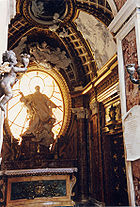
Filippo Juvarra
Filippo Juvarra was an Italian architect and stage set designer.-Biography:Filippo Juvarra was an Italian Baroque architect working in the early part of the eighteenth century. He was born in Messina, Sicily, to a family of goldsmiths and engravers...
, in the creation of the Cappella Antamori in the church of San Girolamo della Carità
San Girolamo della Carità
San Girolamo della Carità is a church in Rome, Italy, located near the Palazzo Farnese and Campo de' Fiori.The church belonged originally to the Franciscan Observants. In 1524 it was taken over by the Archconfraternita della Carità, founded by Giulio de' Medici in 1519; a society of noblemen from...
, Rome, where his statue of San Filippo Neri
Philip Neri
Saint Philip Romolo Neri , also known as Apostle of Rome, was an Italian priest, noted for founding a society of secular priests called the "Congregation of the Oratory".-Early life:...
is set against a large backlit coloured glass window.
Between about 1709-1713 Le Gros was in charge of the Monument of Pope Gregory XV
Pope Gregory XV
Pope Gregory XV , born Alessandro Ludovisi, was pope from 1621, succeeding Paul V on 9 February 1621...
and his cardinal-nephew Ludovico Ludovisi, again in the church of Sant'Ignazio
Sant'Ignazio
The Church of Saint Ignatius of Loyola at Campus Martius is Roman Catholic titular church dedicated to Ignatius of Loyola, the founder of the Jesuit order, located in Rome, Italy...
, where Pierre Monnot
Pierre-Étienne Monnot
Pierre-Étienne Monnot was a French sculptor working mostly in Rome in a late-Baroque idiom.Monnot was born at Orchamps-Vennes, Doubs, Franche-Comté, and brought up at Besançon. Trained at first by his father, he was apprenticed to a sculptor at Dijon, then developed his style during a decade in...
was also brought in to sculpt two Famae
Pheme
In Greek mythology, Pheme was the personification of fame and renown, her favour being notability, her wrath being scandalous rumors. She was a daughter either of Gaia or of Hope, was described as "she who initiates and furthers communication" and had an altar at Athens...
. 1711-1714 followed the Cappella di S. Francesco di Paola in S. Giacomo degl’Incurabili, for which he was the architect and the sculptor of a large relief.
But by then, his star had started to decline rapidly. First, he managed to alienate the Jesuits in 1713 by stubbornly repeating his proposal to transfer his own statue of Stanislas Kostka into the church of Sant'Andrea al Quirinale
Sant'Andrea al Quirinale
The Church of Saint Andrew's at the Quirinal is a Roman Catholic titular church in Rome, built for of the Jesuit seminary on the Quirinal Hill....
as a centrepiece for the newly decorated chapel of the Blessed Stanislas. Then, all the efforts of French officials to convince their king to pay for another Apostle statue in the Lateran and employ Le Gros to make it, led to nothing. He would finally have to recognise that he was fighting a losing battle against Rusconi, who was by then clearly favoured by Pope Clement XI
Pope Clement XI
Pope Clement XI , born Giovanni Francesco Albani, was Pope from 1700 until his death in 1721.-Early life:...
. In 1714 his father died in Paris and Le Gros himself was close to death's door, suffering from gall stones.
Pierre Crozat
thumb|265px|[[Rembrandt]]'s painting [[Danaë |Danae]] from Crozat's collection.Pierre Crozat was a French art collector at the center of a broad circle of cognoscenti; he was the brother of Antoine Crozat....
, whose cabinet in his Parisian house and chapel in his country retreat at Montmorency
Montmorency, Val-d'Oise
Montmorency is a commune in the northern suburbs of Paris, France. It is located from the center of Paris.Montmorency was the fief of the Montmorency family, one of the oldest and most distinguished families of the French nobility...
Le Gros decorated (both destroyed). But he was disappointed to be rebuffed by the Académie and returned to Rome in 1716. Here the last sad chapter of his life opened promptly when he sided with some dissidents who opposed the introduction of new rules at the Accademia di San Luca
Accademia di San Luca
The Accademia di San Luca, was founded in 1577 as an association of artists in Rome, under the directorship of Federico Zuccari, with the purpose of elevating the work of "artists", which included painters, sculptors and architects, above that of mere craftsmen. Other founders included Girolamo...
which subjected non-members to great financial injustice, and he was unceremoniously expelled. This meant that he was then unable to carry out any more public commissions in Rome in his own right. The rich Roman art market was effectively closed for him and he had to settle for a few works outside, namely some statues for the Benedictine abbey at Monte Cassino
Monte Cassino
Monte Cassino is a rocky hill about southeast of Rome, Italy, c. to the west of the town of Cassino and altitude. St. Benedict of Nursia established his first monastery, the source of the Benedictine Order, here around 529. It was the site of Battle of Monte Cassino in 1944...
(after the heavy bombing in World War II, only his Emperor Henry II
Henry II, Holy Roman Emperor
Henry II , also referred to as Saint Henry, Obl.S.B., was the fifth and last Holy Roman Emperor of the Ottonian dynasty, from his coronation in Rome in 1014 until his death a decade later. He was crowned King of the Germans in 1002 and King of Italy in 1004...
shows a reasonable degree of authenticity after restoration) and, without doubt due to the intervention of Juvarra who was by then architect to the Duke of Savoy
Victor Amadeus II of Sardinia
Victor Amadeus II was Duke of Savoy from 1675 to 1730. He also held the titles of marquis of Saluzzo, duke of Montferrat, prince of Piedmont, count of Aosta, Moriana and Nizza. Louis XIV organised his marriage in order to maintain French influence in the Duchy but Victor Amadeus soon broke away...
, two female saints for the church of S. Cristina in Turin
Turin
Turin is a city and major business and cultural centre in northern Italy, capital of the Piedmont region, located mainly on the left bank of the Po River and surrounded by the Alpine arch. The population of the city proper is 909,193 while the population of the urban area is estimated by Eurostat...
(now in Turin Cathedral).
Embittered, Le Gros died from pneumonia in 1719 and was buried in the French national church
San Luigi dei Francesi
The Church of St. Louis of the French is a Roman Catholic minor basilica and titular church in Rome, not far from Piazza Navona. The church is dedicated to the Virgin Mary, to St. Denis the Areopagite and St. Louis IX, king of France...
in Rome. Only in 1725, under the directorship of the painter Giuseppe Chiari
Giuseppe Bartolomeo Chiari
Giuseppe Bartolomeo Chiari , also known simply as Giuseppe Chiari, was an Italian painter of the late-Baroque period, active mostly in Rome....
, was he posthumously rehabilitated and reinstated as a member of the Accademia di San Luca
Accademia di San Luca
The Accademia di San Luca, was founded in 1577 as an association of artists in Rome, under the directorship of Federico Zuccari, with the purpose of elevating the work of "artists", which included painters, sculptors and architects, above that of mere craftsmen. Other founders included Girolamo...
.