

Muziris

Encyclopedia
Muziris is an ancient sea-port
in Southwestern India
on the Periyar River
3.2 km from its mouth. The derivation of the name Muziris is said to be from "Mucciripattanam," "mucciri" means "cleft palate" and "pattanam" means "city". Near Muziris, Periyar River
was branched into two like a cleft palate and so the name "Mucciripattanam. "
In a flood of the Periyar River
in 1341 CE, Muziris was destroyed and the centre of commerce was shifted to other areas. Soon the exact location of Muziris was forgotten. The multi-disciplinary and multi-seasonal archaeological research by the Kerala Council for Historical Research (KCHR) at Pattanam
, a small village at North Parur, is revealing the past of this area and may eventually locate the exact position of Muziris. British Academy (BASAS) recently accorded recognition for the formation of an international research group based on Pattanam.
's Akananuru
, Murachipattanam in Valmiki
's Ramayana
, and as Muzirikode in the Jewish Copper Plate of Bhaskara Ravi Varma (circa 1000 CE). In his Brihtsamhita Varaha Mihira refers to both Baladevapattanam and Marichipattanam as important towns in Kerala. Kern, Varaha Mihira’s translator, identifies these places with the Baliapattana and the Muziris of Ptolemy and other Greek geographers, respectively. Muziris was also mentioned in the 1st century Natural History of Pliny the Elder
, the 2nd century Geographia
of Ptolemy
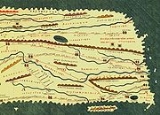
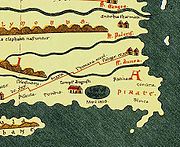
, the 2nd century Muziris Papyrus (p. Vindob G480822), and the 4th century Tabula Peutingeriana
.
 There has been much research about the exact location of the port. It was long considered to be in Kodungallur
in Thrissur district
, because all major ports in ancient times were situated at river mouths.
But in 1983, a large hoard of Roman coins was found at a site about six miles from Kodungallur
in a small village called Pattanam
on the northern shore of Paravur Thodu, a branch of Periyar River
. It is in the Chittatukara Panchayat, of Ernakulam District
, 2 km north of North Paravur
and 25 km north of Kochi. Now this village is one of the most significant archaeological sites in South Asia
. The Excavations carried out at Pattanam
from 2007 to 2011 have uncovered evidences which may support its being the location of ancient sea-port
Muziris.
It is also postulated that the name Pattanam
is an abbreviation of what was originally Musiripattanam, the local name of Muziris.
(c. 23- 77 CE) gives a description of voyages to India in the first century CE. He refers to many Indian ports in his work The Natural History.
(c. 60–100 CE) gives an elaborate description of the Tamil country:
poems in the Sangam Literature, poem no. 149 .
, conceals the ancient maritime history of the world.
, ivory
s and textiles was discovered in Egypt in 1980 and first published in 1985. It is now preserved in a Vienna Museum
. This second century CE document, is known as the Muziris papyrus or the Vienna papyrus,
That Egyptian merchant gave this agreement to the Roman government as a guarantee for a loan That is how this agreement survived through the ages. This discovery has opened a strong base to ancient international and trade laws in particular and has been studied at length by economists, lawyers as well as historians.
(Aanjili, in Malayalam), a tree common in Malabar Coast
, out of which boats are made off. It was identified by the Kerala Forest Institute, Thrissur
.
The bollards some of which are still in satisfactory condition is made of Teak
(Texctona grandis). The word teak comes from the language of the Malabar coast
, Malayalam word theykku.
The wood of the boat is carbon dated by scientists from Bhuveneshwar institute of physics. Radiocarbon dating using AMS Radio Carbon revealed that the date range of the canoe sample is 1300 BC to 100 BC, (that is, 700 plus or minus 600 BC with 95 per cent probability), making it the earliest watercraft excavated from an archeological context in India.
amphora
e, mainly used for transporting wine and olive oil, as well as Yemen
i and West Asian pottery and Indian roulette ware, which is also common on the East Coast of India and also found in Berenice
in Egypt
. This suggests that Muziris was a port of great international fame and that South India
was involved in active trade with several civilisations of West Asia, the Near East
and Europe
.
Researchers seem to agree that the port was already a bustling center of trade by 500 BCE, and there is some evidence that suggests that Muziris was a city, if not a port as well, from before 1500 BCE.
The site for archaeological research at Pattanam (10°09.434’N; 76°12.587’E) covers about 45 hectares. Due to habitation activities it is a disturbed site; some parts are partially destroyed due to sand quarrying. The site seems to have been first occupied by indigenous population around 1000 BCE and continued to be active till the 10th century CE.
The archaeological excavations have unearthed signs of early Roman trade and commerce in beads and ornaments from this hamlet, indicating that this hamlet was part of Muziris. Excavated antiquities include Chera coins, amphorae, terra sigillatta, cameo blanks made of semi-precious stones and large quantities of stone and glass beads. The excavations from 2007 to 2009 produced the largest number of Mediterranean amphora fragments outside the boundaries of the Roman Empire. In 2010, antiquities of small size – beads of both semi-precious stones and glass, pendants and lockets, cameo blanks, coins (predominantly early Chera coins with symbols of an elephant, bow and arrow), objects or fragments of objects made of iron, copper, lead and occasionally gold, and shards of Indian and foreign pottery were excavated. A broken rim with Brahmi script
has been found, the first pre-firing pottery inscription found at Pattanam. Enormous quantities of local pottery of the early historic period, dated between the 1st century BCE and the 4th century CE, shows that this was the period of peak activity at Pattanam. A Tamil-Brahmi script with the letters "a ma na," meaning Jaina, was found at Pattanam in 2011. The letters are followed by two megalithic graffiti symbols which could not be identified. This discovery establishes the prevalence of Jainism on the west coast from at least the 2nd century CE.
Port
A port is a location on a coast or shore containing one or more harbors where ships can dock and transfer people or cargo to or from land....
in Southwestern India
Coastal South West India
Coastal South West India is a geo-cultural region in the Indian Subcontinent that spans entire Coastal South Western India. . The region was referred as Sapta Konkan region in the Skanda Purana .-Region:...
on the Periyar River
Periyar River
Periyar is the longest river in the state of Kerala, India, with a length of 244 km. The Periyar is known as the lifeline of Kerala; it is one of the few perennial rivers in the region and provides drinking water for several major towns...
3.2 km from its mouth. The derivation of the name Muziris is said to be from "Mucciripattanam," "mucciri" means "cleft palate" and "pattanam" means "city". Near Muziris, Periyar River
Periyar River
Periyar is the longest river in the state of Kerala, India, with a length of 244 km. The Periyar is known as the lifeline of Kerala; it is one of the few perennial rivers in the region and provides drinking water for several major towns...
was branched into two like a cleft palate and so the name "Mucciripattanam. "
In a flood of the Periyar River
Periyar River
Periyar is the longest river in the state of Kerala, India, with a length of 244 km. The Periyar is known as the lifeline of Kerala; it is one of the few perennial rivers in the region and provides drinking water for several major towns...
in 1341 CE, Muziris was destroyed and the centre of commerce was shifted to other areas. Soon the exact location of Muziris was forgotten. The multi-disciplinary and multi-seasonal archaeological research by the Kerala Council for Historical Research (KCHR) at Pattanam
Pattanam
Pattanam , presently a land locked rural hamlet located in the Periyar Delta, 2 km north of North Paravur, 9 km south of Kodungallur and 25 km north of Kochi in Ernakulam District in the southern Indian state of Kerala. Pattanam that means coastal town has ancient origins...
, a small village at North Parur, is revealing the past of this area and may eventually locate the exact position of Muziris. British Academy (BASAS) recently accorded recognition for the formation of an international research group based on Pattanam.
Mucciripattanam
Other names that are often used are Muraccipattanam, Mariccipattanam, Mucciri, Vanchi or Muzirikkod. Muziris is referred to as Muchiri in Sangam literatureSangam literature
Sangam literature refers to a body of classical Tamil literature created between the years c. 600 BCE to 300 CE. This collection contains 2381 poems composed by 473 poets, some 102 of whom remain anonymous The period during which these poems were composed is commonly referred to as the Sangam...
's Akananuru
Akananuru
Akananuru , a classical Tamil poetic work, is the seventh book in the Sangam literature anthology Ettuthokai. It contains 400 Akam poems dealing with matters of love and separation...
, Murachipattanam in Valmiki
Valmiki
Valmiki is celebrated as the poet harbinger in Sanskrit literature. He is the author of the epic Ramayana, based on the attribution in the text of the epic itself. He is revered as the Adi Kavi, which means First Poet, for he discovered the first śloka i.e...
's Ramayana
Ramayana
The Ramayana is an ancient Sanskrit epic. It is ascribed to the Hindu sage Valmiki and forms an important part of the Hindu canon , considered to be itihāsa. The Ramayana is one of the two great epics of India and Nepal, the other being the Mahabharata...
, and as Muzirikode in the Jewish Copper Plate of Bhaskara Ravi Varma (circa 1000 CE). In his Brihtsamhita Varaha Mihira refers to both Baladevapattanam and Marichipattanam as important towns in Kerala. Kern, Varaha Mihira’s translator, identifies these places with the Baliapattana and the Muziris of Ptolemy and other Greek geographers, respectively. Muziris was also mentioned in the 1st century Natural History of Pliny the Elder
Pliny the Elder
Gaius Plinius Secundus , better known as Pliny the Elder, was a Roman author, naturalist, and natural philosopher, as well as naval and army commander of the early Roman Empire, and personal friend of the emperor Vespasian...
, the 2nd century Geographia
Geographia (Ptolemy)
The Geography is Ptolemy's main work besides the Almagest...
of Ptolemy
Ptolemy
Claudius Ptolemy , was a Roman citizen of Egypt who wrote in Greek. He was a mathematician, astronomer, geographer, astrologer, and poet of a single epigram in the Greek Anthology. He lived in Egypt under Roman rule, and is believed to have been born in the town of Ptolemais Hermiou in the...
, the 2nd century Muziris Papyrus (p. Vindob G480822), and the 4th century Tabula Peutingeriana
Tabula Peutingeriana
The Tabula Peutingeriana is an itinerarium showing the cursus publicus, the road network in the Roman Empire. The original map of which this is a unique copy was last revised in the fourth or early fifth century. It covers Europe, parts of Asia and North Africa...
.
Location
Kodungallur
Kodungallur is a municipality in Thrissur District, in the state of Kerala, India on the Malabar Coast. Kodungallur is located about 29 km northwest of Kochi city and 38 km Southwest of Thrissur, on National Highway 17 . Muziris the ancient seaport at the mouth of the Periyar River was...
in Thrissur district
Thrissur district
Thrissur is a revenue district of Kerala situated in the central part of that state. Spanning an area of about 3,032 km2, Thrissur district is home to over 10% of Kerala’s population. Thrissur district was formed on July 1, 1949, with the headquarters at Thrissur City. Thrissur is known as...
, because all major ports in ancient times were situated at river mouths.
But in 1983, a large hoard of Roman coins was found at a site about six miles from Kodungallur
Kodungallur
Kodungallur is a municipality in Thrissur District, in the state of Kerala, India on the Malabar Coast. Kodungallur is located about 29 km northwest of Kochi city and 38 km Southwest of Thrissur, on National Highway 17 . Muziris the ancient seaport at the mouth of the Periyar River was...
in a small village called Pattanam
Pattanam
Pattanam , presently a land locked rural hamlet located in the Periyar Delta, 2 km north of North Paravur, 9 km south of Kodungallur and 25 km north of Kochi in Ernakulam District in the southern Indian state of Kerala. Pattanam that means coastal town has ancient origins...
on the northern shore of Paravur Thodu, a branch of Periyar River
Periyar River
Periyar is the longest river in the state of Kerala, India, with a length of 244 km. The Periyar is known as the lifeline of Kerala; it is one of the few perennial rivers in the region and provides drinking water for several major towns...
. It is in the Chittatukara Panchayat, of Ernakulam District
Ernakulam district
-Economy:Agriculture constitutes the most important segment of the district’s economy and it is the biggest source of employment. Of the geographical 235319 hectares, crops are grown in 0 hectares. Coconut is the principal crop followed by rubber, paddy, and tapioca...
, 2 km north of North Paravur
North Paravur
North Paravur formerly known as Parur is a town, municipality in Ernakulam district in the Indian state of Kerala. It is an old and growing municipality. Paravur is the capital of Paravur Taluk in Ernakulam district...
and 25 km north of Kochi. Now this village is one of the most significant archaeological sites in South Asia
South Asia
South Asia, also known as Southern Asia, is the southern region of the Asian continent, which comprises the sub-Himalayan countries and, for some authorities , also includes the adjoining countries to the west and the east...
. The Excavations carried out at Pattanam
Pattanam
Pattanam , presently a land locked rural hamlet located in the Periyar Delta, 2 km north of North Paravur, 9 km south of Kodungallur and 25 km north of Kochi in Ernakulam District in the southern Indian state of Kerala. Pattanam that means coastal town has ancient origins...
from 2007 to 2011 have uncovered evidences which may support its being the location of ancient sea-port
Port
A port is a location on a coast or shore containing one or more harbors where ships can dock and transfer people or cargo to or from land....
Muziris.
It is also postulated that the name Pattanam
Pattanam
Pattanam , presently a land locked rural hamlet located in the Periyar Delta, 2 km north of North Paravur, 9 km south of Kodungallur and 25 km north of Kochi in Ernakulam District in the southern Indian state of Kerala. Pattanam that means coastal town has ancient origins...
is an abbreviation of what was originally Musiripattanam, the local name of Muziris.
Pliny the Elder
Pliny the ElderPliny the Elder
Gaius Plinius Secundus , better known as Pliny the Elder, was a Roman author, naturalist, and natural philosopher, as well as naval and army commander of the early Roman Empire, and personal friend of the emperor Vespasian...
(c. 23- 77 CE) gives a description of voyages to India in the first century CE. He refers to many Indian ports in his work The Natural History.
"To those who are bound for IndiaIndiaIndia , officially the Republic of India , is a country in South Asia. It is the seventh-largest country by geographical area, the second-most populous country with over 1.2 billion people, and the most populous democracy in the world...
, OcelisOcelisOcelis is and ancient port on the Red Sea, on the Arabian side near or at Bab al-Mandeb, the strait separating the Red Sea from the Gulf of Aden....
(On the Red SeaRed SeaThe Red Sea is a seawater inlet of the Indian Ocean, lying between Africa and Asia. The connection to the ocean is in the south through the Bab el Mandeb strait and the Gulf of Aden. In the north, there is the Sinai Peninsula, the Gulf of Aqaba, and the Gulf of Suez...
) is the best place for embarkation. If the wind, called Hippalus (Southwest Monsoon), happens to be blowing it is possible to arrive in forty days at the nearest market in India, "Muziris" by name. This, however, is not a very desirable place for disembarkation, on account of the pirates which frequent its vicinity, where they occupy a place called Nitrias; nor, in fact, is it very rich in articles of merchandise. Besides, the road stead for shipping is a considerable distance from the shore, and the cargoes have to be conveyed in boats, either for loading or discharging. At the moment that I am writing these pages, the name of the king of this place is Caelobothras (KeralaputrasChera dynastyChera Dynasty in South India is one of the most ancient ruling dynasties in India. Together with the Cholas and the Pandyas, they formed the three principle warring Iron Age Tamil kingdoms in southern India...
). Another port, and a much more convenient one, is that which lies in the territory of the people called Neacyndi, Barace by name. Here king Pandion (Pandya) used to reign, dwelling at a considerable distance from the market in the interior, at a city known as Modiera (MaduraiMaduraiMadurai is the third largest city in the Indian state of Tamil Nadu and one of the oldest continuously inhabited cities in the world. It served as the capital city of the Pandyan Kingdom. It is the administrative headquarters of Madurai District and is famous for its temples built by Pandyan and...
). The district from which pepper is carried down to Barace in boats hollowed out of a single tree is known as Cottonara (Kuttanadu).
"Travellers set sail from IndiaIndiaIndia , officially the Republic of India , is a country in South Asia. It is the seventh-largest country by geographical area, the second-most populous country with over 1.2 billion people, and the most populous democracy in the world...
on their return to EuropeEuropeEurope is, by convention, one of the world's seven continents. Comprising the westernmost peninsula of Eurasia, Europe is generally 'divided' from Asia to its east by the watershed divides of the Ural and Caucasus Mountains, the Ural River, the Caspian and Black Seas, and the waterways connecting...
, at the beginning of the Egyptian monthEgyptian calendarThe ancient civil Egyptian calendar had a year that was 360 days long and was divided into 12 months of 30 days each, plus five extra days at the end of the year. The months were divided into three weeks of ten days each...
of TybiaMonth of TobiTobi , also known as Touba, is the fifth month of the Coptic calendar. It lies between January 9 and February 7 of the Gregorian calendar...
, which is our DecemberDecemberDecember is the 12th and last month of the year in the Julian and Gregorian Calendars and one of seven months with the length of 31 days.December starts on the same day as September every year and ends on the same day as April every year.-Etymology:...
, or at all events before the sixth day of the Egyptian month MechirMeshirMeshir , also known as Amshir, is the sixth month of the Coptic calendar. It lies between February 8 and March 9 of the Gregorian calendar...
, the same as our Ides of JanuaryJanuaryJanuary is the first month of the year in the Julian and Gregorian calendars and one of seven months with the length of 31 days. The first day of the month is known as New Year's Day...
; if they do this they can go and return in the same year. They set sail from IndiaIndiaIndia , officially the Republic of India , is a country in South Asia. It is the seventh-largest country by geographical area, the second-most populous country with over 1.2 billion people, and the most populous democracy in the world...
with a south-east wind (Northeast Monsoon), and upon entering the Red SeaRed SeaThe Red Sea is a seawater inlet of the Indian Ocean, lying between Africa and Asia. The connection to the ocean is in the south through the Bab el Mandeb strait and the Gulf of Aden. In the north, there is the Sinai Peninsula, the Gulf of Aqaba, and the Gulf of Suez...
, catch the south-west or south."
Periplus of the Erythraean Sea
The Periplus of the Erythraean SeaPeriplus of the Erythraean Sea
The Periplus of the Erythraean Sea or Periplus of the Red Sea is a Greco-Roman periplus, written in Greek, describing navigation and trading opportunities from Roman Egyptian ports like Berenice along the coast of the Red Sea, and others along Northeast Africa and India...
(c. 60–100 CE) gives an elaborate description of the Tamil country:
"...then come Naura and TyndisTyndisTyndis is an ancient sea-port and harbor-town north to Muziris in the Chera Kingdom, modern day India on the Malabar Coast. The exact location of the port is still unknown, modern day Koyilandi is often identified as Tyndis located in the Sangam Tamil kingdom of the Cheras...
, the first markets of Damirica (Limyrike), and then Muziris and Nelcynda, which are now of leading importance. Tyndis is of the Kingdom of CerobothraChera dynastyChera Dynasty in South India is one of the most ancient ruling dynasties in India. Together with the Cholas and the Pandyas, they formed the three principle warring Iron Age Tamil kingdoms in southern India...
; it is a village in plain sight by the sea. Muziris, of the same KingdomChera dynastyChera Dynasty in South India is one of the most ancient ruling dynasties in India. Together with the Cholas and the Pandyas, they formed the three principle warring Iron Age Tamil kingdoms in southern India...
, abounds in ships sent there with cargoes from Arabia, and by the GreeksAncient GreeceAncient Greece is a civilization belonging to a period of Greek history that lasted from the Archaic period of the 8th to 6th centuries BC to the end of antiquity. Immediately following this period was the beginning of the Early Middle Ages and the Byzantine era. Included in Ancient Greece is the...
; it is located on a river, distant from Tyndis by river and sea five hundred stadiaStadion (unit of length)The stadion, Latinized as stadium and anglicized as stade, is an ancient Greek unit of length. According to Herodotus, one stade is equal to 600 feet. However, there were several different lengths of “feet”, depending on the country of origin....
, and up the river from the shore twenty stadiaStadion (unit of length)The stadion, Latinized as stadium and anglicized as stade, is an ancient Greek unit of length. According to Herodotus, one stade is equal to 600 feet. However, there were several different lengths of “feet”, depending on the country of origin....
...Nelcynda is distant from Muziris by river and sea about five hundred stadiaStadion (unit of length)The stadion, Latinized as stadium and anglicized as stade, is an ancient Greek unit of length. According to Herodotus, one stade is equal to 600 feet. However, there were several different lengths of “feet”, depending on the country of origin....
, and is of another Kingdom, the Pandian (Pandya kingdom). This place also is situated on a river, about one hundred and twenty stadia from the sea...
"There is exported pepper, which is produced in only one region near these markets, a district called Cottonara (Kuttanadu)"
Sangam literature
A tantalizing description of Muziris is in the Akananooru, an anthology of early TamilTamil language
Tamil is a Dravidian language spoken predominantly by Tamil people of the Indian subcontinent. It has official status in the Indian state of Tamil Nadu and in the Indian union territory of Pondicherry. Tamil is also an official language of Sri Lanka and Singapore...
poems in the Sangam Literature, poem no. 149 .
"The beautiful warships of the Yavanas come, to the prosperous and beautiful Muchiri (Muziris) splashing the white foams of 'Chulli' ( Periyar RiverPeriyar RiverPeriyar is the longest river in the state of Kerala, India, with a length of 244 km. The Periyar is known as the lifeline of Kerala; it is one of the few perennial rivers in the region and provides drinking water for several major towns...
) the big river, and then return laden with 'curry' (Black pepperBlack pepperBlack pepper is a flowering vine in the family Piperaceae, cultivated for its fruit, which is usually dried and used as a spice and seasoning. The fruit, known as a peppercorn when dried, is approximately in diameter, dark red when fully mature, and, like all drupes, contains a single seed...
) paying for it in gold."
Decline and fall
It is not clear, however, why its activities as a major trade port ended and what led to its decline:- One theory attributes it to an earthquake or the great flood of 1341 recorded in history, which caused the change of course of the Periyar RiverPeriyar RiverPeriyar is the longest river in the state of Kerala, India, with a length of 244 km. The Periyar is known as the lifeline of Kerala; it is one of the few perennial rivers in the region and provides drinking water for several major towns...
. - Experts says that with the fall of Roman EmpireRoman EmpireThe Roman Empire was the post-Republican period of the ancient Roman civilization, characterised by an autocratic form of government and large territorial holdings in Europe and around the Mediterranean....
this ancient port on the other end of the then known world disappeared mysteriously - During the Ptolemaic Roman period (third century B.C. to sixth century A.D), Berenike and Myos Hermos for example served as key transit ports between ancient EgyptEgyptEgypt , officially the Arab Republic of Egypt, Arabic: , is a country mainly in North Africa, with the Sinai Peninsula forming a land bridge in Southwest Asia. Egypt is thus a transcontinental country, and a major power in Africa, the Mediterranean Basin, the Middle East and the Muslim world...
and RomeRomeRome is the capital of Italy and the country's largest and most populated city and comune, with over 2.7 million residents in . The city is located in the central-western portion of the Italian Peninsula, on the Tiber River within the Lazio region of Italy.Rome's history spans two and a half...
on one side and the Red Sea-Indian Ocean regions on the other.. Then other Indian Ocean regions took charge of the commerce and spread it to other seaports of IndiaIndiaIndia , officially the Republic of India , is a country in South Asia. It is the seventh-largest country by geographical area, the second-most populous country with over 1.2 billion people, and the most populous democracy in the world...
and South AsiaSouth AsiaSouth Asia, also known as Southern Asia, is the southern region of the Asian continent, which comprises the sub-Himalayan countries and, for some authorities , also includes the adjoining countries to the west and the east...
.
Discoveries
A four metre thick soil at PattanamPattanam
Pattanam , presently a land locked rural hamlet located in the Periyar Delta, 2 km north of North Paravur, 9 km south of Kodungallur and 25 km north of Kochi in Ernakulam District in the southern Indian state of Kerala. Pattanam that means coastal town has ancient origins...
, conceals the ancient maritime history of the world.
Muziris papyrus
A papyrus document that mentions a loan agreement made by an Egyptian merchant and a merchant in Muziris, for exporting Gangetic NardSpikenard
Spikenard is a flowering plant of the Valerian family that grows in the Himalayas of China, also found growing in the northern region of India and Nepal. The plant grows to about 1 m in height and has pink, bell-shaped flowers...
, ivory
Ivory
Ivory is a term for dentine, which constitutes the bulk of the teeth and tusks of animals, when used as a material for art or manufacturing. Ivory has been important since ancient times for making a range of items, from ivory carvings to false teeth, fans, dominoes, joint tubes, piano keys and...
s and textiles was discovered in Egypt in 1980 and first published in 1985. It is now preserved in a Vienna Museum
Vienna Museum
The Vienna Museum is a group of museums in Vienna consisting of the museums of the history of the city. In addition to the main building in Karlsplatz and the Hermesvilla, the group includes numerous specialised museums, musicians' residences and archaeological excavations.The permanent exhibit of...
. This second century CE document, is known as the Muziris papyrus or the Vienna papyrus,
That Egyptian merchant gave this agreement to the Roman government as a guarantee for a loan That is how this agreement survived through the ages. This discovery has opened a strong base to ancient international and trade laws in particular and has been studied at length by economists, lawyers as well as historians.
Wharf and a canoe
The most remarkable find in Pattanam is a brick structural wharf complex, with nine bollards to harbour boats and in the midst of this, a highly decayed canoe, all perfectly mummified in mud. The boat 6 meters long was made of Artocarpus hirsutusArtocarpus hirsutus
Artocarpus hirsutus, known by a variety of names, such as Aini, Aini-maram, Aanjili, is a tropical evergreen tree species that is native to India , where it prefers moist, deciduous to partially evergreen woodlands.Its flowers are in axillary inflorescences and its fruits are syncarps and very...
(Aanjili, in Malayalam), a tree common in Malabar Coast
Malabar Coast
The Malabar Coast is a long and narrow coastline on the south-western shore line of the mainland Indian subcontinent. Geographically, it comprises the wettest regions of southern India, as the Western Ghats intercept the moisture-laden monsoon rains, especially on their westward-facing mountain...
, out of which boats are made off. It was identified by the Kerala Forest Institute, Thrissur
Thrissur
This article is about the city in India. For the district, see Thrissur district. For the urban agglomeration area of Thrissur see Thrissur Metropolitan Area...
.
The bollards some of which are still in satisfactory condition is made of Teak
Teak
Teak is the common name for the tropical hardwood tree species Tectona grandis and its wood products. Tectona grandis is native to south and southeast Asia, mainly India, Indonesia, Malaysia, and Burma, but is naturalized and cultivated in many countries, including those in Africa and the...
(Texctona grandis). The word teak comes from the language of the Malabar coast
Malabar Coast
The Malabar Coast is a long and narrow coastline on the south-western shore line of the mainland Indian subcontinent. Geographically, it comprises the wettest regions of southern India, as the Western Ghats intercept the moisture-laden monsoon rains, especially on their westward-facing mountain...
, Malayalam word theykku.
The wood of the boat is carbon dated by scientists from Bhuveneshwar institute of physics. Radiocarbon dating using AMS Radio Carbon revealed that the date range of the canoe sample is 1300 BC to 100 BC, (that is, 700 plus or minus 600 BC with 95 per cent probability), making it the earliest watercraft excavated from an archeological context in India.
Archaeological excavations
The archaeological work done in the area has revealed fragments of imported RomanAncient Rome
Ancient Rome was a thriving civilization that grew on the Italian Peninsula as early as the 8th century BC. Located along the Mediterranean Sea and centered on the city of Rome, it expanded to one of the largest empires in the ancient world....
amphora
Amphora
An amphora is a type of vase-shaped, usually ceramic container with two handles and a long neck narrower than the body...
e, mainly used for transporting wine and olive oil, as well as Yemen
Yemen
The Republic of Yemen , commonly known as Yemen , is a country located in the Middle East, occupying the southwestern to southern end of the Arabian Peninsula. It is bordered by Saudi Arabia to the north, the Red Sea to the west, and Oman to the east....
i and West Asian pottery and Indian roulette ware, which is also common on the East Coast of India and also found in Berenice
Berenice
Berenice or Berenike is the Ancient Macedonian form for Attic Greek Φερενίκη , meaning "bearer of victory", from φέρω "to bear" + νίκη "victory". Berenika priestess of Demeter in Lete ca. 350 BC is the oldest epigraphical evidence. The name also has the form Bernice...
in Egypt
Egypt
Egypt , officially the Arab Republic of Egypt, Arabic: , is a country mainly in North Africa, with the Sinai Peninsula forming a land bridge in Southwest Asia. Egypt is thus a transcontinental country, and a major power in Africa, the Mediterranean Basin, the Middle East and the Muslim world...
. This suggests that Muziris was a port of great international fame and that South India
South India
South India is the area encompassing India's states of Andhra Pradesh, Karnataka, Kerala and Tamil Nadu as well as the union territories of Lakshadweep and Pondicherry, occupying 19.31% of India's area...
was involved in active trade with several civilisations of West Asia, the Near East
Near East
The Near East is a geographical term that covers different countries for geographers, archeologists, and historians, on the one hand, and for political scientists, economists, and journalists, on the other...
and Europe
Europe
Europe is, by convention, one of the world's seven continents. Comprising the westernmost peninsula of Eurasia, Europe is generally 'divided' from Asia to its east by the watershed divides of the Ural and Caucasus Mountains, the Ural River, the Caspian and Black Seas, and the waterways connecting...
.
Researchers seem to agree that the port was already a bustling center of trade by 500 BCE, and there is some evidence that suggests that Muziris was a city, if not a port as well, from before 1500 BCE.
The site for archaeological research at Pattanam (10°09.434’N; 76°12.587’E) covers about 45 hectares. Due to habitation activities it is a disturbed site; some parts are partially destroyed due to sand quarrying. The site seems to have been first occupied by indigenous population around 1000 BCE and continued to be active till the 10th century CE.
The archaeological excavations have unearthed signs of early Roman trade and commerce in beads and ornaments from this hamlet, indicating that this hamlet was part of Muziris. Excavated antiquities include Chera coins, amphorae, terra sigillatta, cameo blanks made of semi-precious stones and large quantities of stone and glass beads. The excavations from 2007 to 2009 produced the largest number of Mediterranean amphora fragments outside the boundaries of the Roman Empire. In 2010, antiquities of small size – beads of both semi-precious stones and glass, pendants and lockets, cameo blanks, coins (predominantly early Chera coins with symbols of an elephant, bow and arrow), objects or fragments of objects made of iron, copper, lead and occasionally gold, and shards of Indian and foreign pottery were excavated. A broken rim with Brahmi script
Brāhmī script
Brāhmī is the modern name given to the oldest members of the Brahmic family of scripts. The best-known Brāhmī inscriptions are the rock-cut edicts of Ashoka in north-central India, dated to the 3rd century BCE. These are traditionally considered to be early known examples of Brāhmī writing...
has been found, the first pre-firing pottery inscription found at Pattanam. Enormous quantities of local pottery of the early historic period, dated between the 1st century BCE and the 4th century CE, shows that this was the period of peak activity at Pattanam. A Tamil-Brahmi script with the letters "a ma na," meaning Jaina, was found at Pattanam in 2011. The letters are followed by two megalithic graffiti symbols which could not be identified. This discovery establishes the prevalence of Jainism on the west coast from at least the 2nd century CE.
Project Muziris Heritage
The project was launched by the Department of Cultural Affairs, Govt. of Kerala. It aims to retrieve the historical heritage of the N. Paravur-Kodungallur region and plans a combination of heritage management initiatives in its restoration, conservation and access to the public. KCHR, identified as the nodal agency for Muziris Heritage Project, provides academic guidance and undertakes archaeological and historical research in the region. KCHR Chairman Dr. K. N. Panikkar has submitted a concept note on Muziris Heritage Project pointing out the possibilities and potential of the proposal.See also
- PattanamPattanamPattanam , presently a land locked rural hamlet located in the Periyar Delta, 2 km north of North Paravur, 9 km south of Kodungallur and 25 km north of Kochi in Ernakulam District in the southern Indian state of Kerala. Pattanam that means coastal town has ancient origins...
- KodungallurKodungallurKodungallur is a municipality in Thrissur District, in the state of Kerala, India on the Malabar Coast. Kodungallur is located about 29 km northwest of Kochi city and 38 km Southwest of Thrissur, on National Highway 17 . Muziris the ancient seaport at the mouth of the Periyar River was...
- ThiruvanchikulamThiruvanchikulamThiruvanchikkulam was the capital of the Chera kingdom. Thiruvanchikulam is situated near the modern city of Kochi in the Kerala Province of modern India south to Mahodayapuram and north to former Muziris, the famous sea port on the Malabar coast...
- North ParavurNorth ParavurNorth Paravur formerly known as Parur is a town, municipality in Ernakulam district in the Indian state of Kerala. It is an old and growing municipality. Paravur is the capital of Paravur Taluk in Ernakulam district...
- Berenice Troglodytica
- South Asian Stone AgeSouth Asian Stone AgeThe South Asian Stone Age covers the Palaeolithic, Mesolithic and Neolithic periods in South Asia. Evidence for the most ancient anatomically modern Homo sapiens in South Asia has been found in the cave sites of Batadomba lena and Beli lena in Sri Lanka.In Mehrgarh, in what is today western...
External links
- BBC report, Search for India's ancient city
- Pattanam Excavations (Comprehensive Resource)
- Pattanam Muziris Maps and Excavations
- Ancient Muziris Story
- Pattanam excavation significant
- http://www.wikimapia.org/#lat=10.1571922&lon=76.2096047&z=18&l=0&m=b Current Excavation Site
- http://www.ias.ac.in/currsci/jul252009/236.pdf
- http://www.indianchristianity.com/html/Books.htm
- Dr. Nagaswamy R., 1995, Roman Karur
- Raghava Aiyangar, R.,1932, Vanci Managar, Madras.
- http://www.thebeadsite.com/UNI-MAPS.html
- Current Excavation Location http://www.wikimapia.org/#lat=10.1571922&lon=76.2096047&z=18&l=0&m=b
- http://beta.thehindu.com/arts/history-and-culture/article472072.ece?homepage=true
- In search of Muziris (The Hindu, May 1, 2010)