


Birch bark document

Encyclopedia
Birch bark
Birch bark or birchbark is the bark of several Eurasian and North American birch trees of the genus Betula.The strong and water-resistant cardboard-like bark can be easily cut, bent, and sewn, which made it a valuable building, crafting, and writing material, since pre-historic times...
. Such documents existed in several cultures. For instance, some Gandharan Buddhist texts
Gandharan Buddhist Texts
The Gandhāran Buddhist Texts are the oldest Buddhist manuscripts yet discovered, dating from about the 1st century CE. They are written in Gāndhārī, and are possibly the oldest extant Indic texts altogether. They were sold to European and Japanese institutions and individuals, and are currently...
have been found written on birch bark and preserved in clay jars.
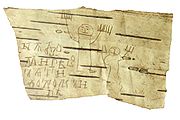
On July 26, 1951, during excavations in Novgorod, a Soviet
Soviet Union
The Soviet Union , officially the Union of Soviet Socialist Republics , was a constitutionally socialist state that existed in Eurasia between 1922 and 1991....
expedition led by Artemiy Artsikhovsky
Artemiy Artsikhovsky
Artemiy Artsikhovsky was a Russian archaeologist and historian, professor , head of the department of archaeology of the Moscow State University, the discoverer of birch bark documents in Novgorod...
found the first Russia
Russia
Russia or , officially known as both Russia and the Russian Federation , is a country in northern Eurasia. It is a federal semi-presidential republic, comprising 83 federal subjects...
n birch bark writing in a layer dated to ca. 1400. Since then, more than 1,000 similar documents were discovered in Staraya Russa
Staraya Russa
Staraya Russa is a town in Novgorod Oblast, Russia, located south of Veliky Novgorod. It is a wharf on the Polist River in the Lake Ilmen basin. It serves as the administrative center of Starorussky District, although administratively it is not a part of it...
, Smolensk
Smolensk
Smolensk is a city and the administrative center of Smolensk Oblast, Russia, located on the Dnieper River. Situated west-southwest of Moscow, this walled city was destroyed several times throughout its long history since it was on the invasion routes of both Napoleon and Hitler. Today, Smolensk...
, Torzhok
Torzhok
Torzhok is a town in Tver Oblast, Russia, famous for its folk craft of goldwork embroidery. Population: Torzhok has twenty-two large and medium-sized industrial enterprises. Two of them are especially significant...
, Pskov
Pskov
Pskov is an ancient city and the administrative center of Pskov Oblast, Russia, located in the northwest of Russia about east from the Estonian border, on the Velikaya River. Population: -Early history:...
, Tver
Tver
Tver is a city and the administrative center of Tver Oblast, Russia. Population: 403,726 ; 408,903 ;...
, Moscow
Moscow
Moscow is the capital, the most populous city, and the most populous federal subject of Russia. The city is a major political, economic, cultural, scientific, religious, financial, educational, and transportation centre of Russia and the continent...
, Ryazan
Ryazan
Ryazan is a city and the administrative center of Ryazan Oblast, Russia. It is located on the Oka River southeast of Moscow. Population: The strategic bomber base Dyagilevo is just west of the city, and the air base of Alexandrovo is to the southeast as is the Ryazan Turlatovo Airport...
, although Novgorod remains by far the most prolific source of them. In Ukraine, birch bark documents were found in Zvenigorod, Volynia. In Belarus
Belarus
Belarus , officially the Republic of Belarus, is a landlocked country in Eastern Europe, bordered clockwise by Russia to the northeast, Ukraine to the south, Poland to the west, and Lithuania and Latvia to the northwest. Its capital is Minsk; other major cities include Brest, Grodno , Gomel ,...
, several documents were unearthed in Vitebsk
Vitebsk
Vitebsk, also known as Viciebsk or Vitsyebsk , is a city in Belarus, near the border with Russia. The capital of the Vitebsk Oblast, in 2004 it had 342,381 inhabitants, making it the country's fourth largest city...
and Mstislavl.
Clay
Clay is a general term including many combinations of one or more clay minerals with traces of metal oxides and organic matter. Geologic clay deposits are mostly composed of phyllosilicate minerals containing variable amounts of water trapped in the mineral structure.- Formation :Clay minerals...
soil which prevents the access of oxygen
Oxygen
Oxygen is the element with atomic number 8 and represented by the symbol O. Its name derives from the Greek roots ὀξύς and -γενής , because at the time of naming, it was mistakenly thought that all acids required oxygen in their composition...
. Serious excavations in Novgorod started only in 1932, although some attempts had been made in the 19th century.
Although their existence was mentioned in some old East Slavic manuscript
Manuscript
A manuscript or handwrite is written information that has been manually created by someone or some people, such as a hand-written letter, as opposed to being printed or reproduced some other way...
s, the discovery of birch bark documents significantly changed the understanding of the cultural level and language spoken by the East Slavs
East Slavs
The East Slavs are Slavic peoples speaking East Slavic languages. Formerly the main population of the medieval state of Kievan Rus, by the seventeenth century they evolved into the Russian, Ukrainian, and Belarusian peoples.-Sources:...
between 11th and 15th centuries. About a hundred stylus
Stylus
A stylus is a writing utensil, or a small tool for some other form of marking or shaping, for example in pottery. The word is also used for a computer accessory . It usually refers to a narrow elongated staff, similar to a modern ballpoint pen. Many styli are heavily curved to be held more easily...
es have also been found, mostly made of iron
Iron
Iron is a chemical element with the symbol Fe and atomic number 26. It is a metal in the first transition series. It is the most common element forming the planet Earth as a whole, forming much of Earth's outer and inner core. It is the fourth most common element in the Earth's crust...
, some of bone or bronze
Bronze
Bronze is a metal alloy consisting primarily of copper, usually with tin as the main additive. It is hard and brittle, and it was particularly significant in antiquity, so much so that the Bronze Age was named after the metal...
.
According to Valentin Yanin
Valentin Yanin
Valentin Lavrentievich Yanin is a leading Russian historian who has authored 700 books and articles. He has also edited a number of important journals and primary sources, including works on medieval Russian law, sphragistics and epigraphy, archaeology and history...
and Andrey Zaliznyak
Andrey Zaliznyak
Andrey Anatolyevich Zaliznyak, is a Russian linguist who specializes in the research of linguistic monuments of Old Novgorod....
, most documents are ordinary letters by various people written in what is considered to be a vernacular dialect
Old Novgorod dialect
Old Novgorod dialect is a term introduced by Andrey Zaliznyak to describe the astonishingly diverse linguistic features of the Old East Slavic birch bark writings from the 11th to 15th centuries excavated in Novgorod and its surroundings...
. The letters are of a personal or business character. A few documents include elaborate obscenities. Very few documents are written in Old Church Slavonic
Old Church Slavonic
Old Church Slavonic or Old Church Slavic was the first literary Slavic language, first developed by the 9th century Byzantine Greek missionaries Saints Cyril and Methodius who were credited with standardizing the language and using it for translating the Bible and other Ancient Greek...
and only one in Old Norse
Old Norse
Old Norse is a North Germanic language that was spoken by inhabitants of Scandinavia and inhabitants of their overseas settlements during the Viking Age, until about 1300....
.
Finnic languages
The term Finnic languages often means the Baltic-Finnic languages, an undisputed branch of the Uralic languages. However, it is also commonly used to mean the Finno-Permic languages, a hypothetical intermediate branch that includes Baltic Finnic, or the more disputed Finno-Volgaic languages....
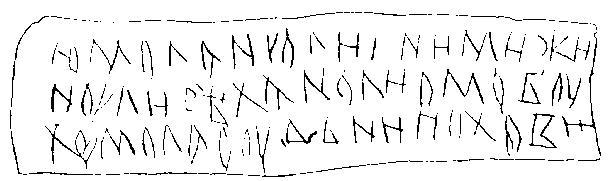
language. It is dated to the beginning of the 13th century. The language used in the document is thought to be an archaic form of the language spoken in Olonets Karelia, a dialect of the Karelian language
Karelian language
Karelian language is a Finnic language spoken mainly in the Russian Republic of Karelia. Linguistically Karelian is closely related to the Finnish dialects spoken in eastern Finland and some Finnish linguists even classified Karelian as a dialect of Finnish...
. http://victorian.fortunecity.com/christy/32/tuohi.html For details and full text, see Birch bark letter no. 292
Birch bark letter no. 292
The Birch bark letter given the document number 292 is the oldest known document in any Finnic language. The document is dated to the beginning of the 13th century...
.
Additionally, there are birch bark letters written in modern times, most notably by victims of the Soviet Regime. People in forced settlements and GULAG camps in Siberia used strips of birch bark to write letters to their loved ones back home, due to the scarcity of paper in the Siberian wilderness. Examples of these letters from Latvian victims of the Soviet regime are currently being considered to be included in the UNESCO "Memory of the World" heritage list. http://www.atmina.unesco.lv/page/78
Example
Novgorod birch-bark letter №336, about 1360-1380 A.D. Case of trampled wheat, release.Original text (with added word division):
сь урѦдѣсѦ Ѧковь съ гюргьмо и съ харѣтономъ по бьсудьнои грамотѣ цто былъ возѦлъ гюргѣ грамоту в ызьѣжьнои пьшьнѣцѣ а харѣтоно во проторѣхо своѣхъ и возѦ гюрьгѣ за вьсь то рубьль и трѣ грѣвоны и коробью пьшьнѣцѣ а харѣтонъ возѦ дьсѦть локотъ сукона и грѣвону а боль не надобѣ гюрьгю нѣ харѣтону до Ѧкова нѣ Ѧкову до гюргѦ нѣ до харитона а на то рѦдьцѣ и послусѣ давыдъ лукѣнъ сынъ и сьтьпанъ таишѣнъ
Translation (with explanations in square brackets):
Here, Yakov has settled with Gyurgiy and with Hariton by courtless deed Gyurgiy has gotten [at court] concerning trampled [by horses] wheat and Hariton concerning his loss. Gyurgiy got one rouble [money], three grivnas [money], and basket [measure] of wheat for all that, and Hariton got ten cubits of cloth and one grivna. And Gyurgiy and Hariton have no more concern to Yakov, nor Yakov to Gyurgiy and Hariton. And witnesses to that are Davyd, son of Luka, and Stepan Taishin.
See also
- See the Old Novgorod dialectOld Novgorod dialectOld Novgorod dialect is a term introduced by Andrey Zaliznyak to describe the astonishingly diverse linguistic features of the Old East Slavic birch bark writings from the 11th to 15th centuries excavated in Novgorod and its surroundings...
article for samples of some texts - Bryggen inscriptionsBryggen inscriptionsThe Bryggen inscriptions are a find of some 670 medieval runic inscriptions on wood and bone found from 1955 and forth at Bryggen in Bergen, Norway. It has been called the most important runic find in the twentieth century...
, documents of the same age found in Bergen, Norway - Wiigwaasabak – birch bark scrolls of the Ojibwa people
- Russian archaeologyRussian archaeologyRussian archaeology begins in the Russian Empire in the 1850s and becomes Soviet archaeology in the early 20th century.The journal Sovetskaya Arkheologiia is published from 1957.-Archaeologists:*Aleksey Uvarov *Dmitry Samokvasov...
- List of Russian archaeologists
External links
- The University of Chicago Slavic Department has a page with a number of photographs of Birch bark documents and Old Novgorodian artifacts. Online library of 956 Russian birch bark documents and modern translations