

Oxford University Museum of Natural History

Encyclopedia
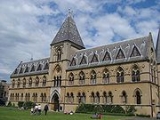
The Oxford University Museum of Natural History, sometimes known simply as the Oxford University Museum, is a museum
displaying many of the University of Oxford's
natural history
specimens, located on Parks Road
in Oxford
, England
. It also contains a lecture
theatre which is used by the University's chemistry
, zoology
and mathematics
departments. The University Museum provides the only access into the adjoining Pitt Rivers Museum
.
in the various colleges. The University's collection of anatomical
and natural history
specimens were similarly spread around the city.
 Regius Professor of Medicine
, Sir Henry Acland, initiated the construction of the museum between 1855 and 1860, to bring together all the aspects of science
around a central display area. In 1858, Acland gave a lecture on the museum, setting forth the reason for the building's construction. He viewed that the University had been one-sided in the forms of study it offered – chiefly theology
, philosophy
, the classics and history
— and that the opportunity should be offered to learn of the natural world and obtain the "knowledge of the great material design of which the Supreme Master-Worker has made us a constituent part".
Several departments moved within the building — astronomy
, geometry
, experimental physics
, mineralogy
, chemistry
, geology
, zoology
, anatomy
, physiology
and medicine
. As the departments grew in size over the years, they moved to new locations along South Parks Road, which remains the home of the University's science departments.
The last department to leave the building was the entomology
department, which moved into the zoology
building in 1978. However, there is still a working entomology laboratory on the first floor of the museum building.
In 1884, a new building to the east of the museum was constructed to house the ethnological
collections of General Augustus Pitt Rivers
— the Pitt Rivers Museum
.
The largest portion of the museum's collections consist of the natural history specimens from the Ashmolean Museum
, including the specimens collected by John Tradescant the elder
and his son of the same name
, William Burchell and geologist William Buckland
. The Christ Church Museum donated its osteological
and physiological
specimens, many of which were collected by Acland.
 The neo-Gothic building was designed by the Irish
architects Thomas Newenham Deane
and Benjamin Woodward
. The museum's design was directly influenced by the writings of critic John Ruskin
, who involved himself by making various suggestions to Woodward during construction. It was built in 1861.
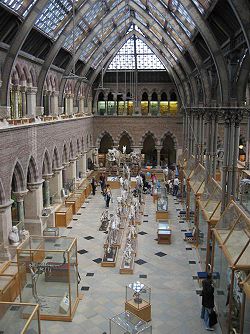
The museum consists of a large square court with a glass
roof, supported by cast iron
pillars, which divide the court into three aisles. Cloistered arcades run around the ground and first floor of the building, with stone columns each made from a different British
stone
, selected by geologist John Phillips
(the Keeper of the Museum). The ornamentation of the stonework and iron pillars incorporates natural forms such as leaves and branches, combining the Pre-Raphaelite style with the scientific
role of the building.
Statues of eminent men of science
stand around the ground floor of the court — from Aristotle
and Bacon
through to Darwin
and Linnaeus
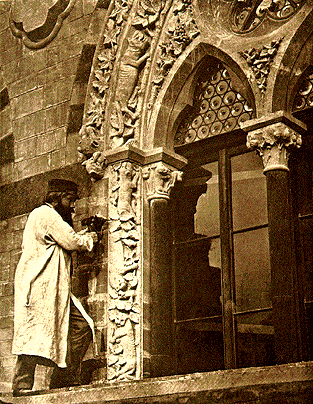
. Although the University paid for the construction of the building, the ornamentation was funded by public subscription — and much of it remains incomplete. The Irish stone carvers O'Shea and Whelan
had been employed to create lively freehand carvings in the Gothic manner. When funding dried up they offered to work unpaid, but were accused by members of the University Congregation
of "defacing" the building by adding unauthorised work. According to Acland, they responded by caricaturing the Congregation as parrots and owls in the carving over the building's entrance. Acland insists that he forced them to remove the heads.
. Representatives of the Church
and science
debated the subject of evolution
, and the event is often viewed as symbolising the defeat of theological
views of creation. However, there are few eye-witness accounts of the debate, and most accounts of the debate were written by scientists.
 Thomas Huxley
and Samuel Wilberforce
, the Bishop of Oxford, are generally cast as the main protagonists in the debate. Huxley was a keen scientist and a staunch supporter of Darwin's
theories. Wilberforce had supported the construction of the museum as the centre for the science
departments, for the study of the wonders of God
's creations.
On the Wednesday of the meeting, June 27, 1860, botanist
Charles Daubeny
presented a paper on plant
sex
uality, which made reference to Darwin's theory of natural selection
. Richard Owen
, a zoologist who believed that evolution
was governed by divine
influence, criticised the theory pointing out that the brain
of the gorilla
was more different from that of man than that of other primate
s. Huxley stated that he would respond to this comment in print, and declined to continue the debate. However, rumours began to spread that the Bishop of Oxford would be attending the conference on the following Saturday.
Initially, Huxley was planning to avoid the Bishop's speech. However, evolutionist Robert Chambers convinced him to stay.
Wilberforce's speech on June 30, 1860, was good-humoured and witty, but was an unfair attack on Darwinism
, ending in the now infamous question to Huxley of whether "it was through his grandfather or grandmother that he claimed descent from a monkey." Some commentators suggested that this question was written by Owen, and others suggested that the Bishop was taught by Owen.
Wilberforce is purported to have turned to his neighbour, chemist
Professor Brodie and exclaiming, "The Lord has delivered him into mine hands." When Huxley spoke, he responded that he had heard nothing from Wilberforce to prejudice Darwin's arguments, which still provided the best explanation of the origin of species yet advanced. He ended with the equally famous response to Wilberforce's question, that he had "no need to be ashamed of having an ape for his grandfather, but that he would be ashamed of having for an ancestor a man of restless and versatile interest who distracts the attention of his hearers from the real point at issue by eloquent digression and skilled appeals to religious prejudice."
However, it seems unlikely that the debate was as spectacular as traditionally suggested – contemporary accounts by journalist
s do not make mention of the words that have become such notable quotations. Additionally, contemporary accounts suggest that it was not Huxley, but Sir Joseph Hooker
who most vocally defended Darwinism
at the meeting.
While all the accounts of the event suggest that the supporters of Darwinism were the most persuasive, it seems likely that the exact nature of the debate was made more sensational in the reports of Huxley's supporters to encourage further support for Darwin's theories.
took place in the lecture theatre of the museum on August 14, 1894, carried out by Professor Oliver Lodge. A radio
signal was sent from the neighbouring Clarendon Laboratory
building, and received by apparatus in the lecture theatre.
displayed at the museum are the most complete remains of a single dodo anywhere in the world. Many museums have complete Dodo skeleton
s, but these are composed of the bones of several individuals. The museum also displays a 1651 painting of a Dodo by Flemish
artist, Jan Savery
.
Charles Dodgson, better known by his pen-name Lewis Carroll
, was a regular visitor to the museum, and Savery's painting is likely to have influenced the character of the Dodo
in Carroll's Alice's Adventures in Wonderland
.
Administratively, the museum is divided into four sections: Geology
(covering the Palaeontological collections), Mineralogy
(the mineral and rock collections), Zoology
and Entomology
. Each has a part-time Curator (who is also a university lecturer) and a full-time Assistant Curator. The museum is led by a Director (currently Professor Jim Kennedy), and there are education, IT, library, conservation and technical staff.
Since 1997, the museum has benefitted from external funding, from Government and private sources, and undertaken a renewal of its displays. As well as central exhibits featuring the dodo and dinosaur
s, there are sets of displays with contemporary designs but within restored Victorian cabinets, on a variety of themes: Evolution, Primates, the History of Life, Vertebrates, Invertebrates and Rocks & Minerals. There are also a number of popular touchable items, which include Mandy the Shetland Pony, a stuffed leopard and other taxidermy. Additionally there is a meteorite and large fossil
s and minerals. Visitors can also see large dinosaur reconstructions and a procession of mammal skeletons.
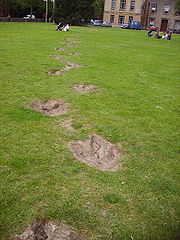 A famous group of ichnite
s was found in a limestone
quarry
at Ardley
, 20 km northeast of Oxford, in 1997. They were thought to have been made by Megalosaurus
and possibly Cetiosaurus
. There are replicas of some of these footprints, set across the front lawn of the museum.
The Hope Entomological Collections are held by the Oxford University Museum of Natural History. The Hope Department was founded by Frederick William Hope
.
Museum
A museum is an institution that cares for a collection of artifacts and other objects of scientific, artistic, cultural, or historical importance and makes them available for public viewing through exhibits that may be permanent or temporary. Most large museums are located in major cities...
displaying many of the University of Oxford's
University of Oxford
The University of Oxford is a university located in Oxford, United Kingdom. It is the second-oldest surviving university in the world and the oldest in the English-speaking world. Although its exact date of foundation is unclear, there is evidence of teaching as far back as 1096...
natural history
Natural history
Natural history is the scientific research of plants or animals, leaning more towards observational rather than experimental methods of study, and encompasses more research published in magazines than in academic journals. Grouped among the natural sciences, natural history is the systematic study...
specimens, located on Parks Road
Parks Road
Parks Road is a road in Oxford, England, with several Oxford University colleges along its route. It runs north-south from the Banbury Road and Norham Gardens at the northern end, where it continues into Bradmore Road, to the junction with Broad Street, Holywell Street and Catte Street to the...
in Oxford
Oxford
The city of Oxford is the county town of Oxfordshire, England. The city, made prominent by its medieval university, has a population of just under 165,000, with 153,900 living within the district boundary. It lies about 50 miles north-west of London. The rivers Cherwell and Thames run through...
, England
England
England is a country that is part of the United Kingdom. It shares land borders with Scotland to the north and Wales to the west; the Irish Sea is to the north west, the Celtic Sea to the south west, with the North Sea to the east and the English Channel to the south separating it from continental...
. It also contains a lecture
Lecture
thumb|A lecture on [[linear algebra]] at the [[Helsinki University of Technology]]A lecture is an oral presentation intended to present information or teach people about a particular subject, for example by a university or college teacher. Lectures are used to convey critical information, history,...
theatre which is used by the University's chemistry
Chemistry
Chemistry is the science of matter, especially its chemical reactions, but also its composition, structure and properties. Chemistry is concerned with atoms and their interactions with other atoms, and particularly with the properties of chemical bonds....
, zoology
Zoology
Zoology |zoölogy]]), is the branch of biology that relates to the animal kingdom, including the structure, embryology, evolution, classification, habits, and distribution of all animals, both living and extinct...
and mathematics
The Mathematical Institute, University of Oxford
The Mathematical Institute is the mathematics department at the University of Oxford, England. It forms one of the ten departments of the Mathematical, Physical and Life Sciences Divisional Board in the University....
departments. The University Museum provides the only access into the adjoining Pitt Rivers Museum
Pitt Rivers Museum
The Pitt Rivers Museum is a museum displaying the archaeological and anthropological collections of the University of Oxford in Oxford, England. The museum is located to the east of the Oxford University Museum of Natural History, and can only be accessed through that building.The museum was...
.
History
The University's Honour School of Natural Science started in 1850, but the facilities for teaching were scattered around the city of OxfordOxford
The city of Oxford is the county town of Oxfordshire, England. The city, made prominent by its medieval university, has a population of just under 165,000, with 153,900 living within the district boundary. It lies about 50 miles north-west of London. The rivers Cherwell and Thames run through...
in the various colleges. The University's collection of anatomical
Anatomy
Anatomy is a branch of biology and medicine that is the consideration of the structure of living things. It is a general term that includes human anatomy, animal anatomy , and plant anatomy...
and natural history
Natural history
Natural history is the scientific research of plants or animals, leaning more towards observational rather than experimental methods of study, and encompasses more research published in magazines than in academic journals. Grouped among the natural sciences, natural history is the systematic study...
specimens were similarly spread around the city.
Medicine
Medicine is the science and art of healing. It encompasses a variety of health care practices evolved to maintain and restore health by the prevention and treatment of illness....
, Sir Henry Acland, initiated the construction of the museum between 1855 and 1860, to bring together all the aspects of science
Science
Science is a systematic enterprise that builds and organizes knowledge in the form of testable explanations and predictions about the universe...
around a central display area. In 1858, Acland gave a lecture on the museum, setting forth the reason for the building's construction. He viewed that the University had been one-sided in the forms of study it offered – chiefly theology
Theology
Theology is the systematic and rational study of religion and its influences and of the nature of religious truths, or the learned profession acquired by completing specialized training in religious studies, usually at a university or school of divinity or seminary.-Definition:Augustine of Hippo...
, philosophy
Philosophy
Philosophy is the study of general and fundamental problems, such as those connected with existence, knowledge, values, reason, mind, and language. Philosophy is distinguished from other ways of addressing such problems by its critical, generally systematic approach and its reliance on rational...
, the classics and history
History
History is the discovery, collection, organization, and presentation of information about past events. History can also mean the period of time after writing was invented. Scholars who write about history are called historians...
— and that the opportunity should be offered to learn of the natural world and obtain the "knowledge of the great material design of which the Supreme Master-Worker has made us a constituent part".
Several departments moved within the building — astronomy
Astronomy
Astronomy is a natural science that deals with the study of celestial objects and phenomena that originate outside the atmosphere of Earth...
, geometry
Geometry
Geometry arose as the field of knowledge dealing with spatial relationships. Geometry was one of the two fields of pre-modern mathematics, the other being the study of numbers ....
, experimental physics
Experimental physics
Within the field of physics, experimental physics is the category of disciplines and sub-disciplines concerned with the observation of physical phenomena in order to gather data about the universe...
, mineralogy
Mineralogy
Mineralogy is the study of chemistry, crystal structure, and physical properties of minerals. Specific studies within mineralogy include the processes of mineral origin and formation, classification of minerals, their geographical distribution, as well as their utilization.-History:Early writing...
, chemistry
Chemistry
Chemistry is the science of matter, especially its chemical reactions, but also its composition, structure and properties. Chemistry is concerned with atoms and their interactions with other atoms, and particularly with the properties of chemical bonds....
, geology
Geology
Geology is the science comprising the study of solid Earth, the rocks of which it is composed, and the processes by which it evolves. Geology gives insight into the history of the Earth, as it provides the primary evidence for plate tectonics, the evolutionary history of life, and past climates...
, zoology
Zoology
Zoology |zoölogy]]), is the branch of biology that relates to the animal kingdom, including the structure, embryology, evolution, classification, habits, and distribution of all animals, both living and extinct...
, anatomy
Anatomy
Anatomy is a branch of biology and medicine that is the consideration of the structure of living things. It is a general term that includes human anatomy, animal anatomy , and plant anatomy...
, physiology
Physiology
Physiology is the science of the function of living systems. This includes how organisms, organ systems, organs, cells, and bio-molecules carry out the chemical or physical functions that exist in a living system. The highest honor awarded in physiology is the Nobel Prize in Physiology or...
and medicine
Medicine
Medicine is the science and art of healing. It encompasses a variety of health care practices evolved to maintain and restore health by the prevention and treatment of illness....
. As the departments grew in size over the years, they moved to new locations along South Parks Road, which remains the home of the University's science departments.
The last department to leave the building was the entomology
Entomology
Entomology is the scientific study of insects, a branch of arthropodology...
department, which moved into the zoology
Zoology
Zoology |zoölogy]]), is the branch of biology that relates to the animal kingdom, including the structure, embryology, evolution, classification, habits, and distribution of all animals, both living and extinct...
building in 1978. However, there is still a working entomology laboratory on the first floor of the museum building.
In 1884, a new building to the east of the museum was constructed to house the ethnological
Ethnology
Ethnology is the branch of anthropology that compares and analyzes the origins, distribution, technology, religion, language, and social structure of the ethnic, racial, and/or national divisions of humanity.-Scientific discipline:Compared to ethnography, the study of single groups through direct...
collections of General Augustus Pitt Rivers
Augustus Pitt Rivers
Lieutenant-General Augustus Henry Lane-Fox Pitt Rivers was an English army officer, ethnologist, and archaeologist. He was noted for his innovations in archaeological methods, and in the museum display of archaeological and ethnological collections.-Life and career:Born Augustus Henry Lane-Fox at...
— the Pitt Rivers Museum
Pitt Rivers Museum
The Pitt Rivers Museum is a museum displaying the archaeological and anthropological collections of the University of Oxford in Oxford, England. The museum is located to the east of the Oxford University Museum of Natural History, and can only be accessed through that building.The museum was...
.
The largest portion of the museum's collections consist of the natural history specimens from the Ashmolean Museum
Ashmolean Museum
The Ashmolean Museum on Beaumont Street, Oxford, England, is the world's first university museum...
, including the specimens collected by John Tradescant the elder
John Tradescant the elder
John Tradescant the elder , father of John Tradescant the younger, was an English naturalist, gardener, collector and traveller, probably born in Suffolk, England...
and his son of the same name
John Tradescant the younger
John Tradescant the Younger , son of John Tradescant the elder, was a botanist and gardener, born in Meopham, Kent and educated at The King's School, Canterbury...
, William Burchell and geologist William Buckland
William Buckland
The Very Rev. Dr William Buckland DD FRS was an English geologist, palaeontologist and Dean of Westminster, who wrote the first full account of a fossil dinosaur, which he named Megalosaurus...
. The Christ Church Museum donated its osteological
Osteology
Osteology is the scientific study of bones. A subdiscipline of anatomy, anthropology, and archeology, osteology is a detailed study of the structure of bones, skeletal elements, teeth, morphology, function, disease, pathology, the process of ossification , the resistance and hardness of bones , etc...
and physiological
Physiology
Physiology is the science of the function of living systems. This includes how organisms, organ systems, organs, cells, and bio-molecules carry out the chemical or physical functions that exist in a living system. The highest honor awarded in physiology is the Nobel Prize in Physiology or...
specimens, many of which were collected by Acland.
The building
Irish people
The Irish people are an ethnic group who originate in Ireland, an island in northwestern Europe. Ireland has been populated for around 9,000 years , with the Irish people's earliest ancestors recorded having legends of being descended from groups such as the Nemedians, Fomorians, Fir Bolg, Tuatha...
architects Thomas Newenham Deane
Thomas Newenham Deane
Sir Thomas Newenham Deane was an Irish architect, the son of Sir Thomas Deane, and father of Sir Thomas Manly Deane, who were also architects....
and Benjamin Woodward
Benjamin Woodward
Benjamin Woodward was an Irish architect who, in partnership with Sir Thomas Newenham Deane, designed a number of buildings in Dublin....
. The museum's design was directly influenced by the writings of critic John Ruskin
John Ruskin
John Ruskin was the leading English art critic of the Victorian era, also an art patron, draughtsman, watercolourist, a prominent social thinker and philanthropist. He wrote on subjects ranging from geology to architecture, myth to ornithology, literature to education, and botany to political...
, who involved himself by making various suggestions to Woodward during construction. It was built in 1861.
The museum consists of a large square court with a glass
Glass
Glass is an amorphous solid material. Glasses are typically brittle and optically transparent.The most familiar type of glass, used for centuries in windows and drinking vessels, is soda-lime glass, composed of about 75% silica plus Na2O, CaO, and several minor additives...
roof, supported by cast iron
Cast iron
Cast iron is derived from pig iron, and while it usually refers to gray iron, it also identifies a large group of ferrous alloys which solidify with a eutectic. The color of a fractured surface can be used to identify an alloy. White cast iron is named after its white surface when fractured, due...
pillars, which divide the court into three aisles. Cloistered arcades run around the ground and first floor of the building, with stone columns each made from a different British
United Kingdom
The United Kingdom of Great Britain and Northern IrelandIn the United Kingdom and Dependencies, other languages have been officially recognised as legitimate autochthonous languages under the European Charter for Regional or Minority Languages...
stone
Rock (geology)
In geology, rock or stone is a naturally occurring solid aggregate of minerals and/or mineraloids.The Earth's outer solid layer, the lithosphere, is made of rock. In general rocks are of three types, namely, igneous, sedimentary, and metamorphic...
, selected by geologist John Phillips
John Phillips (geologist)
John Phillips FRS was an English geologist.- Life and work :Philips was born at Marden in Wiltshire...
(the Keeper of the Museum). The ornamentation of the stonework and iron pillars incorporates natural forms such as leaves and branches, combining the Pre-Raphaelite style with the scientific
Science
Science is a systematic enterprise that builds and organizes knowledge in the form of testable explanations and predictions about the universe...
role of the building.
Statues of eminent men of science
Scientist
A scientist in a broad sense is one engaging in a systematic activity to acquire knowledge. In a more restricted sense, a scientist is an individual who uses the scientific method. The person may be an expert in one or more areas of science. This article focuses on the more restricted use of the word...
stand around the ground floor of the court — from Aristotle
Aristotle
Aristotle was a Greek philosopher and polymath, a student of Plato and teacher of Alexander the Great. His writings cover many subjects, including physics, metaphysics, poetry, theater, music, logic, rhetoric, linguistics, politics, government, ethics, biology, and zoology...
and Bacon
Roger Bacon
Roger Bacon, O.F.M. , also known as Doctor Mirabilis , was an English philosopher and Franciscan friar who placed considerable emphasis on the study of nature through empirical methods...
through to Darwin
Charles Darwin
Charles Robert Darwin FRS was an English naturalist. He established that all species of life have descended over time from common ancestry, and proposed the scientific theory that this branching pattern of evolution resulted from a process that he called natural selection.He published his theory...
and Linnaeus
Carolus Linnaeus
Carl Linnaeus , also known after his ennoblement as , was a Swedish botanist, physician, and zoologist, who laid the foundations for the modern scheme of binomial nomenclature. He is known as the father of modern taxonomy, and is also considered one of the fathers of modern ecology...
. Although the University paid for the construction of the building, the ornamentation was funded by public subscription — and much of it remains incomplete. The Irish stone carvers O'Shea and Whelan
O'Shea and Whelan
O'Shea and Whelan was an Irish family practice of stonemasons and sculptors from Ballyhooly in County Cork. They were notable for their involvement in Ruskinian gothic architecture in the mid-19th century....
had been employed to create lively freehand carvings in the Gothic manner. When funding dried up they offered to work unpaid, but were accused by members of the University Congregation
Congregation (university)
A Congregation is a formal meeting of senior members of a university, especially in the United Kingdom.Examples include the Regent House in the University of Cambridge, and the House of Congregation and the Ancient House of Congregation in the University of Oxford.In recent times, very few...
of "defacing" the building by adding unauthorised work. According to Acland, they responded by caricaturing the Congregation as parrots and owls in the carving over the building's entrance. Acland insists that he forced them to remove the heads.
The 1860 evolution debate
A significant debate in the history of evolutionary biology took place in the museum in 1861 at a meeting of the British Association for the Advancement of ScienceBritish Association for the Advancement of Science
frame|right|"The BA" logoThe British Association for the Advancement of Science or the British Science Association, formerly known as the BA, is a learned society with the object of promoting science, directing general attention to scientific matters, and facilitating interaction between...
. Representatives of the Church
Christian Church
The Christian Church is the assembly or association of followers of Jesus Christ. The Greek term ἐκκλησία that in its appearances in the New Testament is usually translated as "church" basically means "assembly"...
and science
Science
Science is a systematic enterprise that builds and organizes knowledge in the form of testable explanations and predictions about the universe...
debated the subject of evolution
Evolution
Evolution is any change across successive generations in the heritable characteristics of biological populations. Evolutionary processes give rise to diversity at every level of biological organisation, including species, individual organisms and molecules such as DNA and proteins.Life on Earth...
, and the event is often viewed as symbolising the defeat of theological
Theology
Theology is the systematic and rational study of religion and its influences and of the nature of religious truths, or the learned profession acquired by completing specialized training in religious studies, usually at a university or school of divinity or seminary.-Definition:Augustine of Hippo...
views of creation. However, there are few eye-witness accounts of the debate, and most accounts of the debate were written by scientists.
Thomas Huxley
Thomas Henry Huxley PC FRS was an English biologist, known as "Darwin's Bulldog" for his advocacy of Charles Darwin's theory of evolution....
and Samuel Wilberforce
Samuel Wilberforce
Samuel Wilberforce was an English bishop in the Church of England, third son of William Wilberforce. Known as "Soapy Sam", Wilberforce was one of the greatest public speakers of his time and place...
, the Bishop of Oxford, are generally cast as the main protagonists in the debate. Huxley was a keen scientist and a staunch supporter of Darwin's
Charles Darwin
Charles Robert Darwin FRS was an English naturalist. He established that all species of life have descended over time from common ancestry, and proposed the scientific theory that this branching pattern of evolution resulted from a process that he called natural selection.He published his theory...
theories. Wilberforce had supported the construction of the museum as the centre for the science
Science
Science is a systematic enterprise that builds and organizes knowledge in the form of testable explanations and predictions about the universe...
departments, for the study of the wonders of God
God
God is the English name given to a singular being in theistic and deistic religions who is either the sole deity in monotheism, or a single deity in polytheism....
's creations.
On the Wednesday of the meeting, June 27, 1860, botanist
Botany
Botany, plant science, or plant biology is a branch of biology that involves the scientific study of plant life. Traditionally, botany also included the study of fungi, algae and viruses...
Charles Daubeny
Charles Daubeny
Charles Giles Bridle Daubeny was an English chemist, botanist and geologist.Daubeny was born at Stratton near Cirencester in Gloucestershire, the son of the Rev. James Daubeny. He studied at Magdalen College, Oxford under Dr. John Kidd...
presented a paper on plant
Plant
Plants are living organisms belonging to the kingdom Plantae. Precise definitions of the kingdom vary, but as the term is used here, plants include familiar organisms such as trees, flowers, herbs, bushes, grasses, vines, ferns, mosses, and green algae. The group is also called green plants or...
sex
Sex
In biology, sex is a process of combining and mixing genetic traits, often resulting in the specialization of organisms into a male or female variety . Sexual reproduction involves combining specialized cells to form offspring that inherit traits from both parents...
uality, which made reference to Darwin's theory of natural selection
Natural selection
Natural selection is the nonrandom process by which biologic traits become either more or less common in a population as a function of differential reproduction of their bearers. It is a key mechanism of evolution....
. Richard Owen
Richard Owen
Sir Richard Owen, FRS KCB was an English biologist, comparative anatomist and palaeontologist.Owen is probably best remembered today for coining the word Dinosauria and for his outspoken opposition to Charles Darwin's theory of evolution by natural selection...
, a zoologist who believed that evolution
Evolution
Evolution is any change across successive generations in the heritable characteristics of biological populations. Evolutionary processes give rise to diversity at every level of biological organisation, including species, individual organisms and molecules such as DNA and proteins.Life on Earth...
was governed by divine
Divinity
Divinity and divine are broadly applied but loosely defined terms, used variously within different faiths and belief systems — and even by different individuals within a given faith — to refer to some transcendent or transcendental power or deity, or its attributes or manifestations in...
influence, criticised the theory pointing out that the brain
Brain
The brain is the center of the nervous system in all vertebrate and most invertebrate animals—only a few primitive invertebrates such as sponges, jellyfish, sea squirts and starfishes do not have one. It is located in the head, usually close to primary sensory apparatus such as vision, hearing,...
of the gorilla
Gorilla
Gorillas are the largest extant species of primates. They are ground-dwelling, predominantly herbivorous apes that inhabit the forests of central Africa. Gorillas are divided into two species and either four or five subspecies...
was more different from that of man than that of other primate
Primate
A primate is a mammal of the order Primates , which contains prosimians and simians. Primates arose from ancestors that lived in the trees of tropical forests; many primate characteristics represent adaptations to life in this challenging three-dimensional environment...
s. Huxley stated that he would respond to this comment in print, and declined to continue the debate. However, rumours began to spread that the Bishop of Oxford would be attending the conference on the following Saturday.
Initially, Huxley was planning to avoid the Bishop's speech. However, evolutionist Robert Chambers convinced him to stay.
Wilberforce's speech on June 30, 1860, was good-humoured and witty, but was an unfair attack on Darwinism
Darwinism
Darwinism is a set of movements and concepts related to ideas of transmutation of species or of evolution, including some ideas with no connection to the work of Charles Darwin....
, ending in the now infamous question to Huxley of whether "it was through his grandfather or grandmother that he claimed descent from a monkey." Some commentators suggested that this question was written by Owen, and others suggested that the Bishop was taught by Owen.
Wilberforce is purported to have turned to his neighbour, chemist
Chemistry
Chemistry is the science of matter, especially its chemical reactions, but also its composition, structure and properties. Chemistry is concerned with atoms and their interactions with other atoms, and particularly with the properties of chemical bonds....
Professor Brodie and exclaiming, "The Lord has delivered him into mine hands." When Huxley spoke, he responded that he had heard nothing from Wilberforce to prejudice Darwin's arguments, which still provided the best explanation of the origin of species yet advanced. He ended with the equally famous response to Wilberforce's question, that he had "no need to be ashamed of having an ape for his grandfather, but that he would be ashamed of having for an ancestor a man of restless and versatile interest who distracts the attention of his hearers from the real point at issue by eloquent digression and skilled appeals to religious prejudice."
However, it seems unlikely that the debate was as spectacular as traditionally suggested – contemporary accounts by journalist
Journalist
A journalist collects and distributes news and other information. A journalist's work is referred to as journalism.A reporter is a type of journalist who researchs, writes, and reports on information to be presented in mass media, including print media , electronic media , and digital media A...
s do not make mention of the words that have become such notable quotations. Additionally, contemporary accounts suggest that it was not Huxley, but Sir Joseph Hooker
Joseph Dalton Hooker
Sir Joseph Dalton Hooker OM, GCSI, CB, MD, FRS was one of the greatest British botanists and explorers of the 19th century. Hooker was a founder of geographical botany, and Charles Darwin's closest friend...
who most vocally defended Darwinism
Darwinism
Darwinism is a set of movements and concepts related to ideas of transmutation of species or of evolution, including some ideas with no connection to the work of Charles Darwin....
at the meeting.
While all the accounts of the event suggest that the supporters of Darwinism were the most persuasive, it seems likely that the exact nature of the debate was made more sensational in the reports of Huxley's supporters to encourage further support for Darwin's theories.
The 1894 demonstration of wireless telegraphy
The first public demonstration of wireless telegraphyWireless telegraphy
Wireless telegraphy is a historical term used today to apply to early radio telegraph communications techniques and practices, particularly those used during the first three decades of radio before the term radio came into use....
took place in the lecture theatre of the museum on August 14, 1894, carried out by Professor Oliver Lodge. A radio
Radio
Radio is the transmission of signals through free space by modulation of electromagnetic waves with frequencies below those of visible light. Electromagnetic radiation travels by means of oscillating electromagnetic fields that pass through the air and the vacuum of space...
signal was sent from the neighbouring Clarendon Laboratory
Clarendon Laboratory
The Clarendon Laboratory, located on Parks Road with the Science Area in Oxford, England , is part of the Physics Department at Oxford University...
building, and received by apparatus in the lecture theatre.
Charles Dodgson and the Dodo
Today, the head and foot of a DodoDodo
The dodo was a flightless bird endemic to the Indian Ocean island of Mauritius. Related to pigeons and doves, it stood about a meter tall, weighing about , living on fruit, and nesting on the ground....
displayed at the museum are the most complete remains of a single dodo anywhere in the world. Many museums have complete Dodo skeleton
Skeleton
The skeleton is the body part that forms the supporting structure of an organism. There are two different skeletal types: the exoskeleton, which is the stable outer shell of an organism, and the endoskeleton, which forms the support structure inside the body.In a figurative sense, skeleton can...
s, but these are composed of the bones of several individuals. The museum also displays a 1651 painting of a Dodo by Flemish
Flanders
Flanders is the community of the Flemings but also one of the institutions in Belgium, and a geographical region located in parts of present-day Belgium, France and the Netherlands. "Flanders" can also refer to the northern part of Belgium that contains Brussels, Bruges, Ghent and Antwerp...
artist, Jan Savery
Jan Savery
Jan or Hans Savery the Younger was a Dutch Golden Age painter. Though more often referred to as Jan in connection with his best-known painting, he signed his works with Hans, both names being derivatives of Johannes.-Biography:Savery was the son of Jacob Savery and nephew of Hans Savery the...
.
Charles Dodgson, better known by his pen-name Lewis Carroll
Lewis Carroll
Charles Lutwidge Dodgson , better known by the pseudonym Lewis Carroll , was an English author, mathematician, logician, Anglican deacon and photographer. His most famous writings are Alice's Adventures in Wonderland and its sequel Through the Looking-Glass, as well as the poems "The Hunting of the...
, was a regular visitor to the museum, and Savery's painting is likely to have influenced the character of the Dodo
Dodo (Alice's Adventures in Wonderland)
-Tim Burton's Alice in Wonderland version:The Dodo, who in this adaptation of the book is named Uilleam and is portrayed by Michael Gough, bears a down of brilliant blue and is one of Alice's advisers, who also took first note of her identity as the true Alice. Mysteriously, the dodo vanishes...
in Carroll's Alice's Adventures in Wonderland
Alice's Adventures in Wonderland
Alice's Adventures in Wonderland is an 1865 novel written by English author Charles Lutwidge Dodgson under the pseudonym Lewis Carroll. It tells of a girl named Alice who falls down a rabbit hole into a fantasy world populated by peculiar, anthropomorphic creatures...
.
The museum today
The museum has free entrance, is open daily from 10am to 5pm, and attracts over 300,000 visitors a year, including over 15,000 school children on organised visits.Administratively, the museum is divided into four sections: Geology
Geology
Geology is the science comprising the study of solid Earth, the rocks of which it is composed, and the processes by which it evolves. Geology gives insight into the history of the Earth, as it provides the primary evidence for plate tectonics, the evolutionary history of life, and past climates...
(covering the Palaeontological collections), Mineralogy
Mineralogy
Mineralogy is the study of chemistry, crystal structure, and physical properties of minerals. Specific studies within mineralogy include the processes of mineral origin and formation, classification of minerals, their geographical distribution, as well as their utilization.-History:Early writing...
(the mineral and rock collections), Zoology
Zoology
Zoology |zoölogy]]), is the branch of biology that relates to the animal kingdom, including the structure, embryology, evolution, classification, habits, and distribution of all animals, both living and extinct...
and Entomology
Entomology
Entomology is the scientific study of insects, a branch of arthropodology...
. Each has a part-time Curator (who is also a university lecturer) and a full-time Assistant Curator. The museum is led by a Director (currently Professor Jim Kennedy), and there are education, IT, library, conservation and technical staff.
Since 1997, the museum has benefitted from external funding, from Government and private sources, and undertaken a renewal of its displays. As well as central exhibits featuring the dodo and dinosaur
Dinosaur
Dinosaurs are a diverse group of animals of the clade and superorder Dinosauria. They were the dominant terrestrial vertebrates for over 160 million years, from the late Triassic period until the end of the Cretaceous , when the Cretaceous–Paleogene extinction event led to the extinction of...
s, there are sets of displays with contemporary designs but within restored Victorian cabinets, on a variety of themes: Evolution, Primates, the History of Life, Vertebrates, Invertebrates and Rocks & Minerals. There are also a number of popular touchable items, which include Mandy the Shetland Pony, a stuffed leopard and other taxidermy. Additionally there is a meteorite and large fossil
Fossil
Fossils are the preserved remains or traces of animals , plants, and other organisms from the remote past...
s and minerals. Visitors can also see large dinosaur reconstructions and a procession of mammal skeletons.
Ichnite
An ichnite is a fossilised footprint. This is a type of trace fossil. Over the years, many ichnites have been found, around the world, giving important clues about the behaviour of the animals that made them...
s was found in a limestone
Limestone
Limestone is a sedimentary rock composed largely of the minerals calcite and aragonite, which are different crystal forms of calcium carbonate . Many limestones are composed from skeletal fragments of marine organisms such as coral or foraminifera....
quarry
Quarry
A quarry is a type of open-pit mine from which rock or minerals are extracted. Quarries are generally used for extracting building materials, such as dimension stone, construction aggregate, riprap, sand, and gravel. They are often collocated with concrete and asphalt plants due to the requirement...
at Ardley
Ardley
Ardley is a village in Ardley with Fewcott civil parish in Oxfordshire, England, about northwest of Bicester. The parish includes the village of Fewcott that is now contiguous with Ardley.-History:...
, 20 km northeast of Oxford, in 1997. They were thought to have been made by Megalosaurus
Megalosaurus
Megalosaurus is a genus of large meat-eating theropod dinosaurs of the Middle Jurassic period of Europe...
and possibly Cetiosaurus
Cetiosaurus
Cetiosaurus meaning 'whale lizard', from the Greek cetus/κητος meaning 'sea monster' and saurus/σαυρος meaning 'lizard', was a sauropod dinosaur from the Mid to Late Jurassic Period in what are now Europe and Africa. It is estimated to have been about long and to have weighed roughly...
. There are replicas of some of these footprints, set across the front lawn of the museum.
The Hope Entomological Collections are held by the Oxford University Museum of Natural History. The Hope Department was founded by Frederick William Hope
Frederick William Hope
Frederick William Hope was an English entomologist and founder of the Hope Department of Entomology at the University of Oxford....
.