

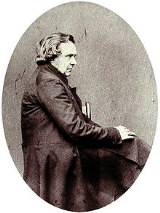
Samuel Wilberforce

Encyclopedia
Samuel Wilberforce was an English
bishop
in the Church of England
, third son of William Wilberforce
. Known as "Soapy Sam", Wilberforce was one of the greatest public speakers of his time and place. The nickname derives from a comment by Benjamin Disraeli that the Bishop's manner was "unctuous, oleaginous, saponaceous" (slippery, evasive and soapy). He is probably best remembered today for his opposition to Charles Darwin
's theory of evolution
— most notably at a famous debate in 1860
during which he is said to have asked Thomas Henry Huxley whether it was through his grandfather or his grandmother that he claimed his descent from a monkey, and got as answer thet 'he would not be ashamed to have a monkey for his ancestor, but he would be ashamed to be connected with a man who used his great gifts to obscure the truth'.
(http://en.wikipedia.org/wiki/1860_Oxford_evolution_debate#cite_note-lucas-1).
, London
. In 1823 he entered Oriel College, Oxford. In the United Debating Society, which afterwards developed into the Union
, he distinguished himself as a zealous advocate of liberalism
. The set of friends with whom he chiefly associated at Oxford—among them William Ewart Gladstone
and Henry Manning—were sometimes named, on account of their exceptionally decorous conduct, the "Bethel Union
"; but he was by no means averse to amusements, and specially delighted in hurdle jumping and hunting. He graduated in 1826, taking a first class in mathematics and a second in classics. He spent the summer and autumn of 1827 touring the continent
. After his marriage on 11 June 1828 to Emily Sargent, he was in December ordained and appointed curate-in-charge at Checkendon near Henley-on-Thames
.
, Bishop of Winchester
to the rector
y of St. Mary's Church, Brighstone
in the Isle of Wight
. In this comparatively retired sphere he soon found scope for that manifold activity which so prominently characterized his subsequent career. In 1831 he published a tract on tithes, "to correct the prejudices of the lower order of farmers," and in the following year a collection of hymns for use in his parish, which had a large general circulation; a small volume of stories entitled the Note Book of a Country Clergyman; and a sermon, The Apostolical Ministry. At the close of 1837 he published the Letters and Journals of Henry Martyn
, the Anglican missionary in India and Persia.
Although a High Church
man, Wilberforce held aloof from the Oxford movement
, and in 1838 his divergence from the Tractarian writers became so marked that John Henry Newman declined further contributions from him to the British Critic
, not deeming it advisable that they should longer "co-operate very closely." In 1838 Wilberforce published, with his elder brother Robert Wilberforce, the Life of his father, and two years later his father's Correspondence. In 1839 he also published Eucharistica (from the old English divines), to which he wrote an introduction, Agathos and other Sunday Stories, and a volume of University Sermons, and in the following year Rocky Island and other Parables. In November 1839 he was installed archdeacon of Surrey, in August 1840 was collated canon of Winchester and in October he accepted the rectory of Alverstoke
.
In 1841, he was chosen Bampton lecturer, and shortly afterwards made chaplain to Prince Albert
, an appointment he owed to the impression produced by a speech at an anti-slavery meeting some months previously. In October 1843, he was appointed by the archbishop of York
to be sub-almoner
to the Queen. In 1844 his A History of the Protestant Episcopal Church in America appeared. In March of the following year he accepted the deanery of Westminster, and in October the bishopric of Oxford
.
The bishop in 1847, upon the suggestion of John Henry Newman, became involved in the Hampden controversy, and signed the remonstrance of the thirteen bishops to Lord John Russell against Hampden's appointment to the bishopric of Hereford. He also endeavoured to obtain satisfactory assurances from Hampden; but, though unsuccessful in this, he withdrew from the suit against him. The publication of a papal bull
in 1850 establishing a Roman hierarchy in England brought the High Church party, of whom Wilberforce was the most prominent member, into temporary disrepute. The secession to the Church of Rome of his brother-in-law, afterwards Cardinal Manning, and then of his brothers, as well as his only daughter and his son-in-law, Mr and Mrs J. H. Pye, brought him under further suspicion, and his revival of the powers of Convocation
lessened his influence at court; but his unfailing tact and wide sympathies, his marvellous energy in church organization, the magnetism of his personality, and his eloquence both on the platform and in the pulpit, gradually won for him recognition as without a rival on the episcopal bench.
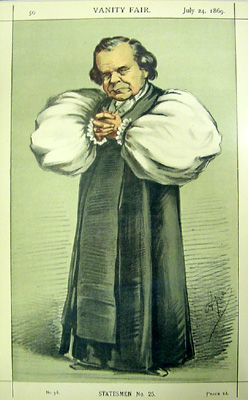
His diary reveals a tender and devout private life which has been overlooked by those who have only considered the versatile facility and persuasive expediency that marked the successful public career of the bishop, and perhaps earned him the sobriquet of "Soapy Sam", though this may have been a reference to his characteristic hand-washing gesture, so clearly captured in the Vanity Fair cartoon by 'Ape' (illustration, right). In the House of Lords
he took a prominent part in the discussion of social and ecclesiastical questions. He has been styled the "bishop of society"; but society occupied only a fraction of his time. The great bent of his energies was ceaselessly directed to the better organization of his diocese and to the furtherance of schemes for increasing the influence and efficiency of the church.
In 1854, he opened a theological college at Cuddesdon
, now known as Ripon College Cuddesdon
, which was afterwards the subject of some controversy on account of its alleged Romanist tendencies.
 He took part in the famous 1860 debate concerning evolution
at a meeting of the British Association on the 30th of June. Richard Owen
and Thomas Henry Huxley had already clashed on man's position in nature two days previously; on the Saturday, at the Oxford University Museum of Natural History
, Wilberforce got his chance to criticise Charles Darwin
's On the Origin of Species by means of Natural Selection
, especially the implication that humans and various species of apes share common ancestors.
Lucas argues that "Wilberforce, contrary to the central tenet of the legend, did not prejudge the issue". He criticised Darwin's theory on scientific grounds, arguing that it was not supported by the facts, and he noted that the greatest names in science were opposed to the theory. Nonetheless, Wilberforce's speech is generally only remembered today for his inquiry as to whether it was through his grandmother or his grandfather that Huxley considered himself descended from a monkey. Thomas Huxley is said to have replied that he would not be ashamed to have a monkey for his ancestor, but he would be ashamed to be connected with a man who used his great gifts to obscure the truth. Darwin was not present, but several of his friends replied, with Huxley perhaps the most effective. The general view was and still is that Huxley had got the better of the exchange but there are dissenting voices and Wilberforce himself thought he had done well. 'Reports from the time suggest that everybody enjoyed himself immensely, and all went cheerfully off to dinner together afterwards.'. As a son of William Wilberforce
he was deeply concerned about the ethical consequences of what we now call Social Darwinism
, whose roots can be found in Darwin's own writings.
To see Wilberforce in the full glory of his social status and reputation, it is perhaps enough to recall that he was not merely Bishop of Oxford (a grand enough post in the nineteenth century) but Lord Bishop of Oxford, a member of the House of Lords and a Fellow of the Royal Society. This last distinction is rarely mentioned in accounts of the famous Oxford debate.
His attitude towards Essays and Reviews in 1861, against which he wrote an article in the Quarterly, won him the special gratitude of the Low Church party, and latterly he enjoyed the full confidence and esteem of all except the extreme men of either side and party. It was also Wilberforce who proclaimed eminent geologist Sir Roderick Murchison
the unofficial King of Siluria. On the publication of John William Colenso
's Commentary on the Romans in 1861, Wilberforce endeavoured to induce the author to hold a private conference with him; but after the publication of the first two parts of the Pentateuch Critically Examined he drew up the address of the bishops which called on Colenso to resign his bishopric. In 1867 he framed the first Report of the Ritualistic Commission, in which coercive measures against ritualism were discountenanced by the use of the word "restrain" instead of "abolish" or "prohibit." He also endeavoured to take the sting out of some resolutions of the second Ritualistic Commission in 1868, and was one of the four who signed the Report with qualifications. Though strongly opposed to the disestablishment of the Irish Church
, yet, when the constituencies decided for it, he advised that no opposition should be made to it by the House of Lords. After twenty-four years in the diocese of Oxford, he was translated by Gladstone
to the bishopric of Winchester. He died on July 19, 1873 after an accidental fall from a horse. Of this, Huxley is said to have remarked that "the Bishop's brains have finally collided with reality, and the consequences have proved fatal".
Wilberforce was the patron of Philip Reginald Egerton
, who founded Bloxham School
in Oxfordshire
.
for its inaccuracy.
His two younger sons both attained distinction in the English church. Ernest Roland Wilberforce
(1840–1908) was bishop of Newcastle-upon-Tyne from 1882 to 1895, and bishop of Chichester
from 1895 till his death. Albert Basil Orme Wilberforce
(1841–1916) was appointed canon residentiary of Westminster in 1894, chaplain of the House of Commons in 1896 and Archdeacon of Westminster in 1900; he published several volumes of sermons.
and Thomas Huxley
in Crispin Whittell
's play Darwin in Malibu
.
England
England is a country that is part of the United Kingdom. It shares land borders with Scotland to the north and Wales to the west; the Irish Sea is to the north west, the Celtic Sea to the south west, with the North Sea to the east and the English Channel to the south separating it from continental...
bishop
Bishop
A bishop is an ordained or consecrated member of the Christian clergy who is generally entrusted with a position of authority and oversight. Within the Catholic Church, Eastern Orthodox, Oriental Orthodox Churches, in the Assyrian Church of the East, in the Independent Catholic Churches, and in the...
in the Church of England
Church of England
The Church of England is the officially established Christian church in England and the Mother Church of the worldwide Anglican Communion. The church considers itself within the tradition of Western Christianity and dates its formal establishment principally to the mission to England by St...
, third son of William Wilberforce
William Wilberforce
William Wilberforce was a British politician, a philanthropist and a leader of the movement to abolish the slave trade. A native of Kingston upon Hull, Yorkshire, he began his political career in 1780, eventually becoming the independent Member of Parliament for Yorkshire...
. Known as "Soapy Sam", Wilberforce was one of the greatest public speakers of his time and place. The nickname derives from a comment by Benjamin Disraeli that the Bishop's manner was "unctuous, oleaginous, saponaceous" (slippery, evasive and soapy). He is probably best remembered today for his opposition to Charles Darwin
Charles Darwin
Charles Robert Darwin FRS was an English naturalist. He established that all species of life have descended over time from common ancestry, and proposed the scientific theory that this branching pattern of evolution resulted from a process that he called natural selection.He published his theory...
's theory of evolution
Evolution
Evolution is any change across successive generations in the heritable characteristics of biological populations. Evolutionary processes give rise to diversity at every level of biological organisation, including species, individual organisms and molecules such as DNA and proteins.Life on Earth...
— most notably at a famous debate in 1860
1860 Oxford evolution debate
The 1860 Oxford evolution debate took place at the Oxford University Museum on 30 June 1860, seven months after the publication of Charles Darwin's On the Origin of Species. Several prominent British scientists and philosophers participated, including Thomas Henry Huxley, Bishop Samuel...
during which he is said to have asked Thomas Henry Huxley whether it was through his grandfather or his grandmother that he claimed his descent from a monkey, and got as answer thet 'he would not be ashamed to have a monkey for his ancestor, but he would be ashamed to be connected with a man who used his great gifts to obscure the truth'.
(http://en.wikipedia.org/wiki/1860_Oxford_evolution_debate#cite_note-lucas-1).
Early life
Wilberforce was born at Clapham CommonClapham Common
Clapham Common is an 89 hectare triangular area of grassland situated in south London, England. It was historically common land for the parishes of Battersea and Clapham, but was converted to parkland under the terms of the Metropolitan Commons Act 1878.43 hectares of the common are within the...
, London
London
London is the capital city of :England and the :United Kingdom, the largest metropolitan area in the United Kingdom, and the largest urban zone in the European Union by most measures. Located on the River Thames, London has been a major settlement for two millennia, its history going back to its...
. In 1823 he entered Oriel College, Oxford. In the United Debating Society, which afterwards developed into the Union
Oxford Union
The Oxford Union Society, commonly referred to simply as the Oxford Union, is a debating society in the city of Oxford, Britain, whose membership is drawn primarily but not exclusively from the University of Oxford...
, he distinguished himself as a zealous advocate of liberalism
Liberalism
Liberalism is the belief in the importance of liberty and equal rights. Liberals espouse a wide array of views depending on their understanding of these principles, but generally, liberals support ideas such as constitutionalism, liberal democracy, free and fair elections, human rights,...
. The set of friends with whom he chiefly associated at Oxford—among them William Ewart Gladstone
William Ewart Gladstone
William Ewart Gladstone FRS FSS was a British Liberal statesman. In a career lasting over sixty years, he served as Prime Minister four separate times , more than any other person. Gladstone was also Britain's oldest Prime Minister, 84 years old when he resigned for the last time...
and Henry Manning—were sometimes named, on account of their exceptionally decorous conduct, the "Bethel Union
Bethel Union
-A Brief History:The main seaports in England in the early 1800s were well served by numerous religious organisations that devoted themselves to the religious welfare of seafarers of merchant and navy ships. These societies were the precursors of the 'seamen's missions' still to be found in...
"; but he was by no means averse to amusements, and specially delighted in hurdle jumping and hunting. He graduated in 1826, taking a first class in mathematics and a second in classics. He spent the summer and autumn of 1827 touring the continent
Continental Europe
Continental Europe, also referred to as mainland Europe or simply the Continent, is the continent of Europe, explicitly excluding European islands....
. After his marriage on 11 June 1828 to Emily Sargent, he was in December ordained and appointed curate-in-charge at Checkendon near Henley-on-Thames
Henley-on-Thames
Henley-on-Thames is a town and civil parish on the River Thames in South Oxfordshire, England, about 10 miles downstream and north-east from Reading, 10 miles upstream and west from Maidenhead...
.
Career
In 1830, Wilberforce was presented by Charles SumnerCharles Richard Sumner
Charles Richard Sumner Charles Richard Sumner Charles Richard Sumner (22 November 1790 - 15 August 1874, born at Kenilworth, was an English bishop.-Life:Sumner was educated at Eton and at Trinity College, Cambridge and graduated BA in 1814, MA in 1817. Later on he was ordained deacon and priest...
, Bishop of Winchester
Bishop of Winchester
The Bishop of Winchester is the head of the Church of England diocese of Winchester, with his cathedra at Winchester Cathedral in Hampshire.The bishop is one of five Church of England bishops to be among the Lords Spiritual regardless of their length of service. His diocese is one of the oldest and...
to the rector
Rector
The word rector has a number of different meanings; it is widely used to refer to an academic, religious or political administrator...
y of St. Mary's Church, Brighstone
St. Mary's Church, Brighstone
St. Mary's Church, Brighstone is a parish church in the Church of England located in Brighstone, Isle of Wight. The churchyard contains a memorial stone to George Albert Cairns VC.-History:The church is medieval dating from the twelfth century....
in the Isle of Wight
Isle of Wight
The Isle of Wight is a county and the largest island of England, located in the English Channel, on average about 2–4 miles off the south coast of the county of Hampshire, separated from the mainland by a strait called the Solent...
. In this comparatively retired sphere he soon found scope for that manifold activity which so prominently characterized his subsequent career. In 1831 he published a tract on tithes, "to correct the prejudices of the lower order of farmers," and in the following year a collection of hymns for use in his parish, which had a large general circulation; a small volume of stories entitled the Note Book of a Country Clergyman; and a sermon, The Apostolical Ministry. At the close of 1837 he published the Letters and Journals of Henry Martyn
Henry Martyn
Henry Martyn was an Anglican priest and missionary to the peoples of India and Persia. Born in Truro, Cornwall, he was educated at Truro Grammar School and St John's College, Cambridge. A chance encounter with Charles Simeon led him to become a missionary...
, the Anglican missionary in India and Persia.
Although a High Church
High church
The term "High Church" refers to beliefs and practices of ecclesiology, liturgy and theology, generally with an emphasis on formality, and resistance to "modernization." Although used in connection with various Christian traditions, the term has traditionally been principally associated with the...
man, Wilberforce held aloof from the Oxford movement
Oxford Movement
The Oxford Movement was a movement of High Church Anglicans, eventually developing into Anglo-Catholicism. The movement, whose members were often associated with the University of Oxford, argued for the reinstatement of lost Christian traditions of faith and their inclusion into Anglican liturgy...
, and in 1838 his divergence from the Tractarian writers became so marked that John Henry Newman declined further contributions from him to the British Critic
British Critic
The British Critic: A New Review was a quarterly publication, established in 1793 as a conservative and high church review journal riding the tide of British reaction against the French Revolution.-High church review:...
, not deeming it advisable that they should longer "co-operate very closely." In 1838 Wilberforce published, with his elder brother Robert Wilberforce, the Life of his father, and two years later his father's Correspondence. In 1839 he also published Eucharistica (from the old English divines), to which he wrote an introduction, Agathos and other Sunday Stories, and a volume of University Sermons, and in the following year Rocky Island and other Parables. In November 1839 he was installed archdeacon of Surrey, in August 1840 was collated canon of Winchester and in October he accepted the rectory of Alverstoke
Alverstoke
Alverstoke is a parish in the borough of Gosport, Hampshire, England, that encompasses land stretching from Haslar to Stokes Bay. Alverstoke lies within half a mile of the shore of Stokes Bay and near the head of a creek which extends a mile westward from Portsmouth Harbour...
.
In 1841, he was chosen Bampton lecturer, and shortly afterwards made chaplain to Prince Albert
Prince Albert
Prince Albert was the husband and consort of Queen Victoria.Prince Albert may also refer to:-Royalty:*Prince Albert Edward or Edward VII of the United Kingdom , son of Albert and Victoria...
, an appointment he owed to the impression produced by a speech at an anti-slavery meeting some months previously. In October 1843, he was appointed by the archbishop of York
Archbishop of York
The Archbishop of York is a high-ranking cleric in the Church of England, second only to the Archbishop of Canterbury. He is the diocesan bishop of the Diocese of York and metropolitan of the Province of York, which covers the northern portion of England as well as the Isle of Man...
to be sub-almoner
Royal Almonry
The Royal Almonry is a small office within the Royal Household of the Sovereign of the United Kingdom, headed by the Lord High Almoner, an office dating from 1103. The almoner is responsible for distributing alms to the poor....
to the Queen. In 1844 his A History of the Protestant Episcopal Church in America appeared. In March of the following year he accepted the deanery of Westminster, and in October the bishopric of Oxford
Bishop of Oxford
The Bishop of Oxford is the diocesan bishop of the Church of England Diocese of Oxford in the Province of Canterbury; his seat is at Christ Church Cathedral, Oxford...
.
The bishop in 1847, upon the suggestion of John Henry Newman, became involved in the Hampden controversy, and signed the remonstrance of the thirteen bishops to Lord John Russell against Hampden's appointment to the bishopric of Hereford. He also endeavoured to obtain satisfactory assurances from Hampden; but, though unsuccessful in this, he withdrew from the suit against him. The publication of a papal bull
Papal bull
A Papal bull is a particular type of letters patent or charter issued by a Pope of the Catholic Church. It is named after the bulla that was appended to the end in order to authenticate it....
in 1850 establishing a Roman hierarchy in England brought the High Church party, of whom Wilberforce was the most prominent member, into temporary disrepute. The secession to the Church of Rome of his brother-in-law, afterwards Cardinal Manning, and then of his brothers, as well as his only daughter and his son-in-law, Mr and Mrs J. H. Pye, brought him under further suspicion, and his revival of the powers of Convocation
Convocation
A Convocation is a group of people formally assembled for a special purpose.- University use :....
lessened his influence at court; but his unfailing tact and wide sympathies, his marvellous energy in church organization, the magnetism of his personality, and his eloquence both on the platform and in the pulpit, gradually won for him recognition as without a rival on the episcopal bench.
His diary reveals a tender and devout private life which has been overlooked by those who have only considered the versatile facility and persuasive expediency that marked the successful public career of the bishop, and perhaps earned him the sobriquet of "Soapy Sam", though this may have been a reference to his characteristic hand-washing gesture, so clearly captured in the Vanity Fair cartoon by 'Ape' (illustration, right). In the House of Lords
House of Lords
The House of Lords is the upper house of the Parliament of the United Kingdom. Like the House of Commons, it meets in the Palace of Westminster....
he took a prominent part in the discussion of social and ecclesiastical questions. He has been styled the "bishop of society"; but society occupied only a fraction of his time. The great bent of his energies was ceaselessly directed to the better organization of his diocese and to the furtherance of schemes for increasing the influence and efficiency of the church.
In 1854, he opened a theological college at Cuddesdon
Cuddesdon
Cuddesdon is an east Oxfordshire village about east of Oxford. It is notable as the location of Ripon College Cuddesdon....
, now known as Ripon College Cuddesdon
Ripon College Cuddesdon
Ripon College Cuddesdon is a Church of England theological college in Cuddesdon, a village outside Oxford, England.-History:Ripon College Cuddesdon was formed from an amalgamation in 1975 of Cuddesdon College and Ripon Hall...
, which was afterwards the subject of some controversy on account of its alleged Romanist tendencies.
1860 Oxford evolution debate
The 1860 Oxford evolution debate took place at the Oxford University Museum on 30 June 1860, seven months after the publication of Charles Darwin's On the Origin of Species. Several prominent British scientists and philosophers participated, including Thomas Henry Huxley, Bishop Samuel...
at a meeting of the British Association on the 30th of June. Richard Owen
Richard Owen
Sir Richard Owen, FRS KCB was an English biologist, comparative anatomist and palaeontologist.Owen is probably best remembered today for coining the word Dinosauria and for his outspoken opposition to Charles Darwin's theory of evolution by natural selection...
and Thomas Henry Huxley had already clashed on man's position in nature two days previously; on the Saturday, at the Oxford University Museum of Natural History
Oxford University Museum of Natural History
The Oxford University Museum of Natural History, sometimes known simply as the Oxford University Museum, is a museum displaying many of the University of Oxford's natural history specimens, located on Parks Road in Oxford, England. It also contains a lecture theatre which is used by the...
, Wilberforce got his chance to criticise Charles Darwin
Charles Darwin
Charles Robert Darwin FRS was an English naturalist. He established that all species of life have descended over time from common ancestry, and proposed the scientific theory that this branching pattern of evolution resulted from a process that he called natural selection.He published his theory...
's On the Origin of Species by means of Natural Selection
The Origin of Species
Charles Darwin's On the Origin of Species, published on 24 November 1859, is a work of scientific literature which is considered to be the foundation of evolutionary biology. Its full title was On the Origin of Species by Means of Natural Selection, or the Preservation of Favoured Races in the...
, especially the implication that humans and various species of apes share common ancestors.
Lucas argues that "Wilberforce, contrary to the central tenet of the legend, did not prejudge the issue". He criticised Darwin's theory on scientific grounds, arguing that it was not supported by the facts, and he noted that the greatest names in science were opposed to the theory. Nonetheless, Wilberforce's speech is generally only remembered today for his inquiry as to whether it was through his grandmother or his grandfather that Huxley considered himself descended from a monkey. Thomas Huxley is said to have replied that he would not be ashamed to have a monkey for his ancestor, but he would be ashamed to be connected with a man who used his great gifts to obscure the truth. Darwin was not present, but several of his friends replied, with Huxley perhaps the most effective. The general view was and still is that Huxley had got the better of the exchange but there are dissenting voices and Wilberforce himself thought he had done well. 'Reports from the time suggest that everybody enjoyed himself immensely, and all went cheerfully off to dinner together afterwards.'. As a son of William Wilberforce
William Wilberforce
William Wilberforce was a British politician, a philanthropist and a leader of the movement to abolish the slave trade. A native of Kingston upon Hull, Yorkshire, he began his political career in 1780, eventually becoming the independent Member of Parliament for Yorkshire...
he was deeply concerned about the ethical consequences of what we now call Social Darwinism
Social Darwinism
Social Darwinism is a term commonly used for theories of society that emerged in England and the United States in the 1870s, seeking to apply the principles of Darwinian evolution to sociology and politics...
, whose roots can be found in Darwin's own writings.
To see Wilberforce in the full glory of his social status and reputation, it is perhaps enough to recall that he was not merely Bishop of Oxford (a grand enough post in the nineteenth century) but Lord Bishop of Oxford, a member of the House of Lords and a Fellow of the Royal Society. This last distinction is rarely mentioned in accounts of the famous Oxford debate.
His attitude towards Essays and Reviews in 1861, against which he wrote an article in the Quarterly, won him the special gratitude of the Low Church party, and latterly he enjoyed the full confidence and esteem of all except the extreme men of either side and party. It was also Wilberforce who proclaimed eminent geologist Sir Roderick Murchison
Roderick Murchison
Sir Roderick Impey Murchison, 1st Baronet KCB DCL FRS FRSE FLS PRGS PBA MRIA was a Scottish geologist who first described and investigated the Silurian system.-Early life and work:...
the unofficial King of Siluria. On the publication of John William Colenso
John William Colenso
John William Colenso , first Anglican bishop of Natal, mathematician, theologian, Biblical scholar and social activist.-Biography:Colenso was born at St Austell, Cornwall, on 24 January 1814...
's Commentary on the Romans in 1861, Wilberforce endeavoured to induce the author to hold a private conference with him; but after the publication of the first two parts of the Pentateuch Critically Examined he drew up the address of the bishops which called on Colenso to resign his bishopric. In 1867 he framed the first Report of the Ritualistic Commission, in which coercive measures against ritualism were discountenanced by the use of the word "restrain" instead of "abolish" or "prohibit." He also endeavoured to take the sting out of some resolutions of the second Ritualistic Commission in 1868, and was one of the four who signed the Report with qualifications. Though strongly opposed to the disestablishment of the Irish Church
Antidisestablishmentarianism
Antidisestablishmentarianism is a political position that originated in 19th-century Britain in opposition to proposals for the disestablishment of the Church of England, that is, to remove the Anglican Church's status as the state church of England, Ireland, and Wales.The establishment was...
, yet, when the constituencies decided for it, he advised that no opposition should be made to it by the House of Lords. After twenty-four years in the diocese of Oxford, he was translated by Gladstone
William Ewart Gladstone
William Ewart Gladstone FRS FSS was a British Liberal statesman. In a career lasting over sixty years, he served as Prime Minister four separate times , more than any other person. Gladstone was also Britain's oldest Prime Minister, 84 years old when he resigned for the last time...
to the bishopric of Winchester. He died on July 19, 1873 after an accidental fall from a horse. Of this, Huxley is said to have remarked that "the Bishop's brains have finally collided with reality, and the consequences have proved fatal".
Wilberforce was the patron of Philip Reginald Egerton
Philip Reginald Egerton
The Reverend Philip Reginald Egerton was an English schoolmaster, priest, cricketer and founder of Bloxham School in Oxfordshire, England. Egerton was educated at Winchester School, where he was school captain, and New College, Oxford...
, who founded Bloxham School
Bloxham School
Bloxham School is an independent co-educational day and boarding school located in the village of Bloxham, three miles from the town of Banbury in Oxfordshire, England. It was founded in 1860 by the Reverend Philip Reginald Egerton and has since become a member of the Woodard Corporation...
in Oxfordshire
Oxfordshire
Oxfordshire is a county in the South East region of England, bordering on Warwickshire and Northamptonshire , Buckinghamshire , Berkshire , Wiltshire and Gloucestershire ....
.
Family
Wilberforce left three sons. The eldest, Reginald G. Wilberforce, was the author of An Unrecorded Chapter of the Indian Mutiny (1894), criticised by his fellow officers of the 52nd Foot52nd (Oxfordshire) Regiment of Foot
The 52nd Regiment of Foot was a light infantry regiment of the British Army throughout much of the 18th and 19th centuries. The regiment first saw active service during the American War of Independence, and were posted to India during the Anglo-Mysore Wars...
for its inaccuracy.
His two younger sons both attained distinction in the English church. Ernest Roland Wilberforce
Ernest Roland Wilberforce
Ernest Roland Wilberforce was an Anglican clergyman and bishop. From 1882 to 1896 he was the first Anglican Bishop of Newcastle upon the diocese's creation, and from 1896 to 1907 he was Bishop of Chichester....
(1840–1908) was bishop of Newcastle-upon-Tyne from 1882 to 1895, and bishop of Chichester
Bishop of Chichester
The Bishop of Chichester is the Ordinary of the Church of England Diocese of Chichester in the Province of Canterbury. The diocese covers the Counties of East and West Sussex. The see is in the City of Chichester where the seat is located at the Cathedral Church of the Holy Trinity...
from 1895 till his death. Albert Basil Orme Wilberforce
Albert Basil Orme Wilberforce
The Ven Albert Basil Orme Wilberforce, DD was an Anglican priest and author in the second half of the 19th century and the first two decades of the 20th...
(1841–1916) was appointed canon residentiary of Westminster in 1894, chaplain of the House of Commons in 1896 and Archdeacon of Westminster in 1900; he published several volumes of sermons.
Portrayals
Wilberforce appears alongside Charles DarwinCharles Darwin
Charles Robert Darwin FRS was an English naturalist. He established that all species of life have descended over time from common ancestry, and proposed the scientific theory that this branching pattern of evolution resulted from a process that he called natural selection.He published his theory...
and Thomas Huxley
Thomas Huxley
Thomas Henry Huxley PC FRS was an English biologist, known as "Darwin's Bulldog" for his advocacy of Charles Darwin's theory of evolution....
in Crispin Whittell
Crispin Whittell
Crispin Whittell is a British director and playwright.He spent much of his early life in Africa. He was a member of the National Youth Theatre of Great Britain, and studied English at Cambridge University.-Career:...
's play Darwin in Malibu
Darwin in Malibu
Darwin in Malibu is a play by British playwright and director, Crispin Whittell.Darwin in Malibu imagines a meeting between Charles Darwin , Thomas Huxley and the Bishop of Oxford, Samuel Wilberforce on the deck of a beach house overlooking the Pacific over a hundred years after their deaths.It...
.