

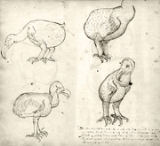
Dodo

Encyclopedia
The dodo was a flightless bird
endemic to the Indian Ocean
island of Mauritius
. Related to pigeons and doves, it stood about a meter (3.3 feet) tall, weighing about 20 kilograms (44.1 lb), living on fruit, and nesting on the ground.
The dodo, which was indigenous only to Mauritius, had lost the power of flight because food was abundant and predators were absent. By 1681 all dodos had been killed by the settlers or by their domesticated animals on the island. The extinction of the bird, within 80 years of its discovery, made man realise for the first time that he could induce the extinction of plants and animals.
The phrase "dead as a dodo" means undoubtedly and unquestionably dead, while the phrase "to go the way of the dodo" means to become extinct or obsolete, to fall out of common usage or practice, or to become a thing of the past.
, east of Madagascar. The dodo was known by the name "walghvogel" ("wallow bird" or "loathsome bird," in reference to its taste), first used in the journal of vice-admiral Wybrand van Warwijck, who visited the island in 1598. The bird was also referred to as "dronte" by the Dutch, a name which is still used in some languages. Although many later writings say that the meat tasted bad, early journals say only that the meat was tough but good, though not as delectable as abundantly available pigeons.
In 1606 Cornelis Matelief de Jonge
wrote an important description of the dodo and some other birds, plants and animals on the island. He described the dodo thus:
Few took particular notice of the bird immediately after its extinction. By the early 19th century it seemed altogether too strange a creature, and was believed by many to be a myth. In 1848, H. E. Strickland and A. G. Melville published a book titled The Dodo and Its Kindred; or the History, Affinities, and Osteology of the Dodo, Solitaire, and Other Extinct Birds of the Islands Mauritius, Rodriguez, and Bourbon in which they attempted to separate Dodo myth from reality. With the discovery of the first batch of dodo bones in the Mauritian swamp, the Mare aux Songes, and the reports written about them by George Clarke, government schoolmaster
at Mahébourg
, from 1865 on, interest in the bird was rekindled.
The etymology
of the word dodo is unclear. Some ascribe it to the Dutch word dodoor for "sluggard", but it more likely is related to dodaars ("knot-arse"), referring to the knot of feathers on the hind end. The first recording of the word dodaerse is in captain Willem van Westsanen's journal in 1602. Thomas Herbert used the word dodo in 1627, but it is unclear whether he was the first; the Portuguese had visited the island in 1507, but, as far as is known, did not mention the bird. Nevertheless, according to the Encarta Dictionary
and Chambers Dictionary of Etymology
, "dodo" derives from Portuguese
doudo (currently doido) meaning "fool" or "crazy". However, the present Portuguese name for the bird, dodô, is taken from the internationally used word dodo.
David Quammen
considered the idea that dodo was an onomatopoeic approximation of the bird's own call, a two-note pigeony sound like "doo-doo".
cytochrome b
and 12S rRNA
sequences
analysis suggests that the dodo's ancestors diverged from those of its closest known relative, the Rodrigues Solitaire
(which is also extinct), around the Paleogene
-Neogene
boundary. As the Mascarenes
are of volcanic
origin and less than 10 million years old, both birds' ancestors remained most likely capable of flight for considerable time after their lineages' separation. The same study has been interpreted to show that the Southeast Asian Nicobar Pigeon
is the closest living relative of the dodo and the Rodrigues Solitaire.
However, the proposed phylogeny
is rather questionable regarding the relationships of other taxa
and must therefore be considered hypothetical pending further research; considering biogeographical
data, it is very likely to be erroneous. All that can be presently said with any certainty is that the ancestors of the didine birds were pigeons from Southeast Asia or the Wallacea
, which agrees with the origin of most of the Mascarenes' birds. Whether the dodo and Rodrigues Solitaire were actually closest to the Nicobar Pigeon among the living birds, or whether they are closer to other groups of the same radiation such as Ducula, Treron
, or Goura
pigeons is not clear at the moment.
For a long time, the dodo and the Rodrigues Solitaire (collectively termed "didines") were placed in a family
of their own, the Raphidae. This was because their relationships to other groups of birds (such as rails
) had yet to be resolved. As of recently, it appears more warranted to include the didines as a subfamily Raphinae in the Columbidae.
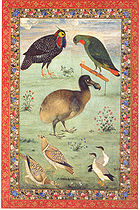 According to artists' renditions, the dodo had greyish and brownish plumage
, a 23-centimeter (9-inch) bill
with a hooked point, very small wing
s, stout yellow legs, and a tuft of curly feather
s high on its rear end. Dodos were very large birds, possibly weighing up to 23 kg (50 pounds), although some estimations give a weight of about 10.6-17.5 kg. The sternum
was insufficient to support flight; these ground-bound birds evolved to take advantage of an island ecosystem
with no predators.
The traditional image of the dodo is of a fat, clumsy bird, hence the synonym Didus ineptus, but this view may be exaggerated. The general opinion of scientists today is that the old European drawings showed overfed captive specimens. A 17th century painting attributed to the Mughal
artist Ustad Mansur
showing a dodo along native Indian birds depicts a slimmer, brownish bird, and is regarded by professor Iwanov and dodo-expert Julian Hume to be one of the most accurate depictions of a dodo. Two live specimens were brought to India in the 1600s according to Peter Mundy
, and the painted specimen might have been one of these. As Mauritius has marked dry and wet seasons, the dodo probably fattened itself on ripe fruits at the end of the wet season to live through the dry season when food was scarce; contemporary reports speak of the birds' "greedy" appetite. In captivity, with food readily available, the birds became overfed very easily.
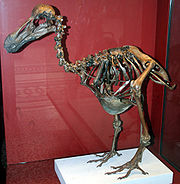
Until recently, the most intact remains, currently on display at the Oxford University Museum of Natural History, were one individual's partly skeletal foot and head which contain the only known soft tissue remains of the species. These remains of the last known stuffed dodo had been kept in Oxford
's Ashmolean Museum
, but in the mid-18th century, the specimen – save the pieces remaining now – had entirely decayed and was ordered to be discarded by the museum's curator or director in or around 1755. The remaining soft tissue has since been severely degraded, as the head was dissected in the late 19th century, and the foot is in a skeletal state.
Until recently, few associated dodo skeletons were known, most of the material consisting of isolated and scattered bones. Dublin's Natural History Museum
and the Oxford University Museum of Natural History
, among others, have a specimen assembled from these disassociated remains. A dodo egg is on display at the East London museum in South Africa
. Manchester Museum
has a small collection of dodo bones on display.
In October 2005, part of the Mare aux Songes, the most important site of dodo remains, was excavated by an international team of researchers. Many remains were found, including bones from birds of various stages of maturity, and several bones obviously belonging to the skeleton of one individual bird and preserved in natural position. These findings were made public in December 2005 in the Naturalis
in Leiden.
In June 2007, adventurers exploring a cave in Mauritius discovered the most complete and well-preserved dodo skeleton
ever.
combined with paintings from the 1600s of apparently albinistic
dodos that surfaced in the 19th century. Nauralists like Walter Rothschild assumed these descriptions where of the white dodo as seen in the painting by Pieter Withoos
, but that the specimen might have been albinistic, due to the wing tips being yellow instead of black as in the old descriptions.
It now appears that all depictions of white dodos were based on a painting, or copies of it, showing a whitish specimen, made by Roelant Savery
in ca. 1611 called "Landscape with Orpheus and the animals". This was apparently based on a stuffed specimen then in Prague
; Savery's several later images all show grayish birds, possibly because he had by then seen a live specimen.
A walghvogel(dodo) described as having a "dirty off-white coloring" was mentioned in an inventory of specimens in the Holy Roman Emperor Rudolf II's collection in Prague by David Fröschl in 1607-1611, so if the 1611 painting by Savery, who was contracted to Rudolf II at the time, is based on this specimen, it could not have been from Reunión, which was not visited by Europeans until 1635.
This white bird was later identified from 17th century descriptions and paintings, which did not match the descriptions of solitaries (reclusive non-gregarious large birds) seen by contemporary explorers on Réunion very well – apart from being mostly white. Due to this, some assumed two species (Raphus solitarius and Victoriornis imperialis) co-existed on Réunion (or "Bourbon", as it was called in former times) – one dodo-like, one resembling the Rodrigues Solitaire
(Pezophaps solitaria). The latter was a dodo relative that generally was not a social bird but for breeding formed monogamous couples. These defended a territory around their large, easily recognized ground nest, deep in the woods; they were thus said to have a "solitary" lifestyle. Though the same French word was used for the birds of both Rodrigues and Réunion, the Réunion Solitaire was given this name because only single individuals were usually encountered all year round. Similar nesting behaviour as on Rodrigues (in the Réunion bird, or in the dodo for that matter) was never reported, marking a conspicuous difference between the two species.
The discovery that it actually was an ibis perfectly fits what the early travellers said about its plumage and habits. The confusion can be explained by the fact that solitaire was used by the writers of the descriptions as a term indicating a non-gregarious lifestyle, which the ibis happened to share with the Rodrigues Solitaire, but was interpreted by the scientists as an indication of a taxonomic
relationship.
, who witnessed a live bird in London in 1638, described it as such:
The tambalacoque
, also known as the "dodo tree", was hypothesized by Stanley Temple to have been eaten from by dodos, and only by passing through the digestive tract of the dodo could the seeds germinate; he claimed that the tambalacocque was now nearly extinct
due to the dodo's disappearance. He force-fed
seventeen tambalacoque fruits to wild turkey
s and three germinated. Temple did not try to germinate any seeds from control fruits not fed to turkeys so the effect of feeding fruits to turkeys was unclear. Temple also overlooked reports on tambalacoque seed germination by A. W. Hill in 1941 and H. C. King in 1946, who found the seeds germinated, albeit very rarely, without abrading.
of people, and this, in combination with its flightlessness, made it easy prey for humans. However, journals are full of reports regarding the bad taste and tough meat of the dodo, while other local species such as the Red Rail
were praised for their taste. When humans first arrived on Mauritius, they also brought with them other animals that had not existed on the island before, including dog
s, pig
s, cat
s, rat
s, and Crab-eating Macaque
s, which plundered the dodo nests, while humans destroyed the forests where the birds made their homes; the impact these animals—especially the pigs and macaques—had on the dodo population is currently considered to have been more severe than that of hunting. The 2005 expedition's finds are apparently of animals killed by a flash flood
; such mass mortalities would have further jeopardized a species already in danger of becoming extinct.
Although there are scattered reports of mass killings of dodos for provisioning of ships, archaeological investigations have hitherto found scant evidence of human predation on these birds. Some bones of at least two dodos were found in caves at Baie du Cap which were used as shelters by fugitive slaves and convicts in the 17th century, but due to their isolation in high, broken terrain, were not easily accessible to dodos naturally.
 There is some controversy surrounding the extinction date of the dodo. Roberts & Solow state that "the extinction of the Dodo is commonly dated to the last confirmed sighting in 1662, reported by shipwreck
ed mariner Volkert Evertsz
" (Evertszoon), but many other sources suggest the more conjectural date of 1681. Roberts & Solow point out that because the sighting prior to 1662 was in 1638, the dodo was likely already very rare by the 1660s, and thus a disputed report from 1674 cannot be dismissed out-of-hand. Statistical
analysis of the hunting records of Isaac Johannes Lamotius give a new estimated extinction date of 1693, with a 95% confidence interval
of 1688 to 1715; the last reported sighting is from the hunting records of Isaac Johannes Lamotius, who gives the year 1688, but it has been suggested that by this time the Dutch name "dodaers" had been transferred to the flightless Red Rail
, which is now also extinct. Considering more circumstantial evidence such as travelers' reports and the lack of good reports after 1689, it is likely that the dodo became extinct before 1700; the last dodo died a little more than a century after the species' discovery in 1581.
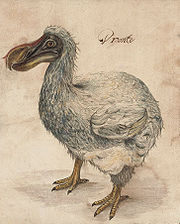 The dodo's significance as one of the best-known extinct animals and its singular appearance has led to its use in literature and popular culture to symbolize a concept or object that will or has become out of date, as in the expression "dead as a dodo" or "gone the way of the dodo". In the same year in which George Clarke started to publish his reports, the newly vindicated bird was featured as a character
in Lewis Carroll
's Alice's Adventures in Wonderland
. With the popularity of the book, the dodo became a well-known and easily recognizable icon of extinction.
In 2009 a previously unpublished 17th century Dutch illustration of a dodo went for sale at Christie's
, and was expected to sell for £6,000. It was sold for £44,450.
The dodo is used by many environmental organizations that promote the protection of endangered species
, such as the Durrell Wildlife Conservation Trust
and the Jersey Zoological Park
, founded by Gerald Durrell
.
The dodo rampant
appears on the coat of arms of
Mauritius
.
Flightless bird
Flightless birds are birds which lack the ability to fly, relying instead on their ability to run or swim. They are thought to have evolved from flying ancestors. There are about forty species in existence today, the best known being the ostrich, emu, cassowary, rhea, kiwi, and penguin...
endemic to the Indian Ocean
Indian Ocean
The Indian Ocean is the third largest of the world's oceanic divisions, covering approximately 20% of the water on the Earth's surface. It is bounded on the north by the Indian Subcontinent and Arabian Peninsula ; on the west by eastern Africa; on the east by Indochina, the Sunda Islands, and...
island of Mauritius
Mauritius
Mauritius , officially the Republic of Mauritius is an island nation off the southeast coast of the African continent in the southwest Indian Ocean, about east of Madagascar...
. Related to pigeons and doves, it stood about a meter (3.3 feet) tall, weighing about 20 kilograms (44.1 lb), living on fruit, and nesting on the ground.
The dodo, which was indigenous only to Mauritius, had lost the power of flight because food was abundant and predators were absent. By 1681 all dodos had been killed by the settlers or by their domesticated animals on the island. The extinction of the bird, within 80 years of its discovery, made man realise for the first time that he could induce the extinction of plants and animals.
The phrase "dead as a dodo" means undoubtedly and unquestionably dead, while the phrase "to go the way of the dodo" means to become extinct or obsolete, to fall out of common usage or practice, or to become a thing of the past.
Discovery and etymology
The earliest known descriptions of the bird were made by Dutch travelers to what is now the island of MauritiusMauritius
Mauritius , officially the Republic of Mauritius is an island nation off the southeast coast of the African continent in the southwest Indian Ocean, about east of Madagascar...
, east of Madagascar. The dodo was known by the name "walghvogel" ("wallow bird" or "loathsome bird," in reference to its taste), first used in the journal of vice-admiral Wybrand van Warwijck, who visited the island in 1598. The bird was also referred to as "dronte" by the Dutch, a name which is still used in some languages. Although many later writings say that the meat tasted bad, early journals say only that the meat was tough but good, though not as delectable as abundantly available pigeons.
In 1606 Cornelis Matelief de Jonge
Cornelis Matelief de Jonge
Cornelis Matelief , was a Dutch admiral who was active in establishing Dutch power in Southeast Asia during the beginning of the 17th century . His fleet was officially on a trading mission, but its true intent was to try to destroy Portuguese power in the area. The ships had 1400 men on board,...
wrote an important description of the dodo and some other birds, plants and animals on the island. He described the dodo thus:
Few took particular notice of the bird immediately after its extinction. By the early 19th century it seemed altogether too strange a creature, and was believed by many to be a myth. In 1848, H. E. Strickland and A. G. Melville published a book titled The Dodo and Its Kindred; or the History, Affinities, and Osteology of the Dodo, Solitaire, and Other Extinct Birds of the Islands Mauritius, Rodriguez, and Bourbon in which they attempted to separate Dodo myth from reality. With the discovery of the first batch of dodo bones in the Mauritian swamp, the Mare aux Songes, and the reports written about them by George Clarke, government schoolmaster
Schoolmaster
A schoolmaster, or simply master, once referred to a male school teacher. This usage survives in British public schools, but is generally obsolete elsewhere.The teacher in charge of a school is the headmaster...
at Mahébourg
Mahébourg
Mahébourg is a small city on the southeastern coast of the island of Mauritius. It is the capital of the Grand Port District.- Overview :...
, from 1865 on, interest in the bird was rekindled.
The etymology
Etymology
Etymology is the study of the history of words, their origins, and how their form and meaning have changed over time.For languages with a long written history, etymologists make use of texts in these languages and texts about the languages to gather knowledge about how words were used during...
of the word dodo is unclear. Some ascribe it to the Dutch word dodoor for "sluggard", but it more likely is related to dodaars ("knot-arse"), referring to the knot of feathers on the hind end. The first recording of the word dodaerse is in captain Willem van Westsanen's journal in 1602. Thomas Herbert used the word dodo in 1627, but it is unclear whether he was the first; the Portuguese had visited the island in 1507, but, as far as is known, did not mention the bird. Nevertheless, according to the Encarta Dictionary
Encarta
Microsoft Encarta was a digital multimedia encyclopedia published by Microsoft Corporation from 1993 to 2009. , the complete English version, Encarta Premium, consisted of more than 62,000 articles, numerous photos and illustrations, music clips, videos, interactive contents, timelines, maps and...
and Chambers Dictionary of Etymology
Chambers Dictionary
The Chambers Dictionary was first published by W. and R. Chambers as Chambers's English Dictionary in 1872. It was an expanded version of Chambers's Etymological Dictionary of 1867, compiled by James Donald...
, "dodo" derives from Portuguese
Portuguese language
Portuguese is a Romance language that arose in the medieval Kingdom of Galicia, nowadays Galicia and Northern Portugal. The southern part of the Kingdom of Galicia became independent as the County of Portugal in 1095...
doudo (currently doido) meaning "fool" or "crazy". However, the present Portuguese name for the bird, dodô, is taken from the internationally used word dodo.
David Quammen
David Quammen
David Quammen is a science, nature and travel writer whose work has appeared in publications such as National Geographic, Outside, Harper's, Rolling Stone, and The New York Times Book Review....
considered the idea that dodo was an onomatopoeic approximation of the bird's own call, a two-note pigeony sound like "doo-doo".
Systematics and evolution
The dodo was a close relative of modern pigeons and doves. mtDNAMitochondrial DNA
Mitochondrial DNA is the DNA located in organelles called mitochondria, structures within eukaryotic cells that convert the chemical energy from food into a form that cells can use, adenosine triphosphate...
cytochrome b
Cytochrome b
Cytochrome b/b6 is the main subunit of transmembrane cytochrome bc1 and b6f complexes. In addition, it commonly refers to a region of mtDNA used for population genetics and phylogenetics.- Function :...
and 12S rRNA
Ribosomal RNA
Ribosomal ribonucleic acid is the RNA component of the ribosome, the enzyme that is the site of protein synthesis in all living cells. Ribosomal RNA provides a mechanism for decoding mRNA into amino acids and interacts with tRNAs during translation by providing peptidyl transferase activity...
sequences
DNA sequence
The sequence or primary structure of a nucleic acid is the composition of atoms that make up the nucleic acid and the chemical bonds that bond those atoms. Because nucleic acids, such as DNA and RNA, are unbranched polymers, this specification is equivalent to specifying the sequence of...
analysis suggests that the dodo's ancestors diverged from those of its closest known relative, the Rodrigues Solitaire
Rodrigues Solitaire
The Rodrigues Solitaire was a flightless member of the pigeon order endemic to Rodrigues, Mauritius. It was a close relative of the Dodo.-Discovery:...
(which is also extinct), around the Paleogene
Paleogene
The Paleogene is a geologic period and system that began 65.5 ± 0.3 and ended 23.03 ± 0.05 million years ago and comprises the first part of the Cenozoic Era...
-Neogene
Neogene
The Neogene is a geologic period and system in the International Commission on Stratigraphy Geologic Timescale starting 23.03 ± 0.05 million years ago and ending 2.588 million years ago...
boundary. As the Mascarenes
Mascarene Islands
The Mascarene Islands is a group of islands in the Indian Ocean east of Madagascar comprising Mauritius, Réunion, Rodrigues, Cargados Carajos shoals, plus the former islands of the Saya de Malha, Nazareth and Soudan banks...
are of volcanic
Volcano
2. Bedrock3. Conduit 4. Base5. Sill6. Dike7. Layers of ash emitted by the volcano8. Flank| 9. Layers of lava emitted by the volcano10. Throat11. Parasitic cone12. Lava flow13. Vent14. Crater15...
origin and less than 10 million years old, both birds' ancestors remained most likely capable of flight for considerable time after their lineages' separation. The same study has been interpreted to show that the Southeast Asian Nicobar Pigeon
Nicobar Pigeon
The Nicobar Pigeon, Caloenas nicobarica, is a pigeon found on small islands and in coastal regions from the Nicobar Islands, east through the Malay Archipelago, to the Solomons and Palau. It is the only living member of the genus Caloenas....
is the closest living relative of the dodo and the Rodrigues Solitaire.
However, the proposed phylogeny
Phylogenetics
In biology, phylogenetics is the study of evolutionary relatedness among groups of organisms , which is discovered through molecular sequencing data and morphological data matrices...
is rather questionable regarding the relationships of other taxa
Taxon
|thumb|270px|[[African elephants]] form a widely-accepted taxon, the [[genus]] LoxodontaA taxon is a group of organisms, which a taxonomist adjudges to be a unit. Usually a taxon is given a name and a rank, although neither is a requirement...
and must therefore be considered hypothetical pending further research; considering biogeographical
Biogeography
Biogeography is the study of the distribution of species , organisms, and ecosystems in space and through geological time. Organisms and biological communities vary in a highly regular fashion along geographic gradients of latitude, elevation, isolation and habitat area...
data, it is very likely to be erroneous. All that can be presently said with any certainty is that the ancestors of the didine birds were pigeons from Southeast Asia or the Wallacea
Wallacea
Wallacea is a biogeographical designation for a group of Indonesian islands separated by deep water straits from the Asian and Australian continental shelves. Wallacea includes Sulawesi, the largest island in the group, as well as Lombok, Sumbawa, Flores, Sumba, Timor, Halmahera, Buru, Seram, and...
, which agrees with the origin of most of the Mascarenes' birds. Whether the dodo and Rodrigues Solitaire were actually closest to the Nicobar Pigeon among the living birds, or whether they are closer to other groups of the same radiation such as Ducula, Treron
Green pigeon
Treron is a genus of bird in the pigeon family Columbidae. The genus is distributed across Asia and Africa. This genus contains 23 species, remarkable for their green coloration, which comes from a carotenoid pigment in their diet. Green pigeons have diets of various fruit, nuts, and/or seeds....
, or Goura
Goura (genus)
The genus Goura consists of three species of crowned pigeons. They are the largest non-extinct members of the pigeon family. The three crowned pigeons are alike and replace each other geographically. The genus was described by James Francis Stephens in 1819.The phylogeny of the crowned pigeons is...
pigeons is not clear at the moment.
For a long time, the dodo and the Rodrigues Solitaire (collectively termed "didines") were placed in a family
Family (biology)
In biological classification, family is* a taxonomic rank. Other well-known ranks are life, domain, kingdom, phylum, class, order, genus, and species, with family fitting between order and genus. As for the other well-known ranks, there is the option of an immediately lower rank, indicated by the...
of their own, the Raphidae. This was because their relationships to other groups of birds (such as rails
Rallidae
The rails, or Rallidae, are a large cosmopolitan family of small to medium-sized birds. The family exhibits considerable diversity and the family also includes the crakes, coots, and gallinules...
) had yet to be resolved. As of recently, it appears more warranted to include the didines as a subfamily Raphinae in the Columbidae.
Description
Plumage
Plumage refers both to the layer of feathers that cover a bird and the pattern, colour, and arrangement of those feathers. The pattern and colours of plumage vary between species and subspecies and can also vary between different age classes, sexes, and season. Within species there can also be a...
, a 23-centimeter (9-inch) bill
Beak
The beak, bill or rostrum is an external anatomical structure of birds which is used for eating and for grooming, manipulating objects, killing prey, fighting, probing for food, courtship and feeding young...
with a hooked point, very small wing
Wing
A wing is an appendage with a surface that produces lift for flight or propulsion through the atmosphere, or through another gaseous or liquid fluid...
s, stout yellow legs, and a tuft of curly feather
Feather
Feathers are one of the epidermal growths that form the distinctive outer covering, or plumage, on birds and some non-avian theropod dinosaurs. They are considered the most complex integumentary structures found in vertebrates, and indeed a premier example of a complex evolutionary novelty. They...
s high on its rear end. Dodos were very large birds, possibly weighing up to 23 kg (50 pounds), although some estimations give a weight of about 10.6-17.5 kg. The sternum
Sternum
The sternum or breastbone is a long flat bony plate shaped like a capital "T" located anteriorly to the heart in the center of the thorax...
was insufficient to support flight; these ground-bound birds evolved to take advantage of an island ecosystem
Ecosystem
An ecosystem is a biological environment consisting of all the organisms living in a particular area, as well as all the nonliving , physical components of the environment with which the organisms interact, such as air, soil, water and sunlight....
with no predators.
The traditional image of the dodo is of a fat, clumsy bird, hence the synonym Didus ineptus, but this view may be exaggerated. The general opinion of scientists today is that the old European drawings showed overfed captive specimens. A 17th century painting attributed to the Mughal
Mughal Empire
The Mughal Empire , or Mogul Empire in traditional English usage, was an imperial power from the Indian Subcontinent. The Mughal emperors were descendants of the Timurids...
artist Ustad Mansur
Ustad Mansur
Ustad Mansur was a seventeenth century Mughal painter and court artist of Jehangir who specialised in depicting plants and animals.-Life and works:...
showing a dodo along native Indian birds depicts a slimmer, brownish bird, and is regarded by professor Iwanov and dodo-expert Julian Hume to be one of the most accurate depictions of a dodo. Two live specimens were brought to India in the 1600s according to Peter Mundy
Peter Mundy
-Life:He came from Penryn in Cornwall. In 1609 he accompanied his father to Rouen, and was then sent to Gascony to learn French. In May 1611 he went as a cabin-boy in a merchant ship, and gradually rose in life until he became of independent circumstances....
, and the painted specimen might have been one of these. As Mauritius has marked dry and wet seasons, the dodo probably fattened itself on ripe fruits at the end of the wet season to live through the dry season when food was scarce; contemporary reports speak of the birds' "greedy" appetite. In captivity, with food readily available, the birds became overfed very easily.
Until recently, the most intact remains, currently on display at the Oxford University Museum of Natural History, were one individual's partly skeletal foot and head which contain the only known soft tissue remains of the species. These remains of the last known stuffed dodo had been kept in Oxford
Oxford
The city of Oxford is the county town of Oxfordshire, England. The city, made prominent by its medieval university, has a population of just under 165,000, with 153,900 living within the district boundary. It lies about 50 miles north-west of London. The rivers Cherwell and Thames run through...
's Ashmolean Museum
Ashmolean Museum
The Ashmolean Museum on Beaumont Street, Oxford, England, is the world's first university museum...
, but in the mid-18th century, the specimen – save the pieces remaining now – had entirely decayed and was ordered to be discarded by the museum's curator or director in or around 1755. The remaining soft tissue has since been severely degraded, as the head was dissected in the late 19th century, and the foot is in a skeletal state.
Until recently, few associated dodo skeletons were known, most of the material consisting of isolated and scattered bones. Dublin's Natural History Museum
Natural History Museum (Ireland)
Ireland's Natural History Museum , often called the Dead Zoo a branch of the National Museum of Ireland, is housed on Merrion Street in Dublin, Ireland...
and the Oxford University Museum of Natural History
Oxford University Museum of Natural History
The Oxford University Museum of Natural History, sometimes known simply as the Oxford University Museum, is a museum displaying many of the University of Oxford's natural history specimens, located on Parks Road in Oxford, England. It also contains a lecture theatre which is used by the...
, among others, have a specimen assembled from these disassociated remains. A dodo egg is on display at the East London museum in South Africa
South Africa
The Republic of South Africa is a country in southern Africa. Located at the southern tip of Africa, it is divided into nine provinces, with of coastline on the Atlantic and Indian oceans...
. Manchester Museum
Manchester Museum
The Manchester Museum is owned by the University of Manchester. Sited on Oxford Road at the heart of the university's group of neo-Gothic buildings, it provides access to about six million items from every continent and serves both as a resource for academic research and teaching and as a regional...
has a small collection of dodo bones on display.
In October 2005, part of the Mare aux Songes, the most important site of dodo remains, was excavated by an international team of researchers. Many remains were found, including bones from birds of various stages of maturity, and several bones obviously belonging to the skeleton of one individual bird and preserved in natural position. These findings were made public in December 2005 in the Naturalis
Naturalis
Naturalis is the national natural history museum of the Netherlands, based in Leiden. It originated from the merger of the Rijksmuseum van Natuurlijke Historie and the Rijksmuseum van Geologie en Mineralogie in 1984. In 1986 it was decided that the museum had to become a public museum and a new...
in Leiden.
In June 2007, adventurers exploring a cave in Mauritius discovered the most complete and well-preserved dodo skeleton
Skeleton
The skeleton is the body part that forms the supporting structure of an organism. There are two different skeletal types: the exoskeleton, which is the stable outer shell of an organism, and the endoskeleton, which forms the support structure inside the body.In a figurative sense, skeleton can...
ever.
The white dodo
The supposed "White Dodo" is now thought to be based on misinterpreted reports of the Réunion Sacred IbisRéunion Sacred Ibis
The Réunion Sacred Ibis, Threskiornis solitarius, is an extinct bird species that was native to the island of Réunion. It is probably the same bird discovered by Portuguese sailors there in 1613...
combined with paintings from the 1600s of apparently albinistic
Albinism
Albinism is a congenital disorder characterized by the complete or partial absence of pigment in the skin, hair and eyes due to absence or defect of an enzyme involved in the production of melanin...
dodos that surfaced in the 19th century. Nauralists like Walter Rothschild assumed these descriptions where of the white dodo as seen in the painting by Pieter Withoos
Pieter Withoos
Pieter Withoos , was a Dutch Golden Age painter.-Biography:Withoos was born in Amersfoort. According to Houbraken he was the second son of Mathias Withoos, brother to the painters Johannes, Frans and Alida Withoos...
, but that the specimen might have been albinistic, due to the wing tips being yellow instead of black as in the old descriptions.
It now appears that all depictions of white dodos were based on a painting, or copies of it, showing a whitish specimen, made by Roelant Savery
Roelant Savery
Roelant Savery , was a Flanders-born Dutch Golden Age painter.-Life:Savery was born in Kortrijk...
in ca. 1611 called "Landscape with Orpheus and the animals". This was apparently based on a stuffed specimen then in Prague
Prague
Prague is the capital and largest city of the Czech Republic. Situated in the north-west of the country on the Vltava river, the city is home to about 1.3 million people, while its metropolitan area is estimated to have a population of over 2.3 million...
; Savery's several later images all show grayish birds, possibly because he had by then seen a live specimen.
A walghvogel(dodo) described as having a "dirty off-white coloring" was mentioned in an inventory of specimens in the Holy Roman Emperor Rudolf II's collection in Prague by David Fröschl in 1607-1611, so if the 1611 painting by Savery, who was contracted to Rudolf II at the time, is based on this specimen, it could not have been from Reunión, which was not visited by Europeans until 1635.
This white bird was later identified from 17th century descriptions and paintings, which did not match the descriptions of solitaries (reclusive non-gregarious large birds) seen by contemporary explorers on Réunion very well – apart from being mostly white. Due to this, some assumed two species (Raphus solitarius and Victoriornis imperialis) co-existed on Réunion (or "Bourbon", as it was called in former times) – one dodo-like, one resembling the Rodrigues Solitaire
Rodrigues Solitaire
The Rodrigues Solitaire was a flightless member of the pigeon order endemic to Rodrigues, Mauritius. It was a close relative of the Dodo.-Discovery:...
(Pezophaps solitaria). The latter was a dodo relative that generally was not a social bird but for breeding formed monogamous couples. These defended a territory around their large, easily recognized ground nest, deep in the woods; they were thus said to have a "solitary" lifestyle. Though the same French word was used for the birds of both Rodrigues and Réunion, the Réunion Solitaire was given this name because only single individuals were usually encountered all year round. Similar nesting behaviour as on Rodrigues (in the Réunion bird, or in the dodo for that matter) was never reported, marking a conspicuous difference between the two species.
The discovery that it actually was an ibis perfectly fits what the early travellers said about its plumage and habits. The confusion can be explained by the fact that solitaire was used by the writers of the descriptions as a term indicating a non-gregarious lifestyle, which the ibis happened to share with the Rodrigues Solitaire, but was interpreted by the scientists as an indication of a taxonomic
Taxonomy
Taxonomy is the science of identifying and naming species, and arranging them into a classification. The field of taxonomy, sometimes referred to as "biological taxonomy", revolves around the description and use of taxonomic units, known as taxa...
relationship.
Diet
Several contemporary sources state that the dodo used gizzard stones. The English historian Sir Hamon L'EstrangeHamon L'Estrange
Hamon L'Estrange was an English writer on history, theology and liturgy, of Calvinist views, loyal both to Charles I and the Church of England. Along with Edward Stephens, he contributed to the seventeenth-century revival of interest in ancient liturgies; with John Cosin and Anthony Sparrow he...
, who witnessed a live bird in London in 1638, described it as such:
The tambalacoque
Tambalacoque
Tambalacoque , also called the Dodo Tree, is a long-lived tree in the family Sapotaceae, endemic to Mauritius. The Dodo Tree is valued for its timber....
, also known as the "dodo tree", was hypothesized by Stanley Temple to have been eaten from by dodos, and only by passing through the digestive tract of the dodo could the seeds germinate; he claimed that the tambalacocque was now nearly extinct
Coextinction
Coextinction of a species is the loss of a species as a consequence of the extinction of another. The term was originally used in the context of the extinction of parasitic insects following the loss of their specific hosts...
due to the dodo's disappearance. He force-fed
Force-feeding
Force-feeding is the practice of feeding a person or an animal against their will. "Gavage" is supplying a nutritional substance by means of a small plastic tube passed through the nose or mouth into the stomach, not explicitly 'forcibly'....
seventeen tambalacoque fruits to wild turkey
Wild Turkey
The Wild Turkey is native to North America and is the heaviest member of the Galliformes. It is the same species as the domestic turkey, which derives from the South Mexican subspecies of wild turkey .Adult wild turkeys have long reddish-yellow to grayish-green...
s and three germinated. Temple did not try to germinate any seeds from control fruits not fed to turkeys so the effect of feeding fruits to turkeys was unclear. Temple also overlooked reports on tambalacoque seed germination by A. W. Hill in 1941 and H. C. King in 1946, who found the seeds germinated, albeit very rarely, without abrading.
Extinction
As with many animals that have evolved in isolation from significant predators, the dodo was entirely fearlessIsland tameness
Island tameness is the tendency of many populations and species of animals living on isolated islands to lose their wariness of potential predators, particularly of large animals. The term is partly synonymous with ecological naïvete, which also has a wider meaning referring to the loss of...
of people, and this, in combination with its flightlessness, made it easy prey for humans. However, journals are full of reports regarding the bad taste and tough meat of the dodo, while other local species such as the Red Rail
Red Rail
The Red Rail or Red Hen of Mauritius, Aphanapteryx bonasia, is an extinct rail. It was only found on the island of Mauritius. The Red Rail, which today is only known from a large number of bones, some descriptions and a handful of drawings and paintings, was a flightless bird, somewhat larger than...
were praised for their taste. When humans first arrived on Mauritius, they also brought with them other animals that had not existed on the island before, including dog
Dog
The domestic dog is a domesticated form of the gray wolf, a member of the Canidae family of the order Carnivora. The term is used for both feral and pet varieties. The dog may have been the first animal to be domesticated, and has been the most widely kept working, hunting, and companion animal in...
s, pig
Pig
A pig is any of the animals in the genus Sus, within the Suidae family of even-toed ungulates. Pigs include the domestic pig, its ancestor the wild boar, and several other wild relatives...
s, cat
Cat
The cat , also known as the domestic cat or housecat to distinguish it from other felids and felines, is a small, usually furry, domesticated, carnivorous mammal that is valued by humans for its companionship and for its ability to hunt vermin and household pests...
s, rat
Rat
Rats are various medium-sized, long-tailed rodents of the superfamily Muroidea. "True rats" are members of the genus Rattus, the most important of which to humans are the black rat, Rattus rattus, and the brown rat, Rattus norvegicus...
s, and Crab-eating Macaque
Crab-eating Macaque
The Crab-eating macaque is a cercopithecine primate native to Southeast Asia. It is also called the "long-tailed macaque", and is referred to as the "cynomolgus monkey" in laboratories.-Etymology:...
s, which plundered the dodo nests, while humans destroyed the forests where the birds made their homes; the impact these animals—especially the pigs and macaques—had on the dodo population is currently considered to have been more severe than that of hunting. The 2005 expedition's finds are apparently of animals killed by a flash flood
Flash flood
A flash flood is a rapid flooding of geomorphic low-lying areas—washes, rivers, dry lakes and basins. It may be caused by heavy rain associated with a storm, hurricane, or tropical storm or meltwater from ice or snow flowing over ice sheets or snowfields...
; such mass mortalities would have further jeopardized a species already in danger of becoming extinct.
Although there are scattered reports of mass killings of dodos for provisioning of ships, archaeological investigations have hitherto found scant evidence of human predation on these birds. Some bones of at least two dodos were found in caves at Baie du Cap which were used as shelters by fugitive slaves and convicts in the 17th century, but due to their isolation in high, broken terrain, were not easily accessible to dodos naturally.
Shipwreck
A shipwreck is what remains of a ship that has wrecked, either sunk or beached. Whatever the cause, a sunken ship or a wrecked ship is a physical example of the event: this explains why the two concepts are often overlapping in English....
ed mariner Volkert Evertsz
Volkert Evertsz
Volkert Evertsz was a Dutch mariner who was shipwrecked on the island of Mauritius and was the last human confirmed to have seen the dodo alive in 1662. A survivor of the shipwreck Arnhem, Evertsz and other party members waded ashore an islet off the coast of Mauritius in 1662 and found Dodos and...
" (Evertszoon), but many other sources suggest the more conjectural date of 1681. Roberts & Solow point out that because the sighting prior to 1662 was in 1638, the dodo was likely already very rare by the 1660s, and thus a disputed report from 1674 cannot be dismissed out-of-hand. Statistical
Statistics
Statistics is the study of the collection, organization, analysis, and interpretation of data. It deals with all aspects of this, including the planning of data collection in terms of the design of surveys and experiments....
analysis of the hunting records of Isaac Johannes Lamotius give a new estimated extinction date of 1693, with a 95% confidence interval
Confidence interval
In statistics, a confidence interval is a particular kind of interval estimate of a population parameter and is used to indicate the reliability of an estimate. It is an observed interval , in principle different from sample to sample, that frequently includes the parameter of interest, if the...
of 1688 to 1715; the last reported sighting is from the hunting records of Isaac Johannes Lamotius, who gives the year 1688, but it has been suggested that by this time the Dutch name "dodaers" had been transferred to the flightless Red Rail
Red Rail
The Red Rail or Red Hen of Mauritius, Aphanapteryx bonasia, is an extinct rail. It was only found on the island of Mauritius. The Red Rail, which today is only known from a large number of bones, some descriptions and a handful of drawings and paintings, was a flightless bird, somewhat larger than...
, which is now also extinct. Considering more circumstantial evidence such as travelers' reports and the lack of good reports after 1689, it is likely that the dodo became extinct before 1700; the last dodo died a little more than a century after the species' discovery in 1581.
Cultural significance
Dodo (Alice's Adventures in Wonderland)
-Tim Burton's Alice in Wonderland version:The Dodo, who in this adaptation of the book is named Uilleam and is portrayed by Michael Gough, bears a down of brilliant blue and is one of Alice's advisers, who also took first note of her identity as the true Alice. Mysteriously, the dodo vanishes...
in Lewis Carroll
Lewis Carroll
Charles Lutwidge Dodgson , better known by the pseudonym Lewis Carroll , was an English author, mathematician, logician, Anglican deacon and photographer. His most famous writings are Alice's Adventures in Wonderland and its sequel Through the Looking-Glass, as well as the poems "The Hunting of the...
's Alice's Adventures in Wonderland
Alice's Adventures in Wonderland
Alice's Adventures in Wonderland is an 1865 novel written by English author Charles Lutwidge Dodgson under the pseudonym Lewis Carroll. It tells of a girl named Alice who falls down a rabbit hole into a fantasy world populated by peculiar, anthropomorphic creatures...
. With the popularity of the book, the dodo became a well-known and easily recognizable icon of extinction.
In 2009 a previously unpublished 17th century Dutch illustration of a dodo went for sale at Christie's
Christie's
Christie's is an art business and a fine arts auction house.- History :The official company literature states that founder James Christie conducted the first sale in London, England, on 5 December 1766, and the earliest auction catalogue the company retains is from December 1766...
, and was expected to sell for £6,000. It was sold for £44,450.
The dodo is used by many environmental organizations that promote the protection of endangered species
Endangered species
An endangered species is a population of organisms which is at risk of becoming extinct because it is either few in numbers, or threatened by changing environmental or predation parameters...
, such as the Durrell Wildlife Conservation Trust
Durrell Wildlife Conservation Trust
Durrell Wildlife Conservation Trust is a conservation organisation with a mission to save species from extinction.Gerald Durrell founded the Jersey Wildlife Preservation Trust as a charitable institution in 1963 with the Dodo as its symbol...
and the Jersey Zoological Park
Jersey Zoological Park
Jersey Zoological Park or Jersey Zoo is a zoological park established in 1959 on the island of Jersey in the English Channel by naturalist and author Gerald Durrell . It is now officially called Durrell Wildlife Conservation Trust after its founder, or Durrell for short...
, founded by Gerald Durrell
Gerald Durrell
Gerald "Gerry" Malcolm Durrell, OBE was a naturalist, zookeeper, conservationist, author and television presenter...
.
The dodo rampant
Attitude (heraldry)
In heraldry, an attitude is the position in which an animal, fictional beast, mythical creature, human or human-like being is emblazoned as a charge, supporter or crest. Many attitudes apply only to predatory beasts and are exemplified by the beast most frequently found in heraldry — the lion. ...
appears on the coat of arms of
Coat of arms of Mauritius
The coat of arms of Mauritius are stipulated in the "Mauritius Laws 1990 Vol.2 SCHEDULE ". The arms were designed by the Lord Mayor of Johannesburg in 1906, Johann Van Der Puf...
Mauritius
Mauritius
Mauritius , officially the Republic of Mauritius is an island nation off the southeast coast of the African continent in the southwest Indian Ocean, about east of Madagascar...
.