


Charles Daubeny

Encyclopedia
Charles Giles Bridle Daubeny (11 February 1795 – 12 December 1867) was an English
chemist
, botanist
and geologist
.
Daubeny was born at Stratton near Cirencester
in Gloucestershire
, the son of the Rev. James Daubeny. He studied at Magdalen College, Oxford
under Dr. John Kidd. In 1819, in the course of a tour through France, he made the volcanic
district of Auvergne
a special study, and his Letters on the Volcanos of Auvergne were published in The Edinburgh Journal. He was elected a fellow of the Royal Society
in 1822.
By subsequent journeys in Hungary
, Transylvania
, Italy
, Sicily
, France
and Germany
he extended his knowledge of volcanic phenomena; and in 1826 the results of his observations were given in a work entitled A Description of Active and Extinct Volcanos. In common with Gay-Lussac
and Davy
, he held subterraneous thermic disturbances to be probably due to the contact of water with metals of the alkalis and alkaline earths.
In November 1822 Daubeny succeeded Kidd as professor of chemistry at Oxford, and retained this post until 1855. In 1834 he was appointed to the chair of botany, to which was subsequently attached that of rural economy. At the Oxford botanical garden he conducted numerous experiments upon the effect of changes in soil, light and the composition of the atmosphere upon vegetation. In 1830 he published in the Philosophical Transactions a paper on the iodine and bromine of mineral waters. In 1831 Daubeny represented the universities of England at the first meeting of the British Association, which at his request held their next session at Oxford. In 1836 he communicated to the Association a report on the subject of mineral and thermal waters.
In 1837 he visited the United States
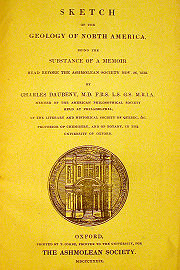
and acquired there the materials for papers on the thermal springs and the geology of North America
, read in 1838 before the Ashmolean Society and the British Association (and published in 1839). In 1856 he became president of the latter body at its meeting at Cheltenham
. The herbarium at Oxford is named after him.
England
England is a country that is part of the United Kingdom. It shares land borders with Scotland to the north and Wales to the west; the Irish Sea is to the north west, the Celtic Sea to the south west, with the North Sea to the east and the English Channel to the south separating it from continental...
chemist
Chemist
A chemist is a scientist trained in the study of chemistry. Chemists study the composition of matter and its properties such as density and acidity. Chemists carefully describe the properties they study in terms of quantities, with detail on the level of molecules and their component atoms...
, botanist
Botany
Botany, plant science, or plant biology is a branch of biology that involves the scientific study of plant life. Traditionally, botany also included the study of fungi, algae and viruses...
and geologist
Geologist
A geologist is a scientist who studies the solid and liquid matter that constitutes the Earth as well as the processes and history that has shaped it. Geologists usually engage in studying geology. Geologists, studying more of an applied science than a theoretical one, must approach Geology using...
.
Daubeny was born at Stratton near Cirencester
Cirencester
Cirencester is a market town in east Gloucestershire, England, 93 miles west northwest of London. Cirencester lies on the River Churn, a tributary of the River Thames, and is the largest town in the Cotswold District. It is the home of the Royal Agricultural College, the oldest agricultural...
in Gloucestershire
Gloucestershire
Gloucestershire is a county in South West England. The county comprises part of the Cotswold Hills, part of the flat fertile valley of the River Severn, and the entire Forest of Dean....
, the son of the Rev. James Daubeny. He studied at Magdalen College, Oxford
Magdalen College, Oxford
Magdalen College is one of the constituent colleges of the University of Oxford in England. As of 2006 the college had an estimated financial endowment of £153 million. Magdalen is currently top of the Norrington Table after over half of its 2010 finalists received first-class degrees, a record...
under Dr. John Kidd. In 1819, in the course of a tour through France, he made the volcanic
Volcano
2. Bedrock3. Conduit 4. Base5. Sill6. Dike7. Layers of ash emitted by the volcano8. Flank| 9. Layers of lava emitted by the volcano10. Throat11. Parasitic cone12. Lava flow13. Vent14. Crater15...
district of Auvergne
Auvergne (province)
Auvergne was a historic province in south central France. It was originally the feudal domain of the Counts of Auvergne. It is now the geographical and cultural area that corresponds to the former province....
a special study, and his Letters on the Volcanos of Auvergne were published in The Edinburgh Journal. He was elected a fellow of the Royal Society
Royal Society
The Royal Society of London for Improving Natural Knowledge, known simply as the Royal Society, is a learned society for science, and is possibly the oldest such society in existence. Founded in November 1660, it was granted a Royal Charter by King Charles II as the "Royal Society of London"...
in 1822.
By subsequent journeys in Hungary
Hungary
Hungary , officially the Republic of Hungary , is a landlocked country in Central Europe. It is situated in the Carpathian Basin and is bordered by Slovakia to the north, Ukraine and Romania to the east, Serbia and Croatia to the south, Slovenia to the southwest and Austria to the west. The...
, Transylvania
Transylvania
Transylvania is a historical region in the central part of Romania. Bounded on the east and south by the Carpathian mountain range, historical Transylvania extended in the west to the Apuseni Mountains; however, the term sometimes encompasses not only Transylvania proper, but also the historical...
, Italy
Italy
Italy , officially the Italian Republic languages]] under the European Charter for Regional or Minority Languages. In each of these, Italy's official name is as follows:;;;;;;;;), is a unitary parliamentary republic in South-Central Europe. To the north it borders France, Switzerland, Austria and...
, Sicily
Sicily
Sicily is a region of Italy, and is the largest island in the Mediterranean Sea. Along with the surrounding minor islands, it constitutes an autonomous region of Italy, the Regione Autonoma Siciliana Sicily has a rich and unique culture, especially with regard to the arts, music, literature,...
, France
France
The French Republic , The French Republic , The French Republic , (commonly known as France , is a unitary semi-presidential republic in Western Europe with several overseas territories and islands located on other continents and in the Indian, Pacific, and Atlantic oceans. Metropolitan France...
and Germany
Germany
Germany , officially the Federal Republic of Germany , is a federal parliamentary republic in Europe. The country consists of 16 states while the capital and largest city is Berlin. Germany covers an area of 357,021 km2 and has a largely temperate seasonal climate...
he extended his knowledge of volcanic phenomena; and in 1826 the results of his observations were given in a work entitled A Description of Active and Extinct Volcanos. In common with Gay-Lussac
Joseph Louis Gay-Lussac
- External links :* from the American Chemical Society* from the Encyclopædia Britannica, 10th Edition * , Paris...
and Davy
Humphry Davy
Sir Humphry Davy, 1st Baronet FRS MRIA was a British chemist and inventor. He is probably best remembered today for his discoveries of several alkali and alkaline earth metals, as well as contributions to the discoveries of the elemental nature of chlorine and iodine...
, he held subterraneous thermic disturbances to be probably due to the contact of water with metals of the alkalis and alkaline earths.
In November 1822 Daubeny succeeded Kidd as professor of chemistry at Oxford, and retained this post until 1855. In 1834 he was appointed to the chair of botany, to which was subsequently attached that of rural economy. At the Oxford botanical garden he conducted numerous experiments upon the effect of changes in soil, light and the composition of the atmosphere upon vegetation. In 1830 he published in the Philosophical Transactions a paper on the iodine and bromine of mineral waters. In 1831 Daubeny represented the universities of England at the first meeting of the British Association, which at his request held their next session at Oxford. In 1836 he communicated to the Association a report on the subject of mineral and thermal waters.
In 1837 he visited the United States
United States
The United States of America is a federal constitutional republic comprising fifty states and a federal district...
and acquired there the materials for papers on the thermal springs and the geology of North America
North America
North America is a continent wholly within the Northern Hemisphere and almost wholly within the Western Hemisphere. It is also considered a northern subcontinent of the Americas...
, read in 1838 before the Ashmolean Society and the British Association (and published in 1839). In 1856 he became president of the latter body at its meeting at Cheltenham
Cheltenham
Cheltenham , also known as Cheltenham Spa, is a large spa town and borough in Gloucestershire, on the edge of the Cotswolds in the South-West region of England. It is the home of the flagship race of British steeplechase horse racing, the Gold Cup, the main event of the Cheltenham Festival held...
. The herbarium at Oxford is named after him.
Works
- Introduction to the Atomic Theory (1831)
- On the Action of Light upon Plants, and of Plants upon the Atmosphere (1836)
- Sketch of the Geology of North America (1839)
- Lectures on Agriculture (1841)
- Lectures on Roman Husbandry (1857); in Climate: an inquiry into the causes of its differences and into its influence on Vegetable Life (1863)
- Essay on the Trees and Shrubs of the Ancients, and a Catalogue of the Trees and Shrubs indigenous to Greece and Italy (1865)