
All Topics  
Megalosaurus

 
Megalosaurus

   Email Print
   Bookmark   Link


Megalosaurus


Megalosaurus (meaning "Great Lizard", from Greek
Ancient Greek

Ancient Greek is the historical stage in the development of the Greek language spanning across the Archaic Greece , Classical Greece , and Hellenistic civilization periods of ancient Greece and the classical antiquity....
, µe?a??-/megalo- meaning 'big', 'tall' or 'great' and sa????/sauros meaning 'lizard') is a genus
Genus

A genus is a low-level taxonomic rank used in the classification of living and fossil organisms. The taxonomic ranks are domain , kingdom , phylum, class , order , family , genus, and species....
 of large meat-eating theropod dinosaur
Dinosaur

Dinosaurs were the dominant vertebrate animals of Landform ecosystems for over 160 million years, from the late Triassic Period until the end of the Cretaceous Period , when most of them became extinct in the Cretaceous?Tertiary extinction event....
s of the Middle Jurassic
Jurassic

The Jurassic is a geologic period that extends from about annum to  Ma, that is, from the end of the Triassic to the beginning of the Cretaceous....
 Period (Bathonian
Bathonian

In the geologic timescale the Bathonian epoch is a stage during the Middle Jurassic, of the Mesozoic geologic era of the Phanerozoic geologic eon....
) of Europe (Southern England
England

native_name =|conventional_long_name = England|common_name = England|image_flag = Flag of England.svg|image_coat = England COA.svg|symbol_type = Royal Coat of Arms...
, France
France

France , officially the French Republic , is a country whose Metropolitan France is located in Western Europe and that also comprises various Overseas departments and territories of France....
, Portugal
Portugal

Portugal , officially the Portuguese Republic , is a country on the Iberian Peninsula. Located in southwestern Europe, Portugal is the westernmost country of mainland Europe and is bordered by the Atlantic Ocean to the west and south and by Spain to the north and east....
). It is significant as the first genus of dinosaur (outside of birds) to be described and named.

egalosaurus was the first dinosaur
Dinosaur

Dinosaurs were the dominant vertebrate animals of Landform ecosystems for over 160 million years, from the late Triassic Period until the end of the Cretaceous Period , when most of them became extinct in the Cretaceous?Tertiary extinction event....
 to be described in the scientific literature.


Discussion
Ask a question about 'Megalosaurus'
Start a new discussion about 'Megalosaurus'
Answer questions from other users
Full Discussion Forum


Encyclopedia


Megalosaurus (meaning "Great Lizard", from Greek
Ancient Greek

Ancient Greek is the historical stage in the development of the Greek language spanning across the Archaic Greece , Classical Greece , and Hellenistic civilization periods of ancient Greece and the classical antiquity....
, µe?a??-/megalo- meaning 'big', 'tall' or 'great' and sa????/sauros meaning 'lizard') is a genus
Genus

A genus is a low-level taxonomic rank used in the classification of living and fossil organisms. The taxonomic ranks are domain , kingdom , phylum, class , order , family , genus, and species....
 of large meat-eating theropod dinosaur
Dinosaur

Dinosaurs were the dominant vertebrate animals of Landform ecosystems for over 160 million years, from the late Triassic Period until the end of the Cretaceous Period , when most of them became extinct in the Cretaceous?Tertiary extinction event....
s of the Middle Jurassic
Jurassic

The Jurassic is a geologic period that extends from about annum to  Ma, that is, from the end of the Triassic to the beginning of the Cretaceous....
 Period (Bathonian
Bathonian

In the geologic timescale the Bathonian epoch is a stage during the Middle Jurassic, of the Mesozoic geologic era of the Phanerozoic geologic eon....
) of Europe (Southern England
England

native_name =|conventional_long_name = England|common_name = England|image_flag = Flag of England.svg|image_coat = England COA.svg|symbol_type = Royal Coat of Arms...
, France
France

France , officially the French Republic , is a country whose Metropolitan France is located in Western Europe and that also comprises various Overseas departments and territories of France....
, Portugal
Portugal

Portugal , officially the Portuguese Republic , is a country on the Iberian Peninsula. Located in southwestern Europe, Portugal is the westernmost country of mainland Europe and is bordered by the Atlantic Ocean to the west and south and by Spain to the north and east....
). It is significant as the first genus of dinosaur (outside of birds) to be described and named.

Discovery


"Scrotum humanum"

Scrotum Humanum
Megalosaurus was the first dinosaur
Dinosaur

Dinosaurs were the dominant vertebrate animals of Landform ecosystems for over 160 million years, from the late Triassic Period until the end of the Cretaceous Period , when most of them became extinct in the Cretaceous?Tertiary extinction event....
 to be described in the scientific literature. Part of a bone was recovered from a limestone quarry at Cornwell near Chipping Norton
Chipping Norton, Oxfordshire

Chipping Norton is a town in the Cotswold Hills in Oxfordshire, England, about southwest of Banbury. It is the highest town above Elevation in Oxfordshire....
, Oxfordshire
Oxfordshire

Oxfordshire is a county in the South East England region, bordering on Northamptonshire, Buckinghamshire, Berkshire, Wiltshire, Gloucestershire, and Warwickshire....
, England in 1676. The fragment was sent to Robert Plot
Robert Plot

Robert Plot was an England natural history, first Professor of Chemistry at the University of Oxford, and the first keeper of the Ashmolean Museum....
, Professor of Chemistry at the University of Oxford
University of Oxford

The University of Oxford , located in the city of Oxford, Oxfordshire, England, is the List of oldest universities in continuous operation in the English-speaking world....
 and first curator of the Ashmolean Museum
Ashmolean Museum

The Ashmolean Museum on Beaumont Street, Oxford, England, is the world's first university museum. Its first building is sometimes attributed to Christopher Wren, though there is no good evidence for this claim, and was built in 1678?1683 to house the collection or cabinet of curiosities Elias Ashmole gave Oxford University in 1677....
, who published a description in his Natural History of Oxfordshire in 1677. He correctly identified the bone as the lower extremity of the femur
Femur

The femur, or thigh bone, is the most proximal bone of the leg in vertebrates capable of walking or jumping, such as most land mammals, birds, many reptiles such as lizards, and amphibians such as frogs....
 of a large animal and he recognized that it was too large to belong to any known species. He therefore concluded it to be the thigh bone of a giant human, such as those mentioned in the bible. The bone has since been lost but the illustration is detailed enough to identify it clearly as the femur of a Megalosaurus.

The Cornwell bone was described again by Richard Brookes
Richard Brookes

Richard Brookes was a naturalist and an early paleontologist who was one of the first to study and describe the Triassic-era predator Megalosaurus, which he named Scrotum Humanum in 1763, referring to anatomical similarities with the human scrotum....
 in 1763. He called it "Scrotum
Scrotum

In some male mammals the scrotum is a protuberance of skin and muscle containing the testicles. It is an extension of the abdomen, and is located between the penis and anus....
 humanum," while comparing its appearance to a pair of human testicles. The label was not considered to be a proper Linnaean "name
Binomen

In ICZN, a binomen, or binominal name, is the name of a species. The term was introduced in 1953.A binomen is a name consisting of two names: generic name and specific name....
" for the animal in question at the time, and was not used in subsequent literature. Technically, though, the name was published after the advent of binomial nomenclature
Binomial nomenclature

In biology, binomial nomenclature is the formal system of naming species. The system is called binominal nomenclature , binary nomenclature , or the binomial classification system....
, and so if it was truly intended to represent the erection of a new genus it would have priority over Megalosaurus. However, the rules of the ICZN
ICZN

ICZN may refer to:*International Commission on Zoological Nomenclature, an organization*International Code of Zoological Nomenclature, published by that organization...
 state that if a name falls into disuse for 50 years after publication, it is no longer in competition for priority. Therefore, the name Scrotum humanum would be a nomen oblitum
Nomen oblitum

A nomen oblitum is a name that has not been used in the scientific community for more than fifty years after its original proposal, and which is either a senior synonym or homonym; that is, a more recent name which is in common use is either the same taxon , or is spelled the same ....
, or "forgotten name" even if it had been a valid genus to begin with.

Buckland's research

More discoveries were made, starting in 1815, again at the Stonesfield
Stonesfield

Stonesfield is a village in Oxfordshire, England on the eastern extremity of the Cotswolds.Combe, Oxfordshire, North Leigh, Ramsden, Finstock, Charlbury, Glympton and Wootton, West Oxfordshire are the closest villages to Stonesfield....
 quarry. They were acquired by William Buckland
William Buckland

The Very Rev. Dr William Buckland Doctor of Divinity Royal Society was an English people geology, paleontology and Dean of Westminster, who wrote the first full account of a fossil dinosaur....
, Professor of Geology at the University of Oxford
University of Oxford

The University of Oxford , located in the city of Oxford, Oxfordshire, England, is the List of oldest universities in continuous operation in the English-speaking world....
 and dean of Christ Church
Christ Church, Oxford

Christ Church , is one of the largest Colleges of the University of Oxford of the University of Oxford in England. As well as being a college, Christ Church is also the cathedral church of the diocese of Oxford, namely Christ Church Cathedral, Oxford....
. He did not know to what animal the bones belonged but, in 1818, after the Napoleonic Wars
Napoleonic Wars

The Napoleonic Wars were a series of conflicts involving Napoleon I of France First French Empire and changing sets of European allies and opposing coalitions that ran from 1803 to 1815....
, the French
French people

French people can refer to:* The legal residents and citizens of France, regardless of ancestry. For a legal discussion, see French nationality law....
 comparative anatomist Georges Cuvier
Georges Cuvier

Baron Georges L?opold Chr?tien Fr?d?ric Dagobert Cuvier was a France natural history and zoology. He was the elder brother of Fr?d?ric Cuvier , also a naturalist....
 visited Buckland in Oxford and realised that the bones belonged to a giant lizard
Lizard

Lizards are a large and widespread group of squamate reptiles, with nearly 5,000 species, ranging across all continents except Antarctica as well as most oceanic island chains....
-like creature. Buckland then published descriptions of the bones in Transactions of the Geological Society, in 1824 (Physician
Physician

A physician, medical practitioner, doctor of medicine, or medical doctor practices medicine, and is concerned with maintaining or restoring human health through the study, diagnosis, and treatment of disease and injury....
 James Parkinson
James Parkinson

James Parkinson was an England physician, geologist, paleontologist, and political activist. He is most famous for his 1817 work, , in which he was the first to describe "paralysis agitans", a condition that would later be named Parkinson's disease after him....
 had described them in an article in 1822).

By 1824, Buckland had a piece of a lower jaw with teeth, some vertebra
Vertebra

A vertebra is an individual bone in the flexible column that defines vertebrate animals. The vertebral column encases and protects the spinal cord, which runs from the base of the cranium down the dorsal side of the animal until reaching the pelvis....
e, and fragments of pelvis
Pelvis

The pelvis or pelvic girdle is the irregular bone structure located at the base of the spine . In the adult human, it is formed by the sacrum and the coccyx, the caudal part of the axial skeleton, and a pair of hip bones, part of the appendicular skeleton or human leg....
, scapula
Scapula

In anatomy, the scapula, omo, or shoulder blade, is the bone that connects the humerus with the clavicle .The scapula forms the posterior part of the shoulder girdle....
 and hind limbs, probably not all from the same individual. Buckland identified the organism as being a giant animal related to the Sauria
Sauria

Sauria is a clade of reptiles that includes all living diapsids, as well as their common ancestor and all its extinct descendants. The ancestral saurian was probably a small lizard-like creature living in the Permian Period....
 (lizards) and he placed it in the new genus Megalosaurus, estimating the animal to be 12 m long in life. In 1826, Ferdinand von Ritgen gave this dinosaur a complete binomial, Megalosaurus conybeari, which was not used by later authors and is now considered a nomen oblitum. A year later, in 1827, Gideon Mantell
Gideon Mantell

Gideon Algernon Mantell was an English people obstetrician, geologist and paleontology. He is credited with discovering the first fossils identified as originating from a dinosaur, which were teeth belonging to Iguanodon....
 included Megalosaurus in his geological survey of southeastern England, and assigned the species its current binomial name, Megalosaurus bucklandii. It would not be until 1842 that Richard Owen
Richard Owen

Sir Richard Owen Order of the Bath was an English people biologist, comparative anatomy and paleontology.Owen is probably best remembered today for coining the word Dinosauria and for his outspoken opposition to Charles Darwin's theory of evolution by natural selection....
 coined the term 'dinosaur'.

Buckland, Megalosaurus Jaw
In 1997, a famous group of fossilised footprints (ichnite
Ichnite

An ichnite is a fossilised footprint. This is a type of trace fossil. Over the years, many ichnites have been found, around the world, giving important clues about the behaviour of the animals that made them....
s) was found in a limestone quarry at Ardley, 20 km Northeast of Oxford
Oxford

Oxford is a City status in the United Kingdom, and the county town of Oxfordshire, in South East England. It has a population of 151,000. The rivers River Cherwell and River Thames run through Oxford and meet south of the city centre....
, England
England

native_name =|conventional_long_name = England|common_name = England|image_flag = Flag of England.svg|image_coat = England COA.svg|symbol_type = Royal Coat of Arms...
. They were thought to have been made by Megalosaurus and possibly also some left by Cetiosaurus
Cetiosaurus

Cetiosaurus meaning 'whale lizard', from the Ancient Greek cetus/??t?? meaning 'sea monster' and saurus/sa???? meaning 'lizard', was a sauropod dinosaur from the Mid to Late Jurassic Period in what are now Europe and Africa....
. There are replicas of some of these footprints, set across the lawn of Oxford University Museum of Natural History
Oxford University Museum of Natural History

The Oxford University Museum of Natural History, sometimes known simply as the Oxford University Museum, is a museum displaying many of the University of Oxford natural history specimens, located on Parks Road in Oxford, England....
.

Description

Since those first finds, many other Megalosaurus bones have been recovered but still no complete skeleton has been found. Therefore, the details of its physical appearance cannot be certain.

Early reconstructions

Goodrich Megalosaurus
In 1852, Benjamin Waterhouse Hawkins
Benjamin Waterhouse Hawkins

Benjamin Waterhouse Hawkins was an England sculpture and natural history artist renowned for combining both in his work on the life-size models of Crystal Palace Dinosaurs, Sydenham, south London....
 was commissioned to a build a model of Megalosaurus for the exhibition of dinosaurs at the Crystal Palace
The Crystal Palace

The Crystal Palace was a Cast iron and glass building originally erected in Hyde Park, London, London, England, to house the The Great Exhibition of 1851....
, which is still there to this day. Early paleontologists, never having seen such a creature before, reconstructed it like the dragon
Dragon

File:Ukiyo-e dragon 2.jpgThe dragon is a legendary creature with serpentine shape or otherwise reptilian traits that features in the mythology of many cultures....
s of popular mythology
Mythology

The word mythology refers to a body of folklore/myths/legends that a particular culture believes to be true and that often use the supernatural to interpret natural events and to explain the nature of the universe and humanity....
, with a huge head and walking on all fours. It was not until the middle of the nineteenth century, when other theropods began to be discovered in North America
North America

North America is the northern continent of the Americas, situated in the Earth's northern hemisphere and almost totally in the western hemisphere....
, that a more accurate picture was developed. Some confusion still exists, for at one time (before classification of dinosaurs became the serious business it is today), all theropods from Europe
Europe

Europe is, conventionally, one of the world's seven continents. Comprising the westernmost peninsula of Eurasia, Europe is generally divided from Asia to its east by the water divide of the Ural Mountains, the Ural , the Caspian Sea, and by the Caucasus Mountains to the southeast....
 were given the title Megalosaurus. Since then, these have mostly been reclassified but older papers can still cause confusion. For further confusion, the most reproduced anatomy
Anatomy

Anatomy is a branch of biology that is the consideration of the body plan. It is a general term that includes human anatomy, animal anatomy and plant anatomy ....
 diagram of a Megalosaurus skeleton was produced before any vertebrae had been recovered. While drawing it, Friedrich von Huene
Friedrich von Huene

Friedrich von Huene was a Germany paleontologist who named more dinosaurs in the early 20th century than anyone else in Europe.Huene was born in T?bingen, Kingdom of W?rttemberg....
 of the University of Tübingen, Germany
Germany

Germany , officially the Federal Republic of Germany , is a country in Central Europe. It is bordered to the north by the North Sea, Denmark, and the Baltic Sea; to the east by Poland and the Czech Republic; to the south by Austria and Switzerland; and to the west by France, Luxembourg, Belgium, and the Netherlands....
, instead used the backbones of
Altispinax
Altispinax

Altispinax was a genus of spinosaurid dinosaur which lived during the early Cretaceous of Europe.The type species, Altispinax dunkeri , is known only from teeth....
, a mysterious big theropod known from high-spined dorsal vertebrae and at times classified as a spinosaur. Hence, many later drawings, based on his original, show Megalosaurus with a deep spinal ridge or even a small sail, like that of Spinosaurus
Spinosaurus

Spinosaurus is a genus of Theropoda dinosaur which lived in what is now North Africa, from the Albian to early Cenomanian faunal stage of the Cretaceous Period , about 100 to 93 annum....
.

Modern reconstructions

In fact,
Megalosaurus did have a relatively large head and the teeth were clearly that of a carnivore
Carnivore

A carnivore , meaning 'meat eater' , is any animal with a diet consisting mainly of meat, whether it comes from animals living or dead .In a more general sense, an animal may be considered a carnivore if it prefers feeding on animal matter over plant matter....
. However, the long tail would have balanced the body and head and so
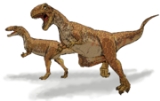
Megalosaurus is now restored as a bipedal beast—like all other theropods—about 9 meters in length. The structure of the cervical vertebrae suggests that its neck would have been very flexible. To support its weight of around one tonne, the legs were large and muscular. Like all theropods, it had three forward facing toes and a single reversed one. Although they had not reached the minuscule size of later theropods like Tyrannosaurus
Tyrannosaurus

Tyrannosaurus is a genus of theropod dinosaur. The famous species Tyrannosaurus rex , commonly abbreviated to T. rex, is a fixture in popular culture around the world....
, the fore limbs of Megalosaurus were small and probably had three or four digits.

Living in what is now Europe, during the Jurassic Period (181 to 169 million years ago),
Megalosaurus may have hunted stegosaurs
Stegosauria

Known colloquially as stegosaurs, the Stegosauria are a group of Herbivore dinosaurs of the Jurassic and Early Cretaceous Period , being found mostly in the Northern Hemisphere, predominantly in what is now North America and China....
 and sauropods. Repeated descriptions of
Megalosaurus hunting Iguanodon
Iguanodon

Iguanodon is a genus of ornithopod dinosaur that lived roughly halfway between the first of the swift bipedalism hypsilophodontids and the ornithopods' culmination in the hadrosaurid dinosaurs....
(another of the earliest dinosaurs named) through the forests that then covered the continent are probably inaccurate, because Iguanodon skeletons are found in much younger Early Cretaceous
Cretaceous

The Cretaceous , usually abbreviated K for its German translation Kreide, is a geologic period from circa to million years ago . In the geologic timescale, the Cretaceous follows on the Jurassic period and is followed by the Paleogene period....
 formations. No fossils assignable to
Megalosaurus have been discovered in Africa
Africa

Africa is the world's second-largest and second most-populous continent, after Asia. At about 30.2 million km? including adjacent islands, it covers 6% of the Earth's total surface area and 20.4% of the total land area....
, contrary to some outdated dinosaur books.

Although
Megalosaurus was a powerful carnivore and could probably have attacked even the largest sauropods, it is also likely that it gained some of its food by scavenging. That is not to detract from its prowess as a hunter (Tyrannosaurus probably did much the same). Efficiency was necessary to feed such a large body.

There is a good descriptive display of
Megalosaurus and of the history of discovery, in the Oxford University Museum of Natural History
Oxford University Museum of Natural History

The Oxford University Museum of Natural History, sometimes known simply as the Oxford University Museum, is a museum displaying many of the University of Oxford natural history specimens, located on Parks Road in Oxford, England....
.

Inaccurate attributions

At one time,
Megalosaurus was a 'wastebasket genus', used to classify many different kinds of large theropods. Dilophosaurus
Dilophosaurus

Dilophosaurus was a theropod dinosaur from the Early Jurassic Period . The name Dilophosaurus has appeared several times in popular culture, such as in the 1993 film Jurassic Park ....
, Eustreptospondylus
Eustreptospondylus

Eustreptospondylus was a genus of megalosaurid dinosaurs from the Callovian stage of the Middle Jurassic period in southern England, at a time when Europe was a series of scattered islands ....
, and Metriacanthosaurus
Metriacanthosaurus

Metriacanthosaurus is a genus of Sinraptoridae dinosaur from the mid-Jurassic Period of England. In 1923 German Paleontologist Friedrich von Huene wrote a paper on Jurassic and Cretaceous European carnivorous dinosaurs....
were all initially believed to be species of Megalosaurus. In recent years, the genus has been subject to extensive reconsideration and most of the extraneous species have been removed.

London   Crystal Palace   Victorian Dinosaurs 1

In popular media


Megalosaurus has the distinction of being the first dinosaur to appear in any popular media. Charles Dickens
Charles Dickens

Charles John Huffam Dickens, Royal Society of Arts , pen-name "Boz", was the most popular English people novelist of the Victorian era, as well as a vigorous Reform movement....
's novel
Bleak House
Bleak House

Bleak House is the ninth novel by Charles Dickens, published in twenty monthly installments between March 1852 and September 1853. It is held to be one of Dickens's finest and most complete novels, containing one of the most vast, complex and engaging arrays of minor characters and sub-plots in his entire canon....
begins with a description of fog, whose primordial character is emphasized by mention of Megalosaurus. It has made a variety of other appearances as well. A Megalosaurus was one of the main dinosaurs featured in John Brosnan
John Brosnan

John Raymond Brosnan was an Australian writer of both fiction and non-fiction works based around the fantasy and science fiction genres. He was born in Perth, Western Australia, and died in South Harrow, London, from acute pancreatitis....
's 1984 novel,
Carnosaur
Carnosaur (novel)

Carnosaur is a horror novel written by Australian author John Brosnan, under the pseudonym of Harry Adam Knight. A Carnosaur was made in 1993 by Adam Simon....
though it was not featured in its film adaptation
Carnosaur (film)

Carnosaur is a 1993 in film horror film starring Diane Ladd as a mad scientist who plans to recreate dinosaurs and destroy humanity. The movie claims to be based on a Carnosaur by Harry Adam Knight that was released in 1984, however it bears little resemblance to the novel....
. In the TV Show
Dinosaurs
Dinosaurs (TV series)

Dinosaurs is an American television sitcom that was originally broadcast on American Broadcasting Company from April 26, 1991 to July 20, 1994....
, Earl Sinclair, the father, is a Megalosaurus. It also appears in the Doctor Who
Doctor Who

Doctor Who is a British Science fiction on television programme produced by the BBC. The programme depicts the adventures of a mysterious alien Time travel known as "Doctor " who travels in his space and time-ship, the TARDIS, which normally appears from the exterior to be a blue 1950s police box....
 book, "The Last Dodo" by Jacqueline Rayner
Jacqueline Rayner

Jacqueline Rayner is a best selling United Kingdom author, best known for her work with the licensed fiction based on the long-running United Kingdom science fiction on television series Doctor Who....
.

Gallery