


Turkish literature

Encyclopedia

Turkish literature comprises both oral compositions and written texts in the Turkish language
Turkish language
Turkish is a language spoken as a native language by over 83 million people worldwide, making it the most commonly spoken of the Turkic languages. Its speakers are located predominantly in Turkey and Northern Cyprus with smaller groups in Iraq, Greece, Bulgaria, the Republic of Macedonia, Kosovo,...
, either in its Ottoman
Ottoman Turkish language
The Ottoman Turkish language or Ottoman language is the variety of the Turkish language that was used for administrative and literary purposes in the Ottoman Empire. It borrows extensively from Arabic and Persian, and was written in a variant of the Perso-Arabic script...
form or in less exclusively literary forms, such as that spoken in the Republic of Turkey
Turkey
Turkey , known officially as the Republic of Turkey , is a Eurasian country located in Western Asia and in East Thrace in Southeastern Europe...
today. The Ottoman Turkish language, which forms the basis of much of the written corpus, was influenced by Persian
Persian language
Persian is an Iranian language within the Indo-Iranian branch of the Indo-European languages. It is primarily spoken in Iran, Afghanistan, Tajikistan and countries which historically came under Persian influence...
and Arabic
Arabic language
Arabic is a name applied to the descendants of the Classical Arabic language of the 6th century AD, used most prominently in the Quran, the Islamic Holy Book...
and used the Ottoman Turkish alphabet
Ottoman Turkish alphabet
The Ottoman Turkish alphabet was the version of the Perso-Arabic alphabet that was used for the Ottoman Turkish language during the time of the Ottoman Empire and in the early years of the Republic of Turkey, until the adoption of the new Turkish alphabet, derived from the Latin script, on...
.
The history of Turkic literature spans a period of nearly 1,500 years. The oldest extant records of written Turkic
Turkic languages
The Turkic languages constitute a language family of at least thirty five languages, spoken by Turkic peoples across a vast area from Eastern Europe and the Mediterranean to Siberia and Western China, and are considered to be part of the proposed Altaic language family.Turkic languages are spoken...
are the Orhon inscriptions
Orkhon script
The Old Turkic script is the alphabet used by the Göktürk and other early Turkic Khanates from at least the 7th century to record the Old Turkic language. It was later used by the Uyghur Empire...
, found in the Orhon River valley
Orkhon Valley
Orkhon Valley Cultural Landscape sprawls along the banks of the Orkhon River in Central Mongolia, some 360 km west from the capital Ulaanbaatar. It was inscribed by UNESCO in the World Heritage List as representing evolution of nomadic pastoral traditions spanning more than two millennia...
in central Mongolia
Mongolia
Mongolia is a landlocked country in East and Central Asia. It is bordered by Russia to the north and China to the south, east and west. Although Mongolia does not share a border with Kazakhstan, its western-most point is only from Kazakhstan's eastern tip. Ulan Bator, the capital and largest...
and dating to the 8th century. Subsequent to this period, between the 9th and 11th centuries, there arose among the nomad
Nomad
Nomadic people , commonly known as itinerants in modern-day contexts, are communities of people who move from one place to another, rather than settling permanently in one location. There are an estimated 30-40 million nomads in the world. Many cultures have traditionally been nomadic, but...
ic Turkic peoples
Turkic peoples
The Turkic peoples are peoples residing in northern, central and western Asia, southern Siberia and northwestern China and parts of eastern Europe. They speak languages belonging to the Turkic language family. They share, to varying degrees, certain cultural traits and historical backgrounds...
of Central Asia
Central Asia
Central Asia is a core region of the Asian continent from the Caspian Sea in the west, China in the east, Afghanistan in the south, and Russia in the north...
a tradition of oral
Oral literature
Oral literature corresponds in the sphere of the spoken word to literature as literature operates in the domain of the written word. It thus forms a generally more fundamental component of culture, but operates in many ways as one might expect literature to do...
epics
Epic poetry
An epic is a lengthy narrative poem, ordinarily concerning a serious subject containing details of heroic deeds and events significant to a culture or nation. Oral poetry may qualify as an epic, and Albert Lord and Milman Parry have argued that classical epics were fundamentally an oral poetic form...
, such as the Book of Dede Korkut
Book of Dede Korkut
The Book of Dede Korkut, also spelled as Dada Gorgud, Dede Qorqut or Korkut-ata , is the most famous epic stories of the Oghuz Turks The stories carry morals and values significant to the social lifestyle of the nomadic Turks and their pre-Islamic beliefs...
of the Oghuz Turks
Oghuz Turks
The Turkomen also known as Oghuz Turks were a historical Turkic tribal confederation in Central Asia during the early medieval Turkic expansion....
—the linguistic and cultural ancestors of the modern Turkish people
Turkish people
Turkish people, also known as the "Turks" , are an ethnic group primarily living in Turkey and in the former lands of the Ottoman Empire where Turkish minorities had been established in Bulgaria, Cyprus, Bosnia and Herzegovina, Georgia, Greece, Kosovo, Macedonia, and Romania...
—and the Manas epic of the Kyrgyz people.
Beginning with the victory of the Seljuks
Seljuq dynasty
The Seljuq ; were a Turco-Persian Sunni Muslim dynasty that ruled parts of Central Asia and the Middle East from the 11th to 14th centuries...
at the Battle of Manzikert
Battle of Manzikert
The Battle of Manzikert , was fought between the Byzantine Empire and Seljuq Turks led by Alp Arslan on August 26, 1071 near Manzikert...
in the late 11th century, the Oghuz Turks began to settle in Anatolia
Anatolia
Anatolia is a geographic and historical term denoting the westernmost protrusion of Asia, comprising the majority of the Republic of Turkey...
, and in addition to the earlier oral traditions there arose a written literary tradition issuing largely—in terms of themes, genres, and styles—from Arabic
Arabic literature
Arabic literature is the writing produced, both prose and poetry, by writers in the Arabic language. The Arabic word used for literature is adab which is derived from a meaning of etiquette, and implies politeness, culture and enrichment....
and Persian literature
Persian literature
Persian literature spans two-and-a-half millennia, though much of the pre-Islamic material has been lost. Its sources have been within historical Persia including present-day Iran as well as regions of Central Asia where the Persian language has historically been the national language...
. For the next 900 years, until shortly before the fall of the Ottoman Empire
Ottoman Empire
The Ottoman EmpireIt was usually referred to as the "Ottoman Empire", the "Turkish Empire", the "Ottoman Caliphate" or more commonly "Turkey" by its contemporaries...
in 1922, the oral and written traditions would remain largely separate from one another. With the founding of the Republic of Turkey
Turkey
Turkey , known officially as the Republic of Turkey , is a Eurasian country located in Western Asia and in East Thrace in Southeastern Europe...
in 1923, the two traditions came together for the first time.
The two traditions of Turkish literature
Throughout most of its history, Turkish literature has been rather sharply divided into two rather different traditions, neither of which exercised much influence upon the other until the 19th century. The first of these two traditions is Turkish folk literature, and the second is Turkish written literature.For most of the history of Turkish literature, the salient difference between the folk and the written traditions has been the variety of language employed. The folk tradition, by and large, was oral and remained free of the influence of Persian and Arabic literature, and consequently of those literatures' respective languages. In folk poetry—which is by far the tradition's dominant genre
Genre
Genre , Greek: genos, γένος) is the term for any category of literature or other forms of art or culture, e.g. music, and in general, any type of discourse, whether written or spoken, audial or visual, based on some set of stylistic criteria. Genres are formed by conventions that change over time...
—this basic fact led to two major consequences in terms of poetic style:
- the poetic metersMeter (poetry)In poetry, metre is the basic rhythmic structure of a verse or lines in verse. Many traditional verse forms prescribe a specific verse metre, or a certain set of metres alternating in a particular order. The study of metres and forms of versification is known as prosody...
employed in the folk poetic tradition were different, being quantitative (i.e., syllabicSyllabic verseSyllabic verse is a poetic form having a fixed number of syllables per line regardless of the number of stresses that are present. It is common in languages that are syllable-timed, such as Japanese or modern French or Finnish — as opposed to stress-timed languages such as English, in which...
) verse, as opposed to the qualitative verse employed in the written poetic tradition; - the basic structural unit of folk poetry became the quatrainQuatrainA quatrain is a stanza, or a complete poem, consisting of four lines of verse. Existing in various forms, the quatrain appears in poems from the poetic traditions of various ancient civilizations including Ancient Greece, Ancient Rome, and China; and, continues into the 21st century, where it is...
(Turkish: dörtlük) rather than the coupletCoupletA couplet is a pair of lines of meter in poetry. It usually consists of two lines that rhyme and have the same meter.While traditionally couplets rhyme, not all do. A poem may use white space to mark out couplets if they do not rhyme. Couplets with a meter of iambic pentameter are called heroic...
s (Turkish: beyit) more commonly employed in written poetry.
Furthermore, Turkish folk poetry has always had an intimate connection with song
Song
In music, a song is a composition for voice or voices, performed by singing.A song may be accompanied by musical instruments, or it may be unaccompanied, as in the case of a cappella songs...
—most of the poetry was, in fact, expressly composed so as to be sung—and so became to a great extent inseparable from the tradition of Turkish folk music
Turkish folk music
Turkish folk music combines the distinct cultural values of all civilisations that have lived in Anatolia and the Ottoman territories in Europe and Asia...
.
In contrast to the tradition of Turkish folk literature, Turkish written literature—prior to the founding
Single-Party Period of Republic of Turkey
The single-party period of the Republic of Turkey begins with the Republican People's Party being the only party between 1925 and 1945. It ends with the establishment of National Development Party . End of single party period marked with Republican People's Party leaving the majority to Democratic...
of the Republic of Turkey in 1923—tended to embrace the influence of Persian and Arabic literature. To some extent, this can be seen as far back as the Seljuk
Sultanate of Rûm
The Sultanate of Rum , also known as the Anatolian Seljuk State , was a Turkic state centered in in Anatolia, with capitals first at İznik and then at Konya. Since the court of the sultanate was highly mobile, cities like Kayseri and Sivas also functioned at times as capitals...
period in the late 11th to early 14th centuries, where official business was conducted in the Persian language, rather than in Turkish, and where a court poet such as Dehhanî—who served under the 13th century sultan
Sultan
Sultan is a title with several historical meanings. Originally, it was an Arabic language abstract noun meaning "strength", "authority", "rulership", and "dictatorship", derived from the masdar سلطة , meaning "authority" or "power". Later, it came to be used as the title of certain rulers who...
Ala ad-Din Kay Qubadh I—wrote in a language highly inflected with Persian.
When the Ottoman Empire arose early in the 14th century, in northwestern Anatolia, it continued this tradition. The standard poetic forms—for poetry was as much the dominant genre in the written tradition as in the folk tradition—were derived either directly from the Persian literary tradition (the gazel
Ghazal
The ghazal is a poetic form consisting of rhyming couplets and a refrain, with each line sharing the same meter. A ghazal may be understood as a poetic expression of both the pain of loss or separation and the beauty of love in spite of that pain. The form is ancient, originating in 6th century...
غزل; the mesnevî
Masnavi (poetic form)
Masnavi, or mathnawī, is the name of a poem written in rhyming couplets, or more specifically, “a poem based on independent, internally rhyming lines”. Most mathnawī followed a meter of eleven, or occasionally ten, syllables, but had no limit in their length...
مسنوى), or indirectly through Persian from the Arabic (the kasîde
Qasida
The qaṣīdaᵗ , in Arabic: قصيدة, plural qasā'id, قــصــائـد; in Persian: قصیده , is a form of lyric poetry that originated in preIslamic Arabia...
قصيده). However, the decision to adopt these poetic forms wholesale led to two important further consequences:
- the poetic meters (Turkish: aruz) of Persian poetry were adopted;
- Persian- and Arabic-based words were brought into the Turkish language in great numbers, as Turkish words rarely worked well within the system of Persian poetic meter.
Out of this confluence of choices, the Ottoman Turkish language—which was always highly distinct from standard Turkish—was effectively born. This style of writing under Persian and Arabic influence came to be known as "Divan literature" (Turkish: divan edebiyatı), dîvân (ديوان) being the Ottoman Turkish word referring to the collected works of a poet.
Just as Turkish folk poetry was intimately bound up with Turkish folk music, so did Ottoman Divan poetry develop a strong connection with Turkish classical music
Ottoman classical music
Ottoman classical music developed in Istanbul and major Ottoman towns from Skopje to Cairo, from Tabriz to Morocco through the palace, mosques, and sufi lodges of the Ottoman Empire. Above all a vocal music, Ottoman music traditionally accompanies a solo singer with a small instrumental ensemble...
, with the poems of the Divan poets often being taken up to serve as song lyrics.
Folk literature
Turkish folk literature is an oral traditionOral tradition
Oral tradition and oral lore is cultural material and traditions transmitted orally from one generation to another. The messages or testimony are verbally transmitted in speech or song and may take the form, for example, of folktales, sayings, ballads, songs, or chants...
deeply rooted, in its form, in Central Asian nomadic traditions. However, in its themes, Turkish folk literature reflects the problems peculiar to a settling (or settled) people who have abandoned the nomadic lifestyle. One example of this is the series of folktales
Folklore
Folklore consists of legends, music, oral history, proverbs, jokes, popular beliefs, fairy tales and customs that are the traditions of a culture, subculture, or group. It is also the set of practices through which those expressive genres are shared. The study of folklore is sometimes called...
surrounding the figure of Keloğlan, a young boy beset with the difficulties of finding a wife, helping his mother to keep the family house intact, and dealing with the problems caused by his neighbors. Another example is the rather mysterious figure of Nasreddin
Nasreddin
Nasreddin was a Seljuq satirical Sufi figure, sometimes believed to have lived during the Middle Ages and considered a populist philosopher and wise man, remembered for his funny stories and anecdotes. He appears in thousands of stories, sometimes witty, sometimes wise, but often, too, a fool or...
, a trickster
Trickster
In mythology, and in the study of folklore and religion, a trickster is a god, goddess, spirit, man, woman, or anthropomorphic animal who plays tricks or otherwise disobeys normal rules and conventional behavior. It is suggested by Hansen that the term "Trickster" was probably first used in this...
who often plays jokes, of a sort, on his neighbors.
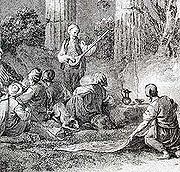
Muslim
A Muslim, also spelled Moslem, is an adherent of Islam, a monotheistic, Abrahamic religion based on the Quran, which Muslims consider the verbatim word of God as revealed to prophet Muhammad. "Muslim" is the Arabic term for "submitter" .Muslims believe that God is one and incomparable...
imam
Imam
An imam is an Islamic leadership position, often the worship leader of a mosque and the Muslim community. Similar to spiritual leaders, the imam is the one who leads Islamic worship services. More often, the community turns to the mosque imam if they have a religious question...
. The Turkic peoples had first become an Islam
Islam
Islam . The most common are and . : Arabic pronunciation varies regionally. The first vowel ranges from ~~. The second vowel ranges from ~~~...
ic people sometime around the 9th or 10th century, as is evidenced from the clear Islamic influence on the 11th century Karakhanid
Kara-Khanid Khanate
The Kara-Khanid Khanate was a confederation of Turkic tribes ruled by a dynasty known in literature as the Karakhanids or Ilek Khanids, . Both dynastic names represent titles with Kara Kağan being the most important Turkish title up till the end of the dynasty.The Khanate ruled Transoxania in...
work the Kutadgu Bilig
Kutadgu Bilig
The Kutadgu Bilig, or Qutadğu Bilig , is a Karakhanid work from the 11th century written by an Uyghur author of Balasagun for the prince of Kashgar. Translated, the title means something like "The Wisdom which brings Happiness" or "The Wisdom that Conduces to Royal Glory or Fortune" , but has...
("Wisdom of Royal Glory"), written by Yusuf Has Hajib
Yusuf Has Hajib
Yusuf Balasaghuni or Yusuf Khas Hajib Balasaghuni was an 11th century Uyghur scribe from the city of Balasaghun, the capital of the Karakhanid Empire. He wrote the Kutadgu Bilig and most of what is known about him comes from his own writings in this work.Balasagun was located near present-day...
. The religion henceforth came to exercise an enormous influence on Turkish society and literature, particularly the heavily mystically oriented
Mysticism
Mysticism is the knowledge of, and especially the personal experience of, states of consciousness, i.e. levels of being, beyond normal human perception, including experience and even communion with a supreme being.-Classical origins:...
Sufi
Sufism
Sufism or ' is defined by its adherents as the inner, mystical dimension of Islam. A practitioner of this tradition is generally known as a '...
and Shi'a
Shi'a Islam
Shia Islam is the second largest denomination of Islam. The followers of Shia Islam are called Shi'ites or Shias. "Shia" is the short form of the historic phrase Shīʻatu ʻAlī , meaning "followers of Ali", "faction of Ali", or "party of Ali".Like other schools of thought in Islam, Shia Islam is...
varieties of Islam. The Sufi influence, for instance, can be seen clearly not only in the tales concerning Nasreddin but also in the works of Yunus Emre
Yunus Emre
Yunus Emre was a Turkish poet and Sufi mystic. He has exercised immense influence on Turkish literature, from his own day until the present...
, a towering figure in Turkish literature and a poet who lived at the end of the 13th and beginning of the 14th century, probably in the Karamanid state in south-central Anatolia. The Shi'a influence, on the other hand, can be seen extensively in the tradition of the aşıks, or ozans, who are roughly akin to medieval European minstrel
Minstrel
A minstrel was a medieval European bard who performed songs whose lyrics told stories of distant places or of existing or imaginary historical events. Although minstrels created their own tales, often they would memorize and embellish the works of others. Frequently they were retained by royalty...
s and who traditionally have had a strong connection with the Alevi
Alevi
The Alevi are a religious and cultural community, primarily in Turkey, constituting probably more than 15 million people....
faith, which can be seen as something of a homegrown Turkish variety of Shi'a Islam. It is, however, important to note that in Turkish culture, such a neat division into Sufi and Shi'a is scarcely possible: for instance, Yunus Emre is considered by some to have been an Alevi, while the entire Turkish aşık/ozan tradition is permeated with the thought of the Bektashi
Bektashi
Bektashi Order or Bektashism is an Islamic Sufi order founded in the 13th century by the Persian saint Haji Bektash Veli. In addition to the spiritual teachings of Haji Bektash Veli the order was significantly influenced during its formative period by both the Hurufis as well as the...
Sufi order
Tariqah
A tariqa is an Islamic religious order. In Sufism one starts with Islamic law, the exoteric or mundane practice of Islam and then is initiated onto the mystical path of a tariqa. Through spiritual practices and guidance of a tariqa the aspirant seeks ḥaqīqah - ultimate truth.-Meaning:A tariqa is a...
, which is itself a blending of Shi'a and Sufi concepts. The word aşık (literally, "lover") is in fact the term used for first-level members of the Bektashi order.
Because the Turkish folk literature tradition extends in a more or less unbroken line from about the 10th or 11th century to today, it is perhaps best to consider the tradition from the perspective of genre. There are three basic genres in the tradition: epic; folk poetry; and folklore.
The epic tradition
The Turkish epic has its roots in the Central Asian epic tradition that gave rise to the Book of Dede KorkutBook of Dede Korkut
The Book of Dede Korkut, also spelled as Dada Gorgud, Dede Qorqut or Korkut-ata , is the most famous epic stories of the Oghuz Turks The stories carry morals and values significant to the social lifestyle of the nomadic Turks and their pre-Islamic beliefs...
; written in Azeri - and recognizably similar to modern Turkish - the form developed from the oral traditions of the Oghuz Turks
Oghuz Turks
The Turkomen also known as Oghuz Turks were a historical Turkic tribal confederation in Central Asia during the early medieval Turkic expansion....
(a branch of the Turkic peoples which migrated towards western Asia
Southwest Asia
Western Asia, West Asia, Southwest Asia or Southwestern Asia are terms that describe the westernmost portion of Asia. The terms are partly coterminous with the Middle East, which describes a geographical position in relation to Western Europe rather than its location within Asia...
and eastern Europe
Eastern Europe
Eastern Europe is the eastern part of Europe. The term has widely disparate geopolitical, geographical, cultural and socioeconomic readings, which makes it highly context-dependent and even volatile, and there are "almost as many definitions of Eastern Europe as there are scholars of the region"...
through Transoxiana
Transoxiana
Transoxiana is the ancient name used for the portion of Central Asia corresponding approximately with modern-day Uzbekistan, Tajikistan, southern Kyrgystan and southwest Kazakhstan. Geographically, it is the region between the Amu Darya and Syr Darya rivers...
, beginning in the 9th century). The Book of Dede Korkut endured in the oral tradition of the Oghuz Turks after settling in Anatolia.. Alpamysh is an earlier epic, translated into English and available online.
The Book of Dede Korkut was the primary element of the Azerbaijani-Turkish epic tradition in the Caucasus and Anatolia for several centuries. Concurrent to the Book of Dede Korkut was the so-called Epic of Köroğlu
Epic of Köroglu
The Epic of Köroğlu is a heroic legend prominent in the oral traditions of the Turkic peoples. The legend typically describes a hero who seeks to avenge a wrong. It was often put to music and played at sporting events as an inspiration to the competing athletes.The legend first began to take shape...
, which concerns the adventures of Rüşen Ali ("Köroğlu", or "son of the blind man") as he exacted revenge for the blinding of his father. The origins of this epic are somewhat more mysterious than those of the Book of Dede Korkut: many believe it to have arisen in Anatolia sometime between the 15th and 17th centuries; more reliable testimony, though, seems to indicate that the story is nearly as old as that of the Book of Dede Korkut, dating from around the dawn of the 11th century. Complicating matters somewhat is the fact that Köroğlu is also the name of a poet of the aşık/ozan tradition.
The epic tradition in modern Turkish literature may be seen in the Epic of Shaykh Bedreddin (Şeyh Bedreddin Destanı), published in 1936 by the poet Nâzım Hikmet Ran
Nazim Hikmet
Nâzım Hikmet Ran , commonly known as Nâzım Hikmet , was a Turkish poet, playwright, novelist and memoirist. He was acclaimed for the "lyrical flow of his statements"...
(1901–1963). This long poem — which concerns an Anatolian shaykh's rebellion against the Ottoman Sultan
Sultan
Sultan is a title with several historical meanings. Originally, it was an Arabic language abstract noun meaning "strength", "authority", "rulership", and "dictatorship", derived from the masdar سلطة , meaning "authority" or "power". Later, it came to be used as the title of certain rulers who...
Mehmed I
Mehmed I
Mehmed I Çelebi was a Sultan of the Ottoman Empire from 1413 to 1421. He was one of the sons of Bayezid I and Valide Sultan Devlet Hatun Mehmed I Çelebi (Ottoman: چلبی محمد, Mehmed I or Mehmed Çelebi) (1382, Bursa – May 26, 1421, Edirne, Ottoman Empire) was a Sultan of the Ottoman Empire...
— is a modern epic, yet draws upon the same independent-minded traditions of the Anatolian people as depicted in the Epic of Köroğlu. Many of the works of the 20th-century novelist Yaşar Kemal
Yasar Kemal
Yaşar Kemal, is a Turkish writer. He is one of Turkey's leading writers. He has long been a candidate for the Nobel Prize in Literature, on the strength of Memed, My Hawk....
(1923– ), such as the 1955 novel Memed, My Hawk
Memed, My Hawk
Memed, My Hawk is a 1955 novel by Yaşar Kemal. It was Kemal's debut novel and is the first novel in his İnce Memed tetralogy. The novel won the Varlik prize for that year and earned Kemal a national reputation...
(İnce Memed), can be considered modern prose
Prose
Prose is the most typical form of written language, applying ordinary grammatical structure and natural flow of speech rather than rhythmic structure...
epics.
Folk poetry
The folk poetry tradition in Turkish literature, as indicated above, was strongly influenced by the Islamic Sufi and Shi'a traditions. Furthermore, as partly evidenced by the prevalence of the still existent aşık/ozan tradition, the dominant element in Turkish folk poetry has always been song. The development of folk poetry in Turkish—which began to emerge in the 13th century with such important writers as Yunus Emre, Sultan Veled, and Şeyyâd Hamza—was given a great boost when, on 13 May 1277, Karamanoğlu Mehmet Bey declared Turkish the official state language of Anatolia's powerful Karamanid state; subsequently, many of the tradition's greatest poets would continue to emerge from this region.There are, broadly speaking, two traditions of Turkish folk poetry:
- the aşık/ozan tradition, which—although much influenced by religion, as mentioned above—was for the most part a secular tradition;
- the explicitly religious tradition, which emerged from the gathering places (tekkes) of the Sufi religious orders and Shi'a groups.
Much of the poetry and song of the aşık/ozan tradition, being almost exclusively oral until the 19th century, remains anonymous. There are, however, a few well-known aşıks from before that time whose names have survived together with their works: the aforementioned Köroğlu (16th century); Karacaoğlan (1606?–1689?), who may be the best-known of the pre-19th century aşıks; Dadaloğlu (1785?–1868?), who was one of the last of the great aşıks before the tradition began to dwindle somewhat in the late 19th century; and several others. The aşıks were essentially minstrels who travelled through Anatolia performing their songs on the bağlama
Baglama
thumb|180px|Cura and bağlamaThe bağlama is a stringed musical instrument shared by various cultures in the Eastern Mediterranean, Near East, and Central Asia....
, a mandolin
Mandolin
A mandolin is a musical instrument in the lute family . It descends from the mandore, a soprano member of the lute family. The mandolin soundboard comes in many shapes—but generally round or teardrop-shaped, sometimes with scrolls or other projections. A mandolin may have f-holes, or a single...
-like instrument whose paired strings are considered to have a symbolic religious significance in Alevi/Bektashi culture. Despite the decline of the aşık/ozan tradition in the 19th century, it experienced a significant revival in the 20th century thanks to such outstanding figures as Aşık Veysel Şatıroğlu
Asik Veysel Satiroglu
Âşık Veysel Şatıroğlu , also known as just Aşık Veysel, was a Turkish alevi minstrel and highly regarded poet of the Turkish folk literature. He was born in the Sivrialan village of the Şarkışla district, Sivas, on October 25, 1894 and died on March 21, 1973...
(1894–1973), Aşık Mahzuni Şerif
Asik Mahzuni Serif
Aşık Mahzuni Şerif , also known as Mahsuni Şerif, was a folk musician, ashik, composer, poet, and author from Turkey.Mahzuni Şerif was born in Berçenek village of Afşin, Kahramanmaraş, Turkey in 1940...
(1938–2002), Neşet Ertaş (1943– ), and many others.
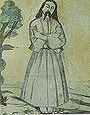
Hymn
A hymn is a type of song, usually religious, specifically written for the purpose of praise, adoration or prayer, and typically addressed to a deity or deities, or to a prominent figure or personification...
s (Turkish ilahi). One major difference from the aşık/ozan tradition, however, is that—from the very beginning—the poems of the tekke tradition were written down. This was because they were produced by revered religious figures in the literate environment of the tekke, as opposed to the milieu of the aşık/ozan tradition, where the majority could not read or write. The major figures in the tradition of tekke literature are: Yunus Emre (1240?–1320?), who is one of the most important figures in all of Turkish literature; Süleyman Çelebi (?–1422), who wrote a highly popular long poem called Vesîletü'n-Necât (وسيلة النجاة "The Means of Salvation", but more commonly known as the Mevlid), concerning the birth
Mawlid
Mawlid or sometimes ميلاد , mīlād is a term used to refer to the observance of the birthday of the Islamic prophet Muhammad which occurs in Rabi' al-awwal,...
of the Islamic prophet
Prophet
In religion, a prophet, from the Greek word προφήτης profitis meaning "foreteller", is an individual who is claimed to have been contacted by the supernatural or the divine, and serves as an intermediary with humanity, delivering this newfound knowledge from the supernatural entity to other people...
Muhammad
Muhammad
Muhammad |ligature]] at U+FDF4 ;Arabic pronunciation varies regionally; the first vowel ranges from ~~; the second and the last vowel: ~~~. There are dialects which have no stress. In Egypt, it is pronounced not in religious contexts...
; Kaygusuz Abdal (1397–?), who is widely considered the founder of Alevi/Bektashi literature; and Pir Sultan Abdal
Pir Sultan Abdal
Pir Sultan Abdal was a legendary Turkish Alevi poet, whose direct and clear language as well as the richness of his imagination and the beauty of his verses led him to become loved among the Turkish people. Pir Sultan Abdal reflected the social, cultural and religious life of the people; he was a...
(?–1560), whom many consider to be the pinnacle of that literature.
Folklore
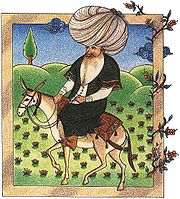
Nasreddin
Nasreddin was a Seljuq satirical Sufi figure, sometimes believed to have lived during the Middle Ages and considered a populist philosopher and wise man, remembered for his funny stories and anecdotes. He appears in thousands of stories, sometimes witty, sometimes wise, but often, too, a fool or...
(known as Nasreddin Hoca, or "teacher Nasreddin", in Turkish), who is the central character of thousands of jokes. He generally appears as a person who, though seeming somewhat stupid to those who must deal with him, actually proves to have a special wisdom all his own:
One day, Nasreddin's neighbor asked him, "Teacher, do you have any forty-year-old vinegar?"—"Yes, I do," answered Nasreddin.—"Can I have some?" asked the neighbor. "I need some to make an ointment with."—"No, you can't have any," answered Nasreddin. "If I gave my forty-year-old vinegar to whoever wanted some, I wouldn't have had it for forty years, would I?"
Similar to the Nasreddin jokes, and arising from a similar religious milieu, are the Bektashi jokes, in which the members of the Bektashi religious order—represented through a character simply named Bektaşi—are depicted as having an unusual and unorthodox wisdom, one that often challenges the values of Islam and of society.
Another popular element of Turkish folklore is the shadow theater centered around the two characters of Karagöz and Hacivat
Karagöz and Hacivat
Karagöz and Hacivat are the lead characters of the traditional Turkish shadow play, popularized during the Ottoman period. The central theme of the plays are the contrasting interaction between the two main characters...
, who both represent stock character
Stock character
A Stock character is a fictional character based on a common literary or social stereotype. Stock characters rely heavily on cultural types or names for their personality, manner of speech, and other characteristics. In their most general form, stock characters are related to literary archetypes,...
s: Karagöz—who hails from a small village—is something of a country bumpkin, while Hacivat is a more sophisticated city-dweller. Popular legend has it that the two characters are actually based on two real persons who worked either for Osman I
Osman I
Osman I or Othman I or El-Gazi Sultan Osman Ghazi, or Osman Bey or I. Osman, Osman Gazi Han), nicknamed "Kara" for his courage, was the leader of the Ottoman Turks, and the founder of the dynasty that established and ruled the Ottoman Empire...
—the founder of the Ottoman dynasty
Ottoman Dynasty
The Ottoman Dynasty ruled the Ottoman Empire from 1299 to 1922, beginning with Osman I , though the dynasty was not proclaimed until Orhan Bey declared himself sultan...
—or for his successor Orhan I
Orhan I
Orhan I or Orhan Bey was the second bey of the nascent Ottoman Empire from 1326 to 1359...
, in the construction of a palace or possibly a mosque at Bursa
Bursa, Turkey
Bursa is a city in northwestern Turkey and the seat of Bursa Province. The metropolitan area in the entire Bursa province had a population of 2.6 million as of 2010, making the city fourth most populous in Turkey. The city is equally one of the most industrialized metropolitan centers in the...
in the early 14th century. The two workers supposedly spent much of their time entertaining the other workers, and were so funny and popular that they interfered with work on the palace, and were subsequently beheaded
Decapitation
Decapitation is the separation of the head from the body. Beheading typically refers to the act of intentional decapitation, e.g., as a means of murder or execution; it may be accomplished, for example, with an axe, sword, knife, wire, or by other more sophisticated means such as a guillotine...
. Supposedly, however, their bodies then picked up their severed heads and walked away.
Ottoman literature
The two primary streams of Ottoman written literature are poetry and proseProse
Prose is the most typical form of written language, applying ordinary grammatical structure and natural flow of speech rather than rhythmic structure...
. Of the two, poetry—specifically, Divan poetry—was by far the dominant stream. Moreover, it should be noted that, until the 19th century, Ottoman prose did not contain any examples of fiction
Fiction
Fiction is the form of any narrative or informative work that deals, in part or in whole, with information or events that are not factual, but rather, imaginary—that is, invented by the author. Although fiction describes a major branch of literary work, it may also refer to theatrical,...
; that is, there were no counterparts to, for instance, the European romance
Romance (genre)
As a literary genre of high culture, romance or chivalric romance is a style of heroic prose and verse narrative that was popular in the aristocratic circles of High Medieval and Early Modern Europe. They were fantastic stories about marvel-filled adventures, often of a knight errant portrayed as...
, short story
Short story
A short story is a work of fiction that is usually written in prose, often in narrative format. This format tends to be more pointed than longer works of fiction, such as novellas and novels. Short story definitions based on length differ somewhat, even among professional writers, in part because...
, or novel
Novel
A novel is a book of long narrative in literary prose. The genre has historical roots both in the fields of the medieval and early modern romance and in the tradition of the novella. The latter supplied the present generic term in the late 18th century....
(though analogous genres did, to some extent, exist in both the Turkish folk tradition and in Divan poetry).
Divan poetry
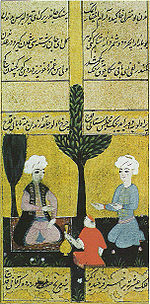
Ritual
A ritual is a set of actions, performed mainly for their symbolic value. It may be prescribed by a religion or by the traditions of a community. The term usually excludes actions which are arbitrarily chosen by the performers....
ized and symbol
Symbol
A symbol is something which represents an idea, a physical entity or a process but is distinct from it. The purpose of a symbol is to communicate meaning. For example, a red octagon may be a symbol for "STOP". On a map, a picture of a tent might represent a campsite. Numerals are symbols for...
ic art form. From the Persian poetry that largely inspired it, it inherited a wealth of symbol
Symbol
A symbol is something which represents an idea, a physical entity or a process but is distinct from it. The purpose of a symbol is to communicate meaning. For example, a red octagon may be a symbol for "STOP". On a map, a picture of a tent might represent a campsite. Numerals are symbols for...
s whose meanings and interrelationships—both of similitude (مراعات نظير mura'ât-i nazîr / تناسب
tenâsüb) and opposition (تضاد tezâd)—were more or less prescribed. Examples of prevalent symbols that, to some extent, oppose one another include, among others:
- the nightingale (بلبل bülbül) — the rose (ﮔل gül)
- the world (جهان cihan; عالم ‘âlem) — the rosegarden (ﮔﻠﺴﺘﺎن gülistan; ﮔﻠﺸﻦ gülşen)
- the ascetic (زاهد zâhid) — the dervishDervishA Dervish or Darvesh is someone treading a Sufi Muslim ascetic path or "Tariqah", known for their extreme poverty and austerity, similar to mendicant friars in Christianity or Hindu/Buddhist/Jain sadhus.-Etymology:The Persian word darvīsh is of ancient origin and descends from a Proto-Iranian...
(درويش derviş)
As the opposition of "the ascetic" and "the dervish" suggests, Divan poetry—much like Turkish folk poetry—was heavily influenced by Sufi thought. One of the primary characteristics of Divan poetry, however—as of the Persian poetry before it—was its mingling of the mystical Sufi element with a profane and even erotic element. Thus, the pairing of "the nightingale" and "the rose" simultaneously suggests two different relationships:
- the relationship between the fervent lover ("the nightingale") and the inconstant beloved ("the rose")
- the relationship between the individual Sufi practitioner (who is often characterized in Sufism as a lover) and GodAllahAllah is a word for God used in the context of Islam. In Arabic, the word means simply "God". It is used primarily by Muslims and Bahá'ís, and often, albeit not exclusively, used by Arabic-speaking Eastern Catholic Christians, Maltese Roman Catholics, Eastern Orthodox Christians, Mizrahi Jews and...
(who is considered the ultimate source and object of love)
Similarly, "the world" refers simultaneously to the physical world and to this physical world considered as the abode of sorrow and impermanence, while "the rosegarden" refers simultaneously to a literal garden and to the garden of Paradise. "The nightingale", or suffering lover, is often seen as situated—both literally and figuratively—in "the world", while "the rose", or beloved, is seen as being in "the rosegarden".
Divan poetry was composed through the constant juxtaposition of many such images within a strict metrical framework, thus allowing numerous potential meanings to emerge. A brief example is the following line of verse, or mısra (مصراع), by the 18th-century judge
Qadi
Qadi is a judge ruling in accordance with Islamic religious law appointed by the ruler of a Muslim country. Because Islam makes no distinction between religious and secular domains, qadis traditionally have jurisdiction over all legal matters involving Muslims...
and poet Hayatî Efendi:
- بر گل مى وار بو گلشن ﻋالمدﻪ خارسز
- Bir gül mü var bu gülşen-i ‘âlemde hârsız
Here, the nightingale is only implied (as being the poet/lover), while the rose, or beloved, is shown to be capable of inflicting pain with its thorns (خار hâr). The world, as a result, is seen as having both positive aspects (it is a rosegarden, and thus analogous to the garden of Paradise) and negative aspects (it is a rosegarden full of thorns, and thus different to the garden of Paradise).
As for the development of Divan poetry over the more than 500 years of its existence, that is—as the Ottomanist Walter G. Andrews points out—a study still in its infancy; clearly defined movements and periods have not yet been decided upon. Early in the history of the tradition, the Persian influence was very strong, but this was mitigated somewhat through the influence of poets such as the Azerbaijani
Azerbaijani people
The Azerbaijanis are a Turkic-speaking people living mainly in northwestern Iran and the Republic of Azerbaijan, as well as in the neighbourhood states, Georgia, Russia and formerly Armenia. Commonly referred to as Azeris or Azerbaijani Turks , they also live in a wider area from the Caucasus to...
Nesîmî
Nesîmî
‘Alī ‘Imādu d-Dīn Nasīmī , often known as Nesimi, –1417 skinned alive in Aleppo) was a 14th-century Azerbaijani or Turkmen Ḥurūfī poet. Known mostly by his pen name of Nesîmî, he composed one divan in Azerbaijani, one in Persian, and a number of poems in Arabic...
(?–1417?) and the Uyghur
Uyghur people
The Uyghur are a Turkic ethnic group living in Eastern and Central Asia. Today, Uyghurs live primarily in the Xinjiang Uyghur Autonomous Region in the People's Republic of China...
Ali Şîr Nevâî (1441–1501), both of whom offered strong arguments for the poetic status of the Turkic languages as against the much-venerated Persian. Partly as a result of such arguments, Divan poetry in its strongest period—from the 16th to the 18th centuries—came to display a unique balance of Persian and Turkish elements, until the Persian influence began to predominate again in the early 19th century.
Turkish poets,(Ottoman
Ottoman Turks
The Ottoman Turks were the Turkish-speaking population of the Ottoman Empire who formed the base of the state's military and ruling classes. Reliable information about the early history of Ottoman Turks is scarce, but they take their Turkish name, Osmanlı , from the house of Osman I The Ottoman...
and Chagatay
Chagatai people
The Chagatai are one of the Tajik peoples of Uzbekistan. The Chagatai live in the Surxondaryo Province in south-east Uzbekistan and in southern Tajikistan. They numbered 63,500 in 1924-25. Together with the Kharduri, the Chagatai are one of the ethnographic groups of Tajiks who maintain a...
), although they had been inspired and influenced by classical Persian poetry, it would be a superficial judgment to consider the former as blind imitators of the latters, as is often done. A limited vocabulary and common technique, and the same world of imagery and subject matter based mainly on Islamic sources were shared by all poets of Islamic literature.
Despite the lack of certainty regarding the stylistic movements and periods of Divan poetry, however, certain highly different styles are clear enough, and can perhaps be seen as exemplified by certain poets:

- FuzûlîFuzûlîFużūlī was the pen name of the Azerbaijani or the Bayat branch of Oghuz Turkish and Ottoman poet, writer and thinker Muhammad bin Suleyman...
(1483?–1556); a unique poet who wrote with equal skill in Ottoman Turkish, Persian, and Arabic, and who came to be as influential in Persian as in Divan poetry - BâkîBâkîBâḳî was the pen name of the Ottoman Turkish poet Mahmud Abdülbâkî...
(1526–1600); a poet of great rhetorical power and linguistic subtlety whose skill in using the pre-established tropes of the Divan tradition is quite representative of the poetry in the time of Süleyman the MagnificentSuleiman the MagnificentSuleiman I was the tenth and longest-reigning Sultan of the Ottoman Empire, from 1520 to his death in 1566. He is known in the West as Suleiman the Magnificent and in the East, as "The Lawgiver" , for his complete reconstruction of the Ottoman legal system... - Nef‘î (1570?–1635); a poet considered the master of the kasîde (a kind of panegyricPanegyricA panegyric is a formal public speech, or written verse, delivered in high praise of a person or thing, a generally highly studied and discriminating eulogy, not expected to be critical. It is derived from the Greek πανηγυρικός meaning "a speech fit for a general assembly"...
), as well as being known for his harshly satirical poems, which led to his executionCapital punishmentCapital punishment, the death penalty, or execution is the sentence of death upon a person by the state as a punishment for an offence. Crimes that can result in a death penalty are known as capital crimes or capital offences. The term capital originates from the Latin capitalis, literally... - Nâbî (1642–1712); a poet who wrote a number of socially oriented poems critical of the stagnation periodStagnation of the Ottoman EmpireThe Stagnation of the Ottoman Empire is the period following the Growth of the Ottoman Empire . During this period the empire continued to have military might. The next period would be shaped by the decline of their military power which followed the loss of huge territories...
of Ottoman history - NedîmNedîmAhmet Nedîm Efendi was the pen name of one of the most celebrated Ottoman poets. He achieved his greatest fame during the reign of Ahmed III, the so-called Tulip Era from 1718 to 1730. Both his life and his work are often seen as being representative of the relaxed attitude and European...
(1681?–1730); a revolutionary poet of the Tulip EraTulip Era in the Ottoman EmpireThe Tulip Period or Tulip Era is a period in Ottoman history from The Treaty of Passarowitz on 21 July 1718 to The Patrona Halil Rebellion on 28 September 1730...
of Ottoman history, who infused the rather élite and abstruse language of Divan poetry with numerous simpler, populist elements - Şeyh Gâlib (1757–1799); a poet of the MevlevîMevleviThe Mevlevi Order, or the Mevlevilik or Mevleviye are a Sufi order founded in Konya by the followers of Jalal ad-Din Muhammad Balkhi-Rumi, a 13th century Persian poet, Islamic jurist, and theologian. They are also known as the Whirling Dervishes due to their famous practice of whirling as a form...
Sufi orderTariqahA tariqa is an Islamic religious order. In Sufism one starts with Islamic law, the exoteric or mundane practice of Islam and then is initiated onto the mystical path of a tariqa. Through spiritual practices and guidance of a tariqa the aspirant seeks ḥaqīqah - ultimate truth.-Meaning:A tariqa is a...
whose work is considered the culmination of the highly complex so-called "Indian style" (سبك هندى sebk-i hindî)
The vast majority of Divan poetry was lyric
Lyric poetry
Lyric poetry is a genre of poetry that expresses personal and emotional feelings. In the ancient world, lyric poems were those which were sung to the lyre. Lyric poems do not have to rhyme, and today do not need to be set to music or a beat...
in nature: either gazels (which make up the greatest part of the repertoire of the tradition), or kasîdes. There were, however, other common genres, most particularly the mesnevî, a kind of verse romance and thus a variety of narrative poetry
Narrative poetry
Narrative poetry is poetry that has a plot. The poems that make up this genre may be short or long, and the story it relates to may be simple or complex. It is usually nondramatic, with objective regular scheme and meter. Narrative poems include epics, ballads, idylls and lays.Some narrative...
; the two most notable examples of this form are the Leylî vü Mecnun (ليلى و مجنون) of Fuzûlî and the Hüsn ü Aşk (حسن و عشق; "Beauty and Love") of Şeyh Gâlib.
Early Ottoman prose
Until the 19th century, Ottoman prose never managed to develop to the extent that contemporary Divan poetry did. A large part of the reason for this was that much prose was expected to adhere to the rules of sec (سجع, also transliterated as seci), or rhymed proseRhymed prose
Rhymed prose is a literary form and literary genre, written in unmetrical rhymes. This form has been known in many different cultures. In some cases the rhymed prose is a distinctive, well-defined style of writing...
, a type of writing descended from the Arabic saj'
Saj'
Saj‘, is a form of rhymed prose in Arabic literature. It is named so because of its evenness or monotony, or from a fancied resemblance between its rhythm and the cooing of a dove. It is a highly artificial style of prose, characterized by a kind of rhythm as well as rhyme...
and which prescribed that between each adjective and noun in a sentence, there must be a rhyme
Rhyme
A rhyme is a repetition of similar sounds in two or more words and is most often used in poetry and songs. The word "rhyme" may also refer to a short poem, such as a rhyming couplet or other brief rhyming poem such as nursery rhymes.-Etymology:...
.
Nevertheless, there was a tradition of prose in the literature of the time. This tradition was exclusively nonfictional
Non-fiction
Non-fiction is the form of any narrative, account, or other communicative work whose assertions and descriptions are understood to be fact...
in nature—the fiction
Fiction
Fiction is the form of any narrative or informative work that deals, in part or in whole, with information or events that are not factual, but rather, imaginary—that is, invented by the author. Although fiction describes a major branch of literary work, it may also refer to theatrical,...
tradition was limited to narrative poetry. A number of such nonfictional prose genres developed:
- the
History
History is the discovery, collection, organization, and presentation of information about past events. History can also mean the period of time after writing was invented. Scholars who write about history are called historians...
, a tradition in which there are many notable writers, including the 15th-century historian
Historian
A historian is a person who studies and writes about the past and is regarded as an authority on it. Historians are concerned with the continuous, methodical narrative and research of past events as relating to the human race; as well as the study of all history in time. If the individual is...
Aşıkpaşazâde and the 17th-century historians Kâtib Çelebi and Naîmâ
Seyahatname
Seyâhatnâme is a Persian term, also used in Ottoman Turkish, which means "book of travels", denoting a literary form and tradition whose examples can be found throughout centuries in the Middle Ages around the Islamic world, starting with the Arab travellers of the Umayyad period.An outstanding...
(سياحت نامه), or travelogue
Travel literature
Travel literature is travel writing of literary value. Travel literature typically records the experiences of an author touring a place for the pleasure of travel. An individual work is sometimes called a travelogue or itinerary. Travel literature may be cross-cultural or transnational in focus, or...
, of which the outstanding example is the 17th-century Seyahâtnâme
Seyahatname
Seyâhatnâme is a Persian term, also used in Ottoman Turkish, which means "book of travels", denoting a literary form and tradition whose examples can be found throughout centuries in the Middle Ages around the Islamic world, starting with the Arab travellers of the Umayyad period.An outstanding...
of Evliya Çelebi
Evliya Çelebi
Evliya Çelebi was an Ottoman traveler who journeyed through the territory of the Ottoman Empire and neighboring lands over a period of forty years.- Life :...
Sefâretnâme
Sefâretnâme , literally the book of embassy, was a genre in the Turkish literature which was closely related to seyahatname , but was specific to the recounting of journeys and experiences of an Ottoman ambassador in a foreign, usually European, land and capital...
(سفارت نامه), a related genre specific to the journeys and experiences of an Ottoman ambassador
Ambassador
An ambassador is the highest ranking diplomat who represents a nation and is usually accredited to a foreign sovereign or government, or to an international organization....
, and which is best exemplified by the 1718–1720 Paris Sefâretnâmesi of Yirmisekiz Mehmed Çelebi
Yirmisekiz Mehmed Çelebi
Yirmisekiz Mehmed Çelebi Efendi, also Mehmed Efendi or Mehemet Effendi, was a Georgian Ottoman statesman who was delegated as ambassador by the Sultan Ahmed III to Louis XV's France in 1720. He is remembered for his account of his embassy mission .Yirmisekiz Mehmed Çelebi was born in Edirne. His...
, ambassador to the court of Louis XV of France
Louis XV of France
Louis XV was a Bourbon monarch who ruled as King of France and of Navarre from 1 September 1715 until his death. He succeeded his great-grandfather at the age of five, his first cousin Philippe II, Duke of Orléans, served as Regent of the kingdom until Louis's majority in 1723...
Siyasatnama
Siyāsatnāma , also known as Siyar al-muluk , is the most famous work by Nizam al-Mulk, the founder of Nizamiyyah schools in medieval Persia and vizier to the Seljuq sultans Alp Arslan and Malik Shah...
, written in Persian by Nizam al-Mulk
Nizam al-Mulk
Abu Ali al-Hasan al-Tusi Nizam al-Mulk, better known as Khwaja Nizam al-Mulk Tusi ; born in 1018 – 14 October 1092) was a Persian scholar and vizier of the Seljuq Empire...
, vizier
Vizier
A vizier or in Arabic script ; ; sometimes spelled vazir, vizir, vasir, wazir, vesir, or vezir) is a high-ranking political advisor or minister in a Muslim government....
to the Seljuk rulers Alp Arslan
Alp Arslan
Alp Arslan was the third sultan of the Seljuq dynasty and great-grandson of Seljuk, the eponymous founder of the dynasty...
and Malik Shah I
Malik Shah I
Jalāl al-Dawlah Malik-shāh was born in 1055, succeeded Alp Arslan as the Seljuq Sultan in 1072, and reigned until his death in 1092....
Biography
A biography is a detailed description or account of someone's life. More than a list of basic facts , biography also portrays the subject's experience of those events...
of notable figures, some of the most notable of which were the 16th-century tezkiretü'ş-şuarâs (تذكرة الشعرا), or biographies of poets, by Latîfî and Aşık Çelebi
Belles-lettres
Belles-lettres or belles lettres is a term that is used to describe a category of writing. A writer of belles-lettres is a belletrist. However, the boundaries of that category vary in different usages....
Debate
Debate or debating is a method of interactive and representational argument. Debate is a broader form of argument than logical argument, which only examines consistency from axiom, and factual argument, which only examines what is or isn't the case or rhetoric which is a technique of persuasion...
s of either a religious or a philosophical nature
The 19th century and Western influence
By the early 19th century, the Ottoman Empire had become moribundSick man of Europe
"Sick man of Europe" is a nickname that has been used to describe a European country experiencing a time of economic difficulty and/or impoverishment...
. Attempts to right this situation had begun during the reign of Sultan Selim III
Selim III
Selim III was the reform-minded Sultan of the Ottoman Empire from 1789 to 1807. The Janissaries eventually deposed and imprisoned him, and placed his cousin Mustafa on the throne as Mustafa IV...
, from 1789 to 1807, but were continuously thwarted by the powerful Janissary corps
Janissary
The Janissaries were infantry units that formed the Ottoman sultan's household troops and bodyguards...
. As a result, only after Sultan Mahmud II
Mahmud II
Mahmud II was the 30th Sultan of the Ottoman Empire from 1808 until his death in 1839. He was born in the Topkapi Palace, Istanbul, the son of Sultan Abdulhamid I...
had abolished the Janissary corps in 1826 was the way paved for truly effective reforms (Ottoman Turkish: تنظيمات tanzîmât).
These reforms finally came to the empire during the Tanzimat period
Tanzimat
The Tanzimât , meaning reorganization of the Ottoman Empire, was a period of reformation that began in 1839 and ended with the First Constitutional Era in 1876. The Tanzimât reform era was characterized by various attempts to modernize the Ottoman Empire, to secure its territorial integrity against...
of 1839–1876, when much of the Ottoman system was reorganized along largely French lines
Civil law (legal system)
Civil law is a legal system inspired by Roman law and whose primary feature is that laws are codified into collections, as compared to common law systems that gives great precedential weight to common law on the principle that it is unfair to treat similar facts differently on different...
. The Tanzimat reforms "were designed both to modernize the empire and to forestall foreign intervention".
Along with reforms to the Ottoman system, serious reforms were also undertaken in the literature, which had become nearly as moribund as the empire itself. Broadly, these literary reforms can be grouped into two areas:
- changes brought to the language of Ottoman written literature;
- the introduction into Ottoman literature of previously unknown genres.
The reforms to the literary language were undertaken because the Ottoman Turkish language was thought by the reformists to have effectively lost its way. It had become more divorced than ever from its original basis in Turkish, with writers using more and more words and even grammatical structures derived from Persian and Arabic, rather than Turkish. Meanwhile, however, the Turkish folk literature tradition of Anatolia, away from the capital Constantinople
Istanbul
Istanbul , historically known as Byzantium and Constantinople , is the largest city of Turkey. Istanbul metropolitan province had 13.26 million people living in it as of December, 2010, which is 18% of Turkey's population and the 3rd largest metropolitan area in Europe after London and...
, came to be seen as an ideal. Accordingly, many of the reformists called for written literature to turn away from the Divan tradition and towards the folk tradition; this call for change can be seen, for example, in a famous statement by the poet and reformist Ziya Pasha
Pasha
Pasha or pascha, formerly bashaw, was a high rank in the Ottoman Empire political system, typically granted to governors, generals and dignitaries. As an honorary title, Pasha, in one of its various ranks, is equivalent to the British title of Lord, and was also one of the highest titles in...
(1829–1880):

Our language is not Ottoman; it is Turkish. What makes up our poetic canon is not gazels and kasîdes, but rather kayabaşıs, üçlemes, and çöğürs', which some of our poets dislike, thinking them crude. But just let those with the ability exert the effort on this road [of change], and what powerful personalities will soon be born!
At the same time as this call—which reveals something of a burgeoning national consciousness
Nationalism
Nationalism is a political ideology that involves a strong identification of a group of individuals with a political entity defined in national terms, i.e. a nation. In the 'modernist' image of the nation, it is nationalism that creates national identity. There are various definitions for what...
—was being made, new literary genres were being introduced into Ottoman literature, primarily the novel and the short story. This trend began in 1861, with the translation into Ottoman Turkish of François Fénelon
François Fénelon
François de Salignac de la Mothe-Fénelon, more commonly known as François Fénelon , was a French Roman Catholic archbishop, theologian, poet and writer...
's 1699 novel Les aventures de Télémaque, by Yusuf Kâmil Pasha, Grand Vizier
Vizier
A vizier or in Arabic script ; ; sometimes spelled vazir, vizir, vasir, wazir, vesir, or vezir) is a high-ranking political advisor or minister in a Muslim government....
to Sultan Abdülaziz. What is widely recognized as the first Turkish novel, Taaşuk-u Tal'at ve Fitnat (تعشق طلعت و فطنت; "Tal'at and Fitnat In Love") by Şemsettin Sami (1850–1904), was published just ten years later, in 1872. The introduction of such new genres into Turkish literature can be seen as part of a trend towards Westernization
Western culture
Western culture, sometimes equated with Western civilization or European civilization, refers to cultures of European origin and is used very broadly to refer to a heritage of social norms, ethical values, traditional customs, religious beliefs, political systems, and specific artifacts and...
that continues to be felt in Turkey to this day.
Due to historically close ties with France
France
The French Republic , The French Republic , The French Republic , (commonly known as France , is a unitary semi-presidential republic in Western Europe with several overseas territories and islands located on other continents and in the Indian, Pacific, and Atlantic oceans. Metropolitan France...
—strengthened during the Crimean War
Crimean War
The Crimean War was a conflict fought between the Russian Empire and an alliance of the French Empire, the British Empire, the Ottoman Empire, and the Kingdom of Sardinia. The war was part of a long-running contest between the major European powers for influence over territories of the declining...
of 1854–1856—it was French literature
French literature
French literature is, generally speaking, literature written in the French language, particularly by citizens of France; it may also refer to literature written by people living in France who speak traditional languages of France other than French. Literature written in French language, by citizens...
that came to constitute the major Western influence on Turkish literature throughout the latter half of the 19th century. As a result, many of the same movements prevalent in France during this period also had their equivalents in the Ottoman Empire: in the developing Ottoman prose tradition, for instance, the influence of Romanticism
Romanticism
Romanticism was an artistic, literary and intellectual movement that originated in the second half of the 18th century in Europe, and gained strength in reaction to the Industrial Revolution...
can be seen during the Tanzimat period, and that of the Realist
Realism (arts)
Realism in the visual arts and literature refers to the general attempt to depict subjects "in accordance with secular, empirical rules", as they are considered to exist in third person objective reality, without embellishment or interpretation...
and Naturalist
Naturalism (literature)
Naturalism was a literary movement taking place from the 1880s to 1940s that used detailed realism to suggest that social conditions, heredity, and environment had inescapable force in shaping human character...
movements in subsequent periods; in the poetic tradition, on the other hand, it was the influence of the Symbolist
Symbolism (arts)
Symbolism was a late nineteenth-century art movement of French, Russian and Belgian origin in poetry and other arts. In literature, the style had its beginnings with the publication Les Fleurs du mal by Charles Baudelaire...
and Parnassian movements that became paramount.
Many of the writers in the Tanzimat period wrote in several different genres simultaneously: for instance, the poet Nâmık Kemal
Namık Kemal
Namık Kemal, born as Mehmed Kemal was a Turkish nationalist poet, translator, journalist, and social reformer.-Biography:...
(1840–1888) also wrote the important 1876 novel İntibâh (انتباه; "Awakening"), while the journalist
Journalist
A journalist collects and distributes news and other information. A journalist's work is referred to as journalism.A reporter is a type of journalist who researchs, writes, and reports on information to be presented in mass media, including print media , electronic media , and digital media A...
Şinasi (1826–1871) is noted for writing, in 1860, the first modern Turkish play
Play (theatre)
A play is a form of literature written by a playwright, usually consisting of scripted dialogue between characters, intended for theatrical performance rather than just reading. There are rare dramatists, notably George Bernard Shaw, who have had little preference whether their plays were performed...
, the one-act
One act play
A one-act play is a play that has only one act, as distinct from plays that occur over several acts. One-act plays may consist of one or more scenes. In recent years the 10-minute play known as "flash drama" has emerged as a popular sub-genre of the one-act play, especially in writing competitions...
comedy
Comedy
Comedy , as a popular meaning, is any humorous discourse or work generally intended to amuse by creating laughter, especially in television, film, and stand-up comedy. This must be carefully distinguished from its academic definition, namely the comic theatre, whose Western origins are found in...
"Şair Evlenmesi" (شاعر اولنمسى; "The Poet's Marriage"). In a similar vein, the novelist Ahmed Midhat Efendi (1844–1912) wrote important novels in each of the major movements: Romanticism (حسن ملاح ياخود سر ايچيكده اسرار Hasan Mellâh yâhud Sırr İçinde Esrâr, 1873; "Hasan the Sailor, or The Mystery Within the Mystery"), Realism (هﻨﻮز اون يدى يشکده Henüz On Yedi Yaşında, 1881; "Just Seventeen Years Old"), and Naturalism (مشاهدات Müşâhedât, 1891; "Observations"). This diversity was, in part, due to the Tanzimat writers' wish to disseminate as much of the new literature as possible, in the hopes that it would contribute to a revitalization of Ottoman social structure
Social structure
Social structure is a term used in the social sciences to refer to patterned social arrangements in society that are both emergent from and determinant of the actions of the individuals. The usage of the term "social structure" has changed over time and may reflect the various levels of analysis...
s.
Early 20th-century Turkish literature
Most of the roots of modern Turkish literature were formed between the years 1896—when the first collective literary movement arose—and 1923, when the Republic of Turkey was officially founded. Broadly, there were three primary literary movements during this period:- the Edebiyyât-ı Cedîde (ادبيات جدیده; "New Literature") movement
- the Fecr-i Âtî (فجر آتى; "Dawn of the Future") movement
- the Millî Edebiyyât (ملى ادبيات; "National Literature") movement
The New Literature movement

Tevfik Fikret
Tevfik Fikret was an Ottoman poet who is considered the founder of the modern school of Turkish poetry.-Biography:...
(1867–1915), were geared towards creating a Western-style "high art
High culture
High culture is a term, now used in a number of different ways in academic discourse, whose most common meaning is the set of cultural products, mainly in the arts, held in the highest esteem by a culture...
" in Turkey. The poetry of the group—of which Tevfik Fikret and Cenâb Şehâbeddîn (1870–1934) were the most influential proponents—was heavily influenced by the French Parnassian movement and the so-called "Decadent
Decadence
Decadence can refer to a personal trait, or to the state of a society . Used to describe a person's lifestyle. Concise Oxford Dictionary: "a luxurious self-indulgence"...
" poets. The group's prose writers, on the other hand—particularly Halit Ziya Uşaklıgil
Halit Ziya Usakligil
Halit Ziya Uşaklıgil/Uşakizâde ) was a Turkish author.-Biography:Halit Ziya Uşaklıgil was born in Istanbul in 1865. He went to primary school and then attended the secondary school Fatih Rustiyesi in the same city. His family moved to Izmir in 1879. He completed his secondary education in Izmir...
(1867–1945)—were primarily influenced by Realism, although the writer Mehmed Rauf (1875–1931) did write the first Turkish example of a psychological novel
Psychological novel
A psychological novel, also called psychological realism, is a work of prose fiction which places more than the usual amount of emphasis on interior characterization, and on the motives, circumstances, and internal action which springs from, and develops, external action...
, 1901's Eylül (ايلول; "September"). The language of the Edebiyyât-ı Cedîde movement remained strongly influenced by Ottoman Turkish.
In 1901, as a result of the article "Edebiyyât ve Hukuk" (ادبيات و ﺣﻘﻮق; "Literature and Law"), translated from French and published in Servet-i Fünûn, the pressure of censorship
Censorship
thumb|[[Book burning]] following the [[1973 Chilean coup d'état|1973 coup]] that installed the [[Military government of Chile |Pinochet regime]] in Chile...
was brought to bear and the magazine was closed down by the government of the Ottoman sultan Abdülhamid II
Abdul Hamid II
His Imperial Majesty, The Sultan Abdülhamid II, Emperor of the Ottomans, Caliph of the Faithful was the 34th sultan of the Ottoman Empire...
. Though it was closed for only six months, the group's writers each went their own way in the meantime, and the Edebiyyât-ı Cedîde movement came to an end.
The Dawn of the Future movement
In the 24 February 1909 edition of the Servet-i Fünûn magazine, a gathering of young writers—soon to be known as the Fecr-i Âtî ("Dawn of the Future") group—released a manifestoManifesto
A manifesto is a public declaration of principles and intentions, often political in nature. Manifestos relating to religious belief are generally referred to as creeds. Manifestos may also be life stance-related.-Etymology:...
in which they declared their opposition to the Edebiyyât-ı Cedîde movement and their adherence to the credo, "Sanat şahsî ve muhteremdir" (صنعت شخصى و محترمدر; "Art is personal and sacred"). Though this credo was little more than a variation of the French writer Théophile Gautier
Théophile Gautier
Pierre Jules Théophile Gautier was a French poet, dramatist, novelist, journalist, art critic and literary critic....
's doctrine of "l'art pour l'art
Art for art's sake
"Art for art's sake" is the usual English rendering of a French slogan, from the early 19th century, l'art pour l'art, and expresses a philosophy that the intrinsic value of art, and the only "true" art, is divorced from any didactic, moral or utilitarian function...
", or "art for art's sake", the group was nonetheless opposed to the blanket importation of Western forms and styles, and essentially sought to create a recognizably Turkish literature. The Fecr-i Âtî group, however, never made a clear and unequivocal declaration of its goals and principles, and so lasted only a few years before its adherents each went their own individual way. The two outstanding figures to emerge from the movement were, in poetry, Ahmed Hâşim (1884–1933), and in prose, Yakup Kadri Karaosmanoğlu
Yakup Kadri Karaosmanoglu
Yakup Kadri Karaosmanoğlu was a Turkish novelist, journalist, diplomat, and senator.-Early life:...
(1889–1974).
The National Literature movement

Constitutional monarchy
Constitutional monarchy is a form of government in which a monarch acts as head of state within the parameters of a constitution, whether it be a written, uncodified or blended constitution...
, and the parliament
Second Constitutional Era (Ottoman Empire)
The Second Constitutional Era of the Ottoman Empire began shortly after Sultan Abdülhamid II restored the constitutional monarchy after the 1908 Young Turk Revolution. The period established many political groups...
subsequently elected was composed almost entirely of members of the Committee of Union and Progress (also known as the "Young Turks
Young Turks
The Young Turks , from French: Les Jeunes Turcs) were a coalition of various groups favouring reformation of the administration of the Ottoman Empire. The movement was against the absolute monarchy of the Ottoman Sultan and favoured a re-installation of the short-lived Kanûn-ı Esâsî constitution...
"). The Young Turks (ژون تورکلر Jön Türkler) had opposed themselves to the increasingly authoritarian
Authoritarianism
Authoritarianism is a form of social organization characterized by submission to authority. It is usually opposed to individualism and democracy...
Ottoman government, and soon came to identify themselves with a specifically Turkish national identity. Along with this notion developed the idea of a Turkish and even pan-Turkish
Pan-Turkism
Pan-Turkism is a nationalist movement that emerged in 1880s among the Turkic intellectuals of the Russian Empire, with the aim of cultural and political unification of all Turkic peoples.-Name:...
nation
Nation
A nation may refer to a community of people who share a common language, culture, ethnicity, descent, and/or history. In this definition, a nation has no physical borders. However, it can also refer to people who share a common territory and government irrespective of their ethnic make-up...
(Turkish: millet), and so the literature of this period came to be known as "National Literature" (Turkish: millî edebiyyât). It was during this period that the Persian- and Arabic-inflected Ottoman Turkish language was definitively turned away from as a vehicle for written literature, and that literature began to assert itself as being specifically Turkish, rather than Ottoman.
At first, this movement crystallized around the magazine Genç Kalemler (کنج قلملر; "Young Pens"), which was begun in the city of Selânik
Thessaloniki
Thessaloniki , historically also known as Thessalonica, Salonika or Salonica, is the second-largest city in Greece and the capital of the region of Central Macedonia as well as the capital of the Decentralized Administration of Macedonia and Thrace...
in 1911 by the three writers who were most representative of the movement: Ziya Gökalp
Ziya Gökalp
Ziya Gökalp was a Turkish sociologist, writer, poet, and political activist. In 1908, after the Young Turk revolution, he adopted the pen name Gökalp , which he retained for the rest of his life...
(1876–1924), a sociologist and thinker; Ömer Seyfettin
Ömer Seyfettin
Ömer Seyfettin, also Omer Seyfeddin, was a Turkish nationalist writer from late 19th to early 20th century, considered to be one of the greatest modern Turkish authors...
(1884–1920), a short-story writer; and Ali Canip Yöntem (1887–1967), a poet. In Genç Kalemlers first issue, an article entitled "New Language" (Turkish: "Yeni Lisan") pointed out that Turkish literature had previously looked for inspiration either to the East
Eastern world
__FORCETOC__The term Eastern world refers very broadly to the various cultures or social structures and philosophical systems of Eastern Asia or geographically the Eastern Culture...
as in the Ottoman Divan tradition, or to the West
Western world
The Western world, also known as the West and the Occident , is a term referring to the countries of Western Europe , the countries of the Americas, as well all countries of Northern and Central Europe, Australia and New Zealand...
as in the Edebiyyât-ı Cedîde and Fecr-i Âtî movements, without ever turning to Turkey itself. This latter was the National Literature movement's primary aim.
The intrinsically nationalistic character of Genç Kalemler, however, quickly took a decidedly chauvinistic
Chauvinism
Chauvinism, in its original and primary meaning, is an exaggerated, bellicose patriotism and a belief in national superiority and glory. It is an eponym of a possibly fictional French soldier Nicolas Chauvin who was credited with many superhuman feats in the Napoleonic wars.By extension it has come...
turn, and other writers—many of whom, like Yakup Kadri Karaosmanoğlu, had been a part of the Fecr-i Âtî movement—began to emerge from within the matrix of the National Literature movement to counter this trend. Some of the more influential writers to come out of this less far-rightist
Far right
Far-right, extreme right, hard right, radical right, and ultra-right are terms used to discuss the qualitative or quantitative position a group or person occupies within right-wing politics. Far-right politics may involve anti-immigration and anti-integration stances towards groups that are...
branch of the National Literature movement were the poet Mehmet Emin Yurdakul (1869–1944), the early feminist
Feminism
Feminism is a collection of movements aimed at defining, establishing, and defending equal political, economic, and social rights and equal opportunities for women. Its concepts overlap with those of women's rights...
novelist Halide Edip Adıvar (1884–1964), and the short-story writer and novelist Reşat Nuri Güntekin
Resat Nuri Güntekin
Reşat Nuri Güntekin was a Turkish novelist, storywriter and playwright. His most known novel, Çalıkuşu is about the destiny of a young Turkish female teacher in Anatolia; a movie was filmed on this book in 1966, and a TV series were produced in 1986...
(1889–1956).
Post-independence literature
Following the Ottoman Empire's defeat in the First World WarWorld War I
World War I , which was predominantly called the World War or the Great War from its occurrence until 1939, and the First World War or World War I thereafter, was a major war centred in Europe that began on 28 July 1914 and lasted until 11 November 1918...
of 1914–1918, the victorious Entente Powers
Allies of World War I
The Entente Powers were the countries at war with the Central Powers during World War I. The members of the Triple Entente were the United Kingdom, France, and the Russian Empire; Italy entered the war on their side in 1915...
began the process of carving up the empire's lands and placing them under their own spheres of influence
Sphere of influence
In the field of international relations, a sphere of influence is a spatial region or conceptual division over which a state or organization has significant cultural, economic, military or political influence....
. In opposition to this process, the military leader Mustafa Kemal (1881–1938), in command of the growing Turkish national movement
Turkish National Movement
The Turkish National Movement encompasses the political and military activities of the Turkish revolutionaries which resulted in the creation and shaping of the Republic of Turkey, as a consequence of the defeat of the Ottoman Empire in World War I....
whose roots lay partly in the Young Turks, organized the 1919–1923 Turkish War of Independence
Turkish War of Independence
The Turkish War of Independence was a war of independence waged by Turkish nationalists against the Allies, after the country was partitioned by the Allies following the Ottoman Empire's defeat in World War I...
. This war ended with the official ending of the Ottoman Empire, the expulsion of the Entente Powers, and the founding of the Republic of Turkey.
The literature of the new republic emerged largely from the pre-independence National Literature movement, with its roots simultaneously in the Turkish folk tradition and in the Western notion of progress. One important change to Turkish literature was enacted in 1928, when Mustafa Kemal initiated the creation and dissemination of a modified version
Turkish alphabet
The Turkish alphabet is a Latin alphabet used for writing the Turkish language, consisting of 29 letters, seven of which have been modified from their Latin originals for the phonetic requirements of the language. This alphabet represents modern Turkish pronunciation with a high degree of accuracy...
of the Latin alphabet
Latin alphabet
The Latin alphabet, also called the Roman alphabet, is the most recognized alphabet used in the world today. It evolved from a western variety of the Greek alphabet called the Cumaean alphabet, which was adopted and modified by the Etruscans who ruled early Rome...
to replace the Arabic-based Ottoman script. Over time, this change—together with changes in Turkey's system of education—would lead to more widespread literacy
Literacy
Literacy has traditionally been described as the ability to read for knowledge, write coherently and think critically about printed material.Literacy represents the lifelong, intellectual process of gaining meaning from print...
in the country.
Prose
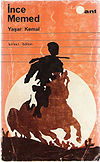
Social realism
Social Realism, also known as Socio-Realism, is an artistic movement, expressed in the visual and other realist arts, which depicts social and racial injustice, economic hardship, through unvarnished pictures of life's struggles; often depicting working class activities as heroic...
, and the "village novel" (köy romanı). Çalıkuşu
Çalikusu
Çalıkuşu, or The Wren, is a novel by Reşat Nuri Güntekin written in 1922, about the destiny of a young Turkish female teacher named Feride in Anatolia.-Plot summary:...
("The Wren") by Reşat Nuri Güntekin
Resat Nuri Güntekin
Reşat Nuri Güntekin was a Turkish novelist, storywriter and playwright. His most known novel, Çalıkuşu is about the destiny of a young Turkish female teacher in Anatolia; a movie was filmed on this book in 1966, and a TV series were produced in 1986...
addresses a similar theme with the works of Karaosmanoğlu. Güntekin's narrative has a detailed and precise style, with a realistic tone.
The social realist movement is perhaps best represented by the short-story writer Sait Faik Abasıyanık (1906–1954), whose work sensitively and realistically treats the lives of cosmopolitan Istanbul's lower classes
Working class
Working class is a term used in the social sciences and in ordinary conversation to describe those employed in lower tier jobs , often extending to those in unemployment or otherwise possessing below-average incomes...
and ethnic minorities, subjects which led to some criticism in the contemporary nationalistic atmosphere. The tradition of the "village novel", on the other hand, arose somewhat later. As its name suggests, the "village novel" deals, in a generally realistic manner, with life in the villages and small towns of Turkey. The major writers in this tradition are Kemal Tahir (1910–1973), Orhan Kemal (1914–1970), and Yaşar Kemal
Yasar Kemal
Yaşar Kemal, is a Turkish writer. He is one of Turkey's leading writers. He has long been a candidate for the Nobel Prize in Literature, on the strength of Memed, My Hawk....
(1923– ). Yaşar Kemal, in particular, has earned fame outside of Turkey not only for his novels—many of which, such as 1955's İnce Memed (Memed, My Hawk
Memed, My Hawk
Memed, My Hawk is a 1955 novel by Yaşar Kemal. It was Kemal's debut novel and is the first novel in his İnce Memed tetralogy. The novel won the Varlik prize for that year and earned Kemal a national reputation...
), elevate local tales to the level of epic—but also for his firmly leftist political stance. In a very different tradition, but evincing a similar strong political viewpoint, was the satirical
Satire
Satire is primarily a literary genre or form, although in practice it can also be found in the graphic and performing arts. In satire, vices, follies, abuses, and shortcomings are held up to ridicule, ideally with the intent of shaming individuals, and society itself, into improvement...
short-story writer Aziz Nesin
Aziz Nesin
Aziz Nesin was a famous Turkish writer and humorist of Crimean Tatar origin and author of more than 100 books.-Pseudonyms:...
(1915–1995) and Rıfat Ilgaz
Rifat Ilgaz
Rıfat Ilgaz was a poet who was born in Cide, Kastamonu, Turkey. He was a teacher, poet, and writer. Ilgaz was one of Turkey’s best-known and most prolific poets and writers, having authored over sixty works.-Biography:...
(1911–1993).
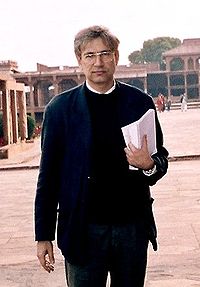
Ahmet Hamdi Tanpinar
Ahmet Hamdi Tanpınar was one of the most important modern novelists and essayists of Turkish literature. He was also a member of the Turkish parliament between 1942 and 1946.-Biography:...
(1901–1962). In addition to being an important essay
Essay
An essay is a piece of writing which is often written from an author's personal point of view. Essays can consist of a number of elements, including: literary criticism, political manifestos, learned arguments, observations of daily life, recollections, and reflections of the author. The definition...
ist and poet, Tanpınar wrote a number of novels—such as Huzur ("A Mind at Peace
A Mind at Peace
A Mind at Peace is an iconic Turkish novel by Ahmet Hamdi Tanpınar , one of the pioneers of literary modernism in Turkey. Tanpınar was a poet, novelist, and critic who worked as a professor of Ottoman and Turkish literature at Istanbul University...
", 1949) and Saatleri Ayarlama Enstitüsü ("The Time Regulation Institute", 1961)—which dramatize the clash between East and West in modern Turkish culture and society. Similar problems are explored by the novelist and short-story writer Oğuz Atay
Oguz Atay
Oğuz Atay was a pioneer of the modern novel in Turkey. His first novel, Tutunamayanlar , appeared 1971-72. Never reprinted in his lifetime and controversial among critics, it has become a best-seller since a new edition came out in 1984...
(1934–1977). Unlike Tanpınar, however, Atay—in such works as his long novel Tutunamayanlar
Tutunamayanlar
Tutunamayanlar is the first novel of Oguz Atay, one of the most prominent Turkish authors. It was written in 1970-71 and published in 1972. Although it was never reprinted in his lifetime and was controversial among critics, it has become a best-seller since a new edition came out in 1984...
("The Good for Nothing", 1971–1972) and his short story "Beyaz Mantolu Adam" ("Man in a White Coat", 1975)—wrote in a more modernist
Modernist literature
Modernist literature is sub-genre of Modernism, a predominantly European movement beginning in the early 20th century that was characterized by a self-conscious break with traditional aesthetic forms...
and existentialist
Existentialism
Existentialism is a term applied to a school of 19th- and 20th-century philosophers who, despite profound doctrinal differences, shared the belief that philosophical thinking begins with the human subject—not merely the thinking subject, but the acting, feeling, living human individual...
vein. On the other hand, Onat Kutlar's İshak ("Isaac", 1959), composed of nine short stories which are written mainly from a child's point of view
Point of view (literature)
The narrative mode is the set of methods the author of a literary, theatrical, cinematic, or musical story uses to convey the plot to the audience. Narration, the process of presenting the narrative, occurs because of the narrative mode...
and are often surrealistic and mystical, represent a very early example of magic realism
Magic realism
Magic realism or magical realism is an aesthetic style or genre of fiction in which magical elements blend with the real world. The story explains these magical elements as real occurrences, presented in a straightforward manner that places the "real" and the "fantastic" in the same stream of...
.
The tradition of literary modernism also informs the work of novelist Adalet Ağaoğlu
Adalet Ağaoğlu
Adalet Ağaoğlu is a Turkish novelist and playwright.-Publishing career:As an author, a playwright and a human rights activist, she became one of the most prized novelists of Turkey...
(1929– ). Her trilogy of novels collectively entitled Dar Zamanlar ("Tight Times", 1973–1987), for instance, examines the changes that occurred in Turkish society between the 1930s and the 1980s in a formally and technically innovative style. Orhan Pamuk
Orhan Pamuk
Ferit Orhan Pamuk , generally known simply as Orhan Pamuk, is a Turkish novelist. He is also the Robert Yik-Fong Tam Professor in the Humanities at Columbia University, where he teaches comparative literature and writing....
(1952– ), winner of the 2006 Nobel Prize in Literature
Nobel Prize in Literature
Since 1901, the Nobel Prize in Literature has been awarded annually to an author from any country who has, in the words from the will of Alfred Nobel, produced "in the field of literature the most outstanding work in an ideal direction"...
, is another such innovative novelist, though his works—such as 1990's Beyaz Kale ("The White Castle
The White Castle
The White Castle is a novel by Turkish author Orhan Pamuk.-Plot introduction:The story is about a young Italian scholar sailing from Venice to Naples who is taken prisoner by the Ottoman Empire...
") and Kara Kitap ("The Black Book
The Black Book (Orhan Pamuk novel)
The Black Book is a novel by Turkish author Orhan Pamuk. It was published in Turkish in 1990 and first translated and published in English in 1994...
") and 1998's Benim Adım Kırmızı ("My Name is Red
My Name is Red
My Name Is Red is a 1998 Turkish novel by Nobel laureate author Orhan Pamuk. The English translation won the International IMPAC Dublin Literary Award in 2003,. The French version won the French Prix du Meilleur Livre Étranger and the Italian version the Premio Grinzane Cavour in 2002...
")—are influenced more by postmodernism
Postmodern literature
The term Postmodern literature is used to describe certain characteristics of post–World War II literature and a reaction against Enlightenment ideas implicit in Modernist literature.Postmodern literature, like postmodernism as a whole, is hard to define and there is little agreement on the exact...
than by modernism. This is true also of Latife Tekin
Latife Tekin
Latife Tekin is one of the most influential Turkish female authors. She was born in 1957 in Kayseri, Turkey. She continued her education in Istanbul. In 1983, her famous novel Sevgili Arsız Ölüm was published. The magic realism in the book was drawn from the Anatolian folklore and traditions...
(1957– ), whose first novel Sevgili Arsız Ölüm ("Dear Shameless Death", 1983) shows the influence not only of postmodernism, but also of magic realism.
Poetry
In the early years of the Republic of Turkey, there were a number of poetic trends. Authors such as Ahmed Hâşim and Yahyâ Kemâl Beyatlı (1884–1958) continued to write important formal verse whose language was, to a great extent, a continuation of the late Ottoman tradition. By far the majority of the poetry of the time, however, was in the tradition of the folk-inspired "syllabist" movement (Beş Hececiler), which had emerged from the National Literature movement and which tended to express patrioticPatriotism
Patriotism is a devotion to one's country, excluding differences caused by the dependencies of the term's meaning upon context, geography and philosophy...
themes couched in the syllabic meter associated with Turkish folk poetry.
The first radical step away from this trend was taken by Nâzım Hikmet Ran
Nazim Hikmet
Nâzım Hikmet Ran , commonly known as Nâzım Hikmet , was a Turkish poet, playwright, novelist and memoirist. He was acclaimed for the "lyrical flow of his statements"...
, who—during his time as a student in the Soviet Union
Soviet Union
The Soviet Union , officially the Union of Soviet Socialist Republics , was a constitutionally socialist state that existed in Eurasia between 1922 and 1991....
from 1921 to 1924—was exposed to the modernist poetry of Vladimir Mayakovsky
Vladimir Mayakovsky
Vladimir Vladimirovich Mayakovsky was a Russian and Soviet poet and playwright, among the foremost representatives of early-20th century Russian Futurism.- Early life :...
and others, which inspired him to start writing verse in a less formal style. At this time, he wrote the poem "Açların Gözbebekleri" ("Pupils of the Hungry"), which introduced free verse
Free verse
Free verse is a form of poetry that refrains from consistent meter patterns, rhyme, or any other musical pattern.Poets have explained that free verse, despite its freedom, is not free. Free Verse displays some elements of form...
into the Turkish language for, essentially, the first time. Much of Nâzım Hikmet's poetry subsequent to this breakthrough would continue to be written in free verse, though his work exerted little influence for some time due largely to censorship
Censorship
thumb|[[Book burning]] following the [[1973 Chilean coup d'état|1973 coup]] that installed the [[Military government of Chile |Pinochet regime]] in Chile...
of his work owing to his Communist
Communism
Communism is a social, political and economic ideology that aims at the establishment of a classless, moneyless, revolutionary and stateless socialist society structured upon common ownership of the means of production...
political stance, which also led to his spending several years in prison. Over time, in such books as Simavne Kadısı Oğlu Şeyh Bedreddin Destanı ("The Epic of Shaykh Bedreddin, Son of Judge Simavne", 1936) and Memleketimden İnsan Manzaraları ("Human Landscapes from My Country", 1939), he developed a voice simultaneously proclamatory and subtle.
Another revolution in Turkish poetry came about in 1941 with the publication of a small volume of verse preceded by an essay and entitled Garip
Garip
Garip was a group of Turkish poets. The group was also known as the First New Movement. It was composed of Orhan Veli, Oktay Rifat and Melih Cevdet, who had been friends since high school. The name "Garip" signalled a break with the conventional, decadent style of Turkish poetry and literature at...
("Strange"). The authors were Orhan Veli Kanık
Orhan Veli
Orhan Veli Kanık or Orhan Veli was a Turkish poet. Kanık who is the founder of Garip Movement together with Oktay Rıfat and Melih Cevdet has moved to the poetic language, utterance of man-in-the street by purposing rootedly to change the old structure in Turkish poetry...
(1914–1950), Melih Cevdet Anday (1915–2002), and Oktay Rifat (1914–1988). Explicitly opposing themselves to everything that had gone in poetry before, they sought instead to create a popular art, "to explore the people's tastes, to determine them, and to make them reign supreme over art". To this end, and inspired in part by contemporary French poets like Jacques Prévert
Jacques Prévert
Jacques Prévert was a French poet and screenwriter. His poems became and remain very popular in the French-speaking world, particularly in schools. Some of the movies he wrote are extremely well regarded, with Les Enfants du Paradis considered one of the greatest films of all time.-Life and...
, they employed not only a variant of the free verse introduced by Nâzım Hikmet, but also highly colloquial language
Colloquialism
A colloquialism is a word or phrase that is common in everyday, unconstrained conversation rather than in formal speech, academic writing, or paralinguistics. Dictionaries often display colloquial words and phrases with the abbreviation colloq. as an identifier...
, and wrote primarily about mundane daily subjects and the ordinary man on the street. The reaction was immediate and polarized: most of the academic establishment
Academia
Academia is the community of students and scholars engaged in higher education and research.-Etymology:The word comes from the akademeia in ancient Greece. Outside the city walls of Athens, the gymnasium was made famous by Plato as a center of learning...
and older poets vilified them, while much of the Turkish population embraced them wholeheartedly. Though the movement itself lasted only ten years—until Orhan Veli's death in 1950, after which Melih Cevdet Anday and Oktay Rifat moved on to other styles—its effect on Turkish poetry continues to be felt today.
Just as the Garip movement was a reaction against earlier poetry, so—in the 1950s and afterwards—was there a reaction against the Garip movement. The poets of this movement, soon known as İkinci Yeni ("Second New",) opposed themselves to the social aspects prevalent in the poetry of Nâzım Hikmet and the Garip poets, and instead—partly inspired by the disruption of language in such Western movements as Dada
Dada
Dada or Dadaism is a cultural movement that began in Zurich, Switzerland, during World War I and peaked from 1916 to 1922. The movement primarily involved visual arts, literature—poetry, art manifestoes, art theory—theatre, and graphic design, and concentrated its anti-war politics through a...
and Surrealism
Surrealism
Surrealism is a cultural movement that began in the early 1920s, and is best known for the visual artworks and writings of the group members....
—sought to create a more abstract poetry through the use of jarring and unexpected language, complex images, and the association of ideas. To some extent, the movement can be seen as bearing some of the characteristics of postmodern literature. The most well-known poets writing in the "Second New" vein were Turgut Uyar (1927–1985), Edip Cansever
Edip Cansever
Edip Cansever was a Turkish poet.-Biography:Born in Istanbul, Turkey, Cansever attended Trade Academy for some time, and worked as an antiquity salesman in Grand Bazaar, Istanbul...
(1928–1986), Cemal Süreya
Cemal Süreya
Cemal Süreyya was a poet and writer.-Biography:After the 1938 Dersim Rebellion, Sureya and his family were forcefully deported to Bilecik, a Turkish city in western Anatolia. This had a significant affect on his poems.He graduated from the Political Sciences Faculty of Ankara University...
(1931–1990), Ece Ayhan
Ece Ayhan
Ece Ayhan Çağlar was a contemporary Turkish poet. He used the name Ece Ayhan in his poems. He is one of the prominent figures of the II...
(1931–2002), Sezai Karakoç
Sezai karakoc
Sezai Karakoç is a Turkish poet.-Biography:He graduated from the Faculty of Political Science at Ankara University and worked in the finance sector for many years...
(1933- ) and İlhan Berk
Ilhan Berk
İlhan Berk was a leading contemporary Turkish poet. He was a dominant figure in the postmodern current in Turkish poetry and was very influential among Turkish literary circles.-Biography:Berk was born in Manisa, Turkey in 1918 and received a teacher's training in Balıkesir...
(1918–2008).
Outside of the Garip and "Second New" movements also, a number of significant poets have flourished, such as Fazıl Hüsnü Dağlarca (1914– ), who wrote poems dealing with fundamental concepts like life, death, God, time, and the cosmos; Behçet Necatigil (1916–1979), whose somewhat allegorical
Allegory
Allegory is a demonstrative form of representation explaining meaning other than the words that are spoken. Allegory communicates its message by means of symbolic figures, actions or symbolic representation...
poems explore the significance of middle-class
Middle class
The middle class is any class of people in the middle of a societal hierarchy. In Weberian socio-economic terms, the middle class is the broad group of people in contemporary society who fall socio-economically between the working class and upper class....
daily life; Can Yücel (1926–1999), who—in addition to his own highly colloquial and varied poetry—was also a translator into Turkish of a variety of world literature; and İsmet Özel
Ismet Özel
İsmet Özel is a Turkish poet and scholar.-Early years:Özel is the sixth child of a police officer from Söke. He attended his primary and secondary school in Kastamonu, Çankırı and Ankara...
(1944– ), whose early poetry was highly leftist
Left-wing politics
In politics, Left, left-wing and leftist generally refer to support for social change to create a more egalitarian society...
but whose poetry since the 1970s has shown a strong mystical
Mysticism
Mysticism is the knowledge of, and especially the personal experience of, states of consciousness, i.e. levels of being, beyond normal human perception, including experience and even communion with a supreme being.-Classical origins:...
and even Islamist
Islamism
Islamism also , lit., "Political Islam" is set of ideologies holding that Islam is not only a religion but also a political system. Islamism is a controversial term, and definitions of it sometimes vary...
influence.
Book Trade
30,000 new titles appear yearly, often in small numbers. 9 verso 17 Euro (pro pocket book/hardcover) - at an average earning of less than 600 Euro monthly - are rather unattractive, where illegal copies at bazaars cost two thirds less. "Official Certificates" for legally published books do not solve the problem, because controlling the illegal book trade remains difficult.5,000 of 10,000 book shops in Turkey are in Istanbul, including the bookfair and growing licence trading. Turkey was a guest of honour at the Frankfurt Bookfair in 2008.
The Important Fictional Works: 1860-present day
- 1860 Şair Evlenmesi ŞinasiŞinasiİbrahim Şinasi was a well-known Ottoman author, journalist, and translator. He was one of the primary authors of the Tanzimat.-Biography:...
- 1873 Vatan Yahut Silistre Namık KemalNamık KemalNamık Kemal, born as Mehmed Kemal was a Turkish nationalist poet, translator, journalist, and social reformer.-Biography:...
- 1900 Aşk-ı Memnu Halit Ziya UşaklıgilHalit Ziya UsakligilHalit Ziya Uşaklıgil/Uşakizâde ) was a Turkish author.-Biography:Halit Ziya Uşaklıgil was born in Istanbul in 1865. He went to primary school and then attended the secondary school Fatih Rustiyesi in the same city. His family moved to Izmir in 1879. He completed his secondary education in Izmir...
- 1919 Memleket Hikayeleri Refik Halit Karay
- 1922 Çalıkuşu Reşat Nuri GüntekinResat Nuri GüntekinReşat Nuri Güntekin was a Turkish novelist, storywriter and playwright. His most known novel, Çalıkuşu is about the destiny of a young Turkish female teacher in Anatolia; a movie was filmed on this book in 1966, and a TV series were produced in 1986...
- 1930 Dokuzuncu Hariciye Koğuşu Peyami Safa
- 1932 Yaban Yakup Kadri KaraosmanoğluYakup Kadri KaraosmanogluYakup Kadri Karaosmanoğlu was a Turkish novelist, journalist, diplomat, and senator.-Early life:...
- 1936 Sinekli Bakkal Halide Edip AdıvarHalide Edip AdivarHalide Edip Adıvar or Halide Edib Adivar was a Turkish novelist and feminist political leader...
- 1938 Üç İstanbul Mithat Cemal Kuntay
- 1941 Fahim Bey ve Biz Abdülhak Şinasi Hisar
- 1943 Yeni Dünya Sabahattin AliSabahattin AliSabahattin Ali was a Turkish novelist, short-story writer, poet, and journalist.-Early life:He was born in 1907 in Eğridere township in Gümülcine sanjak , in the Ottoman Empire. He lived in Istanbul, Çanakkale and Edremit before he entered the school of education in Balıkesir...
- 1944 Aganta Burina Burinata Halikarnas Balıkçısı
- 1949 Huzur Ahmet Hamdi TanpınarAhmet Hamdi TanpinarAhmet Hamdi Tanpınar was one of the most important modern novelists and essayists of Turkish literature. He was also a member of the Turkish parliament between 1942 and 1946.-Biography:...
- 1952 Dost Vüs'at O. Bener
- 1954 Alemdağda Var Bir Yılan Sait Faik AbasıyanıkSait Faik AbasiyanikSait Faik Abasıyanık was one of the greatest Turkish writers of short stories and poetry. Born in Adapazarı, he was educated at the Bursa Erkek Lisesi. He enrolled in the Turcology Department of Istanbul University in 1928, but under pressure from his father went to Switzerland to study economics...
- 1954 Bereketli Topraklar Üzerinde Orhan KemalOrhan KemalOrhan Kemal is the pen name of Turkish novelist Mehmet Raşit Öğütçü. He is known for his realist novels that tells the stories of the poor in Turkey....
- 1955 İnce Memet Yaşar KemalYasar KemalYaşar Kemal, is a Turkish writer. He is one of Turkey's leading writers. He has long been a candidate for the Nobel Prize in Literature, on the strength of Memed, My Hawk....
- 1956 Esir Şehrin İnsanları Kemal TahirKemal TahirKemal Tahir was a prominent Turkish novelist and intellectual. Tahir spent 13 years of his life imprisoned due to political reasons and wrote some of his most important novels during this time...
- 1959 Yılanların Öcü Fakir Baykurt
- 1959 Aylak Adam Yusuf AtılganYusuf AtilganYusuf Atılgan was a Turkish novelist and dramatist, who is best known for his novels Aylak Adam and Anayurt Oteli . He is one of the pioneers of the modern Turkish novel.Atılgan is considered as one of the pioneers of the modern Turkish novel...
- 1960 Ortadirek Yaşar KemalYasar KemalYaşar Kemal, is a Turkish writer. He is one of Turkey's leading writers. He has long been a candidate for the Nobel Prize in Literature, on the strength of Memed, My Hawk....
- 1962 Saatleri Ayarlama Enstitüsü Ahmet Hamdi TanpınarAhmet Hamdi TanpinarAhmet Hamdi Tanpınar was one of the most important modern novelists and essayists of Turkish literature. He was also a member of the Turkish parliament between 1942 and 1946.-Biography:...
- 1964 Küçük Ağa Tarık Buğra
- 1966 Memleketimden İnsan Manzaraları Nazım HikmetNazim HikmetNâzım Hikmet Ran , commonly known as Nâzım Hikmet , was a Turkish poet, playwright, novelist and memoirist. He was acclaimed for the "lyrical flow of his statements"...
- 1971 Tutunamayanlar Oğuz AtayOguz AtayOğuz Atay was a pioneer of the modern novel in Turkey. His first novel, Tutunamayanlar , appeared 1971-72. Never reprinted in his lifetime and controversial among critics, it has become a best-seller since a new edition came out in 1984...
- 1973 Parasız Yatılı FüruzanFüruzanFüruzan Yerdelen is an award-winning self-taught Turkish writer, who is highly regarded for her sensitive characterisations of the poor and her depictions of Turkish immigrants abroad.- Biography :...
- 1973 Anayurt Oteli Yusuf AtılganYusuf AtilganYusuf Atılgan was a Turkish novelist and dramatist, who is best known for his novels Aylak Adam and Anayurt Oteli . He is one of the pioneers of the modern Turkish novel.Atılgan is considered as one of the pioneers of the modern Turkish novel...
- 1979 Bir Düğün Gecesi Adalet AğaoğluAdalet AğaoğluAdalet Ağaoğlu is a Turkish novelist and playwright.-Publishing career:As an author, a playwright and a human rights activist, she became one of the most prized novelists of Turkey...
- 1982 Cevdet Bey ve Oğulları Orhan PamukOrhan PamukFerit Orhan Pamuk , generally known simply as Orhan Pamuk, is a Turkish novelist. He is also the Robert Yik-Fong Tam Professor in the Humanities at Columbia University, where he teaches comparative literature and writing....
- 1983 Sevgili Arsız Ölüm Latife TekinLatife TekinLatife Tekin is one of the most influential Turkish female authors. She was born in 1957 in Kayseri, Turkey. She continued her education in Istanbul. In 1983, her famous novel Sevgili Arsız Ölüm was published. The magic realism in the book was drawn from the Anatolian folklore and traditions...
- 1985 Gece Bilge Karasu
- 1990 Kara Kitap Orhan PamukOrhan PamukFerit Orhan Pamuk , generally known simply as Orhan Pamuk, is a Turkish novelist. He is also the Robert Yik-Fong Tam Professor in the Humanities at Columbia University, where he teaches comparative literature and writing....
- 1995 Puslu Kıtalar Atlası İhsan Oktay AnarIhsan Oktay Anarİhsan Oktay Anar, born 1960 in Yozgat, Turkey, is a Turkish writer, illustrator, literature translator and an academic.He studied philosophy in Ege University on undergraduate , graduate and doctoral levels...
- 1998 Benim Adım Kırmızı Orhan PamukOrhan PamukFerit Orhan Pamuk , generally known simply as Orhan Pamuk, is a Turkish novelist. He is also the Robert Yik-Fong Tam Professor in the Humanities at Columbia University, where he teaches comparative literature and writing....
- 2002 Tol Murat Uyurkulak
- 2005 Uykuların Doğusu Hasan Ali ToptaşHasan Ali ToptasHasan Ali Toptaş is a prominent Turkish novelist and short story writer. He was born in Denizli, Turkey. His first short story book Bir Gülüşün Kimliği was published in 1987...
See also
- Azerbaijani literatureAzerbaijani literatureAzerbaijani literature refers to the literature written in Azerbaijani, which currently is the official state language of the Republic of Azerbaijan and is widely spoken in northwestern Iran and eastern Turkey...
- Chagatai languageChagatai languageThe Chagatai language is an extinct Turkic language which was once widely spoken in Central Asia, and remained the shared literary language there until the early twentieth century...
- Codex CumanicusCodex CumanicusThe Codex Cumanicus was a linguistic manual of the Middle Ages, designed to help Catholic missionaries communicate with the Cumans, a nomadic Turkic people. It is currently housed in the Library of St. Mark, in Venice ....
- List of Ottoman poets
In English
- Ottoman Text Archive Project - University of Washington A diverse collection of selected Ottoman texts, tools for working with digitized texts, and various projects for the dissemination of Ottoman texts.
- Contemporary Turkish Literature An excellent and well-translated selection of contemporary Turkish literature hosted by Bogaziçi UniversityBogaziçi UniversityBoğaziçi University is a public university located on the European side of the Bosphorus strait in Istanbul, Turkey. It has five faculties and two schools offering undergraduate degrees, and six institutes offering graduate degrees...
in IstanbulIstanbulIstanbul , historically known as Byzantium and Constantinople , is the largest city of Turkey. Istanbul metropolitan province had 13.26 million people living in it as of December, 2010, which is 18% of Turkey's population and the 3rd largest metropolitan area in Europe after London and... - Encyclopedia of Turkish Authors A very comprehensive encyclopedia from the Turkish Ministry of Culture and Tourism
- Selected Literatures and Authors Page: Turkish Literature A website with a number of Turkish literature-related links
- The Online Bibliography of Ottoman-Turkish Literature A bi-lingual site presenting in English (see In Turkish section below) a user-submissable database of references to theses, books, articles, papers and research-projects
- Turkish Cultural Foundation A website with a great deal of information on a number of Turkish authors and literary genres
- Turkish Poetry in Translation A website with a good selection of both contemporary and somewhat older Turkish poems
- Turkishpoetry.net Contemporary Turkish poetry web site
In Turkish
- ATON, the Uysal-Walker Archive of Turkish Oral NarrativeUysal-Walker Archive of Turkish Oral NarrativeThe Uysal-Walker Archive of Turkish Oral Narrative is a searchable archive of oral Turkish literature. The archive is housed in the Southwest Collection/Special Collections Library of Texas Tech University in Lubbock, Texas, United States. It includes links to numerous audio recordings in MP3...
A searchable archive of oral literature based at Texas Tech UniversityTexas Tech UniversityTexas Tech University, often referred to as Texas Tech or TTU, is a public research university in Lubbock, Texas, United States. Established on February 10, 1923, and originally known as Texas Technological College, it is the leading institution of the Texas Tech University System and has the...
containing links to numerous MP3 files. - Divan Edebiyat? A website with many examples of Ottoman Divan poetry
- Osmanlı Edebiyatı Çalışmaları Bibliyografyası Veritabanı A bi-lingual site presenting (in Turkish, see above) a user-submissable database of references to theses, books, articles, papers and research-projects