

Natto

Encyclopedia
Japanese cuisine
Japanese cuisine has developed over the centuries as a result of many political and social changes throughout Japan. The cuisine eventually changed with the advent of the Medieval age which ushered in a shedding of elitism with the age of shogun rule...
made from soybean
Soybean
The soybean or soya bean is a species of legume native to East Asia, widely grown for its edible bean which has numerous uses...
s fermented
Fermentation (food)
Fermentation in food processing typically is the conversion of carbohydrates to alcohols and carbon dioxide or organic acids using yeasts, bacteria, or a combination thereof, under anaerobic conditions. Fermentation in simple terms is the chemical conversion of sugars into ethanol...
with Bacillus subtilis
Bacillus subtilis
Bacillus subtilis, known also as the hay bacillus or grass bacillus, is a Gram-positive, catalase-positive bacterium commonly found in soil. A member of the genus Bacillus, B. subtilis is rod-shaped, and has the ability to form a tough, protective endospore, allowing the organism to tolerate...
. It is popular especially as a breakfast food. As a rich source of protein
Protein
Proteins are biochemical compounds consisting of one or more polypeptides typically folded into a globular or fibrous form, facilitating a biological function. A polypeptide is a single linear polymer chain of amino acids bonded together by peptide bonds between the carboxyl and amino groups of...
and probiotics, nattō and the soybean
Soybean
The soybean or soya bean is a species of legume native to East Asia, widely grown for its edible bean which has numerous uses...
paste miso
Miso
is a traditional Japanese seasoning produced by fermenting rice, barley and/or soybeans, with salt and the fungus , the most typical miso being made with soy. The result is a thick paste used for sauces and spreads, pickling vegetables or meats, and mixing with dashi soup stock to serve as miso...
formed a vital source of nutrition
Nutrition
Nutrition is the provision, to cells and organisms, of the materials necessary to support life. Many common health problems can be prevented or alleviated with a healthy diet....
in feudal Japan. Nattō can be an acquired taste
Acquired taste
An acquired taste often refers to an appreciation for a food or beverage that is unlikely to be enjoyed by a person who has not had substantial exposure to it, usually because of some unfamiliar aspect of the food or beverage, including a strong or strange odor An acquired taste often refers to an...
because of its powerful smell, strong flavor, and slippery texture. In Japan
Japan
Japan is an island nation in East Asia. Located in the Pacific Ocean, it lies to the east of the Sea of Japan, China, North Korea, South Korea and Russia, stretching from the Sea of Okhotsk in the north to the East China Sea and Taiwan in the south...
nattō is most popular in the eastern regions, including Kantō
Kanto region
The is a geographical area of Honshu, the largest island of Japan. The region includes the Greater Tokyo Area and encompasses seven prefectures: Gunma, Tochigi, Ibaraki, Saitama, Tokyo, Chiba, and Kanagawa. Within its boundaries, slightly more than 40 percent of the land area is the Kantō Plain....
, Tōhoku, and Hokkaido
Hokkaido
, formerly known as Ezo, Yezo, Yeso, or Yesso, is Japan's second largest island; it is also the largest and northernmost of Japan's 47 prefectural-level subdivisions. The Tsugaru Strait separates Hokkaido from Honshu, although the two islands are connected by the underwater railway Seikan Tunnel...
.
History
Sources differ about the earliest origin of nattō. The materials and tools needed to produce nattō have been commonly available in Japan since ancient times; one source puts the first use of nattō in the Jōmon periodJomon period
The is the time in Japanese prehistory from about 14,000 BC to 300 BC.The term jōmon means "cord-patterned" in Japanese. This refers to the pottery style characteristic of the Jōmon culture, and which has markings made using sticks with cords wrapped around them...
(10,000–300 BC). According to other sources the product may have originated in China
China
Chinese civilization may refer to:* China for more general discussion of the country.* Chinese culture* Greater China, the transnational community of ethnic Chinese.* History of China* Sinosphere, the area historically affected by Chinese culture...
during the Zhou Dynasty
Zhou Dynasty
The Zhou Dynasty was a Chinese dynasty that followed the Shang Dynasty and preceded the Qin Dynasty. Although the Zhou Dynasty lasted longer than any other dynasty in Chinese history, the actual political and military control of China by the Ji family lasted only until 771 BC, a period known as...
(1134-246 BC). There is also the story about Minamoto no Yoshiie
Minamoto no Yoshiie
Minamoto no Yoshiie , also known as Hachimantarō, was a Minamoto clan samurai of the late Heian period, and Chinjufu shogun...
who was on a battle campaign in northeastern Japan between 1086 and 1088 when one day they were attacked while boiling soybeans for their horses. They hurriedly packed up the beans, and did not open the straw bags until a few days later, by which time the beans had fermented. The soldiers ate it anyway, and liked the taste, so they offered some to Yoshiie, who also liked the taste. A third source places the origin of nattō more recently, in the Edo period
Edo period
The , or , is a division of Japanese history which was ruled by the shoguns of the Tokugawa family, running from 1603 to 1868. The political entity of this period was the Tokugawa shogunate....
(1603–1867). It is even possible that the product was discovered independently at different times.
One significant change in the production of nattō happened in the Taishō period
Taisho period
The , or Taishō era, is a period in the history of Japan dating from July 30, 1912 to December 25, 1926, coinciding with the reign of the Taishō Emperor. The health of the new emperor was weak, which prompted the shift in political power from the old oligarchic group of elder statesmen to the Diet...
(1912–1926), when researchers discovered a way to produce a nattō starter culture containing Bacillus natto without the need for straw. This simplified production and permitted more consistency.
Appearance and consumption
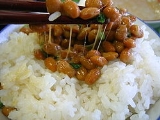
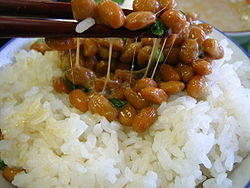
The first thing noticed after opening a pack of nattō is its distinctive smell, somewhat akin to a pungent cheese. Stirring the nattō produces lots of sticky gossamerSpider silk
Spider silk is a protein fiber spun by spiders. Spiders use their silk to make webs or other structures, which function as nets to catch other animals, or as nests or cocoons for protection for their offspring...
-like strings. The nattō strings themselves are often described by the Japanese ideophone
Ideophone
Ideophones are words used by speakers to evoke a vivid impression of certain sensation or sensory perceptions, e.g. smell, color, shape, sound, action, or movement. Ideophones are attested in all languages of the world, however, languages differ in the extent to which they make use of them...
nebaneba, which roughly translates as 'viscid' or 'gooey'. The flavor of nattō is nutty, savory, and slightly salty.
Nattō is commonly eaten at breakfast to accompany rice, possibly with soy sauce, tsuyu
Soba
is the Japanese name for buckwheat. It is synonymous with a type of thin noodle made from buckwheat flour, and in Japan can refer to any thin noodle . Soba noodles are served either chilled with a dipping sauce, or in hot broth as a noodle soup...
broth, mustard
Mustard (condiment)
Mustard is a condiment made from the seeds of a mustard plant...
, scallion
Scallion
Scallions , are the edible plants of various Allium species, all of which are "onion-like", having hollow green leaves and lacking a fully developed root bulb.-Etymology:The words...
s, grated daikon
Daikon
Daikon , Raphanus sativus var. longipinnatus, also called White Radish, Japanese radish, Oriental radish, Chinese radish, lo bok and Mooli , is a mild flavoured, very large, white East Asian radish...
, okra
Okra
Okra is a flowering plant in the mallow family. It is valued for its edible green seed pods. The geographical origin of okra is disputed, with supporters of South Asian, Ethiopian and West African origins...
, or a raw egg. In Hokkaidō and northern Tohoku region, some people dust nattō with sugar. Nattō is commonly used in other foods, such as nattō sushi, nattō toast, in miso soup
Miso soup
is a traditional Japanese soup consisting of a stock called "dashi" into which is mixed softened miso paste. Many ingredients are added depending on regional and seasonal recipes, and personal preference.-Miso paste:...
, tamagoyaki, salad, as an ingredient in okonomiyaki
Okonomiyaki
is a Japanese dish containing a variety of ingredients. The name is derived from the word okonomi, meaning "what you like" or "what you want", and yaki meaning "grilled" or "cooked" . Okonomiyaki is mainly associated with Kansai or Hiroshima areas of Japan, but is widely available throughout the...
, or even with spaghetti or as fried nattō. A dried form of nattō, having little odor or sliminess, can be eaten as a nutritious snack. There is even nattō ice cream
Ice cream
Ice cream is a frozen dessert usually made from dairy products, such as milk and cream, and often combined with fruits or other ingredients and flavours. Most varieties contain sugar, although some are made with other sweeteners...
.
Soybeans are sometimes crushed and fermented. This is called Hikiwarinattō. It is a food that is easy to digest.
The flavor of nattō can differ greatly between people; some find it tastes strong and cheesy and may use it in small amounts to flavor rice or noodles, while others find it tastes bland and unremarkable, requiring the addition of flavoring condiments such as mustard and soy sauce. Many non-Japanese find the taste unpleasant, while others relish it as a delicacy. Some manufacturers produce an odorless or low-odor nattō. The split opinion about its appearance and taste might be compared to Vegemite
Vegemite
Vegemite is a dark brown Australian food paste made from yeast extract. It is a spread for sandwiches, toast, crumpets and cracker biscuits, and filling for pastries...
in Australia
Australia
Australia , officially the Commonwealth of Australia, is a country in the Southern Hemisphere comprising the mainland of the Australian continent, the island of Tasmania, and numerous smaller islands in the Indian and Pacific Oceans. It is the world's sixth-largest country by total area...
, blue cheese
Blue cheese
Blue cheese is a general classification of cow's milk, sheep's milk, or goat's milk cheeses that have had cultures of the mold Penicillium added so that the final product is spotted or veined throughout with blue, blue-gray or blue-green mold, and carries a distinct smell, either from that or...
in France
France
The French Republic , The French Republic , The French Republic , (commonly known as France , is a unitary semi-presidential republic in Western Europe with several overseas territories and islands located on other continents and in the Indian, Pacific, and Atlantic oceans. Metropolitan France...
, surströmming
Surströmming
Surströmming herring") is a northern Swedish dish consisting of fermented Baltic herring. Surströmming is sold in cans, which often bulge during shipping and storage, due to the continued fermentation. When opened, the contents release a strong and sometimes overwhelming odor, which explains why...
in Sweden
Sweden
Sweden , officially the Kingdom of Sweden , is a Nordic country on the Scandinavian Peninsula in Northern Europe. Sweden borders with Norway and Finland and is connected to Denmark by a bridge-tunnel across the Öresund....
, lutefisk
Lutefisk
Lutefisk or Lutfisk is a traditional dish of the Nordic countries and parts of the Midwest United States. It is made from aged stockfish or dried/salted whitefish and lye . It is gelatinous in texture, and has an extremely strong, pungent odor...
in Norway
Norway
Norway , officially the Kingdom of Norway, is a Nordic unitary constitutional monarchy whose territory comprises the western portion of the Scandinavian Peninsula, Jan Mayen, and the Arctic archipelago of Svalbard and Bouvet Island. Norway has a total area of and a population of about 4.9 million...
and Sweden
Sweden
Sweden , officially the Kingdom of Sweden , is a Nordic country on the Scandinavian Peninsula in Northern Europe. Sweden borders with Norway and Finland and is connected to Denmark by a bridge-tunnel across the Öresund....
, mämmi
Mämmi
Mämmi is a traditional Finnish Easter dessert. The Swedish language name for it is memma.Mämmi is made from water, rye flour, and powdered rye malt, seasoned with dark molasses, salt, and dried powdered Seville orange peel. The mixture is then allowed to go through a slow natural sweetening...
in Finland
Finland
Finland , officially the Republic of Finland, is a Nordic country situated in the Fennoscandian region of Northern Europe. It is bordered by Sweden in the west, Norway in the north and Russia in the east, while Estonia lies to its south across the Gulf of Finland.Around 5.4 million people reside...
and Marmite
Marmite
Marmite is the name given to two similar food spreads: the original British version, first produced in the United Kingdom and later South Africa, and a version produced in New Zealand...
in New Zealand
New Zealand
New Zealand is an island country in the south-western Pacific Ocean comprising two main landmasses and numerous smaller islands. The country is situated some east of Australia across the Tasman Sea, and roughly south of the Pacific island nations of New Caledonia, Fiji, and Tonga...
, South Africa
South Africa
The Republic of South Africa is a country in southern Africa. Located at the southern tip of Africa, it is divided into nine provinces, with of coastline on the Atlantic and Indian oceans...
and the UK. Even in Japan, nattō is more popular in some areas than in others. Nattō is known to be popular in the eastern Kantō region
Kanto region
The is a geographical area of Honshu, the largest island of Japan. The region includes the Greater Tokyo Area and encompasses seven prefectures: Gunma, Tochigi, Ibaraki, Saitama, Tokyo, Chiba, and Kanagawa. Within its boundaries, slightly more than 40 percent of the land area is the Kantō Plain....
(Tokyo
Tokyo
, ; officially , is one of the 47 prefectures of Japan. Tokyo is the capital of Japan, the center of the Greater Tokyo Area, and the largest metropolitan area of Japan. It is the seat of the Japanese government and the Imperial Palace, and the home of the Japanese Imperial Family...
), but less popular in Kansai
Kansai
The or the lies in the southern-central region of Japan's main island Honshū. The region includes the prefectures of Mie, Nara, Wakayama, Kyoto, Osaka, Hyōgo, and Shiga. Depending on who makes the distinction, Fukui, Tokushima and even Tottori Prefecture are also included...
(Osaka
Osaka
is a city in the Kansai region of Japan's main island of Honshu, a designated city under the Local Autonomy Law, the capital city of Osaka Prefecture and also the biggest part of Keihanshin area, which is represented by three major cities of Japan, Kyoto, Osaka and Kobe...
, Kobe
Kobe
, pronounced , is the fifth-largest city in Japan and is the capital city of Hyōgo Prefecture on the southern side of the main island of Honshū, approximately west of Osaka...
). 236,000 tons of nattō are consumed in Japan each year.
Production process
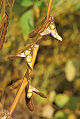
Steaming
Steaming is a method of cooking using steam. Steaming is considered a healthy cooking technique and capable of cooking almost all kinds of food.-Method:...
for 6 hours, although a pressure cooker
Pressure cooking
Pressure cooking is a method of cooking in a sealed vessel that does not permit air or liquids to escape below a preset pressure. Because the boiling point of water increases as the pressure increases, the pressure built up inside the cooker allows the liquid in the pot to rise to a higher...
can be used to reduce the time. The beans are mixed with the bacterium Bacillus subtilis natto
Bacillus subtilis
Bacillus subtilis, known also as the hay bacillus or grass bacillus, is a Gram-positive, catalase-positive bacterium commonly found in soil. A member of the genus Bacillus, B. subtilis is rod-shaped, and has the ability to form a tough, protective endospore, allowing the organism to tolerate...
, known as nattō-kin in Japanese. From this point on, care has to be taken to keep the ingredients away from impurities and other bacteria
Bacteria
Bacteria are a large domain of prokaryotic microorganisms. Typically a few micrometres in length, bacteria have a wide range of shapes, ranging from spheres to rods and spirals...
. The mixture is fermented at 40 °C for up to 24 hours. Afterwards the nattō is cooled, then aged in a refrigerator for up to one week to allow the development of stringiness. During the aging, at a temperature of about 0 °C, the bacilli develop spores
Endospore
An endospore is a dormant, tough, and temporarily non-reproductive structure produced by certain bacteria from the Firmicute phylum. The name "endospore" is suggestive of a spore or seed-like form , but it is not a true spore . It is a stripped-down, dormant form to which the bacterium can reduce...
, and enzymatic
Enzyme
Enzymes are proteins that catalyze chemical reactions. In enzymatic reactions, the molecules at the beginning of the process, called substrates, are converted into different molecules, called products. Almost all chemical reactions in a biological cell need enzymes in order to occur at rates...
peptidases break down the soybean protein into its constituent amino acid
Amino acid
Amino acids are molecules containing an amine group, a carboxylic acid group and a side-chain that varies between different amino acids. The key elements of an amino acid are carbon, hydrogen, oxygen, and nitrogen...
s.
Historically, nattō was made by storing the steamed soybeans in rice straw, which naturally contains B. subtilis natto. The soybeans were packed in straw and left to ferment. The fermentation was done while the beans were buried underground underneath a fire or stored in a warm place in the house, for example under the kotatsu
Kotatsu
A is a low, wooden table frame covered by a futon, or heavy blanket, upon which a table top sits. Underneath is a heat source, often built into the table itself. Kotatsu are used almost exclusively in Japan, although similar devices are used elsewhere....
.
Regardless of the process, Japanese manufacturers need permission from prefecture based on food sanitation law.
Most of the natto on sale is made of B.subtillus natto as seed germ that is cultivated in pure culture.
End product
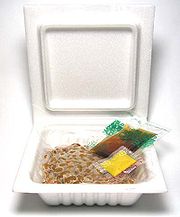
Polystyrene
Polystyrene ) also known as Thermocole, abbreviated following ISO Standard PS, is an aromatic polymer made from the monomer styrene, a liquid hydrocarbon that is manufactured from petroleum by the chemical industry...
containers. A typical package contains two, three or occasionally four containers, each 40 to 50 g. One container typically complements a small bowl of rice. It usually includes a small packet of soy sauce and another packet of karashi
Karashi
is a type of mustard used as a condiment or as a seasoning in Japanese cuisine. Karashi is made from the crushed seeds of Brassica juncea. Karashi is usually sold in powder form or paste form in tubes...
, a type of mustard. Other flavors, such as shiso
Perilla
Perilla is the common name of the herbs of the genus Perilla of the mint family, Lamiaceae. In mild climates, the plant reseeds itself. There are both green-leafed and purple-leafed varieties, which are generally recognized as separate species by botanists. The leaves resemble stinging nettle...
, are available.
Mito City
Mito, Ibaraki
is the capital of Ibaraki Prefecture, Japan and has a central location, moderately offset towards the coast in that prefecture. As of 2005, the city has an estimated population of 263,748 and a total area is 217.45 km², giving a population density of 1,212.91 persons per km²...
and Kumamoto Prefecture
Kumamoto Prefecture
is a prefecture of Japan located on Kyushu Island. The capital is the city of Kumamoto.- History :Historically the area was called Higo Province; and the province was renamed Kumamoto during the Meiji Restoration. The creation of prefectures was part of the abolition of the feudal system...
are major nattō-producing areas.
Outside Japan nattō is sometimes sold frozen and must be thawed before consumption.
To make nattō at home you need a bacterial culture of B. subtilis. B. subtilis nattō is weak in lactic acid. It is important to prevent lactic acid bacteria from breeding. Some B. subtilis nattō which are more odorless are usually inactive, so, there are possibilities that minor germs will breed. Bacteriophage is B. subtilis's enemy. After bacteriophage has acted minor germs may breed, particularly in boiled soy beans.
Medical benefits
The Japanese media frequently claim, especially in television shows for health-concerned viewers, that nattō is health-enhancing and that these claims are backed by medical research.One example is pyrazine
Pyrazine
Pyrazine is a heterocyclic aromatic organic compound with the chemical formula C4H4N2.Pyrazine is a symmetrical molecule with point group D2h. Derivatives like phenazine are well known for their antitumor, antibiotic and diuretic activity. Pyrazine is less basic in nature than pyridine, pyridazine...
: Pyrazine is a compound that, in addition to giving nattō its distinct smell, reduces the likelihood of blood clotting
Coagulation
Coagulation is a complex process by which blood forms clots. It is an important part of hemostasis, the cessation of blood loss from a damaged vessel, wherein a damaged blood vessel wall is covered by a platelet and fibrin-containing clot to stop bleeding and begin repair of the damaged vessel...
. It also contains a serine protease
Serine protease
Serine proteases are enzymes that cleave peptide bonds in proteins, in which serine serves as the nucleophilic amino acid at the active site.They are found ubiquitously in both eukaryotes and prokaryotes...
type enzyme
Enzyme
Enzymes are proteins that catalyze chemical reactions. In enzymatic reactions, the molecules at the beginning of the process, called substrates, are converted into different molecules, called products. Almost all chemical reactions in a biological cell need enzymes in order to occur at rates...
called nattokinase
Nattokinase
Nattokinase is an enzyme extracted and purified from a Japanese food called nattō. Nattō is a food made from fermented soybeans that has been eaten in Japan for many years. Nattō is produced by fermentation by adding the bacterium Bacillus natto, a beneficial bacteria, to boiled soybeans. The...
which may also reduce blood clotting both by direct fibrinolysis
Fibrinolysis
Fibrinolysis is a process that prevents blood clots from growing and becoming problematic. This process has two types: primary fibrinolysis and secondary fibrinolysis...
of clots, and inhibition of the plasma protein
Blood proteins
Blood proteins, also termed serum proteins or plasma proteins, are proteins found in blood plasma. Serum total protein in blood is 7g/dl...
plasminogen activator inhibitor 1. This may help to avoid thrombosis
Thrombosis
Thrombosis is the formation of a blood clot inside a blood vessel, obstructing the flow of blood through the circulatory system. When a blood vessel is injured, the body uses platelets and fibrin to form a blood clot to prevent blood loss...
, as for example in heart attacks
Myocardial infarction
Myocardial infarction or acute myocardial infarction , commonly known as a heart attack, results from the interruption of blood supply to a part of the heart, causing heart cells to die...
, pulmonary embolism
Pulmonary embolism
Pulmonary embolism is a blockage of the main artery of the lung or one of its branches by a substance that has travelled from elsewhere in the body through the bloodstream . Usually this is due to embolism of a thrombus from the deep veins in the legs, a process termed venous thromboembolism...
, or strokes.
An extract from nattō containing nattokinase is available as a dietary supplement. Studies have shown that oral administration of nattokinase in enteric capsules leads to a mild enhancement of fibrinolytic activity in rats and dogs. It is, therefore, plausible to hypothesize that nattokinase might reduce blood clots in humans—although clinical trials have not been conducted. Another study suggests the FAS in natto is the substance which initiates fibrinolysis of clots, which accelerates the activity of not only nattokinase but urokinase.
A 2009 study in Taiwan indicated that the nattokinase in natto has the ability to degrade amyloid fibrils, suggesting that it might be a preventative or a treatment for amyloid-type diseases such as Alzheimer's.
Nattō contains large amounts of vitamin K
Vitamin K
Vitamin K is a group of structurally similar, fat soluble vitamins that are needed for the posttranslational modification of certain proteins required for blood coagulation and in metabolic pathways in bone and other tissue. They are 2-methyl-1,4-naphthoquinone derivatives...
, which is involved in the formation of calcium
Calcium
Calcium is the chemical element with the symbol Ca and atomic number 20. It has an atomic mass of 40.078 amu. Calcium is a soft gray alkaline earth metal, and is the fifth-most-abundant element by mass in the Earth's crust...
-binding groups in proteins, assisting the formation of bone and preventing osteoporosis
Osteoporosis
Osteoporosis is a disease of bones that leads to an increased risk of fracture. In osteoporosis the bone mineral density is reduced, bone microarchitecture is deteriorating, and the amount and variety of proteins in bone is altered...
. Vitamin K1 is found naturally in seaweed, liver, and some vegetables, while vitamin K2 (Menatetrenone
Menatetrenone
Menatetrenone , also known as MK4, is a menaquinone compound used as a hemostatic agent and as adjunctive therapy for the pain of osteoporosis. It is marketed for the latter indication in Japan by Eisai Co., under the trade name Glakay....
) is found in fermented food products such as cheese, miso, and Nattō. Nattō has large amounts of vitamin K2, approximately 870 micrograms per 100 grams of nattō.
According to a study, fermented soybeans, such as nattō, contain vitamin PQQ
Pyrroloquinoline quinone
Pyrroloquinoline quinone was discovered by J.G. Hauge as the third redox cofactor after nicotinamide and flavin in bacteria . Anthony and Zatman also found the unknown redox cofactor in alcohol dehydrogenase and named it methoxatin...
, which is important for the skin. PQQ in human tissues is derived mainly from diet.
According to recent studies, polyamine suppresses excessive immune reactions, and nattō has a much larger amount of it than any other food. Dietary supplements containing the substances extracted from natto such as polyamine, nattokinase, FAS and vitamin K2 are available.
Nattō contains chemicals alleged to prevent cancer
Cancer
Cancer , known medically as a malignant neoplasm, is a large group of different diseases, all involving unregulated cell growth. In cancer, cells divide and grow uncontrollably, forming malignant tumors, and invade nearby parts of the body. The cancer may also spread to more distant parts of the...
, for example, daidzein
Daidzein
Daidzein belongs to the group of isoflavones. Daidzein and other isoflavone compounds, such as genistein, are present in a number of plants and herbs like the Thai Kwao Krua or Pueraria mirifica, Kudzu or Pueraria lobata, and in food sources such as soybeans and soy products like tofu and textured...
, genistein
Genistein
Genistein is one of several known isoflavones. Isoflavones, such as genistein and daidzein, are found in a number of plants including lupin, fava beans, soybeans, kudzu, and psoralea being the primary food source, also in the medicinal plant, Flemingia vestita and coffee Besides functioning as...
, isoflavone
Isoflavone
Isoflavones comprise a class of organic compounds, often naturally occurring, related to the isoflavonoids. Many act as phytoestrogens in mammals...
, phytoestrogen, and the chemical element
Chemical element
A chemical element is a pure chemical substance consisting of one type of atom distinguished by its atomic number, which is the number of protons in its nucleus. Familiar examples of elements include carbon, oxygen, aluminum, iron, copper, gold, mercury, and lead.As of November 2011, 118 elements...
selenium
Selenium
Selenium is a chemical element with atomic number 34, chemical symbol Se, and an atomic mass of 78.96. It is a nonmetal, whose properties are intermediate between those of adjacent chalcogen elements sulfur and tellurium...
. However, most of these chemicals can also be found in other soybean products, and their effect on cancer prevention is uncertain.
Recent studies show nattō may have a cholesterol
Cholesterol
Cholesterol is a complex isoprenoid. Specifically, it is a waxy steroid of fat that is produced in the liver or intestines. It is used to produce hormones and cell membranes and is transported in the blood plasma of all mammals. It is an essential structural component of mammalian cell membranes...
-lowering effect.
Nattō is said to have an antibiotic
Antibiotic
An antibacterial is a compound or substance that kills or slows down the growth of bacteria.The term is often used synonymously with the term antibiotic; today, however, with increased knowledge of the causative agents of various infectious diseases, antibiotic has come to denote a broader range of...
effect, and its use as medicine against dysentery
Dysentery
Dysentery is an inflammatory disorder of the intestine, especially of the colon, that results in severe diarrhea containing mucus and/or blood in the faeces with fever and abdominal pain. If left untreated, dysentery can be fatal.There are differences between dysentery and normal bloody diarrhoea...
was researched by the Imperial Japanese Navy
Imperial Japanese Navy
The Imperial Japanese Navy was the navy of the Empire of Japan from 1869 until 1947, when it was dissolved following Japan's constitutional renunciation of the use of force as a means of settling international disputes...
before World War II
World War II
World War II, or the Second World War , was a global conflict lasting from 1939 to 1945, involving most of the world's nations—including all of the great powers—eventually forming two opposing military alliances: the Allies and the Axis...
.
Nattō is claimed to prevent obesity
Obesity
Obesity is a medical condition in which excess body fat has accumulated to the extent that it may have an adverse effect on health, leading to reduced life expectancy and/or increased health problems...
, possibly because of its low calorie content of approximately 90 calories per 7–8 grams of protein in an average serving. Unverified claims include improved digestion
Digestion
Digestion is the mechanical and chemical breakdown of food into smaller components that are more easily absorbed into a blood stream, for instance. Digestion is a form of catabolism: a breakdown of large food molecules to smaller ones....
, reduced effects of aging
Senescence
Senescence or biological aging is the change in the biology of an organism as it ages after its maturity. Such changes range from those affecting its cells and their function to those affecting the whole organism...
, and the reversal of hair loss in men due to its phytoestrogen
Phytoestrogens
Phytoestrogens are plant-derived xenoestrogens functioning as the primary female sex hormone not generated within the endocrine system but consumed by eating phytoestrogonic plants...
content, which can affect testosterone
Testosterone
Testosterone is a steroid hormone from the androgen group and is found in mammals, reptiles, birds, and other vertebrates. In mammals, testosterone is primarily secreted in the testes of males and the ovaries of females, although small amounts are also secreted by the adrenal glands...
associated with baldness
Baldness
Baldness implies partial or complete lack of hair and can be understood as part of the wider topic of "hair thinning". The degree and pattern of baldness can vary greatly, but its most common cause is male and female pattern baldness, also known as androgenic alopecia, alopecia androgenetica or...
. These conjectured physiological effects of eating natto are based on biochemically active contents of nattō, and have not been confirmed by human study.
Nattō is also sometimes used as an ingredient of pet
Pet
A pet is a household animal kept for companionship and a person's enjoyment, as opposed to wild animals or to livestock, laboratory animals, working animals or sport animals, which are kept for economic or productive reasons. The most popular pets are noted for their loyal or playful...
food, and it is claimed that this improves the health of the pets.
Similar foods
Many countries produce similar traditional soybean foods fermented with Bacillus subtilis, such as shuǐdòuchǐ (水豆豉) of ChinaChinese cuisine
Chinese cuisine is any of several styles originating in the regions of China, some of which have become highly popular in other parts of the world – from Asia to the Americas, Australia, Western Europe and Southern Africa...
, cheonggukjang
Cheonggukjang
Cheonggukjang is a fermented soybean paste used in Korean cuisine. It contains whole as well as ground soybeans.- Production :It can be made in 2 to 3 days through fermentation of boiled soybeans, adding Bacillus subtilis, which is usually contained in the air or in the jip, dried rice plants,...
(청국장) of Korea, thua nao of Thailand, kinema of Nepal
Nepalese cuisine
Nepalese cuisine refers to the cuisines of Nepal. The cultural and geographic diversity of Nepal provide ample space for a variety of cuisines based on ethnicity, soil and climate. Nevertheless dal-bhat-tarkari is eaten throughout the country. Dal is a soup made of lentils and spices...
and the Himalayan regions of West Bengal
West Bengal
West Bengal is a state in the eastern region of India and is the nation's fourth-most populous. It is also the seventh-most populous sub-national entity in the world, with over 91 million inhabitants. A major agricultural producer, West Bengal is the sixth-largest contributor to India's GDP...
and Sikkim
Sikkim
Sikkim is a landlocked Indian state nestled in the Himalayan mountains...
, India
Indian cuisine
Indian cuisine consists of thousands of regional cuisines which date back thousands of years. The dishes of India are characterised by the extensive use of various Indian spices, herbs, vegetables and fruit. Indian cuisine is also known for the widespread practice of vegetarianism in Indian society...
. In addition certain West African bean products are fermented with the bacillus, including dawadawa, sumbala, and iru, made from néré
Parkia biglobosa
Parkia biglobosa or Néré is a tree of the genus Parkia in the family Fabaceae. In West Africa, its fruits are fermented to a condiment called "soumbala" or "dawa-dawa"....
seeds or soybeans, and ogiri
Ogiri
Ogiri is a flavoring made of fermented oil seeds, such as sesame seeds or egusi seeds. The process and product are similar to iru or douchi. Its smell is like cheese, miso, or stinky tofu.Ogiri is best known in West Africa....
, made from sesame
Sesame
Sesame is a flowering plant in the genus Sesamum. Numerous wild relatives occur in Africa and a smaller number in India. It is widely naturalized in tropical regions around the world and is cultivated for its edible seeds, which grow in pods....
or melon seeds.
Methods of eating nattō differs from region to region and many ways are resisted. Some eat nattō with rice, while others eat nattō with curry, Chinese noodles, Japanese style pasta, and tempura.
Natto dishes
Salted nattō is a local dish in the Kouchi prefecture of Japan. Nattō is sprinkled with salt, and roasted "nuka" (powdered rice bran) is added in the pan. In the traditional recipe, the nattō soybeans are steamed with "momigara" (rice bran).Stamina nattō is nattō is mixed with minced chicken, then stir-fried in sesame oil, ginger, and garlic. Tabasco is added as a "secret ingredient." It is offered with the school lunch in the Tottori prefecture of central Japan.
Nattō Ae is nattō is mixed with cheese, soy sauce, parsley and sugar. It is offered with the school lunch in the city of Toyota in the Aichi prefecture of Japan.
Sakura nattō is nattō with horse meat.
In the Iron Chef
Iron Chef
is a Japanese television cooking show produced by Fuji Television. The series, which premiered on October 10, 1992, is a stylized cook-off featuring guest chefs challenging one of the show's resident "Iron Chefs" in a timed cooking battle built around a specific theme ingredient. The series ended...
episode which featured challenger Tatsutoshi Kumamoto vs. Iron Chef Masaharu Morimoto
Masaharu Morimoto
is a well-known Japanese chef, best known as the third Iron Chef on the Japanese TV cooking show Iron Chef, and an Iron Chef on its spinoff, Iron Chef America. He is also known for his unique style of presenting food....
, natto, the theme ingredient, was used in many creative ways including abalone stew, natto sausage and in a cola flavoured dessert.
See also
- Japanese cuisineJapanese cuisineJapanese cuisine has developed over the centuries as a result of many political and social changes throughout Japan. The cuisine eventually changed with the advent of the Medieval age which ushered in a shedding of elitism with the age of shogun rule...
Other fermented soy foods include soy sauce
Soy sauce
Soy sauce is a condiment produced by fermenting soybeans with Aspergillus oryzae or Aspergillus sojae molds, along with water and salt...
, Japanese miso
Miso
is a traditional Japanese seasoning produced by fermenting rice, barley and/or soybeans, with salt and the fungus , the most typical miso being made with soy. The result is a thick paste used for sauces and spreads, pickling vegetables or meats, and mixing with dashi soup stock to serve as miso...
, Chinese dòuchǐ
Douchi
Douchi , also called Chinese fermented black beans , is a flavoring most popular in the cuisine of China, and is used to make black bean sauce....
(fermented black beans) and chòu dòufu
Stinky tofu
Stinky tofu or chòu dòufu is a form of fermented tofu that has a strong odor. It is a popular snack in East and Southeast Asia, particularly mainland China, Taiwan and Hong Kong and in East Asian enclaves elsewhere where it is usually found homemade, at night markets or roadside stands, or as a...
(stinky tofu), Korean doenjang
Doenjang
Doenjang is a traditional Korean fermented soybean paste. Its name literally means "thick paste" in Korean.-Production:...
and cheonggukjang
Cheonggukjang
Cheonggukjang is a fermented soybean paste used in Korean cuisine. It contains whole as well as ground soybeans.- Production :It can be made in 2 to 3 days through fermentation of boiled soybeans, adding Bacillus subtilis, which is usually contained in the air or in the jip, dried rice plants,...
, Nepalese kinema
Kinema
Kinema may refer to:*kinema — a popular Nepali dish which is prepared by fermentation of soybean. Kinema is cooked and taken its soup with rice....
, and Indonesian oncom
Oncom
Oncom is one of the traditional staple foods of West Javan cuisine. There are two kinds of oncom: red oncom and black oncom...
and tempeh
Tempeh
Tempeh , or tempe , is a traditional soy product originally from Indonesia. It is made by a natural culturing and controlled fermentation process that binds soybeans into a cake form, similar to a very firm vegetarian burger patty...
.
- Fermented bean pasteFermented bean pasteFermented bean paste is a category of fermented foods typically made from ground soybeans, which are indigenous to the cuisines of East and Southeast Asia...
Note that amanattō
Amanatto
is a Japanese traditional confectionery that is made of azuki or other beans, covered with refined sugar after simmering with sugar syrup and drying....
is not nattō but, rather, beans sweetened with sugar.