
All Topics  
Tempeh

 
Tempeh

   Email Print
   Bookmark   Link


Tempeh


Tempeh, or tempe in Javanese
Javanese language

Javanese is the language of the people in the central and eastern parts of the island of Java, in Indonesia. In addition, there are also some pockets of Javanese speakers in the northern coast of western Java....
, is made by a natural culturing and controlled fermentation
Fermentation (food)

Fermentation in food processing typically refers to the conversion of sugar to alcohol using yeast under anaerobic conditions. A more general definition of fermentation is the chemical conversion of carbohydrates into alcohols or acids....
 process that binds soybean
Soybean

The soybean or soya bean is a species of legume native to East Asia. The plant is classed as an oilseed rather than a Pulse . It is an annual plant that has been used in China for 5,000 years as a food and a component of drugs....
s into a cake form. It is especially popular on the island of Java
Java

Java is an island of Indonesia and the site of its Capital city, Jakarta. Once the centre of powerful Hindu kingdoms, The spread of Islam in Indonesia , and the core of the colonial Dutch East Indies, Java now plays a dominant role in the economic and political life of Indonesia....
, where it is a staple
Staple food

A staple food is a food that can be stored for use throughout the year and forms the basis of a traditional diet. Staple foods vary from place to place, but are typically inexpensive starchy foods of vegetable origin that are high in food energy and carbohydrate....
 source of protein. Like tofu
Tofu

Tofu , also , doufu , toufu, or bean curd , is a food of China origin, made by coagulating soy milk, and then pressing the resulting curds into blocks....
, tempeh is made from soybeans, but tempeh is a whole soybean product with different nutrition
Nutrition

Nutrition is the provision, to cells and organisms, of the materials necessary to support life. Many common health problems can be prevented or alleviated with good nutrition....
al characteristics and textural qualities. Tempeh's fermentation process and its retention of the whole bean
Soybean

The soybean or soya bean is a species of legume native to East Asia. The plant is classed as an oilseed rather than a Pulse . It is an annual plant that has been used in China for 5,000 years as a food and a component of drugs....
 give it a higher content of protein
Protein

Proteins are organic compounds made of amino acids arranged in a linear chain and joined together by peptide bonds between the carboxyl and amino groups of adjacent amino acid Residue ....
, dietary fiber
Dietary fiber

Dietary fiber, sometimes called "roughage", is the indigestible portion of plant foods that pushes food through the digestive system, absorbing water and easing defecation....
 and vitamin
Vitamin

A vitamin is an organic compound required as a nutrient in tiny amounts by an organism. A compound is called a vitamin when it cannot be biosynthesis in sufficient quantities by an organism, and must be obtained from the diet....
s compared to tofu, as well as firmer texture and stronger flavor
Flavor

Flavor or flavour is the sensory impression of a food or other chemical substance, and is determined mainly by the chemical senses of taste and olfaction....
.


Nutrition Facts


Discussion
Ask a question about 'Tempeh'
Start a new discussion about 'Tempeh'
Answer questions from other users
Full Discussion Forum


Encyclopedia


Tempeh, or tempe in Javanese
Javanese language

Javanese is the language of the people in the central and eastern parts of the island of Java, in Indonesia. In addition, there are also some pockets of Javanese speakers in the northern coast of western Java....
, is made by a natural culturing and controlled fermentation
Fermentation (food)

Fermentation in food processing typically refers to the conversion of sugar to alcohol using yeast under anaerobic conditions. A more general definition of fermentation is the chemical conversion of carbohydrates into alcohols or acids....
 process that binds soybean
Soybean

The soybean or soya bean is a species of legume native to East Asia. The plant is classed as an oilseed rather than a Pulse . It is an annual plant that has been used in China for 5,000 years as a food and a component of drugs....
s into a cake form. It is especially popular on the island of Java
Java

Java is an island of Indonesia and the site of its Capital city, Jakarta. Once the centre of powerful Hindu kingdoms, The spread of Islam in Indonesia , and the core of the colonial Dutch East Indies, Java now plays a dominant role in the economic and political life of Indonesia....
, where it is a staple
Staple food

A staple food is a food that can be stored for use throughout the year and forms the basis of a traditional diet. Staple foods vary from place to place, but are typically inexpensive starchy foods of vegetable origin that are high in food energy and carbohydrate....
 source of protein. Like tofu
Tofu

Tofu , also , doufu , toufu, or bean curd , is a food of China origin, made by coagulating soy milk, and then pressing the resulting curds into blocks....
, tempeh is made from soybeans, but tempeh is a whole soybean product with different nutrition
Nutrition

Nutrition is the provision, to cells and organisms, of the materials necessary to support life. Many common health problems can be prevented or alleviated with good nutrition....
al characteristics and textural qualities. Tempeh's fermentation process and its retention of the whole bean
Soybean

The soybean or soya bean is a species of legume native to East Asia. The plant is classed as an oilseed rather than a Pulse . It is an annual plant that has been used in China for 5,000 years as a food and a component of drugs....
 give it a higher content of protein
Protein

Proteins are organic compounds made of amino acids arranged in a linear chain and joined together by peptide bonds between the carboxyl and amino groups of adjacent amino acid Residue ....
, dietary fiber
Dietary fiber

Dietary fiber, sometimes called "roughage", is the indigestible portion of plant foods that pushes food through the digestive system, absorbing water and easing defecation....
 and vitamin
Vitamin

A vitamin is an organic compound required as a nutrient in tiny amounts by an organism. A compound is called a vitamin when it cannot be biosynthesis in sufficient quantities by an organism, and must be obtained from the diet....
s compared to tofu, as well as firmer texture and stronger flavor
Flavor

Flavor or flavour is the sensory impression of a food or other chemical substance, and is determined mainly by the chemical senses of taste and olfaction....
. Tofu, by contrast, is said to be more versatile in dishes. Because of its nutritional value, tempeh is used worldwide in vegetarian cuisine
Vegetarian cuisine

Vegetarian cuisine refers to food that meets Vegetarianism by excluding meat and animal tissue products. For lacto-ovo vegetarianism , Egg and dairy products such as milk and cheese are permitted....
; some consider it to be a meat analogue
Meat analogue

A meat analogue, also called a meat substitute, mock meat, faux meat, or imitation meat, approximates the aesthetic qualities and/or chemical characteristics of certain types of meat....
. Even long before people found and realized its rich nutritional value, tempeh was referred to as “Javanese meat.”

Production

Tempeh Uncooked
Tempeh begins with whole soybeans, which are softened by soaking and dehulled, then partly cooked. Specialty tempehs may be made from other types of bean
Bean

Bean is a common name for large plant seeds of several genus of the Family Fabaceae used for human food or animal feed.The whole young pods of bean plants, if picked before the pods ripen and dry, can be tender enough to eat whole, whether cooked or raw....
s, wheat
Wheat

Wheat , is a worldwide cultivated Poaceae from the Levant region of the Middle East. Globally, after maize, wheat is the second most-produced food among the cereal just above rice....
, or may include a mixture of beans and whole grain
Whole grain

Whole grains are cereal that contain bran and cereal germ as well as the endosperm, in contrast to refined grains, which retain only the endosperm....
s.

A mild acid
Acid

An acid is traditionally considered any chemical compound that, when dissolved in water, gives a solution with a hydrogen ion Activity greater than in pure water, i.e....
ulent, usually vinegar
Vinegar

Vinegar is an acidic liquid processed from the fermentation of ethanol in a process that yields its key ingredient, acetic acid . It also may come in a diluted form....
, may be added in order to lower the pH and create a selective environment that favors the growth of the tempeh mold over competitors. A fermentation starter
Fermentation starter

Fermentation starters are preparations to assist the beginning of the fermentation process in preparation of various foods and :Category:Fermented beveragess....
 containing the spores of fungus
Fungus

A fungus is a Eukaryote organism that is a member of the Kingdom Fungi . The fungi are a monophyletic group, also called the Eumycota , that is phylogeny distinct from the morphologically similar slime molds and water molds ....
 Rhizopus oligosporus
Rhizopus oligosporus

Rhizopus oligosporus is a fungus of the family Mucoraceae that is a widely used starter culture for the home production of tempeh. The spores produce fluffy, white Mycelium, binding the beans together to create an edible ?cake? of partly fermented soybeans....
 is mixed in. The beans are spread into a thin layer and are allowed to ferment for 24 to 36 hours at a temperature around 30°C
Celsius

Celsius is a temperature scale that is named after the Swedish astronomer Anders Celsius , who developed a similar temperature scale two years before his death....
 (86°F
Fahrenheit

Fahrenheit is a temperature scale named after the physicist Daniel Gabriel Fahrenheit , who proposed it in 1724. Today, the scale has largely been replaced by the Celsius scale; it is still in use for non-scientific purposes in the United States and a few other countries such as Belize....
). In good tempeh, the beans are knitted together by a mat of white mycelia.

Under conditions of lower temperature, or higher ventilation, gray or black patches of spore
Spore

In biology, a spore is a reproduction structure that is adapted for biological dispersal and surviving for extended periods of time in unfavorable conditions....
s may form on the surface—this is not harmful, and should not affect the flavor or quality of the tempeh. This sporulation is normal on fully mature tempeh. A mild ammonia
Ammonia

Ammonia is a chemical compound with the chemical formula nitrogenhydrogen. It is normally encountered as a gas with a characteristic pungent odor....
 smell may accompany good tempeh as it ferments, but it should not be overpowering. In Indonesia, ripe tempeh (two or more days old) is considered a delicacy.

Nutrition

The soy protein
Protein

Proteins are organic compounds made of amino acids arranged in a linear chain and joined together by peptide bonds between the carboxyl and amino groups of adjacent amino acid Residue ....
 in tempeh becomes more digestible as a result of the fermentation process. In particular, the oligosaccharide
Oligosaccharide

An oligosaccharide is a saccharide polymer containing a small number of component sugars, also known as simple sugars. The name derived from the Greek oligos, meaning "a few"....
s that are associated with gas and indigestion are greatly reduced by the Rhizopus culture. In traditional tempeh making shops, the starter culture often contains other beneficial bacteria that produce vitamins such as B12
Vitamin B12

Vitamin B12 is a water soluble vitamin with a key role in the normal functioning of the brain and nervous system, and for the formation of blood....
 (though it is disputed whether this B12 is "bioavailable"). In western countries, it is more common to use a pure culture containing only Rhizopus oligosporus
Rhizopus oligosporus

Rhizopus oligosporus is a fungus of the family Mucoraceae that is a widely used starter culture for the home production of tempeh. The spores produce fluffy, white Mycelium, binding the beans together to create an edible ?cake? of partly fermented soybeans....
.

Preparation


In the kitchen, tempeh is often prepared by cutting it into pieces, soaking in brine
Brine

File:Kissingen-Solepumpe-1848.JPGFile:Kissingen-Solepumpe-1848-2.JPGBrine is water Saturation or nearly saturated with a Salt .It is used to preserve vegetables, fish, and meat, in a process known as brining ....
 or salty
Edible salt

Salt is a dietary mineral composed primarily of sodium chloride that is essential for animal life, but toxic to most land plants. Salt flavor is one of the taste#Basic_tastes, an important Salting_ and a popular food seasoning....
 sauce
Sauce

In cooking, a sauce is liquid or sometimes semi-solid food served on or used in preparing other foods. Sauces are not normally consumed by themselves; they add flavor, moisture, and visual appeal to another dish....
, and then frying
Frying

Frying is the cooking of food in oil or fat, a technique that originated in ancient Old_Kingdom around 2500BC. Chemically, oils and fats are the same, differing only in melting point, but the distinction is only made when needed....
. Cooked tempeh can be eaten alone, or used in chili, stir frys, soups, salads, sandwiches, and stews. Recent popular vegan cookbooks have come up with more creative ways of cooking tempeh, using it as a vegetarian substitution for breakfast meats, such as sausage and bacon. Tempeh has a complex flavor that has been described as nutty, meaty, and mushroom-like. Tempeh freezes well, and is now commonly available in many western supermarkets as well as in ethnic markets and health food stores. Tempeh performs well in a cheese grater, after which it may be used in the place of ground beef (as in tacos). When thin sliced and deep fried in oil, tempeh obtains a crispy golden crust while maintaining a soft interior—its sponge-like consistency make it suitable for marinades. Dried tempeh (whether cooked or raw) provides an excellent stew base for backpackers. For the Thanksgiving
Thanksgiving

Thanksgiving may refer to:*Thanksgiving , the holiday on the fourth Thursday in November.*Thanksgiving , the holiday on the second Monday in October....
 holiday, tempeh (as dark meat) and tofu (as white) may each be thick-sliced and baked with a standard dressing/stuffing preparation to provide a vegan alternative to turkey.

Types

Name Description
tempe bongkrčk made from or with coconut
Coconut

The Coconut Palm is a member of the Family Arecaceae . It is the only species in the genus Cocos, and is a large palm, growing to 30 m tall, with pinnate leaf 4-6 m long, pinnae 60-90 cm long; old leaves break away cleanly leaving the trunk smooth....
 press cake
Press cake

Press cake is the solids remaining after pressing something to extract the liquids. This can be from pressing:*olives for olive oil *Peanut for peanut oil...
 (see below)
tempe bosok (busuk) rotten tempeh, used in small amounts as a flavoring
tempe gembus made from okara
Okara (food)

Okara or soy pulp is a white or yellowish pulp consisting of insoluble parts of the soybean which remain in the filter sack when pureed soybeans are filter ed in the production of soy milk....
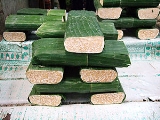
tempe gódhóng tempeh made in banana
Banana

File:Banana and cross section.jpgBanana is the common name for a fruit and also the herbaceous plants of the genus Musa which produce this commonly eaten fruit....
 leaves
tempe goreng deep-fried tempeh
tempe mendoan raw-fried tempeh
tempe kedelai simply tempeh, made from soybeans
tempe murni tempeh made in plastic wrap (lit. pure soybean cake)
tempe oncom also onchom; made from peanut
Peanut

The peanut, or groundnut , is a species in the legume Fabaceae native to South America, Mexico and Central America. It is an annual plant herbaceous plant growing to 30 to 50 cm tall....
 press cake
Press cake

Press cake is the solids remaining after pressing something to extract the liquids. This can be from pressing:*olives for olive oil *Peanut for peanut oil...
; orange color; Neurospora sitophila


A new form of tempeh based on barley
Barley

Barley is an annual plant cereal grain derived from the grass Hordeum vulgare. It serves as a major animal feed crop, with smaller amounts used for malting and in health food, as well as the making of alcoholic beverages beer and whisky....
 and oats instead of soya was developed by scientists at the Swedish Department of Food Science in 2008. It can be produced in climate regions where it is not possible to grow soya beans.

Tempe bongkrčk

Tempe bongkrčk is a variety of tempeh from Central Java, notably Banyumas
Banyumas

Banyumas is a Regencies of Indonesia in the southwestern part of Central Java province in Indonesia. Its capital is Purwokerto.The term Banyumasan is also used as an adjective referring to the culture, language and peoples of larger Banyumas area....
 regency, that is prepared with coconut
Coconut

The Coconut Palm is a member of the Family Arecaceae . It is the only species in the genus Cocos, and is a large palm, growing to 30 m tall, with pinnate leaf 4-6 m long, pinnae 60-90 cm long; old leaves break away cleanly leaving the trunk smooth....
. This type of tempeh occasionally gets contaminated with the bacterium Burkholderia cocovenenans, and the unwanted organism produces toxins (Bongkrek acid
Bongkrek acid

Bongkrek acid is a Cellular respiration toxin more deadly than cyanide.It is produced in fermentation coconut contaminated by the bacterium Burkholderia cocovenenans....
 and toxoflavin) from the coconut, besides killing off the Rhizopus fungus due to the antibiotic
Antibiotic

In common usage, an antibiotic is a substance or compound that kills or inhibits the growth of bacteria. Antibiotics belong to the group of antimicrobial compounds used to treat infections caused by microorganisms, including fungus and protozoa....
 activity of bongkrek acid.

Fatalities from contaminated tempe bongkrčk were once common in the area where it was produced. Thus, the sale of tempeh bongkrčk is prohibited by law nowadays; clandestine manufacture continues however due to the superior culinary value. The problem of contamination is not encountered with bean or grain tempeh, which have a different composition of fatty acids that is not favorable for the growth of B. cocovenenans but encourages growth of Rhizopus instead. When bean or grain tempeh has the proper color, texture and smell, it is a very strong indication that the product is safe. Tempe bongkrčk which is yellow is always highly toxic due to toxoflavin, but tempe bongkrčk with a normal coloration may still contain lethal amounts of bongkrek acid.

Tempe Mendoan

A variation of tempeh cooking method, often found in Purwokerto
Purwokerto

Purwokerto is a city on the island of Java in Indonesia. It is the capital of Banyumas Regency, Central Java region. The estimated population of the city in 2005 was 249,705....
. The origin of the word 'Mendoan' is from Banyumas
Banyumas

Banyumas is a Regencies of Indonesia in the southwestern part of Central Java province in Indonesia. Its capital is Purwokerto.The term Banyumasan is also used as an adjective referring to the culture, language and peoples of larger Banyumas area....
 regional dialect
Dialect

A dialect is a variety of a language that is characteristic of a particular group of the language's speakers. The term is applied most often to regional speech patterns, but a dialect may also be defined by other factors, such as social class....
, which means "to cook instantly in very hot oil", that results in raw and limp cooking.

See also

  • Tofu
    Tofu

    Tofu , also , doufu , toufu, or bean curd , is a food of China origin, made by coagulating soy milk, and then pressing the resulting curds into blocks....
  • Miso
    Miso

    is a traditional Japanese cuisine produced by fermentation rice, barley and/or soybeans, with salt and the fungus , the most typical miso being made with soy....
  • Douchi
    Douchi

    Douchi, also called Chinese fermented black beans, is a flavoring most popular in the cuisine of China, and is used to make black bean sauce....
  • Natto
    Natto

    is a traditional Japanese cuisine made from fermentation soybeans, popular especially for breakfast. As a rich source of protein, natto and the soybean paste miso formed a vital source of nutrition in History of Japan#Feudal_Japan_.2812th_-_19th_century.29....
  • Oncom
    Oncom

    Oncom is one of the staple foods of Indonesia. In Indonesia, there are two kinds of oncom: red oncom and black oncom. Oncom is closely related to tempeh; both are foods fermented using fungus, traditionally made in Indonesia....
  • Iru
    Iru

    Ir? is a type of fermented locust beans used as a condiment in cooking. It is similar to ogiri and douchi. It is very popular among the Yoruba people of Nigeria....
  • Ogiri
    Ogiri

    Ogiri is a flavoring made of fermentation oil seeds, such as sesame seeds or egusi seeds. The process and product are similar to iru or douchi. Its smell is like cheese, miso, or stinky tofu....


External links

  • - Mother Earth News, Issue # 47 - September/October 1977