


Kansai

Encyclopedia

Japan
Japan is an island nation in East Asia. Located in the Pacific Ocean, it lies to the east of the Sea of Japan, China, North Korea, South Korea and Russia, stretching from the Sea of Okhotsk in the north to the East China Sea and Taiwan in the south...
's main island Honshū
Honshu
is the largest island of Japan. The nation's main island, it is south of Hokkaido across the Tsugaru Strait, north of Shikoku across the Inland Sea, and northeast of Kyushu across the Kanmon Strait...
. The region includes the prefecture
Prefecture
A prefecture is an administrative jurisdiction or subdivision in any of various countries and within some international church structures, and in antiquity a Roman district governed by an appointed prefect.-Antiquity:...
s of Mie
Mie Prefecture
is a prefecture of Japan which is part of the Kansai regions on Honshū island. The capital is the city of Tsu.- History :Until the Meiji Restoration, Mie prefecture was known as Ise Province and Iga Province....
, Nara
Nara Prefecture
is a prefecture in the Kansai region on Honshū Island, Japan. The capital is the city of Nara.-History:The present-day Nara Prefecture was created in 1887, making it independent of Osaka Prefecture....
, Wakayama
Wakayama Prefecture
is a prefecture of Japan located on the Kii Peninsula in the Kansai region on Honshū island. The capital is the city of Wakayama.- History :Present-day Wakayama is mostly the western part of the province of Kii.- 1953 Wakayama Prefecture flood disaster :...
, Kyoto
Kyoto Prefecture
is a prefecture of Japan located in the Kansai region of the island of Honshu. The capital is the city of Kyoto.- History :Until the Meiji Restoration, the area of Kyoto prefecture was known as Yamashiro....
, Osaka
Osaka Prefecture
is a prefecture located in the Kansai region on Honshū, the main island of Japan. The capital is the city of Osaka. It is the center of Osaka-Kobe-Kyoto area.- History :...
, Hyōgo
Hyogo Prefecture
is a prefecture of Japan located in the Kansai region on Honshū island. The capital is Kobe.The prefecture's name was previously alternately spelled as Hiogo.- History :...
, and Shiga
Shiga Prefecture
is a prefecture of Japan, which forms part of the Kansai region on Honshu Island. The capital is the city of Ōtsu.- History :Shiga was known as Ōmi Province or Gōshū before the prefectural system was established...
. Depending on who makes the distinction, Fukui
Fukui Prefecture
is a prefecture of Japan located in the Chūbu region on Honshū island. The capital is the city of Fukui.- Prehistory :The Kitadani Dinosaur Quarry, on the Sugiyama River within the city limits of Katsuyama, has yielded the Fukuiraptor kitadaniensis and Fukuisaurus tetoriensis as well as an unnamed...
, Tokushima
Tokushima Prefecture
is a prefecture of Japan located on Shikoku island. The capital is the city of Tokushima.- Tokushima Prefecture and Myodo Prefecture :Long ago, Tokushima City belonged to a region known as Myōdō-gun...
and even Tottori Prefecture
Tottori Prefecture
is a prefecture of Japan located in the Chūgoku region. The capital is the city of Tottori. It is the least populous prefecture in Japan.- History :Before the Meiji Restoration, Tottori encompassed the old provinces of Hōki and Inaba...
are also included. While the use of the terms "Kansai" and "Kinki" have changed over history, in most modern contexts the two can be considered the same. The urban region of Osaka
Osaka
is a city in the Kansai region of Japan's main island of Honshu, a designated city under the Local Autonomy Law, the capital city of Osaka Prefecture and also the biggest part of Keihanshin area, which is represented by three major cities of Japan, Kyoto, Osaka and Kobe...
, Kobe
Kobe
, pronounced , is the fifth-largest city in Japan and is the capital city of Hyōgo Prefecture on the southern side of the main island of Honshū, approximately west of Osaka...
and Kyoto
Kyoto
is a city in the central part of the island of Honshū, Japan. It has a population close to 1.5 million. Formerly the imperial capital of Japan, it is now the capital of Kyoto Prefecture, as well as a major part of the Osaka-Kobe-Kyoto metropolitan area.-History:...
(Keihanshin region) is the second most populated in Japan after the Greater Tokyo Area
Greater Tokyo Area
The Greater Tokyo Area is a large metropolitan area in Kantō region, Japan, consisting of most of the prefectures of Chiba, Kanagawa, Saitama, and Tokyo . In Japanese, it is referred to by various terms, including the , , and others....
.
Overview
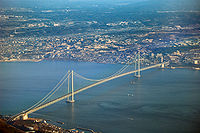
Osaka
is a city in the Kansai region of Japan's main island of Honshu, a designated city under the Local Autonomy Law, the capital city of Osaka Prefecture and also the biggest part of Keihanshin area, which is represented by three major cities of Japan, Kyoto, Osaka and Kobe...
and Kyoto
Kyoto
is a city in the central part of the island of Honshū, Japan. It has a population close to 1.5 million. Formerly the imperial capital of Japan, it is now the capital of Kyoto Prefecture, as well as a major part of the Osaka-Kobe-Kyoto metropolitan area.-History:...
forms the core of the region, from there the Kansai area stretches west along the Seto Inland Sea towards Himeji
Himeji, Hyogo
is a city located in Hyōgo Prefecture in the Kansai region of Japan. As of April 1, 2011, the city has an estimated population of 535,945, with 206,409 households. The total area is 534.43 km².- History :...
and Kobe
Kobe
, pronounced , is the fifth-largest city in Japan and is the capital city of Hyōgo Prefecture on the southern side of the main island of Honshū, approximately west of Osaka...
and east encompassing Lake Biwa
Lake Biwa
is the largest freshwater lake in Japan, located in Shiga Prefecture , northeast of the former capital city of Kyoto. Because of its proximity to the ancient capital, references to Lake Biwa appear frequently in Japanese literature, particularly in poetry and in historical accounts of battles.-...
, Japan's largest freshwater lake. In the north the region is bordered by the Sea of Japan
Sea of Japan
The Sea of Japan is a marginal sea of the western Pacific Ocean, between the Asian mainland, the Japanese archipelago and Sakhalin. It is bordered by Japan, North Korea, Russia and South Korea. Like the Mediterranean Sea, it has almost no tides due to its nearly complete enclosure from the Pacific...
, to the south by the Kii Peninsula
Kii Peninsula
The is the largest peninsula on the island of Honshū in Japan. The area south of the “Central Tectonic Line” is called Nankii , and includes the most poleward living coral reefs in the world due to the presence of the warm Kuroshio Current, though these are threatened by global warming and human...
and Pacific Ocean
Pacific Ocean
The Pacific Ocean is the largest of the Earth's oceanic divisions. It extends from the Arctic in the north to the Southern Ocean in the south, bounded by Asia and Australia in the west, and the Americas in the east.At 165.2 million square kilometres in area, this largest division of the World...
, and to the east by the Japanese Alps
Japanese Alps
The is a series of mountain ranges in Japan that bisect the main island of Honshū. The name was coined by William Gowland, the "Father of Japanese Archaeology," and later popularized by Reverend Walter Weston , an English missionary for whom a memorial plaque is located at Kamikochi, a tourist...
(for Kansai) or Ise Bay
Ise Bay
Ise Bay is a bay located at the mouth of the Kiso River between Mie and Aichi Prefectures in Japan. Ise Bay has an average depth of 19.5 metres and a maximum depth of 30 metres toward the centre. The mouth of the bay is 9 kilometres wide and is connected to the smaller Mikawa Bay by two channels:...
(for Kinki). Four of Japan's national parks lie within its borders, in whole or in part. The area also contains six of the seven top prefectures in terms of national treasure
National treasures of Japan
National Treasures are the most precious of Japan's Tangible Cultural Properties, as determined and designated by the Agency for Cultural Affairs...
s. Other geographical features include Amanohashidate
Amanohashidate
Amanohashidate is one of Japan's three scenic views. The sandbar is located in Miyazu Bay in northern Kyoto Prefecture.A thin strip of land connects two opposing sides of Miyazu Bay...
in Kyoto Prefecture
Kyoto Prefecture
is a prefecture of Japan located in the Kansai region of the island of Honshu. The capital is the city of Kyoto.- History :Until the Meiji Restoration, the area of Kyoto prefecture was known as Yamashiro....
and Awaji Island
Awaji Island
is an island in Hyōgo Prefecture, Japan, in the eastern part of the Seto Inland Sea between the islands of Honshū and Shikoku. The island has an area of 592.17 km²...
in Hyōgo
Hyogo Prefecture
is a prefecture of Japan located in the Kansai region on Honshū island. The capital is Kobe.The prefecture's name was previously alternately spelled as Hiogo.- History :...
.
The Kansai region is often compared with the Kantō region
Kanto region
The is a geographical area of Honshu, the largest island of Japan. The region includes the Greater Tokyo Area and encompasses seven prefectures: Gunma, Tochigi, Ibaraki, Saitama, Tokyo, Chiba, and Kanagawa. Within its boundaries, slightly more than 40 percent of the land area is the Kantō Plain....
, which lies to its east and consists primarily of Tokyo
Tokyo
, ; officially , is one of the 47 prefectures of Japan. Tokyo is the capital of Japan, the center of the Greater Tokyo Area, and the largest metropolitan area of Japan. It is the seat of the Japanese government and the Imperial Palace, and the home of the Japanese Imperial Family...
and the surrounding area. Whereas the Kanto region is symbolic of standardization throughout Japan, the Kansai region displays many more idiosyncrasies: the culture in Kyoto
Kyoto
is a city in the central part of the island of Honshū, Japan. It has a population close to 1.5 million. Formerly the imperial capital of Japan, it is now the capital of Kyoto Prefecture, as well as a major part of the Osaka-Kobe-Kyoto metropolitan area.-History:...
, the mercantilism of Osaka
Osaka
is a city in the Kansai region of Japan's main island of Honshu, a designated city under the Local Autonomy Law, the capital city of Osaka Prefecture and also the biggest part of Keihanshin area, which is represented by three major cities of Japan, Kyoto, Osaka and Kobe...
, the history of Nara
Nara, Nara
is the capital city of Nara Prefecture in the Kansai region of Japan. The city occupies the northern part of Nara Prefecture, directly bordering Kyoto Prefecture...
, or the cosmopolitanism of Kobe
Kobe
, pronounced , is the fifth-largest city in Japan and is the capital city of Hyōgo Prefecture on the southern side of the main island of Honshū, approximately west of Osaka...
, and represents the focus of counterculture
Counterculture
Counterculture is a sociological term used to describe the values and norms of behavior of a cultural group, or subculture, that run counter to those of the social mainstream of the day, the cultural equivalent of political opposition. Counterculture can also be described as a group whose behavior...
in Japan. This East-West rivalry has deep historical roots, particularly from the Edo period
Edo period
The , or , is a division of Japanese history which was ruled by the shoguns of the Tokugawa family, running from 1603 to 1868. The political entity of this period was the Tokugawa shogunate....
. With a samurai population of less than 1% the culture of the merchant city of Osaka stood in sharp contrast to that of Edo
Edo
, also romanized as Yedo or Yeddo, is the former name of the Japanese capital Tokyo, and was the seat of power for the Tokugawa shogunate which ruled Japan from 1603 to 1868...
, the seat of power for the Tokugawa shogunate
Tokugawa shogunate
The Tokugawa shogunate, also known as the and the , was a feudal regime of Japan established by Tokugawa Ieyasu and ruled by the shoguns of the Tokugawa family. This period is known as the Edo period and gets its name from the capital city, Edo, which is now called Tokyo, after the name was...
.

Popular regional dishes include takoyaki
Takoyaki
is a popular ball-shaped Japanese dumpling or more like a savory pancake made of batter and cooked in a special takoyaki pan...
, okonomiyaki
Okonomiyaki
is a Japanese dish containing a variety of ingredients. The name is derived from the word okonomi, meaning "what you like" or "what you want", and yaki meaning "grilled" or "cooked" . Okonomiyaki is mainly associated with Kansai or Hiroshima areas of Japan, but is widely available throughout the...
and kitsune udon
Udon
is a type of thick wheat-flour noodle of Japanese cuisine.Udon is usually served hot as noodle soup in its simplest form as kake udon, in a mildly flavoured broth called kakejiru which is made of dashi, soy sauce , and mirin. It is usually topped with thinly chopped scallions...
. Hyōgo Prefecture
Hyogo Prefecture
is a prefecture of Japan located in the Kansai region on Honshū island. The capital is Kobe.The prefecture's name was previously alternately spelled as Hiogo.- History :...
is well known for its Kobe beef
Kobe beef
refers to cuts of beef from the black Tajima-ushi breed of Wagyū cattle, raised according to strict tradition in Hyōgo Prefecture, Japan. The meat is generally considered to be a delicacy, renowned for its flavour, tenderness, and fatty, well-marbled texture. Kobe beef can be prepared as steak,...
and dairy products. Sake is another specialty of the region, the areas of Nada
Nada-ku, Kobe
is one of 9 wards of Kobe in Japan. It has an area of 31.4 km², and a population of 129,095 .A leading national university in Japan, Kobe University, is located in this ward, as is the city's Oji Zoo....
and Fushimi
Fushimi-ku, Kyoto
is one of the eleven wards in the city of Kyoto, in Kyoto Prefecture, Japan. Famous places in Fushimi include the Fushimi Inari Shrine, with thousands of torii lining the paths up and down a mountain; Fushimi Castle, originally built by Toyotomi Hideyoshi, with its rebuilt towers and gold-lined...
produce 45% of all sake in Japan. As opposed to food from Eastern Japan, food in the Kansai area tends to be sweeter, and foods such as nattō
Natto
is a traditional Japanese food made from soybeans fermented with Bacillus subtilis. It is popular especially as a breakfast food. As a rich source of protein and probiotics, nattō and the soybean paste miso formed a vital source of nutrition in feudal Japan. Nattō can be an acquired taste because...
tend to be less popular.
The dialects (弁, -ben) of the people of the Kansai region have their own variations of pronunciation, vocabulary, and grammar. Kansai-ben
Kansai-ben
The is a group of Japanese dialects in the Kansai region of Japan. In technical term,it is called ; Kansai is also known as "Kinki", hence the alternative term. They are typified by the speech of Osaka, the major city of Kansai, which is referred to specifically as Osaka-ben...
is the group of dialects spoken in the Kansai area, but is often treated as a dialect in its own right. Kansai-ben is especially strong in cities such as Osaka, Kyoto, and Kobe.
For association football
Football (soccer)
Association football, more commonly known as football or soccer, is a sport played between two teams of eleven players with a spherical ball...
purposes, the regional Kansai Football League excludes clubs in Mie Prefecture, who instead compete in the Tōkai
Tokai region
The is a sub-region of the Chūbu region in Japan that runs along the Pacific Ocean. The name means "East sea" and comes from the Tōkaidō, one of the Edo Five Routes...
Football League.
History
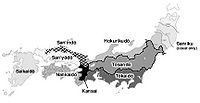
Ritsuryo
is the historical law system based on the philosophies of Confucianism and Chinese Legalism in Japan. The political system in accord to Ritsuryō is called "Ritsuryō-sei"...
reforms of the 6th century, the Gokishichidō
Gokishichido
was the name for ancient administrative units organized in Japan during the Asuka Period , as part of a legal and governmental system borrowed from the Chinese...
system established the provinces of Yamato
Yamato Province
was a province of Japan, located in Kinai, corresponding to present-day Nara Prefecture in Honshū. It was also called . At first, the name was written with one different character , and for about ten years after 737, this was revised to use more desirable characters . The final revision was made in...
, Yamashiro
Yamashiro Province
was a province of Japan, located in Kinai. It overlaps the southern part of modern Kyoto Prefecture on Honshū. Aliases include , the rare , and . It is classified as an upper province in the Engishiki....
, Kawachi
Kawachi Province
was a province of Japan in the eastern part of modern Osaka Prefecture. It originally held the southwestern area that was split off into Izumi Province...
, Settsu
Settsu Province
was a province of Japan, which today comprises the eastern part of Hyōgo Prefecture and the northern part of Osaka Prefecture. It was also referred to as or .Osaka and Osaka Castle were the main center of the province.-History:...
and Izumi
Izumi Province
was a province of Japan. It is also referred to as . It lay in Kinai, and its area today composes the south-western part of Osaka Prefecture . The Ōshōji in Sakai was the border with Settsu Province, until the beginning of the Meiji period, when the boundary was changed to be at the Yamato River...
. Kinai and Kinki, both roughly meaning "the neighbourhood of the capital", referred to these provinces. In common usage, Kinai now refers to the Osaka-Kobe-Kyoto
Osaka-Kobe-Kyoto
is a Japanese metropolitan region encompassing the metropolitan areas of the cities of Osaka in Osaka prefecture, Kobe in Hyōgo Prefecture, and Kyoto in Kyoto prefecture. The entire region has a population of 18,644,000 over an area of 11,170 km²...
(Keihanshin) area, the center of the Kansai region.
Kansai (literally Western Tollgates) in its original usage refers to the land west of the Osaka Tollgate , the border between Yamashiro Province
Yamashiro Province
was a province of Japan, located in Kinai. It overlaps the southern part of modern Kyoto Prefecture on Honshū. Aliases include , the rare , and . It is classified as an upper province in the Engishiki....
and Ōmi Province
Omi Province
is an old province of Japan, which today comprises Shiga Prefecture. It was one of the provinces that made up the Tōsandō circuit. It is nicknamed as .Lake Biwa, Japan's largest lake, is located at the center of the province...
(present-day Kyoto
Kyoto Prefecture
is a prefecture of Japan located in the Kansai region of the island of Honshu. The capital is the city of Kyoto.- History :Until the Meiji Restoration, the area of Kyoto prefecture was known as Yamashiro....
and Shiga
Shiga Prefecture
is a prefecture of Japan, which forms part of the Kansai region on Honshu Island. The capital is the city of Ōtsu.- History :Shiga was known as Ōmi Province or Gōshū before the prefectural system was established...
prefectures). During the Kamakura period
Kamakura period
The is a period of Japanese history that marks the governance by the Kamakura Shogunate, officially established in 1192 in Kamakura by the first shogun Minamoto no Yoritomo....
, this border was redefined to include Ōmi
Omi Province
is an old province of Japan, which today comprises Shiga Prefecture. It was one of the provinces that made up the Tōsandō circuit. It is nicknamed as .Lake Biwa, Japan's largest lake, is located at the center of the province...
and Iga
Iga Province
was an old province of Japan in the area that is today western Mie Prefecture. It was sometimes called . Iga bordered on Ise, Ōmi, Yamato, and Yamashiro Provinces.-Geography:...
Provinces. It is not until the Edo period
Edo period
The , or , is a division of Japanese history which was ruled by the shoguns of the Tokugawa family, running from 1603 to 1868. The political entity of this period was the Tokugawa shogunate....
that Kansai came to acquire its current form. (see Kamigata
Kamigata
Kamigata is a region of Japan referring to the cities of Kyoto and Osaka; the term is used particularly when discussing elements of Edo period urban culture such as ukiyo-e and kabuki, and when making a comparison to the urban culture of the Edo/Tokyo region.Kabuki, ukiyo-e, and many of the other...
) Like all regions of Japan
Regions of Japan
The regions of Japan are not official administrative units, but have been traditionally used as the regional division of Japan in a number of contexts...
, the Kansai region is not an administrative unit, but rather a cultural and historical one, which emerged much later during the Heian Period
Heian period
The is the last division of classical Japanese history, running from 794 to 1185. The period is named after the capital city of Heian-kyō, or modern Kyōto. It is the period in Japanese history when Buddhism, Taoism and other Chinese influences were at their height...
after the expansion of Japan saw the development of the Kanto Region
Kanto region
The is a geographical area of Honshu, the largest island of Japan. The region includes the Greater Tokyo Area and encompasses seven prefectures: Gunma, Tochigi, Ibaraki, Saitama, Tokyo, Chiba, and Kanagawa. Within its boundaries, slightly more than 40 percent of the land area is the Kantō Plain....
to the east and the need to differentiate what was previously the center of Japan in Kansai emerged.

Nara, Nara
is the capital city of Nara Prefecture in the Kansai region of Japan. The city occupies the northern part of Nara Prefecture, directly bordering Kyoto Prefecture...
, the most eastern point on the Silk Road
Silk Road
The Silk Road or Silk Route refers to a historical network of interlinking trade routes across the Afro-Eurasian landmass that connected East, South, and Western Asia with the Mediterranean and European world, as well as parts of North and East Africa...
, that became the site of Japan's first permanent capital. This period
Nara period
The of the history of Japan covers the years from AD 710 to 794. Empress Gemmei established the capital of Heijō-kyō . Except for 5 years , when the capital was briefly moved again, it remained the capital of Japanese civilization until Emperor Kammu established a new capital, Nagaoka-kyō, in 784...
(AD 710–784) saw the spread of Buddhism
Buddhism
Buddhism is a religion and philosophy encompassing a variety of traditions, beliefs and practices, largely based on teachings attributed to Siddhartha Gautama, commonly known as the Buddha . The Buddha lived and taught in the northeastern Indian subcontinent some time between the 6th and 4th...
to Japan and the construction of Tōdai-ji
Todai-ji
, is a Buddhist temple complex located in the city of Nara, Japan. Its Great Buddha Hall , the largest wooden building in the world, houses the world's largest bronze statue of the Buddha Vairocana, known in Japanese simply as Daibutsu . The temple also serves as the Japanese headquarters of the ...
in 745. The Kansai region also boasts the Shinto
Shinto
or Shintoism, also kami-no-michi, is the indigenous spirituality of Japan and the Japanese people. It is a set of practices, to be carried out diligently, to establish a connection between present day Japan and its ancient past. Shinto practices were first recorded and codified in the written...
religion's holiest shrine at Ise Shrine
Ise Shrine
is a Shinto shrine dedicated to goddess Amaterasu-ōmikami, located in the city of Ise in Mie prefecture, Japan. Officially known simply as , Ise Jingū is in fact a shrine complex composed of a large number of Shinto shrines centered on two main shrines, and ....
(built in 690 AD) in Mie prefecture
Mie Prefecture
is a prefecture of Japan which is part of the Kansai regions on Honshū island. The capital is the city of Tsu.- History :Until the Meiji Restoration, Mie prefecture was known as Ise Province and Iga Province....
.
The Heian period
Heian period
The is the last division of classical Japanese history, running from 794 to 1185. The period is named after the capital city of Heian-kyō, or modern Kyōto. It is the period in Japanese history when Buddhism, Taoism and other Chinese influences were at their height...
saw the capital moved to Heian-kyō ' onMouseout='HidePop("67489")' href="/topics/Kyoto">Kyoto
Kyoto
is a city in the central part of the island of Honshū, Japan. It has a population close to 1.5 million. Formerly the imperial capital of Japan, it is now the capital of Kyoto Prefecture, as well as a major part of the Osaka-Kobe-Kyoto metropolitan area.-History:...
), where it would remain for over a thousand years until the Meiji Restoration
Meiji Restoration
The , also known as the Meiji Ishin, Revolution, Reform or Renewal, was a chain of events that restored imperial rule to Japan in 1868...
. During this golden age, the Kansai region would give birth to traditional Japanese culture. In 788, Saicho
Saicho
was a Japanese Buddhist monk credited with founding the Tendai school in Japan, based around the Chinese Tiantai tradition he was exposed to during his trip to China beginning in 804. He founded the temple and headquarters of Tendai at Enryaku-ji on Mt. Hiei near Kyoto. He is also said to have...
, the founder of the Tendai
Tendai
is a Japanese school of Mahayana Buddhism, a descendant of the Chinese Tiantai or Lotus Sutra school.Chappell frames the relevance of Tendai for a universal Buddhism:- History :...
sect of Buddhism established his monastery at Mount Hiei
Mount Hiei
is a mountain to the northeast of Kyoto, lying on the border between the Kyoto and Shiga prefectures, Japan.The temple of Enryaku-ji, the first outpost of the Japanese Tiantai sect of Buddhism, was founded atop Mount Hiei by Saichō in 788. Both Nichiren and Honen studied at the temple before...
in Shiga prefecture
Shiga Prefecture
is a prefecture of Japan, which forms part of the Kansai region on Honshu Island. The capital is the city of Ōtsu.- History :Shiga was known as Ōmi Province or Gōshū before the prefectural system was established...
. Japan's most famous tale, and some say the world's first modern novel, The Tale of Genji
The Tale of Genji
is a classic work of Japanese literature attributed to the Japanese noblewoman Murasaki Shikibu in the early 11th century, around the peak of the Heian period. It is sometimes called the world's first novel, the first modern novel, the first psychological novel or the first novel still to be...
was penned by Murasaki Shikibu
Murasaki Shikibu
Murasaki Shikibu was a Japanese novelist, poet and lady-in-waiting at the Imperial court during the Heian period. She is best known as the author of The Tale of Genji, written in Japanese between about 1000 and 1012...
while performing as a lady-in-waiting
Lady-in-waiting
A lady-in-waiting is a female personal assistant at a royal court, attending on a queen, a princess, or a high-ranking noblewoman. Historically, in Europe a lady-in-waiting was often a noblewoman from a family highly thought of in good society, but was of lower rank than the woman on whom she...
in Heian-kyo. Noh
Noh
, or - derived from the Sino-Japanese word for "skill" or "talent" - is a major form of classical Japanese musical drama that has been performed since the 14th century. Many characters are masked, with men playing male and female roles. Traditionally, a Noh "performance day" lasts all day and...
and Kabuki
Kabuki
is classical Japanese dance-drama. Kabuki theatre is known for the stylization of its drama and for the elaborate make-up worn by some of its performers.The individual kanji characters, from left to right, mean sing , dance , and skill...
, Japan's traditional dramatic forms both saw their birth and evolution in Kyoto, while Bunraku
Bunraku
, also known as Ningyō jōruri , is a form of traditional Japanese puppet theater, founded in Osaka in 1684.Three kinds of performers take part in a bunraku performance:* Ningyōtsukai or Ningyōzukai—puppeteers* Tayū—the chanters* Shamisen players...
, Japanese puppet theater, is native to Osaka
Osaka
is a city in the Kansai region of Japan's main island of Honshu, a designated city under the Local Autonomy Law, the capital city of Osaka Prefecture and also the biggest part of Keihanshin area, which is represented by three major cities of Japan, Kyoto, Osaka and Kobe...
.
Because of its unique position in Japanese history, the Kansai region hosts a number of well-known historical and cultural landmarks, including five of Japan's sixteen World Heritage Site
World Heritage Site
A UNESCO World Heritage Site is a place that is listed by the UNESCO as of special cultural or physical significance...
s: Hōryū-ji
Hōryū-ji
is a Buddhist temple in Ikaruga, Nara Prefecture, Japan. Its full name is Hōryū Gakumonji , or Learning Temple of the Flourishing Law, the complex serving as seminary and monastery both....
, Himeji Castle
Himeji Castle
When the han feudal system was abolished in 1871, Himeji Castle was put up for auction. The castle was purchased by a Himeji resident for 23 Japanese yen...
, Historic Monuments of Ancient Kyoto (Kyoto, Uji and Otsu Cities), Historic Monuments of Ancient Nara
Historic Monuments of Ancient Nara
The UNESCO World Heritage Site Historic Monuments of Ancient Nara encompasses eight places in the old capital Nara in Nara Prefecture, Japan. Five are Buddhist temples, one is a Shinto shrine, one is a Palace and one a primeval forest. The properties include 26 buildings designated by the Japanese...
, and Sacred Sites and Pilgrimage Routes in the Kii Mountain Range
Sacred Sites and Pilgrimage Routes in the Kii Mountain Range
Sacred Sites and Pilgrimage Routes in the Kii Mountain Range is a UNESCO World Heritage Site located on the Kii Peninsula in Japan.- Selection criteria :...
.
.png)