


Endospore

Encyclopedia
Dormancy
Dormancy is a period in an organism's life cycle when growth, development, and physical activity are temporarily stopped. This minimizes metabolic activity and therefore helps an organism to conserve energy. Dormancy tends to be closely associated with environmental conditions...
, tough, and temporarily non-reproductive structure produced by certain bacteria from the Firmicute phylum. The name "endospore" is suggestive of a spore or seed-like form (endo means within), but it is not a true spore
Spore
In biology, a spore is a reproductive structure that is adapted for dispersal and surviving for extended periods of time in unfavorable conditions. Spores form part of the life cycles of many bacteria, plants, algae, fungi and some protozoa. According to scientist Dr...
(i.e. not an offspring). It is a stripped-down, dormant form to which the bacterium can reduce itself. Endospore formation is usually triggered by a lack of nutrients, and usually occurs in gram-positive bacteria. In endospore formation, the bacterium divides within its cell wall. One side then engulfs the other. Endospores enable bacteria to lie dormant for extended periods, even centuries. Revival of spores millions of years old has been claimed. When the environment becomes more favorable, the endospore can reactivate itself to the vegetative state. Most types of bacteria cannot change to the endospore form. Examples of those that can include Bacillus
Bacillus
Bacillus is a genus of Gram-positive, rod-shaped bacteria and a member of the division Firmicutes. Bacillus species can be obligate aerobes or facultative anaerobes, and test positive for the enzyme catalase. Ubiquitous in nature, Bacillus includes both free-living and pathogenic species...
and Clostridium
Clostridium
Clostridium is a genus of Gram-positive bacteria, belonging to the Firmicutes. They are obligate anaerobes capable of producing endospores. Individual cells are rod-shaped, which gives them their name, from the Greek kloster or spindle...
.
The endospore consists of the bacterium's DNA and part of its cytoplasm, surrounded by a very tough outer coating.
Endospores can survive without nutrients. They are resistant to ultraviolet radiation, desiccation, high temperature, extreme freezing and chemical disinfectants. According to scientist Dr. Steinn Sigurdsson, "There are viable bacterial spores that have been found that are 40 million years old on Earth - and we know they're very hardened to radiation." Common anti-bacterial agents that work by destroying vegetative cell walls do not affect endospores. Endospores are commonly found in soil and water, where they may survive for long periods of time.
Some classes of bacteria can turn into exospores, also known as microbial cyst
Microbial cyst
A microbial cyst is a resting or dormant stage of a microorganism, usually a bacterium or a protist, that helps the organism to survive in unfavorable environmental conditions. It can be thought of as a state of suspended animation in which the metabolic processes of the cell are slowed down and...
s, instead of endospores. Exospores and endospores are two kinds of "hibernating" or dormant stages seen in some classes of microorganisms.
Structure
Sieve
A sieve, or sifter, separates wanted elements from unwanted material using a woven screen such as a mesh or net. However, in cooking, especially with flour, a sifter is used to aerate the substance, among other things. A strainer is a type of sieve typically used to separate a solid from a liquid...
that excludes large toxic molecules like lysozyme
Lysozyme
Lysozyme, also known as muramidase or N-acetylmuramide glycanhydrolase, are glycoside hydrolases, enzymes that damage bacterial cell walls by catalyzing hydrolysis of 1,4-beta-linkages between N-acetylmuramic acid and N-acetyl-D-glucosamine residues in a peptidoglycan and between...
, is resistant to many toxic molecules and may also contain enzymes that are involved in germination
Germination
Germination is the process in which a plant or fungus emerges from a seed or spore, respectively, and begins growth. The most common example of germination is the sprouting of a seedling from a seed of an angiosperm or gymnosperm. However the growth of a sporeling from a spore, for example the...
. The cortex lies beneath the spore coat and consists of peptidoglycan
Peptidoglycan
Peptidoglycan, also known as murein, is a polymer consisting of sugars and amino acids that forms a mesh-like layer outside the plasma membrane of bacteria , forming the cell wall. The sugar component consists of alternating residues of β- linked N-acetylglucosamine and N-acetylmuramic acid...
. The core wall lies beneath the cortex and surrounds the protoplast
Protoplast
Protoplast, from the ancient Greek πρῶτον + verb πλάθω or πλάττω , initially referred to the first organized body of a species.Protoplast has several biological definitions:...
or core of the endospore. The core contains the spore chromosomal DNA
DNA
Deoxyribonucleic acid is a nucleic acid that contains the genetic instructions used in the development and functioning of all known living organisms . The DNA segments that carry this genetic information are called genes, but other DNA sequences have structural purposes, or are involved in...
is encased in chromatin
Chromatin
Chromatin is the combination of DNA and proteins that make up the contents of the nucleus of a cell. The primary functions of chromatin are; to package DNA into a smaller volume to fit in the cell, to strengthen the DNA to allow mitosis and meiosis and prevent DNA damage, and to control gene...
-like proteins known as SASPs (small acid-soluble spore proteins), that protect the spore DNA from UV radiation and heat. The core also contains normal cell structures, such as ribosome
Ribosome
A ribosome is a component of cells that assembles the twenty specific amino acid molecules to form the particular protein molecule determined by the nucleotide sequence of an RNA molecule....
s and other enzymes, but is not metabolically active.
Up to 20% of the dry weight of the endospore consists of calcium dipicolinate within the core, which is thought to stabilize the DNA
DNA
Deoxyribonucleic acid is a nucleic acid that contains the genetic instructions used in the development and functioning of all known living organisms . The DNA segments that carry this genetic information are called genes, but other DNA sequences have structural purposes, or are involved in...
. Dipicolinic acid
Dipicolinic acid
Dipicolinic acid is a chemical compound which composes 5% to 15% of the dry weight of bacterial spores...
could be responsible for the heat resistance of the spore, and calcium
Calcium
Calcium is the chemical element with the symbol Ca and atomic number 20. It has an atomic mass of 40.078 amu. Calcium is a soft gray alkaline earth metal, and is the fifth-most-abundant element by mass in the Earth's crust...
may aid in resistance to heat and oxidizing agents. However, mutants resistant to heat but lacking dipicolinic acid have been isolated, suggesting other mechanisms contributing to heat resistance are at work.
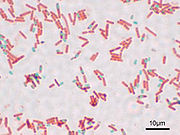
Visualising endospores under the light microscope can be difficult due to the impermeability of the endospore wall to dyes and stains. While the rest of a bacterial cell may stain, the endospore is left colourless. To combat this, a special stain technique called a Moeller stain
Moeller stain
Endospores are surrounded be a highly resistant spore coat, The spore coat is highly resistant to excessive heat, freezing and desiccation as well as chemical agents. More importantly, for identification, spores are resistant to commonly employed staining techniques; therefore alternative staining...
is used. That allows the endospore to show up as red, while the rest of the cell stains blue. Another staining technique for endospores is the Schaeffer-Fulton stain
Schaeffer-Fulton stain
The Schaeffer–Fulton stain is a technique designed to isolate endospores by staining any present endospores green, and any other bacterial bodies red. The green stain is malachite green, and the counterstain is safranin, which dyes any other bacterial bodies red.-Procedure:Using an aseptic...
, which stains endospores green and bacterial bodies red. The arrangement of spore layers is as follows:
- Exosporium
- Spore coat
- Spore cortex
- Core wall
Location
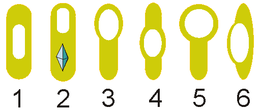
The position of the endospore differs among bacterial species and is useful in identification. The main types within the cell are terminal, subterminal, and centrally placed endospores. Terminal endospores are seen at the poles of cells, whereas central endospores are more or less in the middle. Subterminal endospores are those between these two extremes, usually seen far enough towards the poles but close enough to the center so as not to be considered either terminal or central. Lateral endospores are seen occasionally.Examples of bacteria having terminal endospores include Clostridium tetani
Clostridium tetani
Clostridium tetani is a rod-shaped, anaerobic bacterium of the genus Clostridium. Like other Clostridium species, it is Gram-positive, and its appearance on a gram stain resembles tennis rackets or drumsticks. C. tetani is found as spores in soil or in the gastrointestinal tract of animals. C...
, the pathogen that causes the disease tetanus
Tetanus
Tetanus is a medical condition characterized by a prolonged contraction of skeletal muscle fibers. The primary symptoms are caused by tetanospasmin, a neurotoxin produced by the Gram-positive, rod-shaped, obligate anaerobic bacterium Clostridium tetani...
. Bacteria having a centrally placed endospore include Bacillus cereus
Bacillus cereus
Bacillus cereus is an endemic, soil-dwelling, Gram-positive, rod-shaped, beta hemolytic bacterium. Some strains are harmful to humans and cause foodborne illness, while other strains can be beneficial as probiotics for animals...
, and those having a subterminal endospore include Bacillus subtilis
Bacillus subtilis
Bacillus subtilis, known also as the hay bacillus or grass bacillus, is a Gram-positive, catalase-positive bacterium commonly found in soil. A member of the genus Bacillus, B. subtilis is rod-shaped, and has the ability to form a tough, protective endospore, allowing the organism to tolerate...
. Sometimes the endospore can be so large the cell can be distended around the endospore, this is typical of Clostridium tetani
Clostridium tetani
Clostridium tetani is a rod-shaped, anaerobic bacterium of the genus Clostridium. Like other Clostridium species, it is Gram-positive, and its appearance on a gram stain resembles tennis rackets or drumsticks. C. tetani is found as spores in soil or in the gastrointestinal tract of animals. C...
.
Formation and destruction
When a bacterium detects environmental conditions are becoming unfavourable it may start the process of endosporulation, which takes about eight hours. The DNADNA
Deoxyribonucleic acid is a nucleic acid that contains the genetic instructions used in the development and functioning of all known living organisms . The DNA segments that carry this genetic information are called genes, but other DNA sequences have structural purposes, or are involved in...
is replicated and a membrane wall known as a spore septum
Septum
In anatomy, a septum is a wall, dividing a cavity or structure into smaller ones.-In human anatomy:...
begins to form between it and the rest of the cell. The plasma membrane of the cell surrounds this wall and pinches off to leave a double membrane around the DNA, and the developing structure is now known as a forespore. Calcium dipicolinate is incorporated into the forespore during this time. Next the peptidoglycan cortex forms between the two layers and the bacterium adds a spore coat to the outside of the forespore. Sporulation is now complete, and the mature endospore will be released when the surrounding vegetative cell is degraded.
Endospores are resistant to most agents that would normally kill the vegetative cells they formed from. Nearly all household cleaning products, alcohols, quaternary ammonium compounds and detergents have little effect. However, alkylating
Alkylation
Alkylation is the transfer of an alkyl group from one molecule to another. The alkyl group may be transferred as an alkyl carbocation, a free radical, a carbanion or a carbene . Alkylating agents are widely used in chemistry because the alkyl group is probably the most common group encountered in...
agents (e.g. ethylene oxide
Ethylene oxide
Ethylene oxide, also called oxirane, is the organic compound with the formula . It is a cyclic ether. This means that it is composed of two alkyl groups attached to an oxygen atom in a cyclic shape . This colorless flammable gas with a faintly sweet odor is the simplest epoxide, a three-membered...
), and 10% bleach are effective against endospores. To kill anthrax spores, standard household bleach (with 5% sodium hypochlorite) diluted freshly 1:10 in water (100ml of bleach in 900ml of water) must be in contact with the spore for at least 5 minutes. This contact time is important as a very small fraction of spores can survive longer than 10 minutes while soaked in this bleach solution . Higher concentrations of bleach is not more effective, and can cause some types of bacteria to aggregate and thus survive.
While resistant to extreme heat and radiation, endospores can be destroyed by burning or by autoclaving
Autoclave
An autoclave is an instrument used to sterilize equipment and supplies by subjecting them to high pressure saturated steam at 121 °C for around 15–20 minutes depending on the size of the load and the contents. It was invented by Charles Chamberland in 1879, although a precursor known as the...
. Endospores are able to survive boiling at 100°C for hours, although the longer the number of hours the fewer that will survive. An indirect way to destroy them is to place them in an environment that reactivates them to their vegetative state. They will germinate within a day or two with the right environmental conditions, and then the vegetative cells can be straightforwardly destroyed. This indirect method is called Tyndallization
Tyndallization
Tyndallization is an old process for sterilizing food. It is still occasionally used.A simple, effective, modern sterilizing method is to heat the substance being sterilized to 121°C for 15 minutes in a pressure cooker...
. It was the usual method for a while in the late 19th century before the advent of inexpensive autoclaves. Prolonged exposure to ionising radiation, such as x-ray
X-ray
X-radiation is a form of electromagnetic radiation. X-rays have a wavelength in the range of 0.01 to 10 nanometers, corresponding to frequencies in the range 30 petahertz to 30 exahertz and energies in the range 120 eV to 120 keV. They are shorter in wavelength than UV rays and longer than gamma...
s and gamma ray
Gamma ray
Gamma radiation, also known as gamma rays or hyphenated as gamma-rays and denoted as γ, is electromagnetic radiation of high frequency . Gamma rays are usually naturally produced on Earth by decay of high energy states in atomic nuclei...
s, will also kill most endospores.
Reactivation
Reactivation of the endospore occurs when conditions are more favourable and involves activation, germination, and outgrowth. Even if an endospore is located in plentiful nutrients, it may fail to germinate unless activation has taken place. This may be triggered by heating the endospore. Germination involves the dormant endospore starting metabolic activity and thus breaking hibernation. It is commonly characterised by rupture or absorption of the spore coat, swelling of the endospore, an increase in metabolic activity, and loss of resistance to environmental stress. Outgrowth follows germination and involves the core of the endospore manufacturing new chemical components and exiting the old spore coat to develop into a fully functional vegetative bacterial cell, which can divide to produce more cells.Importance
As a simplified model for cellular differentiationCellular differentiation
In developmental biology, cellular differentiation is the process by which a less specialized cell becomes a more specialized cell type. Differentiation occurs numerous times during the development of a multicellular organism as the organism changes from a simple zygote to a complex system of...
, the molecular details of endospore formation have been extensively studied, specifically in the model organism
Model organism
A model organism is a non-human species that is extensively studied to understand particular biological phenomena, with the expectation that discoveries made in the organism model will provide insight into the workings of other organisms. Model organisms are in vivo models and are widely used to...
Bacillus subtilis
Bacillus subtilis
Bacillus subtilis, known also as the hay bacillus or grass bacillus, is a Gram-positive, catalase-positive bacterium commonly found in soil. A member of the genus Bacillus, B. subtilis is rod-shaped, and has the ability to form a tough, protective endospore, allowing the organism to tolerate...
. These studies have contributed much to our understanding of the regulation of gene expression
Gene expression
Gene expression is the process by which information from a gene is used in the synthesis of a functional gene product. These products are often proteins, but in non-protein coding genes such as ribosomal RNA , transfer RNA or small nuclear RNA genes, the product is a functional RNA...
, transcription factor
Transcription factor
In molecular biology and genetics, a transcription factor is a protein that binds to specific DNA sequences, thereby controlling the flow of genetic information from DNA to mRNA...
s, and the sigma factor
Sigma factor
A sigma factor is a bacterial transcription initiation factor that enables specific binding of RNA polymerase to gene promoters. Different sigma factors are activated in response to different environmental conditions...
subunits of RNA polymerase
RNA polymerase
RNA polymerase is an enzyme that produces RNA. In cells, RNAP is needed for constructing RNA chains from DNA genes as templates, a process called transcription. RNA polymerase enzymes are essential to life and are found in all organisms and many viruses...
.
Endospores of the bacterium Bacillus anthracis
Bacillus anthracis
Bacillus anthracis is the pathogen of the Anthrax acute disease. It is a Gram-positive, spore-forming, rod-shaped bacterium, with a width of 1-1.2µm and a length of 3-5µm. It can be grown in an ordinary nutrient medium under aerobic or anaerobic conditions.It is one of few bacteria known to...
were used in the 2001 anthrax attacks
2001 anthrax attacks
The 2001 anthrax attacks in the United States, also known as Amerithrax from its Federal Bureau of Investigation case name, occurred over the course of several weeks beginning on Tuesday, September 18, 2001, one week after the September 11 attacks. Letters containing anthrax spores were mailed to...
. The powder found in contaminated postal letters was composed of extracellular anthrax endospores. Inhalation, ingestion or skin contamination of these endospores, which were technically incorrectly labelled as "spores", led to a number of deaths.
Geobacillus stearothermophilus endospores are used as biological indicators when an autoclave is used in sterilization procedures.