
All Topics  
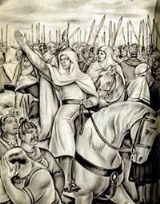
Muhammad bin Qasim

 
Muhammad Bin Qasim

   Email Print
   Bookmark   Link


Muhammad bin Qasim


Muhammad bin Qasim Al-Thaqafi (c. 31 December, 695
695

Events...
–18 July, 715
715

Events...
) was an Umayyad general who conquered the Sindh
Sindh

Sindh is one of the four Subdivisions of Pakistan of Pakistan and historically is home to the Sindhi people. Different cultural and ethnic groups also reside in Sindh including Urdu-speaking Muslim refugees who migrated to Pakistan from India upon independence as well as the people migrated from other provinces after independence....
 and Punjab
Punjab (Pakistan)

The Punjab...
 regions along the Indus river
Indus River

File:Indian subcontinent CIA.pngThe Indus River is the longest river in Pakistan and the twenty-first largest river in the world, in terms of annual flow, on the Indian Subcontinent....
 (now a part of Pakistan
Pakistan

Pakistan , officially the Islamic Republic of Pakistan, is a country located in South Asia and borders Central Asia and the Middle East. It has a 1,046 kilometre coastline along the Arabian Sea and Gulf of Oman in the south, and is bordered by Afghanistan and Iran in the west, India in the east and People's Republic of China in th...
). He was born in the city of Taif
Taif

Dave "Taif" Ball is a bassist who has toured and recorded with many artists and bands, including Barbara Thompson's Paraphernalia, John Martyn, David Knopfler, How We Live, Killing Joke, Lloyd Cole, Phillip Boa, Steve Hackett, Voodoocult, Vanessa Mae, John Hiseman's Colosseum, and The Billy Thompson Quartet....
 (in modern day Saudi Arabia
Saudi Arabia

The Kingdom of Saudi Arabia, KSA , is an Arab country and the largest country of the Arabian Peninsula. It is bordered by Jordan on the northwest, Iraq on the north and northeast, Kuwait, Qatar, Bahrain, and the United Arab Emirates on the east, Oman on the southeast, and Yemen on the south....
). The conquest of Sindh and Punjab began the Islam
Islam

Islam is a Monotheism, Abrahamic religion originating with the teachings of the Prophets of Islam Muhammad, a 7th century Arab religious and political figure....
ic era in South Asia
South Asia

South Asia, also known as Southern Asia, is the southern region of the Asian continent, which comprises the sub-Himalayan countries and, for some authorities , also includes the adjoining countries on the west and the east....
 and continues to lend the Sindh province of Pakistan the nickname Bab-e-Islam (The Gateway of Islam).

Life and career
A member of the Thaqeef tribe, which is still settled in and around the city of Taif, Muhammad bin Qasim's father was Qasim bin Yusuf who died when Muhammad bin Qasim was young, leaving his mother in charge of his education.


Discussion
Ask a question about 'Muhammad bin Qasim'
Start a new discussion about 'Muhammad bin Qasim'
Answer questions from other users
Full Discussion Forum


Encyclopedia


Muhammad bin Qasim Al-Thaqafi (c. 31 December, 695
695

Events...
–18 July, 715
715

Events...
) was an Umayyad general who conquered the Sindh
Sindh

Sindh is one of the four Subdivisions of Pakistan of Pakistan and historically is home to the Sindhi people. Different cultural and ethnic groups also reside in Sindh including Urdu-speaking Muslim refugees who migrated to Pakistan from India upon independence as well as the people migrated from other provinces after independence....
 and Punjab
Punjab (Pakistan)

The Punjab...
 regions along the Indus river
Indus River

File:Indian subcontinent CIA.pngThe Indus River is the longest river in Pakistan and the twenty-first largest river in the world, in terms of annual flow, on the Indian Subcontinent....
 (now a part of Pakistan
Pakistan

Pakistan , officially the Islamic Republic of Pakistan, is a country located in South Asia and borders Central Asia and the Middle East. It has a 1,046 kilometre coastline along the Arabian Sea and Gulf of Oman in the south, and is bordered by Afghanistan and Iran in the west, India in the east and People's Republic of China in th...
). He was born in the city of Taif
Taif

Dave "Taif" Ball is a bassist who has toured and recorded with many artists and bands, including Barbara Thompson's Paraphernalia, John Martyn, David Knopfler, How We Live, Killing Joke, Lloyd Cole, Phillip Boa, Steve Hackett, Voodoocult, Vanessa Mae, John Hiseman's Colosseum, and The Billy Thompson Quartet....
 (in modern day Saudi Arabia
Saudi Arabia

The Kingdom of Saudi Arabia, KSA , is an Arab country and the largest country of the Arabian Peninsula. It is bordered by Jordan on the northwest, Iraq on the north and northeast, Kuwait, Qatar, Bahrain, and the United Arab Emirates on the east, Oman on the southeast, and Yemen on the south....
). The conquest of Sindh and Punjab began the Islam
Islam

Islam is a Monotheism, Abrahamic religion originating with the teachings of the Prophets of Islam Muhammad, a 7th century Arab religious and political figure....
ic era in South Asia
South Asia

South Asia, also known as Southern Asia, is the southern region of the Asian continent, which comprises the sub-Himalayan countries and, for some authorities , also includes the adjoining countries on the west and the east....
 and continues to lend the Sindh province of Pakistan the nickname Bab-e-Islam (The Gateway of Islam).

Life and career


A member of the Thaqeef tribe, which is still settled in and around the city of Taif, Muhammad bin Qasim's father was Qasim bin Yusuf who died when Muhammad bin Qasim was young, leaving his mother in charge of his education. Umayyad governor Al-Hajjaj ibn Yusuf, Muhammad bin Qasim's paternal uncle, was instrumental in teaching Muhammad bin Qasim about warfare and governing. Muhammad bin Qasim married his cousin Zubaidah, Hajjaj's daughter, shortly before going to Sindh
Sindh

Sindh is one of the four Subdivisions of Pakistan of Pakistan and historically is home to the Sindhi people. Different cultural and ethnic groups also reside in Sindh including Urdu-speaking Muslim refugees who migrated to Pakistan from India upon independence as well as the people migrated from other provinces after independence....
. . Another paternal uncle of Muhammad bin Qasim was Muhammad bin Yusuf, governor of Yemen
Yemen

Yemen , officially the Republic of Yemen is an Arab country located on the Arabian Peninsula in Southwest Asia. Yemen has an estimated population of more than 23 million people and is bordered by Saudi Arabia to the North, the Red Sea to the West, the Arabian Sea and Gulf of Aden to the South, and Oman to the east....
. Under Hajjaj's patronage, Muhammad bin Qasim was made governor of Persia
Persian Empire

The 'Persian Empire' was a series of successive Iranian or Persianization empires that ruled over the Iranian plateau, the original Persian homeland, and beyond in Southwest Asia, South Asia, Central Asia and the Caucasus....
, where he succeeded in putting down a rebellion. At the age of seventeen, he was sent by Caliph
Caliph

The Caliph is the head of state in a Caliphate, and the title for the leader of the Islamic Ummah, an Islamic community ruled by the Shari'ah....
 Al-Walid I
Al-Walid I

Al-Walid ibn Abd al-Malik or Al-Walid I was an Umayyad caliph who ruled from 705 - 715. He continued the expansion of the Islamic empire that was sparked by his father, and was an effective ruler....
 to lead an army towards South Asia into what are today the Sindh and Punjab regions of Pakistan.

Umayyad interest in Sindh


According to Berzin, Umayyad interest in the region stemmed from their desire to control the trade route down the Indus River
Indus River

File:Indian subcontinent CIA.pngThe Indus River is the longest river in Pakistan and the twenty-first largest river in the world, in terms of annual flow, on the Indian Subcontinent....
 valley to the seaports of Sindh, an important link in the ancient Silk Road. They had earlier unsuccessfully sought to gain control of the route, via the Khyber Pass
Khyber Pass

The Khyber Pass, is the mountain pass that links Pakistan and Afghanistan.Throughout history it has been an important trade route between Central Asia and South Asia and a Military strategy military location....
, from the Turki-Shahi
Shahi

The Shahi , Sahi , also called Shahiya dynasties ruled portions of the Kabul and the old province of Gandhara from the decline of the Kushan Empire in third century to the early ninth century ....
s of Gandhara
Gandhara

Gandhara is the name of an ancient kingdom , located in northern Pakistan, Jammu and Kashmir and eastern Afghanistan. Gandhara was located mainly in the vale of Peshawar, the Potohar plateau and on the Kabul River....
. By way of skirting Gandhara and taking Sindh to its south, they thus sought to open a second front against Gandhara and had on occasion attempted the conquest prior to this campaign.

According to Wink, Umayyad interest in the region was galvanized by the operation of the Mids
Meds (tribe)

Meds was a Scythian tribe that settled in Sindh, Pakistan....
 and others. They had operated preying
Piracy

Piracy is a warlike act committed by a foreign nonstate actor, especially robbery or crime committed at sea, on a river, or sometimes on shore, either from a vessel flying no national flag, or one flying a national flag but without authorization from a nation....
 upon Sassanid shipping in the past, from the mouth of the Tigris
Tigris

The Tigris is the eastern member of the two great rivers that define Mesopotamia, along with the Euphrates, which flows from the mountains of southeastern Turkey through Iraq....
 to the Sri Lanka
Sri Lanka

Sri Lanka, officially the Democratic Socialist Republic of Sri Lanka is an island country in South Asia, located about off the southern coast of India....
n coast, in their bawarij
Bawarij

Bawarij were Demographics of India corsairs that chased Arab shipping bound for India and China. They are mentioned by Abu al-Hasan 'Ali al-Mas'udi as frequenting the pirate den at Socotra and Marco Polo describes them as pirates of Gujarat....
 and now did so to Arab
Arab

An Arab is a person who Identity as such on linguistic or cultural grounds. The plural form, Arabs , refers to the Ethnocultural group at large....
 shipping from their bases at Kutch, Debal
Debal

Debal was a port located at modern Karachi, Sindh, Pakistan. In Arabic, it was usually called Daybul . According to the British historian Eliot, parts of city of Thatta....
 and Kathiawar
Kathiawar

Kathiawar or Kathiawad is a peninsula in western India. It is part of Gujarat state, bounded on the north by the great wetland of the Rann of Kutch, on the northwest by the Gulf of Kutch, on the west and south by the Arabian Sea, and on the southeast and east by the Gulf of Cambay....
. At the time, Sindh was the wild frontier
Frontier

A frontier is a political and geographical term referring to areas near or beyond a Border....
 region of al-Hind inhabited largely by semi-nomadic tribes whose activities disturbed much of the Western Indian Ocean
Indian Ocean

The Indian Ocean is the third largest of the world's oceanic divisions, covering about 20% of the water on the Earth's surface. It is bounded on the north by Asia ; on the west by Africa; on the east by Indochina, the Sunda Islands, and Australia; and on the south by the Southern Ocean ....
. Muslim sources insist that it was these persistent activities along increasingly important Indian trade routes by Debal pirates and others which forced the Arabs to subjugate the area, in order to control the seaports and maritime routes of which Sindh was the hinge as well the overland passage. During Hajjaj's governorship, the Mids of Debal in one of their raids had kidnapped Muslim women travelling from Sri Lanka to Arabia, thus providing a casus belli
Casus belli

Casus belli is a Latin language expression meaning the justification for acts of war. Casus means "incident", "rupture" or indeed "case", while belli means "of war"....
 to the rising power of the Umayyad Caliphate that enabled them to gain a foothold in the Makran
Makran

Makran is a semi-desert coastal strip in the south of Balochistan , in Iran and Pakistan, along the coast of the Arabian Sea and the Gulf of Oman....
, Balochistan
Balochistan (Pakistan)

Balochistan, or Baluchistan, is a Subdivisions of Pakistan in Pakistan, the largest in the country by geographical area; it is slightly smaller than Norway....
 and Sindh regions.

Political setting

The campaign for the conquest of Sindh under Qasim was launched during the same period as the Umayyad conquest of Hispania and an offensive against the Kabul Shahan
History of Arabs in Afghanistan

The History of Arabs in Afghanistan span several centuries from ethnic Ghazi warriors who battled or migrated to the area now known as Afghanistan during conflicts dating back from the 7th century till the recent Soviet war in Afghanistan when they assisted fellow Muslims in fighting the Soviets and pro-Soviet Afghans....
. It was a period of great expansion of the Umayyads under the governorship of Hajjaj, the first governor of both the Arabi and Ajami halves of the ex-Sassanid domains. Conflict was endemic among the frontier Muslims, with a considerable number seeking refuge with the king of Sindh. The period also experienced an intensification of the rivalry between Arab conquerors and the mawali
Mawali

Mawali or mawala is a term in Classical Arabic used to address non-Arab Muslims.The term gained prominence in the centuries following the futuh in the 7th century, as many non-Arabs such as Persian people, Egyptians, and Turkish people converted to Islam....
; new non-Arab converts; who were usually allied with Hajjaj's political opponents and thus frequently forced to participate in the Jihad
Jihad

Jihad , an List of Islamic terms in Arabic, is a religious duty of Muslims. In Arabic language, the word jihad is a noun meaning "struggle." Jihad appears frequently in the Qur'an and common usage as the idiomatic expression "striving in the way of Allah "....
s on the frontier - such as Kabul, Sind and Transoxania. Through conquest, the caliphate intended to protect its maritime interest, while also cutting off refuge for fleeing rebel chieftains as well as Sindhi military support to the Sassanid rump state; akin to those received at several prior major battles during the their conquest of Persia
Islamic conquest of Persia

The Islamic conquest of Persian Empire led to the end of the Sassanid Persian Empire and the eventual extirpation of the Zoroastrianism religion in Iran....
 - such as those at Salasal
Battle of Chains

The Battle of Sallasil or the Battle of Chains was the first battle fought between the Arab Army and the Sassanid Persian Empire. The battle was fought soon after the Ridda Wars were over and Arabia was united under the authority of Abu Bakr....
 and Qadisiyyah
Battle of al-Qadisiyyah

The Battle of al-Qadisiyyah was the decisive engagement between the Rashidun Caliphate and the Sassanid Empire during the first period of Islamic expansion around 636 CE, which resulted in the Islamic conquest of Persia....
.

The campaign

Qasim
Muhammad bin Qasim's expedition was actually the third attempt, the first having failed due to stiffer-than-expected opposition as well as heat, exhaustion and scurvy
Scurvy

Scurvy is a disease resulting from a deficiency of vitamin C, which is required for the synthesis of collagen in humans. The chemical name for vitamin C, ascorbic acid, is derived from the Latin name of scurvy, scorbutus....
.

Hajjaj had put more care and planning into this campaign than the first campaign under Badil bin Tuhfa. Hajjaj superintended this campaign from Kufa
Kufa

Kufa is a city in Iraq, about 170 km south of Baghdad, and 10 km northeast of Najaf. It is located on the banks of the Euphrates River. The estimated population in 2003 was 110,000....
 by maintaining close contact with Muhammad bin Qasim in the form of regular reports and then regularly issuing orders. The army which departed from Shiraz
Shiraz

Shiraz may refer to:* Shiraz, Iran, a city* Vosketap, Armenia, formerly called ShirazPeople:* Hovhannes Shiraz, Armenian poet* Shiraz Ali, former Bermudian cricketer...
 in 710 CE under Muhammad bin Qasim was 6,000 Syrian cavalry
Cavalry

The Cavalry is the second oldest of the Combat Arms, and as soldiers or warriors who fought mounted on horseback in combat, it represents the mobility and offensive power of the armed forces....
 and detachments of mawali
Mawali

Mawali or mawala is a term in Classical Arabic used to address non-Arab Muslims.The term gained prominence in the centuries following the futuh in the 7th century, as many non-Arabs such as Persian people, Egyptians, and Turkish people converted to Islam....
 from Iraq
Iraq

Iraq , officially the Republic of Iraq , is a country in Western Asia spanning most of the northwestern end of the Zagros Mountains, the eastern part of the Syrian Desert and the northern part of the Arabian Desert....
. At the borders of Sindh he was joined by an advance guard and six thousand camel riders
Camel cavalry

File:The camel corps at Beersheba2.jpgCamel cavalry, or camelry, is a generic designation for armed forces using camels as a means of transportation....
 and later reinforcements from the governor
Governor

A governor is a governing official, usually the Executive of a non-sovereign level of government, ranking under the head of state. In federations, a governor may be the title of each appointed or elected politician who governs a constitutive state....
 of Makran
Makran

Makran is a semi-desert coastal strip in the south of Balochistan , in Iran and Pakistan, along the coast of the Arabian Sea and the Gulf of Oman....
 transferred directly to Debal
Debal

Debal was a port located at modern Karachi, Sindh, Pakistan. In Arabic, it was usually called Daybul . According to the British historian Eliot, parts of city of Thatta....
 by sea along with five catapult
Catapult

A catapult is any one of a number of non-handheld mechanical devices used to throw a projectile a great distance without the aid of an explosive substance?particularly various types of ancient and medieval siege engines....
s. The army that eventually captured Sindh would later be swelled by the Jats and Mids as well as other irregulars that heard of successes in Sindh. When Muhammad bin Qasim passed through Makran
Makran

Makran is a semi-desert coastal strip in the south of Balochistan , in Iran and Pakistan, along the coast of the Arabian Sea and the Gulf of Oman....
 while raising forces, he had to re-subdue the restive Umayyad towns of Fannazbur and Arman Belah (Lasbela) The first town assaulted was Debal and upon the orders of Al-Hajjaj, he exacted a bloody retribution on Debal by giving no quarter to its residents or priests and destroying its great temple
Temple

A temple is a structure reserved for religious or spiritual activities, such as prayer and sacrifice, or analogous rites. A ??templum?? constituted a sacred precinct as defined by a priest, or augur....
 in the process of freeing the kidnapped women. He then settled a garrison of four thousand colonists in one quarter Debal and built a mosque
Mosque

A mosque is a place of worship for followers of Islam. Muslims often refer to the mosque by its Arabic name, masjid, ? . The word "mosque" in English refers to all types of buildings dedicated for Islamic worship, although there is a distinction in Arabic between the smaller, privately owned mosque and the larger, "collective" mosque ,...
 over the remains of the original temple.

From Debal the Arab army then marched north taking towns such as Nerun and Sadusan (Sehwan
Sehwan

Sehwan is located in Sindh province of Pakistan. Sehwan town is of unimpeachable antiquity, Sehwan, some eighty miles north-west of Hyderabad, Pakistan lay on the opposite bank of the Indus....
) peacefully. A mosque was built to replace the main temples, and one-fifth of the booty
Booty

Booty may refer to:* A nautical term for treasure* American slang for buttocks...
 and slaves were dispatched to Hajjaj and the Caliph. The conquest of these towns was accomplished easily; however, Dahir's armies being prepared on the other side of the Indus had not yet been fought. In preparation to meet them, Muhammad bin Qasim moved back to Nerun to resupply and receive reinforcements sent by Hajjaj. Camped on the east bank of the Indus, Qasim sent emissaries and bargained with the river Jats and boatmen. Upon securing the aid of Mokah Basayah, "the King of the island of Bet", Muhammad bin Qasim crossed over the river where he was joined by the forces of the Thakore
Thakore

Thakur, Thakore, Thakar, Thakrar, Thakhor etc., is an Indian feudal and colonial title in Hindi. A Thikana is the state or estate of a Thakur....
 of Bhatta and the western Jats.

At Ar-rur (Nawabshah
Nawabshah

Nawabshah city is located in the centre of Sindh, By road it is at 4 hours drive from Karachi to National Highway Sakrand along the left bank of River Indus near Sakrand Taluka, Pakistan....
) he was met by Dahir's forces and the eastern Jats in battle. Qasim was triumphant in this battle and Dahir died in the battle leaving Muhammad bin Qasim in control of Sind. In the wake of the battle enemy soldiers were put to death - but not artisans, merchants or farmers - and Dahir and his chiefs, the "daughters of princes" and the usual fifth of the booty and slaves was sent on to Hajjaj. Soon the capitals of the other provinces, Brahmanabad
Mansura (Brahmanabad)

Mansura was the capital of the Arab empire in Sindh. When Muhammad bin Qasim conquered Sindh in 711 A.D., he chose Brahminabad as his capital city....
, Alor (Aror) and Multan
Multan

is a city in the Punjab of Pakistan and capital of Multan District. It is located in the southern part of the province. Multan District has a population of over 3.8 million and the city itself is the sixth largest within the boundaries of Pakistan....
, were captured alongside other in-between towns with only light Muslim casualties. Usually after a siege of a few weeks or months the Arabs gained a city through the intervention of heads of mercantile houses with whom subsequent treaties and agreements would be settled. After battles all fighting men were executed and their wives and children enslaved in considerable numbers and the usual fifth of the booty and slaves were sent to Hajjaj. The general populace was encouraged to carry on with their trades and taxes and tributes settled.

With Sindh secured Qasim sent expeditions to Surashtra, where his generals made peaceful treaty settlements with the Rashtrakuta
Rashtrakuta

The Rashtrakuta Dynasty was a Royal family Indian dynasty ruling large parts of southern, central and northern India between the sixth and the thirteenth centuries....
. Sea trade from Central India passed to Byzantium
Byzantium

Byzantium was an Ancient Greece city, which was founded by Greeks colonists from Megara in 667 BC and named after their king Byzas or Byzantas ....
 via the ports here, and the Arabs wished to tax these as well, especially if commerce might be diverted here from the Sindhi ports. Muhammad bin Qasim wrote out letters to "kings of Hind" to surrender and accept Islam
Islam

Islam is a Monotheism, Abrahamic religion originating with the teachings of the Prophets of Islam Muhammad, a 7th century Arab religious and political figure....
, and subsequently 10,000 cavalry were sent to Kannauj
Kannauj

Kannauj , also spelt Kanauj, is a city and a municipal board or Nagar Palika Parishad in Kannauj district in the Indian States and territories of India of Uttar Pradesh....
 asking them to submit and pay tribute before his recall ended the campaign.

Military and political strategy

The military strategy was outlined by Hajjaj to Muhammad bin Qasim in a letter:

The Arabs' first concern was to facilitate the conquest of Sindh with the fewest casualties while also trying to preserve the economic infrastructure. Towns were given two options: submit to Arab authority peacefully or be attacked by force (anwattan), with the choice governing their treatment upon capture. The capture of towns was usually accomplished by means of a treaty with a party from among the enemy, who were then extended special privileges and material rewards. There were two types of such treaties, "Sulh
Sulh

Sulh is an Arabic word which mean "peace".It is derived from the same root as Arabic word musalaha meaning reconciliation. ...
" or "ahd-e-wasiq (capitulation)" and "aman (surrender/ peace)". Upon the capture of towns and fortresses, Muhammad bin Qasim performed executions as part of his military strategy, but they were limited to the ahl-i-harb (fighting men), whose surviving dependents were also enslaved.

Where resistance was strong, prolonged and intensive, often resulting in considerable Arab casualties, Muhammad bin Qasim's response was dramatic, inflicting 6,000 deaths at Rawar, between 6,000 and 26,000 at Brahmanabad, 4,000 at Iskalandah and 6,000 at Multan. Conversely, in areas taken by sulh, such as Armabil, Nirun, and Aror, resistance was light and few casualties occurred. Sulh appeared to be Muhammad bin Qasim's preferred mode of conquest, the method used for more than 60% of the towns and tribes recorded by Baladhuri or the Chachnama. At one point, he was actually berated by Hajjaj for being too lenient. Meanwhile, the common folk were often pardoned and encouraged to continue working; Hajajj ordered that this option not be granted to any inhabitant of Daybul, yet Qasim still bestowed it upon certain groups and individuals.

After each major phase of his conquest, Muhammad bin Qasim attempted to establish law and order in the newly-conquered territory by showing religious tolerance and incorporating the ruling class – the Brahmin
Brahmin

Brahmin is the class of educators, law makers, scholars and preachers of Dharma in Hinduism. It is said to occupy the highest position among the varna in Hinduism of Hinduism....
s and Shramana
Shramana

A shramana is a mendicant in certain ascetic traditions of ancient India, including Jainism, Buddhism, and Ajivika religion . Famous include religious leaders Mahavira and Gautama Buddha....
s – into his administration.

Reasons for success


Muhammad bin Qasim's success has been partly ascribed to Dahir being an unpopular Hindu king ruling over a Buddhist
Buddhism

Buddhism is a family of beliefs and practices considered by most to be a religionand is based on the teachings attributed to Siddhartha Gautama, commonly known as "The Buddha" , who was born in what is today Nepal....
 majority who saw Chach of Alor
Chach of Alor

Chach is the name of the Brahmin Chamberlain and Secretary to Rai Sahasi the Second, of the Rai Dynasty who succeeded him to the throne of Sindh....
 and his kin as usurpers of the Rai Dynasty
Rai Dynasty

The Rai Dynasty rulers of Sindh were patrons of Buddhism even though they also established a huge temple of Shiva in present-day Sukkur, derived from original Shankar, close to their capital in Alor ....
. This is attributed to having resulted in support being provided by Buddhists and inclusion of rebel soldiers serving as valuable infantry in his cavalry-heavy force from the Jat and Meds
Meds (tribe)

Meds was a Scythian tribe that settled in Sindh, Pakistan....
. Brahman, Buddhist, Greek, and Arab testimony however can be found that attests towards amicable relations between the adherents of the two religions up to the 7th century.

Along with this were:
  1. Superior military equipment; such as siege engines and the Mongol bow
    Mongol bow

    The Mongol bow is a recurve bow composite bow Bow renowned for its military effectiveness. The old Mongolian bows that were used during the Mongol conquests of Genghis Khan were smaller than the modern weapons used at most Naadam festivals today....
    .
  2. Troop discipline and leadership.
  3. The concept of Jihad as a morale booster.
  4. Religion; the widespread belief in the prophecy of Muslim success, as well as Dahir's marriage to his sister which alienated him from others.
  5. The Samanis persuading the population to submit and not take up arms in self-defence because Buddhism was a religion of peace.
  6. The laboring under disabilities of the Lohana Jats.
  7. Defections from among Dahirs chiefs and nobles.


Administration by Muhammad bin Qasim


After the conquest, Muhammad bin Qasim's task was to set up an administrative structure for a stable Muslim state that incorporated a newly conquered alien land, inhabited by non-Muslims. He adopted a conciliatory policy, asking for acceptance of Muslim rule by the natives in return for non-interference in their religious practice, so long as the natives paid their taxes and tribute. He established Islamic Sharia
Sharia

Sharia is the body of Islamic religious law. The term means "way" or "path to the water source"; it is the legal framework within which the public and private aspects of life are regulated for those living in a legal system based on Fiqh and for Muslims living outside the domain....
 law over the people of the region; however, Hindus were allowed to rule their villages and settle their disputes according to their own laws, and traditional hierarchical institutions, including the Village Headmen (Rais) and Chieftains (dihqans) were maintained. A Muslim officer called an amil was stationed with a troop of cavalry to manage each town on a hereditary basis

Everywhere taxes (mal) and tribute (kharaj) were settled and hostages taken - occasionally this also meant the custodians of temples. Natives were excused from military service and payment of the tax paid by Muslim subjects - Zakat
Zakat

Zakah "alms for the poor" Believers in Islam are aware that by giving a fixed percentage of their surplus wealth, they are fulfilling this religious obligation....
. The tax enforced on the natives was the jizya
Jizya

Under Sharia, jizya or jizyah is a per capita tax levied on a section of an Islamic state's non-Muslim citizens, who meet certain criteria....
 - it was a progressive tax
Progressive tax

A progressive tax is a tax by which the tax rate increases as the taxable amount increases. "Progressive" describes a distribution effect on income or Consumption , referring to the way the rate progresses from low to high, where the average tax rate is less than the marginal tax rate....
, being heavier on the upper classes and light for the poor. In addition, three percent of government revenue was allocated to the Brahmins.

Incorporation of ruling elite into administration


During his administration, Hindus and Buddhists were inducted into the administration as trusted advisors and governors. A Hindu, Kaksa, was at one point the second most important member of his administration. Dahir's prime minister and various chieftains were also incorporated into the administration.

Jat clashes with Muhammad bin Qasim


Significant Medieval Muslim chronicles such as the Chachnama ,Zainul-akhbar and Tarikh-I-baihaqi have recorded battles between the Jats and forces of Muhammad bin Qasim .

Treatment of Jats

The narrative in the Chach Nama conveys that Chach humiliated the Jats and Lohanas. Denzil Ibbetson
Denzil Ibbetson

Sir Denzil Charles Jelf Ibbetson, Order of the Star of India , was an administrator in British India and an author. He served as governor of the Central Provinces and Berar from 1900 to 1902....
 records that "Muhammad bin Qasim maintained these regulations, declaring that the jats resembled the savages of Persia " According to Wink "While the Jats were also granted (aman) a considerable number of Jats were also captured as prisoners of war and deported to Iraq and elsewhere as slaves.

Religion

No mass conversions were attempted and the destruction of temples such as the Sun Temple at Multan was forbidden. However, Qasim was not entirely deferential to the native religions. Many town temples containing idols were converted into mosques. At Multan, 6000 custodians of the Sun-temple were made captive and their wealth confiscated. The temple housing the great idol (sanam) was a source of great wealth for the town, receiving pilgrims from across the region. Muhammad bin Qasim left the idol where it was;, but he hung a piece of cow flesh on its neck by way of mockery; he then built a mosque in the same bazaar
Bazaar

File:Railway Road by Ajaz Anwar.jpgA bazaar , , is a permanent merchandising area, marketplace, or street of shops where goods and services are exchanged or sold....
 at the center of the town. Again, this observation is generally disputed by Lane-Poole who writes that, " as a rule Mohammedan government was at once tolerant and economic".

A small minority who converted to Islam were granted exemption from slavery and taxes. Hindus and Buddhists were included in the status of Dhimmi
Dhimmi

A dhimmi is a non-Muslim subject of a state governed in accordance with sharia. The term connotes an obligation of the state to protect the individual, including the individual's life, property, and freedom of religion and worship, and required loyalty to the empire, and a poll tax known as the jizya....
 (protected people) was conferred upon them.

An eccelastical office, "sadru-I-Islam al affal", was created to oversee the secular governors. While some proslytization occurred, the social dynamics of Sind were no different from other regions newly conquered by Muslim forces such as Egypt
Egypt

Egypt is a country mainly in North Africa, with the Sinai Peninsula forming a land bridge in Western Asia. Covering an area of about , Egypt borders the Mediterranean Sea to the north, the Gaza Strip and Israel to the northeast, the Red Sea to the east, Sudan to the south and Libya to the west....
, where conversion to Islam was slow and took centuries.

Death

Muhammad bin Qasim had begun preparations for further expansions when Hajjaj died, as did Caliph Al-Walid I
Al-Walid I

Al-Walid ibn Abd al-Malik or Al-Walid I was an Umayyad caliph who ruled from 705 - 715. He continued the expansion of the Islamic empire that was sparked by his father, and was an effective ruler....
, who was succeeded by Sulayman ibn Abd al-Malik
Sulayman ibn Abd al-Malik

Sulayman bin Abd al-Malik was an Umayyad caliph who ruled from 715 until 717. His father was Abd al-Malik, and he was a younger brother of the previous caliph, al-Walid I....
. After Hajjaj's death, the new governor took revenge against all who were close to Hajjaj. Sulayman owed political support to opponents of Hajjaj and so recalled both of Hajjaj's successful generals Qutaibah bin Muslim
Qutaibah bin Muslim

Qutaibah bin Muslim was an Arab commander of the Umayyad Caliphate army in the East, and made his greatest gains during the reign of Caliph Al-Walid I....
 and Qasim. He also appointed Yazid ibn Yazid ibn al-Muhallab
Yazid ibn al-Muhallab

Yazid ibn al-Muhallab was a provincial governor in the time of the Umayyad dynasty.In A.H. 78 Al-Hajjaj bin Yousef appointed al-Muhallab Khurasan's governor....
, once tortured by Hajjaj and a son of Al Muhallab ibn Abi Suffrah, as the governor of Fars, Kirman, Makran and Sindh; he immediately placed Qasim in chains.

There are two accounts regarding the details of Qasim's fate:
  1. The account from the Chachnama narrates a tale according to which the during Muhammad bin Qasim s governorship, the daughters of Dahir were taken captive and were sent on as presents to the Khalifa for his harem
    Harem

    Harem refers to the sphere of women in a usually polygyny household and their quarters which is enclosed and forbidden to men. It originated in the Near East and came to the Western world via the Ottoman Empire....
    . The account relates that they then tricked the Khalifa into believing that Muhammad bin Qasim had violated them before sending them on and as a result of this subterfuge, Muhammad bin Qasim was wrapped in oxen hides and returned to Syria
    Syria

    Syria , officially the Syrian Arab Republic , is an Arab-majority country in Southwest Asia, bordering Lebanon and the Mediterranean Sea to the west, Israel to the southwest, Jordan to the south, Iraq to the east, and Turkey to the north....
    , resulting in his death en route from suffocation. This narrative attributes the motive for this subterfuge to securing vengeance for their father's death. Upon discovering this subterfuge, the Khalifa is recorded to have been filled with remorse and ordered the sisters buried alive in a wall.
  2. The Persian historian Baladhuri's account states that the Khalifa was a political enemy of Hajjaj and recalled Muhammad bin Qasim after Hajjaj's death and imprisoned him; Muhammad bin Qasim is reported to have died under torture in Mosul
    Mosul

    Mosul is a city in northern Iraq and the capital of the Ninawa Governorate, some 400 km northwest of Baghdad. The original city stands on the west bank of the Tigris River, opposite the ancient city of Nineveh on the east bank, but the metropolitan area has now grown to encompass substantial areas on both banks, with five bridges linkin...
    .


Muhammad bin Qasim had a son called Umro bin Muhammad who later became governor of Sindh
Sindh

Sindh is one of the four Subdivisions of Pakistan of Pakistan and historically is home to the Sindhi people. Different cultural and ethnic groups also reside in Sindh including Urdu-speaking Muslim refugees who migrated to Pakistan from India upon independence as well as the people migrated from other provinces after independence....
.

Controversy

There is controversy regarding the conquest and subsequent conversion of Sindh. This is usually voiced in two antagonistic perspectives viewing Qasim's actions:

His conquest, as described by Stanley Lane-Poole, in Medieval India (Published in 1970 by Haskell House Publishers Ltd),was "liberal". He imposed customary poll tax, took hostages for good conduct and spared peoples' lives and lands. He even left their shrines undesecrated: 'The temples;, he proclaimed, 'shall be inviolate, like the churches of the Christians, the synagogues of the Jews and altars of the Magians'. In the same text, however, it is mentioned that "Occasional desecration of Hindu fanes took place...but such demonstrations were probably rare sops to the official conscience..".

  1. Coercive conversion has been attributed to early historians such as Elliot, Cousens, Majumdar and Vaidya. They hold the view that the conversion of Sindh was necessitated as a direct consequence of the violent nature of Islam. Qasim's numerical inferiority is said to explain any instances of apparent religious toleration, with the destruction of temples seen as a reflection of the more basic, religiously motivated intolerance.
  2. Voluntary conversion has been attributed to Thomas W. Arnold and modern Muslim historians such as Habib and Qureishi. They believe that the conquest was largely peaceful, and the conversion entirely so, and that the Arab forces enacted liberal, generous and tolerant policies. These historians mention the "praiseworthy conduct of Arab Muslims" and attribute their actions to a "superior civilizational complex".


Various polemic
Polemic

Polemics is the practice of disputing or controverting religion, philosophy, politics, or scientific matters. As such, a polemic text on a topic is often written specifically to dispute or refute a position or theory that is widely viewed to be beyond reproach....
al perceptions of Islam, Hinduism and Buddhism are also reflected in this debate. Elliot perceived Islam as a religion of "terror, devastation, murder and rapine" where the conquering Arabs were characterized as "ruthless bigots" and "furious zealots" motivated by "plunder and proselytism". The period of Qasim's rule has been called by U.T. Thakkur "the darkest period in Sind history", with the records speaking of massive forced conversions, temple destruction, slaughters and genocides; the people of Sindh, described as inherently pacifist due to their Hindu/Buddhist religious inclinations, had to adjust to the conditions of "barbarian inroad". On one extreme, the Arab Muslims are seen as being compelled by religious stricture to conquer and forcibly convert Sindh, but on the other hand, they can be seen as being respectful and tolerant of non-Muslims as part of their religious duty, with conversion being facilitated by the vitality, equality and morals of the Islamic religion. Citations of towns taken either violently or bloodlessly, reading back into Arab Sindh information belonging to a later date and dubious accounts such as those of the forcible circumcision of Brahmins at Deybul or Qasims consideration of Hindu sentiment in forbidding the slaughter of cows are used as examples for one particular view or the other.

Some historians strike a middle ground, saying that Qasim was torn between the political expediency of making peace with the Hindus and Buddhists; having to call upon non-Muslims to serve under him as part of his mandate to administer newly conquered land; and orthodoxy by refraining from seeking the co-operation of "infidels". It is contended that Qasim may have struck a middle ground, conferring the status of Dhimmi
Dhimmi

A dhimmi is a non-Muslim subject of a state governed in accordance with sharia. The term connotes an obligation of the state to protect the individual, including the individual's life, property, and freedom of religion and worship, and required loyalty to the empire, and a poll tax known as the jizya....
 upon the native Sindhis and permitting them to participate in his administration, but treating them as "noncitizens" (i.e. in the Khilafat, but not of it)..

Legacy

  • Qasim's presence and rule was very brief. His conquest for the Umayyads brought Sindh into the gambit of the Muslim world


  • The next Arab governor died on arrival. Dahir's son Jaisimha recaptured Brahmanabad and c. 720, he was granted pardon and included in the administration in return for converting to Islam. Soon, however, he recanted and split off when the Umayyads were embroiled in a succession crisis. Later, Junaid Ibn Abdur Rahman al-Marri killed Jaisimha and recaptured the territory before his successors once again struggled to hold and keep it. During the Abassid period, c. 870, the local emirs shook off all allegiance to the caliphs and by the 10th century the region was split into two weak states, Mansurah
    Mansura (Brahmanabad)

    Mansura was the capital of the Arab empire in Sindh. When Muhammad bin Qasim conquered Sindh in 711 A.D., he chose Brahminabad as his capital city....
     on the lower Indus and Multan
    Multan

    is a city in the Punjab of Pakistan and capital of Multan District. It is located in the southern part of the province. Multan District has a population of over 3.8 million and the city itself is the sixth largest within the boundaries of Pakistan....
     on the upper Indus, which were soon captured by Ismailis who set up an independent Fatimid
    Fatimid

    The Fatimid Caliphate or al-Fatimiyyun was an Arab Shi'a dynasty that ruled over varying areas of the Maghreb, Egypt, Sicily, Malta and the Levant from 5 January 909 to 1171....
     state. These successor states did not achieve much and shrank in size. The Arab conquest remained checked in what is now the south of Pakistan for three centuries by powerful Hindu monarchs to the north and east until the arrival of Mahmud of Ghazni
    Mahmud of Ghazni

    'Mahmud of Ghazni Province' , also known as , was the founder of the Ghaznavid Empire, which he ruled from 997 until his death. Mahmud turned the former provincial city of Ghazni into the wealthy capital of an extensive empire which extended from Afghanistan into most of Iran as well as Pakistan and regions of North-West India....
    .


  • Coastal trade and a Muslim colony in Sindh allowed for cultural exchanges and the arrival of Sufi missionaries to expand Muslim influence. From Debal, which remained an important port until the 12th century, commercial links with the Persian Gulf
    Persian Gulf

    The Persian Gulf, in the Southwest Asian region, is an extension of the Indian Ocean located between Iran and the Arabian Peninsula. Historically and commonly known as the Persian Gulf, this body of water is sometimes Persian Gulf naming dispute referred to as the Arabian Gulf by certain Arab countries or simply The Gulf, although nei...
     and the Middle East
    Middle East

    File:GreaterMiddleEast1.pngThe Middle East is a region that spans southwestern Asia, western Asia, and northeastern Africa. It has no clear boundaries, often used as a synonym to Near East, in opposition to Far East....
     intensified as Sindh became the "hinge of the Indian Ocean Trade and overland passway."


  • Port Qasim
    Port Qasim

    The Port Muhammad Bin Qasim is a port in Karachi, Pakistan on the coastline of the Arabian Sea.It was constructed in the late 1970s to relieve congestion at Karachi Port....
    , Pakistan's second major port is named in honor of Muhammad bin Qasim.


  • Muhammad bin Qasim is sometimes called "the first Pakistani".


  • Yom-e-Babul Islam is observed in Pakistan, in honor of Muhammad bin Qasim.


See also

  • Battle of Rajasthan
    Battle of Rajasthan

    The Battle of Rajasthan is a battle where the Hindu Rajput clans defeated the Muslim Arab invaders in 738 CE. It should be noted that while all sources agree on the broad outline of the conflict and the result, there is no detailed information on the actual battle/s....
  • Qutaibah bin Muslim
    Qutaibah bin Muslim

    Qutaibah bin Muslim was an Arab commander of the Umayyad Caliphate army in the East, and made his greatest gains during the reign of Caliph Al-Walid I....
  • Muslim conquests
    Muslim conquests

    Arab Muslim conquests , also referred to as the Islamic conquests or Arab conquests, began after the death of the Islamic prophet Muhammad....
  • Abdullah Shah Ghazi
    Abdullah Shah Ghazi

    Abdullah Shah Ghazi is considered to be patron saint of Karachi, Sindh, Pakistan. The dargah of Abdullah Shah Ghazi is located in Clifton, Karachi neighbourhood of Saddar Town in Karachi....


External links


Footnotes