


Materia medica

Encyclopedia
Materia medica is a Latin
medical
term for the body of collected knowledge about the therapeutic properties of any substance used for healing (i.e., medicine
s). The term 'materia medica' derived from the title of a work by the Ancient Greek physician Pedanius Dioscorides
in the 1st century AD, De materia medica libre. In Latin, the materia medica literally means "medical material/substance" and was used from the period of the Roman Empire
until the twentieth century, but has now been generally replaced in medical education contexts by the term pharmacology
.
is an ancient recipe book dated to approximately 1552 B.C.E. It contains a mixture of magic and medicine with invocations to banish disease and a catalogue of useful plants, minerals, magic amulets and spells. The most famous Egyptian physician was Imhotep
, in Memphis about 3500 B.C.E. Imhotep’s materia medica consisted of procedures for treating head and torso injuries, tending of wounds, and prevention and curing infections and advanced principles of hygiene.
In India, the Ayurveda
is traditional medicine that emphasizes plant-based treatments, hygiene, and balance in the body’s state of being. Indian materia medica included knowledge of plants, where they grow in all season, methods for storage and shelf life of harvested materials. It also included directions for making juice from vegetables, dried powders from herb, cold infusions and extracts.
The earliest Chinese manual of materia medica
, the Shennong Bencao Jing
(Shennong Emperor's Classic of Materia Medica), was compiled in the first century AD during the Han dynasty
, but it was attributed to the mythical Shennong
. It lists some 365 medicines of which 252 of them are herbs. Earlier literature included lists of prescriptions for specific ailments, exemplified by a manuscript Recipes for Fifty-Two Ailments
, found in the Mawangdui tomb, which was sealed in 168 BC. Succeeding generations augmented the Shennong Bencao Jing, as in the Yaoxing Lun
(Treatise on the Nature of Medicinal Herbs), a 7th century Tang Dynasty
treatise on herbal medicine.
In Greece, Hippocrates
, (born 460 B.C.E.), was a philosopher and known as the Father of Medicine. He founded a school of medicine that focused on treating the causes of disease rather than its symptoms. Disease was dictated by natural laws and therefore could be treated through close observation of symptoms. Hippocrates stressed discovering and eliminating the causes of diseases. His treatises, Aphorisms and Prognostics discusses 265 drugs, the importance of diet and external treatments for diseases. Theophrastus
, (390-280 B.C.E.), was a disciple of Aristotle
and a philosopher of natural history
, considered by historians as the “Father of Botany.” He wrote a treatise entitled, Historia Plantarium, about 300 B.C.E. It was the first attempt to organize and classify plants, plant lore, and botanical morphology in Greece. It provided physicians with a rough taxonomy of plants and details of medicinal herbs and herbal concoctions.
Galen
, was a philosopher, physician, pharmacist and a prolific medical writer. He collected and compiled an extensive record of the medical knowledge of his day and added the results of his own observations. He wrote on the structure of organs, but not their uses; the pulse and its association with respiration; the arteries and the movement of blood; and the uses of theriac
s. “In treatises such as On Theriac to Piso, On Theriac to Pamphilius, and On Antidotes, Galen identified theriac as a sixty-four-ingredient compound, able to cure any ill known.” His work was rediscovered in the fifteenth century and became the authority on medicine and healing for the next two centuries. His medicine was based on the regulation of the four humors (blood, phlegm, black bile, and yellow bile) and their properties (wet, dry, hot, and cold).
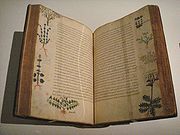
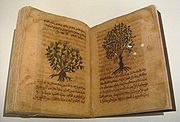 The Greek physician Pedanius Dioscorides
, of Anazarbus in Asia Minor, wrote a five volume treatises concerning medical matters , entitled Περί ύλης ιατρικής in Greek or De materia medica in Latin. This famous commentary covered about 500 plants along with a number of therapeutically useful animal and mineral products. It documented the description and direct observations of plants, fruits, seeds, the effects that various drugs had on patients. De materia medica was the first extensive drug affinity system that included about a thousand natural product drugs (mostly plant-bases), 4,740 medicinal usages for drugs, and 360 medical properties (antiseptic, anti-inflammatory, stimulants, etc.) Dioscorides' plant
descriptions use an elementary classification, though he cannot be said to have used botanical taxonomy
. Book one describes the uses for aromatic oils, salves
and ointments
, trees and shrubs,and fleshy fruits, even if not aromatic. Book two included uses for animals, parts of animals, animal products, cereals, leguminous,
malvaceous, cruciferous
, and other garden herbs. Book three detailed the properties of roots, juices, herbs and seeds,used for food or medicine. Book four continued to describe the uses for roots and herbs, specifically narcotic and
poisonous medicinal plants. Book five dealt with the medicinal uses for wine and metallic ores
. It is a precursor to all modern pharmacopeias, and is considered one of the most influential herbal books in history. It remained in use until about 1600 B.C.E.
, Muslim botanists
and Muslim physicians
significantly expanded on the earlier knowledge of materia medica. For example, al-Dinawari
described more than 637 plant drugs in the 9th century, and Ibn al-Baitar described more than 1,400 different plants, food
s and drugs, over 300 of which were his own original discoveries, in the 13th century. The experiment
al scientific method
was introduced into the field of materia medica in the 13th century by the Andalusian
-Arab botanist Abu al-Abbas al-Nabati, the teacher of Ibn al-Baitar. Al-Nabati introduced empirical
techniques in the testing, description and identification of numerous materia medica, and he separated unverified reports from those supported by actual tests and observations. This allowed the study of materia medica to evolve into the science
of pharmacology
. Avicenna
, 980-1037 C.E., was a Persian philosopher, physician, and Islamic scholar. He wrote about 40 books on medicine. His two most famous books are the Canon of Medicine and The Book of Healing and were used in medieval universities as medical textbooks. He did much to popularize the connection between Greek and Arabic medicine translating works by Hippocrates, Aristotle and Galen into Arabic. Avicenna stressed the importance of diet, exercise, and hygiene. He also was the first to describe parasitic infection, to use urine for diagnostic purposes and discouraged physicians from the practice of surgery because it was too base and manual.
In medieval Europe, medicinal herbs and plants were cultivated in monastery and nunnery gardens beginning about the eighth century. Charlemagne
gave orders for the collection of medicinal plants to systematically grown in his royal garden. This royal garden was an important precedent for botanical garden
s and physic gardens that were established in the sixteenth century. It was also the beginning of the study botany
as a separate discipline. In about the twelfth century, medicine and pharmacy began to be taught in universities.
Shabbethai Ben Abraham, better known as Shabbethai Donnolo
, (913-c 982), was a ninth century Italian Jew and the author of an early Hebrew text, Antidotarium. It consisted of detailed drugs descriptions, medicinal remedies, practical methods for preparing medicine from roots. It was a veritable glossary of herbs and drugs used during the medieval period. Donnollo was widely traveled and collected information from Arabic, Greek and Roman sources.
In the Dark and Middle Ages Nestorian
Christians were banished for their heretical views that they carried to Asia Minor
. The Greek text was translated into Syriac when pagan Greek scholars fled east after Constantine
’s conquest of Byzantium
,
Stephanos (son of Basilios, a Christian living in Baghdad
under the Khalif Motawakki) made an Arabic translation of De Materia Medica from the Greek in 854CE. In 948CE the Byzantine Emperor Romanus II, son and co-regent of Constantine Porphyrogenitos
, sent a beautifully illustrated Greek manuscript of De Materia Medica to the Spanish Khalif, Abd-Arrahman III. Later The Syriac scholar Bar Hebraeus prepared an illustrated Syriac version in 1250, which was translated into Arabic.
, Avicenna
, Galen
, Dioscorides, Platearius and Serapio, inspired the appearance of 3 main works printed in Mainz
: In 1484 The Herbarius, the following year The Gart der Gesundheit, and in 1491 the Ortus Sanistatus. The works contain 16, 242 and 570 references to Dioscorides, respectively.
The 1st appearance of Dioscorides as a printed book was a Latin translation printed at Colle
, Italy by Johanemm Allemanun de Mdemblik in 1478.
The greek version appeared in 1499 by Manutius at Venice
.
The most useful books of botany, pharmacy and medicine used by students and scholars were supplemented commentaries on Dioscorides, including the works of Fuchs
, Anguillara
, Mattioli, Maranta
, Cesalpino, Dodoens, Fabius Columna, Gaspard Bauhin
& Johann Bauhin
, and De Villanueva/Servetus. In several of these versions, the annotations and comments exceed the Dioscoridean text and have much new botany. Printers were not merely printing the authentic Materia Medica, but hiring experts on the medical and botanical field for criticism, commentaries, that would raise the stature of the printers and the work.
Most of these authors copied each other, from previous works. It was normal to add previous commentaries and marginalia, trying to make them look more enriched or thorough.
There were several De Materia Medica works noted as Anonymous A, B, C and D by the expert on Dioscorides-De Materia Medica professor John M. Riddle
. The Anonymous A has to do with authors on translations of handwrittting. Riddle
proved Anonymous C to be Bruyerinus Champier.
During the XVI century, the most representative among them were Ermolao Barbaro
, Jean Ruel, Broyeurinus, Michel de Villeneuve, Pietro Andrea Mattioli
, Andres Laguna
, Marcello Virgilio, Martin Mathee and Valerius Cordus
.
Ermolao Barbaro
The work of the Italian physician and humanist Ermolao Barbaro
, was published in 1516, 23 years after his death. Poliziano
wrote to Ermalao Barbaro, forwarding a manuscript of the first-century pharmacologist Pedanius Dioscorides
, asking him to send it back “annotated by that very learned hand of yours, thus lending the volume additional value and authority."Barbaro was professor of the University of Padua
in 1477 and translated many texts from Greek to Latin. .
He sought to avoid mistakes by gathering as many manuscrips as he could for checking the texts. He claimed to have corrected 5000 mistakes between 2 editions of Pliny the Elder
's Naturalis historia , a work he found very similar to Materia Medica for which he used at least 2 editions as well.
The result of Barbaro
's effort occupied no less than 58 pages printed in three columns of about 50 entries each. The work provides a key to over 9,000 items; all references were to pages. This was the first annotated Latin translation of Dioscorides' Materia Medica, and so Barbaro became the earliest of the Renaissance
translators of Dioscorides.
, a practice that saw its golden age in the XVI century. Barbaro's work was later corrected by Giovanni-Battista.
Jean Ruel was the dean of the Faculty of Medicine and physician to King Francis I of France
. He perfected the Latin translation of the Materia Medica directly from the "princeps edition. He tried to develop a translation joining philology
, botany
and medicine
. This work, printed in 1516 by Henri Estienne/Stephano
, became became very popular, having 20 editions during the XVI century. He published editions until 1537 printed by Simon de Colines
.
From this point, Latin was the preferred language for presenting De Materia Medica,and Ruel's editions became the basis from which many other important authors would start to create their own Materia Medica. Ruel was also teacher of two great De Materia Medica authors: Michel de Villeneuve and Andres Laguna
Bruyerinus Champier was the nephew of Symphorien Champier
, and physician of Henry II of France
. He was an arabist, and translated works of Avicena In 1550 he published his first Materia Medica, printed by Balthazar Arnoullet in Lyon
. This work had a second edition in 1552 printed by Arnoullet in Lyon & Vienne
. Both works were illustrated with figures by Fuchs
, but in this last edition there were also 30 woodcuts by the botanist and physician Jacob Dalechamp. . It seems that the reason that he used his initials, H.B.P and not his full name name in the work, could be that he practically transcribed commentaries of Mattioli.
The scholar González Echeverría has proved before the ISHM that the John M. Riddle
Anonymous B (De Materia Medica of 1543) is Michael de Villeneuve/Servetus, and that the Anonymous D (De Materia Medica of 1554 of Mattioli plus non signed commentaries) is two comentarians, Michael de Villeneuve and Mattioi, being the last one hired for editing the "Lyon
printers Tribute to Michel de Villeneuve" edition.
Michel de Villeneuve, who already had his 1st death sentence from the University of Paris
, anonymously published a Dioscorides-De Materia Medica in 1543, printed by Jean & Francois Frellon in Lyon. It has 277 marginalia and 20 comentaries on a De Materia Medica of Jean Ruel. This work has been proved by Gonzalez Echeverría to be associated to an anonymous Pharmacopeia that Michael de Villeneuve published the same year, meant to be a single unit, which is typical when it comes to De Materia Medica-Pharmacopeia. This work had 6 later editions, in 1546 and 1547 by Jean Frellon, who considered Michael de Villeneuve " his friend and brother", another in 1547 by Thibaut Payen , etc.
There is another Materia Medica with commentaries on a Ruel edition of 1537, printed by Simon de Colines
. This work contains hundreds of manuscript marginaia, all along 420 out of 480 pages. The scholar Gonzalez Echeverria demonstrated in the ISHM with a graphological, historical and linguistic study that this task was carried out by Michel de Villeneuve. It also demonstrated that this document was written by the same hand that wrote the famous " Manuscript of Paris", a work also by Michel de Villeneuve , consisting of a draft for his Chirstianismo Restitutio. “The manuscript of the Complutense
” is not just a union of the ideas of the previous works by Michel de Villeneuve, Syropum Ratio, etc, but also of the later works, Enquiridion, De Materia Medica of 1543,.. sharing with this last one many of its 20 big commentaries, for instance.
In 1554, after the immolation of Michael de Villeneuve/Servetus, the editors and printers that had worked with him decided to make a new De Materia Medica as a tribute to their colleague and friend. All the commentaries that could identify Michel de Villeneuve as the author dissapeared, but the rest are copied from his work of 1543. It is a very strange edition because there exist 4 diferent kind of copies with different cover, one per editor: Jean Frellon, Guillaume Rouillé
, Antoine Vicent and Balthazar Arnoullet, who was also the printer of this unique edition, in Lyon
. For developing a bigger work and to blur the mark of Michel de Villeneuve, they hired the great expert on De Materia Medica, Pietro Andrea Mattioli.
Pietro Andrea Mattioli
Pietro Andrea Mattioli
was a renowned botanist and physician. He published a translation of De Materia Medica into Italian in 1544 and ten years later later published a work in latin with all the plants of Dioscorides and 562 woodcuts illustrations. It appeared in 1554 , printed by Vicenzo Valgrisi, in Venice
. Mattioli made a massive contribution to the original text of Pedani's Dioscorides In some sections Mattioli added information that exceeded 15 times the length of the original text It resluted in a very big extension of the work, in beauty and information. It was later translated into German, French and Bohemian
.
Mattioli held a post in the Imperial Court as physician to Ferdinand II, Archduke of Austria
, and the Emperor Maximilian II, Holy Roman Emperor
. This position granted him an inmense influence. It was frecuent for him to try the effects of poisonous plants on prisoners in order to get his works more popular. He also affirmed that Jean Ruel had declared some information in the licopsis chapter of his Materia Medica. This is false, but still Mattioli used it as a reason for and attacking Ruel. He did not tolerate neither rivals nor corrections. The naturalists and physicians daring to disagree with him, or that had corrected him, were attacked. The list of important charaters that were amonishted, rebuked, or persued by the Inquisition
contains Wieland, Anguillara
, Gesner,Lusitanus
,etc... This made editions of De Materia Medica of Matiolli, omnipresent in all the continet, but specially in northern Europe.
Andres Laguna
In 1554 the physician Andres Laguna
published his Annotations on Dioscorides of Anazarbus
printed by Guillaume Rouillé
in Lyon. Laguna was the first to translate De Materia Medica into Castilian
. His translation was made from one of the Latin editions of Jean Ruel. It was also based on classes Laguna took from Ruel as his pupil in Paris. Laguna points out some of his teacher's erroneous translations, and adds many commentaries, which make up more than half of the total work.
Laguna
explored many Mediterranean areas and obtained results concerning many new herbs, he also added these prescriptions and commentaries to the recipes and teachings of Pedanius' Dioscorides. He aslo includes some animal and mineral products but only those related to simple medicines, that is, animal and mineral
products that are medicine or are parts of a medical compound. This was not an illustrated work. In 1555 he reedited this work with woodcuts.
It was reprinted twenty-two times by the end of the eighteenth century;
Laguna
wrote very well explained and practical commentaries. He refers anecdotes, adds commentaries on the plants, provides their synonyms in different languages, and explains their uses in the XVI century.These qualities and the number of woodcuts made this work very popular and appreciated in medicine far beyond XVI century. He had problems with Mattioli for using some of his commentaries without mentioning him.
Laguna had problems with the Inquisition
, just like Michel de Villeneuve, for both were jewish-converso
, a fact that coud have made them limit their commentaries for avoiding risks. Nevertheless he was the physician of Charles V
and the Pope Julius III
, and that helped to establish his work as the last word in Materia Medica, and as the basis of Spanish botany.
Valerius Cordus
The physician Valerius Cordus
, son of the famous botanist Euricius Cordus, went through many woods and mountains discovering hundreds of new herbs. He gave lectures on Dioscorides at the University of Wittenberg, which experts from the University attended. Cordus
had no intention of publishing his work. Five years after his death, a Materia Medica with commentaries was published. It contained the index of the Botanologicon, the outstanding work of his father Euricius, who developed a scientific classification of the plants. The following pages are on Gesner's Nomenclature, relating the different synonyms used for referring to the same plants of the Dioscorides work.
The abstracts of the lectures of Valerius Cordus go from page 449 to 553 as commentaries. This section consisted of a very refined explanation of Dioscorides teachings with more specifics on the variety of plants and habitats, and corrections of errors. Cordus
refers to both his and his father's observations. Eucharius Rösslin
's herbal illustrations are prominent in this work, followed by 200 of Fuchs
. This work and the model of botanical description and, many consider it the boldest innovation that was made by any botanist of the XVI century
The french physician Martin Mathee published in 1553 the french translation of De Materia Medica, printed by Balthazar Arnoullet, in Lyon. This granted much more access for the students of medicine to the teachings.
The greek version was reprinted in 1518,1523 and 1529, and reprinted in 1518, 1523 and 1529. Between 1555 and 1752 there were at least twelve Spanish editions; and as many in Italian from 1542. French editions appeared from 1553; and German editions from 1546.
Latin
Latin is an Italic language originally spoken in Latium and Ancient Rome. It, along with most European languages, is a descendant of the ancient Proto-Indo-European language. Although it is considered a dead language, a number of scholars and members of the Christian clergy speak it fluently, and...
medical
Medicine
Medicine is the science and art of healing. It encompasses a variety of health care practices evolved to maintain and restore health by the prevention and treatment of illness....
term for the body of collected knowledge about the therapeutic properties of any substance used for healing (i.e., medicine
Medicine
Medicine is the science and art of healing. It encompasses a variety of health care practices evolved to maintain and restore health by the prevention and treatment of illness....
s). The term 'materia medica' derived from the title of a work by the Ancient Greek physician Pedanius Dioscorides
Pedanius Dioscorides
Pedanius Dioscorides was a Greek physician, pharmacologist and botanist, the author of a 5-volume encyclopedia about herbal medicine and related medicinal substances , that was widely read for more than 1,500 years.-Life:...
in the 1st century AD, De materia medica libre. In Latin, the materia medica literally means "medical material/substance" and was used from the period of the Roman Empire
Roman Empire
The Roman Empire was the post-Republican period of the ancient Roman civilization, characterised by an autocratic form of government and large territorial holdings in Europe and around the Mediterranean....
until the twentieth century, but has now been generally replaced in medical education contexts by the term pharmacology
Pharmacology
Pharmacology is the branch of medicine and biology concerned with the study of drug action. More specifically, it is the study of the interactions that occur between a living organism and chemicals that affect normal or abnormal biochemical function...
.
Ancient
The earliest known writing about medicine was a hundred and ten page Egyptian papyrus. It was supposedly written by the god, Thoth, about sixteen centuries before the common era. The Ebers papyrusEbers papyrus
The Ebers Papyrus, also known as Papyrus Ebers, is an Egyptian medical papyrus dating to circa 1550 BC. Among the oldest and most important medical papyri of ancient Egypt, it was purchased at Luxor, in the winter of 1873–74 by Georg Ebers...
is an ancient recipe book dated to approximately 1552 B.C.E. It contains a mixture of magic and medicine with invocations to banish disease and a catalogue of useful plants, minerals, magic amulets and spells. The most famous Egyptian physician was Imhotep
Imhotep
Imhotep , fl. 27th century BC was an Egyptian polymath, who served under the Third Dynasty king Djoser as chancellor to the pharaoh and high priest of the sun god Ra at Heliopolis...
, in Memphis about 3500 B.C.E. Imhotep’s materia medica consisted of procedures for treating head and torso injuries, tending of wounds, and prevention and curing infections and advanced principles of hygiene.
In India, the Ayurveda
Ayurveda
Ayurveda or ayurvedic medicine is a system of traditional medicine native to India and a form of alternative medicine. In Sanskrit, words , meaning "longevity", and , meaning "knowledge" or "science". The earliest literature on Indian medical practice appeared during the Vedic period in India,...
is traditional medicine that emphasizes plant-based treatments, hygiene, and balance in the body’s state of being. Indian materia medica included knowledge of plants, where they grow in all season, methods for storage and shelf life of harvested materials. It also included directions for making juice from vegetables, dried powders from herb, cold infusions and extracts.
The earliest Chinese manual of materia medica
Chinese herbology
Chinese Herbology is the theory of Traditional Chinese herbal therapy, which accounts for the majority of treatments in Traditional Chinese medicine ....
, the Shennong Bencao Jing
Shen nong ben cao jing
The Shénnóng Běn Cǎo Jīng is a Chinese book on agriculture and medicinal plants. Its origin has been attributed to the mythical Chinese emperor Shennong, who was said to have lived around 2800 BC. Researchers hypothesize this is a compilation of oral traditions written between about 300 BC and...
(Shennong Emperor's Classic of Materia Medica), was compiled in the first century AD during the Han dynasty
Han Dynasty
The Han Dynasty was the second imperial dynasty of China, preceded by the Qin Dynasty and succeeded by the Three Kingdoms . It was founded by the rebel leader Liu Bang, known posthumously as Emperor Gaozu of Han. It was briefly interrupted by the Xin Dynasty of the former regent Wang Mang...
, but it was attributed to the mythical Shennong
Shennong
Shennong , which names mean "Divine Farmer", but also known as the Emperor of the Five Grains , was a legendary ruler of China and culture hero reputed to have lived some 5,000 years ago...
. It lists some 365 medicines of which 252 of them are herbs. Earlier literature included lists of prescriptions for specific ailments, exemplified by a manuscript Recipes for Fifty-Two Ailments
Wushi'er Bingfang
The Wushi'er Bingfang , or Recipes for Fifty-Two Ailments, is an ancient Chinese medical text that was discovered in 1973 in Mawangdui in a tomb that was sealed in 168 BCE under the Han Dynasty. The text was copied in seal script on sheets of silk around 215 BCE, under the Qin Dynasty, but might...
, found in the Mawangdui tomb, which was sealed in 168 BC. Succeeding generations augmented the Shennong Bencao Jing, as in the Yaoxing Lun
Yaoxing Lun
Yaoxing Lun , literally Treatise on the Nature of Medicinal Herbs, is a 7th century Tang Dynasty Chinese treatise on herbal medicine.-See also:*Pharmacognosy*Chinese herbology*Compendium of Materia Medica*Traditional Chinese medicine...
(Treatise on the Nature of Medicinal Herbs), a 7th century Tang Dynasty
Tang Dynasty
The Tang Dynasty was an imperial dynasty of China preceded by the Sui Dynasty and followed by the Five Dynasties and Ten Kingdoms Period. It was founded by the Li family, who seized power during the decline and collapse of the Sui Empire...
treatise on herbal medicine.
In Greece, Hippocrates
Hippocrates
Hippocrates of Cos or Hippokrates of Kos was an ancient Greek physician of the Age of Pericles , and is considered one of the most outstanding figures in the history of medicine...
, (born 460 B.C.E.), was a philosopher and known as the Father of Medicine. He founded a school of medicine that focused on treating the causes of disease rather than its symptoms. Disease was dictated by natural laws and therefore could be treated through close observation of symptoms. Hippocrates stressed discovering and eliminating the causes of diseases. His treatises, Aphorisms and Prognostics discusses 265 drugs, the importance of diet and external treatments for diseases. Theophrastus
Theophrastus
Theophrastus , a Greek native of Eresos in Lesbos, was the successor to Aristotle in the Peripatetic school. He came to Athens at a young age, and initially studied in Plato's school. After Plato's death he attached himself to Aristotle. Aristotle bequeathed to Theophrastus his writings, and...
, (390-280 B.C.E.), was a disciple of Aristotle
Aristotle
Aristotle was a Greek philosopher and polymath, a student of Plato and teacher of Alexander the Great. His writings cover many subjects, including physics, metaphysics, poetry, theater, music, logic, rhetoric, linguistics, politics, government, ethics, biology, and zoology...
and a philosopher of natural history
Natural history
Natural history is the scientific research of plants or animals, leaning more towards observational rather than experimental methods of study, and encompasses more research published in magazines than in academic journals. Grouped among the natural sciences, natural history is the systematic study...
, considered by historians as the “Father of Botany.” He wrote a treatise entitled, Historia Plantarium, about 300 B.C.E. It was the first attempt to organize and classify plants, plant lore, and botanical morphology in Greece. It provided physicians with a rough taxonomy of plants and details of medicinal herbs and herbal concoctions.
Galen
Galen
Aelius Galenus or Claudius Galenus , better known as Galen of Pergamon , was a prominent Roman physician, surgeon and philosopher...
, was a philosopher, physician, pharmacist and a prolific medical writer. He collected and compiled an extensive record of the medical knowledge of his day and added the results of his own observations. He wrote on the structure of organs, but not their uses; the pulse and its association with respiration; the arteries and the movement of blood; and the uses of theriac
Theriac
Theriac or theriaca was a medical concoction originally formulated by the Greeks in the 1st century AD and became popular throughout the ancient world as far away as China and India via the trading links of the Silk Route...
s. “In treatises such as On Theriac to Piso, On Theriac to Pamphilius, and On Antidotes, Galen identified theriac as a sixty-four-ingredient compound, able to cure any ill known.” His work was rediscovered in the fifteenth century and became the authority on medicine and healing for the next two centuries. His medicine was based on the regulation of the four humors (blood, phlegm, black bile, and yellow bile) and their properties (wet, dry, hot, and cold).
Pedanius Dioscorides
Pedanius Dioscorides was a Greek physician, pharmacologist and botanist, the author of a 5-volume encyclopedia about herbal medicine and related medicinal substances , that was widely read for more than 1,500 years.-Life:...
, of Anazarbus in Asia Minor, wrote a five volume treatises concerning medical matters , entitled Περί ύλης ιατρικής in Greek or De materia medica in Latin. This famous commentary covered about 500 plants along with a number of therapeutically useful animal and mineral products. It documented the description and direct observations of plants, fruits, seeds, the effects that various drugs had on patients. De materia medica was the first extensive drug affinity system that included about a thousand natural product drugs (mostly plant-bases), 4,740 medicinal usages for drugs, and 360 medical properties (antiseptic, anti-inflammatory, stimulants, etc.) Dioscorides' plant
descriptions use an elementary classification, though he cannot be said to have used botanical taxonomy
Botanical nomenclature
Botanical nomenclature is the formal, scientific naming of plants. It is related to, but distinct from taxonomy. Plant taxonomy is concerned with grouping and classifying plants; botanical nomenclature then provides names for the results of this process. The starting point for modern botanical...
. Book one describes the uses for aromatic oils, salves
Salve
A salve is a medical ointment used to soothe the head or other body surface. A popular eye medicine known as "Phrygian powder" was one of Laodicea's sources of wealth...
and ointments
Topical
In medicine, a topical medication is applied to body surfaces such as the skin or mucous membranes such as the vagina, anus, throat, eyes and ears.Many topical medications are epicutaneous, meaning that they are applied directly to the skin...
, trees and shrubs,and fleshy fruits, even if not aromatic. Book two included uses for animals, parts of animals, animal products, cereals, leguminous,
malvaceous, cruciferous
Cruciferous vegetables
Vegetables of the family Brassicaceae are called cruciferous vegetables. The vegetables are widely cultivated, with many genera, species, and cultivars being raised for food production such as cauliflower, cabbage, cress, bok choy, broccoli and similar green leaf vegetables...
, and other garden herbs. Book three detailed the properties of roots, juices, herbs and seeds,used for food or medicine. Book four continued to describe the uses for roots and herbs, specifically narcotic and
poisonous medicinal plants. Book five dealt with the medicinal uses for wine and metallic ores
Ore
An ore is a type of rock that contains minerals with important elements including metals. The ores are extracted through mining; these are then refined to extract the valuable element....
. It is a precursor to all modern pharmacopeias, and is considered one of the most influential herbal books in history. It remained in use until about 1600 B.C.E.
Medieval
Later in the medieval Islamic worldIslamic Golden Age
During the Islamic Golden Age philosophers, scientists and engineers of the Islamic world contributed enormously to technology and culture, both by preserving earlier traditions and by adding their own inventions and innovations...
, Muslim botanists
Muslim Agricultural Revolution
The Arab Agricultural Revolution is a term coined by the historian Andrew Watson in his influential 1974 paper postulating a fundamental transformation in agriculture from the 8th century to the 13th century in the Muslim...
and Muslim physicians
Islamic medicine
In the history of medicine, Islamic medicine, Arabic medicine or Arabian medicine refers to medicine developed in the Islamic Golden Age, and written in Arabic, the lingua franca of Islamic civilization....
significantly expanded on the earlier knowledge of materia medica. For example, al-Dinawari
Al-Dinawari
Ābu Ḥanīfah Āḥmad ibn Dawūd Dīnawarī was a Persian polymath excelling as much in astronomy, agriculture, botany and metallurgy and as he did in geography, mathematics and history. He was born in Dinawar, . He studied astronomy, mathematics and mechanics in Isfahan and philology and poetry in...
described more than 637 plant drugs in the 9th century, and Ibn al-Baitar described more than 1,400 different plants, food
Food
Food is any substance consumed to provide nutritional support for the body. It is usually of plant or animal origin, and contains essential nutrients, such as carbohydrates, fats, proteins, vitamins, or minerals...
s and drugs, over 300 of which were his own original discoveries, in the 13th century. The experiment
Experiment
An experiment is a methodical procedure carried out with the goal of verifying, falsifying, or establishing the validity of a hypothesis. Experiments vary greatly in their goal and scale, but always rely on repeatable procedure and logical analysis of the results...
al scientific method
Scientific method
Scientific method refers to a body of techniques for investigating phenomena, acquiring new knowledge, or correcting and integrating previous knowledge. To be termed scientific, a method of inquiry must be based on gathering empirical and measurable evidence subject to specific principles of...
was introduced into the field of materia medica in the 13th century by the Andalusian
Al-Andalus
Al-Andalus was the Arabic name given to a nation and territorial region also commonly referred to as Moorish Iberia. The name describes parts of the Iberian Peninsula and Septimania governed by Muslims , at various times in the period between 711 and 1492, although the territorial boundaries...
-Arab botanist Abu al-Abbas al-Nabati, the teacher of Ibn al-Baitar. Al-Nabati introduced empirical
Empirical
The word empirical denotes information gained by means of observation or experimentation. Empirical data are data produced by an experiment or observation....
techniques in the testing, description and identification of numerous materia medica, and he separated unverified reports from those supported by actual tests and observations. This allowed the study of materia medica to evolve into the science
Science
Science is a systematic enterprise that builds and organizes knowledge in the form of testable explanations and predictions about the universe...
of pharmacology
Pharmacology
Pharmacology is the branch of medicine and biology concerned with the study of drug action. More specifically, it is the study of the interactions that occur between a living organism and chemicals that affect normal or abnormal biochemical function...
. Avicenna
Avicenna
Abū ʿAlī al-Ḥusayn ibn ʿAbd Allāh ibn Sīnā , commonly known as Ibn Sīnā or by his Latinized name Avicenna, was a Persian polymath, who wrote almost 450 treatises on a wide range of subjects, of which around 240 have survived...
, 980-1037 C.E., was a Persian philosopher, physician, and Islamic scholar. He wrote about 40 books on medicine. His two most famous books are the Canon of Medicine and The Book of Healing and were used in medieval universities as medical textbooks. He did much to popularize the connection between Greek and Arabic medicine translating works by Hippocrates, Aristotle and Galen into Arabic. Avicenna stressed the importance of diet, exercise, and hygiene. He also was the first to describe parasitic infection, to use urine for diagnostic purposes and discouraged physicians from the practice of surgery because it was too base and manual.
In medieval Europe, medicinal herbs and plants were cultivated in monastery and nunnery gardens beginning about the eighth century. Charlemagne
Charlemagne
Charlemagne was King of the Franks from 768 and Emperor of the Romans from 800 to his death in 814. He expanded the Frankish kingdom into an empire that incorporated much of Western and Central Europe. During his reign, he conquered Italy and was crowned by Pope Leo III on 25 December 800...
gave orders for the collection of medicinal plants to systematically grown in his royal garden. This royal garden was an important precedent for botanical garden
Botanical garden
A botanical garden The terms botanic and botanical, and garden or gardens are used more-or-less interchangeably, although the word botanic is generally reserved for the earlier, more traditional gardens. is a well-tended area displaying a wide range of plants labelled with their botanical names...
s and physic gardens that were established in the sixteenth century. It was also the beginning of the study botany
Botany
Botany, plant science, or plant biology is a branch of biology that involves the scientific study of plant life. Traditionally, botany also included the study of fungi, algae and viruses...
as a separate discipline. In about the twelfth century, medicine and pharmacy began to be taught in universities.
Shabbethai Ben Abraham, better known as Shabbethai Donnolo
Shabbethai Donnolo
Shabbethai Donnolo was an Italian physician, and writer on medicine and astrology born at Oria. When twelve years of age he was made prisoner by the Arabs under the leadership of the Fatimite Abu Ahmad Ja'far ibn 'Ubaid, but was ransomed by his relatives at Otranto, while the rest of his family...
, (913-c 982), was a ninth century Italian Jew and the author of an early Hebrew text, Antidotarium. It consisted of detailed drugs descriptions, medicinal remedies, practical methods for preparing medicine from roots. It was a veritable glossary of herbs and drugs used during the medieval period. Donnollo was widely traveled and collected information from Arabic, Greek and Roman sources.
In the Dark and Middle Ages Nestorian
Nestorian
Nestorian or Nestorians can refer to:*Nestorianism, a Christological doctrine developed by Nestorius, Patriarch of Constantinople, condemned as heresy by the Council of Ephesus in 431...
Christians were banished for their heretical views that they carried to Asia Minor
Asia Minor
Asia Minor is a geographical location at the westernmost protrusion of Asia, also called Anatolia, and corresponds to the western two thirds of the Asian part of Turkey...
. The Greek text was translated into Syriac when pagan Greek scholars fled east after Constantine
Constantine
Constantine most commonly refers to one of the following:*Constantine , a given name and surname*Constantine I, Roman Emperor from 306 to 337, commonly known as Constantine the GreatIt may also refer to:- People :Roman/Byzantine Emperors...
’s conquest of Byzantium
Byzantium
Byzantium was an ancient Greek city, founded by Greek colonists from Megara in 667 BC and named after their king Byzas . The name Byzantium is a Latinization of the original name Byzantion...
,
Stephanos (son of Basilios, a Christian living in Baghdad
Baghdad
Baghdad is the capital of Iraq, as well as the coterminous Baghdad Governorate. The population of Baghdad in 2011 is approximately 7,216,040...
under the Khalif Motawakki) made an Arabic translation of De Materia Medica from the Greek in 854CE. In 948CE the Byzantine Emperor Romanus II, son and co-regent of Constantine Porphyrogenitos
Porphyrogenitos
Porphyrogénnētos, Latinized as Porphyrogenitus was an honorific title given to a son, or daughter , of a reigning emperor in the Byzantine Empire. However, not every imperial prince or princess was accorded this distinction...
, sent a beautifully illustrated Greek manuscript of De Materia Medica to the Spanish Khalif, Abd-Arrahman III. Later The Syriac scholar Bar Hebraeus prepared an illustrated Syriac version in 1250, which was translated into Arabic.
Modern Age
Matthaeus SilvaticusMatthaeus Silvaticus
Matthaeus Silvaticus or Mattheus Sylvaticus was a medieval Latin medical writer and botanist. His main notability is a book about medicating agents which he completed about year 1317 under the Latin title Pandectarum Medicinae or Pandectae Medicinae...
, Avicenna
Avicenna
Abū ʿAlī al-Ḥusayn ibn ʿAbd Allāh ibn Sīnā , commonly known as Ibn Sīnā or by his Latinized name Avicenna, was a Persian polymath, who wrote almost 450 treatises on a wide range of subjects, of which around 240 have survived...
, Galen
Galen
Aelius Galenus or Claudius Galenus , better known as Galen of Pergamon , was a prominent Roman physician, surgeon and philosopher...
, Dioscorides, Platearius and Serapio, inspired the appearance of 3 main works printed in Mainz
Mainz
Mainz under the Holy Roman Empire, and previously was a Roman fort city which commanded the west bank of the Rhine and formed part of the northernmost frontier of the Roman Empire...
: In 1484 The Herbarius, the following year The Gart der Gesundheit, and in 1491 the Ortus Sanistatus. The works contain 16, 242 and 570 references to Dioscorides, respectively.
The 1st appearance of Dioscorides as a printed book was a Latin translation printed at Colle
Colle
Colle is a frazione of the comune of Bettona in the Province of Perugia, Umbria, central Italy. It stands at an elevation of 230 metres above sea level. At the time of the Istat census of 2001 it had 114 inhabitants....
, Italy by Johanemm Allemanun de Mdemblik in 1478.
The greek version appeared in 1499 by Manutius at Venice
Venice
Venice is a city in northern Italy which is renowned for the beauty of its setting, its architecture and its artworks. It is the capital of the Veneto region...
.
The most useful books of botany, pharmacy and medicine used by students and scholars were supplemented commentaries on Dioscorides, including the works of Fuchs
Leonhart Fuchs
Leonhart Fuchs , sometimes spelled Leonhard Fuchs, was a German physician and one of the three founding fathers of botany, along with Otto Brunfels and Hieronymus Bock .-Biography:...
, Anguillara
Anguillara
Anguillara were a baronal family of Latium, especially powerful in Rome and in the current province of Viterbo during the Middle Ages and the early Renaissance....
, Mattioli, Maranta
Maranta
Maranta can refer to:*The Marantaceae family of "prayer plants", including arrowroot*Maranta , a genus within that familyMaranta as a personal name may refer to:...
, Cesalpino, Dodoens, Fabius Columna, Gaspard Bauhin
Gaspard
Gaspard is a Francophone male given name or family name and may refer to:* Gaspard Dughet , French painter* Gaspard de Coligny , French Huguenot leader* Claude Gaspard Bachet de Méziriac , French mathematician...
& Johann Bauhin
Johann Bauhin
Johann Bauhin was a Swiss botanist.He studied botany at Tübingen under Leonhart Fuchs . He then travelled with Conrad Gessner, after which he started a practise of medicine at Basel, where he was elected Professor of Rhetoric in 1566...
, and De Villanueva/Servetus. In several of these versions, the annotations and comments exceed the Dioscoridean text and have much new botany. Printers were not merely printing the authentic Materia Medica, but hiring experts on the medical and botanical field for criticism, commentaries, that would raise the stature of the printers and the work.
Most of these authors copied each other, from previous works. It was normal to add previous commentaries and marginalia, trying to make them look more enriched or thorough.
There were several De Materia Medica works noted as Anonymous A, B, C and D by the expert on Dioscorides-De Materia Medica professor John M. Riddle
John Riddle
John Riddle is an Alumni Distinguished Professor emeritus of History at North Carolina State University and a specialist in the history of medicine.His specialization is the history of drugs particularly during the classical and medieval periods....
. The Anonymous A has to do with authors on translations of handwrittting. Riddle
John Riddle
John Riddle is an Alumni Distinguished Professor emeritus of History at North Carolina State University and a specialist in the history of medicine.His specialization is the history of drugs particularly during the classical and medieval periods....
proved Anonymous C to be Bruyerinus Champier.
During the XVI century, the most representative among them were Ermolao Barbaro
Ermolao Barbaro
Ermolao or Hermolao Barbaro, also Hermolaus Barbarus , was an Italian Renaissance scholar.-Education:Ermolao Barbaro was born in Venice, the son of Zaccaria Barbaro, and the grandson of Francesco Barbaro...
, Jean Ruel, Broyeurinus, Michel de Villeneuve, Pietro Andrea Mattioli
Pietro Andrea Mattioli
Pietro Andrea Gregorio Mattioli was a doctor and naturalist born in Siena.He received his MD at the University of Padua in 1523, and subsequently practiced the profession in Siena, Rome, Trento and Gorizia, becoming personal physician of Ferdinand II, Archduke of Austria in Prague and Ambras...
, Andres Laguna
Andrés Laguna
Andrés Laguna de Segovia was a Spanish humanist physician, pharmacologist, and botanist.-Biography:Laguna was born in Segovia, according to Diego de Colmenares and other historians, to a converted Jewish doctor. He studied the arts for two years in Salamanca, then moved to Paris in 1530, where he...
, Marcello Virgilio, Martin Mathee and Valerius Cordus
Valerius Cordus
Valerius Cordus was a German physician and botanist who authored one of the greatest pharmacopoeias and one of the most celebrated herbals in history...
.
Ermolao BarbaroErmolao BarbaroErmolao or Hermolao Barbaro, also Hermolaus Barbarus , was an Italian Renaissance scholar.-Education:Ermolao Barbaro was born in Venice, the son of Zaccaria Barbaro, and the grandson of Francesco Barbaro...
The work of the Italian physician and humanist Ermolao Barbaro
Ermolao Barbaro
Ermolao or Hermolao Barbaro, also Hermolaus Barbarus , was an Italian Renaissance scholar.-Education:Ermolao Barbaro was born in Venice, the son of Zaccaria Barbaro, and the grandson of Francesco Barbaro...
, was published in 1516, 23 years after his death. Poliziano
Poliziano
Angelo Ambrogini, commonly known by his nickname, anglicized as Politian, Italian Poliziano, Latin Politianus was an Italian Renaissance classical scholar and poet, one of the revivers of Humanist Latin...
wrote to Ermalao Barbaro, forwarding a manuscript of the first-century pharmacologist Pedanius Dioscorides
Pedanius Dioscorides
Pedanius Dioscorides was a Greek physician, pharmacologist and botanist, the author of a 5-volume encyclopedia about herbal medicine and related medicinal substances , that was widely read for more than 1,500 years.-Life:...
, asking him to send it back “annotated by that very learned hand of yours, thus lending the volume additional value and authority."Barbaro was professor of the University of Padua
University of Padua
The University of Padua is a premier Italian university located in the city of Padua, Italy. The University of Padua was founded in 1222 as a school of law and was one of the most prominent universities in early modern Europe. It is among the earliest universities of the world and the second...
in 1477 and translated many texts from Greek to Latin. .
He sought to avoid mistakes by gathering as many manuscrips as he could for checking the texts. He claimed to have corrected 5000 mistakes between 2 editions of Pliny the Elder
Pliny the Elder
Gaius Plinius Secundus , better known as Pliny the Elder, was a Roman author, naturalist, and natural philosopher, as well as naval and army commander of the early Roman Empire, and personal friend of the emperor Vespasian...
's Naturalis historia , a work he found very similar to Materia Medica for which he used at least 2 editions as well.
The result of Barbaro
Ermolao Barbaro
Ermolao or Hermolao Barbaro, also Hermolaus Barbarus , was an Italian Renaissance scholar.-Education:Ermolao Barbaro was born in Venice, the son of Zaccaria Barbaro, and the grandson of Francesco Barbaro...
's effort occupied no less than 58 pages printed in three columns of about 50 entries each. The work provides a key to over 9,000 items; all references were to pages. This was the first annotated Latin translation of Dioscorides' Materia Medica, and so Barbaro became the earliest of the Renaissance
Renaissance
The Renaissance was a cultural movement that spanned roughly the 14th to the 17th century, beginning in Italy in the Late Middle Ages and later spreading to the rest of Europe. The term is also used more loosely to refer to the historical era, but since the changes of the Renaissance were not...
translators of Dioscorides.
, a practice that saw its golden age in the XVI century. Barbaro's work was later corrected by Giovanni-Battista.
Jean Ruel
Jean Ruel was the dean of the Faculty of Medicine and physician to King Francis I of France
Francis I of France
Francis I was King of France from 1515 until his death. During his reign, huge cultural changes took place in France and he has been called France's original Renaissance monarch...
. He perfected the Latin translation of the Materia Medica directly from the "princeps edition. He tried to develop a translation joining philology
Philology
Philology is the study of language in written historical sources; it is a combination of literary studies, history and linguistics.Classical philology is the philology of Greek and Classical Latin...
, botany
Botany
Botany, plant science, or plant biology is a branch of biology that involves the scientific study of plant life. Traditionally, botany also included the study of fungi, algae and viruses...
and medicine
Medicine
Medicine is the science and art of healing. It encompasses a variety of health care practices evolved to maintain and restore health by the prevention and treatment of illness....
. This work, printed in 1516 by Henri Estienne/Stephano
Henri Estienne (elder)
Henri Estienne, also known as Henricus Stephanus, was a 16th-century Parisian printer. He was born in Paris in 1470 and began as a bookseller in Paris from 1502 to 1520, though his father was not in favour of this enterprise. He began to print probably in 1505. In this year he issued the Abrégé de...
, became became very popular, having 20 editions during the XVI century. He published editions until 1537 printed by Simon de Colines
Simon de Colines
Simon de Colines , a Parisian printer, one of the first printer type of the French Renaissance. He was active in Paris between 1520 and 1546. Colines used elegant roman and italic types and a Greek type, with accents, that was superior to its predecessors...
.
From this point, Latin was the preferred language for presenting De Materia Medica,and Ruel's editions became the basis from which many other important authors would start to create their own Materia Medica. Ruel was also teacher of two great De Materia Medica authors: Michel de Villeneuve and Andres Laguna
Andrés Laguna
Andrés Laguna de Segovia was a Spanish humanist physician, pharmacologist, and botanist.-Biography:Laguna was born in Segovia, according to Diego de Colmenares and other historians, to a converted Jewish doctor. He studied the arts for two years in Salamanca, then moved to Paris in 1530, where he...
Bruyerinus
Bruyerinus Champier was the nephew of Symphorien Champier
Symphorien Champier
Symphorien Champier , a Lyonnese doctor born in Saint-Symphorien, France, was a relation of the Chevalier de Bayard through his wife, Marguerite Terrail.-Life:...
, and physician of Henry II of France
Henry II of France
Henry II was King of France from 31 March 1547 until his death in 1559.-Early years:Henry was born in the royal Château de Saint-Germain-en-Laye, near Paris, the son of Francis I and Claude, Duchess of Brittany .His father was captured at the Battle of Pavia in 1525 by his sworn enemy,...
. He was an arabist, and translated works of Avicena In 1550 he published his first Materia Medica, printed by Balthazar Arnoullet in Lyon
Lyon
Lyon , is a city in east-central France in the Rhône-Alpes region, situated between Paris and Marseille. Lyon is located at from Paris, from Marseille, from Geneva, from Turin, and from Barcelona. The residents of the city are called Lyonnais....
. This work had a second edition in 1552 printed by Arnoullet in Lyon & Vienne
Vienne, Isère
Vienne is a commune in south-eastern France, located south of Lyon, on the Rhône River. It is the second largest city after Grenoble in the Isère department, of which it is a subprefecture. The city's population was of 29,400 as of the 2001 census....
. Both works were illustrated with figures by Fuchs
Leonhart Fuchs
Leonhart Fuchs , sometimes spelled Leonhard Fuchs, was a German physician and one of the three founding fathers of botany, along with Otto Brunfels and Hieronymus Bock .-Biography:...
, but in this last edition there were also 30 woodcuts by the botanist and physician Jacob Dalechamp. . It seems that the reason that he used his initials, H.B.P and not his full name name in the work, could be that he practically transcribed commentaries of Mattioli.
Michel de Villeneuve/Servetus
The scholar González Echeverría has proved before the ISHM that the John M. Riddle
John Riddle
John Riddle is an Alumni Distinguished Professor emeritus of History at North Carolina State University and a specialist in the history of medicine.His specialization is the history of drugs particularly during the classical and medieval periods....
Anonymous B (De Materia Medica of 1543) is Michael de Villeneuve/Servetus, and that the Anonymous D (De Materia Medica of 1554 of Mattioli plus non signed commentaries) is two comentarians, Michael de Villeneuve and Mattioi, being the last one hired for editing the "Lyon
Lyon
Lyon , is a city in east-central France in the Rhône-Alpes region, situated between Paris and Marseille. Lyon is located at from Paris, from Marseille, from Geneva, from Turin, and from Barcelona. The residents of the city are called Lyonnais....
printers Tribute to Michel de Villeneuve" edition.
Michel de Villeneuve, who already had his 1st death sentence from the University of Paris
University of Paris
The University of Paris was a university located in Paris, France and one of the earliest to be established in Europe. It was founded in the mid 12th century, and officially recognized as a university probably between 1160 and 1250...
, anonymously published a Dioscorides-De Materia Medica in 1543, printed by Jean & Francois Frellon in Lyon. It has 277 marginalia and 20 comentaries on a De Materia Medica of Jean Ruel. This work has been proved by Gonzalez Echeverría to be associated to an anonymous Pharmacopeia that Michael de Villeneuve published the same year, meant to be a single unit, which is typical when it comes to De Materia Medica-Pharmacopeia. This work had 6 later editions, in 1546 and 1547 by Jean Frellon, who considered Michael de Villeneuve " his friend and brother", another in 1547 by Thibaut Payen , etc.
There is another Materia Medica with commentaries on a Ruel edition of 1537, printed by Simon de Colines
Simon de Colines
Simon de Colines , a Parisian printer, one of the first printer type of the French Renaissance. He was active in Paris between 1520 and 1546. Colines used elegant roman and italic types and a Greek type, with accents, that was superior to its predecessors...
. This work contains hundreds of manuscript marginaia, all along 420 out of 480 pages. The scholar Gonzalez Echeverria demonstrated in the ISHM with a graphological, historical and linguistic study that this task was carried out by Michel de Villeneuve. It also demonstrated that this document was written by the same hand that wrote the famous " Manuscript of Paris", a work also by Michel de Villeneuve , consisting of a draft for his Chirstianismo Restitutio. “The manuscript of the Complutense
Complutense University of Madrid
The Complutense University of Madrid is a university in Madrid, and one of the oldest universities in the world. It is located on a sprawling campus that occupies the entirety of the Ciudad Universitaria district of Madrid, with annexes in the district of Somosaguas in the neighboring city of...
” is not just a union of the ideas of the previous works by Michel de Villeneuve, Syropum Ratio, etc, but also of the later works, Enquiridion, De Materia Medica of 1543,.. sharing with this last one many of its 20 big commentaries, for instance.
In 1554, after the immolation of Michael de Villeneuve/Servetus, the editors and printers that had worked with him decided to make a new De Materia Medica as a tribute to their colleague and friend. All the commentaries that could identify Michel de Villeneuve as the author dissapeared, but the rest are copied from his work of 1543. It is a very strange edition because there exist 4 diferent kind of copies with different cover, one per editor: Jean Frellon, Guillaume Rouillé
Guillaume Rouillé
Guillaume Rouillé, Latin Rovillium , was one of the most prominent humanist bookseller-printers in 16th-century Lyon. He invented the pocket book format called the sextodecimo, printed with sixteen leaves to the folio sheet, half the size of the octavo format, and published many works of history...
, Antoine Vicent and Balthazar Arnoullet, who was also the printer of this unique edition, in Lyon
Lyon
Lyon , is a city in east-central France in the Rhône-Alpes region, situated between Paris and Marseille. Lyon is located at from Paris, from Marseille, from Geneva, from Turin, and from Barcelona. The residents of the city are called Lyonnais....
. For developing a bigger work and to blur the mark of Michel de Villeneuve, they hired the great expert on De Materia Medica, Pietro Andrea Mattioli.
Pietro Andrea MattioliPietro Andrea MattioliPietro Andrea Gregorio Mattioli was a doctor and naturalist born in Siena.He received his MD at the University of Padua in 1523, and subsequently practiced the profession in Siena, Rome, Trento and Gorizia, becoming personal physician of Ferdinand II, Archduke of Austria in Prague and Ambras...
Pietro Andrea Mattioli
Pietro Andrea Mattioli
Pietro Andrea Gregorio Mattioli was a doctor and naturalist born in Siena.He received his MD at the University of Padua in 1523, and subsequently practiced the profession in Siena, Rome, Trento and Gorizia, becoming personal physician of Ferdinand II, Archduke of Austria in Prague and Ambras...
was a renowned botanist and physician. He published a translation of De Materia Medica into Italian in 1544 and ten years later later published a work in latin with all the plants of Dioscorides and 562 woodcuts illustrations. It appeared in 1554 , printed by Vicenzo Valgrisi, in Venice
Venice
Venice is a city in northern Italy which is renowned for the beauty of its setting, its architecture and its artworks. It is the capital of the Veneto region...
. Mattioli made a massive contribution to the original text of Pedani's Dioscorides In some sections Mattioli added information that exceeded 15 times the length of the original text It resluted in a very big extension of the work, in beauty and information. It was later translated into German, French and Bohemian
Bohemian
A Bohemian is a resident of the former Kingdom of Bohemia, either in a narrow sense as the region of Bohemia proper or in a wider meaning as the whole country, now known as the Czech Republic. The word "Bohemian" was used to denote the Czech people as well as the Czech language before the word...
.
Mattioli held a post in the Imperial Court as physician to Ferdinand II, Archduke of Austria
Ferdinand II, Archduke of Austria
Ferdinand II, Archduke of Further Austria was ruler of Further Austria including Tirol.-Life account:...
, and the Emperor Maximilian II, Holy Roman Emperor
Maximilian II, Holy Roman Emperor
Maximilian II was king of Bohemia and king of the Romans from 1562, king of Hungary and Croatia from 1563, emperor of the Holy Roman Empire of the German Nation from 1564 until his death...
. This position granted him an inmense influence. It was frecuent for him to try the effects of poisonous plants on prisoners in order to get his works more popular. He also affirmed that Jean Ruel had declared some information in the licopsis chapter of his Materia Medica. This is false, but still Mattioli used it as a reason for and attacking Ruel. He did not tolerate neither rivals nor corrections. The naturalists and physicians daring to disagree with him, or that had corrected him, were attacked. The list of important charaters that were amonishted, rebuked, or persued by the Inquisition
Inquisition
The Inquisition, Inquisitio Haereticae Pravitatis , was the "fight against heretics" by several institutions within the justice-system of the Roman Catholic Church. It started in the 12th century, with the introduction of torture in the persecution of heresy...
contains Wieland, Anguillara
Anguillara
Anguillara were a baronal family of Latium, especially powerful in Rome and in the current province of Viterbo during the Middle Ages and the early Renaissance....
, Gesner,Lusitanus
Amato Lusitano
João Rodrigues de Castelo Branco, better known as Amato Lusitano and Amatus Lusitanus , was a notable Portuguese Jewish physician of the 16th century. Like Herophilus, Galen, Ibn al-Nafis, Michael Servetus, Realdo Colombo and William Harvey, he is credited as making a discovery in the circulation...
,etc... This made editions of De Materia Medica of Matiolli, omnipresent in all the continet, but specially in northern Europe.
Andres LagunaAndrés LagunaAndrés Laguna de Segovia was a Spanish humanist physician, pharmacologist, and botanist.-Biography:Laguna was born in Segovia, according to Diego de Colmenares and other historians, to a converted Jewish doctor. He studied the arts for two years in Salamanca, then moved to Paris in 1530, where he...
In 1554 the physician Andres Laguna
Andrés Laguna
Andrés Laguna de Segovia was a Spanish humanist physician, pharmacologist, and botanist.-Biography:Laguna was born in Segovia, according to Diego de Colmenares and other historians, to a converted Jewish doctor. He studied the arts for two years in Salamanca, then moved to Paris in 1530, where he...
published his Annotations on Dioscorides of Anazarbus
Anazarbus
Anazarbus in Ancient Cilicia was an ancient Cilician city, situated in Anatolia in modern Turkey, in the present Çukurova about 15 km west of the main stream of the present Ceyhan River and near its tributary the Sempas Su.A lofty isolated ridge formed its acropolis...
printed by Guillaume Rouillé
Guillaume Rouillé
Guillaume Rouillé, Latin Rovillium , was one of the most prominent humanist bookseller-printers in 16th-century Lyon. He invented the pocket book format called the sextodecimo, printed with sixteen leaves to the folio sheet, half the size of the octavo format, and published many works of history...
in Lyon. Laguna was the first to translate De Materia Medica into Castilian
Spanish language
Spanish , also known as Castilian , is a Romance language in the Ibero-Romance group that evolved from several languages and dialects in central-northern Iberia around the 9th century and gradually spread with the expansion of the Kingdom of Castile into central and southern Iberia during the...
. His translation was made from one of the Latin editions of Jean Ruel. It was also based on classes Laguna took from Ruel as his pupil in Paris. Laguna points out some of his teacher's erroneous translations, and adds many commentaries, which make up more than half of the total work.
Laguna
Andrés Laguna
Andrés Laguna de Segovia was a Spanish humanist physician, pharmacologist, and botanist.-Biography:Laguna was born in Segovia, according to Diego de Colmenares and other historians, to a converted Jewish doctor. He studied the arts for two years in Salamanca, then moved to Paris in 1530, where he...
explored many Mediterranean areas and obtained results concerning many new herbs, he also added these prescriptions and commentaries to the recipes and teachings of Pedanius' Dioscorides. He aslo includes some animal and mineral products but only those related to simple medicines, that is, animal and mineral
Mineral
A mineral is a naturally occurring solid chemical substance formed through biogeochemical processes, having characteristic chemical composition, highly ordered atomic structure, and specific physical properties. By comparison, a rock is an aggregate of minerals and/or mineraloids and does not...
products that are medicine or are parts of a medical compound. This was not an illustrated work. In 1555 he reedited this work with woodcuts.
It was reprinted twenty-two times by the end of the eighteenth century;
Laguna
Andrés Laguna
Andrés Laguna de Segovia was a Spanish humanist physician, pharmacologist, and botanist.-Biography:Laguna was born in Segovia, according to Diego de Colmenares and other historians, to a converted Jewish doctor. He studied the arts for two years in Salamanca, then moved to Paris in 1530, where he...
wrote very well explained and practical commentaries. He refers anecdotes, adds commentaries on the plants, provides their synonyms in different languages, and explains their uses in the XVI century.These qualities and the number of woodcuts made this work very popular and appreciated in medicine far beyond XVI century. He had problems with Mattioli for using some of his commentaries without mentioning him.
Laguna had problems with the Inquisition
Inquisition
The Inquisition, Inquisitio Haereticae Pravitatis , was the "fight against heretics" by several institutions within the justice-system of the Roman Catholic Church. It started in the 12th century, with the introduction of torture in the persecution of heresy...
, just like Michel de Villeneuve, for both were jewish-converso
Converso
A converso and its feminine form conversa was a Jew or Muslim—or a descendant of Jews or Muslims—who converted to Catholicism in Spain or Portugal, particularly during the 14th and 15th centuries. Mass conversions once took place under significant government pressure...
, a fact that coud have made them limit their commentaries for avoiding risks. Nevertheless he was the physician of Charles V
Charles V
Charles V may refer to:* Charles V, Holy Roman Emperor , also Charles I of Spain* Charles V of Naples , better known as Charles II of Spain* Charles V of France , called the Wise...
and the Pope Julius III
Pope Julius III
Pope Julius III , born Giovanni Maria Ciocchi del Monte, was Pope from 7 February 1550 to 1555....
, and that helped to establish his work as the last word in Materia Medica, and as the basis of Spanish botany.
Valerius CordusValerius CordusValerius Cordus was a German physician and botanist who authored one of the greatest pharmacopoeias and one of the most celebrated herbals in history...
The physician Valerius Cordus
Valerius Cordus
Valerius Cordus was a German physician and botanist who authored one of the greatest pharmacopoeias and one of the most celebrated herbals in history...
, son of the famous botanist Euricius Cordus, went through many woods and mountains discovering hundreds of new herbs. He gave lectures on Dioscorides at the University of Wittenberg, which experts from the University attended. Cordus
Valerius Cordus
Valerius Cordus was a German physician and botanist who authored one of the greatest pharmacopoeias and one of the most celebrated herbals in history...
had no intention of publishing his work. Five years after his death, a Materia Medica with commentaries was published. It contained the index of the Botanologicon, the outstanding work of his father Euricius, who developed a scientific classification of the plants. The following pages are on Gesner's Nomenclature, relating the different synonyms used for referring to the same plants of the Dioscorides work.
The abstracts of the lectures of Valerius Cordus go from page 449 to 553 as commentaries. This section consisted of a very refined explanation of Dioscorides teachings with more specifics on the variety of plants and habitats, and corrections of errors. Cordus
Valerius Cordus
Valerius Cordus was a German physician and botanist who authored one of the greatest pharmacopoeias and one of the most celebrated herbals in history...
refers to both his and his father's observations. Eucharius Rösslin
Eucharius Rösslin
Eucharius Rösslin , sometimes known as Eucharius Rhodion, was a German physician who authored a book about childbirth called Der Rosengarten in 1513, which became a standard medical text for midwives.He was an apothecary at Freiburg before being elected physician to the city of Frankfurt on Main...
's herbal illustrations are prominent in this work, followed by 200 of Fuchs
Leonhart Fuchs
Leonhart Fuchs , sometimes spelled Leonhard Fuchs, was a German physician and one of the three founding fathers of botany, along with Otto Brunfels and Hieronymus Bock .-Biography:...
. This work and the model of botanical description and, many consider it the boldest innovation that was made by any botanist of the XVI century
Martin Mathee
The french physician Martin Mathee published in 1553 the french translation of De Materia Medica, printed by Balthazar Arnoullet, in Lyon. This granted much more access for the students of medicine to the teachings.
The greek version was reprinted in 1518,1523 and 1529, and reprinted in 1518, 1523 and 1529. Between 1555 and 1752 there were at least twelve Spanish editions; and as many in Italian from 1542. French editions appeared from 1553; and German editions from 1546.
See also
- Physic Garden
- Chelsea Physic GardenChelsea Physic GardenThe Chelsea Physic Garden was established as the Apothecaries’ Garden in London, England in 1673. It is the second oldest botanical garden in Britain, after the University of Oxford Botanic Garden, which was founded in 1621.Its rock garden is the oldest English garden devoted to alpine plants...
- Botanical GardenBotanical gardenA botanical garden The terms botanic and botanical, and garden or gardens are used more-or-less interchangeably, although the word botanic is generally reserved for the earlier, more traditional gardens. is a well-tended area displaying a wide range of plants labelled with their botanical names...
- TheriacTheriacTheriac or theriaca was a medical concoction originally formulated by the Greeks in the 1st century AD and became popular throughout the ancient world as far away as China and India via the trading links of the Silk Route...
- HerbalHerbalAThe use of a or an depends on whether or not herbal is pronounced with a silent h. herbal is "a collection of descriptions of plants put together for medicinal purposes." Expressed more elaborately — it is a book containing the names and descriptions of plants, usually with information on their...