
All Topics  
Imhotep

 
Imhotep

   Email Print
   Bookmark   Link


Imhotep


Imhotep (sometimes spelled Immutef, Im-hotep, or Ii-em-Hotep; called Imuthes by the Greeks), fl. 27th century BC (2650 BC-2600 BC) (Egyptian meaning "the one who comes in, with peace") was an Egyptian
Egyptians

Egyptians is the name of the nationality and Mediterranean North African ethnic group native to Egypt.Egyptian identity is closely tied to the Geography of Egypt, dominated by the lower Nile Valley, the small strip of cultivable land stretching from the Cataracts of the Nile to the Mediterranean Sea and enclosed by desert both to the Easte...
 polymath
Polymath

A polymath is a person whose knowledge is not restricted to one subject area. In less formal terms, a polymath may simply refer to someone who is very knowledgeable....
, who served under the Third Dynasty
Third dynasty of Egypt

Third Dynasty The Third Dynasty of ancient Egypt is the first dynasty of the Old Kingdom. Other dynasties of the Old Kingdom include the Fourth dynasty of Egypt, Fifth dynasty of Egypt and Sixth dynasty of Egypt....
 king, Djoser
Djoser

Netjerikhet or Djoser is the best-known pharaoh of the Third dynasty of Egypt. He commissioned his official, Imhotep , to build the first of the pyramids, a step pyramid for him at Saqqara....
, as chancellor
Chancellor

Chancellor or chancellour is an official title used in countries whose civilization has arisen directly or indirectly out of the Roman Empire....
 to the pharaoh
Pharaoh

Pharaoh is a title used in many modern discussions of the ancient Egyptian rulers of all periods. In antiquity this title began to be used for the ruler who was the religious and political leader of united ancient Egypt, only during the New Kingdom, specifically, during the middle of the Eighteenth dynasty of Egypt....
 and high priest of the sun god Ra
Ra

Ra is an ancient Egyptian Solar deity . By the Fifth dynasty of Egypt he became a major deity in ancient Egyptian religion, identified primarily with the noon, with other deities representing other positions of the sun....
 at Heliopolis
Heliopolis (ancient)

Heliopolis , meaning sun-city, was one of the most ancient cities of Egypt, and capital of the 13th Lower Egyptian Nome . Its name also refers to an unrelated Heliopolis of Cairo, also known as ??? ???????, Masr al-gidedah ....
.


Discussion
Ask a question about 'Imhotep'
Start a new discussion about 'Imhotep'
Answer questions from other users
Full Discussion Forum


Encyclopedia


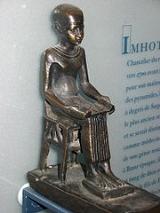
Imhotep Louvre
Imhotep (sometimes spelled Immutef, Im-hotep, or Ii-em-Hotep; called Imuthes by the Greeks), fl. 27th century BC (2650 BC-2600 BC) (Egyptian meaning "the one who comes in, with peace") was an Egyptian
Egyptians

Egyptians is the name of the nationality and Mediterranean North African ethnic group native to Egypt.Egyptian identity is closely tied to the Geography of Egypt, dominated by the lower Nile Valley, the small strip of cultivable land stretching from the Cataracts of the Nile to the Mediterranean Sea and enclosed by desert both to the Easte...
 polymath
Polymath

A polymath is a person whose knowledge is not restricted to one subject area. In less formal terms, a polymath may simply refer to someone who is very knowledgeable....
, who served under the Third Dynasty
Third dynasty of Egypt

Third Dynasty The Third Dynasty of ancient Egypt is the first dynasty of the Old Kingdom. Other dynasties of the Old Kingdom include the Fourth dynasty of Egypt, Fifth dynasty of Egypt and Sixth dynasty of Egypt....
 king, Djoser
Djoser

Netjerikhet or Djoser is the best-known pharaoh of the Third dynasty of Egypt. He commissioned his official, Imhotep , to build the first of the pyramids, a step pyramid for him at Saqqara....
, as chancellor
Chancellor

Chancellor or chancellour is an official title used in countries whose civilization has arisen directly or indirectly out of the Roman Empire....
 to the pharaoh
Pharaoh

Pharaoh is a title used in many modern discussions of the ancient Egyptian rulers of all periods. In antiquity this title began to be used for the ruler who was the religious and political leader of united ancient Egypt, only during the New Kingdom, specifically, during the middle of the Eighteenth dynasty of Egypt....
 and high priest of the sun god Ra
Ra

Ra is an ancient Egyptian Solar deity . By the Fifth dynasty of Egypt he became a major deity in ancient Egyptian religion, identified primarily with the noon, with other deities representing other positions of the sun....
 at Heliopolis
Heliopolis (ancient)

Heliopolis , meaning sun-city, was one of the most ancient cities of Egypt, and capital of the 13th Lower Egyptian Nome . Its name also refers to an unrelated Heliopolis of Cairo, also known as ??? ???????, Masr al-gidedah ....
. He is considered to be the first engineer
Engineer

An engineer is a person professionally engaged in a field of engineering. Engineers are concerned with developing economical and safe solutions to practical problems, by applying mathematics and scientific knowledge while considering technical constraints....
, architect
Architect

An architect is trained and licenced in planning and designing buildings, and participates in supervising the construction of a building. Etymologically, architect derives from the Latin architectus, itself derived from the Greek arkhitekton , i.e....
 and physician
Physician

A physician, medical practitioner, doctor of medicine, or medical doctor practices medicine, and is concerned with maintaining or restoring human health through the study, diagnosis, and treatment of disease and injury....
 in history known by name. The full list of his titles is:
Chancellor of the King of Egypt, Doctor, First in line after the King of Upper Egypt, Administrator of the Great Palace, Hereditary nobleman, High Priest of Heliopolis, Builder, Chief Carpenter, Chief Sculptor and Maker of Vases in Chief.
Imhotep was one of very few mortals to be depicted as part of a pharaoh's statue. He was one of only a few commoners ever to be accorded divine status after death. The center of his cult was Memphis
Memphis, Egypt

Memphis was the ancient capital of the first Nome of Lower Egypt, and of the Old Kingdom of Egypt from its foundation until around 2200 BC and later for shorter periods during the New Kingdom, and an administrative centre throughout ancient history....
. From the First Intermediate Period onward Imhotep was also revered as a poet and philosopher. His sayings were famously referred to in poems: I have heard the words of Imhotep and Hordedef with whose discourses men speak so much.

The location of Imhotep's tomb was lost in antiquity
Antiquity

Antiquity or antiquities may refer to:*"ancient history" generally, and may be used of any historical period before the Middle Ages; such as in Ancient Egypt, Mesopotamia, or other Ancient Near East....
 and is still unknown, despite efforts to find it. The general consensus is that it is well hidden at Saqqara
Saqqara

Saqqara or Sakkara, Saqqarah is a vast, ancient burial ground in Egypt, serving as the necropolis for the Ancient Egyptian capital, Memphis, Egypt....
. Imhotep's historicity is confirmed by two contemporary inscriptions made during his lifetime on the base or pedestal of one of Djoser's statues (Cairo JE 49889) and also by a graffito on the enclosure wall surrounding Sekhemkhet
Sekhemkhet

Sekhemkhet was a Pharaoh in Egypt during the Third dynasty of Egypt. According to the Manethonian tradition, a king known as Tyris reigned for a relatively brief period of seven years, and modern scholars believe Djoserty and Sekhemkhet are the same person....
's unfinished step-pyramid. The latter inscription suggests that Imhotep outlived Djoser by few years and went on to serve in the construction of king Sekhemkhet's pyramid which was abandoned due to this ruler's brief reign.

Attribution of achievements and inventions

Most known information about him is based on hearsay and conjecture. The ancient Egyptians credited him with many inventions. For example, it is claimed that he invented or improved the papyrus
Papyrus

Papyrus is a thick paper material produced from the pith of the papyrus plant, Cyperus papyrus, a wetland Cyperaceae that was once abundant in the Nile Delta of Egypt....
 scroll. James Henry Breasted
James Henry Breasted

James Henry Breasted was an American archaeologist and historian....
 says of Imhotep:

Engineering and architecture

As one of the officials of the Pharaoh
Pharaoh

Pharaoh is a title used in many modern discussions of the ancient Egyptian rulers of all periods. In antiquity this title began to be used for the ruler who was the religious and political leader of united ancient Egypt, only during the New Kingdom, specifically, during the middle of the Eighteenth dynasty of Egypt....
,Djosèr
Djoser

Netjerikhet or Djoser is the best-known pharaoh of the Third dynasty of Egypt. He commissioned his official, Imhotep , to build the first of the pyramids, a step pyramid for him at Saqqara....
, he designed the Pyramid of Djoser
Pyramid of Djoser

The Pyramid of Djoser , or step pyramid is an archeological remain in the Saqqara necropolis, Egypt, northwest of the city of Memphis, Egypt....
 (the Step Pyramid
Step pyramid

The construction of step pyramids has been an ancient part of several cultures throughout history. These pyramids typically are large and made of several layers, or steps, of stone....
) at Saqqara
Saqqara

Saqqara or Sakkara, Saqqarah is a vast, ancient burial ground in Egypt, serving as the necropolis for the Ancient Egyptian capital, Memphis, Egypt....
 in Egypt
History of Ancient Egypt

The History of ancient Egypt spans the period from the early Predynastic Egypt settlements of the northern Nile Valley to the History of Roman Egypt in 30 BC....
 in 2630
27th century BC

The 27th century BC is a century which lasted from the year 2700 BC to 2601 BC....
–2611 BC. He may have been responsible for the first known use of column
Column

File:National Capitol Columns - Washington, D.C..jpgA column in structural engineering is a vertical structural element that transmits, through physical compression, the weight of the structure above to other structural elements below....
s in architecture
Architecture

The term architecture can refer to a process, a profession or documentation.As a process, architecture is the activity of designing and construction buildings and other physical structures by a person or a computer, primarily to provide shelter....
. As an instigator of Egyptian culture, Imhotep's idealized image lasted well into the Ptolemaic period. The Egyptian historian Manetho
Manetho

Manetho was an Egyptian historian and priest from Sebennytos who lived during the Ptolemaic dynasty, ca. 3rd century BC. Manetho wrote the Aegyptiaca ....
 credited him with inventing the method of a stone-dressed building during Djoser's reign, though he was not the first to actually build with stone. Stone walling, flooring, lintels, and jambs had appeared sporadically during the Archaic Period
Archaic period

In the sequence of North American pre-Columbian cultural stages first proposed by Gordon Willey and Philip Phillips in 1958, the Archaic period was the second period of human occupation in the Americas, from around 8000 BC to 1000 BC although as its ending is defined by the adoption of sedentary farming, this date can vary significantly acro...
, though it is true that a building of the Step Pyramid
Step pyramid

The construction of step pyramids has been an ancient part of several cultures throughout history. These pyramids typically are large and made of several layers, or steps, of stone....
's size and made entirely out of stone had never before been constructed. Before Djoser pharaohs were buried in mastaba
Mastaba

A mastaba was a kind of Ancient Egyptian tomb in the form of a flat-roofed, rectangular with outward sloping sides that marked the burial site of many eminent Egyptians of Egypt's History of Egypt....
 tombs.

Medicine

Imhotep is credited with being the founder of Egyptian medicine
Ancient Egyptian medicine

Ancient Egyptian Medicine refers to the practices of medicine common in Ancient Egypt from circa 33rd century BC until the Achaemenid Empire invasion of 523 BC....
 and with being the author of a medical treatise remarkable for being devoid of magical thinking, the so-called Edwin Smith papyrus
Edwin Smith papyrus

The Edwin Smith Papyrus is the only surviving copy of part of an Ancient Egyptian textbook on Physical trauma surgery. It is among the world's earliest surviving examples of medical literature, the Kahun Gynecological Papyrus being older, and is the world's oldest surgical document....
 containing anatomical
Anatomy

Anatomy is a branch of biology that is the consideration of the body plan. It is a general term that includes human anatomy, animal anatomy and plant anatomy ....
 observations, ailments, and cures. The surviving papyrus was probably written around 1700 BC but may be a copy of texts a thousand years older. This attribution of authorship is speculative, however.

Birth myths

According to myth Imhotep's mother was a mortal named Kheredu-ankh, elevated later to semi-divine status by claims that she was the daughter of Banebdjedet. Conversely, as the "Son of Ptah", his mother was sometimes claimed to be Sekhmet
Sekhmet

In Egyptian mythology, Sekhmet , was originally the warrior goddess of Upper Egypt. She is depicted as a lion, the fiercest hunter known to the Egyptians....
, the patron of Upper Egypt
Upper Egypt

File:Ancient Egypt map-en.svgUpper Egypt is a narrow strip of land that extends from the Cataracts of the Nile section of Upper Egypt, between El-Ayait and Asyut is sometimes known as Middle Egypt....
 whose consort Ptah was often said to be. He is said to have been born near Memphis.

Deification

As Imhotep was considered the inventor of healing approach, he was also sometimes said to be the one who held up the goddess Nut
Nut (goddess)

In the Ennead mythology, Nut , was the goddess of the sky. Her name means Night. Some of the titles of Nut were Coverer of the Sky, She Who Protects, Mistress of All, and She Who Holds a Thousand Souls....
 (the deification of the sky), as the separation of Nut and Geb
Geb

Geb was the egyptian mythology god of the Earth and a member of the Ennead of Heliopolis . The name was pronounced as such from the Greek period onward, ...
 (the deification of the earth) was said to be what held back chaos
Chaos

Chaos typically refers to unpredictability, and is the antithesis of cosmos.The word did not mean "disorder" in classical-period ancient Greece....
. Due to the position this would have placed him in, he was also sometimes said to be Nut's son. In artwork he also is linked with the great goddess, Hathor
Hathor

In Egyptian mythology, Hathor was originally a personification of the Milky Way, which was seen as the milk that flowed from the udders of a heavenly cow....
, who eventually became identified as the wife of Ra
Ra

Ra is an ancient Egyptian Solar deity . By the Fifth dynasty of Egypt he became a major deity in ancient Egyptian religion, identified primarily with the noon, with other deities representing other positions of the sun....
. He also was associated with Ma'at, the goddess who personified the concept of truth, cosmic order, and justice—having created order out of chaos and being responsible for maintaining it. Also after Death, the Ancient Egyptians believed Imhotep became a god.

Two thousand years after his death, his status was raised to that of a deity
God

God is a deity in theism and deism religions and other belief systems, representing either the sole deity in monotheism, or a principal deity in polytheism....
. He became the god of medicine
Medicine

Medicine is the art and science of healing. It encompasses a range of health care practices evolved to maintain and restore health by the prevention and treatment of illness....
 and healing
Healing

Healing, assessed physically, is the process by which the Cell in the body regenerate and repair to reduce the size of a damaged or necrosis area.Healing incorporates both the removal of necrotic Biological tissue , and the replacement of this tissue....
. He later was linked to Asclepius
Asclepius

Asclepius is the god of medicine and healing in ancient Greek mythology. Asclepius represents the healing aspect of the medical arts, while his daughters Hygieia, Meditrina, Iaso, Aceso, Aglaea and Panacea symbolize the forces of cleanliness, medicine, and healing, respectively....
 by the Greek
Ancient Greece

The term Ancient Greece refers to the period of History of Greece lasting from the Greek Dark Ages ca. 1100 BC and the Dorian invasion, to 146 BC and the Roman Republic conquest of Greece after the Battle of Corinth ....
s. He was associated with Amenhotep son of Hapu, who was another deified architect, in the region of Thebes
Thebes, Egypt

Thebes was a city in Ancient Egypt located about 800 km south of the Mediterranean, on the east bank of the river Nile . It was the capital of Waset, the fourth Upper Egyptian Nome ....
 where they were worshipped as "brothers".

Legacy

The Encyclopedia Britannica reads, in part, "The evidence afforded by Egyptian and Greek texts support the view that Imhotep's reputation was very respected in early times... His prestige increased with the lapse of centuries and his temples in Greek times were the centers of medical teachings."

It is Imhotep, says Sir William Osler, who was the real 'Father of Medicine', "the first figure of a physician to stand out clearly from the mists of antiquity."

Imhotep was also identified with Thoth, the Egyptian god of writing, education, literacy and scribes through the Greco-Roman Period.

Imhotep Dreams

The Upper Egyptian Famine Stela, dating from the Ptolemaic period, bears an inscription containing a legend about a famine of seven years during the reign of Djoser
Djoser

Netjerikhet or Djoser is the best-known pharaoh of the Third dynasty of Egypt. He commissioned his official, Imhotep , to build the first of the pyramids, a step pyramid for him at Saqqara....
. Imhotep is credited with having been instrumental in ending it: one of his priests explained the connection between the god Khnum and the rise of the Nile to the king, who then had a dream in which the Nile god spoke to him, promising to end the drought.

Trivia

  • The original 1932 film The Mummy
    The Mummy (1932 film)

    The Mummy is a horror film from Universal Studios directed by Karl Freund and starring Boris Karloff as a revived ancient Egyptian priest. The movie also features Zita Johann, David Manners and Edward van Sloan....
     as well as the 1999 version
    The Mummy (1999 film)

    The Mummy is a 1999 in film United States adventure film written and directed by Stephen Sommers and starring Brendan Fraser, and Rachel Weisz, with Arnold Vosloo in the title role as the reanimated mummy....
     and its sequel are loosely based on the real-life Imhotep.


  • In 1987 a small model of Imhotep went missing from the British Museum
    British Museum

    The British Museum is a museum of human history and culture situated in London. Its collections, which number more than 7 million Object , are amongst the largest and most comprehensive in the world and originate from all continents, illustrating and documenting the story of human culture from its beginning to the present....
     and its whereabouts were unknown for just over a year. It was found in the possession of the son of a managing director of an imaging firm in Cambridge
    Cambridge

    The city status in the United Kingdom of Cambridge is a College town and the administrative centre of the county of Cambridgeshire, England. It lies about 50 miles north of London....
    . The boy, Max Salisbury, 19 at the time, was found guilty and served 3 years in prison for the theft.


  • Imhotep is the first entry in Asimov's Biographical Encyclopedia of Science and Technology
    Asimov's Biographical Encyclopedia of Science and Technology

    Asimov's Biographical Encyclopedia of Science and Technology is a history of science by Isaac Asimov, more recently updated by his daughter Robyn Asimov....
    .


  • In Mathew Reilly's Seven Ancient Wonders
    Seven Ancient Wonders

    Seven Ancient Wonders is a book written by the Australia author Matthew Reilly in 2005. Its sequel, The Six Sacred Stones was released in the fall of 2007....
    , Imhotep is credited with the construction of the locations, and designing the elaborate booby traps, in which the Seven Wonders of the Ancient World
    Seven Wonders of the Ancient World

    The Seven Wonders of the World is a well known list of seven remarkable constructions of classical antiquity. It was based on guide-books popular among Ancient Greece tourists and only includes works located around the Mediterranean rim....
     is stored.

See also

  • History of ancient Egypt
    History of Ancient Egypt

    The History of ancient Egypt spans the period from the early Predynastic Egypt settlements of the northern Nile Valley to the History of Roman Egypt in 30 BC....
  • Third dynasty of Egypt
    Third dynasty of Egypt

    Third Dynasty The Third Dynasty of ancient Egypt is the first dynasty of the Old Kingdom. Other dynasties of the Old Kingdom include the Fourth dynasty of Egypt, Fifth dynasty of Egypt and Sixth dynasty of Egypt....
  • Ancient Egyptian architecture
    Ancient Egyptian architecture

    The Nile valley has been the site of one of the most influential civilizations which developed a vast array of diverse structures encompassing ancient Egyptian architecture....
  • Ancient Egyptian medicine
    Ancient Egyptian medicine

    Ancient Egyptian Medicine refers to the practices of medicine common in Ancient Egypt from circa 33rd century BC until the Achaemenid Empire invasion of 523 BC....