
All Topics  
Mary Anning

 
Mary Anning

   Email Print
   Bookmark   Link


Mary Anning


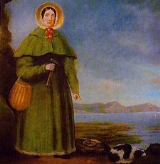
Mary Anning (May 21, 1799 – March 9, 1847) was an early British fossil
Fossil

Fossils are the preserved remains or trace fossil of animals, plants, and other organisms from the remote past. The totality of fossils, both discovered and undiscovered, and their placement in fossiliferous Rock formations and sedimentary rock layers is known as the fossil record....
 collector and paleontologist
Paleontology

File:Geological time spiral - sharper.pngPaleontology from Greek: pa?a??? "old, ancient", ??, ??t- "being, creature", and ????? "speech, thought" is the study of prehistory life, including organisms' evolution and interactions with each other and their environments ....
.

in the coastal southern English
England

native_name =|conventional_long_name = England|common_name = England|image_flag = Flag of England.svg|image_coat = England COA.svg|symbol_type = Royal Coat of Arms...
 town of Lyme Regis
Lyme Regis

Lyme Regis is a coastal town in West Dorset, England, situated 25 miles west of Dorchester, Dorset and east of Exeter. The town lies in Lyme Bay, on the English Channel coast at the Dorset-Devon border....
 in Dorset
Dorset

Dorset , is a Counties of England in South West England on the English Channel coast. The county town is Dorchester, Dorset, situated in the south of the county at ....
, Mary Anning was marked out for an unusual life at the age of 15 months when in 1800 a lightning strike in the village caught four people in the open. Three died but Mary survived.

Mary's father, Richard, was a cabinet maker who supplemented his income by mining the coastal cliff-side fossil beds near Lyme Regis, and selling his finds to tourists.


Discussion
Ask a question about 'Mary Anning'
Start a new discussion about 'Mary Anning'
Answer questions from other users
Full Discussion Forum


Encyclopedia


Mary Anning (May 21, 1799 – March 9, 1847) was an early British fossil
Fossil

Fossils are the preserved remains or trace fossil of animals, plants, and other organisms from the remote past. The totality of fossils, both discovered and undiscovered, and their placement in fossiliferous Rock formations and sedimentary rock layers is known as the fossil record....
 collector and paleontologist
Paleontology

File:Geological time spiral - sharper.pngPaleontology from Greek: pa?a??? "old, ancient", ??, ??t- "being, creature", and ????? "speech, thought" is the study of prehistory life, including organisms' evolution and interactions with each other and their environments ....
.

Early life

Born in the coastal southern English
England

native_name =|conventional_long_name = England|common_name = England|image_flag = Flag of England.svg|image_coat = England COA.svg|symbol_type = Royal Coat of Arms...
 town of Lyme Regis
Lyme Regis

Lyme Regis is a coastal town in West Dorset, England, situated 25 miles west of Dorchester, Dorset and east of Exeter. The town lies in Lyme Bay, on the English Channel coast at the Dorset-Devon border....
 in Dorset
Dorset

Dorset , is a Counties of England in South West England on the English Channel coast. The county town is Dorchester, Dorset, situated in the south of the county at ....
, Mary Anning was marked out for an unusual life at the age of 15 months when in 1800 a lightning strike in the village caught four people in the open. Three died but Mary survived.

Mary's father, Richard, was a cabinet maker who supplemented his income by mining the coastal cliff-side fossil beds near Lyme Regis, and selling his finds to tourists. Richard Anning moved to Lyme from Colyton in Devon. He married Mary Moore on 8 August 1793 in Blandford. Returning to Lyme, the couple lived in a house built on the town’s bridge, and attended the local Congregational Church
Congregational church

Congregational churches are Protestantism Christianity churches practicing congregationalist church governance, in which each Wiktionary:congregation independently and autonomously runs its own affairs....
, where their children were baptized. Soon after their marriage a daughter Mary was born. She was followed by a second daughter, Martha, who died almost at once, then by a son Joseph, in 1796. In 1798 a second son, Henry, died in infancy and the eldest child, Mary, was burned to death, either sitting too close to the fire, or falling into it. When another daughter was born the following May, she was given the name of her dead sister, Mary. At least four more children followed: Henry, 1801; Percival, 1803; Elizabeth, 1804; and Richard, 1809. All died within a couple of years of birth, leaving only two surviving children, Joseph and Mary, when their father Richard died in 1810 at age 44. When he died of tuberculosis
Tuberculosis

Tuberculosis is a common and often deadly infectious disease caused by mycobacterium, mainly Mycobacterium tuberculosis . Tuberculosis usually attacks the lungs but can also affect the central nervous system, the lymphatic system, the circulatory system, the genitourinary system, the gastrointestinal system, bones, joints, and even the...
 the Anning family was left without support. Mary and her brother Joseph began collecting fossils full-time in an effort to earn some income.

Fossil collecting was in vogue in the late 18th century and early 19th century, at first as a pastime akin to stamp collecting but gradually transforming into a science as the importance of fossils to geology
Geology

Geology is the science and study of the solid and liquid matter that constitute the Earth. The field of geology encompasses the study of the composition, structural geology, physical properties, dynamics, and History of the Earth of Earth materials, and the processes by which they are formed, moved, and changed....
 and biology
Biology

Biology is a branch of the natural sciences concerned with the study of living organisms and their interaction with each other and their environment ....
 became understood. Anning catered to the commercial side of the field, selling her finds. She soon forged relationships within the scientific community, whose passion for fossils grew to be a major source of income for her. One of Anning's first discoveries was made shortly after her father's death when she was just twelve. She found the first complete skeleton of an ichthyosaur
Ichthyosaur

Ichthyosaurs were giant marine reptiles that resembled fish and dolphins. Ichthyosaurs thrived during much of the Mesozoic era; based on fossil evidence, they first appeared approximately 245 million years ago and disappeared about 90 million years ago, about 25 million years before the dinosaurs became extinct....
 ever discovered, though ichthyosaur fossil fragments had been found in Wales as early as 1699. Her brother had discovered the skull of what appeared to be a large crocodile a year earlier. The rest of the skeleton was not to be found at first, but Mary located it after a storm scoured away a portion of the cliff containing it. It was an important find, and was soon described in the Transactions of the Royal Society
Philosophical Transactions of the Royal Society

The Philosophical Transactions of the Royal Society, or Phil. Trans., is a scientific journal published by the Royal Society.Begun in 1665, it is the oldest scientific journal printed in the Anglosphere and the second oldest in the world, after the French Journal des s?avans....
. She went on to find two other distinct species of ichthyosaur.

As her reputation grew, Mary came to the attention of Thomas Birch, a wealthy fossil collector. Disturbed by the poverty of the Anning family, Birch arranged for the sale of his own fossil collection, the proceeds of which (some £400) were given to the Annings. Put on a sure (if somewhat austere) financial footing for the first time in a decade, Mary carried on with her fossil collecting even after her brother gained employment as an upholsterer.

Her next major discovery was a skeleton of a plesiosaur
Plesiosaur

Plesiosaurs were carnivore aquatic reptiles. After their discovery, they were somewhat fancifully said to have resembled , although they had no shell....
 in 1821, the first of its kind to be found. The fossil was subsequently described by William Conybeare
William Daniel Conybeare

William Daniel Conybeare Fellow of the Royal Society , dean of Llandaff, one of the most distinguished of English geologists, who was born in London, was a grandson of John Conybeare, bishop of Bristol , a notable preacher and divine, and son of Dr William Conybeare, rector of Bishopsgate....
 as Plesiosaurus dolichodeirus and is the type specimen (holotype
Holotype

A holotype is one of several possible biological types. A type is what fixes a name to a taxon. A holotype is a single physical example of an organism, known to have been used when the species was formally described....
) of the species, which itself is the type species of the genus. She found an 'unrivalled specimen' of Dapedium
Dapedium

Dapedium is an extinct species of enamel-scaled fish. The first-described finding was an example of D. politum, found in the Lower Lias of Lyme Regis, on the Jurassic Coast of England ....
 politum
, a ray-finned fish, as described in 1828. She discovered an important fossil of a pterosaur
Pterosaur

Pterosaurs were flying reptiles of the clade or Order Pterosauria. They existed from the late Triassic to the end of the Cretaceous Period . Pterosaurs are the earliest vertebrates known to have evolved powered flight....
, a Pterodactylus macronyx (later renamed by Richard Owen
Richard Owen

Sir Richard Owen Order of the Bath was an English people biologist, comparative anatomy and paleontology.Owen is probably best remembered today for coining the word Dinosauria and for his outspoken opposition to Charles Darwin's theory of evolution by natural selection....
 Dimorphodon
Dimorphodon

Dimorphodon was a genus of medium-sized pterosaur from the Early Jurassic Period . It was named by Palaeontology Richard Owen in 1859. Dimorphodon means "two-form tooth" , referring to the fact that it had two distinct types of teeth in its jaws - which is comparatively rare among reptiles....
 macronyx
), the first found outside Germany and thought to be the first complete skeleton.

Those were the three finds that left her mark in history, but she continued collecting for the remainder of her life, making numerous other contributions to early paleontology. In her late thirties she was granted an annuity
Annuity (financial contracts)

An annuity contract is a financial product, typically offered by a financial institution, that may accumulate value and take a current value and pay it out over a period of years....
 by the British Association for the Advancement of Science
British Association for the Advancement of Science

The British Association for the Advancement of Science or the British Science Association, formally known as the BA, is a learned society with the object of promoting science, directing general attention to scientific matters, and facilitating interaction between scientific workers....
 in return for her efforts. Anning died at the age of 47, of breast cancer
Breast cancer

Breast cancer is a cancer that starts in the Cell of the breast in women and men. Worldwide, breast cancer is the second most common type of cancer after lung cancer and the fifth most common cause of cancer death....
. A few months earlier she had been made an honorary member of the Geological Society of London
Geological Society of London

The Geological Society of London is a learned society based in the United Kingdom with the aim of "investigating the mineral structure of the Earth"....
 despite being ineligible for regular membership due to the sexist
Sexism

Sexism, a term coined in the late 20th century, refers to the belief or attitude that one gender or sex is inferior to or less valuable than the other....
 mores
Mores

Mores are norm or convention s. Mores derive from the established practices of a society rather than its written laws. They consist of shared understandings about the kinds of behaviour likely to evoke approval, disapproval, toleration or sanction, within particular contexts....
 of the time.

Impact

Maryanningwindow
Maryanninggravestone
Taken all together, Mary Anning's discoveries became key pieces of evidence for extinction. Until her time it was widely believed that animals did not become extinct; any oddities found were explained away as still living somewhere in an unexplored region of the earth. The bizarre nature of the fossils found by Anning struck a heavy blow against this argument, and set the stage for real understanding of life in earlier geologic ages.

For a time after her death, Mary dropped into obscurity but, in recent decades, she has been rediscovered. After her death, a eulogy was read at the Geological Society, 'some members' of which subsequently contributed to a stained-glass window to her memory, in the parish church of St Michael the Archangel
Lyme Regis

Lyme Regis is a coastal town in West Dorset, England, situated 25 miles west of Dorchester, Dorset and east of Exeter. The town lies in Lyme Bay, on the English Channel coast at the Dorset-Devon border....
, the Society having failed to elect her to membership during her lifetime, possibly as a result of latter-day sexism
Sexism

Sexism, a term coined in the late 20th century, refers to the belief or attitude that one gender or sex is inferior to or less valuable than the other....
. The inscription reads: "This window is sacred to the memory of Mary Anning of this parish, who died 9 March AD 1847 and is erected by the vicar and some members of the Geological Society of London in commemoration of her usefulness in furthering the science of geology, as also of her benevolence of heart and integrity of life." (It depicts the corporal works of mercy, i.e. feeding the hungry, giving drink to the thirsty, clothing the naked, sheltering the homeless, visiting prisoners and visiting the sick.)

Mary Anning is believed to be the source of the old tongue-twister
Tongue-twister

A tongue-twister is a phrase that is designed to be difficult to articulate properly. Tongue-twisters may rely on similar but distinct phonemes , unfamiliar constructs in loanwords, or other features of a language....
, "She sells sea shells by the sea shore."

In 2005, a Mary Anning 'facsimile' was created at the Natural History Museum
Natural History Museum

The Natural History Museum is one of three large museums on Exhibition Road, South Kensington, London . Its main frontage is on Cromwell Road. The museum is a non-departmental public body sponsored by the Department for Culture, Media and Sport...
 as one of a number of notable gallery characters to patrol its displays. She is thus among other luminaries including Carl Linnaeus, Dorothea Bate
Dorothea Bate

Dorothea Minola Alice Bate Geological Society of London , also known as Dorothy Bate, was a United Kingdom palaeontologist, a pioneer of archaeozoology....
, and William Smith
William Smith (geologist)

William Smith was an English people geologist, credited with creating the first nationwide geological map. He is known as the "Father of English Geology", although recognition was very slow in coming....
.

Writer John Fowles
John Fowles

John Robert Fowles was an England novelist and essayist....
 in "The French Lieutenant's Woman
The French Lieutenant's Woman

The French Lieutenant's Woman is a 1969 novel by John Fowles. The book was inspired by the 1823 novel Ourika by Claire de Duras, which Fowles translated to English in 1977 ....
" (Ch. 8) notes: "One of the meanest disgraces of British palaeontology is that though many scientists of the day gratefully used her finds to establish their own reputation, not one native type bears the name anningii".

Bibliography

  • Torrens, Hugh. 1995. "Mary Anning (1799-1847) of Lyme: 'the greatest fossilist the world ever knew'," British Journal for the History of Science, 25:257-284.
  • Anon. 1828. "Another discovery by Mary Anning of Lyme. An unrivalled specimen of Dapedium politum an antediluvian fish." Salisbury and Winchester Journal, 108:5599 2.


See also

  • Jurassic Coast
    Jurassic Coast

    The Jurassic Coast is a World Heritage Site on the English Channel coast of southern England. The site stretches from Orcombe Point near Exmouth, Devon in East Devon to Old Harry Rocks near Swanage in East Dorset, a distance of ....
  • List of fossil sites
    List of fossil sites

    This is a worldwide list of important and/or well-known localities where fossils have been found. Such locations may either be a geological formation or a single site....
     (with link directory)


Further reading

  • Laurence Anholt, Stone Girl Bone Girl: The Story of Mary Anning, ISBN 1-84507-700-8, Frances Lincoln Publishers 2006
  • Jeannine Atkins, Mary Anning and the Sea Dragon, ISBN-10: 0374348405 ISBN-13: 978-0374348403 , Farrar Straus Giroux 1999 (this is a wonderful large 32 page book with beautiful illustrations by Michael Dooling)
  • Don Brown, Rare Treasure: Mary Anning and Her Remarkable Discoveries, ISBN 0-618-31081-9, Houghton Mifflin Co 2003
  • Nigel J. Clarke, Mary Anning 1799-1847: A Brief History, ISBN 0-907683-57-6, Clarke (Nigel J) Publications 1998
  • Sheila Cole, The Dragon in the Cliff: A Novel Based on the Life of Mary Anning, ISBN 0-595-35074-7, iUniverse.com 2005
  • Marie Day, Dragon in the Rocks: A Story Based on the Childhood of the Early Paleontologist, Mary Anning, ISBN 1-895688-38-8, Maple Tree Press 1995
  • Dennis B. Fradin, Mary Anning: The Fossil Hunter (Remarkable Children), ISBN 0-382-39487-9, Silver Burdett Press 1997
  • Thomas W. Goodhue, Curious Bones: Mary Anning and the Birth of Paleontology (Great Scientists), ISBN 1-883846-93-5
  • Thomas W. Goodhue, Fossil Hunter: The Life and Times of Mary Anning (1799-1847), ISBN 1-930901-55-0, cademica Pr Llc 2004
  • Patricia Pierce, Jurassic Mary: Mary Anning and the Primeval Monsters, ISBN 0-7509-4039-5, Sutton Publishing 2006
  • Crispin Tickell, Mary Anning of Lyme Regis, ISBN 0-9527662-0-5, Lyme Regis Philpot Museum 1996
  • Sally M. Walker, Mary Anning: Fossil Hunter (On My Own Biographies (Hardcover)), ISBN 1-57505-425-6, Carolrhoda Books 2000
  • 2007 QCA KS1 Sats Level 3 Reading Paper "Stones and Bones" Section 3: Mary Anning


External links