


John Gould

Encyclopedia
John Gould was an English
ornithologist and bird artist. The Gould League
in Australia
was named after him. His identification of the birds now nicknamed "Darwin's finches
" played a role in the inception of Darwin's theory
of evolution
by natural selection
. Gould's work is referenced in Charles Darwin
's book, On the Origin of Species.
, Dorset
, the son of a gardener, and the boy probably had a scanty education. Shortly afterwards his father obtained a position on an estate near Guildford
, Surrey
, and then in 1818 became foreman in the Royal Gardens of Windsor. He was for some time under the care of J T Aiton, of the Royal Gardens of Windsor. The young Gould started training as a gardener, being employed under his father at Windsor from 1818 to 1824, and he was subsequently a gardener at Ripley
Castle in Yorkshire
. He became an expert in the art of taxidermy
and in 1824 he set himself up in business in London
as a taxidermist, and his skill led to him becoming the first Curator and Preserver at the museum of the Zoological Society of London
in 1827.
, many not previously described. Gould published these birds in A Century of Birds from the Himalaya Mountains (1830–1832). The text was by Nicholas Aylward Vigors
and the illustrations were lithographed by Gould's wife Elizabeth
, daughter of Nicholas Coxen of Kent. This work was followed by four more in the next seven years including Birds of Europe in five volumes – completed in 1837, with the text written by Gould himself, edited by his clerk Edwin Prince. Some of the illustrations were made by Edward Lear
as part of his Illustrations of the Family of Psittacidae in 1832. Lear however was in financial difficulty and he sold the entire set of lithographs to Gould. The books were published in a very large size, imperial folio, with magnificent coloured plates. Eventually 41 of these volumes were published with about 3000 plates. They appeared in parts at £3 3s. a number, subscribed for in advance, and in spite of the heavy expense of preparing the plates, Gould succeeded in making his ventures pay and in realizing a fortune. In 1838 he and his wife moved to Australia to work on the Birds of Australia and shortly after his return to England, his wife died in 1841.
presented his mammal and bird specimens collected during the second voyage of HMS Beagle
to the Geological Society of London
at their meeting on 4 January 1837, the bird specimens were given to Gould for identification. He set aside his paying work and at the next meeting on 10 January reported that birds from the Galápagos Islands
which Darwin had thought were blackbirds, "gross-bills" and finch
es were in fact "a series of ground Finches which are so peculiar" as to form "an entirely new group, containing 12 species." This story made the newspapers. In March, Darwin met Gould again, learning that his Galápagos "wren" was another species of finch and the mockingbird
s he had labelled by island were separate species rather than just varieties, with relatives on the South America
n mainland. Subsequently Gould advised that the smaller southern Rhea
specimen that had been rescued from a Christmas dinner was a separate species which he named Rhea darwinii, whose territory overlapped with the northern rheas. Darwin had not bothered to label his finches by island, but others on the expedition had taken more care. He now sought specimens collected by captain Robert FitzRoy
and crewmen. From them he was able to establish that the species were unique to islands, an important step on the inception of his theory
of evolution
by natural selection
. Gould's work on the birds was published between 1838 and 1842 in five numbers as Part 3 of Zoology of the Voyage of H.M.S. Beagle
, edited by Charles Darwin.
intending to study the birds of that country and be the first to produce a major work on the subject. They took with them the collector John Gilbert
. They arrived in Tasmania
in September, making the acquaintance of the governor Sir John Franklin
and his wife. Gould and Gilbert collected on the island. In February 1839 Gould sailed to Sydney
, leaving his pregnant wife with the Franklins. He travelled to his brother-in-law's station at Yarrundi, spending his time searching for bowerbird
s in the Liverpool Range
. In April he returned to Tasmania for the birth of his son. In May he sailed to Adelaide
to meet Charles Sturt
, who was preparing to lead an expedition to the Murray River
. Gould collected in the Mount Lofty
range, the Murray Scrubs and Kangaroo Island
, returning again to Hobart
in July. He then travelled with his wife to Yarrundi. They returned home to England in May 1840.
The result of the trip was The Birds of Australia (1840–1848). It included a total of 600 plates in seven volumes, 328 of which were new to science and named by Gould. He also published A Monograph of the Macropodidae, or Family of Kangaroos (1841–1842) and the three volume work The Mammals of Australia
(1849–1861).
Elizabeth died in 1841 and Gould's books subsequently used illustrations by a number of artists, including Henry Constantine Richter
, William Matthew Hart
and Joseph Wolf
.
s. He accumulated a collection of 320 species, which he exhibited at the Great Exhibition of 1851. Despite his interest Gould had never seen a live hummingbird. In May 1857 he travelled to the United States
with his second son Charles. He arrived in New York
too early in the season to see hummingbirds in that city, but on 21 May 1857 in Bartram's Gardens in Philadelphia he finally saw his first live bird, a Ruby-throated Hummingbird
. He then continued to Washington D.C. where he saw large numbers in the gardens of the Capitol. Gould attempted to return to England with live specimens, but not being aware of the conditions necessary to keep them they only lived for two months at most. Gould published: A Monograph of the Trochilidae or Humming Birds with 360 plates (1849–61); The Mammals of Australia (1845–63), Handbook to the Birds of Australia (1865), The Birds of Asia (1850–83), The Birds of Great Britain (1862–73) and The Birds of New Guinea and the adjacent Papuan Islands (1875–88).
' painting The Ruling Passion
.
The Gould League
, founded in Australia in 1909, was named after him. This organisation gave many Australians their first introduction to birds, along with more general environmental and ecological education. One of its major sponsors was the Royal Australasian Ornithologists Union
, also known as Birds Australia.
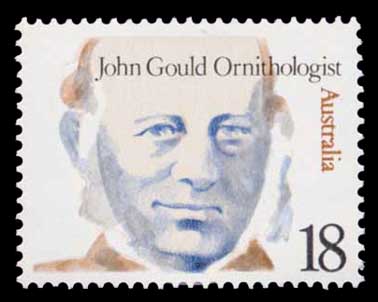
In 1976 he was honoured on a postage stamp
bearing his portrait issued by Australia Post
http://www.australianstamp.com/images/large/0011840.jpg.
England
England is a country that is part of the United Kingdom. It shares land borders with Scotland to the north and Wales to the west; the Irish Sea is to the north west, the Celtic Sea to the south west, with the North Sea to the east and the English Channel to the south separating it from continental...
ornithologist and bird artist. The Gould League
Gould League
The Gould League is an independent Australian organisation promoting environmental education, originally founded in Victoria in 1909 and named after the English ornithologist John Gould...
in Australia
Australia
Australia , officially the Commonwealth of Australia, is a country in the Southern Hemisphere comprising the mainland of the Australian continent, the island of Tasmania, and numerous smaller islands in the Indian and Pacific Oceans. It is the world's sixth-largest country by total area...
was named after him. His identification of the birds now nicknamed "Darwin's finches
Darwin's finches
Darwin's finches are a group of 14 or 15 species of passerine birds. It is still not clear which bird family they belong to, but they are not related to the true finches. They were first collected by Charles Darwin on the Galápagos Islands during the second voyage of the Beagle...
" played a role in the inception of Darwin's theory
Inception of Darwin's theory
The inception of Darwin's theory occurred during an intensively busy period which began when Charles Darwin returned from the survey voyage of the Beagle, with his reputation as a fossil collector and geologist already established...
of evolution
Evolution
Evolution is any change across successive generations in the heritable characteristics of biological populations. Evolutionary processes give rise to diversity at every level of biological organisation, including species, individual organisms and molecules such as DNA and proteins.Life on Earth...
by natural selection
Natural selection
Natural selection is the nonrandom process by which biologic traits become either more or less common in a population as a function of differential reproduction of their bearers. It is a key mechanism of evolution....
. Gould's work is referenced in Charles Darwin
Charles Darwin
Charles Robert Darwin FRS was an English naturalist. He established that all species of life have descended over time from common ancestry, and proposed the scientific theory that this branching pattern of evolution resulted from a process that he called natural selection.He published his theory...
's book, On the Origin of Species.
Early life
Gould was born in Lyme RegisLyme Regis
Lyme Regis is a coastal town in West Dorset, England, situated 25 miles west of Dorchester and east of Exeter. The town lies in Lyme Bay, on the English Channel coast at the Dorset-Devon border...
, Dorset
Dorset
Dorset , is a county in South West England on the English Channel coast. The county town is Dorchester which is situated in the south. The Hampshire towns of Bournemouth and Christchurch joined the county with the reorganisation of local government in 1974...
, the son of a gardener, and the boy probably had a scanty education. Shortly afterwards his father obtained a position on an estate near Guildford
Guildford
Guildford is the county town of Surrey. England, as well as the seat for the borough of Guildford and the administrative headquarters of the South East England region...
, Surrey
Surrey
Surrey is a county in the South East of England and is one of the Home Counties. The county borders Greater London, Kent, East Sussex, West Sussex, Hampshire and Berkshire. The historic county town is Guildford. Surrey County Council sits at Kingston upon Thames, although this has been part of...
, and then in 1818 became foreman in the Royal Gardens of Windsor. He was for some time under the care of J T Aiton, of the Royal Gardens of Windsor. The young Gould started training as a gardener, being employed under his father at Windsor from 1818 to 1824, and he was subsequently a gardener at Ripley
Ripley, North Yorkshire
Ripley is a village and civil parish in North Yorkshire in England, a few miles north of Harrogate on the A61 road towards Ripon.A castle dating from the 15th century, Ripley Castle, has been the home of the Ingilby family for 700 years. The present owner is Sir Thomas Ingilby, 6th Baronet , the...
Castle in Yorkshire
Yorkshire
Yorkshire is a historic county of northern England and the largest in the United Kingdom. Because of its great size in comparison to other English counties, functions have been increasingly undertaken over time by its subdivisions, which have also been subject to periodic reform...
. He became an expert in the art of taxidermy
Taxidermy
Taxidermy is the act of mounting or reproducing dead animals for display or for other sources of study. Taxidermy can be done on all vertebrate species of animals, including mammals, birds, fish, reptiles, and amphibians...
and in 1824 he set himself up in business in London
London
London is the capital city of :England and the :United Kingdom, the largest metropolitan area in the United Kingdom, and the largest urban zone in the European Union by most measures. Located on the River Thames, London has been a major settlement for two millennia, its history going back to its...
as a taxidermist, and his skill led to him becoming the first Curator and Preserver at the museum of the Zoological Society of London
Zoological Society of London
The Zoological Society of London is a charity devoted to the worldwide conservation of animals and their habitats...
in 1827.
Research and works published
Gould's position brought him into contact with the country's leading naturalists, and also meant that he was often the first to see new collections of birds given to the Society. In 1830 a collection of birds arrived from the HimalayasHimalayas
The Himalaya Range or Himalaya Mountains Sanskrit: Devanagari: हिमालय, literally "abode of snow"), usually called the Himalayas or Himalaya for short, is a mountain range in Asia, separating the Indian subcontinent from the Tibetan Plateau...
, many not previously described. Gould published these birds in A Century of Birds from the Himalaya Mountains (1830–1832). The text was by Nicholas Aylward Vigors
Nicholas Aylward Vigors
Nicholas Aylward Vigors was an Irish zoologist and politician.Vigors was born at Old Leighlin, County Carlow. He studied at Trinity College, Oxford. He served in the army during the Peninsular War from 1809 to 1811. He then returned to Oxford, graduating with a B.A. in 1815 and in 1817 with an...
and the illustrations were lithographed by Gould's wife Elizabeth
Elizabeth Gould (illustrator)
Elizabeth Gould was a British artist and illustrator, married to naturalist John Gould. She produced many illustrations for his ornithological works....
, daughter of Nicholas Coxen of Kent. This work was followed by four more in the next seven years including Birds of Europe in five volumes – completed in 1837, with the text written by Gould himself, edited by his clerk Edwin Prince. Some of the illustrations were made by Edward Lear
Edward Lear
Edward Lear was an English artist, illustrator, author, and poet, renowned today primarily for his literary nonsense, in poetry and prose, and especially his limericks, a form that he popularised.-Biography:...
as part of his Illustrations of the Family of Psittacidae in 1832. Lear however was in financial difficulty and he sold the entire set of lithographs to Gould. The books were published in a very large size, imperial folio, with magnificent coloured plates. Eventually 41 of these volumes were published with about 3000 plates. They appeared in parts at £3 3s. a number, subscribed for in advance, and in spite of the heavy expense of preparing the plates, Gould succeeded in making his ventures pay and in realizing a fortune. In 1838 he and his wife moved to Australia to work on the Birds of Australia and shortly after his return to England, his wife died in 1841.
Work with Darwin
When Charles DarwinCharles Darwin
Charles Robert Darwin FRS was an English naturalist. He established that all species of life have descended over time from common ancestry, and proposed the scientific theory that this branching pattern of evolution resulted from a process that he called natural selection.He published his theory...
presented his mammal and bird specimens collected during the second voyage of HMS Beagle
Second voyage of HMS Beagle
The second voyage of HMS Beagle, from 27 December 1831 to 2 October 1836, was the second survey expedition of HMS Beagle, under captain Robert FitzRoy who had taken over command of the ship on its first voyage after her previous captain committed suicide...
to the Geological Society of London
Geological Society of London
The Geological Society of London is a learned society based in the United Kingdom with the aim of "investigating the mineral structure of the Earth"...
at their meeting on 4 January 1837, the bird specimens were given to Gould for identification. He set aside his paying work and at the next meeting on 10 January reported that birds from the Galápagos Islands
Galápagos Islands
The Galápagos Islands are an archipelago of volcanic islands distributed around the equator in the Pacific Ocean, west of continental Ecuador, of which they are a part.The Galápagos Islands and its surrounding waters form an Ecuadorian province, a national park, and a...
which Darwin had thought were blackbirds, "gross-bills" and finch
Finch
The true finches are passerine birds in the family Fringillidae. They are predominantly seed-eating songbirds. Most are native to the Northern Hemisphere, but one subfamily is endemic to the Neotropics, one to the Hawaiian Islands, and one subfamily – monotypic at genus level – is found...
es were in fact "a series of ground Finches which are so peculiar" as to form "an entirely new group, containing 12 species." This story made the newspapers. In March, Darwin met Gould again, learning that his Galápagos "wren" was another species of finch and the mockingbird
Mockingbird
Mockingbirds are a group of New World passerine birds from the Mimidae family. They are best known for the habit of some species mimicking the songs of other birds and the sounds of insects and amphibians, often loudly and in rapid succession. There are about 17 species in three genera...
s he had labelled by island were separate species rather than just varieties, with relatives on the South America
South America
South America is a continent situated in the Western Hemisphere, mostly in the Southern Hemisphere, with a relatively small portion in the Northern Hemisphere. The continent is also considered a subcontinent of the Americas. It is bordered on the west by the Pacific Ocean and on the north and east...
n mainland. Subsequently Gould advised that the smaller southern Rhea
Rhea (bird)
The rheas are ratites in the genus Rhea, native to South America. There are two existing species: the Greater or American Rhea and the Lesser or Darwin's Rhea. The genus name was given in 1752 by Paul Möhring and adopted as the English common name. Möhring's reason for choosing this name, from the...
specimen that had been rescued from a Christmas dinner was a separate species which he named Rhea darwinii, whose territory overlapped with the northern rheas. Darwin had not bothered to label his finches by island, but others on the expedition had taken more care. He now sought specimens collected by captain Robert FitzRoy
Robert FitzRoy
Vice-Admiral Robert FitzRoy RN achieved lasting fame as the captain of HMS Beagle during Charles Darwin's famous voyage, and as a pioneering meteorologist who made accurate weather forecasting a reality...
and crewmen. From them he was able to establish that the species were unique to islands, an important step on the inception of his theory
Inception of Darwin's theory
The inception of Darwin's theory occurred during an intensively busy period which began when Charles Darwin returned from the survey voyage of the Beagle, with his reputation as a fossil collector and geologist already established...
of evolution
Evolution
Evolution is any change across successive generations in the heritable characteristics of biological populations. Evolutionary processes give rise to diversity at every level of biological organisation, including species, individual organisms and molecules such as DNA and proteins.Life on Earth...
by natural selection
Natural selection
Natural selection is the nonrandom process by which biologic traits become either more or less common in a population as a function of differential reproduction of their bearers. It is a key mechanism of evolution....
. Gould's work on the birds was published between 1838 and 1842 in five numbers as Part 3 of Zoology of the Voyage of H.M.S. Beagle
Zoology of the Voyage of H.M.S. Beagle
The Zoology of the Voyage of H.M.S. Beagle Under the Command of Captain Fitzroy, R.N., during the Years 1832 to 1836 is a 5-part book published unbound in nineteen numbers as they were ready, between February 1838 and October 1843...
, edited by Charles Darwin.
Research in Australia
In 1838 the Goulds sailed to AustraliaAustralia
Australia , officially the Commonwealth of Australia, is a country in the Southern Hemisphere comprising the mainland of the Australian continent, the island of Tasmania, and numerous smaller islands in the Indian and Pacific Oceans. It is the world's sixth-largest country by total area...
intending to study the birds of that country and be the first to produce a major work on the subject. They took with them the collector John Gilbert
John Gilbert (naturalist)
John Gilbert was an English naturalist and explorer.Gilbert's birthday is 14 March, but the year is not known, estimates range from 1810 to 1815.He came from New Zealand to Australia in 1838....
. They arrived in Tasmania
Tasmania
Tasmania is an Australian island and state. It is south of the continent, separated by Bass Strait. The state includes the island of Tasmania—the 26th largest island in the world—and the surrounding islands. The state has a population of 507,626 , of whom almost half reside in the greater Hobart...
in September, making the acquaintance of the governor Sir John Franklin
John Franklin
Rear-Admiral Sir John Franklin KCH FRGS RN was a British Royal Navy officer and Arctic explorer. Franklin also served as governor of Tasmania for several years. In his last expedition, he disappeared while attempting to chart and navigate a section of the Northwest Passage in the Canadian Arctic...
and his wife. Gould and Gilbert collected on the island. In February 1839 Gould sailed to Sydney
Sydney
Sydney is the most populous city in Australia and the state capital of New South Wales. Sydney is located on Australia's south-east coast of the Tasman Sea. As of June 2010, the greater metropolitan area had an approximate population of 4.6 million people...
, leaving his pregnant wife with the Franklins. He travelled to his brother-in-law's station at Yarrundi, spending his time searching for bowerbird
Bowerbird
Bowerbirds make up the bird family Ptilonorhynchidae. The family has 20 species in eight genera. These are medium-sized passerines, ranging from the Golden Bowerbird to the Great Bowerbird...
s in the Liverpool Range
Liverpool Range
The Liverpool Range is a mountain range and a lava-field province in New South Wales, Australia.The Liverpool Range starts from the volcanic plateau known as the Barrington Tops and runs for about 100 km westwards, forming the northern boundary of the Hunter Valley district...
. In April he returned to Tasmania for the birth of his son. In May he sailed to Adelaide
Adelaide
Adelaide is the capital city of South Australia and the fifth-largest city in Australia. Adelaide has an estimated population of more than 1.2 million...
to meet Charles Sturt
Charles Sturt
Captain Charles Napier Sturt was an English explorer of Australia, and part of the European Exploration of Australia. He led several expeditions into the interior of the continent, starting from both Sydney and later from Adelaide. His expeditions traced several of the westward-flowing rivers,...
, who was preparing to lead an expedition to the Murray River
Murray River
The Murray River is Australia's longest river. At in length, the Murray rises in the Australian Alps, draining the western side of Australia's highest mountains and, for most of its length, meanders across Australia's inland plains, forming the border between New South Wales and Victoria as it...
. Gould collected in the Mount Lofty
Mount Lofty
Mount Lofty is the highest point in the Mount Lofty Ranges. It is located about 15km east of the centre of the city of Adelaide in South Australia and gives unrivalled panoramic views of the city and the Adelaide plains and foothills. It was first climbed by a European when explorer Collet Barker...
range, the Murray Scrubs and Kangaroo Island
Kangaroo Island
Kangaroo Island is Australia's third-largest island after Tasmania and Melville Island. It is southwest of Adelaide at the entrance of Gulf St Vincent. Its closest point to the mainland is off Cape Jervis, on the tip of the Fleurieu Peninsula in the state of South Australia. The island is long...
, returning again to Hobart
Hobart
Hobart is the state capital and most populous city of the Australian island state of Tasmania. Founded in 1804 as a penal colony,Hobart is Australia's second oldest capital city after Sydney. In 2009, the city had a greater area population of approximately 212,019. A resident of Hobart is known as...
in July. He then travelled with his wife to Yarrundi. They returned home to England in May 1840.
The result of the trip was The Birds of Australia (1840–1848). It included a total of 600 plates in seven volumes, 328 of which were new to science and named by Gould. He also published A Monograph of the Macropodidae, or Family of Kangaroos (1841–1842) and the three volume work The Mammals of Australia
The Mammals of Australia
The Mammals of Australia is a three volume work written and published by John Gould between 1845–63. It contains 182 illustrations by the author and its artist H. C. Richter...
(1849–1861).
Elizabeth died in 1841 and Gould's books subsequently used illustrations by a number of artists, including Henry Constantine Richter
Henry Constantine Richter
Henry Constantine Richter was a zoological illustrator.Richter was employed by John Gould to assist with the illustrations of his zoological works after the death of Gould's wife Elizabeth...
, William Matthew Hart
William Matthew Hart
William Matthew Hart was an English bird illustrator and lithographer who worked for John Gould.Hart started medical training, but was unable to complete his studies for financial resons. He began working for Gould in 1851, beginning an association that was to last thirty years...
and Joseph Wolf
Joseph Wolf
Joseph Wolf was a German artist who specialized in natural history illustration. He moved to the British Museum in 1848 and became the choice of illustrator for numerous explorers and collectors. He depicted animals accurately in life-like postures and has been considered one of the great pioneers...
.
Study of hummingbirds
Throughout his professional life Gould had a strong interest in hummingbirdHummingbird
Hummingbirds are birds that comprise the family Trochilidae. They are among the smallest of birds, most species measuring in the 7.5–13 cm range. Indeed, the smallest extant bird species is a hummingbird, the 5-cm Bee Hummingbird. They can hover in mid-air by rapidly flapping their wings...
s. He accumulated a collection of 320 species, which he exhibited at the Great Exhibition of 1851. Despite his interest Gould had never seen a live hummingbird. In May 1857 he travelled to the United States
United States
The United States of America is a federal constitutional republic comprising fifty states and a federal district...
with his second son Charles. He arrived in New York
New York
New York is a state in the Northeastern region of the United States. It is the nation's third most populous state. New York is bordered by New Jersey and Pennsylvania to the south, and by Connecticut, Massachusetts and Vermont to the east...
too early in the season to see hummingbirds in that city, but on 21 May 1857 in Bartram's Gardens in Philadelphia he finally saw his first live bird, a Ruby-throated Hummingbird
Ruby-throated Hummingbird
The Ruby-throated Hummingbird , is a small hummingbird. It is the only species of hummingbird that regularly nests east of the Mississippi River in North America.- Description :...
. He then continued to Washington D.C. where he saw large numbers in the gardens of the Capitol. Gould attempted to return to England with live specimens, but not being aware of the conditions necessary to keep them they only lived for two months at most. Gould published: A Monograph of the Trochilidae or Humming Birds with 360 plates (1849–61); The Mammals of Australia (1845–63), Handbook to the Birds of Australia (1865), The Birds of Asia (1850–83), The Birds of Great Britain (1862–73) and The Birds of New Guinea and the adjacent Papuan Islands (1875–88).
Tributes
A visit to Gould in his old age provided the inspiration for John Everett MillaisJohn Everett Millais
Sir John Everett Millais, 1st Baronet, PRA was an English painter and illustrator and one of the founders of the Pre-Raphaelite Brotherhood.-Early life:...
' painting The Ruling Passion
The Ruling Passion
The Ruling Passion, sometimes called The Ornithologist, is a painting by John Everett Millais which was shown at the Royal Academy Exhibition in 1885....
.
The Gould League
Gould League
The Gould League is an independent Australian organisation promoting environmental education, originally founded in Victoria in 1909 and named after the English ornithologist John Gould...
, founded in Australia in 1909, was named after him. This organisation gave many Australians their first introduction to birds, along with more general environmental and ecological education. One of its major sponsors was the Royal Australasian Ornithologists Union
Royal Australasian Ornithologists Union
The Royal Australasian Ornithologists Union, also known as Birds Australia, was founded in 1901 to promote the study and conservation of the native bird species of Australia and adjacent regions. This makes it Australia's oldest national birding association. It is also Australia's largest...
, also known as Birds Australia.
In 1976 he was honoured on a postage stamp
Postage stamp
A postage stamp is a small piece of paper that is purchased and displayed on an item of mail as evidence of payment of postage. Typically, stamps are made from special paper, with a national designation and denomination on the face, and a gum adhesive on the reverse side...
bearing his portrait issued by Australia Post
Australia Post
Australia Post is the trading name of the Australian Government-owned Australian Postal Corporation .-History:...
http://www.australianstamp.com/images/large/0011840.jpg.
See also
- Gould's MouseGould's MouseGould's Mouse lived in eastern inland Australia, and was named after John Gould's wife, Elizabeth. It was slightly smaller than a black rat, and quite social, living in small family groups that sheltered by day in a nest of soft, dry grass in a burrow. It usually dug burrows at a depth of 15 cm...
- Gould's PetrelGould's PetrelGould's Petrel is a species of seabird in the Procellariidae family. It is a small petrel, 30 cm long with a wingspan of about 70 cm. It is largely grey above and white below with a blackish crown and hindneck and a black M-shaped band across the wings and rump.The subspecies P. l...
- Gould's SunbirdGould's SunbirdMrs Gould's Sunbird is a species of bird in the Nectariniidae family.It is found in Bangladesh, Bhutan, China, Hong Kong, India, Laos, Myanmar, Nepal, Thailand, and Vietnam. Its natural habitats are temperate forests and subtropical or tropical moist montane forests.-References:* BirdLife...
- Gouldian FinchGouldian FinchThe Gouldian Finch, Erythrura gouldiae , also known as the Lady Gouldian Finch, Gould's Finch or the Rainbow Finch, is a colorful passerine bird endemic to Australia. There is strong evidence of a continuing decline, even at the best-known site near Katherine in the Northern Territory...
- List of wildlife artists
- Gouldii (disambiguation), a disambiguation page with species named after Gould
External links
- John Gould Inc. - Exhibition at the Australian Museum
- Research Library – John Gould and the bird illustrators
- The Zoology of the Voyage of H.M.S. Beagle – bibliography by Freeman, R. B. (1977)
- John Gould's place in Australian culture, Ockham's Razor
- Patterns of Nature: The Art of John Gould at the National Library of Australia
- A. H. Chisholm, 'Gould, John (1804 - 1881)', Australian Dictionary of BiographyAustralian Dictionary of BiographyThe Australian Dictionary of Biography is a national, co-operative enterprise, founded and maintained by the Australian National University to produce authoritative biographical articles on eminent people in Australia's history....
, Volume 1, MUP, 1966, pp 465–467. - Scanned books from Gallica
- The Mammals of Australia - Series of high resolution images taken from the 1845 edition.