


Scelidosaurus

Encyclopedia
Scelidosaurus is a genus
of quadrupedal, lightly plated, herbivorous
dinosaur
about 4 metres (13.1 ft) long. It lived during the Early Jurassic
Period, during the Hettangian
to Sinemurian
stages
around 199.6 to 194 million years ago. Its fossils have been found in both England
and in Arizona
, in the United States. Scelidosaurus has been called the earliest complete dinosaur. This genus and related genera have been found on three continents.
Comparative anatomist Richard Owen
described Scelidosaurus in 1859. Only one species
, S. harrisonii, is considered valid today, although other species have been proposed over the years. One of the most primitive of the thyreophora
ns, the exact placement of Scelidosaurus within the suborder has been the subject of debate for nearly 150 years. This is not helped by the paucity of knowledge about its closest relatives.
al, with the hindlimbs considerably longer than the forelimbs. It may have reared up on its hind legs to browse on foliage from trees, but its forefeet were as large as its hind feet, indicating a mostly quadrupedal posture. Scelidosaurus had four toes, with the innermost digit being the smallest.
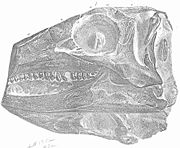 Unlike later ankylosaurs, the skull
was low and triangular in shape, longer than it was wide, similar to that of primitive ornithischians. The head of Scelidosaurus was small, and it had a neck that was longer than that of most armoured dinosaurs.
Like other thyreophorans, Scelidosaurus was herbivorous
, with very small, leaf-shaped cheek teeth suitable for cropping vegetation. It is believed Scelidosaurus fed with a puncture-crush system of tooth-on-tooth action, with simple up-and-down jaw movement. Unlike later ankylosaurs, Scelidosaurus still had the five pairs of fenestrae (skull openings) seen in primitive ornithischians, and its teeth were more leaf-shaped than later armoured dinosaurs.
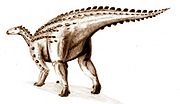 The most obvious feature of Scelidosaurus is its armour, consisting of bony scute
s embedded in the skin. These osteoderms were arranged in parallel rows down the animal's body. Osteoderms are also found in the skin of crocodile
s, armadillo
s and some lizard
s. These osteoderms ranged in both size and shape; most were small, flat plates, but thicker scutes also occurred. The scutes were aligned in regular horizontal rows down the animal's neck, back, and hips, with smaller scutes arranged on the limbs and tail. The lateral scutes were conical, rather than the blade-like osteoderms of Scutellosaurus
, and have been used to identify the genus. It also had a pair of distinctive three-pointed scutes behind the head. Compared to later ankylosaurs, Scelidosaurus was lightly armoured.
Fossilized skin impressions have also been found. Between the bony scutes, Scelidosaurus had rounded scales similar to those of a Gila monster
. Between the large scutes, very small (5-10 millimetres [0.2-0.4 in]) flat "granules" of bone were distributed within the skin. In later ankylosaurs, these small scutes may have developed into larger scutes, fusing into the multi-osteodermal plate armour seen in genera such as Ankylosaurus.
, which also bore primitive teeth and simple jaws. Also like stegosaurs, they may have swallowed gastrolith
s to aid processing of food (because of the lack of chewing ability), in the same manner used by modern birds and crocodiles. Their diet would have consisted of leaved plants or fruits, as grasses did not evolve until late into the Cretaceous Period, after Scelidosaurus had become extinct.
, including a heavy body highest at the hips and bony plates down its back.
Scelidosaurus gives its name to the Scelidosauridae, a group of primitive ornithischians close to the ancestry of ankylosaurs and stegosaurs. Aside from Scelidosaurus, other members of the clade
include Bienosaurus
and possibly Scutellosaurus
. Originally proposed by Edward Drinker Cope
in 1869, the family was resurrected by Chinese paleontologist Dong Zhiming
in 2001 after study of Bienosaurus, which shares close affinities with Scelidosaurus. The scelidosaurids have been found in Early Jurassic formations, and may have persisted into the Late Jurassic. Their fossils have been found in China
, England, and Arizona. Some paleontologists consider the Scelidosauridae paraphyletic
, but Benton
(2004) lists the group as monophyletic
.
Fossil records of thyreophorans more basal than Scelidosaurus are sparse. The more primitive Scutellosaurus
, also found in Arizona, was an earlier genus which was facultatively bipedal. A trackway of a possible early armoured dinosaur, from around 195 million years ago, has been found in France. Ancestors of these primitive thyreophorans evolved from early ornithischians similar to Lesothosaurus
during the Late Triassic.
, based on several nearly complete skeletons. A potential second species from the Sinemurian
-age Lower Lufeng Formation, S. oehleri, was described by D.J. Simmons in 1965 under its own genus, Tatisaurus
. In 1996 Spencer G. Lucas
moved it to Scelidosaurus. Although the fossils are fragmentary, this reassessment has not been accepted, and S. oehleri is today once again recognized as Tatisaurus.
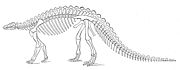 While James Harrison of Charmouth
(Early Sinemurian
stage, 196.5-194 million years ago), West Dorset of England was quarrying the cliffs of Black Ven
(between Charmouth and Lyme Regis
), possibly for raw material for the manufacture of cement
, in 1858, he found a few fragmentary fossil
s of limb bones. He sent them to Professor Richard Owen
of the Natural History Museum
(originally the British Museum
(Natural History), London). These, with later finds from the same spot, revealed a nearly complete skeleton. Scelidosaurus was named by Sir Richard Owen in 1859; however, a complete description did not appear until 1863. Unfortunately, mixed in with the Scelidosaurus fossils were the partial remains of a theropod dinosaur; this was not discovered until 1968. In 1888, Richard Lydekker
selected the knee joint as the lectotype
of Scelidosaurus.
For many years, the enigmatic fossils of Scelidosaurus caused some debate over the classification of the genus. Von Zittel (1902), Swinton (1934), and Appleby et al. (1967) identified the genus as a stegosaur. In a 1968 paper, Romer argued it was an ankylosaur. In 1977, Richard Thulborn of the University of Queensland
attempted to reclassify Scelidosaurus as an ornithopod similar to Tenontosaurus
or Iguanodon
. Thulborn argued Scelidosaurus was a lightly built bipedal dinosaur adapted for running. Thulborn's 1977 theories on the genus have since been rejected.
In 1968, B. H. Newman applied to have Lydekker's selection of the knee joint as the lectotype officially rescinded by the International Commission on Zoological Nomenclature
, as the joint was from a megalosaur. Wells et al. informally reassigned these bones, consisting of a femur
and partial tibia
, to "Merosaurus
" in 1995.
In 1989, scutes identified as belonging to Scelidosaurus sp., which were found in the Kayenta Formation
(Glen Canyon Group) of northern Arizona
, helped to determine the age of the strata was around 199.6-196.5 million years ago. These scutes also established a geographic tie-in between Arizona's Glen Canyon and Europe, where fossils of Scelidosaurus had previously been discovered. Some scientists have disputed the assignment to Scelidosaurus, though.
In 2000, Martill et al. announced the preservation of soft tissue in a specimen of Scelidosaurus. These fossils consist of eight caudal vertebrae in a cut slab of carbonate mudstone, which was judged to date from the late Hettangian
to Sinemurian
stages
. Parts of the fossil were preserved in such a way that an envelope of preserved soft tissue is visible around the vertebrae, and show the presence of an epidermal layer over the scutes. The authors concluded that the osteoderms of all basal armoured dinosaurs were covered in a tough, probably keratinous layer of skin.
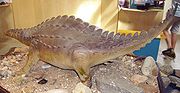 Although Scelidosaurus is nowhere near as well known as its sister taxa Ankylosaurus or Stegosaurus, the genus has appeared infrequently in popular media. One instance is in Nintendo's Jurassic Park III: Park Builder
video game, where the player controls a menagerie of dinosaurs, including Scelidosaurus. The dinosaur is also one of the main exhibits at the Charmouth Heritage Coast Centre
in Charmouth
, England
. The center houses both a model and a cast of Scelidosaurus, fossils of which were collected in the area. The children's show Harry and His Bucket Full of Dinosaurs
features a Scelidosaurus named Sid as one of Harry's dinosaur friends.
Genus
In biology, a genus is a low-level taxonomic rank used in the biological classification of living and fossil organisms, which is an example of definition by genus and differentia...
of quadrupedal, lightly plated, herbivorous
Herbivore
Herbivores are organisms that are anatomically and physiologically adapted to eat plant-based foods. Herbivory is a form of consumption in which an organism principally eats autotrophs such as plants, algae and photosynthesizing bacteria. More generally, organisms that feed on autotrophs in...
dinosaur
Dinosaur
Dinosaurs are a diverse group of animals of the clade and superorder Dinosauria. They were the dominant terrestrial vertebrates for over 160 million years, from the late Triassic period until the end of the Cretaceous , when the Cretaceous–Paleogene extinction event led to the extinction of...
about 4 metres (13.1 ft) long. It lived during the Early Jurassic
Jurassic
The Jurassic is a geologic period and system that extends from about Mya to Mya, that is, from the end of the Triassic to the beginning of the Cretaceous. The Jurassic constitutes the middle period of the Mesozoic era, also known as the age of reptiles. The start of the period is marked by...
Period, during the Hettangian
Hettangian
The Hettangian is the earliest age or lowest stage of the Jurassic period of the geologic timescale. It spans the time between 199.6 ± 0.6 Ma and 196.5 ± 1 Ma . The Hettangian follows the Rhaetian and is followed by the Sinemurian.In Europe stratigraphy the Hettangian is a part of the time span in...
to Sinemurian
Sinemurian
In the geologic timescale, the Sinemurian is an age or stage in the Early or Lower Jurassic epoch or series. It spans the time between 196.5 ± 2 Ma and 189.6 ± 1.5 Ma...
stages
Faunal stage
In chronostratigraphy, a stage is a succession of rock strata laid down in a single age on the geologic timescale, which usually represents millions of years of deposition. A given stage of rock and the corresponding age of time will by convention have the same name, and the same boundaries.Rock...
around 199.6 to 194 million years ago. Its fossils have been found in both England
England
England is a country that is part of the United Kingdom. It shares land borders with Scotland to the north and Wales to the west; the Irish Sea is to the north west, the Celtic Sea to the south west, with the North Sea to the east and the English Channel to the south separating it from continental...
and in Arizona
Arizona
Arizona ; is a state located in the southwestern region of the United States. It is also part of the western United States and the mountain west. The capital and largest city is Phoenix...
, in the United States. Scelidosaurus has been called the earliest complete dinosaur. This genus and related genera have been found on three continents.
Comparative anatomist Richard Owen
Richard Owen
Sir Richard Owen, FRS KCB was an English biologist, comparative anatomist and palaeontologist.Owen is probably best remembered today for coining the word Dinosauria and for his outspoken opposition to Charles Darwin's theory of evolution by natural selection...
described Scelidosaurus in 1859. Only one species
Species
In biology, a species is one of the basic units of biological classification and a taxonomic rank. A species is often defined as a group of organisms capable of interbreeding and producing fertile offspring. While in many cases this definition is adequate, more precise or differing measures are...
, S. harrisonii, is considered valid today, although other species have been proposed over the years. One of the most primitive of the thyreophora
Thyreophora
The Thyreophora were a subgroup of the ornithischian dinosaurs...
ns, the exact placement of Scelidosaurus within the suborder has been the subject of debate for nearly 150 years. This is not helped by the paucity of knowledge about its closest relatives.
Description
A full-grown Scelidosaurus was rather small, compared to most other dinosaurs. Some scientists have estimated a length of 4 metres (13 ft) Scelidosaurus was quadrupedQuadruped
Quadrupedalism is a form of land animal locomotion using four limbs or legs. An animal or machine that usually moves in a quadrupedal manner is known as a quadruped, meaning "four feet"...
al, with the hindlimbs considerably longer than the forelimbs. It may have reared up on its hind legs to browse on foliage from trees, but its forefeet were as large as its hind feet, indicating a mostly quadrupedal posture. Scelidosaurus had four toes, with the innermost digit being the smallest.
Skull
Skull
The skull is a bony structure in the head of many animals that supports the structures of the face and forms a cavity for the brain.The skull is composed of two parts: the cranium and the mandible. A skull without a mandible is only a cranium. Animals that have skulls are called craniates...
was low and triangular in shape, longer than it was wide, similar to that of primitive ornithischians. The head of Scelidosaurus was small, and it had a neck that was longer than that of most armoured dinosaurs.
Like other thyreophorans, Scelidosaurus was herbivorous
Herbivore
Herbivores are organisms that are anatomically and physiologically adapted to eat plant-based foods. Herbivory is a form of consumption in which an organism principally eats autotrophs such as plants, algae and photosynthesizing bacteria. More generally, organisms that feed on autotrophs in...
, with very small, leaf-shaped cheek teeth suitable for cropping vegetation. It is believed Scelidosaurus fed with a puncture-crush system of tooth-on-tooth action, with simple up-and-down jaw movement. Unlike later ankylosaurs, Scelidosaurus still had the five pairs of fenestrae (skull openings) seen in primitive ornithischians, and its teeth were more leaf-shaped than later armoured dinosaurs.
Armour
Scute
A scute or scutum is a bony external plate or scale, as on the shell of a turtle, the skin of crocodilians, the feet of some birds or the anterior portion of the mesonotum in insects.-Properties:...
s embedded in the skin. These osteoderms were arranged in parallel rows down the animal's body. Osteoderms are also found in the skin of crocodile
Crocodile
A crocodile is any species belonging to the family Crocodylidae . The term can also be used more loosely to include all extant members of the order Crocodilia: i.e...
s, armadillo
Armadillo
Armadillos are New World placental mammals, known for having a leathery armor shell. Dasypodidae is the only surviving family in the order Cingulata, part of the superorder Xenarthra along with the anteaters and sloths. The word armadillo is Spanish for "little armored one"...
s and some lizard
Lizard
Lizards are a widespread group of squamate reptiles, with nearly 3800 species, ranging across all continents except Antarctica as well as most oceanic island chains...
s. These osteoderms ranged in both size and shape; most were small, flat plates, but thicker scutes also occurred. The scutes were aligned in regular horizontal rows down the animal's neck, back, and hips, with smaller scutes arranged on the limbs and tail. The lateral scutes were conical, rather than the blade-like osteoderms of Scutellosaurus
Scutellosaurus
Scutellosaurus is a genus of herbivorous dinosaur that lived in North America around 200 to 196 million years ago, in the Early Jurassic times....
, and have been used to identify the genus. It also had a pair of distinctive three-pointed scutes behind the head. Compared to later ankylosaurs, Scelidosaurus was lightly armoured.
Fossilized skin impressions have also been found. Between the bony scutes, Scelidosaurus had rounded scales similar to those of a Gila monster
Gila monster
The Gila monster is a species of venomous lizard native to the southwestern United States and northwestern Mexican state of Sonora...
. Between the large scutes, very small (5-10 millimetres [0.2-0.4 in]) flat "granules" of bone were distributed within the skin. In later ankylosaurs, these small scutes may have developed into larger scutes, fusing into the multi-osteodermal plate armour seen in genera such as Ankylosaurus.
Diet
Scelidosaurus and its Jurassic relatives were herbivorous. However, while other ornithischians possessed teeth capable of grinding plant material, Scelidosaurus had smaller, less complex teeth and a jaw capable of only simple up-and-down jaw movements. In this aspect, they resembled the stegosauridsStegosauridae
Stegosauridae is a family of stegosauria, large thyreophorans. They lived longer than other Stegosaurs; while all Huayangosauridae and most of basal stegosaurs died out in Tithonian - Kimmeridgian, stegosauridae survived till Middle Cretaceous. They are usually characterized by triangular plates on...
, which also bore primitive teeth and simple jaws. Also like stegosaurs, they may have swallowed gastrolith
Gastrolith
A gastrolith, also called a stomach stone or gizzard stones, is a rock held inside a gastrointestinal tract. Gastroliths are retained in the muscular gizzard and used to grind food in animals lacking suitable grinding teeth. The grain size depends upon the size of the animal and the gastrolith's...
s to aid processing of food (because of the lack of chewing ability), in the same manner used by modern birds and crocodiles. Their diet would have consisted of leaved plants or fruits, as grasses did not evolve until late into the Cretaceous Period, after Scelidosaurus had become extinct.
Classification
Scelidosaurus was an ornithischian and has been classified at different times as an ankylosaur or stegosaur. This debate is still ongoing; at this time, it is considered to be either more closely related to ankylosaurids than to stegosaurids and, by extension, a true ankylosaur, or basal to the ankylosaur-stegosaur split. The stegosaur classification has fallen out of favor, but is seen in older dinosaur books. Despite its ankylosaur classification, Scelidosaurus shared similarities with StegosaurusStegosaurus
Stegosaurus is a genus of armored stegosaurid dinosaur. They lived during the Late Jurassic period , some 155 to 150 million years ago in what is now western North America. In 2006, a specimen of Stegosaurus was announced from Portugal, showing that they were present in Europe as well...
, including a heavy body highest at the hips and bony plates down its back.
Scelidosaurus gives its name to the Scelidosauridae, a group of primitive ornithischians close to the ancestry of ankylosaurs and stegosaurs. Aside from Scelidosaurus, other members of the clade
Clade
A clade is a group consisting of a species and all its descendants. In the terms of biological systematics, a clade is a single "branch" on the "tree of life". The idea that such a "natural group" of organisms should be grouped together and given a taxonomic name is central to biological...
include Bienosaurus
Bienosaurus
Bienosaurus was a dinosaur from the Early Jurassic. The genus was an armoured dinosaur from the Lower Lufeng Formation in Yunnan Province in China.-Discovery and species:...
and possibly Scutellosaurus
Scutellosaurus
Scutellosaurus is a genus of herbivorous dinosaur that lived in North America around 200 to 196 million years ago, in the Early Jurassic times....
. Originally proposed by Edward Drinker Cope
Edward Drinker Cope
Edward Drinker Cope was an American paleontologist and comparative anatomist, as well as a noted herpetologist and ichthyologist. Born to a wealthy Quaker family, Cope distinguished himself as a child prodigy interested in science; he published his first scientific paper at the age of nineteen...
in 1869, the family was resurrected by Chinese paleontologist Dong Zhiming
Dong Zhiming
Dong Zhiming , from the Institute of Vertebrate Paleontology and Paleoanthropology in Beijing, is one of China's leading paleontologists. He began working at the IVPP in 1962, learning from Yang Zhongjian who was director at the time...
in 2001 after study of Bienosaurus, which shares close affinities with Scelidosaurus. The scelidosaurids have been found in Early Jurassic formations, and may have persisted into the Late Jurassic. Their fossils have been found in China
China
Chinese civilization may refer to:* China for more general discussion of the country.* Chinese culture* Greater China, the transnational community of ethnic Chinese.* History of China* Sinosphere, the area historically affected by Chinese culture...
, England, and Arizona. Some paleontologists consider the Scelidosauridae paraphyletic
Paraphyly
A group of taxa is said to be paraphyletic if the group consists of all the descendants of a hypothetical closest common ancestor minus one or more monophyletic groups of descendants...
, but Benton
Michael J. Benton
Michael J. Benton is a British paleontologist, a Fellow of the Royal Society of Edinburgh, and professor of vertebrate palaeontology in the Department of Earth Sciences at the University of Bristol....
(2004) lists the group as monophyletic
Monophyly
In common cladistic usage, a monophyletic group is a taxon which forms a clade, meaning that it contains all the descendants of the possibly hypothetical closest common ancestor of the members of the group. The term is synonymous with the uncommon term holophyly...
.
Fossil records of thyreophorans more basal than Scelidosaurus are sparse. The more primitive Scutellosaurus
Scutellosaurus
Scutellosaurus is a genus of herbivorous dinosaur that lived in North America around 200 to 196 million years ago, in the Early Jurassic times....
, also found in Arizona, was an earlier genus which was facultatively bipedal. A trackway of a possible early armoured dinosaur, from around 195 million years ago, has been found in France. Ancestors of these primitive thyreophorans evolved from early ornithischians similar to Lesothosaurus
Lesothosaurus
Lesothosaurus is an herbivorous ornithischian dinosaur. It was named by paleontologist Peter Galton in 1978, the name meaning "lizard from Lesotho". The genus is monotypic, having only one valid species, Lesothosaurus diagnosticus, within the genus....
during the Late Triassic.
Species
S. harrisonii, described by Owen, is currently the only recognized speciesSpecies
In biology, a species is one of the basic units of biological classification and a taxonomic rank. A species is often defined as a group of organisms capable of interbreeding and producing fertile offspring. While in many cases this definition is adequate, more precise or differing measures are...
, based on several nearly complete skeletons. A potential second species from the Sinemurian
Sinemurian
In the geologic timescale, the Sinemurian is an age or stage in the Early or Lower Jurassic epoch or series. It spans the time between 196.5 ± 2 Ma and 189.6 ± 1.5 Ma...
-age Lower Lufeng Formation, S. oehleri, was described by D.J. Simmons in 1965 under its own genus, Tatisaurus
Tatisaurus
Tatisaurus is a genus of ornithischian dinosaur from the Early Jurassic from the Lower Lufeng Formation in Yunnan Province in China. Little is known as the remains are fragmentary.-Discovery and species:...
. In 1996 Spencer G. Lucas
Spencer G. Lucas
Spencer George Lucas is an American paleontologist and stratigrapher, and curator of paleontology at the New Mexico Museum of Natural History and Science. His main areas of study are late Paleozoic, Mesozoic and early Cenozoic vertebrate fossils, stratigraphy, and continental deposits,...
moved it to Scelidosaurus. Although the fossils are fragmentary, this reassessment has not been accepted, and S. oehleri is today once again recognized as Tatisaurus.
History of discovery
Charmouth
Charmouth is a village at the mouth of the River Char in West Dorset, England, with a population of 1,687 according to the 2001 census.-The village:...
(Early Sinemurian
Sinemurian
In the geologic timescale, the Sinemurian is an age or stage in the Early or Lower Jurassic epoch or series. It spans the time between 196.5 ± 2 Ma and 189.6 ± 1.5 Ma...
stage, 196.5-194 million years ago), West Dorset of England was quarrying the cliffs of Black Ven
Black Ven
Black Ven is a cliff in Dorset, England. It is part of the Jurassic Coast World Heritage site. The cliff is famous for its mudslides, in fact, it has the largest mudslides in Europe. The area is popular with tourists because a number of fossils are found in the area.- History :The Black Ven has...
(between Charmouth and Lyme Regis
Lyme Regis
Lyme Regis is a coastal town in West Dorset, England, situated 25 miles west of Dorchester and east of Exeter. The town lies in Lyme Bay, on the English Channel coast at the Dorset-Devon border...
), possibly for raw material for the manufacture of cement
Cement
In the most general sense of the word, a cement is a binder, a substance that sets and hardens independently, and can bind other materials together. The word "cement" traces to the Romans, who used the term opus caementicium to describe masonry resembling modern concrete that was made from crushed...
, in 1858, he found a few fragmentary fossil
Fossil
Fossils are the preserved remains or traces of animals , plants, and other organisms from the remote past...
s of limb bones. He sent them to Professor Richard Owen
Richard Owen
Sir Richard Owen, FRS KCB was an English biologist, comparative anatomist and palaeontologist.Owen is probably best remembered today for coining the word Dinosauria and for his outspoken opposition to Charles Darwin's theory of evolution by natural selection...
of the Natural History Museum
Natural History Museum
The Natural History Museum is one of three large museums on Exhibition Road, South Kensington, London, England . Its main frontage is on Cromwell Road...
(originally the British Museum
British Museum
The British Museum is a museum of human history and culture in London. Its collections, which number more than seven million objects, are amongst the largest and most comprehensive in the world and originate from all continents, illustrating and documenting the story of human culture from its...
(Natural History), London). These, with later finds from the same spot, revealed a nearly complete skeleton. Scelidosaurus was named by Sir Richard Owen in 1859; however, a complete description did not appear until 1863. Unfortunately, mixed in with the Scelidosaurus fossils were the partial remains of a theropod dinosaur; this was not discovered until 1968. In 1888, Richard Lydekker
Richard Lydekker
Richard Lydekker was an English naturalist, geologist and writer of numerous books on natural history.-Biography:...
selected the knee joint as the lectotype
Lectotype
In botanical nomenclature and zoological nomenclature, a lectotype is a kind of name-bearing type. When a species was originally described on the basis of a name-bearing type consisting of multiple specimens, one of those may be designated as the lectotype...
of Scelidosaurus.
For many years, the enigmatic fossils of Scelidosaurus caused some debate over the classification of the genus. Von Zittel (1902), Swinton (1934), and Appleby et al. (1967) identified the genus as a stegosaur. In a 1968 paper, Romer argued it was an ankylosaur. In 1977, Richard Thulborn of the University of Queensland
University of Queensland
The University of Queensland, also known as UQ, is a public university located in state of Queensland, Australia. Founded in 1909, it is the oldest and largest university in Queensland and the fifth oldest in the nation...
attempted to reclassify Scelidosaurus as an ornithopod similar to Tenontosaurus
Tenontosaurus
Tenontosaurus is a genus of medium- to large-sized ornithopod dinosaur. The genus is known from the late Aptian to Albian ages of the middle Cretaceous period sediments of western North America, dating between 115 to 108 million years ago...
or Iguanodon
Iguanodon
Iguanodon is a genus of ornithopod dinosaur that lived roughly halfway between the first of the swift bipedal hypsilophodontids and the ornithopods' culmination in the duck-billed dinosaurs...
. Thulborn argued Scelidosaurus was a lightly built bipedal dinosaur adapted for running. Thulborn's 1977 theories on the genus have since been rejected.
In 1968, B. H. Newman applied to have Lydekker's selection of the knee joint as the lectotype officially rescinded by the International Commission on Zoological Nomenclature
International Commission on Zoological Nomenclature
The International Commission on Zoological Nomenclature is an organization dedicated to "achieving stability and sense in the scientific naming of animals". Founded in 1895, it currently comprises 28 members from 20 countries, mainly practicing zoological taxonomists...
, as the joint was from a megalosaur. Wells et al. informally reassigned these bones, consisting of a femur
Femur
The femur , or thigh bone, is the most proximal bone of the leg in tetrapod vertebrates capable of walking or jumping, such as most land mammals, birds, many reptiles such as lizards, and amphibians such as frogs. In vertebrates with four legs such as dogs and horses, the femur is found only in...
and partial tibia
Tibia
The tibia , shinbone, or shankbone is the larger and stronger of the two bones in the leg below the knee in vertebrates , and connects the knee with the ankle bones....
, to "Merosaurus
Merosaurus
"Merosaurus" is the informal name given to an as yet undescribed genus of dinosaur from the Early Jurassic ....
" in 1995.
In 1989, scutes identified as belonging to Scelidosaurus sp., which were found in the Kayenta Formation
Kayenta Formation
The Kayenta Formation is a geologic layer in the Glen Canyon Group that is spread across the Colorado Plateau province of the United States, including northern Arizona, northwest Colorado, Nevada, and Utah. This rock formation is particularly prominent in southeastern Utah, where it is seen in the...
(Glen Canyon Group) of northern Arizona
Arizona
Arizona ; is a state located in the southwestern region of the United States. It is also part of the western United States and the mountain west. The capital and largest city is Phoenix...
, helped to determine the age of the strata was around 199.6-196.5 million years ago. These scutes also established a geographic tie-in between Arizona's Glen Canyon and Europe, where fossils of Scelidosaurus had previously been discovered. Some scientists have disputed the assignment to Scelidosaurus, though.
In 2000, Martill et al. announced the preservation of soft tissue in a specimen of Scelidosaurus. These fossils consist of eight caudal vertebrae in a cut slab of carbonate mudstone, which was judged to date from the late Hettangian
Hettangian
The Hettangian is the earliest age or lowest stage of the Jurassic period of the geologic timescale. It spans the time between 199.6 ± 0.6 Ma and 196.5 ± 1 Ma . The Hettangian follows the Rhaetian and is followed by the Sinemurian.In Europe stratigraphy the Hettangian is a part of the time span in...
to Sinemurian
Sinemurian
In the geologic timescale, the Sinemurian is an age or stage in the Early or Lower Jurassic epoch or series. It spans the time between 196.5 ± 2 Ma and 189.6 ± 1.5 Ma...
stages
Faunal stage
In chronostratigraphy, a stage is a succession of rock strata laid down in a single age on the geologic timescale, which usually represents millions of years of deposition. A given stage of rock and the corresponding age of time will by convention have the same name, and the same boundaries.Rock...
. Parts of the fossil were preserved in such a way that an envelope of preserved soft tissue is visible around the vertebrae, and show the presence of an epidermal layer over the scutes. The authors concluded that the osteoderms of all basal armoured dinosaurs were covered in a tough, probably keratinous layer of skin.
In popular culture
Jurassic Park III: Park Builder
Jurassic Park III: Park Builder is a construction and management simulation game for the Game Boy Advance that was developed by Konami and released in 2001.-Summary:...
video game, where the player controls a menagerie of dinosaurs, including Scelidosaurus. The dinosaur is also one of the main exhibits at the Charmouth Heritage Coast Centre
Charmouth Heritage Coast Centre
The Charmouth Heritage Coast Centre is based in the upstairs floor of a long-disused cement factory on the foreshore of Charmouth in Dorset, England....
in Charmouth
Charmouth
Charmouth is a village at the mouth of the River Char in West Dorset, England, with a population of 1,687 according to the 2001 census.-The village:...
, England
England
England is a country that is part of the United Kingdom. It shares land borders with Scotland to the north and Wales to the west; the Irish Sea is to the north west, the Celtic Sea to the south west, with the North Sea to the east and the English Channel to the south separating it from continental...
. The center houses both a model and a cast of Scelidosaurus, fossils of which were collected in the area. The children's show Harry and His Bucket Full of Dinosaurs
Harry and His Bucket Full of Dinosaurs
Harry and His Bucket Full of Dinosaurs is a series of children's books written and drawn by Ian Whybrow and Adrian Reynolds. The series is about a 5-year-old boy named Harry, who has a bucket full of dinosaurs. In the books the dinosaurs talk to Harry but seem to be toys to the other characters...
features a Scelidosaurus named Sid as one of Harry's dinosaur friends.
External links
- Ankylosauromorpha at the Tree of Life
- Scelidosauridae
- Scelidosaurus at Thescelosaurus! (scroll to Thyreophora)
- Scelidosaurus at Dinodata