


Larissa

Encyclopedia
Larissa is the capital and biggest city of the Thessaly
region of Greece
and capital of the Larissa regional unit. It is a principal agricultural centre and a national transportation hub, linked by road and rail with the port of Volos
, the city of Thessaloniki
and Athens
. Larissa's population, within its municipality, has 163,380 inhabitants, while the regional unit of Larissa reached a population of 284,420 (in 2011). The urban area of the city, although most of it contained within the Larissa municipality, also includes the communities of Giannouli
, Platykampos
, Nikaia, Terpsithea and several other suburban settlements, which bring the wider urban area population of the city to about 220,000 inhabitants. According to archaeological evidence the city and its area has been inhabited since the tenth millennium BCE. Today, Larissa is a major commercial and industrial centre in Greece
. Legend has it that Achilles
was born here and Hippocrates
, the Father of Medicine, died here as well.
and the main railway from Athens
to Thessaloniki
(Salonika) crossing through Thessaly
. The region is directly linked to the rest of Europe
through the International Airport of Central Greece
located in Nea Anchialos
a short distance from Larissa.
Larissa lies on the river Pineios.
The Larissa Chasma, a deep gash in the surface of Dione
, a natural satellite of Saturn, was named after Larissa.
to have been founded by Acrisius
, who was killed accidentally by his grandson, Perseus
. There lived Peleus
, the hero beloved by the gods, and his son Achilles
; however, the city is not mentioned by Homer
, unless it should be identified with Argissa of the Iliad
.
In mythology, the nymph Larissa
was a daughter of the primordial man Pelasgus
.
human settlement have been recovered from the area, but it was peripheral to areas of advanced culture. The area around Larissa was extremely fruitful; it was agriculturally important and in antiquity
was known for its horses.
The name Larissa, inherited from the Pelasgian settlers— an alternative name for the district was Pelasgiotis— was common to many Pelasgian towns: the ancient Greek word larissa means "stronghold".
Larissa is thought to be where the famous Greek physician Hippocrates
and the famous philosopher Gorgias of Leontini died.
When Larissa ceased minting the federal coins it shared with other Thessalian towns and adopted its own coinage in the late 5th century BC, it chose local types for its coins. The obverse depicted the nymph of the local spring, Larissa, for whom the town was named; probably the choice was inspired by the famous coins of Kimon depicting the Syracusan nymph Arethusa
. The reverse depicted a horse in various poses. The horse was an appropriate symbol of Thessaly, a land of plains, which was well known for its horses. Usually there is a male figure; he should perhaps be seen as the eponymous hero of the Thessalians, Thessalos, who is probably also to be identified on many of the earlier, federal coins of Thessaly.
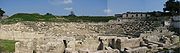 Larissa, sometimes written Larisa on ancient coins and inscriptions, is near the site of the Homeric Argissa. It appears in early times, when Thessaly
was mainly governed by a few aristocratic families, as an important city under the rule of the Aleuadae
, whose authority extended over the whole district of Pelasgiotis
. This powerful family possessed for many generations before 369 BC the privilege of furnishing the tagus, the local term for the strategos
of the combined Thessalian forces. The principal rivals of the Aleuadae were the Scopadac of Crannon, the remains of which are about 14 miles south west.
Larissa was indeed the birthplace of Meno
, who thus became, along with Xenophon
and a few others, one of the generals leading several thousands Greeks from various places, in the ill-fated expedition of 401 (retold in Xenophon's Anabasis
) meant to help Cyrus the Younger
, son of Darius II
, king of Persia, overthrow his elder brother Artaxerxes II
and take over the throne of Persia (Meno is featured in Plato
's dialogue bearing his name, in which Socrates
uses the example of "the way to Larissa" to help explain Meno the difference between true opinion
and science
(Meno, 97a–c) ; this "way to Larissa" might well be on the part of Socrates an attempt to call to Meno's mind a "way home", understood as the way toward one's true and "eternal" home reached only at death, that each man is supposed to seek in his life).
The constitution of the town was democratic, which explains why it sided with Athens
in the Peloponnesian War
. In the neighbourhood of Larissa was celebrated a festival which recalled the Roman Saturnalia
, and at which the slaves were waited on by their masters. It was taken by the Thebans and afterwards by the Macedonian kings, and Demetrius Poliorcestes
gained possession of it for a time, 302 BC
.
signed in 197 BC
a treaty with the Romans after his defeat at Cynoscephalae, and it was there also that Antiochus III, the Great, won a great victory, 192 BC
.
As the chief city of ancient Thessaly, Larissa was directly annexed by Philip II of Macedon in 344, and from then on Larissa was under Macedonian control; in 196 B.C. Larissa became an ally of Rome and was the headquarters of the Thessalian League
.
Larissa is frequently mentioned in connection with the Roman civil wars which preceded the establishment of the empire and Pompey
sought refuge there after the defeat of Pharsalus.
It was conquered by the Ottoman Empire
in 1386/87 and again in the 1390s, but only came under permanent Ottoman control in 1423, by Turahan Bey
. Under Ottoman rule, the city was known as Yeni-şehir i-Fenari, "new citadel". As the chief town and military base of Ottoman Thessaly, Larissa was a predominantly Muslim city. The town was noted for its trade fair in the 17th and 18th centuries, while the seat of the pasha of Thessaly was also transferred there in 1770. The city remained in Ottoman hands until Thessaly became part of the independent Greek kingdom in 1881, except for a period where Ottoman forces re-occupied it during the Greco-Turkish War of 1897.
On 6 March 1770, Aya Pasha massacred there 3000 Christians from Trikala
.
In the 19th century, there was a small village in the outskirts of town very unusually inhabited by Africans from the Sudan
, a curious remnant of the forces collected by Ali Pasha
. In the 19th century, the town produced leather
, cotton
, silk
and tobacco
. Fevers and agues were prevalent owing to bad drainage and the overflowing of the river; and the death-rate was higher than the birth rate. It was also renowned for the minaret
s of its mosque
s (four of which were still in use in the early part of the 20th century) and the Muslim
burial grounds.
during the Greek War of Independence
. In 1881, the city, along with the rest of Thessaly
, was incorporated into the Kingdom of Greece
. A considerable portion of the Turkish population emigrated into the Ottoman Empire at that point. During the Greco-Turkish War of 1897, the city was the headquarters of Greek Crown Prince Constantine
. The flight of the Greek army from here to Farsala
took place on April 23, 1897. Turkish troops entered the city two days later. After a treaty for peace was signed, they withdrew and Larissa remained permanently in Greece
. This was followed by a further exodus of Turks in 1898.
. St. Achillius of the 4th century, is celebrated for his miracles. Lequien cites twenty-nine bishops from the fourth to the 18th centuries; the most famous is Jermias II, who occupied the Patriarch of the West until 733, when the Emperor Leo III the Isaurian
annexed it to the Patriarchate of Constantinople. In the first years of the 10th century it had ten suffragan sees; subsequently the number increased and about the year 1175 under the Emperor Manuel I Comnenus, it reached twenty-eight. At the close of the 15th century, under the Turkish domination, there were only ten suffragan sees, which gradually grew less and finally disappeared.
Larissa remains a titular see
of the Roman Catholic Church.
1st Mucicipal District
(pop. 26,035)
2nd Municipal District
(pop. 41,816)
3rd Municipal District
(pop. 30,121)
4rh Municipal District
(pop. 26,814)
Community of Terpsithèa
(pop. 1,290)
From 1 January 2011, in accordance with the Kallikratis plan (new administrative division of Greece), the new municipality of Larissa includes also the former mucipalities of Giannouli
and Koilada
.
, with connections to Motorway A1 and national roads EO3
and EO6
.
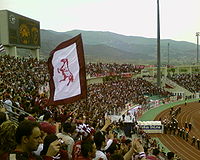 The local football club AEL 1964 FC currently participates in Super League Greece
. The team became Greek Champion
in 1988 and won the Greek Cup in 1985 & 2007. These titles place AEL in the 5 biggest football clubs of Greece
. AEL holds its home games in the newbuild AEL FC Arena sice November 2010, an UEFA
-3 star rated football ground.
Other important sport venues are the National Sport Center of Larissa (EAK Larissas), which includes the Alcazar Stadium and the Neapoli Indoor Hall.

with:
Bălţi
, Moldova
Banská Bystrica
, Slovakia
Knoxville
, Tennessee
, United States
Stara Zagora
, Bulgaria
Rybnik
, Poland
, since 13 June 2003 Ürgüp
, Turkey
Denizli
, Turkey
Thessaly
Thessaly is a traditional geographical region and an administrative region of Greece, comprising most of the ancient region of the same name. Before the Greek Dark Ages, Thessaly was known as Aeolia, and appears thus in Homer's Odyssey....
region of Greece
Greece
Greece , officially the Hellenic Republic , and historically Hellas or the Republic of Greece in English, is a country in southeastern Europe....
and capital of the Larissa regional unit. It is a principal agricultural centre and a national transportation hub, linked by road and rail with the port of Volos
Volos
Volos is a coastal port city in Thessaly situated midway on the Greek mainland, about 326 km north of Athens and 215 km south of Thessaloniki...
, the city of Thessaloniki
Thessaloniki
Thessaloniki , historically also known as Thessalonica, Salonika or Salonica, is the second-largest city in Greece and the capital of the region of Central Macedonia as well as the capital of the Decentralized Administration of Macedonia and Thrace...
and Athens
Athens
Athens , is the capital and largest city of Greece. Athens dominates the Attica region and is one of the world's oldest cities, as its recorded history spans around 3,400 years. Classical Athens was a powerful city-state...
. Larissa's population, within its municipality, has 163,380 inhabitants, while the regional unit of Larissa reached a population of 284,420 (in 2011). The urban area of the city, although most of it contained within the Larissa municipality, also includes the communities of Giannouli
Giannouli
Giannouli is a former municipality in the Larissa regional unit, Thessaly, Greece. Since the 2011 local government reform it is part of the municipality Larissa, of which it is a municipal unit. Population 10,022 ....
, Platykampos
Platykampos
Platykampos is a village and a former municipality in the Larissa regional unit, Thessaly, Greece. Since the 2011 local government reform it is part of the municipality Kileler, of which it is a municipal unit. Population 8,292 ....
, Nikaia, Terpsithea and several other suburban settlements, which bring the wider urban area population of the city to about 220,000 inhabitants. According to archaeological evidence the city and its area has been inhabited since the tenth millennium BCE. Today, Larissa is a major commercial and industrial centre in Greece
Greece
Greece , officially the Hellenic Republic , and historically Hellas or the Republic of Greece in English, is a country in southeastern Europe....
. Legend has it that Achilles
Achilles
In Greek mythology, Achilles was a Greek hero of the Trojan War, the central character and the greatest warrior of Homer's Iliad.Plato named Achilles the handsomest of the heroes assembled against Troy....
was born here and Hippocrates
Hippocrates
Hippocrates of Cos or Hippokrates of Kos was an ancient Greek physician of the Age of Pericles , and is considered one of the most outstanding figures in the history of medicine...
, the Father of Medicine, died here as well.
Geography
There are a number of highways including E75European route E75
European route E 75 is part of the International E-road network, which is a series of main roads in Europe.The E 75 starts from Vardø, Norway in the Barents Sea and runs south through Finland, Poland, Czech Republic, Slovakia, Hungary, Serbia and Republic of Macedonia to Sitia, Greece on...
and the main railway from Athens
Athens
Athens , is the capital and largest city of Greece. Athens dominates the Attica region and is one of the world's oldest cities, as its recorded history spans around 3,400 years. Classical Athens was a powerful city-state...
to Thessaloniki
Thessaloniki
Thessaloniki , historically also known as Thessalonica, Salonika or Salonica, is the second-largest city in Greece and the capital of the region of Central Macedonia as well as the capital of the Decentralized Administration of Macedonia and Thrace...
(Salonika) crossing through Thessaly
Thessaly
Thessaly is a traditional geographical region and an administrative region of Greece, comprising most of the ancient region of the same name. Before the Greek Dark Ages, Thessaly was known as Aeolia, and appears thus in Homer's Odyssey....
. The region is directly linked to the rest of Europe
Europe
Europe is, by convention, one of the world's seven continents. Comprising the westernmost peninsula of Eurasia, Europe is generally 'divided' from Asia to its east by the watershed divides of the Ural and Caucasus Mountains, the Ural River, the Caspian and Black Seas, and the waterways connecting...
through the International Airport of Central Greece
International Airport of Central Greece
Nea Anchialos National Airport is an airport located near the town of Nea Anchialos in Greece. It serves the city of Volos and is also known as Volos Central Greece Airport or Volos Nea Anchialos Airport of Central Greece....
located in Nea Anchialos
Nea Anchialos
Nea Anchialos is a town and a former municipality in Magnesia, Thessaly, Greece. Since the 2011 local government reform it is part of the municipality Volos, of which it is a municipal unit. It is situated southwest of Volos and north of Almyros. It is placed on the national highway...
a short distance from Larissa.
Larissa lies on the river Pineios.
The Larissa Chasma, a deep gash in the surface of Dione
Dione (moon)
Dione is a moon of Saturn discovered by Cassini in 1684. It is named after the titan Dione of Greek mythology. It is also designated Saturn IV.- Name :...
, a natural satellite of Saturn, was named after Larissa.
Mythology
The city is said in Greek mythologyGreek mythology
Greek mythology is the body of myths and legends belonging to the ancient Greeks, concerning their gods and heroes, the nature of the world, and the origins and significance of their own cult and ritual practices. They were a part of religion in ancient Greece...
to have been founded by Acrisius
Acrisius
Acrisius was a mythical king of Argos, and a son of Abas and Aglaea , grandson of Lynceus, great-grandson of Danaus. His twin brother was Proetus, with whom he is said to have quarreled even in the womb of his mother...
, who was killed accidentally by his grandson, Perseus
Perseus
Perseus ,Perseos and Perseas are not used in English. the legendary founder of Mycenae and of the Perseid dynasty of Danaans there, was the first of the mythic heroes of Greek mythology whose exploits in defeating various archaic monsters provided the founding myths of the Twelve Olympians...
. There lived Peleus
Peleus
In Greek mythology, Pēleus was a hero whose myth was already known to the hearers of Homer in the late 8th century BCE. Peleus was the son of Aeacus, king of the island of Aegina, and Endeïs, the oread of Mount Pelion in Thessaly; he was the father of Achilles...
, the hero beloved by the gods, and his son Achilles
Achilles
In Greek mythology, Achilles was a Greek hero of the Trojan War, the central character and the greatest warrior of Homer's Iliad.Plato named Achilles the handsomest of the heroes assembled against Troy....
; however, the city is not mentioned by Homer
Homer
In the Western classical tradition Homer , is the author of the Iliad and the Odyssey, and is revered as the greatest ancient Greek epic poet. These epics lie at the beginning of the Western canon of literature, and have had an enormous influence on the history of literature.When he lived is...
, unless it should be identified with Argissa of the Iliad
Iliad
The Iliad is an epic poem in dactylic hexameters, traditionally attributed to Homer. Set during the Trojan War, the ten-year siege of the city of Troy by a coalition of Greek states, it tells of the battles and events during the weeks of a quarrel between King Agamemnon and the warrior Achilles...
.
In mythology, the nymph Larissa
Larissa (mythology)
In Greek mythology, Larissa was a local nymph from Thessaly. She was described by Pausanias as a daughter of Pelasgus. However, Hellanicus states that the sons of Poseidon and Larissa were Achaios, Phthios, and Pelasgus...
was a daughter of the primordial man Pelasgus
Pelasgus
In Greek mythology, Pelasgus was the eponymous ancestor of the Pelasgians, the mythical inhabitants of Greece who established the worship of the Dodonaean Zeus, Hephaestus, the Cabeiri, and other divinities. In the different parts of the country once occupied by Pelasgians, there existed...
.
Antiquity
Traces of PaleolithicPaleolithic
The Paleolithic Age, Era or Period, is a prehistoric period of human history distinguished by the development of the most primitive stone tools discovered , and covers roughly 99% of human technological prehistory...
human settlement have been recovered from the area, but it was peripheral to areas of advanced culture. The area around Larissa was extremely fruitful; it was agriculturally important and in antiquity
Classical antiquity
Classical antiquity is a broad term for a long period of cultural history centered on the Mediterranean Sea, comprising the interlocking civilizations of ancient Greece and ancient Rome, collectively known as the Greco-Roman world...
was known for its horses.
The name Larissa, inherited from the Pelasgian settlers— an alternative name for the district was Pelasgiotis— was common to many Pelasgian towns: the ancient Greek word larissa means "stronghold".
Larissa is thought to be where the famous Greek physician Hippocrates
Hippocrates
Hippocrates of Cos or Hippokrates of Kos was an ancient Greek physician of the Age of Pericles , and is considered one of the most outstanding figures in the history of medicine...
and the famous philosopher Gorgias of Leontini died.
When Larissa ceased minting the federal coins it shared with other Thessalian towns and adopted its own coinage in the late 5th century BC, it chose local types for its coins. The obverse depicted the nymph of the local spring, Larissa, for whom the town was named; probably the choice was inspired by the famous coins of Kimon depicting the Syracusan nymph Arethusa
Arethusa (mythology)
For other uses, see ArethusaArethusa means "the waterer". In Greek mythology, she was a nymph and daughter of Nereus , and later became a fountain on the island of Ortygia in Syracuse, Sicily....
. The reverse depicted a horse in various poses. The horse was an appropriate symbol of Thessaly, a land of plains, which was well known for its horses. Usually there is a male figure; he should perhaps be seen as the eponymous hero of the Thessalians, Thessalos, who is probably also to be identified on many of the earlier, federal coins of Thessaly.
Thessaly
Thessaly is a traditional geographical region and an administrative region of Greece, comprising most of the ancient region of the same name. Before the Greek Dark Ages, Thessaly was known as Aeolia, and appears thus in Homer's Odyssey....
was mainly governed by a few aristocratic families, as an important city under the rule of the Aleuadae
Aleuadae
The Aleuadae were an ancient Thessalian family of Larissa who claimed descent from the mythical Aleuas. The Aleuadae were the noblest and most powerful among all the families of Thessaly, whence Herodotus calls its members "rulers" or "kings" .-Aleuas:The first Aleuas, who bore the epithet of...
, whose authority extended over the whole district of Pelasgiotis
Pelasgiotis
Pelasgiotis was an elongated district of ancient Thessaly from the Vale of Tempe to the southern city of Pherae. Pelasgiotis included the below localities: Argos Pelasgikon, Argyra, Atrax, Crannon, Cynoscephalae, Elateia, Gyrton, Mopsion, Larissa, Kondaia, Onchestos river and town, Phayttos,...
. This powerful family possessed for many generations before 369 BC the privilege of furnishing the tagus, the local term for the strategos
Strategos
Strategos, plural strategoi, is used in Greek to mean "general". In the Hellenistic and Byzantine Empires the term was also used to describe a military governor...
of the combined Thessalian forces. The principal rivals of the Aleuadae were the Scopadac of Crannon, the remains of which are about 14 miles south west.
Larissa was indeed the birthplace of Meno
Menon III of Pharsalus
Menon , son of Alexidemus, was a Thessalian, probably from Pharsalus and is famous for appearing in Plato's dialogue the Meno and for being among the generals killed by Artaxerxes after the Battle of Cunaxa as detailed in Xenophon's Anabasis.-Biography:Menon is reported, by both Xenophon and...
, who thus became, along with Xenophon
Xenophon
Xenophon , son of Gryllus, of the deme Erchia of Athens, also known as Xenophon of Athens, was a Greek historian, soldier, mercenary, philosopher and a contemporary and admirer of Socrates...
and a few others, one of the generals leading several thousands Greeks from various places, in the ill-fated expedition of 401 (retold in Xenophon's Anabasis
Anabasis (Xenophon)
Anabasis is the most famous work, in seven books, of the Greek professional soldier and writer Xenophon. The journey it narrates is his best known accomplishment and "one of the great adventures in human history," as Will Durant expressed the common assessment.- The account :Xenophon accompanied...
) meant to help Cyrus the Younger
Cyrus the Younger
Cyrus the Younger, son of Darius II of Persia and Parysatis, was a Persian prince and general. The time of his birth is unknown, but he died in 401 B.C. The history of Cyrus and of the retreat of the Greeks is told by Xenophon in his Anabasis. Another account, probably from Sophaenetus of...
, son of Darius II
Darius II of Persia
Darius II , was king of the Persian Empire from 423 BC to 405 BC.Artaxerxes I, who died on December 25, 424 BC, was followed by his son Xerxes II. After a month and a half Xerxes II was murdered by his brother Secydianus or Sogdianus...
, king of Persia, overthrow his elder brother Artaxerxes II
Artaxerxes II of Persia
Artaxerxes II Mnemon was king of Persia from 404 BC until his death. He was a son of Darius II of Persia and Parysatis.-Reign:...
and take over the throne of Persia (Meno is featured in Plato
Plato
Plato , was a Classical Greek philosopher, mathematician, student of Socrates, writer of philosophical dialogues, and founder of the Academy in Athens, the first institution of higher learning in the Western world. Along with his mentor, Socrates, and his student, Aristotle, Plato helped to lay the...
's dialogue bearing his name, in which Socrates
Socrates
Socrates was a classical Greek Athenian philosopher. Credited as one of the founders of Western philosophy, he is an enigmatic figure known chiefly through the accounts of later classical writers, especially the writings of his students Plato and Xenophon, and the plays of his contemporary ...
uses the example of "the way to Larissa" to help explain Meno the difference between true opinion
Opinion
In general, an opinion is a subjective belief, and is the result of emotion or interpretation of facts. An opinion may be supported by an argument, although people may draw opposing opinions from the same set of facts. Opinions rarely change without new arguments being presented...
and science
Science
Science is a systematic enterprise that builds and organizes knowledge in the form of testable explanations and predictions about the universe...
(Meno, 97a–c) ; this "way to Larissa" might well be on the part of Socrates an attempt to call to Meno's mind a "way home", understood as the way toward one's true and "eternal" home reached only at death, that each man is supposed to seek in his life).
The constitution of the town was democratic, which explains why it sided with Athens
Athens
Athens , is the capital and largest city of Greece. Athens dominates the Attica region and is one of the world's oldest cities, as its recorded history spans around 3,400 years. Classical Athens was a powerful city-state...
in the Peloponnesian War
Peloponnesian War
The Peloponnesian War, 431 to 404 BC, was an ancient Greek war fought by Athens and its empire against the Peloponnesian League led by Sparta. Historians have traditionally divided the war into three phases...
. In the neighbourhood of Larissa was celebrated a festival which recalled the Roman Saturnalia
Saturnalia
Saturnalia is an Ancient Roman festival/ celebration held in honour of Saturn , the youngest of the Titans, father of the major gods of the Greeks and Romans, and son of Uranus and Gaia...
, and at which the slaves were waited on by their masters. It was taken by the Thebans and afterwards by the Macedonian kings, and Demetrius Poliorcestes
Demetrius I of Macedon
Demetrius I , called Poliorcetes , son of Antigonus I Monophthalmus and Stratonice, was a king of Macedon...
gained possession of it for a time, 302 BC
302 BC
Year 302 BC was a year of the pre-Julian Roman calendar. At the time, it was known as the Year of the Consulship of Denter and Paullus...
.
Hellenistic and Roman era
It was in Larissa that Philip V of MacedonPhilip V of Macedon
Philip V was King of Macedon from 221 BC to 179 BC. Philip's reign was principally marked by an unsuccessful struggle with the emerging power of Rome. Philip was attractive and charismatic as a young man...
signed in 197 BC
197 BC
Year 197 BC was a year of the pre-Julian Roman calendar. At the time it was known as the Year of the Consulship of Cethegus and Rufus...
a treaty with the Romans after his defeat at Cynoscephalae, and it was there also that Antiochus III, the Great, won a great victory, 192 BC
192 BC
Year 192 BC was a year of the pre-Julian Roman calendar. At the time it was known as the Year of the Consulship of Flamininus and Ahenobarbus...
.
As the chief city of ancient Thessaly, Larissa was directly annexed by Philip II of Macedon in 344, and from then on Larissa was under Macedonian control; in 196 B.C. Larissa became an ally of Rome and was the headquarters of the Thessalian League
Thessalian League
The Thessalian League was a loose confederacy of feudal-like city-states and tribes in the Thessalian valley in Northern Greece and was run by a few aristocratic Thessalian families . The seat of the Thessalian diet was Larissa....
.
Larissa is frequently mentioned in connection with the Roman civil wars which preceded the establishment of the empire and Pompey
Pompey
Gnaeus Pompeius Magnus, also known as Pompey or Pompey the Great , was a military and political leader of the late Roman Republic...
sought refuge there after the defeat of Pharsalus.
Middle Ages and Ottoman period
The town was taken from the Byzantine Empire by Bulgaria for a while in the later 10th century and later held by Serbia. It was Frankish until 1400.It was conquered by the Ottoman Empire
Ottoman Empire
The Ottoman EmpireIt was usually referred to as the "Ottoman Empire", the "Turkish Empire", the "Ottoman Caliphate" or more commonly "Turkey" by its contemporaries...
in 1386/87 and again in the 1390s, but only came under permanent Ottoman control in 1423, by Turahan Bey
Turahan Bey
Turahan Bey or Turakhan Beg was a prominent Ottoman military commander and Ottoman governor of Thessaly from 1423 until his death in 1456. He participated in many Ottoman campaigns of the second quarter of the 15th century, fighting against the Byzantines as well as against the Crusade of Varna...
. Under Ottoman rule, the city was known as Yeni-şehir i-Fenari, "new citadel". As the chief town and military base of Ottoman Thessaly, Larissa was a predominantly Muslim city. The town was noted for its trade fair in the 17th and 18th centuries, while the seat of the pasha of Thessaly was also transferred there in 1770. The city remained in Ottoman hands until Thessaly became part of the independent Greek kingdom in 1881, except for a period where Ottoman forces re-occupied it during the Greco-Turkish War of 1897.
On 6 March 1770, Aya Pasha massacred there 3000 Christians from Trikala
Trikala
Trikala is a city in northwestern Thessaly, Greece. It is the capital of the Trikala peripheral unit, and is located NW of Athens, NW, of Karditsa, E of Ioannina and Metsovo, S of Grevena, SW of Thessaloniki, and W of Larissa...
.
In the 19th century, there was a small village in the outskirts of town very unusually inhabited by Africans from the Sudan
Sudan
Sudan , officially the Republic of the Sudan , is a country in North Africa, sometimes considered part of the Middle East politically. It is bordered by Egypt to the north, the Red Sea to the northeast, Eritrea and Ethiopia to the east, South Sudan to the south, the Central African Republic to the...
, a curious remnant of the forces collected by Ali Pasha
Ali Pasha
Ali Pasha of Tepelena or of Yannina, surnamed Aslan, "the Lion", or the "Lion of Yannina", Ali Pashë Tepelena was an Ottoman Albanian ruler of the western part of Rumelia, the Ottoman Empire's European territory which was also called Pashalik of Yanina. His court was in Ioannina...
. In the 19th century, the town produced leather
Leather
Leather is a durable and flexible material created via the tanning of putrescible animal rawhide and skin, primarily cattlehide. It can be produced through different manufacturing processes, ranging from cottage industry to heavy industry.-Forms:...
, cotton
Cotton
Cotton is a soft, fluffy staple fiber that grows in a boll, or protective capsule, around the seeds of cotton plants of the genus Gossypium. The fiber is almost pure cellulose. The botanical purpose of cotton fiber is to aid in seed dispersal....
, silk
Silk
Silk is a natural protein fiber, some forms of which can be woven into textiles. The best-known type of silk is obtained from the cocoons of the larvae of the mulberry silkworm Bombyx mori reared in captivity...
and tobacco
Tobacco
Tobacco is an agricultural product processed from the leaves of plants in the genus Nicotiana. It can be consumed, used as a pesticide and, in the form of nicotine tartrate, used in some medicines...
. Fevers and agues were prevalent owing to bad drainage and the overflowing of the river; and the death-rate was higher than the birth rate. It was also renowned for the minaret
Minaret
A minaret مناره , sometimes مئذنه) is a distinctive architectural feature of Islamic mosques, generally a tall spire with an onion-shaped or conical crown, usually either free standing or taller than any associated support structure. The basic form of a minaret includes a base, shaft, and gallery....
s of its mosque
Mosque
A mosque is a place of worship for followers of Islam. The word is likely to have entered the English language through French , from Portuguese , from Spanish , and from Berber , ultimately originating in — . The Arabic word masjid literally means a place of prostration...
s (four of which were still in use in the early part of the 20th century) and the Muslim
Muslim
A Muslim, also spelled Moslem, is an adherent of Islam, a monotheistic, Abrahamic religion based on the Quran, which Muslims consider the verbatim word of God as revealed to prophet Muhammad. "Muslim" is the Arabic term for "submitter" .Muslims believe that God is one and incomparable...
burial grounds.
Modern Greek era
Larissa was the headquarters of Hursid PashaHursid Pasha
Hurşid Ahmed Pasha was an Ottoman General and Grand Vizier during the early 19th century. He was of Georgian descent.- Early life :...
during the Greek War of Independence
Greek War of Independence
The Greek War of Independence, also known as the Greek Revolution was a successful war of independence waged by the Greek revolutionaries between...
. In 1881, the city, along with the rest of Thessaly
Thessaly
Thessaly is a traditional geographical region and an administrative region of Greece, comprising most of the ancient region of the same name. Before the Greek Dark Ages, Thessaly was known as Aeolia, and appears thus in Homer's Odyssey....
, was incorporated into the Kingdom of Greece
Kingdom of Greece
The Kingdom of Greece was a state established in 1832 in the Convention of London by the Great Powers...
. A considerable portion of the Turkish population emigrated into the Ottoman Empire at that point. During the Greco-Turkish War of 1897, the city was the headquarters of Greek Crown Prince Constantine
Constantine I of Greece
Constantine I was King of Greece from 1913 to 1917 and from 1920 to 1922. He was commander-in-chief of the Hellenic Army during the unsuccessful Greco-Turkish War of 1897 and led the Greek forces during the successful Balkan Wars of 1912–1913, in which Greece won Thessaloniki and doubled in...
. The flight of the Greek army from here to Farsala
Farsala
Farsala , known in Antiquity as Φάρσαλος, Pharsalos or Pharsalus, is a city in southern Thessaly, in Greece. Farsala is located in the southern part of Larissa regional unit, and is one of its largest towns. The city is linked with GR-3, the old highway linking Larissa and Lamia and is also...
took place on April 23, 1897. Turkish troops entered the city two days later. After a treaty for peace was signed, they withdrew and Larissa remained permanently in Greece
Greece
Greece , officially the Hellenic Republic , and historically Hellas or the Republic of Greece in English, is a country in southeastern Europe....
. This was followed by a further exodus of Turks in 1898.
Ecclesiastical history
Christianity penetrated early to Larissa, though its first bishop is recorded only in 325 at the Council of NicaeaFirst Council of Nicaea
The First Council of Nicaea was a council of Christian bishops convened in Nicaea in Bithynia by the Roman Emperor Constantine I in AD 325...
. St. Achillius of the 4th century, is celebrated for his miracles. Lequien cites twenty-nine bishops from the fourth to the 18th centuries; the most famous is Jermias II, who occupied the Patriarch of the West until 733, when the Emperor Leo III the Isaurian
Leo III the Isaurian
Leo III the Isaurian or the Syrian , was Byzantine emperor from 717 until his death in 741...
annexed it to the Patriarchate of Constantinople. In the first years of the 10th century it had ten suffragan sees; subsequently the number increased and about the year 1175 under the Emperor Manuel I Comnenus, it reached twenty-eight. At the close of the 15th century, under the Turkish domination, there were only ten suffragan sees, which gradually grew less and finally disappeared.
Larissa remains a titular see
Titular see
A titular see in various churches is an episcopal see of a former diocese that no longer functions, sometimes called a "dead diocese". The ordinary or hierarch of such a see may be styled a "titular bishop", "titular metropolitan", or "titular archbishop"....
of the Roman Catholic Church.
Municipality
The municipality Larissa was formed at the 2011 local government reform by the merger of the following 3 former municipalities, that became municipal units:- GiannouliGiannouliGiannouli is a former municipality in the Larissa regional unit, Thessaly, Greece. Since the 2011 local government reform it is part of the municipality Larissa, of which it is a municipal unit. Population 10,022 ....
- KoiladaKoiladaKoilada is a village and a former municipality in the Larissa regional unit, Thessaly, Greece. Since the 2011 local government reform it is part of the municipality Larissa, of which it is a municipal unit. Population 3305 ....
- Larissa
Districts
The municipal unit of Larissa is divided into four city-districts or municipal communities (29 city areas) plus 2 suburban communities (Amphithea and Koulourion). The Municipality includes also the Community of Terpsithèa (with the suburban community of Argyssa).1st Mucicipal District
(pop. 26,035)
- Papastàvrou
- Saint Athanàsios
- Alkazàr
- Hippocrates-Pèra
- Potamòpolis
- Philippòpolis
- Livadàki
- Saint Thomas
- Saint Paraskevi-Mezourlo
- Neàpolis
2nd Municipal District
(pop. 41,816)
- Saint Achellios
- Saint Nikòlaos
- Ambelòkipoi
- Saints Sarànta
- Saint Konstantinos
- Stathmòs
3rd Municipal District
(pop. 30,121)
- Lachanòkipoi
- Nèa Smyrne-Kamynia
- Kalyvia-Saint Marina
- Saint Geòrgios
- Anatoli
- Koulouri
- Amphithèa
4rh Municipal District
(pop. 26,814)
- Charavgi-Toumba-OKE
- Pyrovolikà-Pharos
- Avèrof-Sèkfo
- Nèa Politia
- Epiròtika
- Anthoupolis
- Neràida
- Kàmpos
Community of Terpsithèa
(pop. 1,290)
- Terpsithèa
- Argyssa
From 1 January 2011, in accordance with the Kallikratis plan (new administrative division of Greece), the new municipality of Larissa includes also the former mucipalities of Giannouli
Giannouli
Giannouli is a former municipality in the Larissa regional unit, Thessaly, Greece. Since the 2011 local government reform it is part of the municipality Larissa, of which it is a municipal unit. Population 10,022 ....
and Koilada
Koilada
Koilada is a village and a former municipality in the Larissa regional unit, Thessaly, Greece. Since the 2011 local government reform it is part of the municipality Larissa, of which it is a municipal unit. Population 3305 ....
.
Historical population
- 1889: 13,610 (city)
- 1907: 18,001 (city)
- 1907: 95,066 (prefecture)
- 1991: 113,781 (city)
- 1991: 277,973 (prefecture)
- 2001: 126,076 (city)
- 2001: 279,305 (prefecture)
- 2011: 163,380 (new municipality)
- 2011: 284,420 (prefecture)
Archaeological sites
- Ancient Theatre A'
- Ancient Theatre B'
- Fortress Hill & Ancient Agora
Museums
- Municipal Gallery-G.I. Katsigras Museum
- Historical & Folklore Museum
- Archaeological Museum of Larissa
- Veterinary Military Museum
- Folklore Society of Larissa
Transport
Larissa sits in the middle of the plain of ThessalyThessaly
Thessaly is a traditional geographical region and an administrative region of Greece, comprising most of the ancient region of the same name. Before the Greek Dark Ages, Thessaly was known as Aeolia, and appears thus in Homer's Odyssey....
, with connections to Motorway A1 and national roads EO3
Greek National Road 3
Greek National Road 3 begins from Eleusis and heads north, passing Larissa, Florina and terminates at the border with the Republic of Macedonia in Niki, which from there links with the M3. The road is part of the E65. In the late 1980s, motorway bypasses have been constructed for the towns...
and EO6
Greek National Road 6
Greek National Road 6 is a highway in north-central Greece. It begins at the port of Igoumenitsa and ends at Larissa. Part of the new road is run under the name Egnatia Odos from Igoumenitsa to east of the tunnel at Metsovo. It has junctions of GR-19GR-5/20/E55, GR-15, GR-30 and finally at...
.
- Larissa's Urban Bus System
- Larissa's Interurban System
- Larissa Central Railway Station at 39°37′46"N 22°25′22.2"E
- Mezourlo Freight Railway station at 39°37′08"N 22°24′30"E
- Larissa Airport
- Larissa Tram (planned)
Sports
Super League Greece
The Superleague Greece is the highest professional football league in Greece. It was formed on July 16, 2006 and replaced Alpha Ethniki at the top of the Greek football league system. The league consists of 16 teams and runs from August to May, with teams playing 30 games each...
. The team became Greek Champion
Super League Greece
The Superleague Greece is the highest professional football league in Greece. It was formed on July 16, 2006 and replaced Alpha Ethniki at the top of the Greek football league system. The league consists of 16 teams and runs from August to May, with teams playing 30 games each...
in 1988 and won the Greek Cup in 1985 & 2007. These titles place AEL in the 5 biggest football clubs of Greece
Greece
Greece , officially the Hellenic Republic , and historically Hellas or the Republic of Greece in English, is a country in southeastern Europe....
. AEL holds its home games in the newbuild AEL FC Arena sice November 2010, an UEFA
UEFA
The Union of European Football Associations , almost always referred to by its acronym UEFA is the administrative and controlling body for European association football, futsal and beach soccer....
-3 star rated football ground.
Other important sport venues are the National Sport Center of Larissa (EAK Larissas), which includes the Alcazar Stadium and the Neapoli Indoor Hall.
Ancient
- Achillius of Larissa (270–330), saint
- Hippokrates of KosHippocratesHippocrates of Cos or Hippokrates of Kos was an ancient Greek physician of the Age of Pericles , and is considered one of the most outstanding figures in the history of medicine...
(460 BC–370 BC), physician, died in Larissa - LarissaLarissa (mythology)In Greek mythology, Larissa was a local nymph from Thessaly. She was described by Pausanias as a daughter of Pelasgus. However, Hellanicus states that the sons of Poseidon and Larissa were Achaios, Phthios, and Pelasgus...
, mythological nymph from Thessaly - MediusMedius of LarissaMedius , son of Oxythemis, was a native of Larissa in Thessaly and a friend of Alexander the Great. He is mentioned as commanding a trireme during the descent of the Indus river, but with this exception his name does not occur in the military operations of the king...
(4th century BC), friend of Alexander the Great - PhilinnaPhilinnaPhilinna or Philine was the name of many Greek females, as, for instance, of the female dancer of Philinna of Larissa in Thessaly, who was the mother of Philip III Arrhidaeus by Philip II. It was also the name of the mother of the poet Theocritus .-References:*Dictionary of Greek and Roman...
(4th century BC), dancer, mother of Philip III ArrhidaeusPhilip III of MacedonPhilip III Arrhidaeus was the king of Macedonia from after June 11, 323 BC until his death. He was a son of King Philip II of Macedonia by Philinna of Larissa, allegedly a Thessalian dancer, and a half-brother of Alexander the Great... - PhiloPhilo of LarissaPhilo of Larissa, was a Greek philosopher. He was a pupil of Clitomachus, whom he succeeded as head of the Academy. During the Mithradatic wars which would see the destruction of the Academy, he travelled to Rome where Cicero heard him lecture. None of his writings survive...
(1st century BC), philosopher
Modern
- Thanasis Papakonstantinou (1959-) poet,songwriter,singer,musician
- Paraskevas Boubourakas (1972–) fashion model
- Konstantinos ChalkiasKonstantinos ChalkiasKonstantinos "Kostas" Chalkias is a Greek footballer, born 30 May 1974 in Larissa, Greece. He stands 2.00 m tall and plays in the goalkeeper position. He currently plays for PAOK F.C..-Greece:...
(1974–) footballer - Dimosthenis DikoudisDimosthenis DikoudisDimosthenis "Dimos" Dikoudis , is a Greek professional basketball player, currently playing for PAOK in Greek League. He is 2.08 m tall and he plays as a forward-center....
(1977–) basketball player - Petros Efthimiou (1950–) politician
- Theofanis GekasTheofanis GekasTheofanis Gekas is a Greek football striker who currently plays for the German club Eintracht Frankfurt. He has been the top goalscorer of the Greek League and the Bundesliga in previous seasons...
(1980–) footballer - Alexis GeorgoulisAlexis GeorgoulisAlexis Georgoulis is a Greek actor and director who became particularly popular in Greece after his participation in the 2001 Greek Television Series "You Are My Mate"...
(1974–) actor - Yannis Goumas (1975–) footballer
- Kostas GousgounisKostas GousgounisKostas Gousgounis is a legendary figure of 1970s and 1980s Greek pornography, although a few of his films were in the genre of hardcore pornography....
(1931–) porn actor - Fani HalkiaFaní HalkiáFani Chalkia is a Greek hurdler.Chalkia won the gold medal in the women's 400m hurdles at the 2004 Summer Olympics in Athens. During the semifinals Halkia set an Olympic record of 52.77 seconds....
(1979–) hurdler - M. KaragatsisM. KaragatsisM. Karagatsis was the pen name of the important modern Greek novelist, journalist, critic and playwright Dimitris Rodopoulos. He was born in Athens, lived in Larissa and studied law in France. The pen name M. Karagatsis is the name the novelist is known with. The letter "M." comes from Mitya,...
(1908–1960) novelist, journalist - Vassilis KarapialisVassilis KarapialisVassilios Karapialis is a retired Greek footballer. He successfully competed for Larissa, Olympiacos and the Greek national football team. He is considered to be one of the best number 10 shirt of all times in Greece and the last before another great player, Vassilis Tsiartas.-Youth years at...
(1965–) footballer - Nestoras KommatosNestoras KommatosNestoras Kommatos is a Greek professional basketball player. He is 6'8" in height and he plays at the small forward position. His father is Greek and his mother is from Guyana....
(1977–) basketball player - Dimitris P. KraniotisDimitris P. KraniotisDimitris P. Kraniotis is a contemporary Greek poet. Born in 15 July 1966 in Stomio - Larissa, a coastal town in central Greece.- Biography :...
(1966–) poet & medical doctor - Lakis LazopoulosLakis LazopoulosLakis Lazopoulos is a Greek playwright, actor and songwriter. His birth name is Apostolos Lazopoulos , Lakis being a diminutive. Lazopoulos was ranked 83rd by the public in Skai TV's Great Greeks in 2009...
actor, comedian, script author & director - Georgios MitsibonasGeorgios MitsibonasGeorgios Mitsibonas was a famous Greek football player during the 1980s and 1990s. He was born in 1962 in the village of Tsaritsani in the prefecture of Larissa. He started his football career as a centre forward in Ikonomos Tsaritsanis and in 1981 he signed with Larissa where he played one year...
(1962–1997) footballer - Vaggelis MorasVaggelis MorasVangelis Moras is a Greek international footballer who plays for Swansea City.-Club career:Moras started his career at the Greek club Larissa and moved to Proodeftiki at the age of 20...
(1981–) footballer - Giorgakis OlympiosGiorgakis OlympiosGiorgakis Olympios was a Greek armatolos and military commander during the Greek War of Independence against the Ottoman Empire. Noted for his activities with the Filiki Eteria in the Danubian Principalities, he is considered to be a leading figure of the Greek Revolution.-Early activities:He was...
(1772–1821) armatolosArmatoloiArmatoloi , were Greek Christian irregular soldiers, or militia, commissioned by the Ottomans to enforce the Sultan's authority within an administrative district called an Armatoliki... - George SeremetisGeorge SeremetisGeorge Dimitriou Seremetis was a prominent Greek lawyer and the mayor of Thessaloniki during World War II....
(1879–1950) lawyer, mayor of Thessaloniki - Sotiris Skipis (1881–1952) poet
- Georgios SoufliasGeorgios SoufliasGeorgios Ath. Souflias is a Greek politician. He is a member of the New Democracy political party and was Minister for the Environment, Physical Planning and Public Works for the duration of the Karamanlis administration....
(1941–) politician - Dimitris Spanoulis (1979–) basketball player
- Vassilis SpanoulisVassilis SpanoulisVassilis Spanoulis is a Greek professional basketball player who plays for the Greek League and Euroleague club Olympiacos Piraeus. A 6 ft 4 in tall guard, Spanoulis first played for GS Larissa and enjoyed a highly successful career start, winning the Greek League's award for Best Young...
(1982–) basketball player - Athena TachaAthena TachaAthena Tacha , is best known in the fields of environmental public sculpture and conceptual art, but has also worked extensively in photography, film and artists’ books...
(1936–) artist - Takis Tloupas (1920–2003) photographer
- Achilleas Tzartzanos (1873–1946) linguist, philologist
- Anna Vagena actress
- Ekaterini VoggoliEkaterini VoggoliEkaterini Voggoli is a retired Greek discus thrower.She is the 2002 European champion and 2003 World Championship bronze medallist. In June 2004 she beat Anastasia Kelesidou's Greek record by 2 centimetres, throwing 67.72 metres in Athens....
(1970–) discus thrower - Antonis Vratsanos (1919–2008) awarded "Senior Commander of the Order of Honor" for his action of resistance against foreign occupation troops in the years 1941–44
- Eleni ZafeiriouEleni ZafeiriouEleni Zafeiriou was a Greek film actress. She appeared in 108 films between 1951 and 1996.She was born in Larissa, Greece, and died in Athens.-In film:* Bitter Bread * Dead City * I Agni tou limaniou...
(1916–2004), actress
Twin Towns — Sister Cities
Larissa is twinnedTown twinning
Twin towns and sister cities are two of many terms used to describe the cooperative agreements between towns, cities, and even counties in geographically and politically distinct areas to promote cultural and commercial ties.- Terminology :...
with:
Bălţi
Balti
Balti can refer to:* Balti language, a language spoken in Baltistan in Pakistan and Ladakh in Kashmir* Balti people, Muslims of Ladakhi/Tibetan origin from Baltistan in Pakistan and Ladakh in Kashmir...
, Moldova
Moldova
Moldova , officially the Republic of Moldova is a landlocked state in Eastern Europe, located between Romania to the West and Ukraine to the North, East and South. It declared itself an independent state with the same boundaries as the preceding Moldavian Soviet Socialist Republic in 1991, as part...
Banská Bystrica
Banská Bystrica
Banská Bystrica is a key city in central Slovakia located on the Hron River in a long and wide valley encircled by the mountain chains of the Low Tatras, the Veľká Fatra, and the Kremnica Mountains. With 81,281 inhabitants, Banská Bystrica is the sixth most populous municipality in Slovakia...
, Slovakia
Slovakia
The Slovak Republic is a landlocked state in Central Europe. It has a population of over five million and an area of about . Slovakia is bordered by the Czech Republic and Austria to the west, Poland to the north, Ukraine to the east and Hungary to the south...
Knoxville
Knoxville, Tennessee
Founded in 1786, Knoxville is the third-largest city in the U.S. state of Tennessee, U.S.A., behind Memphis and Nashville, and is the county seat of Knox County. It is the largest city in East Tennessee, and the second-largest city in the Appalachia region...
, Tennessee
Tennessee
Tennessee is a U.S. state located in the Southeastern United States. It has a population of 6,346,105, making it the nation's 17th-largest state by population, and covers , making it the 36th-largest by total land area...
, United States
United States
The United States of America is a federal constitutional republic comprising fifty states and a federal district...
Stara Zagora
Stara Zagora
Stara Zagora is the sixth largest city in Bulgaria, and a nationally important economic center. Located in Southern Bulgaria, it is the administrative capital of the homonymous Stara Zagora Province...
, Bulgaria
Bulgaria
Bulgaria , officially the Republic of Bulgaria , is a parliamentary democracy within a unitary constitutional republic in Southeast Europe. The country borders Romania to the north, Serbia and Macedonia to the west, Greece and Turkey to the south, as well as the Black Sea to the east...
Rybnik
Rybnik
Rybnik is a city in southern Poland, in the Silesian Voivodeship. Rybnik is located close to the border with the Czech Republic and just outside the southern border of the largest urban area in Poland, the Upper Silesian Metropolitan Union...
, Poland
Poland
Poland , officially the Republic of Poland , is a country in Central Europe bordered by Germany to the west; the Czech Republic and Slovakia to the south; Ukraine, Belarus and Lithuania to the east; and the Baltic Sea and Kaliningrad Oblast, a Russian exclave, to the north...
, since 13 June 2003 Ürgüp
Ürgüp
Ürgüp is a town and district of Nevşehir Province in the Central Anatolia region of Turkey. Located in the historical region of Cappadocia, and near the cave Churches of Göreme, it is renowned for its nightlife and for its good adjustment to tourism, making it a popular night stop for Cappadocia...
, Turkey
Turkey
Turkey , known officially as the Republic of Turkey , is a Eurasian country located in Western Asia and in East Thrace in Southeastern Europe...
Denizli
Denizli
Denizli is a growing industrial city in the Southwestern part of Turkey and the eastern end of the alluvial valley formed by the river Büyük Menderes, where the plain reaches an elevation of about a hundred meters. Denizli is located in southwestern Turkey, in the country's Aegean Region.The city...
, Turkey
Turkey
Turkey , known officially as the Republic of Turkey , is a Eurasian country located in Western Asia and in East Thrace in Southeastern Europe...
See also
- CERETETHCERETETHThe CEnter for REsearch and TEchnology THessaly, or CE.RE.TE.TH , is a legal, non profit entity organized under the auspices of the General Secretariat for Research and Technology , of the Greek Ministry of Development. CE.RE.TE.TH was established in January 2006...
, Center of Technology Thessaly - 2013 Mediterranean Games2013 Mediterranean GamesThe XVIIth Mediterranean Games, commonly known as the 2013 Mediterranean Games will be the 17th Mediterranean Games. The Games will be held in Mersin, Turkey over 10 days from June 24 to July 3, 2013....
Larissa-Volos
External links
- Larissa; 1911 Encyclopædia article.
- Source
- Official Website
- Region of Thessaly Official Website
- International airport of Central Greece
- Larissa on Web