

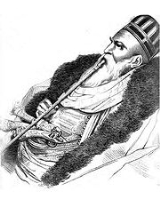
Ali Pasha

Encyclopedia
Ali Pasha of Tepelena or of Yannina, surnamed Aslan, "the Lion", or the "Lion of Yannina", Ali Pashë Tepelena (1740 – January 24, 1822) was an Ottoman
Albanian
ruler (pasha
) of the western part of Rumelia
, the Ottoman Empire's Europe
an territory which was also called Pashalik of Yanina. His court was in Ioannina
. Ali had three sons: Ahmet Muhtar Pasha (served in the 1809 war against the Russians), Veli Pasha of Morea
and Salih Pasha of Vlore
. Ali Pasha of Tepelena died on February 5, 1822 at the age of 82.
: Ali Pashë Tepelenjoti; Aromanian
: Ali Pãshelu; Greek
: Αλή Πασάς Τεπελενλής Ali Pasas Tepelenlis or Αλή Πασάς των Ιωαννίνων Ali Pasas ton Ioanninon (Ali Pasha of Ioannina
); and Turkish
: Tepedelenli Ali Paşa.
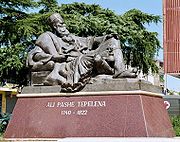 Ali was born in 1740 into a powerful clan in the village Beçisht, at the foot of the Këlcyrë
mountains near the Albanian town of Tepelenë
. He was one of the Tosk tribes and his ancestors had for some time held the hereditary office of bey
of Tepeleni. His father Veli was bey
(and possibly a retired Janissary
).
About his origin, Robert Elsie
, an expert in Albanian culture and affairs, states that he was born of a Turkish family from Anatolia
. However, this has been refuted since it was proven that his family originated from southern Albania. According to other sources Ali Pasha was a "Liapis", that is, from one of the minor Albanian tribes. As this tribe was in disrepute among the other Albanians for their poverty and predatory habits, he thought it proper to call himelf after Tepeleni, a town of the Tosks. No one dared to dispute this until after his death
Ali's father, Veli Bey, was murdered when Ali was fourteen years old by rival neighbouring chiefs who seized the territories of his Tosk tribe. The family lost much of its political and material status following the murder of his father. In 1758, his mother, Hanko, a woman of extraordinary character, thereupon herself formed and led a brigand band, and studied to inspire the boy with her own fierce and indomitable temper, with a view to revenge and the recovery of their lost wealth. According to Byron: "Ali inherited 6 dram
and a musket
after the death of his father...Ali collected a few followers from among the retainers of his father, made himself master, first of one village, then of another, amassed money, increased his power, and at last found himself at the head of a considerable body of Albanians".
Ali became a famous brigand leader and attracted the attention of the Turkish authorities. He was assigned to suppress brigandage and highway robbery and always in the field fought for the "Sultan
and Empire
" with great bravery, particularly against the famous rebel Pazvantoğlu
. He aided the pasha of Negroponte (Euboea
) in putting down a rebellion at Shkodër
, it was during this period that he was introduced to the Janissary units and was inspired by their discipline. In 1768 he married the daughter of the wealthy pasha of Delvina, with whom he entered an alliance.
His rise through Ottoman ranks continued with his appointment as lieutenant to the pasha of Rumelia
. In 1787 he was awarded the pashaluk
of Trikala
in reward for his services at Banat
during the Austro-Turkish War (1787–1791). In 1788 he seized control of Ioannina
, and enlisted most of the Brigands under his own banner. Ioannina would be his power base for the next 33 years. He took advantage of a weak Ottoman government to expand his territory still further until he gained control of most of Albania, western Greece and the Peloponnese
.
During war-time, Ali Pasha could assemble an army of 50,000 men in a matter of two to three days, and could double that number in two to three weeks. Leading these armed forces was the Supreme Council. Commander in Chief of this Council was the founder and financier, Ali Pasha. Members of the Council included Myftar Pasha, Veli Pasha, Xheladin bej Ohri, Abdullah Pashe Taushani and a number of his trusted men like Hasan Dervishi, Halil Patrona, Omar Vrioni, Meço Bono, Ago Myhyrdari, Thanasis Vagias
, Veli Gega (murdered by Katsantonis), and Tahir Abazi.
Among many acclaimed personalities Ali Pasha was dubbed the "Mahometan Buonaparte".
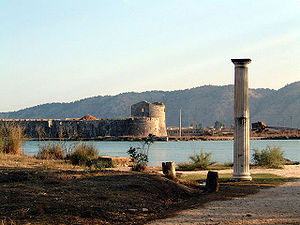
During the early days of his rule he was personally known for his alertness, he soon became a well known Albanian Muslim figure he also commanded one of the largest battalions of Albanian
Janissaries, his servicemen also included men such as Samson Cerfberr of Medelsheim
. Ali Pasha adhered to the Sufi Order of the Bektashi
Brotherhood. Ali Pasha was also known to have fasted during the month of Ramadan
.
Ali's policy as ruler of Ioánnina was mostly governed by expediency; he operated as a semi-independent despot and pragmatically allied himself with whoever offered the most advantage at the time. In fact, it was Ali Pasha and his Albanian soldiers and mercenaries who subdued the independent Souli
.
Ali Pasha wanted to establish in the Mediterranean a sea-power which should rival that of the dey
of Algiers
. In order to gain a seaport on the Albanian coast that was dominated by Venice
, Ali Pasha formed an alliance with Napoleon I of France
who had established François Pouqueville
as his general consul in Ioannina, with the complete consent of the Ottoman
Sultan
Selim III
.
After the Treaty of Tilsit, where Napoleon granted the Czar his plan to dismantle the Ottoman Empire, Ali switched sides and allied with the Britain
in 1807, a detailed account of his alliance with the British was written by Sir Richard Church. His actions were permitted by the Ottoman government in Constantinople
for a mixture of expediency—it was deemed better to have Ali as a semi-ally than as an enemy—and weakness, as the central government did not have an agenda to oust him at that time.
The poet George Gordon Byron, 6th Baron Byron
visited Ali's court in Ioánnina in 1809 and recorded the encounter in his work Childe Harold. He evidently had mixed feelings about the despot, noting the splendor of Ali's court and the Greek cultural revival that he had encouraged in Ioánnina, which Byron described as being "superior in wealth, refinement and learning" to any other Greek town.
In a letter to his mother, however, Byron deplored Ali's cruelty: "His Highness is a remorseless tyrant, guilty of the most horrible cruelties, very brave, so good a general that they call him the Mahometan Buonaparte ... but as barbarous as he is successful, roasting rebels, etc, etc.."
Different tales about his sexual orientation
emerged from western visitors to Pasha's court (including Byron, the Baron de Vaudoncourt, and Frederick North, Earl of Guildford
). These documenters wrote that he kept a large harem
of both men as well as women. Such accounts may reflect the Orientalist
imagination of Europe and underplay the historical role of Pasha rather than telling us anything necessarily definitive about his sexuality.
Ali Pasha, according to one opinion, "was a cruel and faithless tyrant; still he was not a Turk, but an Albanian; he was a rebel against the Sultan (Mahmud II
), and he was so far an indirect friend of the Sultan's enemies". Throughout his rule he is known to have maintained close relations and corresponded with famous leaders such as Husein Gradaščević
, Ibrahim Bushati
, Mehmet Ali Pasha and Ibrahim Pasha
.
Though certainly no friend to the Greek Nationalists (he had personally ordered the painful execution of the Klepht Katsantonis), however his rule brought relative stability it was only after his forceful deposition that the people of Greece objected the rule of Sultan Mahmud II
and the newly appointed Hursid Pasha
and thus began the Greek War of Independence
.
Ali Pasha was using Greek almost as his official language, and over the gate of his castle in Yannina there was an inscription in Greek in which he claimed descent from King Pyrrhus of Epirus.
A long epic poem known as the Alipashiad
consists of more than 10.000 lines is dedicated to the exploits of Ali Pasha. The Alipashiad
was composed by Haxhi Shekreti, an Albanian
Muslim
from Delvino and was written entirely in Greek.
he used Greek
for all his courtly dealings since the population of the region he controlled was predominantly Greek
speaking. As a consequence, a part of the local Greek population showed sympathy towards his rule. This also activated new educational opportunities, with businessmen of the Greek diaspora
, subsidizing a number of new educational purposes. As historian Douglas Dakin notes:
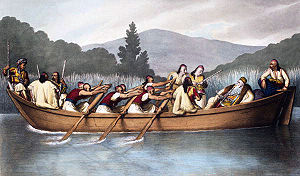 The cruelties inflicted by Ali Pasha on his subjects became notorious throughout the region, and have been described in local folksong and poetry. Forty years after the inhabitants of Gardhiq and Hormova, Albania, had wronged his mother after murdering his father Veli Bey (according to the story, she was tied and put in prison and, with her daughter, raped and tortured every night by another group of men), Ali wrought revenge by having 739 male descendants of the original offenders executed.
In 1808, Mühürdar a commanding Janissary of Ali Pasha captured one of his most renowned opponents, the Greek klepht
Katsantonis, who was executed in public by having his bones broken with a sledgehammer. One of Ali's notorious crimes was the massive murder of arbitrarily chosen young Greek girls of Ioannina. They were unfoundly sentenced as adulteresses, tied up in sacks and drowned in Lake Pamvotis. Oral Aromanian tradition (songs) tells about the cruelty of Ali Pasha's troops.
In Αt 1798 Ali's troops attacked the coastal town of Preveza
, which was defended by French troops and local Greeks. When the town was finally conquered a major slaughter occurred against the local people as retaliation for their resistance. Moreover, in the early nineteenth century his troops completed the destruction of the once prosperous cultural center of Moscopole
, in modern southeastern Albania, and led its Aromanian
population to flee from the region.
brought to the attention of Sultan Mahmud II
issues conspicuously related to Ali pasha; Halet Efendi
accused Ali Pasha of grabbing power and influence in Ottoman Rumelia
away from the Sublime Porte. In 1820, Ali Pasha, after long tensions with the Turkish Reforms
, allegedly ordered the assassination of Gaskho Bey, a political opponent in Istanbul
; Sultan Mahmud II
, who sought to restore the authority of the Sublime Porte, took this as a major opportunity to move against Ali Pasha by ordering his immediate deposition.
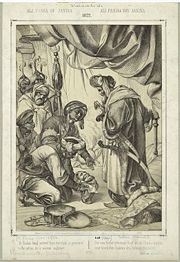
.jpg) Ali Pasha refused to resign his official post and put up a fierce resistance to the Sultan's troop movements, as some 20,000 Turkish troops led by Hursid Pasha
Ali Pasha refused to resign his official post and put up a fierce resistance to the Sultan's troop movements, as some 20,000 Turkish troops led by Hursid Pasha
were fighting Ali Pasha's small but formidable army. Most of his followers abandoned him without fighting and fled, including Androutsos
and his sons Veli and Muhtar, or passed to the Ottoman army, such as Omer Vrioni and Alexis Noutsos, who went unopposed to Ioannina, which was besieged from september 1820.
On December 4, 1820, Ali Pasha and the Souliotes
formed an anti-Ottoman coalition, to which the Souliotes contributed 3,000 soldiers. Ali Pasha gained the support of the Souliotes mainly because he offered to allow the return of the Souliotes to their land, and partly by appeal to their shared Albanian origin. Initially, the coalition was successful and managed to control most of the region, but when the Muslim Albanian troops of Ali Pasha were informed of the beginning of the Greek revolts in the Morea, it was terminated.
Ali's rebellion against the Sublime Porte increased the value of the Greek military element since their services were sought by the Porte as well. He is said to have contracted the services of the Klephts and Souliots in exile in the Ionian Islands
as well as the armatoles under his command. However he feared that the Klephts might rout him before the arrival of the Ottoman Turks.
After about two years of fighting, in January 1822, Ottoman forces had taken most of the fortifications of Ioannina except the fortified palace inside the kastro. Ali Pasha opened negotiations. Deceived with offers of a full pardon, he was persuaded to leave the fortress and settle in the Monastery of St Panteleimon on the island in Lake Pamvotis, previously taken by the Ottoman army during the siege. When asked to surrender for beheading, he famously proclaimed, "My head ... will not be surrendered like the head of a slave," and kept fighting till the end, but was shot through the floor of his room and his head cut off to be sent to the Sultan. Ali Pasha of Tepelena died on February 5, 1822 at the age of 80.
Ali Pasha was buried with full honors in a mausoleum next to the Fethiye Mosque
, which still stands. Despite his brutal rule, villagers paid their last respect to Ali: "Never was seen greater mourning than that of the warlike Epirotes."
The former monastery in which Ali Pasha was killed is today a popular tourist attraction. The holes made by the bullets can still be seen, and the monastery has a museum dedicated to him, which includes a number of his personal possessions.
eer, Haxhi Shekreti, composed the poem Alipashiad
. The poem was written in Greek language
, since the author considered it a more prestigious language in which to praise his master. Alipashiad bears the unusual feature to be written from the Muslim point of view of that time.
In the novel The Count of Monte Cristo
by Alexandre Dumas, père
, Ali Pasha's downfall was brought about by the treachery of Fernand Mondego, an officer in the French Army. Not knowing of the betrayal, Pasha entrusted his wife and daughter to Mondego for safekeeping but he sold them into slavery. Monte Cristo subsequently located the daughter, Haydée
, and helped her take revenge on Mondego by testifying in Paris of his betrayal of Ali Pasha.
Ali Pasha is also a major character in the 1854 Mór Jókai
's Hungarian novel Janicsárok végnapjai ("The Last Days of the Janissaries"), translated into English by R. Nisbet Bain, 1897, under the title The Lion of Janina.
Ali Pasha and Hursid Pasha
are the main characters in Ismail Kadare
's historic novel The Niche of Shame (original title "El Nicho De La Vergüenza").
Many of the conflicting versions about the origin of the "Spoonmaker's Diamond
", a major treasure of the Topkapi Palace
in Istanbul, link it with Ali Pasha - though their historical authenticity is doubtful.
Ottoman Empire
The Ottoman EmpireIt was usually referred to as the "Ottoman Empire", the "Turkish Empire", the "Ottoman Caliphate" or more commonly "Turkey" by its contemporaries...
Albanian
Albanians
Albanians are a nation and ethnic group native to Albania and neighbouring countries. They speak the Albanian language. More than half of all Albanians live in Albania and Kosovo...
ruler (pasha
Pasha
Pasha or pascha, formerly bashaw, was a high rank in the Ottoman Empire political system, typically granted to governors, generals and dignitaries. As an honorary title, Pasha, in one of its various ranks, is equivalent to the British title of Lord, and was also one of the highest titles in...
) of the western part of Rumelia
Rumelia
Rumelia was an historical region comprising the territories of the Ottoman Empire in Europe...
, the Ottoman Empire's Europe
Europe
Europe is, by convention, one of the world's seven continents. Comprising the westernmost peninsula of Eurasia, Europe is generally 'divided' from Asia to its east by the watershed divides of the Ural and Caucasus Mountains, the Ural River, the Caspian and Black Seas, and the waterways connecting...
an territory which was also called Pashalik of Yanina. His court was in Ioannina
Ioannina
Ioannina , often called Jannena within Greece, is the largest city of Epirus, north-western Greece, with a population of 70,203 . It lies at an elevation of approximately 500 meters above sea level, on the western shore of lake Pamvotis . It is located within the Ioannina municipality, and is the...
. Ali had three sons: Ahmet Muhtar Pasha (served in the 1809 war against the Russians), Veli Pasha of Morea
Morea
The Morea was the name of the Peloponnese peninsula in southern Greece during the Middle Ages and the early modern period. It also referred to a Byzantine province in the region, known as the Despotate of Morea.-Origins of the name:...
and Salih Pasha of Vlore
Vlorë
Vlorë is one of the biggest towns and the second largest port city of Albania, after Durrës, with a population of about 94,000 . It is the city where the Albanian Declaration of Independence was proclaimed on November 28, 1912...
. Ali Pasha of Tepelena died on February 5, 1822 at the age of 82.
Name
His name in the local languages was: AlbanianAlbanian language
Albanian is an Indo-European language spoken by approximately 7.6 million people, primarily in Albania and Kosovo but also in other areas of the Balkans in which there is an Albanian population, including western Macedonia, southern Montenegro, southern Serbia and northwestern Greece...
: Ali Pashë Tepelenjoti; Aromanian
Aromanian language
Aromanian , also known as Macedo-Romanian, Arumanian or Vlach is an Eastern Romance language spoken in Southeastern Europe...
: Ali Pãshelu; Greek
Greek language
Greek is an independent branch of the Indo-European family of languages. Native to the southern Balkans, it has the longest documented history of any Indo-European language, spanning 34 centuries of written records. Its writing system has been the Greek alphabet for the majority of its history;...
: Αλή Πασάς Τεπελενλής Ali Pasas Tepelenlis or Αλή Πασάς των Ιωαννίνων Ali Pasas ton Ioanninon (Ali Pasha of Ioannina
Ioannina
Ioannina , often called Jannena within Greece, is the largest city of Epirus, north-western Greece, with a population of 70,203 . It lies at an elevation of approximately 500 meters above sea level, on the western shore of lake Pamvotis . It is located within the Ioannina municipality, and is the...
); and Turkish
Turkish language
Turkish is a language spoken as a native language by over 83 million people worldwide, making it the most commonly spoken of the Turkic languages. Its speakers are located predominantly in Turkey and Northern Cyprus with smaller groups in Iraq, Greece, Bulgaria, the Republic of Macedonia, Kosovo,...
: Tepedelenli Ali Paşa.
Early years
Këlcyrë
Këlcyrë is a municipality in the Përmet District, southern Albania, located on the bank of the river Vjosë. The municipality consists of the town Këlcyrë and the villages Fshat Këlcyrë, Mbrezhdan, Maleshovë, Limar, Leskaj and Kala...
mountains near the Albanian town of Tepelenë
Tepelenë (town)
Tepelenë is the principal settlement in the eponymous Tepelenë District of southern Albania. It is located on the left bank of the Vjosë river, about three kilometres downstream from its union with the Drino....
. He was one of the Tosk tribes and his ancestors had for some time held the hereditary office of bey
Bey
Bey is a title for chieftain, traditionally applied to the leaders of small tribal groups. Accoding to some sources, the word "Bey" is of Turkish language In historical accounts, many Turkish, other Turkic and Persian leaders are titled Bey, Beg, Bek, Bay, Baig or Beigh. They are all the same word...
of Tepeleni. His father Veli was bey
Bey
Bey is a title for chieftain, traditionally applied to the leaders of small tribal groups. Accoding to some sources, the word "Bey" is of Turkish language In historical accounts, many Turkish, other Turkic and Persian leaders are titled Bey, Beg, Bek, Bay, Baig or Beigh. They are all the same word...
(and possibly a retired Janissary
Janissary
The Janissaries were infantry units that formed the Ottoman sultan's household troops and bodyguards...
).
About his origin, Robert Elsie
Robert Elsie
Robert Elsie is a scholar who specializes in Albanian literature and folklore.- Life :Born on June 29, 1950 Vancouver, British Columbia, Canada Elsie studied at the University of British Columbia, graduating in 1972 with a diploma in Classical Studies and Linguistics...
, an expert in Albanian culture and affairs, states that he was born of a Turkish family from Anatolia
Anatolia
Anatolia is a geographic and historical term denoting the westernmost protrusion of Asia, comprising the majority of the Republic of Turkey...
. However, this has been refuted since it was proven that his family originated from southern Albania. According to other sources Ali Pasha was a "Liapis", that is, from one of the minor Albanian tribes. As this tribe was in disrepute among the other Albanians for their poverty and predatory habits, he thought it proper to call himelf after Tepeleni, a town of the Tosks. No one dared to dispute this until after his death
Ali's father, Veli Bey, was murdered when Ali was fourteen years old by rival neighbouring chiefs who seized the territories of his Tosk tribe. The family lost much of its political and material status following the murder of his father. In 1758, his mother, Hanko, a woman of extraordinary character, thereupon herself formed and led a brigand band, and studied to inspire the boy with her own fierce and indomitable temper, with a view to revenge and the recovery of their lost wealth. According to Byron: "Ali inherited 6 dram
Dirham
Dirham or dirhem is a unit of currency in several Arab or Berber nations, and formerly the related unit of mass in the Ottoman Empire and Persian states...
and a musket
Musket
A musket is a muzzle-loaded, smooth bore long gun, fired from the shoulder. Muskets were designed for use by infantry. A soldier armed with a musket had the designation musketman or musketeer....
after the death of his father...Ali collected a few followers from among the retainers of his father, made himself master, first of one village, then of another, amassed money, increased his power, and at last found himself at the head of a considerable body of Albanians".
Ali became a famous brigand leader and attracted the attention of the Turkish authorities. He was assigned to suppress brigandage and highway robbery and always in the field fought for the "Sultan
Sultan
Sultan is a title with several historical meanings. Originally, it was an Arabic language abstract noun meaning "strength", "authority", "rulership", and "dictatorship", derived from the masdar سلطة , meaning "authority" or "power". Later, it came to be used as the title of certain rulers who...
and Empire
Ottoman Empire
The Ottoman EmpireIt was usually referred to as the "Ottoman Empire", the "Turkish Empire", the "Ottoman Caliphate" or more commonly "Turkey" by its contemporaries...
" with great bravery, particularly against the famous rebel Pazvantoğlu
Osman Pazvantoglu
Osman Pazvantoğlu was a Bosnian Ottoman soldier, a governor of the Vidin district after 1794, and a rebel against Ottoman rule...
. He aided the pasha of Negroponte (Euboea
Euboea
Euboea is the second largest Greek island in area and population, after Crete. The narrow Euripus Strait separates it from Boeotia in mainland Greece. In general outline it is a long and narrow, seahorse-shaped island; it is about long, and varies in breadth from to...
) in putting down a rebellion at Shkodër
Shkodër
Shkodër , is a city located on Lake of Shkoder in northwestern Albania in the District of Shkodër, of which it is the capital. It is one of the oldest and most historic towns in Albania, as well as an important cultural and economic centre. Shkodër's estimated population is 90,000; if the...
, it was during this period that he was introduced to the Janissary units and was inspired by their discipline. In 1768 he married the daughter of the wealthy pasha of Delvina, with whom he entered an alliance.
His rise through Ottoman ranks continued with his appointment as lieutenant to the pasha of Rumelia
Rumelia
Rumelia was an historical region comprising the territories of the Ottoman Empire in Europe...
. In 1787 he was awarded the pashaluk
Pashaluk
Pashaluk or Pashalik is a term for one type of the Subdivisions of the Ottoman Empire.It is the abstract word derived from pasha, denoting the quality, office or jurisdiction of a pasha or the territory administered by him....
of Trikala
Trikala
Trikala is a city in northwestern Thessaly, Greece. It is the capital of the Trikala peripheral unit, and is located NW of Athens, NW, of Karditsa, E of Ioannina and Metsovo, S of Grevena, SW of Thessaloniki, and W of Larissa...
in reward for his services at Banat
Banat
The Banat is a geographical and historical region in Central Europe currently divided between three countries: the eastern part lies in western Romania , the western part in northeastern Serbia , and a small...
during the Austro-Turkish War (1787–1791). In 1788 he seized control of Ioannina
Ioannina
Ioannina , often called Jannena within Greece, is the largest city of Epirus, north-western Greece, with a population of 70,203 . It lies at an elevation of approximately 500 meters above sea level, on the western shore of lake Pamvotis . It is located within the Ioannina municipality, and is the...
, and enlisted most of the Brigands under his own banner. Ioannina would be his power base for the next 33 years. He took advantage of a weak Ottoman government to expand his territory still further until he gained control of most of Albania, western Greece and the Peloponnese
Peloponnese
The Peloponnese, Peloponnesos or Peloponnesus , is a large peninsula , located in a region of southern Greece, forming the part of the country south of the Gulf of Corinth...
.
During war-time, Ali Pasha could assemble an army of 50,000 men in a matter of two to three days, and could double that number in two to three weeks. Leading these armed forces was the Supreme Council. Commander in Chief of this Council was the founder and financier, Ali Pasha. Members of the Council included Myftar Pasha, Veli Pasha, Xheladin bej Ohri, Abdullah Pashe Taushani and a number of his trusted men like Hasan Dervishi, Halil Patrona, Omar Vrioni, Meço Bono, Ago Myhyrdari, Thanasis Vagias
Thanasis Vagias
Thanasis Vagias was a Greek counselor and confidant of Ali Pasha, a Muslim Albanian ruler of Ottoman Epirus. Vagias was born in Lekël, Tepelenë. His name had become notorious because, under Ali's service, he led an attack against the village of Kardhiq, near Gjirokaster, modern southern Albania....
, Veli Gega (murdered by Katsantonis), and Tahir Abazi.
Among many acclaimed personalities Ali Pasha was dubbed the "Mahometan Buonaparte".
Ali Pasha as ruler
During the early days of his rule he was personally known for his alertness, he soon became a well known Albanian Muslim figure he also commanded one of the largest battalions of Albanian
Albanians
Albanians are a nation and ethnic group native to Albania and neighbouring countries. They speak the Albanian language. More than half of all Albanians live in Albania and Kosovo...
Janissaries, his servicemen also included men such as Samson Cerfberr of Medelsheim
Samson Cerfberr of Medelsheim
Samson Cerfberr of Medelsheim was a French soldier and author.He led an erratic and adventurous life, wandering over the world, changing his name and even his religion several times...
. Ali Pasha adhered to the Sufi Order of the Bektashi
Bektashi
Bektashi Order or Bektashism is an Islamic Sufi order founded in the 13th century by the Persian saint Haji Bektash Veli. In addition to the spiritual teachings of Haji Bektash Veli the order was significantly influenced during its formative period by both the Hurufis as well as the...
Brotherhood. Ali Pasha was also known to have fasted during the month of Ramadan
Ramadan
Ramadan is the ninth month of the Islamic calendar, which lasts 29 or 30 days. It is the Islamic month of fasting, in which participating Muslims refrain from eating, drinking, smoking and sex during daylight hours and is intended to teach Muslims about patience, spirituality, humility and...
.
Ali's policy as ruler of Ioánnina was mostly governed by expediency; he operated as a semi-independent despot and pragmatically allied himself with whoever offered the most advantage at the time. In fact, it was Ali Pasha and his Albanian soldiers and mercenaries who subdued the independent Souli
Souli
Souli is a municipality in Epirus, northwestern Greece. It was originally settled by both Greek and Albanian refugees who were hunted by the Ottomans in Thesprotia, Greece and Laberia, Albania. In early modern times, it was inhabited by about 12,000 Souliotes. After their expulsion the population...
.
Ali Pasha wanted to establish in the Mediterranean a sea-power which should rival that of the dey
Dey
Dey was the title given to the rulers of the Regency of Algiers and Tripoli under the Ottoman Empire from 1671 onwards...
of Algiers
Algiers
' is the capital and largest city of Algeria. According to the 1998 census, the population of the city proper was 1,519,570 and that of the urban agglomeration was 2,135,630. In 2009, the population was about 3,500,000...
. In order to gain a seaport on the Albanian coast that was dominated by Venice
Venice
Venice is a city in northern Italy which is renowned for the beauty of its setting, its architecture and its artworks. It is the capital of the Veneto region...
, Ali Pasha formed an alliance with Napoleon I of France
Napoleon I of France
Napoleon Bonaparte was a French military and political leader during the latter stages of the French Revolution.As Napoleon I, he was Emperor of the French from 1804 to 1815...
who had established François Pouqueville
Francois Pouqueville
François Charles Hugues Laurent Pouqueville was a French diplomat, writer, explorer, physician and historian, member of the ....
as his general consul in Ioannina, with the complete consent of the Ottoman
Ottoman Empire
The Ottoman EmpireIt was usually referred to as the "Ottoman Empire", the "Turkish Empire", the "Ottoman Caliphate" or more commonly "Turkey" by its contemporaries...
Sultan
Sultan
Sultan is a title with several historical meanings. Originally, it was an Arabic language abstract noun meaning "strength", "authority", "rulership", and "dictatorship", derived from the masdar سلطة , meaning "authority" or "power". Later, it came to be used as the title of certain rulers who...
Selim III
Selim III
Selim III was the reform-minded Sultan of the Ottoman Empire from 1789 to 1807. The Janissaries eventually deposed and imprisoned him, and placed his cousin Mustafa on the throne as Mustafa IV...
.
After the Treaty of Tilsit, where Napoleon granted the Czar his plan to dismantle the Ottoman Empire, Ali switched sides and allied with the Britain
United Kingdom of Great Britain and Ireland
The United Kingdom of Great Britain and Ireland was the formal name of the United Kingdom during the period when what is now the Republic of Ireland formed a part of it....
in 1807, a detailed account of his alliance with the British was written by Sir Richard Church. His actions were permitted by the Ottoman government in Constantinople
Constantinople
Constantinople was the capital of the Roman, Eastern Roman, Byzantine, Latin, and Ottoman Empires. Throughout most of the Middle Ages, Constantinople was Europe's largest and wealthiest city.-Names:...
for a mixture of expediency—it was deemed better to have Ali as a semi-ally than as an enemy—and weakness, as the central government did not have an agenda to oust him at that time.
The poet George Gordon Byron, 6th Baron Byron
George Gordon Byron, 6th Baron Byron
George Gordon Byron, 6th Baron Byron, later George Gordon Noel, 6th Baron Byron, FRS , commonly known simply as Lord Byron, was a British poet and a leading figure in the Romantic movement...
visited Ali's court in Ioánnina in 1809 and recorded the encounter in his work Childe Harold. He evidently had mixed feelings about the despot, noting the splendor of Ali's court and the Greek cultural revival that he had encouraged in Ioánnina, which Byron described as being "superior in wealth, refinement and learning" to any other Greek town.
In a letter to his mother, however, Byron deplored Ali's cruelty: "His Highness is a remorseless tyrant, guilty of the most horrible cruelties, very brave, so good a general that they call him the Mahometan Buonaparte ... but as barbarous as he is successful, roasting rebels, etc, etc.."
Different tales about his sexual orientation
Sexual orientation
Sexual orientation describes a pattern of emotional, romantic, or sexual attractions to the opposite sex, the same sex, both, or neither, and the genders that accompany them. By the convention of organized researchers, these attractions are subsumed under heterosexuality, homosexuality,...
emerged from western visitors to Pasha's court (including Byron, the Baron de Vaudoncourt, and Frederick North, Earl of Guildford
Frederick North, Lord North
Frederick North, 2nd Earl of Guilford, KG, PC , more often known by his courtesy title, Lord North, which he used from 1752 until 1790, was Prime Minister of Great Britain from 1770 to 1782. He led Great Britain through most of the American War of Independence...
). These documenters wrote that he kept a large harem
Harem
Harem refers to the sphere of women in what is usually a polygynous household and their enclosed quarters which are forbidden to men...
of both men as well as women. Such accounts may reflect the Orientalist
Orientalism
Orientalism is a term used for the imitation or depiction of aspects of Eastern cultures in the West by writers, designers and artists, as well as having other meanings...
imagination of Europe and underplay the historical role of Pasha rather than telling us anything necessarily definitive about his sexuality.
Ali Pasha, according to one opinion, "was a cruel and faithless tyrant; still he was not a Turk, but an Albanian; he was a rebel against the Sultan (Mahmud II
Mahmud II
Mahmud II was the 30th Sultan of the Ottoman Empire from 1808 until his death in 1839. He was born in the Topkapi Palace, Istanbul, the son of Sultan Abdulhamid I...
), and he was so far an indirect friend of the Sultan's enemies". Throughout his rule he is known to have maintained close relations and corresponded with famous leaders such as Husein Gradaščević
Husein Gradašcevic
Husein-kapetan Gradaščević was a Bosnian Muslim general who fought for Bosnian autonomy in the Ottoman Empire. He is often referred to as "Zmaj od Bosne", meaning "Dragon of Bosnia"...
, Ibrahim Bushati
Ibrahim Bushati
Ibrahim Bushati or Ibrahim Bushat Pasha was a noble of the Bushati family in Ottoman controlled Albania near the city of Shkodër...
, Mehmet Ali Pasha and Ibrahim Pasha
Ibrahim Pasha of Egypt
Ibrahim Pasha was the eldest son of Muhammad Ali, the Wāli and unrecognised Khedive of Egypt and Sudan. He served as a general in the Egyptian army that his father established during his reign, taking his first command of Egyptian forces was when he was merely a teenager...
.
Though certainly no friend to the Greek Nationalists (he had personally ordered the painful execution of the Klepht Katsantonis), however his rule brought relative stability it was only after his forceful deposition that the people of Greece objected the rule of Sultan Mahmud II
Mahmud II
Mahmud II was the 30th Sultan of the Ottoman Empire from 1808 until his death in 1839. He was born in the Topkapi Palace, Istanbul, the son of Sultan Abdulhamid I...
and the newly appointed Hursid Pasha
Hursid Pasha
Hurşid Ahmed Pasha was an Ottoman General and Grand Vizier during the early 19th century. He was of Georgian descent.- Early life :...
and thus began the Greek War of Independence
Greek War of Independence
The Greek War of Independence, also known as the Greek Revolution was a successful war of independence waged by the Greek revolutionaries between...
.
Ali Pasha was using Greek almost as his official language, and over the gate of his castle in Yannina there was an inscription in Greek in which he claimed descent from King Pyrrhus of Epirus.
A long epic poem known as the Alipashiad
Alipashiad
The Alipashiad or Alipashias is a Greek epic poem, written in early 19th century by the Muslim Albanian Haxhi Shehreti. The work is inspired by and named after Ali Pasha, the Ottoman lord of Ioannina, Epirus, describing, in heroic style, his life and military campaigns.-Background and historical...
consists of more than 10.000 lines is dedicated to the exploits of Ali Pasha. The Alipashiad
Alipashiad
The Alipashiad or Alipashias is a Greek epic poem, written in early 19th century by the Muslim Albanian Haxhi Shehreti. The work is inspired by and named after Ali Pasha, the Ottoman lord of Ioannina, Epirus, describing, in heroic style, his life and military campaigns.-Background and historical...
was composed by Haxhi Shekreti, an Albanian
Albanians
Albanians are a nation and ethnic group native to Albania and neighbouring countries. They speak the Albanian language. More than half of all Albanians live in Albania and Kosovo...
Muslim
Muslim
A Muslim, also spelled Moslem, is an adherent of Islam, a monotheistic, Abrahamic religion based on the Quran, which Muslims consider the verbatim word of God as revealed to prophet Muhammad. "Muslim" is the Arabic term for "submitter" .Muslims believe that God is one and incomparable...
from Delvino and was written entirely in Greek.
Impact on modern Greek Enlightenment
Although Ali Pasha's native language was AlbanianAlbanian language
Albanian is an Indo-European language spoken by approximately 7.6 million people, primarily in Albania and Kosovo but also in other areas of the Balkans in which there is an Albanian population, including western Macedonia, southern Montenegro, southern Serbia and northwestern Greece...
he used Greek
Greek language
Greek is an independent branch of the Indo-European family of languages. Native to the southern Balkans, it has the longest documented history of any Indo-European language, spanning 34 centuries of written records. Its writing system has been the Greek alphabet for the majority of its history;...
for all his courtly dealings since the population of the region he controlled was predominantly Greek
Greeks
The Greeks, also known as the Hellenes , are a nation and ethnic group native to Greece, Cyprus and neighboring regions. They also form a significant diaspora, with Greek communities established around the world....
speaking. As a consequence, a part of the local Greek population showed sympathy towards his rule. This also activated new educational opportunities, with businessmen of the Greek diaspora
Greek diaspora
The Greek diaspora, also known as Hellenic Diaspora or Diaspora of Hellenism, is a term used to refer to the communities of Greek people living outside the traditional Greek homelands, but more commonly in southeast Europe and Asia Minor...
, subsidizing a number of new educational purposes. As historian Douglas Dakin notes:
Atrocities
In 1808, Mühürdar a commanding Janissary of Ali Pasha captured one of his most renowned opponents, the Greek klepht
Klepht
Klephts were self-appointed armatoloi, anti-Ottoman insurgents, and warlike mountain-folk who lived in the countryside when Greece was a part of the Ottoman Empire...
Katsantonis, who was executed in public by having his bones broken with a sledgehammer. One of Ali's notorious crimes was the massive murder of arbitrarily chosen young Greek girls of Ioannina. They were unfoundly sentenced as adulteresses, tied up in sacks and drowned in Lake Pamvotis. Oral Aromanian tradition (songs) tells about the cruelty of Ali Pasha's troops.
In Αt 1798 Ali's troops attacked the coastal town of Preveza
Preveza
Preveza is a town in the region of Epirus, northwestern Greece, located at the mouth of the Ambracian Gulf. It is the capital of the regional unit of Preveza, which is part of the region of Epirus. An immersed tunnel, completed in 2002 which runs between Preveza and Actium, connects the town...
, which was defended by French troops and local Greeks. When the town was finally conquered a major slaughter occurred against the local people as retaliation for their resistance. Moreover, in the early nineteenth century his troops completed the destruction of the once prosperous cultural center of Moscopole
Moscopole
Moscopole was a cultural and commercial center of the Aromanians, and now a small municipality in Korçë District, modern southeastern Albania. At its peak, in the mid 18th century, it hosted the first printing press in the Balkans outside Istanbul, educational institutions and numerous churches...
, in modern southeastern Albania, and led its Aromanian
Aromanians
Aromanians are a Latin people native throughout the southern Balkans, especially in northern Greece, Albania, the Republic of Macedonia, Bulgaria, and as an emigrant community in Serbia and Romania . An older term is Macedo-Romanians...
population to flee from the region.
Downfall
In 1819, Halet EfendiHalet Efendi
Mohamed-Sayd Halet Effendi was a Ottoman Empire Foreign Minister and ambassador to Paris from 1802 to 1806. He was still ambassador to the court of Napoleon I in 1806...
brought to the attention of Sultan Mahmud II
Mahmud II
Mahmud II was the 30th Sultan of the Ottoman Empire from 1808 until his death in 1839. He was born in the Topkapi Palace, Istanbul, the son of Sultan Abdulhamid I...
issues conspicuously related to Ali pasha; Halet Efendi
Halet Efendi
Mohamed-Sayd Halet Effendi was a Ottoman Empire Foreign Minister and ambassador to Paris from 1802 to 1806. He was still ambassador to the court of Napoleon I in 1806...
accused Ali Pasha of grabbing power and influence in Ottoman Rumelia
Rumelia
Rumelia was an historical region comprising the territories of the Ottoman Empire in Europe...
away from the Sublime Porte. In 1820, Ali Pasha, after long tensions with the Turkish Reforms
Ottoman military reform efforts
Ottoman military reform efforts began after the Belle Époque of European civilization. Ottoman military reforms follow the empire's transformation to become a modern country. It followed the same period only a couple decade later of Russia's reforms, and Japan's opening of its doors to west during...
, allegedly ordered the assassination of Gaskho Bey, a political opponent in Istanbul
Istanbul
Istanbul , historically known as Byzantium and Constantinople , is the largest city of Turkey. Istanbul metropolitan province had 13.26 million people living in it as of December, 2010, which is 18% of Turkey's population and the 3rd largest metropolitan area in Europe after London and...
; Sultan Mahmud II
Mahmud II
Mahmud II was the 30th Sultan of the Ottoman Empire from 1808 until his death in 1839. He was born in the Topkapi Palace, Istanbul, the son of Sultan Abdulhamid I...
, who sought to restore the authority of the Sublime Porte, took this as a major opportunity to move against Ali Pasha by ordering his immediate deposition.
Hursid Pasha
Hurşid Ahmed Pasha was an Ottoman General and Grand Vizier during the early 19th century. He was of Georgian descent.- Early life :...
were fighting Ali Pasha's small but formidable army. Most of his followers abandoned him without fighting and fled, including Androutsos
Odysseas Androutsos
Odysseas Androutsos ; was a hero of the Greek War of Independence.-Early life:He was born in Ithaca in 1788, however his family was from the village of Livanates in Phthiotis prefecture...
and his sons Veli and Muhtar, or passed to the Ottoman army, such as Omer Vrioni and Alexis Noutsos, who went unopposed to Ioannina, which was besieged from september 1820.
On December 4, 1820, Ali Pasha and the Souliotes
Souliotes
Souliotes were a warlike community from the area of Souli, in Greece, who became famous across Greece for their resistance against the local Ottoman Pashalik of Yanina ruled by the Muslim Albanian Ali Pasha...
formed an anti-Ottoman coalition, to which the Souliotes contributed 3,000 soldiers. Ali Pasha gained the support of the Souliotes mainly because he offered to allow the return of the Souliotes to their land, and partly by appeal to their shared Albanian origin. Initially, the coalition was successful and managed to control most of the region, but when the Muslim Albanian troops of Ali Pasha were informed of the beginning of the Greek revolts in the Morea, it was terminated.
Ali's rebellion against the Sublime Porte increased the value of the Greek military element since their services were sought by the Porte as well. He is said to have contracted the services of the Klephts and Souliots in exile in the Ionian Islands
Ionian Islands
The Ionian Islands are a group of islands in Greece. They are traditionally called the Heptanese, i.e...
as well as the armatoles under his command. However he feared that the Klephts might rout him before the arrival of the Ottoman Turks.
After about two years of fighting, in January 1822, Ottoman forces had taken most of the fortifications of Ioannina except the fortified palace inside the kastro. Ali Pasha opened negotiations. Deceived with offers of a full pardon, he was persuaded to leave the fortress and settle in the Monastery of St Panteleimon on the island in Lake Pamvotis, previously taken by the Ottoman army during the siege. When asked to surrender for beheading, he famously proclaimed, "My head ... will not be surrendered like the head of a slave," and kept fighting till the end, but was shot through the floor of his room and his head cut off to be sent to the Sultan. Ali Pasha of Tepelena died on February 5, 1822 at the age of 80.
Hursid PashaHursid PashaHurşid Ahmed Pasha was an Ottoman General and Grand Vizier during the early 19th century. He was of Georgian descent.- Early life :...
, to whom it was presented on a large dish of silver plate, rose to receive it, bowed three times before it, and respectfully kissed the beard, expressing aloud his wish that he himself might deserve a similar end. To such an extent did the admiration with which Ali's bravery inspired these men efface the memory of his crimes.
Ali Pasha was buried with full honors in a mausoleum next to the Fethiye Mosque
Fethiye Mosque (Ioannina)
The Fethiye Mosque is an Ottoman mosque in Ioannina, Greece.The mosque was built in the city's inner castle immediately after the conquest by the Ottomans in 1430, near the ruins of an early 13th-century Byzantine church dedicated to the Archangels Michael and Gabriel. Originally it was a wooden...
, which still stands. Despite his brutal rule, villagers paid their last respect to Ali: "Never was seen greater mourning than that of the warlike Epirotes."
The former monastery in which Ali Pasha was killed is today a popular tourist attraction. The holes made by the bullets can still be seen, and the monastery has a museum dedicated to him, which includes a number of his personal possessions.
Ali Pasha in literature
In early 19th century, Ali's personal balladBallad
A ballad is a form of verse, often a narrative set to music. Ballads were particularly characteristic of British and Irish popular poetry and song from the later medieval period until the 19th century and used extensively across Europe and later the Americas, Australia and North Africa. Many...
eer, Haxhi Shekreti, composed the poem Alipashiad
Alipashiad
The Alipashiad or Alipashias is a Greek epic poem, written in early 19th century by the Muslim Albanian Haxhi Shehreti. The work is inspired by and named after Ali Pasha, the Ottoman lord of Ioannina, Epirus, describing, in heroic style, his life and military campaigns.-Background and historical...
. The poem was written in Greek language
Greek language
Greek is an independent branch of the Indo-European family of languages. Native to the southern Balkans, it has the longest documented history of any Indo-European language, spanning 34 centuries of written records. Its writing system has been the Greek alphabet for the majority of its history;...
, since the author considered it a more prestigious language in which to praise his master. Alipashiad bears the unusual feature to be written from the Muslim point of view of that time.
In the novel The Count of Monte Cristo
The Count of Monte Cristo
The Count of Monte Cristo is an adventure novel by Alexandre Dumas. It is often considered to be, along with The Three Musketeers, Dumas's most popular work. He completed the work in 1844...
by Alexandre Dumas, père
Alexandre Dumas, père
Alexandre Dumas, , born Dumas Davy de la Pailleterie was a French writer, best known for his historical novels of high adventure which have made him one of the most widely read French authors in the world...
, Ali Pasha's downfall was brought about by the treachery of Fernand Mondego, an officer in the French Army. Not knowing of the betrayal, Pasha entrusted his wife and daughter to Mondego for safekeeping but he sold them into slavery. Monte Cristo subsequently located the daughter, Haydée
Haydée
Haydée, ou Le secret is an opéra comique by the French composer Daniel Auber, first performed at the Théâtre Royal de l'Opéra-Comique, Paris on 28 December 1847...
, and helped her take revenge on Mondego by testifying in Paris of his betrayal of Ali Pasha.
Ali Pasha is also a major character in the 1854 Mór Jókai
Mór Jókai
Mór Jókai , born Móric Jókay de Ásva , outside Hungary also known as Maurus Jokai, was a Hungarian dramatist and novelist.-Early life:...
's Hungarian novel Janicsárok végnapjai ("The Last Days of the Janissaries"), translated into English by R. Nisbet Bain, 1897, under the title The Lion of Janina.
Ali Pasha and Hursid Pasha
Hursid Pasha
Hurşid Ahmed Pasha was an Ottoman General and Grand Vizier during the early 19th century. He was of Georgian descent.- Early life :...
are the main characters in Ismail Kadare
Ismail Kadare
Ismail Kadare is an Albanian writer. He is known for his novels, although he was first noticed for his poetry collections. In the 1960s he focused on short stories until the publication of his first novel, The General of the Dead Army. In 1996 he became a lifetime member of the Academy of Moral...
's historic novel The Niche of Shame (original title "El Nicho De La Vergüenza").
Many of the conflicting versions about the origin of the "Spoonmaker's Diamond
Spoonmaker's Diamond
The Spoonmaker's Diamond is a pear-shaped diamond which is considered the pride of the Imperial Treasury exhibitions at the Topkapi Palace Museum and its most valuable single exhibit...
", a major treasure of the Topkapi Palace
Topkapi Palace
The Topkapı Palace is a large palace in Istanbul, Turkey, that was the primary residence of the Ottoman Sultans for approximately 400 years of their 624-year reign....
in Istanbul, link it with Ali Pasha - though their historical authenticity is doubtful.
Sources
- "Ali Pasa Tepelenë." Encyclopædia Britannica (2005)
- "Ali Pasha (1744? – 1822)". The Columbia Encyclopedia (2004).
- Ellingham et al. Rough Guide to Greece, (2000)
- Fleming, Katherine Elizabeth. The Muslim Bonaparte: diplomacy and orientalism in Ali Pasha's Greece. Princeton University Press, 1999. ISBN 978-0-691-00194-4.
- Koliopoulos, John S. (1987) Brigands with a Cause, Brigandage and Irredentism in Modern Greece 1821-1912. Clarendon Press, Oxford. ISBN 0-19-822863-5
Further reading
- Brøndsted, Peter OlufPeter Oluf BrøndstedPeter Oluf Brøndsted , Danish archaeologist and traveller.-Biography:Brøndsted wasas born at Fruering in Jutland. After studying at the University of Copenhagen he visited Paris in 1806 with his friend Georg Koes. After remaining there two years, they went together to Italy...
, Interviews with Ali Pacha; edited by Jacob Isager, (Athens, 1998) - Davenport, The Life of Ali Pasha, (London, 1837)
- Dumas père, AlexandreAlexandre Dumas, pèreAlexandre Dumas, , born Dumas Davy de la Pailleterie was a French writer, best known for his historical novels of high adventure which have made him one of the most widely read French authors in the world...
, Ali Pacha, Celebrated Crimes - Fauriel, Claude Charles: Die Sulioten und ihre Kriege mit Ali Pascha von Janina, (Breslau, 1834)
- Jóka, MórMór JókaiMór Jókai , born Móric Jókay de Ásva , outside Hungary also known as Maurus Jokai, was a Hungarian dramatist and novelist.-Early life:...
: Janicsárok végnapjai, Pest, 1854. (in English: Maurus Jókai: The Lion of Janina, translated by R. Nisbet Bain, 1897). http://mek.oszk.hu/07100/07146/07146.pdf - Manzour, Ibrahim, Mémoires sur la Grèce et l'Albanie pendant le gouvernement d'Ali Pacha, (Paris, 1827)
- Pouqueville, François, Voyage en Morée, à Constantinople, en Albanie, et dans plusieurs autres parties de l'Empire Ottoman (Paris, 1805, 3 vol. in-8°), translated in English, German, Greek, Italian, Swedish, etc. available on line at Gallica
- Pouqueville, François, Travels in Epirus, Albania, Macedonia, and Thessaly (London: printed for Sir Richard Phillips and Co, 1820), an English denatured and truncated edition available on line
- Pouqueville, François, Voyage en Grèce (Paris, 1820–1822, 5 vol. in-8° ; 20 édit., 1826–1827, 6 vol. in-8°), his capital work
- Pouqueville, François, Histoire de la régénération de la Grèce (Paris, 1824, 4 vol. in-8°), translated in many languages. French original edition available on Google books http://books.google.fr/books?id=kM8GAAAAQAAJ&printsec=titlepage&source=gbs_summary_r&cad=0#PPP9,M1
- Pouqueville, François, Notice sur la fin tragique d’Ali-Tébélen (Paris 1822, in-8°)
- Skiotis, Dennis N., "From Bandit to Pasha: first steps in the rise to power of Ali of Tepelen, 1750-1784", International Journal of Middle East Studies 2: 3: 219-244 (July, 1971)at JSTOR
- Vaudoncourt, Guillaume de Memoirs on the Ionian Islands ... : including the life and character of Ali Pacha. London: Baldwin, Cradock and Joy, 1816