
For the legend of Gordias, a person who was taken by the people and made King, in obedience to the command of the oracle, see GordiasGordias was a royal name in the mythic prehistory of Phrygia. In the mythological age, kings of Phrygia were alternately named Gordias and Midas....
.
Midas or
King Midas is popularly remembered in
Greek mythologyGreek mythology is the body of myths and legends belonging to the ancient Greeks, concerning their gods and heroes, the nature of the world, and the origins and significance of their own cult and ritual practices. They were a part of religion in ancient Greece...
for his ability to turn everything he touched into
goldGold is a chemical element with the symbol Au and an atomic number of 79. Gold is a dense, soft, shiny, malleable and ductile metal. Pure gold has a bright yellow color and luster traditionally considered attractive, which it maintains without oxidizing in air or water. Chemically, gold is a...
. This was called the
Golden touch, or the
Midas touch. He bears some relation to the historical
Mita, king of the
MushkiThe Mushki were an Iron Age people of Anatolia, known from Assyrian sources. They do not appear in Hittite records. Several authors have connected them with the Moschoi of Greek sources and the Georgian tribe of the Meskhi. Josephus Flavius identified the Moschoi with the Biblical Meshech...
in Western Anatolia in the later 8th century BC.King Mita of Mushki warred with Sargon II of Assyria and defended his kingdom of Phrygia from the Cimmerians.
History
There are some different accounts of Midas' life. In one, Midas was king of
PessinusPessinus was a city in Anatolia, the Asian part of Turkey on the upper course of the river Sakarya River , from which the mythological King Midas is said to have ruled a greater Phrygian realm...
, a city of
PhrygiaIn antiquity, Phrygia was a kingdom in the west central part of Anatolia, in what is now modern-day Turkey. The Phrygians initially lived in the southern Balkans; according to Herodotus, under the name of Bryges , changing it to Phruges after their final migration to Anatolia, via the...
, who as a child was adopted by the king
GordiasGordias was a royal name in the mythic prehistory of Phrygia. In the mythological age, kings of Phrygia were alternately named Gordias and Midas....
and
CybeleCybele , was a Phrygian form of the Earth Mother or Great Mother. As with Greek Gaia , her Minoan equivalent Rhea and some aspects of Demeter, Cybele embodies the fertile Earth...
, the
goddessA goddess is a female deity. In some cultures goddesses are associated with Earth, motherhood, love, and the household. In other cultures, goddesses also rule over war, death, and destruction as well as healing....
whose consort he was, and who (by some accounts) was the goddess-mother of Midas himself. Some accounts place the youth of Midas in
MacedonMacedonia or Macedon was an ancient kingdom, centered in the northeastern part of the Greek peninsula, bordered by Epirus to the west, Paeonia to the north, the region of Thrace to the east and Thessaly to the south....
ian Bermion (See
BrygesBryges or Briges is the historical name given to a people of the ancient Balkans. They are generally considered to have been related to the Phrygians, who during classical antiquity lived in western Anatolia. Both names, Bryges and Phrygians, are assumed to be variants of the same root. Based on...
) In
ThracianThrace is a historical and geographic area in southeast Europe. As a geographical concept, Thrace designates a region bounded by the Balkan Mountains on the north, Rhodope Mountains and the Aegean Sea on the south, and by the Black Sea and the Sea of Marmara on the east...
MygdoniaMygdonia was an ancient territory, part of Ancient Thrace, later conquered by Macedon, which comprised the plains around Therma together with the valleys of Klisali and Besikia, including the area of the Axios river mouth and extending as far east as Lake Bolbe. To the north it was joined by...
, Midas was known for his garden of roses:
HerodotusHerodotus was an ancient Greek historian who was born in Halicarnassus, Caria and lived in the 5th century BC . He has been called the "Father of History", and was the first historian known to collect his materials systematically, test their accuracy to a certain extent and arrange them in a...
remarks on the settlement of the ancient kings of Macedon on the slopes of Mount Bermion "the place called the garden of Midas son of Gordias, where roses grow of themselves, each bearing sixty blossoms and of surpassing fragrance". In this garden, according to Macedonians,
SilenosIn Greek mythology, Silenus was a companion and tutor to the wine god Dionysus.-Evolution of the character:The original Silenus resembled a folklore man of the forest with the ears of a horse and sometimes also the tail and legs of a horse...
was taken captive. According to the
IliadThe Iliad is an epic poem in dactylic hexameters, traditionally attributed to Homer. Set during the Trojan War, the ten-year siege of the city of Troy by a coalition of Greek states, it tells of the battles and events during the weeks of a quarrel between King Agamemnon and the warrior Achilles...
(V.860), he had one son,
LityersesIn Greek mythology, Lityerses was a son of Midas. He challenged people to harvesting contests and beheaded those he beat. Heracles won the contest and killed him. He was also known as the reaper of men....
, the demonic reaper of men, but in some variations of the myth he instead had a daughter, Zoë or "life". In some myths they say dionysus gave him this.
ArrianLucius Flavius Arrianus 'Xenophon , known in English as Arrian , and Arrian of Nicomedia, was a Roman historian, public servant, a military commander and a philosopher of the 2nd-century Roman period...
gives an alternative story of the descent and life of Midas. According to him, Midas was the son of Gordios, a poor peasant, and a Telmissian maiden of the prophetic race. When Midas grew up to be a handsome and valiant man, the Phrygians were harassed by civil discord, and consulting the oracle, they were told that a wagon would bring them a king, who would put an end to their discord. While they were still deliberating, Midas arrived with his father and mother, and stopped near the assembly, wagon and all. They, comparing the oracular response with this occurrence, decided that this was the person whom the god told them the wagon would bring. They therefore appointed Midas king and he, putting an end to their discord, dedicated his father’s wagon in the citadel as a thank-offering to Zeus the king for sending the eagle. In addition to this the following saying was current concerning the wagon, that whosoever could loosen the cord of the yoke of this wagon, was destined to gain the rule of Asia. This someone was to be
Alexander the Great.
The Great Tumulus
In 1957, Rodney Young and a team from the
University of PennsylvaniaThe University of Pennsylvania is a private, Ivy League university located in Philadelphia, Pennsylvania, United States. Penn is the fourth-oldest institution of higher education in the United States,Penn is the fourth-oldest using the founding dates claimed by each institution...
opened a chamber tomb at the heart of the Great Tumulus (in Greek, Μεγάλη Τούμπα) – 53 metres in height, about 300 metres in diameter – on the site of ancient
GordionGordium was the capital city of ancient Phrygia. It was located at the site of modern Yassıhüyük, about 70–80 km southwest of Ankara , in the immediate vicinity of Polatlı district. The site was excavated by Gustav and Alfred Körte in 1900 and then by the University of Pennsylvania Museum,...
(modern Yassihöyük, Turkey), where there are more than 100
tumuliA tumulus is a mound of earth and stones raised over a grave or graves. Tumuli are also known as barrows, burial mounds, Hügelgrab or kurgans, and can be found throughout much of the world. A tumulus composed largely or entirely of stones is usually referred to as a cairn...
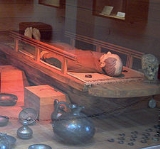
of different sizes and from different periods. They discovered a royal burial, its timbers recently dated as cut to about 740 BC complete with remains of the funeral feast and "the best collection of Iron Age drinking vessels ever uncovered". This inner chamber was rather large; 5.15 metres by 6.2 metres in breadth and 3.25 metres high. On the remains of a wooden coffin in the northwest corner of the tomb lay a skeleton of a man 1.59 metres in height and about 60 years old. In the tomb were found an ornate inlaid table, two inlaid serving stands, and eight other tables, as well as bronze and pottery vessels and bronze fibulae. Although no identifying texts were originally associated with the site, it was called Tumulus MM (for "Midas Mound") by the excavator. As this funerary monument was erected before the traditional date given for the death of King Midas in the early 7th century BC, it is now generally thought to have covered the burial of his father (
GordiasGordias was a royal name in the mythic prehistory of Phrygia. In the mythological age, kings of Phrygia were alternately named Gordias and Midas....
).
That "tomb" is no longer believed to be a tomb, but rather a sacred site to
CybeleCybele , was a Phrygian form of the Earth Mother or Great Mother. As with Greek Gaia , her Minoan equivalent Rhea and some aspects of Demeter, Cybele embodies the fertile Earth...
.
Myth
Once, as
OvidPublius Ovidius Naso , known as Ovid in the English-speaking world, was a Roman poet who is best known as the author of the three major collections of erotic poetry: Heroides, Amores, and Ars Amatoria...
relates in
MetamorphosesMetamorphoses is a Latin narrative poem in fifteen books by the Roman poet Ovid describing the history of the world from its creation to the deification of Julius Caesar within a loose mythico-historical framework. Completed in AD 8, it is recognized as a masterpiece of Golden Age Latin literature...
XI
DionysusDionysus was the god of the grape harvest, winemaking and wine, of ritual madness and ecstasy in Greek mythology. His name in Linear B tablets shows he was worshipped from c. 1500—1100 BC by Mycenean Greeks: other traces of Dionysian-type cult have been found in ancient Minoan Crete...
found his old schoolmaster and foster father, the
satyrIn Greek mythology, satyrs are a troop of male companions of Pan and Dionysus — "satyresses" were a late invention of poets — that roamed the woods and mountains. In myths they are often associated with pipe-playing....
Silenus, missing.
The old satyr had been drinking wine and had wandered away drunk, later to be found by some Phrygian peasants, who carried him to their king, Midas (alternatively, he passed out in Midas' rose garden). Midas recognized him and treated him hospitably, entertaining him for ten days and nights with politeness, while Silenus delighted Midas and his friends with stories and songs.
On the eleventh day, he brought Silenus back to
DionysusDionysus was the god of the grape harvest, winemaking and wine, of ritual madness and ecstasy in Greek mythology. His name in Linear B tablets shows he was worshipped from c. 1500—1100 BC by Mycenean Greeks: other traces of Dionysian-type cult have been found in ancient Minoan Crete...
in
LydiaLydia was an Iron Age kingdom of western Asia Minor located generally east of ancient Ionia in the modern Turkish provinces of Manisa and inland İzmir. Its population spoke an Anatolian language known as Lydian....
.
DionysusDionysus was the god of the grape harvest, winemaking and wine, of ritual madness and ecstasy in Greek mythology. His name in Linear B tablets shows he was worshipped from c. 1500—1100 BC by Mycenean Greeks: other traces of Dionysian-type cult have been found in ancient Minoan Crete...
offered Midas his choice of whatever reward he wished for. Midas asked that whatever he might touch should be changed into gold.
Midas rejoiced in his new power, which he hastened to put to the test. He touched an oak twig and a stone; both turned to gold. Overjoyed, as soon as he got home, he ordered the servants to set a feast on the table. "So Midas, king of Lydia, swelled at first with pride when he found he could transform everything he touched to gold; but when he beheld his food grow rigid and his drink harden into golden ice then he understood that this gift was a bane and in his loathing for gold, cursed his prayer" (
ClaudianClaudian was a Roman poet, who worked for Emperor Honorius and the latter's general Stilicho.A Greek-speaking citizen of Alexandria and probably not a Christian convert, Claudian arrived in Rome before 395. He made his mark with a eulogy of his two young patrons, Probinus and Olybrius, thereby...
,
In Rufinem). In a version told by
Nathaniel HawthorneNathaniel Hawthorne was an American novelist and short story writer.Nathaniel Hawthorne was born in 1804 in the city of Salem, Massachusetts to Nathaniel Hathorne and the former Elizabeth Clarke Manning. His ancestors include John Hathorne, a judge during the Salem Witch Trials...
in
A Wonder-Book for Girls and BoysA Wonder-Book for Girls and Boys is a children's book written by American author Nathaniel Hawthorne in which he rewrites myths from Greek mythology...
(1852), Midas found that when he touched his daughter, she turned into a statue as well.
Now, Midas hated the gift he had coveted. He prayed to
DionysusDionysus was the god of the grape harvest, winemaking and wine, of ritual madness and ecstasy in Greek mythology. His name in Linear B tablets shows he was worshipped from c. 1500—1100 BC by Mycenean Greeks: other traces of Dionysian-type cult have been found in ancient Minoan Crete...
, begging to be delivered from starvation.
DionysusDionysus was the god of the grape harvest, winemaking and wine, of ritual madness and ecstasy in Greek mythology. His name in Linear B tablets shows he was worshipped from c. 1500—1100 BC by Mycenean Greeks: other traces of Dionysian-type cult have been found in ancient Minoan Crete...
his prayer heard, and consented; he told Midas to wash in the river
PactolusPactolus is a river near the Aegean coast of Turkey. The river rises from Mount Tmolus, flows through the ruins of the ancient city of Sardis, and empties into the Gediz River, the ancient Hermus. The Pactolus once contained electrum that was the basis of the economy of the ancient state of Lydia...
.
Midas did so, and when he touched the waters, the power flowed into the river, and the river sands turned into gold. This explained why the river Pactolus was so rich in gold, and the wealth of the dynasty claiming Midas as its forefather no doubt the impetus for this aetiological myth. Gold was perhaps not the only metallic source of Midas' riches: "King Midas, a Phrygian, son of Cybele, first discovered black and white lead".
Midas, now hating wealth and splendor, moved to the country and became a worshipper of Pan, the god of the fields and satyr. Roman mythographers asserted that his tutor in music was
OrpheusOrpheus was a legendary musician, poet, and prophet in ancient Greek religion and myth. The major stories about him are centered on his ability to charm all living things and even stones with his music; his attempt to retrieve his wife from the underworld; and his death at the hands of those who...
.
Once, Pan had the audacity to compare his music with that of Apollo, and challenged Apollo, the god of the
lyreThe lyre is a stringed musical instrument known for its use in Greek classical antiquity and later. The word comes from the Greek "λύρα" and the earliest reference to the word is the Mycenaean Greek ru-ra-ta-e, meaning "lyrists", written in Linear B syllabic script...
, to a trial of skill (also see
MarsyasIn Greek mythology, the satyr Marsyas is a central figure in two stories involving music: in one, he picked up the double flute that had been abandoned by Athena and played it; in the other, he challenged Apollo to a contest of music and lost his hide and life...
).
TmolusTmolus was a King of Lydia and husband to Omphale. He is the eponymous namesake of Mount Tmolus , which lies in Lydia with the Lydian capital at its foot and Hypaepa on its southern slope...
, the mountain-god, was chosen as umpire. Pan blew on his pipes and, with his rustic melody, gave great satisfaction to himself and his faithful follower, Midas, who happened to be present.
Then, Apollo struck the strings of his lyre. Tmolus at once awarded the victory to Apollo, and all but one agreed with the judgment. Midas dissented, and questioned the justice of the award.
Apollo would not suffer such a depraved pair of ears any longer, and caused them to become the ears of a
donkeyThe donkey or ass, Equus africanus asinus, is a domesticated member of the Equidae or horse family. The wild ancestor of the donkey is the African Wild Ass, E...
. The myth is illustrated by two paintings,
"Apollo and Marsyas" by Palma il Giovane (1544–1628), one depicting the scene before, and one after, the punishment.
Midas was mortified at this mishap. He attempted to hide his misfortune under an ample turban or headdress, but his barber of course knew the secret, so was told not to mention it. However, the barber could not keep the secret; he went out into the meadow, dug a hole in the ground, whispered the story into it, then covered the hole up. A thick bed of reeds later sprang up in the meadow, and began whispering the story, saying "King Midas has an ass's ears".
Sarah Morris demonstrated (Morris 2004) that donkeys' ears were a Bronze Age royal attribute, borne by King Tarkasnawa (Greek Tarkondemos) of
MiraMira also known as Omicron Ceti , is a red giant star estimated 200-400 light years away in the constellation Cetus. Mira is a binary star, consisting of the red giant Mira A along with Mira B. Mira A is also an oscillating variable star and was the first non-supernova variable star discovered,...
, on a seal inscribed in both
HittiteHittite is the extinct language once spoken by the Hittites, a people who created an empire centred on Hattusa in north-central Anatolia...
cuneiform and Luwian hieroglyphs: in this connection, the myth would appear for Greeks, to justify the exotic attribute.
In pre-Islamic legend of Central Asia, the king of the Ossounes of the Yenisei basin had donkey's ears. He would hide them, and order each of his barbers killed to hide his secret. The last barber among his people was counselled to whisper the heavy secret into a well after sundown, but he didn't cover the well afterwards. The well water rose and flooded the kingdom, creating the waters of Lake Issyk-Kul.
See also
- The tales of King Midas have been told by many with some variations: by John Dryden
John Dryden was an influential English poet, literary critic, translator, and playwright who dominated the literary life of Restoration England to such a point that the period came to be known in literary circles as the Age of Dryden.Walter Scott called him "Glorious John." He was made Poet...
; by Geoffrey ChaucerGeoffrey Chaucer , known as the Father of English literature, is widely considered the greatest English poet of the Middle Ages and was the first poet to have been buried in Poet's Corner of Westminster Abbey...
in the Wife of Bath's Tale"The Wife of Bath's Tale" and prologue are among the best-known of Geoffrey Chaucer's Canterbury Tales. They give insight into the role of women in the Late Middle Ages and are probably of interest to Chaucer himself, for the character is one of his most developed ones, with her prologue twice as...
; making Midas' queen the betrayer of the secret (as Midas' wife, Aristotle names Demodike (or Hermodike) of Kyme; Eudemus fr. 611, 37; Pollux 9, 83,); by Ted HughesEdward James Hughes OM , more commonly known as Ted Hughes, was an English poet and children's writer. Critics routinely rank him as one of the best poets of his generation. Hughes was British Poet Laureate from 1984 until his death.Hughes was married to American poet Sylvia Plath, from 1956 until...
in Tales from OvidTales from Ovid is a poetical work written by the English poet Ted Hughes. Published in 1997 by Faber and Faber, it is a retelling of twenty-four tales from Ovid's Metamorphoses. It won the Whitbread Book Of The Year Award for 1997 and has been translated into several languages. It was one of his...
; and by Carol Ann DuffyCarol Ann Duffy, CBE, FRSL is a Scottish poet and playwright. She is Professor of Contemporary Poetry at the Manchester Metropolitan University, and was appointed Britain's poet laureate in May 2009...
in "Mrs. Midas" from The World's WifeThe World's Wife is a collection of poems by Carol Ann Duffy published in 1999.The World's Wife is Carol Ann Duffy's first themed collection of poems, which was first published in 1999...
.
- Midas is also called the Berecynthian hero, after Mount Berecynthus in Phrygia).
- The Midas touch, see Grey goo
Grey goo is a hypothetical end-of-the-world scenario involving molecular nanotechnology in which out-of-control self-replicating robots consume all matter on Earth while building more of themselves, a scenario known as ecophagy .Self-replicating machines of the macroscopic variety were originally...
effect, MG, and Ice-nineIce-nine is a fictional material appearing in Kurt Vonnegut's novel Cat's Cradle. It is supposed to be a more stable polymorph of water than common ice which instead of melting at 0 degrees Celsius , melts at 45.8 °C...
.
- Philosopher's Stone
The philosopher's stone is a legendary alchemical substance said to be capable of turning base metals into gold or silver. It was also sometimes believed to be an elixir of life, useful for rejuvenation and possibly for achieving immortality. For many centuries, it was the most sought-after goal...
- Alchemy
Alchemy is an influential philosophical tradition whose early practitioners’ claims to profound powers were known from antiquity. The defining objectives of alchemy are varied; these include the creation of the fabled philosopher's stone possessing powers including the capability of turning base...
- The Greek Level 'King Midas' Palace' in the first Tomb Raider game features (unsurprisingly) his palace, and his giant stone hand. If Lara steps onto the hand she will turn to gold and it is game over.
- King Midas also makes an appearance in the PSP game God of War: Ghost of Sparta, where he is found by Kratos and, after his hand burned off in a river of lava, thrown into a lava-fall by the Spartan, turning it into gold.
- Children's movies and television shows often tell the story as a fairy tale
A fairy tale is a type of short story that typically features such folkloric characters, such as fairies, goblins, elves, trolls, dwarves, giants or gnomes, and usually magic or enchantments. However, only a small number of the stories refer to fairies...
, generally replacing the gods with fairies, genies, a fairy godmotherIn fairy tales, a fairy godmother is a fairy with magical powers who acts as a mentor or parent to someone, in the role that an actual godparent was expected to play in many societies...
, or even the wizards and witches.